
Writing a resume can get tricky when you want to describe someone who can adjust quickly. You might be trying to explain that you work well with new teams, changing priorities, unfamiliar tools, or different work conditions. If you’re searching for another word for adaptable, you have many strong options that can make your resume sound more specific and natural.
The best alternatives include flexible, versatile, adjustable, resourceful, open minded, resilient, agile, and responsive.
The right choice depends on the situation. Flexible is simple and widely understood. Versatile shows that you can handle different tasks. Resourceful suggests that you can find practical answers when conditions change. Resilient focuses on staying effective during difficult situations. Agile often fits fast moving workplaces where priorities shift quickly.
This guide explains the meaning and origin of adaptable and gives you more than 30 useful alternatives. You’ll also see which words fit resumes, essays, emails, texting, speaking, leadership, and different workplace situations. The examples will help you choose a word that sounds confident without overstating your abilities.
Need another vocabulary suggestion? Read Another Word for Organized: 25 Best Resume Choices (2026).
What Is Another Word For Adaptable
A strong alternative is flexible because it clearly shows that someone can adjust to new situations, plans, people, or demands.
Other useful choices include versatile, adjustable, resourceful, resilient, agile, responsive, open minded, cooperative, accommodating, and multifaceted.
However, these words aren’t exact copies. Each one highlights a slightly different quality.
For example, a flexible employee can change plans without much trouble. A versatile employee can perform different types of work. A resourceful employee can find solutions with limited support. A resilient employee can recover and continue after setbacks.
That difference matters on a resume.
Instead of choosing the biggest sounding word, choose the one that matches what you actually did. Precise language gives your experience more credibility and helps a hiring manager understand your value quickly.
Adaptable may fit if you changed your approach when a project shifted. Versatile may be better if you worked across several roles. Resourceful may tell the story more clearly if you solved unexpected problems with limited resources.
What Does Adaptable Mean In Plain English
Adaptable describes a person or thing that can adjust to new conditions.
An adaptable person doesn’t need everything to stay the same. They can learn a new process, change direction, work with different people, or respond to unexpected events.
Think about starting a new job.
You may have a new manager, new software, new coworkers, and different expectations. Someone who adjusts quickly can learn the new system, ask useful questions, change their routine, and still get the work done.
That person is adaptable.
Adaptability can describe more than people. Likewise, an adaptable plan can change when circumstances shift. Similarly, an adaptable system can respond to new demands. Meanwhile, an adaptable organization can adjust to changes in its market.
On a resume, though, adaptable usually describes a person’s ability to adjust.
It often connects with several valuable workplace qualities.
These include learning quickly, accepting change, working with different teams, managing shifting priorities, learning new technology, and staying productive during uncertainty.
Still, simply writing adaptable doesn’t prove much.
A stronger resume shows the behavior behind the word.
For example:
Adapted to a new scheduling system and trained team members during the transition.
That sentence gives evidence. It tells the reader what changed and what you did.
Where Did The Word Adaptable Come From
Adaptable comes from the verb adapt.
Adapt comes through French from the Latin adaptare, which means to fit or adjust something to a particular purpose.
The central idea has remained clear over time.
Something that adapts changes so it can work under new conditions.
The suffix able means capable of doing something. So adaptable literally carries the sense of being capable of adjusting.
That history connects closely with the modern meaning.
When you call a person adaptable, you’re saying that the person can adjust their behavior, skills, plans, or methods when circumstances change.
The word has a positive meaning in most professional settings.
Employers often value people who can learn and adjust because workplaces rarely stay exactly the same. Projects change. Customers change their needs. Technology changes. Teams change. Priorities move.
Adaptability can help someone remain useful through those changes.
Still, adaptability doesn’t mean accepting every change without thought.
A strong adaptable worker can adjust while keeping good judgment. They know when to change direction and when to stay with a sound plan.
That distinction can make your resume language more convincing.
What Are The Best Synonyms For Adaptable
There are many useful alternatives, but each one carries its own tone.
| Word | Meaning | Tone | Example |
|---|---|---|---|
| Agile | Able to respond quickly to change | Modern | Agile approach to shifting project demands. |
| Responsive | Quick to react to needs or changes | Professional | Responsive to customer and team needs. |
| Open minded | Willing to consider new ideas | Friendly | Open minded when learning new methods. |
| Accommodating | Willing to adjust for others | Professional | Accommodating during schedule changes. |
| Multifaceted | Having many skills or abilities | Formal | Multifaceted professional with broad experience. |
| Dynamic | Able to change and grow with conditions | Professional | Dynamic professional in a changing industry. |
| Flexible minded | Willing to change thinking or approach | Conversational | Flexible minded when facing new challenges. |
| Adaptable | Able to adjust effectively | Professional | Adaptable across changing work environments. |
| Versatile | Effective in many different situations | Professional | Versatile employee who supports several functions. |
| Cooperative | Willing to work with others | Everyday | Cooperative during team changes. |
| Receptive | Willing to accept new ideas | Formal | Receptive to feedback and new procedures. |
| Teachable | Willing and able to learn | Everyday | Teachable and quick to learn new systems. |
| Resilient | Able to continue after difficulty | Strong | Resilient during demanding projects. |
| Innovative | Able to create new approaches | Strong | Innovative when existing methods failed. |
| Resourceful | Able to solve problems creatively | Strong | Resourceful when plans changed unexpectedly. |
| Mobile | Able to move or work in different settings | Professional | Mobile across multiple project locations. |
| Versed | Experienced in different areas | Formal | Well versed in several business systems. |
| Multifunctional | Able to serve several purposes | Professional | Multifunctional team member across operations. |
| Elastic | Able to stretch or adjust | Figurative | Elastic approach to changing workloads. |
| Responsive | Able to react appropriately | Professional | Responsive to changing customer expectations. |
| Progressive | Open to development and change | Formal | Progressive approach to workplace improvements. |
| Enterprising | Able to act confidently in new situations | Strong | Enterprising approach to new market challenges. |
| Resourceful | Skilled at handling unexpected needs | Professional | Resourceful during fast changing projects. |
| Receptive | Open to suggestions and change | Formal | Receptive to new technology and feedback. |
| Dynamic | Active and capable of changing | Professional | Dynamic worker who handled shifting priorities. |
| Open to change | Willing to adjust when needed | Everyday | Open to change during company restructuring. |
| Quick learning | Able to gain new skills quickly | Everyday | Quick learning approach to unfamiliar software. |
Which Adaptable Synonyms Are Mild And Which Are Strong
Some alternatives make a light claim. Others suggest a higher level of ability.
A simple progression can help.
- Open to change gives a mild and straightforward message.
- Flexible suggests that you can adjust plans or methods.
- Adjustable suggests that you can change your approach when needed.
- Receptive suggests that you accept new ideas or feedback.
- Responsive suggests that you react appropriately to changing needs.
- Versatile suggests that you can handle different tasks or roles.
- Resourceful suggests that you can solve unexpected problems.
- Agile suggests quick adjustment in a changing environment.
- Resilient suggests that you remain effective after setbacks.
- Innovative suggests that you can create new approaches.
- Multifaceted suggests a broad range of abilities.
- Enterprising suggests confidence and initiative in unfamiliar situations.
Strong words aren’t automatically better.
Simply, flexible is accurate if you changed your schedule to attend a different meeting. Resourceful or innovative may be more appropriate if you created a new process after an unexpected operational problem. Resilient tells a stronger and more specific story if you recovered from a major setback and kept the project moving.
The goal isn’t to sound impressive at any cost.
The goal is to sound accurate.
What Is Another Word For Adaptable On A Resume
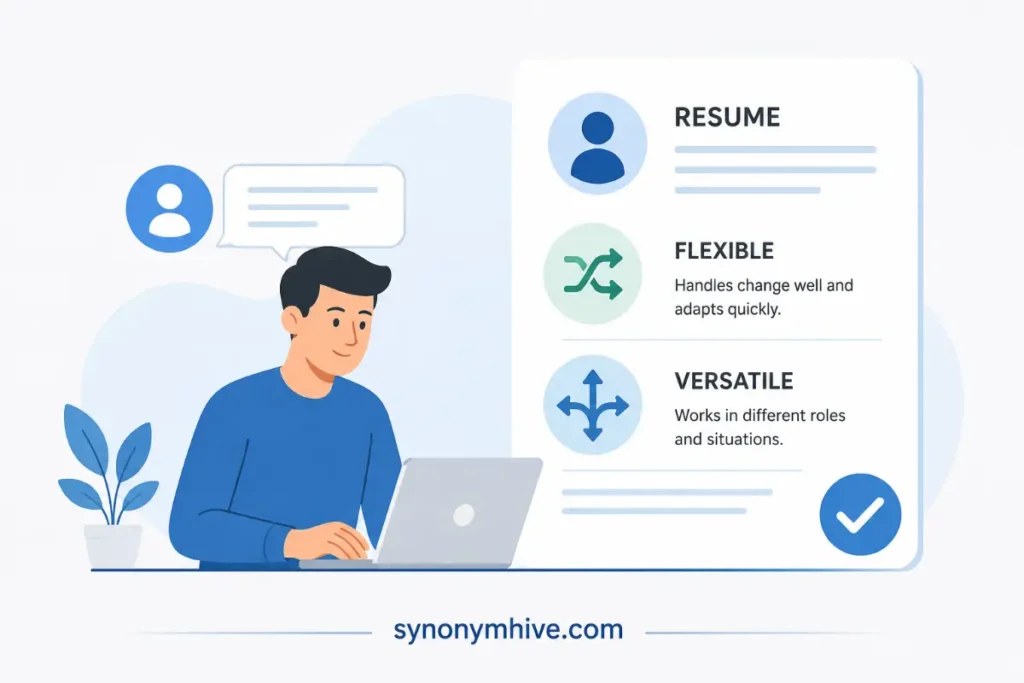
For resumes, flexible and versatile are among the safest choices because most hiring managers understand them immediately.
However, more specific terms can create a stronger impression when they match your experience.
Resourceful is excellent for roles that involve unexpected problems.
Agile can work well in industries where teams respond quickly to changing requirements.
Resilient fits roles that involve pressure, setbacks, or difficult working conditions.
Responsive works well in customer service and client focused positions.
Open minded fits jobs that require learning, collaboration, and acceptance of new ideas.
For example:
Try this.
Adapted quickly to new software and trained coworkers during a company wide system change.
You can also write:
Try this.
Worked across multiple departments and adjusted priorities to support changing business needs.
Or:
Try this.
Developed resourceful solutions when project requirements changed unexpectedly.
The last example is especially useful because it shows the behavior instead of simply naming the trait.
What Is Another Phrase For Adaptable In An Essay
In an essay, flexible, resilient, responsive, resourceful, versatile, and open minded can all work.
The best option depends on your subject.
Describing a person who changes their behavior to fit new circumstances? Adaptable or flexible works well.
Explaining someone who survives difficult circumstances? Resilient may be stronger.
Discussing someone who considers new viewpoints? Open minded is more accurate.
Describing a person who can perform several different roles? Versatile fits.
For example:
The new manager proved flexible when the team’s priorities changed.
Another example:
The character remained resilient after several unexpected setbacks.
Or:
The researcher stayed open minded when new evidence challenged the original theory.
Good essay writing depends on precision.
A synonym should add meaning rather than simply replace a repeated word.
What Is Another Expression For Adaptable In An Email
Professional emails usually benefit from simple language.
Flexible, open, responsive, and willing to adjust are useful choices.
For example:
I’m flexible and can adjust the meeting time if needed.
Or:
I’m happy to adjust the schedule to meet the team’s needs.
Or:
We’re open to changing the plan if the new information affects the timeline.
These phrases sound natural because they don’t try too hard.
An email should be easy to understand at a glance.
You don’t need a formal word like multifaceted when flexible communicates the point clearly.
What Is Another Phrase For Adaptable In Texting
Texting usually calls for everyday language.
Flexible, easygoing, open, willing to adjust, and good with change can all work.
For example:
I’m flexible. Just tell me what time works.
Or:
She’s really good with change.
Or:
He’s easygoing and can adjust if the plan changes.
These expressions feel natural in casual conversation.
A formal term such as multifaceted would sound out of place in most texts.
The setting should guide your word choice.
What Is Another Alternative For Adaptable In Speaking
In everyday speech, flexible is probably the easiest alternative.
You can also say someone is good with change, open to new ideas, versatile, or quick to adjust.
For example:
She’s flexible and works well with different teams.
Or:
He’s good at adjusting when plans change.
At work, you might use more specific language.
For example:
I’m comfortable adapting to changing priorities.
Or:
I can quickly adjust when project requirements change.
Natural speech doesn’t need complicated vocabulary.
Clear language usually sounds more confident.
What Is Another Phrase For Adaptable In Leadership
Leadership often requires more than simply accepting change.
A strong leader may need to adjust plans, listen to new information, guide a team through uncertainty, and make decisions under pressure.
For that reason, flexible, agile, resilient, responsive, resourceful, and open minded can work well.
For example:
Led an agile team through changing project requirements.
Or:
Adjusted leadership strategies to support a growing team.
Or:
Used a resourceful approach to keep projects moving during staffing changes.
These examples show adaptability through action.
They also avoid making the resume sound vague.
What Is Another Expression For Adaptable In Customer Service
Customer service workers often need to respond to different personalities, needs, complaints, and unexpected requests.
Responsive is especially useful in this setting.
Flexible also works when discussing schedules, procedures, or customer needs.
Resourceful can show that you find practical solutions.
For example:
Responded quickly to changing customer needs while maintaining service standards.
Or:
Used resourceful solutions to address unusual customer requests.
Or:
Adjusted communication styles to support customers with different needs.
These descriptions show that adaptability can involve people as well as processes.
What Is Another Phrase For Adaptable In Management
Managers often need to adjust plans while keeping the team focused.
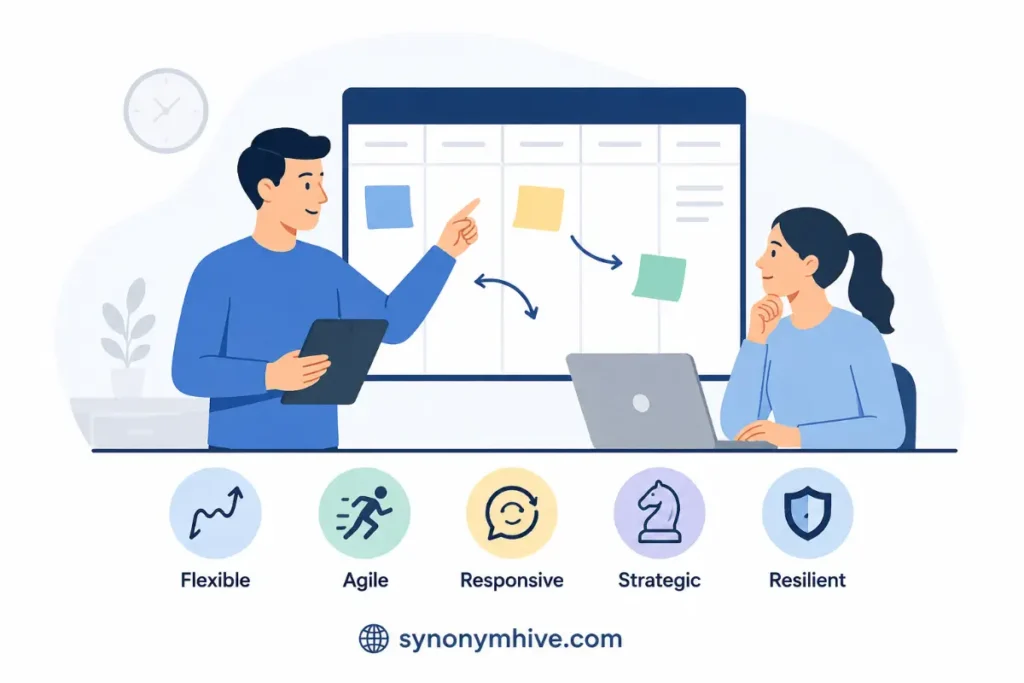
Flexible, agile, responsive, strategic, and resilient can work well.
For example:
Adjusted staffing plans to meet changing business demands.
Or:
Led the team through changing priorities while maintaining productivity.
Or:
Used an agile management approach during a major process change.
The strongest wording shows both change and action.
Simply saying flexible manager doesn’t tell the reader much.
Showing how you adjusted a staffing plan does.
How Do Flexible And Versatile Differ
Flexible and versatile are close but focus on different strengths.
| Flexible | Versatile |
|---|---|
| Focuses on adjusting | Focuses on range |
| Works well for changing plans | Works well for different tasks |
| Highlights willingness to change | Highlights ability across roles |
| Common in everyday English | Strong on resumes |
| Example: Flexible when priorities change | Example: Versatile across several departments |
Imagine an employee who can switch from one schedule to another without trouble.
Flexible is a natural choice.
Now imagine an employee who can handle sales, customer service, reporting, and training.
Versatile is stronger because it shows range.
Both are useful, but they tell different stories.
Discover another helpful synonym list in Another Word For Teamwork Resume Choices 2026.
How Do Resourceful And Resilient Differ
Resourceful and resilient are often confused because both can describe people who handle difficult situations.
Resourceful means you can find ways to solve problems.
Resilient means you can recover from setbacks and keep going.
For example:
She was resourceful when the team lost access to its main software.
This suggests that she found another way to get the work done.
She was resilient after the project faced several setbacks.
This suggests that she recovered and continued.
A person can be both.
Someone may respond to a difficult situation with a resourceful solution and then show resilience when the problem continues.
Choose resourceful when the solution matters most.
Choose resilient when recovery and persistence matter most.
How Do Agile And Flexible Differ
Agile and flexible overlap, but agile often suggests speed.
Flexible can describe a calm willingness to change.
Agile can suggest quick movement when conditions shift.
For example:
Flexible approach to changing team schedules.
Agile response to changing customer demands.
Agile is especially common in technology, project management, product development, and other fast changing professional settings.
Still, don’t use agile simply because it sounds modern.
If your work involved ordinary schedule changes, flexible may be more natural.
If you repeatedly changed priorities quickly and helped a project respond to new information, agile may fit better.
What Are Some Real Examples Of Adaptable Synonyms
Here are examples that show how these terms can work in real situations.
- Adjusted training methods to support employees with different learning needs.
- Worked across three departments and quickly learned new procedures.
- Responded to changing customer expectations while maintaining strong service.
- Developed resourceful solutions when project requirements changed.
- Remained resilient during a demanding company transition.
- Used an agile approach to respond to shifting product requirements.
- Stayed open minded when team members suggested new processes.
- Adjusted communication styles when working with different clients.
- Learned new software quickly after the company changed its technology platform.
- Supported multiple teams during a period of rapid organizational growth.
- Shifted project priorities when new customer data changed the original plan.
- Took on additional responsibilities during a period of staff shortages.
- Adjusted sales strategies based on changing market conditions.
- Learned unfamiliar procedures and applied them within a short training period.
- Worked effectively with remote and in person teams.
- Changed project schedules to respond to unexpected supply delays.
- Used practical solutions when the original plan became unworkable.
- Accepted feedback and adjusted work methods to improve results.
- Managed changing deadlines while keeping key tasks on schedule.
- Moved between different responsibilities while maintaining consistent performance.
- Supported customers with different needs by adjusting communication methods.
- Learned new responsibilities after moving into a broader role.
- Adapted team workflows after the company introduced new reporting requirements.
- Adjusted presentation methods based on audience needs.
- Responded calmly when unexpected issues affected project timelines.
These examples show an important resume principle.
Don’t simply tell employers that you’re adaptable.
Show the change you faced and the action you took.
Which Adaptable Synonyms Work Best By Job Type
Different jobs call for different language.
| Job Type | Strong Choices | Example |
|---|---|---|
| Customer service | Responsive and flexible | Responded to changing customer needs. |
| Technology | Agile and resourceful | Used agile methods during changing requirements. |
| Management | Flexible and strategic | Adjusted team plans as priorities changed. |
| Sales | Responsive and versatile | Adjusted sales methods for different clients. |
| Education | Open minded and flexible | Adjusted lessons for different learning needs. |
| Healthcare | Responsive and resilient | Responded to changing patient needs. |
| Marketing | Creative and agile | Adjusted campaigns based on market changes. |
| Finance | Flexible and analytical | Adjusted reporting processes after policy changes. |
| Human resources | Open minded and responsive | Adjusted employee programs based on feedback. |
| Operations | Resourceful and versatile | Solved workflow issues during staffing changes. |
| Project management | Agile and flexible | Adjusted project plans as requirements changed. |
| Retail | Flexible and responsive | Adjusted service approaches for customer needs. |
This approach helps you avoid generic resume language.
A hiring manager should be able to see why your particular form of adaptability matters to the role.
What Are Common Mistakes With Another Word For Adaptable
The first mistake is using a synonym that doesn’t match the evidence.
Don’t call yourself innovative if you only followed a new procedure.
Don’t call yourself versatile if you’ve only worked within one narrow task.
Your wording should reflect real experience.
The second mistake is using too many synonyms at once.
For example:
Highly flexible, versatile, agile, resilient, resourceful, responsive, innovative professional.
That sounds crowded.
It also tells the reader very little.
Pick the two or three qualities that best match your experience.
The third mistake is relying on adjectives instead of actions.
A sentence such as adaptable employee doesn’t show what you accomplished.
A sentence such as adjusted project priorities when customer requirements changed gives the reader useful evidence.
The fourth mistake is choosing a word because it sounds impressive.
Fancy vocabulary won’t strengthen weak evidence.
Simple words can be powerful when they describe meaningful results.
When Should You Not Use Adaptable
Don’t use adaptable when you actually mean something else.
Simply, versatile is more precise if you mean someone can do many different jobs.
Alternatively, resilient is better if you mean someone recovers from hardship.
Creatively, innovative is more accurate if you mean someone creates new ideas.
Resourcefully, resourceful fits better if you mean someone solves problems with limited resources.
Receptively, receptive may be the right choice if you mean someone accepts feedback.
Flexibly, flexible is usually the clearest option if you mean someone changes plans easily.
This distinction matters because resume readers value accuracy.
A good resume isn’t a thesaurus exercise.
Every word should help the reader understand what you can do.
What Are The Antonyms Of Adaptable
The main opposites include rigid, inflexible, resistant, fixed, unyielding, stubborn, and unresponsive.
These words describe someone or something that struggles to change.
For example:
Flexible describes someone who can adjust a plan.
Inflexible describes someone who refuses or struggles to adjust.
Responsive describes someone who reacts to changing needs.
Unresponsive describes someone who fails to react appropriately.
You normally wouldn’t use these negative terms on a resume.
However, knowing the opposites can help you understand the exact meaning of the positive terms.
How Can You Show Adaptability Without Using The Word
One of the best ways to show adaptability is to describe a change and your response.
For example:
Moved from in person training to virtual training and created new materials for remote employees.
That sentence never names the skill.
Still, the reader can see it.
Another example:
Took on customer service responsibilities during a staffing shortage and maintained response targets.
Again, the behavior proves the quality.
You can also show adaptability through learning.
For example:
Learned a new scheduling system and trained six coworkers within two weeks.
This tells the reader that you can adjust to unfamiliar tools and responsibilities.
Results make these examples even stronger.
If you have real numbers, include them.
For example:
Adjusted the sales process after a market shift and increased qualified leads by 15 percent.
Only use numbers you can support.
Credible evidence is always better than inflated claims.
How Can You Choose The Right Synonym Quickly
Start by asking what kind of change you handled.
Changing plans? Choose flexible.
Handling different roles? Choose versatile.
Solving an unexpected problem? Choose resourceful.
Recovering from a setback? Choose resilient.
Responding quickly? Choose agile.
Reacting to customers or changing needs? Choose responsive.
Accepting new ideas? Choose open minded.
Creating a new approach? Choose innovative.
Doing many different kinds of work? Choose multifaceted.
Learning a new skill quickly? Describe the learning action instead of forcing an adjective.
This simple test can make your writing more precise.
How Can You Make Adaptability Sound Strong On A Resume
Strong resume writing connects adaptability to a real business need.
Instead of:
Adaptable employee who works well in changing environments.
Try:
Adjusted project priorities to meet changing client requirements while keeping deadlines on track.
Instead of:
Flexible team member.
Try:
Supported three departments and adjusted daily priorities based on business needs.
Instead of:
Resourceful problem solver.
Try:
Developed practical solutions when staffing and supply issues affected project timelines.
The stronger examples work because they show action.
They also give the hiring manager a reason to believe the claim.
How Can You Avoid Repeating The Same Word
You don’t need to repeat the same adjective across your resume.
Instead, describe different forms of adjustment.
- Adjust priorities.
- Learn new systems.
- Support different teams.
- Respond to customer needs.
- Develop practical solutions.
- Take on new responsibilities.
- Change communication methods.
- Modify workflows.
- Learn unfamiliar procedures.
- Respond to unexpected problems.
These action phrases naturally demonstrate flexibility without relying on the same adjective.
Your resume will also sound more human.
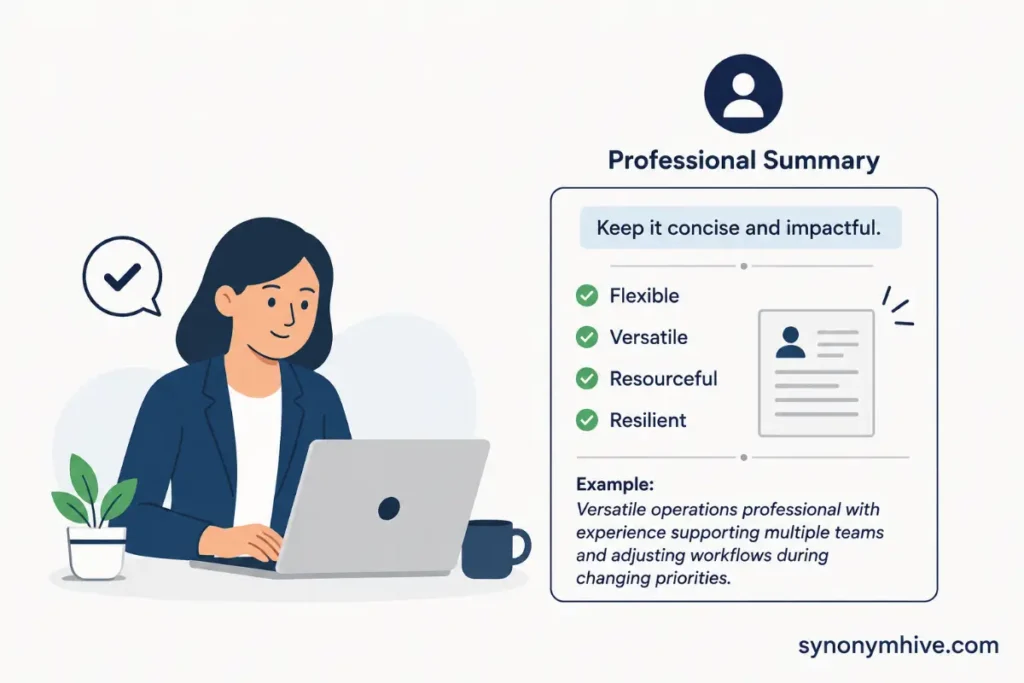
What Is Another Word For Adaptable In A Professional Summary
Your professional summary should stay concise.
Flexible, versatile, resourceful, and resilient are usually safe choices.
For example:
Versatile operations professional with experience supporting multiple teams and adjusting workflows during periods of growth.
Another option is:
Resourceful customer service professional known for finding practical solutions to changing customer needs.
You can also avoid the adjective entirely.
For example:
Operations professional experienced in managing changing priorities, learning new systems, and supporting cross functional teams.
This style often sounds stronger because it gives evidence instead of making a broad claim.
How Can You Use Adaptable In A Cover Letter
A cover letter gives you more room to explain how you respond to change.
Instead of simply saying you’re adaptable, connect the quality to a real experience.
For example:
During my previous role, our team introduced a new customer management system with a short transition period. I learned the system quickly, helped coworkers adjust, and continued supporting customers throughout the change.
This gives the employer a clear example.
The reader doesn’t have to take your word for it.
They can see the behavior.
That is the difference between a claim and evidence.
How Can You Use Adaptability In An Interview
Interviewers often ask questions about change because they want to understand how you react when plans don’t go smoothly.
A strong answer should explain the situation, what changed, what you did, and what happened next.
For example:
Our company changed its scheduling system during a busy period. I learned the new process quickly, helped my coworkers understand it, and adjusted my daily workflow. The transition went smoothly and our team continued meeting its deadlines.
This answer sounds more convincing than:
I’m very adaptable.
The example gives the interviewer something they can evaluate.
Explore more word choices in Another Word For Implemented Resume Choices 2026.
Conclusion
Choosing the right alternative depends on the exact strength you want to show. Flexible is clear and natural for changing plans. Versatile highlights a broad range of skills. Resourceful shows that you can find practical answers when things don’t go as planned. Resilient focuses on recovery after setbacks. Agile suggests quick adjustment. Responsive works well when you react to customers or changing needs.
For a resume, don’t rely on an adjective alone. Show how you adjusted to a new system, supported another team, changed a process, learned a new skill, or handled an unexpected challenge. That evidence gives the word meaning.
The strongest resume language isn’t always the fanciest. It is accurate, specific, and connected to something you actually achieved. Choose the word that tells your story clearly and let your experience do the heavy lifting.
Frequently Asked Questions
What is another phrase for adaptable?
Flexible is one of the clearest alternatives, while versatile, resourceful, resilient, agile, and responsive offer more specific meanings.
What’s another way to say adaptable on a resume?
You can use flexible, versatile, resourceful, agile, resilient, or responsive depending on the skill you want to highlight.
What is a professional word for adaptable?
Versatile, responsive, resourceful, agile, and resilient can sound professional when they accurately describe your experience.
What is a stronger word for adaptable?
Resourceful, resilient, agile, and versatile can sound stronger because each one highlights a specific ability beyond simply adjusting to change.
Is flexible the same as adaptable?
Flexible and adaptable are very close, but flexible often focuses on changing plans while adaptable can describe a broader ability to adjust to new conditions.
What is the best synonym for adaptable on a resume?
Versatile is often a strong resume choice when you can handle different tasks, while resourceful or agile may be better for specific types of work.
How do I show adaptability on my resume?
Describe a real situation where you learned something new, changed your approach, took on a new responsibility, or responded successfully to an unexpected change.