
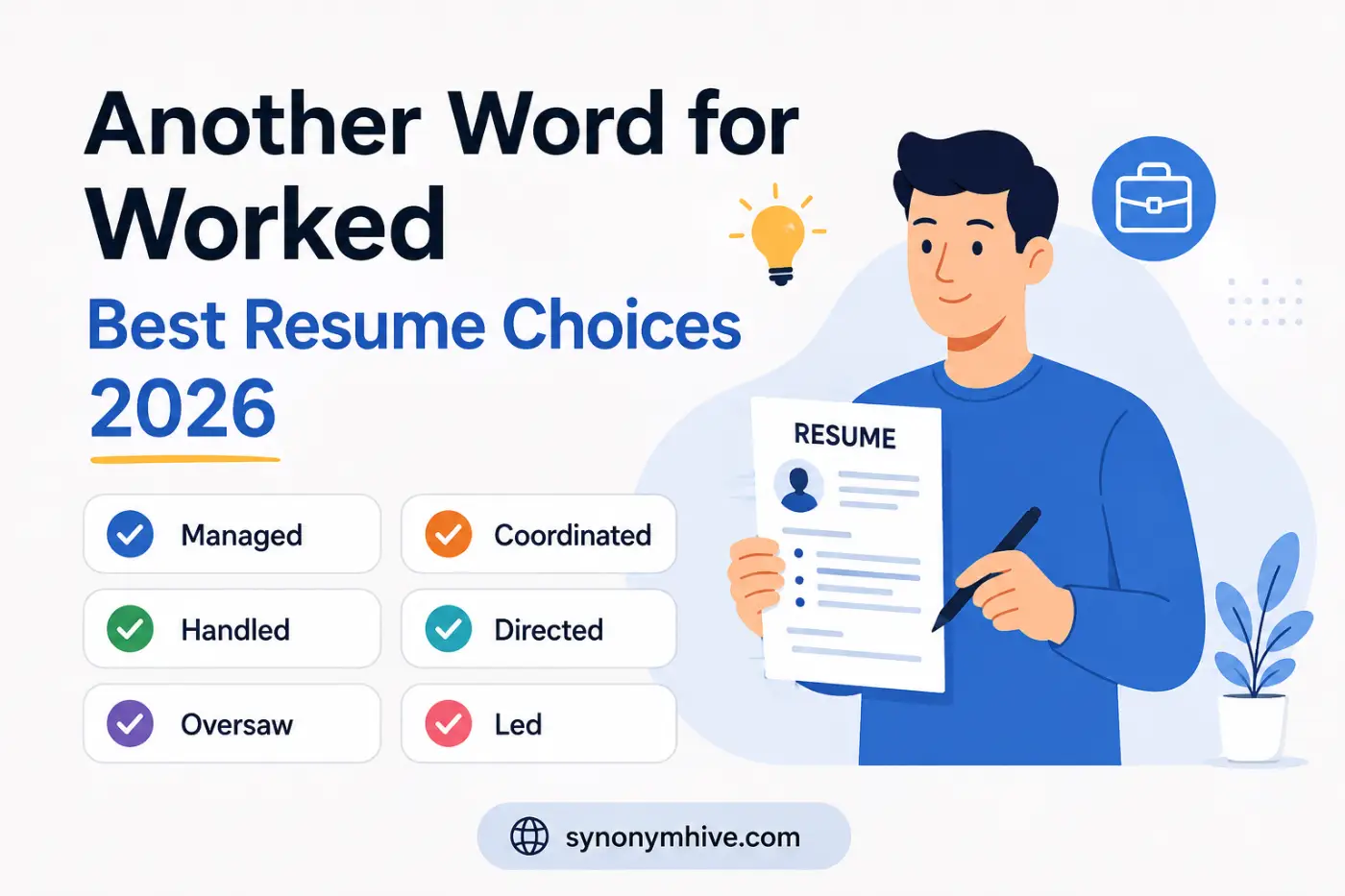
You’re writing a resume and you notice the word worked appearing again and again. Maybe you worked with customers. You worked on projects. You worked with a team. After a few lines the wording starts to sound flat. That’s when looking for another word for worked can make your writing much stronger.
The right replacement depends on what you actually did. A resume needs specific action words that show your role and results. An essay may need a more formal term. A text message can use a simple everyday word. Your goal isn’t to replace worked every time. Your goal is to choose a word that tells the reader exactly what happened.
The best alternative to worked depends on context. Strong choices include contributed, performed, completed, handled, managed, collaborated, operated, served, supported, executed, and delivered.
Need a similar word? Read Another Word for Detail Oriented: Resume Wins 2026.
What does worked mean in plain English
Worked is the past tense and past participle of the verb work. In simple English, it usually means that someone did a task, spent time doing a job, tried to achieve something, operated something, or produced a result.
The meaning changes with the sentence.
For example, I worked at a hospital means I had a job at a hospital. I worked on a report means I spent time creating or improving a report. The machine worked means the machine operated correctly. She worked hard means she made a strong effort.
That’s why another term for worked can vary so much. The word you choose should match the exact meaning you want to communicate.
On a resume, worked is often too broad. A hiring manager wants to know what you actually did. Managed tells the reader that you had responsibility. Coordinated shows that you organized people or tasks. Created shows that you produced something. Assisted shows that you supported someone or a process.
The strongest replacement adds information instead of simply making the sentence sound different.
Where did the word worked come from
The word worked comes from the much older word work. Work has roots in Old English where the word referred to labor, action, effort, or something produced by activity.
Over time, work developed many meanings. It can describe physical labor, professional activity, creative effort, a task, a result, or the operation of a machine or system.
Worked became the regular past form of work. English uses it to describe an action that happened in the past.
For example, I worked yesterday tells us that the activity happened before now. She worked on the project tells us that she spent time on the project. The plan worked tells us that the plan produced the desired result.
This wide range of meanings explains why you have so many choices when searching for another term for worked. English has different verbs for different kinds of work and effort.
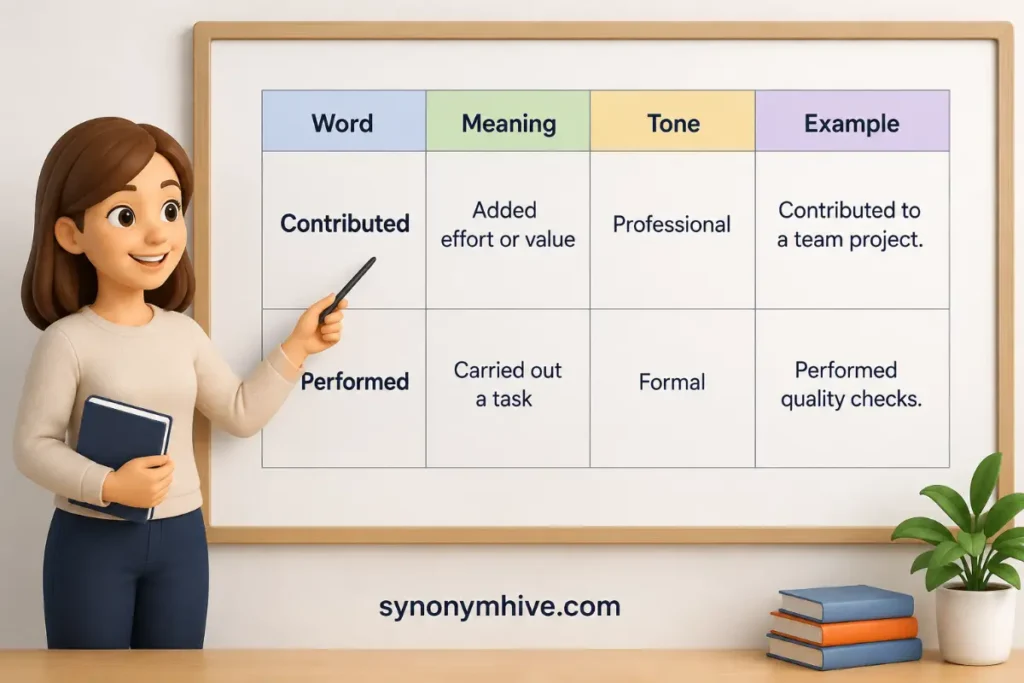
Master Synonym List for Another Word for Worked
The best replacement depends on the situation. Some words sound natural in everyday conversation while others work better on resumes or in formal writing.
| Word | Meaning | Tone | Example |
|---|---|---|---|
| Contributed | Added effort or value | Professional | Contributed to a team project. |
| Performed | Carried out a task | Formal | Performed quality checks. |
| Completed | Finished a task | Professional | Completed customer orders. |
| Handled | Managed a task or situation | Everyday | Handled customer requests. |
| Built | Developed something over time | Everyday | Built strong client relationships. |
| Led | Guided people or activities | Strong | Led a team of eight employees. |
| Directed | Controlled or guided an activity | Formal | Directed daily operations. |
| Served | Helped customers or clients | Professional | Served more than 50 customers daily. |
| Practiced | Used a skill or method | Neutral | Practiced basic accounting skills. |
| Conducted | Carried out an activity | Formal | Conducted employee interviews. |
| Completed | Finished assigned work | Neutral | Completed weekly assignments. |
| Pursued | Made an active effort toward a goal | Formal | Pursued new sales opportunities. |
| Tackled | Took on a difficult task | Conversational | Tackled complex customer issues. |
| Tackled | Dealt with a challenge | Strong | Tackled several workflow problems. |
| Helped | Provided assistance | Simple | Helped customers find products. |
| Did | Performed an action | Very simple | Did research for the project. |
| Engaged | Took part in an activity | Professional | Engaged with community partners. |
| Participated | Took part in something | Neutral | Participated in team meetings. |
| Maintained | Kept something operating or in good condition | Professional | Maintained client records. |
| Administered | Managed a process or system | Formal | Administered employee records. |
| Processed | Handled information or transactions | Professional | Processed customer payments. |
| Oversaw | Supervised an activity | Strong | Oversaw daily store operations. |
| Trained | Taught someone a skill | Professional | Trained new employees. |
| Resolved | Solved a problem | Strong | Resolved customer complaints. |
| Achieved | Reached a goal | Strong | Achieved quarterly sales targets. |
Some words in this list overlap in meaning. They aren’t interchangeable in every sentence. For example, operated makes sense for equipment or machinery. You wouldn’t normally say you operated a customer relationship.
Likewise, collaborated focuses on teamwork. Managed focuses on responsibility. Completed focuses on finishing. Choosing the precise verb makes your writing more credible.
Which synonyms for worked sound simple and natural
If you want plain English, use words that people hear and use every day.
What are the simplest alternatives to worked
- Helped.
- Did.
- Handled.
- Used.
- Made.
- Built.
- Led.
- Served.
- Completed.
- Took part.
These choices are useful in everyday writing because they don’t sound forced.
For example, instead of saying I worked with customers, you could write I helped customers. If you had responsibility for customer issues, handled customer issues may be better.
Simple words can be powerful. You don’t need a complicated verb to sound professional.
Which everyday words can replace worked
Everyday alternatives work well in emails, texts, conversations, and informal writing.
Try helped, handled, did, joined, took part, spent time on, fixed, made, built, or practiced.
For example, you might say, I helped my brother with his application. You could say, We fixed the problem this morning. You might also say, I spent all afternoon on the report.
These options sound natural because they match the way people normally speak.
When searching for another term for worked in casual writing, don’t choose the most formal option automatically. A word like administered may be technically correct but awkward in a friendly text.
Which formal words can replace worked
Formal writing needs more precise verbs.
Strong choices include performed, conducted, executed, administered, coordinated, managed, operated, contributed, developed, maintained, and facilitated.
For example, instead of writing, The researcher worked with participants, you could write, The researcher conducted interviews with participants.
Instead of saying, The team worked on the policy, you could write, The team developed the policy.
Formal words work best when they describe a clear action. Avoid using them simply to make your writing sound impressive.
Which slang or casual phrases can replace worked
Slang depends heavily on the situation. You might hear people say hustled, put in the hours, put in the work, pulled it off, handled it, or got it done.
These phrases can sound lively in conversation.
For example, I put in the hours to finish the project sounds more personal than I worked on the project. We pulled it off after three weeks of planning shows that the group succeeded after facing a challenge.
These expressions usually don’t belong in a formal resume. They can fit social posts, casual messages, personal stories, or dialogue.
Which word should you use based on intensity
Not every form of work has the same level of effort. The best synonym can show that difference.
What is a mild alternative to worked
For mild effort, use helped, participated, assisted, contributed, or took part.
These words suggest involvement without making a strong claim about leadership or effort.
For example, I contributed to the team project shows participation. It doesn’t claim that you managed the project.
What is a medium strength alternative to worked
For regular responsibility, use handled, performed, completed, coordinated, supported, developed, or maintained.
These words tell the reader that you had an active role.
For example, I handled customer inquiries gives more information than I worked with customers.
What is a strong alternative to worked
For major responsibility or results, use managed, led, directed, executed, delivered, resolved, improved, or achieved.
These verbs show ownership and impact.
For example, I managed daily operations tells the reader that you had responsibility. I resolved customer complaints shows a specific skill and outcome.
Don’t use a strong word unless it accurately describes your role. A resume becomes less trustworthy when every task sounds like executive leadership.
What part of speech is worked
Worked is primarily the past tense and past participle form of the verb work.
In the sentence I worked at a bank, worked is a verb.
In the sentence The worked metal had a smooth finish, worked functions as an adjective describing metal. This use is less common in everyday writing.
Most people searching for another phrase for worked are looking for a replacement verb. That means your replacement should usually be another verb.
The best choice depends on the action behind worked.
If you mean helped, use assisted or supported. If you mean led, use managed or directed.
What is the another word for worked on a resume
The best resume word depends on your actual responsibility. Contributed, managed, coordinated, completed, developed, handled, supported, executed, delivered, and achieved are among the most useful options.
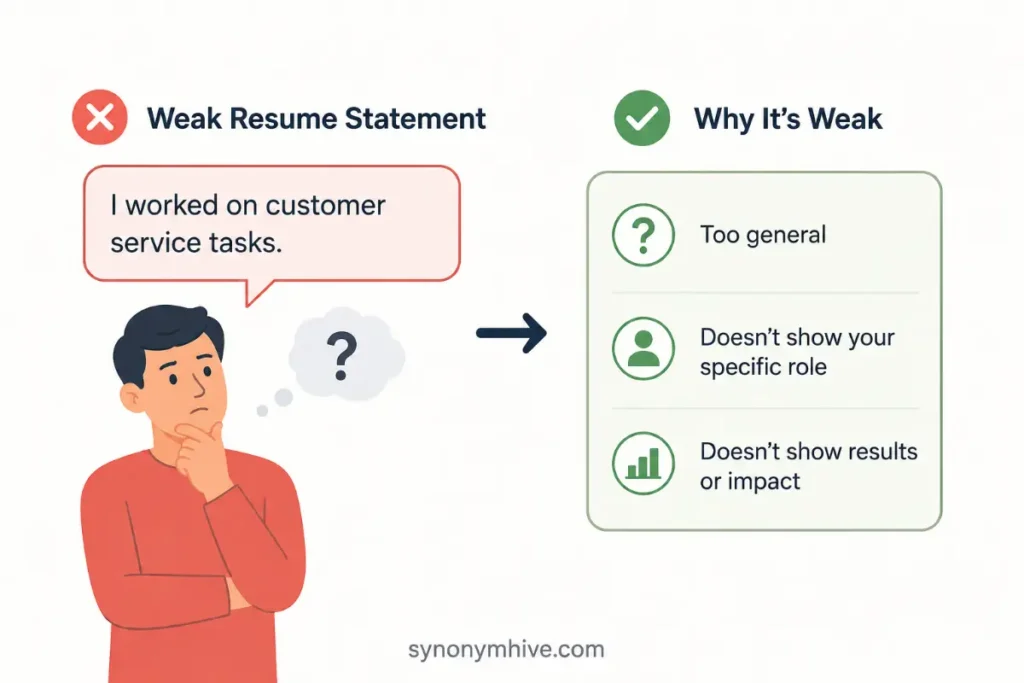
A weak resume statement might say:
I worked on customer service tasks.
That sentence doesn’t tell the hiring manager much.
A stronger version might say:
I handled customer inquiries and resolved service issues.
Now the reader can see the action.
Another example is:
I worked on a marketing campaign.
A stronger version could be:
I developed social media content for a seasonal marketing campaign.
The second sentence gives the reader a clearer picture of your skills.
When choosing another term for worked on a resume, ask yourself one simple question. What did I actually do?
That question usually reveals the right verb.
What should I say instead of worked with a team
Use collaborated, coordinated, supported, partnered, or contributed.
For example:
I collaborated with a five person sales team to improve customer follow up.
This sounds stronger because collaborated tells the reader that you worked with other people toward a shared goal.
If you led the group, use led instead.
If you organized the team’s activities, use coordinated.
The right verb should match your real role.
What should I say instead of worked on a project
Use completed, developed, contributed to, managed, created, executed, or delivered.
For example:
I completed a website redesign project three weeks ahead of schedule.
That sentence gives the reader an action and a result.
If you were responsible for the whole project, managed may be more accurate.
What should I say instead of worked at a company
Use served, held, joined, supported, or was employed by depending on the sentence.
For a resume, you usually don’t need to replace worked at at all. Your job title and company name already show employment.
Instead of writing I worked at ABC Company from 2022 to 2025, a resume can simply list:
Customer Service Representative
ABC Company
2022 to 2025.
Then use strong verbs in your accomplishment statements.
What is the best word for worked in an essay
The best essay replacement depends on the idea behind the sentence.
Choose contributed when discussing participation. Describe developed when discussing an idea. Mention studied when discussing research. Highlight examined when discussing analysis. Consider attempted when discussing an effort. Emphasize succeeded when discussing a successful result.
For example:
The students worked to improve their community.
A stronger academic version could be:
The students contributed to community improvement efforts.
Another option is:
The students organized a local cleanup project.
The second sentence is even better if organizing the cleanup was the actual action.
Academic writing benefits from precision. Instead of searching only for another expression for worked, identify the action first and then choose the verb.
What is the best word for worked in an email
Use simple and professional language in emails.
Helpful options include handled, completed, reviewed, prepared, updated, discussed, contacted, assisted, and coordinated.
For example:
I reviewed the document and corrected the formatting issues.
That sounds clearer than:
I worked on the document.
You can also use worked when it is the most natural choice. There’s no rule saying you must replace it.
If you want to explain effort, worked may be exactly right.
For example:
I worked on the report this morning and should have the final version ready by Friday.
That sentence sounds natural and professional.
What is the best word for worked in a text message
Keep it simple.
Try helped, fixed, did, handled, finished, or got done.
For example:
Resolved the issue.
Completed the report.
Supported Sarah with the presentation.
Handled it this morning.
You don’t need formal vocabulary in a text. Clear language wins.
What is the best word for worked in everyday speaking
In conversation, worked is often the best word because it’s natural and easy to understand.
You can also use helped, tried, fixed, handled, practiced, served, or succeeded depending on the meaning.
For example:
Worked all day.
Assisted my dad with the repairs.
Resolved the problem.
Attempted to solve it.
Practiced for three hours.
The best spoken English usually sounds direct. Don’t replace a familiar word just because you think a longer word sounds smarter.

What are some real examples for another word for worked
Real examples make the difference easier to see.
Served customers every day.
Assisted customers with product questions and purchases.
Prepared monthly reports for the management team.
Collaborated with designers to improve the website layout.
Resolved customer complaints and documented each case.
Supported a small team during daily operations.
Improved sales through targeted customer outreach.
Trained new employees during their first two weeks.
Managed inventory records and checked stock levels.
Coordinated with suppliers to maintain product availability.
Conducted research for a university project.
Operated computer systems to process customer orders.
Resolved the issue after reviewing the account history.
Achieved the quarterly sales goal.
Developed training materials for new staff.
Partnered with local organizations on community events.
These examples show why a direct replacement isn’t always enough. The strongest sentence usually comes from identifying the action behind the original wording.
Find more synonyms in Another Word for Supported Best Resume Choices 2026.
Worked vs contributed and what is the difference
Worked is broad. Contributed is more specific about participation.
I worked on the project means I spent time doing something related to the project.
I contributed to the project means I added effort, knowledge, ideas, or resources to it.
Contributed works especially well when you want to show teamwork without claiming full responsibility.
For example:
I contributed to a team project that improved the customer onboarding process.
That sentence gives you a professional tone without overstating your role.
Use worked when the exact nature of the activity isn’t important. Use contributed when your involvement or added value matters.
Worked vs managed and what is the difference
Worked simply shows activity. Managed shows responsibility and control.
I worked in the sales department tells us where you worked.
I managed the sales department tells us that you were responsible for the department.
These meanings are very different.
This distinction matters on resumes. Never replace worked with managed just because managed sounds stronger. Use it only if you actually supervised people, processes, resources, or operations.
For example:
I managed a team of six customer service representatives.
That sentence makes a clear leadership claim.
If you were a team member rather than a manager, collaborated or contributed would be safer and more accurate.
Worked vs performed and what is the difference
Performed usually means you carried out a task or duty. It sounds more formal than worked.
I worked inspections sounds unnatural.
I performed inspections sounds correct.
Performed works well when the task is specific and repeatable.
Examples include performed quality checks, performed safety inspections, performed data analysis, and performed equipment testing.
Use performed in professional writing when you want to highlight the completion of a defined duty.
Worked vs completed and what is the difference
Worked focuses on the activity. Completed focuses on the finished result.
I worked on five reports tells the reader that you spent time on them.
I completed five reports tells the reader that you finished them.
If your achievement is finishing work on time, completed is usually stronger.
For example:
Completed 25 customer reports each month with high accuracy.
That statement gives the reader a measurable result instead of a vague description of effort.
Worked vs collaborated and what is the difference
Collaborated specifically means working with other people.
I worked on the website could mean you worked alone.
I collaborated on the website tells the reader that you worked with others.
Use collaborated when teamwork is important to the message.
For example:
I collaborated with the product and design teams to improve the customer experience.
This is especially useful on resumes because teamwork is a common workplace skill.
Common mistakes when replacing worked
Replacing every instance of worked can create new problems.
Using a word that is too strong
Words like led, directed, managed, and achieved make strong claims.
If you only assisted a manager, don’t write that you managed the department.
Accurate writing builds trust. A recruiter can usually spot inflated language quickly.
Choosing a synonym without checking the meaning
Synonyms aren’t identical twins. They are more like relatives. They share some traits but still have important differences.
For example, operated usually refers to equipment, machinery, software, or systems. Managed refers to responsibility. Collaborated refers to teamwork. Completed refers to finishing.
Choose based on meaning rather than appearance.
Using formal words in casual writing
You probably wouldn’t text a friend and say, I facilitated dinner preparations.
You’d say, I helped make dinner.
Match the word to the audience.
Replacing worked when it already sounds natural
Sometimes worked is the best choice.
I worked late last night is natural.
I exerted professional effort until late last night sounds stiff and unnatural.
Good writing isn’t about replacing simple words with fancy ones. It’s about choosing the clearest word.
Using vague resume verbs
Worked, helped, did, and assisted can all become vague when they lack details.
Instead of:
Worked with customers.
Try:
Assisted 40 to 50 customers each day and resolved product questions.
The second sentence gives the hiring manager something concrete to understand.
When should you not replace worked
You don’t need a synonym when worked already communicates the exact idea.
Use worked when you want to emphasize effort, time, or activity.
For example:
I worked late to finish the report.
Worked is natural here because the focus is effort.
Another example is:
The new strategy worked.
Here worked means succeeded or produced the desired result. You wouldn’t replace it with managed or collaborated.
You could say:
The new strategy succeeded.
Or:
The new strategy produced the desired result.
The meaning changes slightly with each choice.
This is an important point when searching for another term for worked. First identify which meaning of worked you have in your sentence.
What are the antonyms of worked
The opposite of worked depends on the meaning.
When worked means functioned, possible opposites include failed, stopped, broke, or malfunctioned.
For worked meaning succeeded, the opposite could be failed.
When worked means made an effort, the opposite could be ignored, avoided, or neglected.
For worked meaning operated, the opposite could be stopped or remained inactive.
Examples include:
The machine worked.
The machine failed.
The plan worked.
The plan failed.
She worked hard.
She avoided the task.
The best antonym depends on the specific meaning.
How do you choose the right synonym
Choosing the right word gets easier when you follow a simple process.
- Identify the action.
Ask what you actually did. Did you help, lead, create, repair, organize, study, manage, or finish something?
- Identify the audience.
A resume needs professional action verbs. A text message needs natural language. An academic essay may need more formal wording.
- Identify the level of responsibility.
Use contributed or assisted for support. Use managed or directed for leadership.
- Add a result when possible.
Instead of saying you handled customer service, explain what happened because of your work.
- Stay accurate.
Never choose a stronger word just to impress the reader.
- Read the sentence aloud.
If the sentence sounds like something a real person would say or write, you’re probably on the right track.
What is the best resume strategy for replacing worked
The best resume strategy is to replace vague descriptions with specific actions and results.
Consider this sentence:
Worked with customers and worked on sales reports.
It repeats worked and gives little detail.
A stronger version is:
Assisted customers with product questions and prepared weekly sales reports.
Now the reader sees two clear responsibilities.
You can make it even stronger with results:
Assisted more than 50 customers each day and prepared weekly sales reports for the sales manager.
Specific numbers can add credibility when they are accurate.
You can also show impact:
Improved customer response times by organizing support requests into priority categories.
Notice that the strongest version doesn’t depend on finding another term for worked. It explains the work itself.
That’s the real goal of strong resume writing.
How can you avoid repeating worked
Start by identifying the different actions in your experience.
Instead of writing:
I worked with customers. I worked with suppliers.
You could write:
I prepared weekly reports. I supported the manager with daily scheduling.
Now each sentence has its own purpose.
This approach also makes your resume easier to scan. Hiring managers can quickly see your skills without reading the same verb several times.
Which words work best for different job duties
Different tasks call for different verbs.
Choose assisted, served, resolved, handled, supported, and responded for customer service.
Select led, managed, directed, supervised, coordinated, and oversaw for leadership.
Highlight collaborated, partnered, contributed, supported, and participated for teamwork.
Mention studied, analyzed, examined, investigated, and conducted for research.
Describe developed, created, produced, designed, built, and prepared for creation.
Apply organized, processed, maintained, coordinated, scheduled, and managed for administration.
Consider operated, configured, tested, monitored, maintained, and developed for technology.
Emphasize generated, increased, promoted, supported, presented, and achieved for sales.
Choosing from these groups makes your writing more precise because the verb matches the task.
US and UK usage notes
The word worked is common in both American and British English. The basic meaning stays the same.
The bigger difference usually appears in vocabulary around work rather than in worked itself.
American English often uses terms such as job, resume, vacation, and apartment. British English may use role, CV, holiday, and flat in similar contexts.
For a US audience, use American vocabulary consistently.
If you’re writing a US resume, resume is the standard term. Keep your other word choices natural for American readers too.
You usually don’t need a different synonym for worked just because of the regional variety. The context matters far more than the dialect.
What should you remember about another word for worked
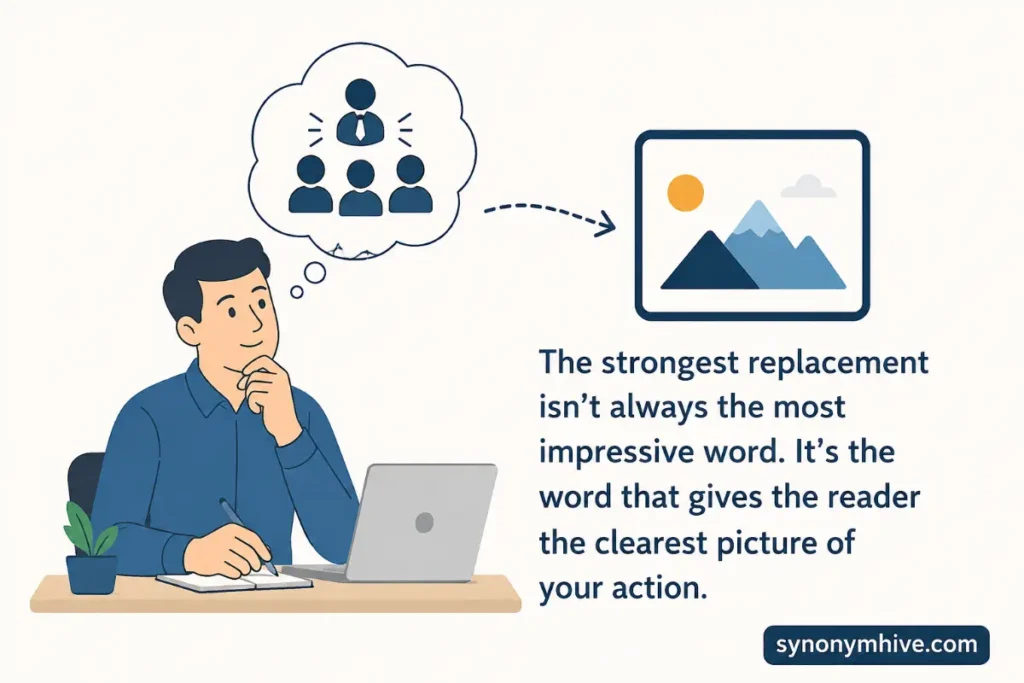
The strongest replacement isn’t always the most impressive word. It’s the word that gives the reader the clearest picture of your action.
Choose contributed when you want to show participation. Highlight collaborated for teamwork. Mention managed for responsibility. Describe completed for finished tasks. Apply developed for creating or improving something. Select operated for equipment or systems. Emphasize resolved for problems. Use achieved for goals.
For a resume, highlight action and results. In an email, keep the wording natural and professional. When texting someone, choose simple language that sounds clear and natural.
The word worked isn’t bad. It’s simply broad. When you need more detail, choose a verb that tells the reader exactly what happened.
Find more synonyms in Another Word For Implemented Resume Choices 2026.
Conclusion
Choosing another word for worked comes down to meaning and context. You don’t need a fancy replacement. You need a word that clearly shows what you did. Use managed for responsibility. Choose collaborated for teamwork. Use completed for finished tasks. Pick developed for creating something and resolved for solving problems. On a resume you’ll make a stronger impression by pairing these verbs with clear results and specific details. In an essay or email you can keep the language simple and natural. Remember that worked is still a perfectly good word when it fits the sentence. The goal is not to remove it completely. The goal is to make every sentence clearer and more useful to the reader.
Frequently Asked Questions
What is another way to say worked?
A strong alternative depends on the meaning. Common choices include contributed, performed, completed, handled, managed, assisted, collaborated, supported, coordinated, operated, and delivered.
What is another alternative for worked on a resume?
For a resume, use a specific action verb such as managed, completed, developed, coordinated, supported, executed, delivered, or contributed. The best choice should describe your actual responsibility.
What is another synonym for worked with a team?
Collaborated is often the best choice because it clearly shows teamwork. You can also use partnered, contributed, supported, or coordinated based on your role.
What’s another way to say worked hard?
You can say put in strong effort, showed dedication, stayed committed, persisted, pushed through challenges, or remained focused. For formal writing, demonstrated dedication or maintained a strong work ethic can fit well.
What word can replace worked in an essay?
Use a verb that describes the exact action. Options include contributed, developed, conducted, examined, studied, completed, pursued, or participated.
Is worked a good word for a resume?
Worked is acceptable but often too general for resume bullet points. Specific verbs such as managed, developed, coordinated, resolved, and achieved usually give the reader more useful information.
Can I use worked in professional writing?
Yes. Worked is perfectly correct in professional writing when it clearly communicates the intended meaning. Don’t replace it just to sound more formal.