
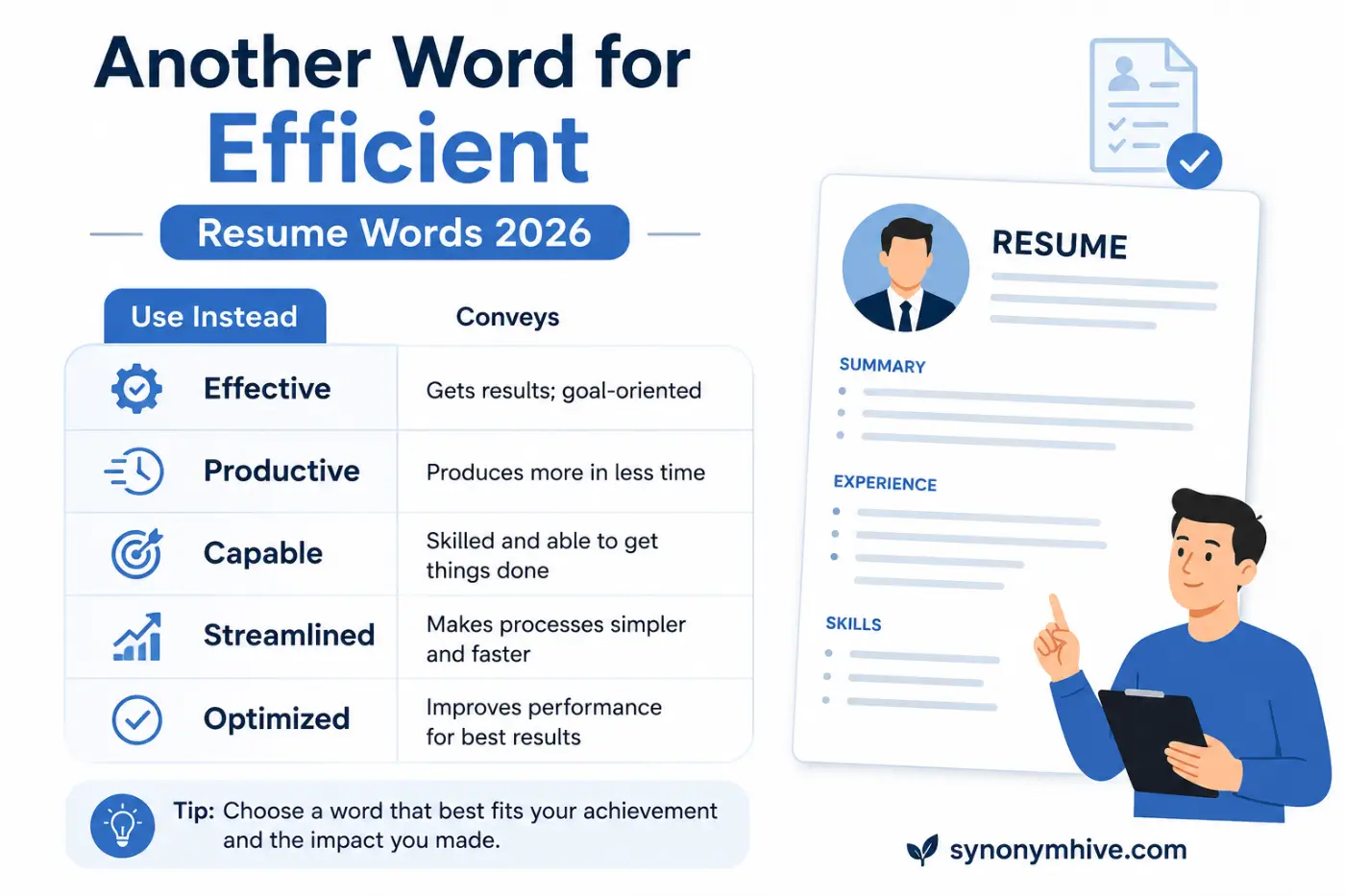
Writing a resume can be harder than it looks. You may know exactly what you did at work but struggle to describe it in a way that sounds strong and natural. If you keep using the word efficient, your resume can start to feel repetitive. That’s when finding another word for efficient can help you show your skills with more precision.
Efficient usually means getting a good result while using time effort money or resources wisely. However, different synonyms highlight different strengths. Productive focuses on output. Effective focuses on results. Streamlined focuses on improving a process. Resourceful focuses on solving problems with what you have.
The best alternatives include productive, effective, organized, streamlined, resourceful, proficient, systematic, and economical. The right choice depends on the skill or result you want to emphasize.
This guide explains the meaning and origin of efficient and gives you more than 30 useful alternatives. You’ll also learn which words work best on a resume in an essay in an email in a text and in everyday speech. Along the way, you’ll see real examples and clear comparisons that make the differences easier to understand.
Compare more word options with another word for committed Best Choices That Win 2026.
What does another phrase for efficient mean
Efficient means achieving a useful result without wasting unnecessary time effort energy money or materials. An efficient person knows how to get work done in a smart and organized way.
For example, imagine two employees who receive the same assignment. One finishes it accurately in four hours after using a clear process. The other takes seven hours and repeats several steps that weren’t needed. The first employee has worked more efficiently.
The word can describe people as well as systems and processes.
An efficient employee completes important tasks without unnecessary delays.
An efficient machine uses less energy to produce the same result.
The central idea is simple. Efficient work produces useful results while avoiding waste.
That meaning gives you several directions when searching for a stronger alternative. You might want to highlight speed. You might want to show productivity.
That’s why simply replacing efficient with the first synonym you find isn’t always the best approach.
Where did the word efficient come from
The word efficient has roots in Latin. It comes from efficere which means to accomplish or bring about. The word entered English through French and developed around the idea of producing a desired result.
This origin helps explain the two major ideas connected to efficient.
The first idea involves accomplishing something successfully.
The second involves accomplishing it without unnecessary waste.
Both ideas still appear in modern English.
For instance, an efficient employee might finish a report quickly while maintaining accuracy. An efficient manufacturing process might produce the same number of products while using less material.
This distinction becomes useful when you choose a synonym. Effective is closely connected to accomplishing a goal. Economical is more strongly connected to saving resources. Productive emphasizes useful output. Streamlined suggests that someone has simplified a process.
The words overlap but they aren’t interchangeable in every sentence.
What are the best synonyms for another word for efficient
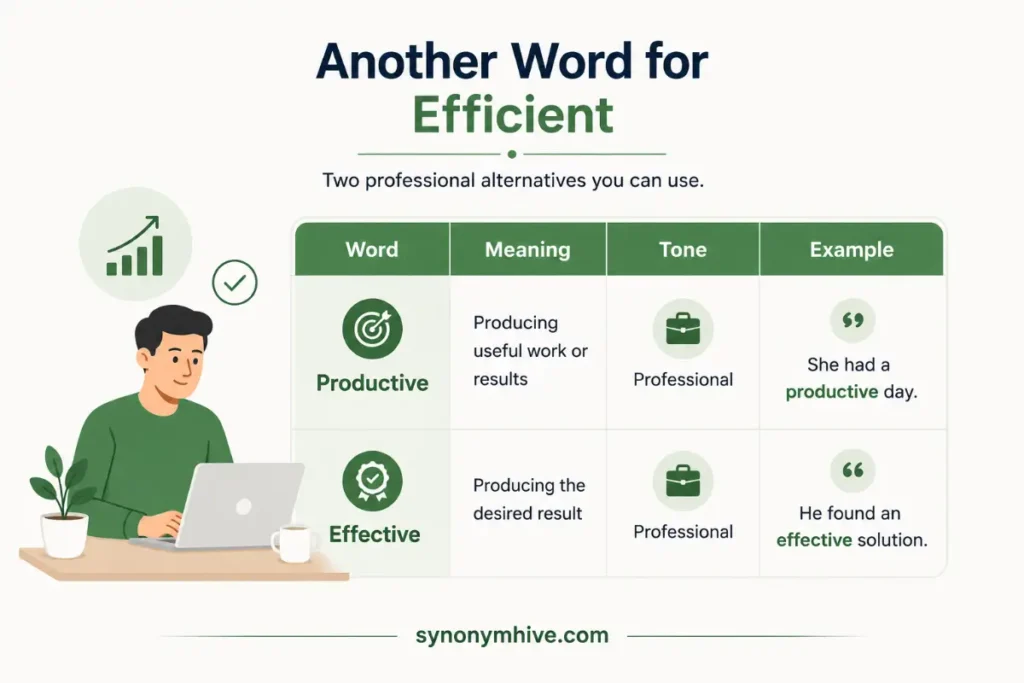
English gives you many ways to express the idea of efficiency. The best option depends on your audience and the point you want to make.
| Word | Meaning | Tone | Example |
|---|---|---|---|
| Productive | Producing useful work or results | Professional | She had a productive day. |
| Effective | Producing the desired result | Professional | He found an effective solution. |
| Organized | Working in a planned and orderly way | Everyday | She’s highly organized. |
| Streamlined | Simplified by removing unnecessary steps | Professional | We streamlined the approval process. |
| Resourceful | Finding smart solutions with available resources | Strong | He’s a resourceful problem solver. |
| Capable | Having the ability to do something well | Neutral | She’s a capable manager. |
| Competent | Having enough skill to perform well | Formal | He’s a competent supervisor. |
| Skillful | Showing strong ability | Neutral | She’s a skillful negotiator. |
| Methodical | Working carefully through an ordered process | Formal | He takes a methodical approach. |
| Systematic | Following a clear and organized method | Formal | She uses a systematic process. |
| Economical | Using money or resources carefully | Formal | The new system is economical. |
| Practical | Focused on useful and realistic results | Everyday | He suggested a practical solution. |
| Timely | Happening at an appropriate time | Professional | She provided a timely update. |
| Prompt | Happening quickly or without delay | Everyday | He gave a prompt response. |
| Swift | Happening quickly | Strong | The company took swift action. |
| Fast | Moving or working quickly | Casual | She’s fast at processing requests. |
| Quick | Taking little time | Everyday | He found a quick solution. |
| Agile | Able to adapt and act quickly | Professional | The agile team adjusted quickly. |
| Responsive | Reacting quickly and appropriately | Professional | She’s responsive to customers. |
| Proficient | Highly skilled at a task | Formal | He’s proficient with spreadsheets. |
| Able | Having the skill or power to do something | Simple | She’s able to manage the workload. |
Which synonyms are mild and which are strong
Synonyms can also differ in intensity. Some simply describe good performance. Others suggest that someone has made a major improvement.
Mild choices
Capable, able, practical, organized, quick, and dependable are fairly moderate choices.
They sound natural and don’t make an exaggerated claim.
For example, saying someone is capable tells the reader that the person can handle the work. Saying someone is organized tells the reader that the person manages tasks and information clearly.
These words work well when you want your writing to sound straightforward.
Moderate choices
Productive, effective, proficient, methodical, systematic, responsive, and resourceful communicate stronger ability.
They give the reader more information about how someone performs.
A productive employee gets meaningful work completed.
An effective manager achieves useful results.
A proficient worker has strong skills.
A resourceful employee can solve problems with limited resources.
Strong choices
Streamlined, optimized, highly productive, and results driven can sound stronger because they suggest improvement or measurable performance.
These words work particularly well when you can support them with evidence.
For example, don’t simply say that you optimized a process if you can explain what changed. A stronger resume statement might mention that you optimized a reporting process and reduced preparation time.
Specific evidence gives strong words credibility.
What words describe different types of efficiency
Efficiency doesn’t always look the same. A person can be efficient because they manage time well. Another person can be efficient because they reduce waste.
Prioritizing time? Use prompt, quick, timely, or swift.
Emphasizing output? Use productive.
Highlighting successful results? Use effective.
Focusing on planning? Use organized.
Describing problem solving? Use resourceful.
Emphasizing cost savings? Use economical.
Highlighting process improvement? Use streamlined.
Describing technical performance? Use optimized.
Highlighting skills? Use proficient or capable.
This approach makes your writing more accurate because you’re describing the actual quality instead of reaching for a generic synonym.
What is the best word for a resume
A resume needs evidence. Simply calling yourself efficient doesn’t tell an employer much.
Instead, choose a word that connects to something you actually accomplished.
Productive works well when you handled a large amount of useful work.
Effective works well when you solved problems or achieved goals.
Streamlined works especially well when you improved an existing process.
Resourceful works when you found solutions despite limited time money staff or tools.
Organized works when your role involved planning scheduling records or coordination.
Proficient works when you want to highlight a specific professional skill.
Optimized works well for technical work process improvement data systems and operations.
For example, compare these statements.
I’m an efficient office assistant.
Managed daily scheduling and reduced appointment delays.
The second version is stronger because it shows an action and a result.
You can also write:
Streamlined client intake procedures to reduce processing time.
Improved team productivity by creating a centralized task tracking system.
Developed an effective filing process that improved document retrieval.
These statements give the employer something concrete to understand.
How can you use another word for efficient on a resume
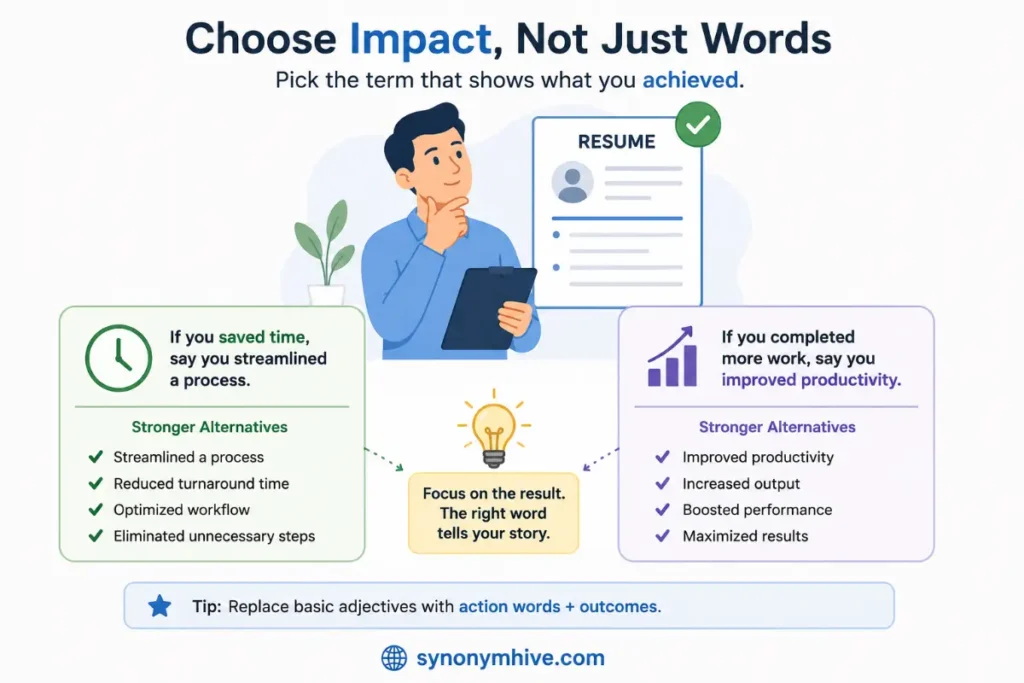
When choosing another term for efficient on a resume, think about the achievement behind the adjective.
Saving time? Say you streamlined a process.
Completing more work? Say you improved productivity.
Solving difficult problems? Say you were resourceful.
Managing many priorities? Say you were organized.
Achieving a goal? Say your approach was effective.
Reducing expenses? Say you created a more economical process.
The strongest resume language often removes the adjective completely.
Instead of:
Efficient customer service representative.
Try:
Resolved customer requests quickly while maintaining accurate records.
Instead of:
Efficient project manager.
Try:
Coordinated multiple project deadlines and kept deliverables on schedule.
Instead of:
Efficient administrative assistant.
Try:
Managed calendars records and correspondence for a busy department.
The examples work because they show efficiency rather than simply claiming it.
What is the best word for an essay
Effective is often the strongest general choice for an essay because it clearly communicates successful results.
Productive can work when discussing work study research or activity.
Systematic is useful when describing a structured method.
Economical works when discussing careful resource use.
Practical is useful when an idea focuses on realistic results.
For example:
The program created an effective way to support new students.
Researchers used a systematic approach to study the results.
The policy offers a practical solution to the problem.
The new method provides an economical way to use limited resources.
Academic writing doesn’t become stronger just because you use complicated words. Precision matters more than formality.
If effective says exactly what you mean, use effective.
What is the best word for an email
Professional emails need clear language. You usually don’t need a fancy synonym.
Use effective when discussing a solution.
Use timely when discussing information or communication.
For example:
We’ve created a streamlined process for submitting requests.
Thank you for your prompt response.
The new approach has been effective so far.
Your timely update helped us adjust the schedule.
These sentences sound professional without sounding stiff.
What is the best word for texting
Text messages usually call for simple language.
Quick, fast, easy, practical, and organized are natural choices.
You might tell a friend:
I found a quick way to finish it.
This new app makes the process much easier.
That shortcut is really fast.
The new system is much more practical.
You probably wouldn’t use systematic or proficient in a casual text unless the situation calls for it.
The best synonym is the one that sounds normal for the person and situation.
What is the best word when speaking
Everyday conversation favors familiar words.
Effective, productive, organized, quick, practical, and fast all sound natural.
You might say that a coworker is organized because they always know what needs to happen next.
You might say someone is productive because they get a lot done.
Simple words often communicate ideas better than impressive sounding ones.
What are some real examples of efficient synonyms
The following examples show how different synonyms work in realistic situations.
- The new scheduling system is more effective because employees can find open appointments faster.
- She’s highly organized and keeps every client request in one central system.
- The manager streamlined the approval process by removing unnecessary steps.
- He found a practical solution that solved the problem without increasing the budget.
- The team became more productive after creating a clear daily workflow.
- She was resourceful when the project lost funding and still found a way to meet the deadline.
- The technician used a systematic process to identify the source of the problem.
- His prompt response helped the customer resolve the issue before the end of the day.
- The company optimized its delivery process and reduced unnecessary delays.
- She’s proficient with spreadsheet software and can manage large data sets accurately.
- The new equipment is economical because it uses less energy during normal operation.
- He gave a timely update so the rest of the team could adjust its schedule.
- The supervisor developed a streamlined training process for new employees.
- She remained capable and calm while managing several urgent requests.
- The practical workflow helped the team finish the project ahead of schedule.
- The department became more productive after it introduced a shared task system.
- The resourceful technician repaired the equipment without waiting for replacement parts.
- The organized assistant prepared the meeting materials before the deadline.
- The effective campaign increased customer responses during the first month.
- The optimized database allowed employees to find records faster.
These examples show an important point. Strong writing often comes from changing the sentence instead of simply replacing one word.
Efficient vs effective what is different
Efficient and effective are among the closest alternatives but they focus on different ideas.
Effective describes how well something achieves the desired result.
Imagine a customer service team that answers every message within five minutes but fails to solve the customers’ problems. The team may be efficient in terms of speed but ineffective in terms of results.
Now imagine a team that solves every customer problem but takes an hour for each case. It may be effective but not very efficient.
This distinction is useful in professional writing.
Use efficient when you want to emphasize resource use.
Use effective when you want to emphasize successful results.
That small difference can make your sentence much more accurate.
Discover another helpful synonym list in Another Word For Growth Mindset Best Resume Words 2026.
Efficient vs productive what is different
Efficient and productive are closely related but they don’t mean exactly the same thing.
Productive focuses on the amount of useful work or output.
Efficient focuses on how well resources are used while producing that result.
An employee can be productive by completing ten important tasks in a day.
An employee can be efficient by completing those tasks with less wasted time and effort.
This is why productive can be an excellent resume choice. It often connects naturally to measurable achievements.
For example:
She is an efficient employee.
She consistently handles a high volume of customer cases.
The second statement gives the reader evidence. It doesn’t simply label the employee.
Efficient vs organized what is different
Organized describes structure and planning. Efficient describes performance with limited waste.
An organized employee may keep clear records maintain a useful calendar and plan tasks carefully.
An efficient employee may use those systems to complete work faster with fewer unnecessary steps.
A person can be organized without being efficient. Someone may have a beautifully arranged schedule but spend too much time on tasks that don’t matter.
Use organized when planning structure and coordination are central to your point.
Use efficient when resource use and performance are the main ideas.
Efficient vs streamlined what is different
Streamlined usually describes something that has been simplified.
Efficient describes something that performs well without unnecessary waste.
For example, a company can streamline its hiring process by removing duplicate interviews. The new process may then become more efficient.
Streamlined is especially useful on resumes because it suggests action.
It tells the employer that you improved something.
Compare these two statements.
Managed an efficient process.
Streamlined the process by removing unnecessary approval steps.
The second statement gives a clearer picture of your contribution.
Efficient vs resourceful what is different
Resourceful describes someone who finds smart solutions with the resources available.
Efficient focuses more directly on reducing waste and improving performance.
A resourceful employee may solve a problem without the usual equipment.
An efficient employee may redesign the workflow so the same work takes less time.
These qualities can overlap.
For example, a resourceful manager may find a way to keep a project moving after the budget is reduced. An efficient manager may redesign the process so the team can complete the same work using fewer resources.
Choose resourceful when creative problem solving is the main idea.
Efficient vs proficient what is different
Proficient means skilled or competent at something.
Efficient means able to achieve a result without unnecessary waste.
Someone can be highly proficient with a computer program but still use it inefficiently.
Likewise, someone can work efficiently while having only moderate technical skills.
Use proficient when you want to highlight skill.
Use efficient when you want to highlight performance and resource use.
On a resume, the two words can work together.
For example:
Proficient in spreadsheet analysis and efficient in managing large reporting tasks.
That sentence gives each word a separate job.
What are the common mistakes with another word for efficient
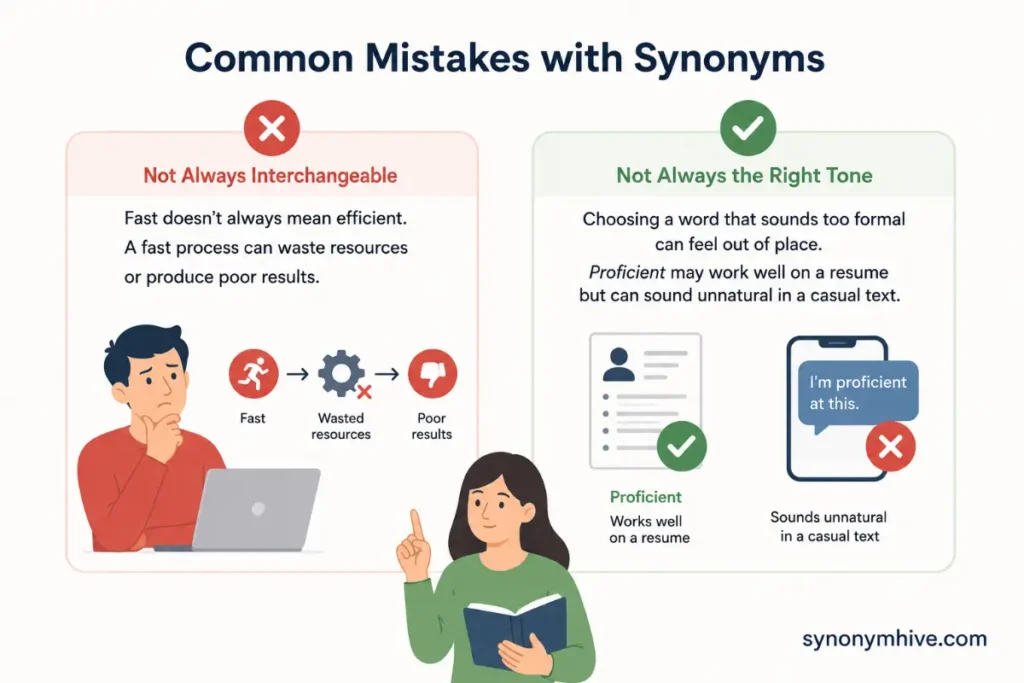
One common mistake is treating every synonym as interchangeable.
Fast doesn’t always mean efficient. A fast process can waste resources or produce poor results.
Another mistake is choosing a word that sounds too formal for the situation. Proficient may work well on a resume but can sound unnatural in a casual text.
A third mistake is making unsupported claims.
Calling yourself highly productive doesn’t prove anything. A specific achievement gives the claim weight.
A fourth mistake is repeating the same synonym throughout your writing. If every paragraph uses productive then the writing becomes predictable.
A fifth mistake is choosing a word because it sounds impressive rather than because it fits the meaning.
Clear language usually wins.
When should you not use efficient
Don’t use efficient when you only mean fast.
Use quick or fast when speed is the only point.
Don’t use efficient when you mean successful.
Use effective when the main idea is achieving a desired result.
Don’t use efficient when you mean highly skilled.
Use proficient or skilled when ability is the main point.
Don’t use efficient when you mean creative at solving problems.
Use resourceful.
Don’t use efficient when you mean carefully planned.
Use organized or systematic.
Don’t use efficient when you mean inexpensive.
Use economical or cost conscious.
These small distinctions make your writing sound more natural and precise.
What are the antonyms of efficient
The direct antonym is inefficient.
Other related opposites include wasteful, ineffective, unproductive, disorganized, slow, impractical, and cumbersome.
Inefficient means using more time effort energy money or resources than necessary.
Wasteful focuses on unnecessary use of resources.
Ineffective means failing to achieve the desired result.
Unproductive means producing little useful output.
Disorganized describes poor structure or planning.
Cumbersome describes something that is difficult to manage because it has unnecessary complexity.
Choose the opposite that matches the problem you want to describe.
How can you choose the right synonym
Choosing the right word becomes easier when you identify the main idea first.
- Choose productive when you want to emphasize useful output.
- Choose effective when you want to emphasize successful results.
- Choose streamlined when you want to emphasize process improvement.
- Choose resourceful when you want to emphasize creative problem solving.
- Choose organized when you want to emphasize planning and structure.
- Choose economical when you want to emphasize careful resource use.
- Choose prompt when you want to emphasize a fast response.
- Choose proficient when you want to emphasize skill.
- Choose systematic when you want to emphasize an ordered method.
- Choose optimized when you want to emphasize improved performance.
- Choose practical when you want to emphasize a realistic solution.
- Choose responsive when you want to emphasize quick and appropriate action.
- Choose dependable when you want to emphasize consistency.
- Choose timely when you want to emphasize appropriate timing.
- Choose capable when you want to emphasize ability.
Then read the full sentence aloud.
Does the word sound natural.
Does it express exactly what you mean.
Can you support the claim with an example or result.
If the answer is yes, you’ve probably found the right word.
How can you improve resume language
Strong resume writing focuses on actions and results.
Instead of saying:
Efficient employee who manages office tasks.
Say:
Managed daily office operations and reduced scheduling delays.
Instead of:
Efficient customer service representative.
Say:
Resolved a high volume of customer requests while maintaining accurate records.
Instead of:
Efficient project coordinator.
Say:
Streamlined project tracking and helped the team meet key deadlines.
Instead of:
Efficient sales assistant.
Say:
Organized customer records and improved follow up response times.
These examples show the difference between describing yourself and proving your value.
If you have numbers available, use them.
You might mention the percentage of time saved. You might mention the number of customers handled.
Specific results make professional writing more credible.
Why context matters more than finding a perfect synonym
There isn’t one perfect replacement that works in every sentence.
Describing a person, productive, organized, resourceful, capable, and proficient may work well. For a process, streamlined, systematic, optimized, practical, and economical may fit better. Regarding a response, prompt, timely, and responsive may sound more natural. Highlighting results, effective may be the clearest option. Emphasizing speed, quick, fast, and swift may be better.
The goal isn’t to find the fanciest replacement. The goal is to choose the word that tells the reader exactly what you mean.
What should you remember when choosing another word for efficient
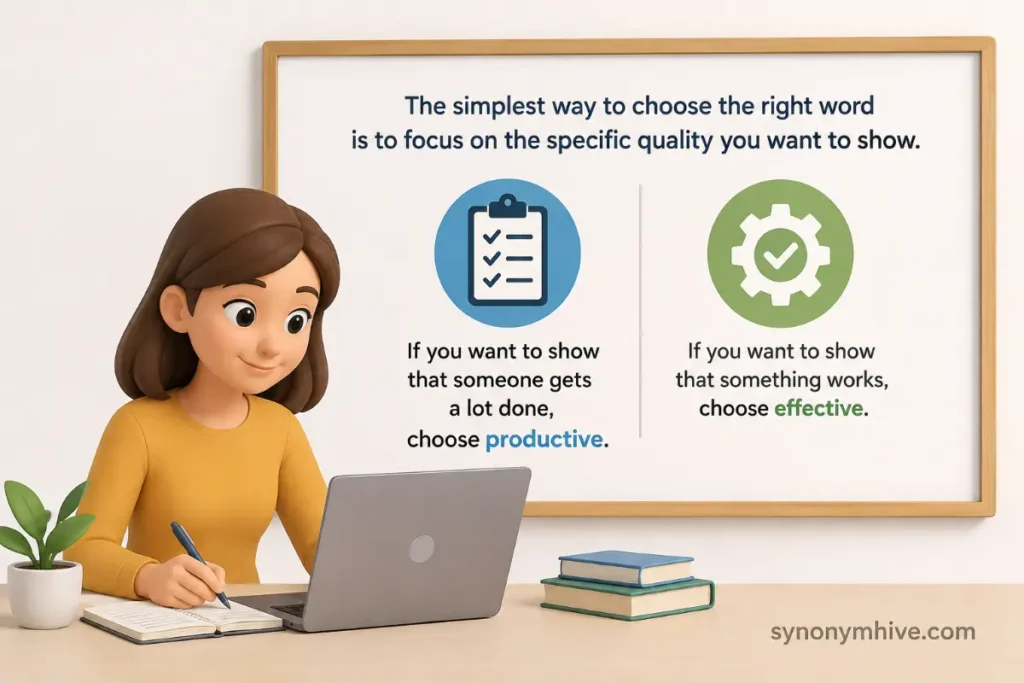
The simplest way to choose the right word is to focus on the specific quality you want to show.
Demonstrating that someone gets a lot done? Choose productive.
Showing that something works? Choose effective.
Highlighting process improvement? Choose streamlined.
Describing creative problem solving? Choose resourceful.
Emphasizing planning skills? Choose organized.
Highlighting strong technical ability? Choose proficient.
Showing careful resource use? Choose economical.
Emphasizing speed? Choose prompt or quick.
Highlighting improved performance? Choose optimized.
This approach keeps your writing clear and prevents unnecessary synonym swapping.
Quick tips for choosing the right word
- Start with the exact idea you want to communicate.
- Use productive for useful output.
- Use effective for successful results.
- Use streamlined for process improvement.
- Use resourceful for problem solving.
- Use organized for planning and structure.
- Use economical for careful resource use.
- Use prompt for fast responses.
- Use proficient for strong skills.
- Use systematic for an ordered process.
- Use optimized for improved performance.
- Use practical for realistic solutions.
- Add measurable results to resume claims when possible.
- Keep casual writing simple.
- Don’t choose a complicated word just because it sounds impressive.
- Make sure the replacement keeps the original meaning.
- Read the sentence aloud before publishing it.
Good word choice should make your writing easier to understand. If a synonym makes the sentence harder to read without adding meaning, it probably isn’t the right choice.
Discover another helpful synonym list in Another Word For Implemented Resume Choices 2026.
Conclusion
The best synonym depends on the exact quality you want your reader to notice. Productive highlights output. Effective highlights successful results. Streamlined shows that you improved a process. Resourceful points to smart problem solving. Organized highlights planning while proficient focuses on skill.
On a resume, specific achievements are stronger than broad claims. Instead of simply describing yourself as efficient, show how you saved time, reduced waste, improved productivity, solved a difficult problem, or helped a team reach a goal.
Good word choice doesn’t mean using complicated vocabulary. It means choosing a word that fits the situation and carries the right meaning. Once you understand these differences, your writing becomes more precise and your professional language becomes much easier to build.
Frequently Asked Questions
What’s another way to say efficient?
Productive, effective, organized, streamlined, resourceful, economical, and proficient are useful alternatives. The best choice depends on the exact idea you want to express.
What is another term for efficient on a resume?
Strong resume choices include productive, effective, streamlined, resourceful, organized, and proficient. Choose the word that matches your actual achievement.
What is a professional synonym for efficient?
Effective, productive, streamlined, systematic, proficient, and optimized can work well in professional writing. Each one highlights a slightly different strength.
What is a simple word for efficient?
Quick, organized, practical, effective, and productive are simple alternatives. They work well in everyday conversations and general writing.
Is productive the same as efficient?
No. Productive focuses on useful output while efficient focuses on achieving results with minimal waste of time effort or resources.
Is effective better than efficient on a resume?
Effective can be better when you want to highlight successful results. Efficient can be better when you want to highlight smart use of time effort or resources.
What is the strongest synonym for efficient?
Streamlined, optimized, productive, and resourceful can sound strong in professional writing. The strongest choice is the one you can support with a clear result.