

You’re updating your resume and you reach a familiar challenge. You know you’re good at fixing issues and finding practical answers but writing problem solving skills on your resume can feel too basic. If you’re searching for another word for problem solving you have plenty of strong options that can make your experience clearer.
Strong alternatives include troubleshooting, analysis, critical thinking, resolution, decision making, diagnosis, innovation, and strategic thinking.
This guide covers the meaning and origin of problem solving along with more than 30 useful alternatives. You’ll also learn which words work best on resumes, in essays, emails, texts, and everyday speech. Real examples and side by side comparisons will help you choose a word that sounds natural and accurately reflects your skills.
Discover another helpful synonym list in Another Word for Punctual Best Resume Words: Stand Out 2026.
What Does Problem Solving Mean In Plain English
Problem solving means finding a practical way to deal with a difficult situation or reach a desired result.
The process usually starts when something goes wrong or when someone needs a better way to accomplish a goal. You identify the issue, understand its cause, consider possible solutions, choose an approach, and take action.
For example, imagine a customer keeps receiving an incorrect order. A strong employee doesn’t simply apologize. They look at the ordering process, find the source of the error, fix it, and help prevent the same mistake from happening again.
That is problem solving.
The skill appears in almost every type of work. A teacher solves classroom challenges. A nurse responds to changing patient needs. A software developer fixes bugs. A manager handles staffing problems. A sales representative finds ways to address customer concerns.
Because the skill is so common, the phrase can lose some impact on a resume.
That’s why specific language helps.
Instead of simply writing that you have problem solving skills, explain how you use those skills. You might troubleshoot technical issues, analyze business problems, resolve customer complaints, improve processes, or develop creative solutions.
Those verbs give the reader something concrete.
Where Did The Term Problem Solving Come From
The idea of solving problems is much older than the modern phrase.
Human beings have always needed to identify challenges and find ways around them. The formal study of problem solving became especially important in education, psychology, mathematics, science, engineering, and management.
The English verb solve comes from the Latin word solvere, which carried the idea of loosening or releasing. Over time, solve developed the sense of finding an answer to a question or difficulty.
Problem comes from the Greek problema, which referred to something put forward as a question or challenge.
Together, problem solving describes the process of dealing with a challenge and finding an answer.
Today, the term has a broad meaning. It can describe everything from fixing a broken computer to deciding how a company should respond to a major business challenge.
That broad meaning explains why you have so many alternatives.
Different situations call for different kinds of solutions.
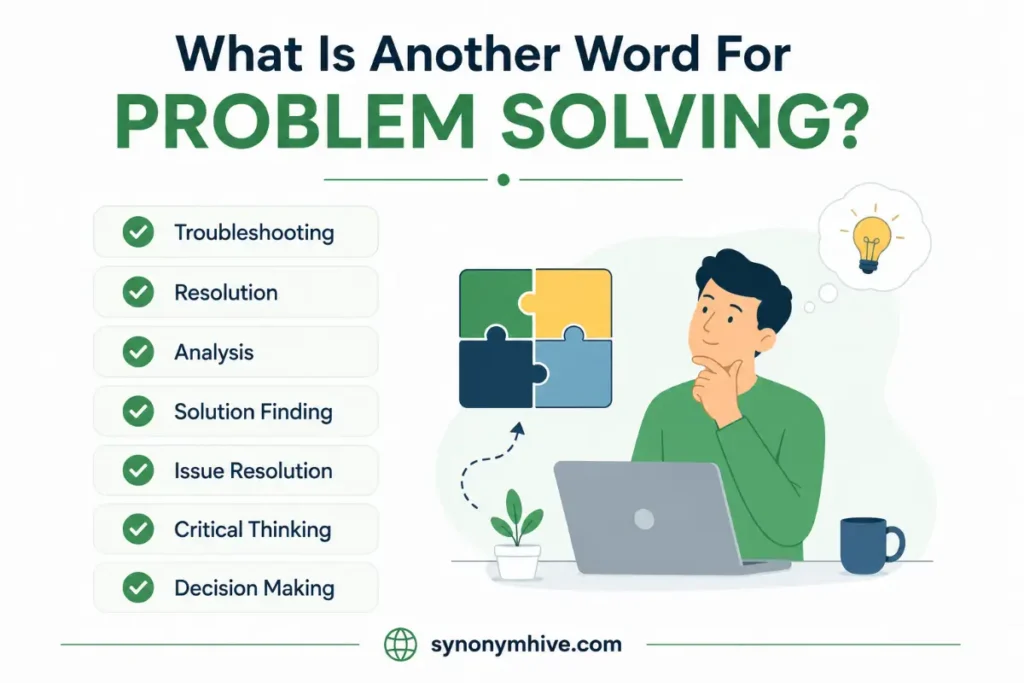
What Is Another Word For Problem Solving
| Word | Meaning | Tone | Example |
|---|---|---|---|
| Troubleshooting | Finding and fixing faults | Professional | Troubleshot software issues for customers. |
| Analysis | Studying information to understand an issue | Formal | Analyzed sales data to identify weak areas. |
| Resolution | Finding an answer that settles an issue | Professional | Led customer issue resolution. |
| Diagnosis | Identifying the cause of a problem | Technical | Diagnosed system failures and restored service. |
| Decision making | Choosing the best course of action | Professional | Used strong decision making during emergencies. |
| Investigation | Examining facts to find the cause | Formal | Investigated recurring billing errors. |
| Innovation | Creating new and useful solutions | Strong | Developed innovative solutions to workflow issues. |
| Strategic thinking | Solving problems through long term planning | Formal | Used strategic thinking to improve operations. |
| Reasoning | Using logic to reach an answer | Academic | Applied logical reasoning to complex cases. |
| Evaluation | Judging options or results | Professional | Evaluated solutions before implementation. |
| Assessment | Examining a situation carefully | Formal | Assessed operational risks before making changes. |
| Improvement | Making something work better | Simple | Improved the customer support process. |
| Optimization | Making a process more effective | Technical | Optimized workflows to reduce processing time. |
| Creativity | Producing fresh ideas | Friendly | Used creativity to solve design challenges. |
| Resourcefulness | Finding useful answers with limited resources | Strong | Used resourcefulness during equipment shortages. |
| Judgment | Making sound choices | Professional | Applied sound judgment during difficult cases. |
| Mediation | Helping resolve disagreements | Formal | Used mediation to settle team conflicts. |
| Repair | Fixing something that is damaged | Practical | Repaired equipment and restored production. |
| Correction | Fixing an error | Formal | Identified errors and completed corrections. |
| Intervention | Taking action to improve a situation | Formal | Made early interventions to prevent delays. |
Which Problem Solving Words Are Mild And Which Are Strong
Not every alternative carries the same level of intensity.
Some words describe basic assistance. Others suggest advanced judgment, leadership, or technical expertise.
A useful progression looks like this.
- Help suggests basic assistance with an issue.
- Support shows that you helped someone handle a challenge.
- Fix suggests that you corrected a specific problem.
- Improve shows that you made something work better.
- Resolve suggests that you brought an issue to a satisfactory end.
- Analyze shows that you studied information to understand the issue.
- Troubleshoot suggests a structured approach to finding faults.
- Diagnose suggests identifying the underlying cause.
- Optimize shows that you improved performance or efficiency.
- Innovate suggests that you created a new approach.
- Strategize suggests planning at a higher level.
- Transform suggests a major improvement or change.
The strongest word isn’t always the best word.
If you fixed a printer issue, troubleshoot is more accurate than transform.
If you redesigned an inefficient process, optimize or improve may fit better.
Your word should match the scale of the work.
What Are The Best Problem Solving Words By Part Of Speech
Many useful alternatives can work as nouns, verbs, or adjectives.
For resumes, action verbs usually make the strongest impression.
Common verbs include:
- Analyze.
- Diagnose.
- Resolve.
- Troubleshoot.
- Improve.
- Optimize.
- Investigate.
- Evaluate.
- Develop.
- Innovate.
- Adapt.
- Strategize.
Common nouns include:
- Analysis.
- Resolution.
- Diagnosis.
- Innovation.
- Strategy.
- Reasoning.
- Evaluation.
- Assessment.
- Investigation.
- Troubleshooting.
Adjectives can also describe the skill.
You might write:
Strong analytical skills.
Creative thinking skills.
Strategic thinking abilities.
Sound judgment.
Resourceful approach.
Logical reasoning.
On a resume, however, a strong action verb often gives you more room to show what you accomplished.
Compare:
Strong problem solving skills.
With:
Analyzed customer complaints and redesigned the support process.
The second example gives evidence instead of making a broad claim.
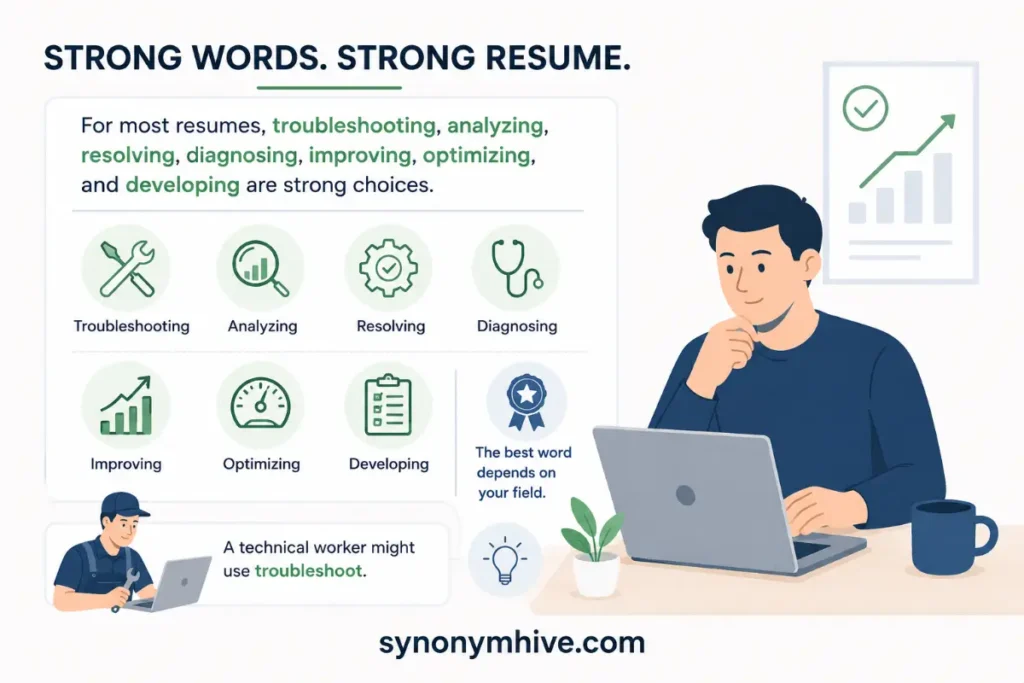
What Is The Another Word For Problem Solving On A Resume
For most resumes, troubleshooting, analyzing, resolving, diagnosing, improving, optimizing, and developing are strong choices.
The best word depends on your field.
A technical worker might use troubleshoot.
A business analyst might use analyze.
A customer service professional might use resolve.
An operations manager might use optimize.
A designer might use innovate.
A manager might use strategic thinking or decision making.
For example:
Try this.
Resolved customer complaints by identifying recurring service issues and improving response procedures.
This sentence does more than say you are good at solving problems. It shows what you did.
Another example:
Try this.
Troubleshot technical issues and reduced service interruptions for remote customers.
Or:
Try this.
Analyzed workflow problems and introduced process changes that reduced delays.
These examples are stronger because they connect the skill to a real action.
What Is The Best Word For Problem Solving In An Essay
In an essay, analysis, reasoning, critical thinking, investigation, and resolution usually fit well.
The right choice depends on the subject.
If you’re discussing how a scientist studies an issue, investigation or analysis may work.
If you’re discussing how a character deals with a difficult situation, decision making or resourcefulness may fit.
For example:
The manager used careful analysis to identify the cause of the decline in sales.
Another option is:
The character showed resourcefulness by finding a practical solution with limited resources.
Essay writing benefits from precise language because the reader needs to understand exactly what kind of thinking took place.
What Is The Best Word For Problem Solving In An Email
Professional emails usually need simple language.
Resolve, address, fix, review, investigate, and handle can all work.
For example:
I reviewed the issue and found the cause.
Or:
I investigated the problem and identified the source of the delay.
Or:
We resolved the customer complaint this morning.
These sentences sound direct and professional.
You don’t need complicated vocabulary in an email.
Clear language saves time for everyone involved.
What Is The Best Word For Problem Solving In Texting
Texting usually calls for everyday language.
Fix, figure out, handle, sort out, work through, and deal with are common choices.
For example:
I’ll figure it out.
I fixed the issue.
We worked through the problem.
I’ll handle it.
Those expressions sound more natural in casual conversation than formal terms such as resolution or strategic analysis.
The situation matters.
You might use troubleshoot in a text about a computer problem.
You might use work through when discussing a difficult situation with another person.
What Is The Best Word For Problem Solving In Speaking
In everyday speech, fix, handle, figure out, work through, and sort out are natural choices.
At work, resolve, analyze, address, and troubleshoot can sound more professional.
For example:
I helped the team figure out why orders were getting delayed.
Or:
I worked with the team to resolve the issue.
Or:
We troubleshot the system and found the problem.
Natural speech doesn’t require impressive vocabulary.
The best word is the one your listener understands immediately.
What Is The Best Word For Problem Solving In Customer Service
Resolve is one of the strongest choices for customer service.
Customer service workers often identify an issue, communicate with the customer, and find a satisfactory answer.
For example:
Resolved customer complaints while maintaining high satisfaction scores.
You can also use address.
Addressed customer concerns and coordinated solutions with the operations team.
Resolve suggests the issue reached an outcome.
Address suggests that you took action to deal with it.
Handle can work in casual descriptions, but resolve usually sounds stronger on a resume.
What Is The Best Word For Problem Solving In Technology
Troubleshooting and debugging are especially useful in technology.
Troubleshooting usually describes finding and fixing faults in hardware, networks, systems, or devices.
Debugging is more specific to software and code.
Diagnosis can also work when you identify the source of a technical failure.
For example:
Troubleshot network issues for more than 100 remote users.
Or:
Debugged software errors before each product release.
Or:
Diagnosed system failures and restored service within established response times.
These words tell the reader exactly what kind of technical work you performed.
What Is The Best Word For Problem Solving In Management
Managers often need words that show judgment, strategy, leadership, and decision making.
Useful choices include strategic thinking, decision making, conflict resolution, analysis, resourcefulness, and crisis management.
For example:
Used strategic thinking to improve staffing and reduce scheduling conflicts.
Or:
Led conflict resolution efforts during team disputes.
Or:
Applied data analysis to improve department performance.
These terms show that management problem solving involves more than simply fixing small issues.
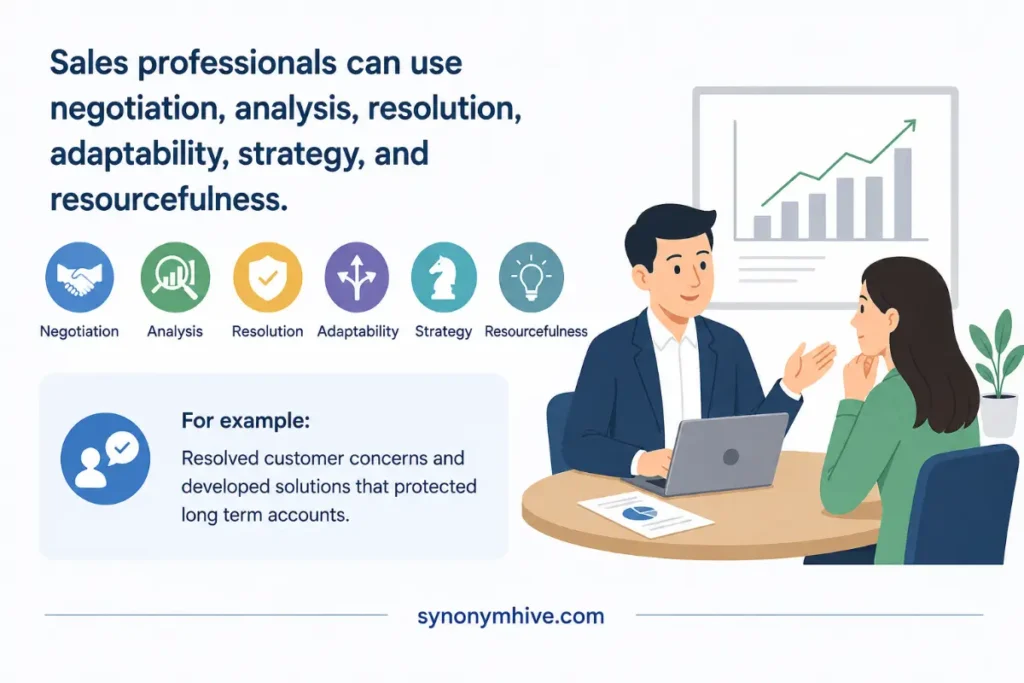
What Is The Another Word For Problem Solving In Sales
Sales professionals can use negotiation, analysis, resolution, adaptability, strategy, and resourcefulness.
For example:
Resolved customer concerns and developed solutions that protected long term accounts.
Or:
Analyzed customer needs to recommend suitable products.
Or:
Adapted sales strategies to changing customer demands.
Sales often involves finding an answer that works for both the customer and the business.
Specific language helps show that skill.
What Is The Best Word For Problem Solving In Leadership
Leadership focused language should show judgment and ownership.
Useful terms include strategic thinking, decision making, conflict resolution, resourcefulness, innovation, and crisis management.
For example:
Used strategic thinking to guide the team through major operational changes.
Or:
Led conflict resolution efforts and improved communication across departments.
Or:
Made timely decisions during service disruptions.
These examples show leadership through action instead of simply claiming that you have leadership skills.
Explore another synonym guide: Another Word for Team Player: Best Resume Choices (2026).
What Are Some Original Examples Of Problem Solving Synonyms
Here are practical examples from different real world situations.
- Customer service.
Resolved customer complaints by identifying recurring service problems. - Technology.
Troubleshot network issues and restored access for remote employees. - Software.
Debugged application errors before each major release. - Business analysis.
Analyzed sales data to identify declining product categories. - Operations.
Optimized workflow procedures to reduce processing delays. - Management.
Used strategic thinking to improve staffing decisions. - Education.
Applied critical thinking to evaluate different classroom strategies. - Sales.
Addressed customer concerns and recommended practical solutions. - Healthcare.
Assessed changing conditions and coordinated timely responses. - Engineering.
Diagnosed equipment failures and recommended corrective action. - Human resources.
Mediated workplace conflicts and helped employees reach practical agreements. - Project management.
Investigated project delays and adjusted timelines to protect deadlines. - Retail.
Handled inventory issues and improved stock tracking procedures. - Finance.
Investigated reporting errors and corrected inaccurate records. - Marketing.
Analyzed campaign performance and adjusted strategies based on results. - Construction.
Adapted project plans when material deliveries changed. - Hospitality.
Resolved guest concerns while maintaining service standards. - Research.
Evaluated competing explanations before reaching a conclusion. - Design.
Developed creative solutions to improve user experience. - Team leadership.
Facilitated discussions that helped the team reach a practical decision.
These examples show a useful rule.
Don’t just name the skill.
Show the action.
Troubleshooting Vs Analysis What Is The Difference
Troubleshooting and analysis both involve finding answers, but they focus on different activities.
| Troubleshooting | Analysis |
|---|---|
| Focuses on finding and fixing faults | Focuses on understanding information |
| Common in technical work | Common in business and research |
| Usually targets a specific issue | Can examine broader patterns |
| Often leads directly to a repair | Often supports a later decision |
| Practical and action focused | Evidence and reasoning focused |
For example:
Troubleshot a network connection problem.
This tells the reader you found and fixed a technical fault.
Analyzed network data to identify patterns in service interruptions.
This tells the reader you studied information to understand a larger issue.
Both are valuable.
The better choice depends on what you actually did.
Analysis Vs Critical Thinking What Is The Difference
Analysis involves breaking information into parts and examining it carefully.
Critical thinking goes a step further by questioning information, comparing evidence, judging claims, and reaching a reasoned conclusion.
For example:
Analyzed customer feedback to identify common complaints.
This focuses on examining information.
Applied critical thinking to evaluate competing solutions.
This focuses on judgment.
The two skills often work together.
You might analyze the facts first and then use critical thinking to decide what those facts mean.
Resolution Vs Decision Making What Is The Difference
Resolution focuses on ending or settling a problem.
Decision making focuses on choosing an action.
For example:
Resolved a customer complaint.
This means the issue reached an acceptable outcome.
Made a decision to replace the damaged equipment.
This describes the choice that was made.
A person can make a decision without fully resolving a problem.
Likewise, a problem can reach resolution after several decisions.
That distinction can help you choose stronger resume language.
Diagnosis Vs Troubleshooting What Is The Difference
Diagnosis means identifying the cause of an issue.
Troubleshooting usually includes the process of testing possible causes and taking corrective action.
For example:
Diagnosed the cause of recurring system failures.
This emphasizes identifying the source.
Troubleshot recurring system failures and restored normal operation.
This suggests both investigation and action.
Diagnosis can sound more specialized.
Troubleshooting often sounds more practical.
What Are The Best Alternatives For Different Industries
Different fields use different language for solving problems.
| Industry | Useful Terms | Example |
|---|---|---|
| Technology | Troubleshooting and debugging | Debugged software errors. |
| Business | Analysis and strategy | Analyzed business performance. |
| Customer service | Resolution and response | Resolved customer complaints. |
| Healthcare | Assessment and diagnosis | Assessed changing conditions. |
| Education | Critical thinking and reasoning | Applied critical thinking in lessons. |
| Engineering | Diagnosis and optimization | Optimized equipment performance. |
| Sales | Negotiation and resolution | Resolved customer concerns. |
| Human resources | Mediation and conflict resolution | Mediated workplace disputes. |
| Marketing | Analysis and strategy | Analyzed campaign results. |
| Management | Decision making and strategic thinking | Made strategic staffing decisions. |
| Finance | Investigation and analysis | Investigated reporting errors. |
| Operations | Optimization and improvement | Optimized workflow procedures. |
This industry approach can make your resume more relevant.
A hiring manager should quickly recognize the type of work you can handle.
Are There US And UK Differences In Problem Solving Terms
The core vocabulary is largely the same in American and British English.
Problem solving is widely understood in both varieties.
Some related terms may vary slightly in spelling or usage.
For example, American English commonly uses analyze and analyzing. British English uses analyse and analysing.
Advisor and adviser are both accepted forms in English.
Program is common in American English, while programme is often used in British English outside computing.
The important point is consistency.
If you’re writing a US resume, use American spelling throughout the document.
You don’t need special regional vocabulary to sound professional.
What Common Mistakes Should You Avoid
One common mistake is using broad claims without evidence.
For example:
Excellent problem solving skills.
That statement sounds positive, but it doesn’t prove anything.
A better approach is:
Resolved recurring customer complaints by identifying service gaps and improving response procedures.
Now the reader can see the skill in action.
Another mistake is using a synonym that doesn’t match the task.
Calling routine software debugging innovation would be misleading.
Calling a major process redesign a simple fix would undersell your contribution.
A third mistake is stuffing several related terms into one sentence.
For example:
Used critical thinking, analysis, troubleshooting, innovation, strategy, reasoning, and resolution to solve problems.
That sounds like a list of keywords rather than real experience.
Choose one or two terms and support them with details.
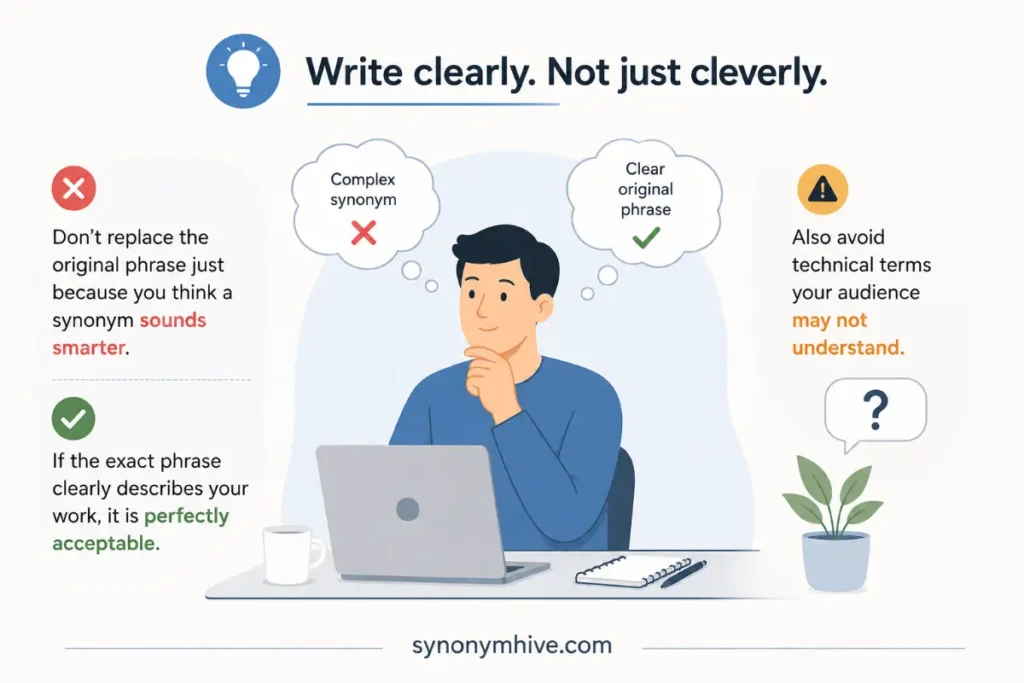
When Should You Another Word For Problem Solving
Don’t replace the original phrase just because you think a synonym sounds smarter.
If the exact phrase clearly describes your work, it is perfectly acceptable.
Also avoid technical terms your audience may not understand.
If you’re writing a general resume, troubleshooting may be clear.
Root cause analysis may be useful in a technical role but unnecessary in a general job application.
The same rule applies to everyday writing.
You wouldn’t normally use optimization when you simply mean improvement.
You wouldn’t use diagnosis when you only mean noticing a problem.
Accuracy always comes first.
How Can You Show Problem Solving Without Saying It
The easiest way is to describe the action you took.
Instead of:
Used strong problem solving skills to help customers.
Write:
Resolved customer complaints by identifying service issues and coordinating solutions.
Instead of:
Excellent problem solving skills in technology.
Write:
Troubleshot network issues and restored service for remote employees.
Instead of:
Strong problem solving and leadership abilities.
Write:
Analyzed staffing challenges and redesigned schedules to improve team coverage.
These sentences prove the skill.
That’s much stronger than simply naming it.
How Can You Add Results To Problem Solving Resume Bullets
Results make a resume bullet more convincing.
Start with the action.
Then describe the issue.
Finally, add the result.
For example:
Resolved recurring billing issues and reduced customer complaints by 18 percent.
Or:
Optimized inventory procedures and reduced stock discrepancies by 20 percent.
Or:
Troubleshot network failures and reduced average service interruptions by 30 percent.
Only use real numbers from your experience.
If you don’t have a measurable result, describe a clear outcome.
For example:
Investigated reporting errors and corrected inaccurate monthly records.
That still shows useful work.
How Can You Choose The Right Word Quickly
Start with the problem itself.
Was it a technical fault?
Choose troubleshoot.
Was it a software error?
Choose debug.
Was it a business question?
Choose analyze.
Was it a customer complaint?
Choose resolve.
Was it a disagreement?
Choose mediate.
Was it a process that needed to work better?
Choose optimize or improve.
Was it a situation that required a new idea?
Choose innovate.
Was it a decision involving several factors?
Choose evaluate or use decision making.
Was it a long term challenge?
Choose strategic thinking.
This method keeps your language accurate and natural.
What Makes A Resume Description Sound Strong
Strong resume language has three parts.
The first is a clear action.
The second is a specific responsibility.
The third is useful evidence.
For example:
Analyzed customer feedback and redesigned support procedures to improve response times.
The action is analyzed.
The responsibility is customer feedback and support procedures.
The result is improved response time.
You can make the same structure work with almost any skill.
Troubleshot network failures and restored service for remote employees.
Resolved customer complaints and improved response procedures.
Optimized inventory workflows and reduced processing delays.
Developed new strategies to improve team productivity.
Specific details make ordinary skills more persuasive.
How Can You Avoid Repeating The Same Resume Words
You don’t need to use the same phrase in every bullet.
Instead, describe different actions.
- Analyze customer data.
- Resolve customer concerns.
- Troubleshoot technical issues.
- Improve internal processes.
- Optimize team workflows.
- Develop practical solutions.
- Evaluate project risks.
- Investigate recurring errors.
- Adapt plans to changing conditions.
- Facilitate team discussions.
This creates natural variety without forcing unusual vocabulary into your resume.
The important thing is that every verb should represent a real action.
Which Word Should You Choose For A Resume
Choose the word that gives the clearest picture of your contribution.
Fixed something? Use fixed, repaired, resolved, or troubleshot.
Studied something? Use analyzed, assessed, evaluated, or investigated.
Improved something? Use improved or optimized.
Created something new? Use developed or innovated.
Helped people reach an agreement? Use mediated or facilitated.
Made important choices? Use evaluated or decided.
Planned for larger challenges? Use strategized or used strategic thinking.
Specific language beats impressive language.
A simple word used accurately can make a stronger impression than a complicated word used loosely.
Looking for another word? See Another Word for Supported Best Resume Choices 2026.
Conclusion
The strongest alternative depends on the kind of challenge you handled and the action you took. Troubleshooting works for technical faults. Analysis fits careful study of information. Resolution works for customer concerns and other issues that need a clear outcome. Diagnosis fits finding the cause of a problem. Innovation works when you create a new approach. Strategic thinking fits larger challenges that require planning and judgment.
On a resume, specific action verbs usually work better than broad claims. Instead of saying you have great skills, show how you analyzed, resolved, improved, investigated, or optimized something. Add a real result when you can.
Good word choice doesn’t need to sound complicated. It needs to be accurate, clear, and connected to real experience. That approach makes your resume easier to understand and gives your skills more weight.
Frequently Asked Questions
What is another phrase for problem solving?
Common alternatives include troubleshooting, analysis, critical thinking, resolution, diagnosis, decision making, innovation, reasoning, investigation, and strategic thinking. The best choice depends on the kind of challenge you handled.
What’s another way to say problem solving?
You can say troubleshooting, resolving issues, analyzing problems, finding solutions, diagnosing faults, improving processes, or developing solutions. Pick the phrase that matches your actual work.
What is a professional word for problem solving on a resume?
Troubleshooting, analysis, resolution, diagnosis, optimization, and strategic thinking are strong professional options. Use the term that most closely matches your responsibilities.
What is a stronger word for problem solving?
Innovation, strategic thinking, diagnosis, optimization, and resourcefulness can sound stronger in specific situations. They should only describe work that actually required those skills.
What is the best synonym for problem solving skills?
The best synonym depends on the job. Troubleshooting fits technical roles while analysis, critical thinking, resolution, innovation, and strategic thinking can fit broader professional roles.
How do you describe problem solving on a resume?
Use a strong action verb and explain the problem you addressed and the result. For example, say that you analyzed workflow issues and improved a process instead of simply claiming strong skills.
Is problem solving one word or two words?
Problem solving is normally written as two words when used as a noun phrase. It is often written with a hyphen before a noun as a compound modifier, such as problem solving skills.