
When you’re writing a resume, you may notice how often the word effective appears. You might write that you’re an effective leader, an effective manager, or an effective communicator. The word works, but using it again and again can make your resume sound plain. If you’re looking for another word for effective, the best choice depends on what you actually did and the result you produced.
A strong resume doesn’t just say that you’re effective. It shows how you solved problems, improved results, helped customers, led people, saved time, or completed important work. Words such as productive, successful, capable, efficient, impactful, skilled, and accomplished can give your writing more detail and energy.
Answer box: The best alternative to effective depends on your meaning. For a resume, strong choices include productive, efficient, successful, accomplished, capable, skilled, impactful, and results driven.
This guide explains the meaning and origin of effective, gives you more than 20 useful alternatives, compares close synonyms, and shows which word fits a resume, essay, email, text, or conversation. You’ll also learn which words sound too strong in certain situations and how to choose a better word without making your writing sound forced.
Learn more useful word alternatives in Another Word for Team Player: Best Resume Choices (2026).
another word for effective for resumes
The word effective means producing the result you want. If an employee uses an effective process, the process works. If a manager is effective, that manager gets useful results through their decisions and actions.
That basic meaning makes effective a positive word. However, it doesn’t tell the reader much by itself. A resume becomes stronger when you replace a broad description with a word that explains the type of strength you want to highlight.
For example, compare these two sentences.
I was an effective team leader.
I led a team of 12 employees and improved project completion time by 18 percent.
The second sentence gives evidence. It doesn’t depend on a vague positive label. Still, you can use a precise synonym when you need a shorter description.
An effective employee might be productive, efficient, capable, skilled, successful, dependable, or accomplished. Each word adds a slightly different idea.
Where does effective come from
Effective has a long history in English. It appeared in the late fourteenth century with the sense of serving an intended purpose. English took the word from Old French effectif, which came from Latin effectivus. The Latin family connects to efficere, meaning to work out or accomplish.
That history helps explain the modern meaning. At its core, effective has always been connected with getting something done or producing an intended result.
The related noun effect comes from Latin effectus, meaning accomplishment or performance. The English word effect developed meanings connected with results and consequences.
So when you call a person or method effective, you’re pointing toward results. You’re saying that something works for its intended purpose.
What does effective mean in plain English
Effective simply means good at producing the result you want.
An effective teacher helps students learn. An effective sales strategy helps increase sales.
The word can describe people, actions, methods, plans, tools, systems, and strategies. It can also describe communication.
On a resume, however, effective can become too general. Hiring managers usually learn more from a specific word such as productive or accomplished.
How do you choose the best resume word
Start with the result you want to communicate. Don’t choose a synonym just because it sounds more impressive.
Completing a large amount of useful work? Productive may fit.
Reducing wasted time or resources while completing work? Efficient may fit better.
Reaching an important goal? Successful or accomplished may be stronger.
Having a useful ability? Skilled or capable may make more sense.
Creating a clear positive result through your work? Impactful can work well.
The strongest resume language matches the evidence behind it. A good word should act like a label on a well organized file. It should quickly tell the reader what kind of value you brought.
another phrase for effective with the right tone
Not every synonym has the same tone. Some sound simple and natural. Others sound more formal. A few work best in casual speech.
The table below gives you a broad set of options so you can choose a word that fits your sentence instead of simply replacing effective with the first synonym you find.
| Word | Meaning | Tone | Example |
|---|---|---|---|
| Productive | Produces a useful amount of work or results | Simple | She had a productive week. |
| Efficient | Gets results with little wasted time or effort | Professional | He created a more efficient process. |
| Successful | Achieves the desired result | Everyday | The campaign was successful. |
| Capable | Has the ability to do something well | Professional | She is a capable project manager. |
| Skilled | Has developed strong ability through practice | Professional | He is a skilled communicator. |
| Accomplished | Has achieved important results | Formal | She is an accomplished leader. |
| Impactful | Creates a noticeable effect | Modern professional | His work was highly impactful. |
| Powerful | Has a strong effect | Strong | She gave a powerful presentation. |
| Useful | Provides practical value | Simple | The training was useful. |
| Helpful | Makes a situation easier or better | Everyday | His advice was helpful. |
| Practical | Works well in real situations | Professional | She offered a practical solution. |
| Valuable | Provides meaningful benefit | Professional | He became a valuable team member. |
| Potent | Has strong power or effect | Formal | The strategy was potent. |
| Effectual | Produces the desired result | Formal | The approach proved effectual. |
| Efficacious | Produces the intended result reliably | Very formal | The treatment was efficacious. |
| Competent | Has enough skill to perform well | Professional | She is a competent analyst. |
| Proficient | Has a high level of skill | Professional | He is proficient in data analysis. |
| Adept | Very skilled at something | Formal | She is adept at solving problems. |
| Resourceful | Finds smart ways to solve problems | Strong professional | He is a resourceful manager. |
| Results oriented | Focuses on achieving measurable goals | Resume focused | She is a results oriented supervisor. |
| High performing | Produces strong results | Professional | He joined a high performing team. |
| Productive | Creates useful output consistently | Professional | She remained productive under pressure. |
Simple alternatives that sound natural
Simple words often work best when you want your writing to sound clear and direct.
Productive, useful, helpful, strong, successful, and capable are easy to understand. They don’t make the reader stop and think about what you mean.
For example, instead of saying that you were an effective assistant, you could say that you were a capable assistant. If your main strength was completing a lot of work, productive may be more accurate.
Simple language can also make your resume easier to scan. A recruiter doesn’t need to decode complicated vocabulary to understand your value.
Everyday alternatives for casual writing
In texts and casual emails, you probably don’t need formal words such as efficacious or effectual.
Useful, helpful, good, successful, strong, and practical usually sound more natural.
You could say that a study method was useful or that someone’s advice was helpful. You could say that a plan worked well instead of calling it effective.
Natural language usually wins in everyday communication.
Formal alternatives for professional writing
Professional writing gives you more room for words such as efficient, accomplished, proficient, competent, adept, and impactful.
These words can work well in resumes, business reports, professional profiles, and formal emails. Still, context matters.
For example, proficient usually describes a person’s skill level. Efficient often describes a process, worker, system, or use of resources. Accomplished usually suggests a record of meaningful achievement.
Choosing the exact word can make one sentence much sharper.
Slang and casual alternatives
Slang does not offer many direct replacements for effective because the word itself is already fairly neutral.
In casual American English, people may say something works, gets the job done, hits the mark, or does the trick. These expressions are conversational rather than formal.
For example, you might tell a friend that a study trick really works. You wouldn’t normally put that phrase on a professional resume.
another word for effective by intensity
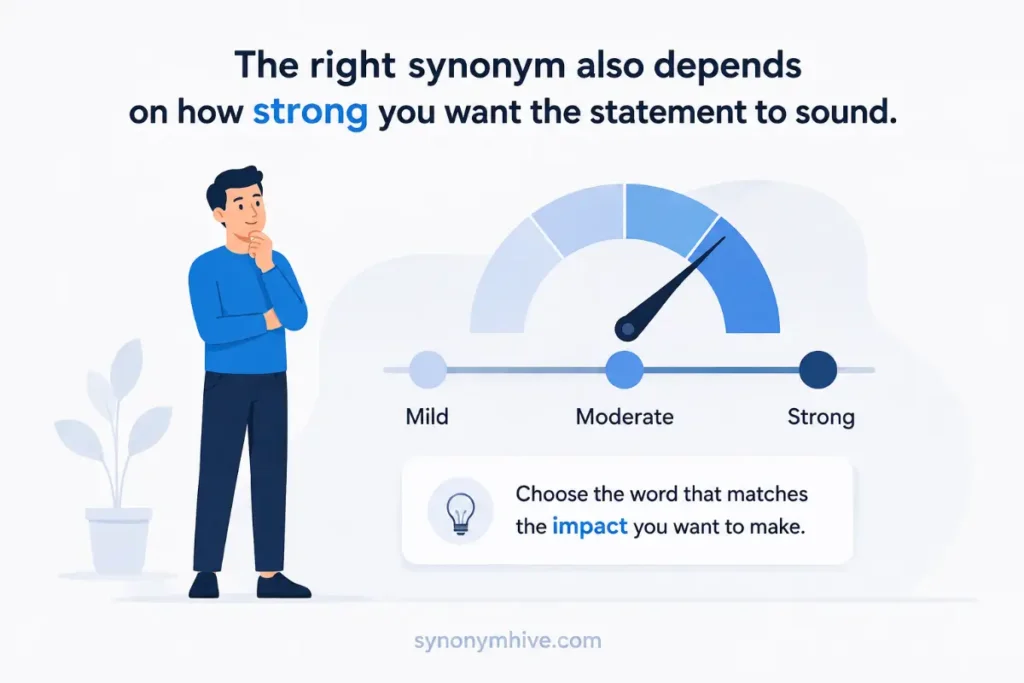
The right synonym also depends on how strong you want the statement to sound.
Think of the words as a volume control. You don’t want the volume at maximum for every sentence. A moderate word can sound more credible than an exaggerated one.
Mild alternatives
Useful, helpful, practical, good, solid, and capable are relatively mild.
They work when you want to make a positive statement without claiming exceptional performance.
Example.
She developed a useful training guide for new employees.
This sentence sounds believable because useful doesn’t make a huge claim.
Moderate alternatives
Productive, efficient, successful, skilled, proficient, valuable, and competent are stronger.
These words suggest clear ability or results. They work well in resumes because they communicate value without automatically sounding exaggerated.
Example.
He created an efficient scheduling process that reduced delays.
The word efficient fits because the sentence gives a specific result.
Strong alternatives
Accomplished, outstanding, exceptional, powerful, impactful, and highly successful carry more weight.
Use these words when your evidence supports them.
Example.
She led an outstanding customer service initiative that earned the highest satisfaction score in the department.
The stronger word works because the sentence provides a clear reason for the claim.
Very strong alternatives
Words such as exceptional, extraordinary, remarkable, and transformative make a major claim.
Use them carefully. If every skill on your resume sounds extraordinary, none of them will feel special.
A strong resume doesn’t need to shout. Specific evidence often creates more impact than dramatic adjectives.
another phrase for effective by part of speech
Effective is mainly an adjective. Most direct alternatives in the list above are also adjectives.
That matters because you can’t always swap words without changing the grammar of your sentence.
For example.
She is a capable manager.
She is an accomplished manager.
All three replacements work grammatically, but they don’t mean exactly the same thing.
You can also change the sentence structure.
She successfully managed the team.
She managed the team with strong results.
The adverb effectively becomes effectively in one form and can become efficiently or successfully in another. The best choice depends on the meaning you want.
Adjective choices
Use productive, efficient, capable, skilled, successful, accomplished, proficient, adept, valuable, or impactful when you need to describe a person, process, plan, or thing.
Example.
He is a skilled sales representative.
Adverb choices
Use effectively, efficiently, successfully, skillfully, competently, or productively when describing how someone performs an action.
Example.
She efficiently organized the project schedule.
Noun choices
If you’re discussing the quality of producing results, effectiveness and efficacy may fit.
Effectiveness is the more common choice in general American English.
Efficacy is more formal and often appears in technical, scientific, medical, or academic writing.
The history of efficacy also connects it with the idea of producing a desired result. The English noun dates to the sixteenth century and comes from Latin efficacia.
Which Another Word for Effective works best on a resume
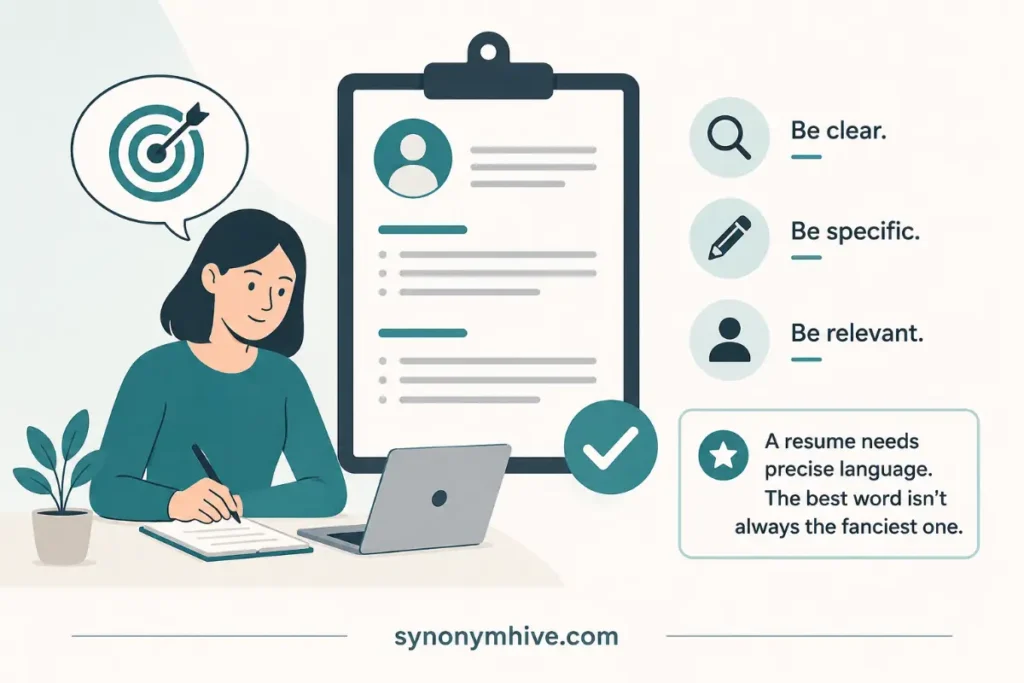
A resume needs precise language. The best word isn’t always the fanciest one.
Resume
For a resume, productive, efficient, accomplished, skilled, proficient, capable, resourceful, and successful are strong choices.
Example.
Instead of writing:
I was an effective employee who handled customer requests.
Try:
I efficiently handled more than 60 customer requests per day while maintaining high service standards.
The second sentence gives the reader something concrete. It shows performance instead of simply labeling it.
Essay
In an essay, your choice depends on the subject.
Effective works well in academic writing because it is neutral and clear. You can also use successful, useful, powerful, practical, productive, or impactful.
Example.
The author uses powerful imagery to show the effects of isolation.
Here, powerful gives a different idea from effective. It focuses on strength rather than simply producing the intended result.
Professional emails usually benefit from simple language.
Try useful, helpful, successful, practical, efficient, or clear.
Example.
Your suggestion was helpful and gave us a practical way to solve the problem.
This sounds more natural than repeating effective several times in the same email.
Texting
Text messages should sound natural. You can say something works, does the trick, helps, or gets the job done.
Example.
That study method really works.
You don’t need formal vocabulary in a casual conversation.
Speaking
In everyday speech, simple words usually sound best.
You can say good, useful, helpful, strong, successful, or practical.
Example.
That was a really useful suggestion.
The sentence sounds natural because the word matches the setting.
How do you use these words in real sentences
Context gives a synonym its real meaning. The following examples show how different words can work across common situations.
- The new scheduling system was efficient because it reduced manual work.
- Maria is a capable supervisor who keeps projects moving when problems arise.
- The training program was successful because new employees reached their targets faster.
- James is a skilled writer who can explain technical ideas in simple language.
- The sales team had a productive month and exceeded its revenue goal.
- She is an accomplished designer with years of experience creating digital products.
- The manager offered a practical solution that the entire team could use immediately.
- His customer service approach was helpful and easy for new employees to follow.
- The campaign had a powerful effect on brand awareness.
- She used a resourceful approach to solve the staffing problem without increasing costs.
- The analyst created a useful report that helped executives make a faster decision.
- He became a valuable member of the team because he could solve problems independently.
- The presentation was impactful because it used clear examples and real customer data.
- The department became more productive after the team removed several unnecessary steps.
- She is proficient in spreadsheet analysis and regularly prepares reports for senior managers.
- He is adept at handling difficult customer conversations calmly.
- The project was successful because the team set clear goals from the beginning.
- The new process was practical enough for employees to use without extra training.
These examples show why a synonym should match the actual quality you’re describing. Efficient focuses on reduced waste. Productive focuses on output. Skilled focuses on ability. Accomplished focuses on achievement. Resourceful focuses on problem solving.
Effective vs efficient what’s the difference
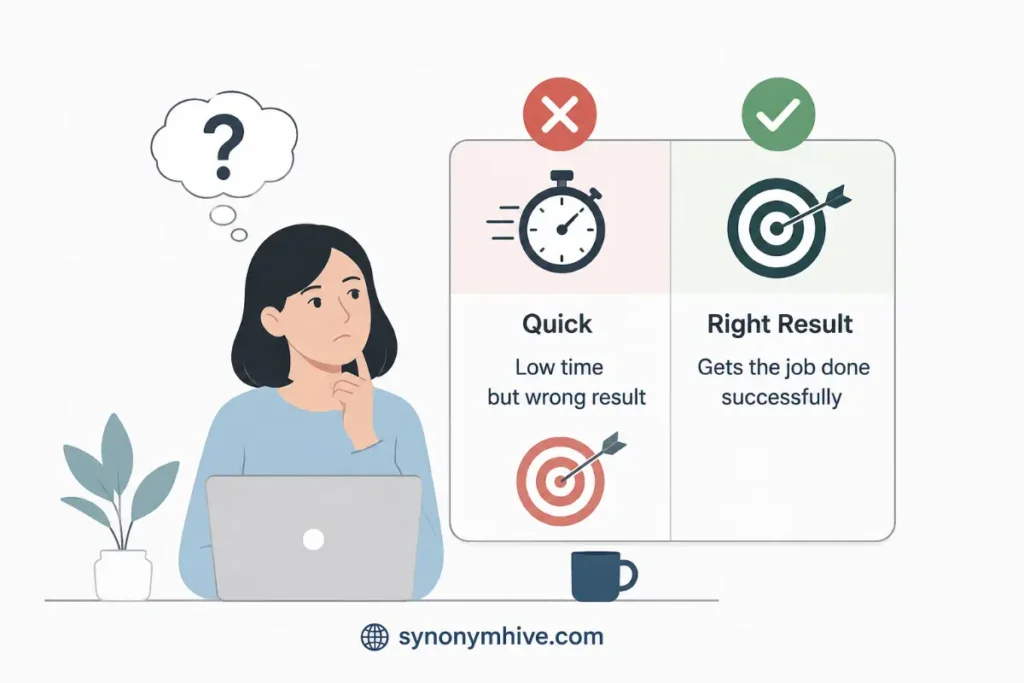
Effective means something produces the desired result. Efficient means it produces that result with little wasted time, effort, money, or resources.
Consider a team that completes a project on time. The team was effective because it reached the goal.
Now imagine another team completes the same project on time while using fewer hours and fewer resources. That team was efficient as well.
You can remember the difference this way.
Effective asks if the result was achieved.
Efficient asks how economically the result was achieved.
This distinction matters on resumes. If you improved a workflow and saved time, efficient may be a stronger choice than effective.
Example.
She developed an efficient reporting system that cut weekly preparation time by five hours.
The word efficient adds useful information that effective would not provide.
You may also like Another Word for Delivered Best Resume Choices 2026.
Effective vs successful what’s the difference
Successful focuses on achieving a goal. Effective focuses on producing the intended result.
The words often overlap.
A marketing campaign can be effective because it reaches its target audience. It can also be successful because it meets its sales goal.
Still, successful usually points more directly to an outcome.
If you have a measurable achievement on your resume, successful can be useful. If you’re describing how a method or approach works, effective may fit better.
Example.
She led a successful product launch that generated strong first month sales.
Here, successful connects naturally with the completed goal.
When should you avoid a another word for effective
Don’t replace effective simply to make your writing sound smarter.
A synonym can be worse if it changes the meaning.
For example, efficient doesn’t always mean effective. Something can use very little time and still fail to produce the desired result.
Likewise, skilled doesn’t automatically mean successful. A highly skilled person can work on a project that doesn’t reach its goal.
Impactful can also be too strong if the effect wasn’t clearly noticeable.
Efficacious may sound too formal for a normal resume. It can make simple writing feel stiff.
Powerful describes strength or influence rather than basic effectiveness.
Accomplished suggests a record of achievement. Don’t use it just because someone completed one routine task.
The safest rule is simple. Choose the word you can support with evidence.
Common mistakes when replacing effective
One common mistake is using the same synonym repeatedly.
A resume that says productive, productive, productive in every section quickly becomes repetitive. Mix your language based on the specific achievement.
Another mistake is using a word that doesn’t match the noun.
You can describe a person as skilled. You can describe a process as efficient.
Some combinations sound possible but feel unnatural because the meaning doesn’t fit.
A third mistake is exaggeration.
If you write that every project was exceptional, the claim loses power. Save your strongest words for achievements that truly deserve them.
A fourth mistake is replacing a useful adjective with a longer phrase that adds no information.
For example, saying very highly effective when effective already communicates the point can create clutter. A measurable result would be more useful.
What are the antonyms of effective
The main antonym is ineffective.
Other opposites include unsuccessful, unproductive, inefficient, useless, weak, inadequate, impractical, and incapable.
The right opposite depends on the original meaning.
If something doesn’t produce the intended result, ineffective works.
If it produces little useful work, unproductive is more precise.
Like synonyms, antonyms have different shades of meaning.
How do you choose the right word
Choosing a strong alternative gets easier when you ask a few simple questions.
- What result am I describing.
- Am I talking about a person, process, skill, method, or outcome.
- Do I mean strong results or efficient use of resources.
- Do I have evidence that supports the claim.
- Is the sentence for a resume, essay, email, text, or conversation.
- Does the word sound natural for the audience.
- Am I making a claim that is stronger than the evidence.
These questions prevent most synonym mistakes.
For a resume, start with the achievement rather than the adjective. Write down what you did, what changed, and what result followed. Then choose the word that best describes that result.
For example, suppose you improved a customer support system.
You could write that you were effective at improving customer service.
A stronger version might say that you streamlined customer support and reduced response times by 25 percent.
The second version gives evidence. The verb streamlined also carries more useful information than a general adjective.
Quick tips for better resume word choice
- Match the word to the result.
- Use efficient for time and resource savings.
- Use productive for strong output.
- Use skilled for developed ability.
- Use proficient for a strong level of knowledge or ability.
- Use accomplished for proven achievements.
- Use successful for goals that were reached.
- Use resourceful for creative problem solving.
- Use capable for reliable ability.
- Use impactful for a clear and noticeable effect.
- Use simple words when they communicate the idea better.
- Support strong claims with numbers, outcomes, or specific examples.
- Avoid repeating the same adjective throughout your resume.
- Don’t choose a complicated word just because it sounds impressive.
- Read the sentence aloud before you submit it.
A resume should feel confident without sounding inflated. Specific evidence gives your words weight.
Regional notes for US and UK English
The main alternatives to effective are understood in both American and British English. Words such as efficient, successful, productive, capable, skilled, and accomplished work across both varieties.
The bigger differences usually involve spelling or style rather than the core meaning of these synonyms.
For a US audience, use American spelling and natural American phrasing. For example, organize and organization are standard US forms.
The word efficacious is also understood in American English, but it is much more formal than effective. It often appears in technical or academic contexts rather than casual business writing.
Regional slang can vary more. Expressions such as gets the job done or does the trick are widely understandable in American English, but they belong in casual settings rather than formal resumes.
Discover related words in Another Word For Problem Solver: 15 Resume Power Picks 2026.
Conclusion
The best resume language doesn’t come from replacing every common word with a bigger one. It comes from choosing the word that tells the truth about your work.
If you’re searching for another word for effective, start with the result. Use productive when you want to show strong output. Choose efficient when you saved time or resources. Use skilled when you want to highlight ability. Choose accomplished when you have a record of achievement. Successful works well when you reached a clear goal.
Most importantly, support your word choice with evidence. Numbers, outcomes, responsibilities, and specific achievements make a resume more convincing than a long list of impressive adjectives. Good writing doesn’t need to sound complicated. The right word can do more work than five vague ones.
Frequently Asked Questions
What’s another way to say effective on a resume?
Strong options include productive, efficient, skilled, capable, accomplished, successful, proficient, and impactful. Pick the word that best matches the result you can support.
What is another term for effective in professional writing?
Another term for effective can be efficient, productive, successful, capable, accomplished, or impactful. The best choice depends on the exact meaning of your sentence.
Is efficient the same as effective?
No. Effective means something produces the intended result, while efficient focuses on achieving that result with little wasted time, effort, money, or resources.
What is a stronger word than effective?
Accomplished, outstanding, exceptional, impactful, and powerful can sound stronger than effective. Use them only when your evidence supports the stronger claim.
What is a simple synonym for effective?
Useful, helpful, successful, capable, and productive are simple alternatives. These words are easy to understand and work well in everyday writing.
Can I use efficacious on a resume?
You can, but it usually sounds too formal for most resumes. Words such as effective, efficient, successful, and productive tend to sound more natural and direct.
Which word is best for a strong resume?
Productive, efficient, skilled, accomplished, capable, proficient, and successful are strong choices for resumes. The best word is the one that accurately describes your achievement and fits the evidence.