
You’re writing an email, polishing an essay, updating your resume, or texting a friend when awesome suddenly seems too common. You need another word for awesome that sounds natural and matches what you actually mean.
Awesome can describe something impressive, exciting, beautiful, excellent, enjoyable, or surprisingly good. Since the word covers so many ideas, the best replacement depends on the situation.
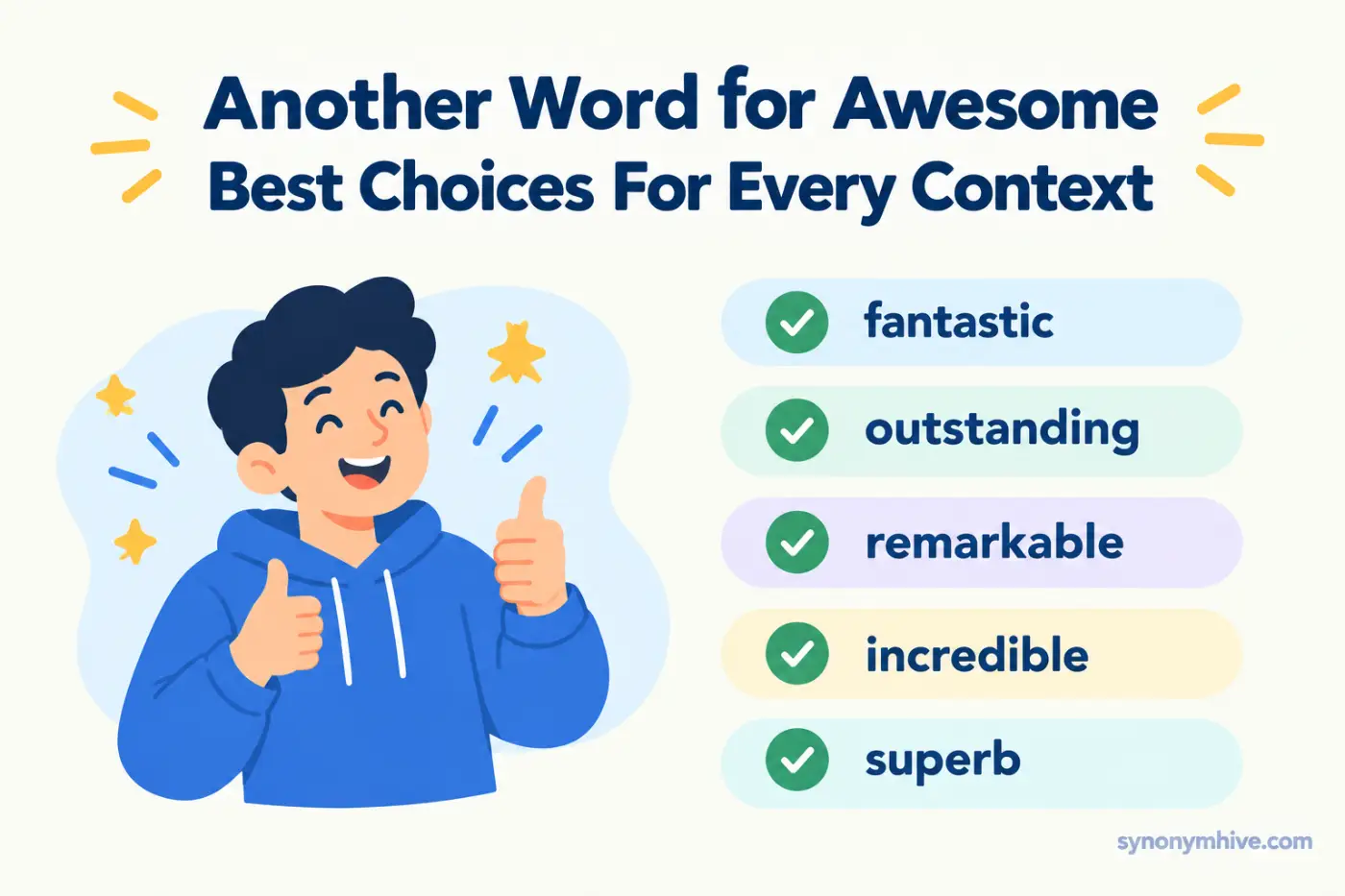
Another word for awesome can be amazing, incredible, fantastic, impressive, excellent, outstanding, remarkable, phenomenal, epic, or incredible.
Some choices sound professional. Others work better in casual speech or Gen Z slang. This guide explains the meaning and origin of awesome, compares more than 30 useful alternatives, and shows how to choose the right word for resumes, essays, emails, texts, conversations, and social media.
Find more synonyms in another word for crazy Best Choices For Every Context.
What does awesome mean in simple English
Awesome means extremely impressive, enjoyable, exciting, or admirable. In modern everyday English, people often use it to show strong approval or excitement.
For example, you might say, “That concert was awesome,” because you enjoyed the performance. You might also say, “Awesome job,” to praise someone for doing something well.
The word can describe people, experiences, places, ideas, achievements, objects, and events. Its meaning often depends on context and tone.
In casual American English, awesome is very common. That makes it useful, but it can also make your writing sound repetitive if you use it too often.
A stronger replacement gives readers more information. Amazing suggests surprise or admiration. Excellent suggests high quality. Impressive points to skill or achievement. Stunning often focuses on beauty or visual impact.
Where does the word awesome come from
Awesome comes from the older word awe. Awe refers to a strong reaction caused by something powerful, impressive, beautiful, or difficult to understand.
The word awesome originally had a more serious meaning. It described something that inspired awe or deep respect. Over time, everyday English shifted the word toward a much more positive and casual meaning.
Today, awesome is often used as a simple way to say that something is very good. A person might call a meal awesome, a movie awesome, or a friend’s new idea awesome.
That modern meaning is much broader than the original sense. The change also explains why awesome can sound casual in professional writing even though it has a long history in English.
What is another word for awesome
The best replacement depends on the quality you want to highlight. Use amazing or incredible for strong admiration. Choose excellent or outstanding for high quality. Use impressive for skill or achievement. Pick stunning for beauty and epic for an exciting informal tone.
For professional writing, excellent, outstanding, remarkable, impressive, and exceptional are useful choices. For casual conversation, amazing, fantastic, incredible, brilliant, epic, and awesome itself sound natural.
Gen Z slang adds informal options such as fire, sick, lit, iconic, elite, and GOATed. These expressions belong mostly in casual digital communication and can sound out of place in formal writing.
Master synonym list
The table below groups useful alternatives by tone and common use. Some are close synonyms, while others match only certain meanings of awesome.
| Word | Meaning | Tone | Example |
|---|---|---|---|
| Amazing | Extremely good or surprising | Everyday | The view was amazing. |
| Incredible | Very impressive or hard to believe | Everyday | She gave an incredible performance. |
| Fantastic | Extremely good or enjoyable | Everyday | We had a fantastic time. |
| Excellent | Very high quality | Neutral | Your report was excellent. |
| Spectacular | Very impressive or exciting | Strong | The fireworks were spectacular. |
| Cool | Good, stylish, or interesting | Casual | That is a cool design. |
| Epic | Extremely impressive or exciting | Slang | That was an epic concert. |
| Fire | Excellent or exciting | Gen Z slang | That new song is fire. |
| Sick | Extremely good or impressive | Slang | Those shoes are sick. |
| Lit | Exciting or energetic | Slang | The party was lit. |
| Iconic | Highly memorable or influential | Slang | That scene is iconic. |
| Elite | Extremely high quality | Slang | That performance was elite. |
| Goated | Exceptionally good or considered among the best | Slang | That player is goated. |
| Top notch | Excellent quality | Informal | The service was top notch. |
| First rate | Excellent quality | Neutral | She provided first rate support. |
| Superb | Extremely good | Formal | The presentation was superb. |
| Brilliant | Clever or excellent | Everyday | That solution was brilliant. |
| Awe inspiring | Extremely impressive | Formal | The mountain view was awe inspiring. |
| Unforgettable | So good it stays in memory | Neutral | It was an unforgettable trip. |
This range gives you more control than simply replacing awesome with amazing every time. The strongest choice is the word that matches the exact reason something impressed you.
Which synonym should you use for a mild positive meaning
When you want to say that something is good without sounding overly excited, try nice, good, cool, solid, pleasing, enjoyable, or impressive.
Cool is especially common in casual American English. It can describe an object, idea, plan, style, or experience.
Impressive works well when you want to show respect for someone’s ability or achievement.
Enjoyable focuses on the experience itself. It works well in reviews and everyday comments.
For example, “The workshop was enjoyable” sounds calmer than “The workshop was phenomenal.” Both are positive, but the level of praise is different.
Which synonym works for a strong positive meaning
For strong praise, use amazing, incredible, phenomenal, exceptional, outstanding, spectacular, extraordinary, or remarkable.
Amazing is broad and natural. Incredible suggests that something is so good or unusual that it is difficult to believe.
Phenomenal is stronger and often appears in professional praise, sports commentary, and reviews.
Exceptional suggests that something stands clearly above the normal level.
Outstanding means something is noticeably better than what is typical.
Spectacular often works for visual experiences, performances, events, and major achievements.
Which synonym works for beauty
If awesome means beautiful or visually impressive, use stunning, gorgeous, breathtaking, magnificent, spectacular, striking, elegant, or beautiful.
Stunning is especially useful when something creates a strong visual reaction.
Magnificent sounds more formal and grand.
Breathtaking describes something so beautiful or impressive that it creates a powerful reaction.
Striking works well when something catches attention because of a strong visual feature.
For example, “The sunset was stunning” gives the reader a clearer picture than “The sunset was awesome.”
Which synonym works for achievement
When praising someone’s work, use excellent, impressive, outstanding, exceptional, remarkable, brilliant, or phenomenal.
These words work well because they explain the kind of praise you are giving.
For example, “Your presentation was impressive” highlights the quality of the performance.
“Your presentation was outstanding” gives stronger praise.
“Your presentation was excellent” sounds professional and direct.
Which synonym works for excitement
For an exciting event or experience, use thrilling, incredible, epic, spectacular, unforgettable, wild, amazing, or exhilarating.
Epic is highly informal and works especially well in conversations and online posts.
Thrilling is useful for sports, entertainment, adventures, and suspenseful experiences.
Unforgettable focuses on the lasting impact rather than excitement alone.
For example, “The final match was thrilling” tells the reader that the competition created excitement.
What is another word for awesome in Gen Z slang
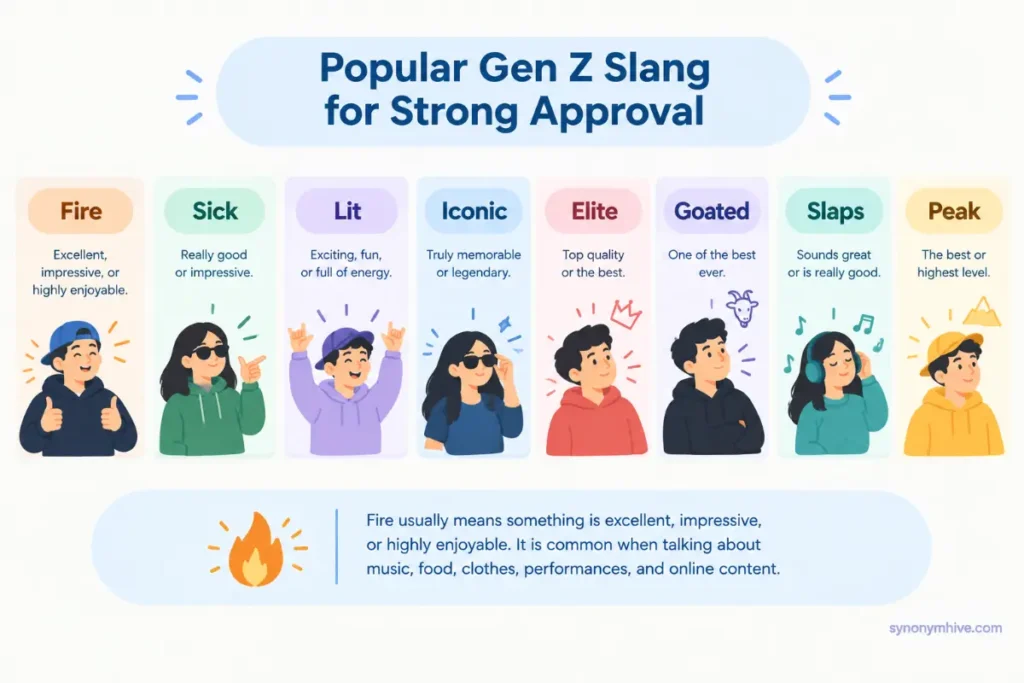
Popular Gen Z slang can express strong approval in a more casual way. Common options include fire, sick, lit, iconic, elite, goated, slaps, and peak.
Fire usually means something is excellent, impressive, or highly enjoyable. It is common when talking about music, food, clothes, performances, and online content.
Sick can mean extremely cool or impressive in casual speech. It does not necessarily mean someone is ill.
Lit often describes something exciting, energetic, or fun. Its use can vary by age and online community.
Iconic means highly memorable or strongly associated with a person, moment, style, or cultural reference.
Elite is used casually to say something is at a very high level.
Goated comes from GOAT, meaning greatest of all time. It is usually used for people, performances, skills, or achievements that someone considers exceptional.
Slaps is often used for music, food, or other things that are especially enjoyable.
Peak can describe something that represents an especially high level of quality or enjoyment.
These words are best for texts, social media, gaming communities, casual conversations, and other informal spaces. They are usually poor choices for resumes, school essays, and formal business communication.
How do synonyms change by intensity
Not every synonym has the same strength. Choosing the right level keeps your writing natural.
Mild positive words
Use nice, good, cool, enjoyable, pleasing, solid, and pleasant when you want moderate praise.
These words do not sound dramatic. They work well when you like something but do not want to make a huge statement.
Medium positive words
Use great, impressive, excellent, wonderful, fantastic, terrific, and brilliant for stronger everyday praise.
These are useful in conversations, emails, reviews, and general writing.
Strong positive words
Use amazing, incredible, outstanding, exceptional, remarkable, phenomenal, spectacular, and extraordinary when you want strong praise.
These words tell readers that something stands clearly above the normal level.
Very strong informal words
Use epic, fire, iconic, elite, goated, or sick in casual settings when you want energetic praise.
These words carry a strong social or cultural tone. Their meaning also depends on the audience.
How do these synonyms work by part of speech
Most alternatives to awesome are adjectives because awesome itself is usually an adjective.
You can say that a movie was amazing, a performance was impressive, or a result was outstanding.
Some related words work as nouns. Excellence, brilliance, greatness, magnificence, and awesomeness are nouns.
For example, “Her performance showed remarkable excellence” uses excellence as a noun.
Some words also have related adverb forms. Excellent becomes excellently, remarkable becomes remarkably, and impressive becomes impressively.
Using the correct form matters. You cannot always replace awesome directly without changing the grammar of the sentence.
What is the best word by context
The right synonym changes depending on where you plan to use it. A resume needs different vocabulary from a group chat.
What is another term for awesome on a resume
On a resume, use impressive, outstanding, exceptional, excellent, remarkable, or strong. Even better, explain the result behind the praise.
For example, instead of writing “I did an awesome job managing projects,” write “I successfully managed 12 client projects while meeting weekly deadlines.”
The second version is stronger because it gives evidence instead of relying on a general compliment.
If you need a single adjective, impressive or outstanding usually works better than casual slang.
What is another phrase for awesome in an essay
For an essay, use excellent, impressive, remarkable, exceptional, significant, extraordinary, or notable depending on your meaning.
Avoid slang such as fire, lit, sick, or goated. These words may work in a personal essay about culture or language, but they usually do not fit standard academic writing.
For example, write “The author presents a remarkable argument” instead of “The author presents an awesome argument.”
What is another word for awesome in a text
Texting gives you much more freedom. Try amazing, incredible, epic, fire, sick, iconic, lit, cool, or wild.
Your relationship with the reader matters. A casual word can sound friendly and natural in a text but strange in a message to a manager.
For example, “That new restaurant is fire” sounds natural among friends. “That new restaurant is exceptional” sounds more formal.
What is another word for awesome in an email
For a professional email, use excellent, impressive, outstanding, wonderful, remarkable, or great.
“Awesome” itself can be fine in an informal workplace, especially when your team commonly uses casual language. Still, a more specific word can make the message sound polished.
For example, “You did an excellent job on the report” gives clear professional praise.
What is another term for awesome when speaking
In everyday speech, amazing, incredible, fantastic, great, brilliant, wonderful, and awesome are all natural.
If you want casual excitement, try epic or wild.
If you want respectful praise, use impressive or outstanding.
What are 15 examples of better word choices
Seeing the alternatives in complete sentences makes the differences easier to understand.
The new museum has an impressive collection of modern art.
Her presentation was outstanding and easy to follow.
We had an incredible time at the beach.
That was a brilliant solution to a difficult problem.
The mountain view was breathtaking at sunrise.
Your final report looks excellent.
The concert was epic from beginning to end.
The new restaurant has fantastic food.
His progress over the past year has been remarkable.
The fireworks were spectacular.
That new song is fire.
Your new jacket is seriously sick.
The game last night was absolutely wild.
Her performance was phenomenal.
The entire experience was unforgettable.
These sentences show how the same general idea can become more precise with the right vocabulary.
Is amazing the same as awesome
Amazing and awesome are close, but they are not identical in every situation.
Amazing often suggests surprise, admiration, or something that exceeds expectations.
Awesome is broader and can simply mean very good, exciting, or enjoyable.
Compare these sentences.
The food was awesome.
The food was amazing.
Both are natural. Amazing can sound slightly stronger because it suggests that the food exceeded expectations.
The difference is small in casual speech, so the best choice often depends on personal style.
Is incredible the same as awesome
Incredible often carries a stronger sense of surprise or disbelief.
For example, “She ran an incredible race” praises an unusually strong performance.
“Her race was awesome” sounds more casual and enthusiastic.
Use incredible when you want stronger admiration. Use awesome when you want relaxed everyday praise.
Is fantastic the same as awesome
Fantastic and awesome are both positive informal words, especially in everyday American English.
Fantastic often describes an enjoyable experience, excellent result, or very good idea.
Awesome is more flexible and can work as a reaction. For example, “Awesome, thanks” is common in casual speech. “Fantastic, thanks” is possible, but it has a slightly different tone.
What are the best formal alternatives
Formal writing benefits from words such as excellent, outstanding, exceptional, remarkable, impressive, extraordinary, notable, and superb.
The best choice depends on the subject.
Use outstanding for performance or results.
Use exceptional for ability or quality that is unusually high.
Do not choose a formal synonym simply because it sounds sophisticated. The meaning must still fit the sentence.
What are the best everyday alternatives
Everyday conversation works well with amazing, fantastic, incredible, wonderful, great, brilliant, terrific, cool, impressive, and epic.
These words are easy to understand and sound natural in American English.
Great is especially useful when you want a simple positive word.
Fantastic is more enthusiastic.
Brilliant can mean clever or excellent.
Cool can suggest that something is stylish, interesting, or appealing.
Epic is more dramatic and informal.
What are the best slang alternatives
For casual slang, try fire, sick, lit, iconic, elite, goated, slaps, peak, and epic.
Keep the audience in mind. Slang changes quickly and can sound natural among friends but awkward in formal communication.
For example, “That album slaps” is casual and expressive. “That album is excellent” is neutral and widely appropriate.
Neither sentence is automatically better. They simply serve different audiences.
What are the US and UK differences
Most common synonyms for awesome work across American and British English, but certain informal words can carry different levels of popularity.
Brilliant is especially common in British English as a general word of praise. American speakers understand it but may use great, awesome, amazing, or fantastic more often in everyday conversation.
Terrific is familiar in American English and can sound slightly old fashioned or less common in some British contexts.
Cool is widely understood in both varieties.
Gen Z slang spreads through social media, so regional boundaries are less clear than they once were. Still, slang can vary by age, platform, city, and online community.
For US focused writing, simple words such as amazing, impressive, excellent, incredible, fantastic, and outstanding are broadly understood.
Which synonym should you use for a person
When praising a person, avoid vague language when you can explain the specific quality.
Use impressive for ability or achievement.
Use brilliant for intelligence or a very good idea.
For example, “She is awesome” is friendly but broad.
“She is an exceptional teacher who makes difficult ideas easy to understand” gives the reader much more information.
Which synonym should you use for a product
For products, excellent, impressive, high quality, innovative, reliable, stylish, exceptional, and outstanding can work.
Use impressive when the product performs especially well.
Use innovative when it introduces a useful new idea.
Use high quality when discussing materials, construction, or overall standards.
This approach makes product descriptions more useful than simply calling something awesome.
Which synonym should you use for an experience
For experiences, try amazing, incredible, unforgettable, fantastic, thrilling, spectacular, enjoyable, memorable, or extraordinary.
An unforgettable experience is one that stays in your memory.
A thrilling experience creates excitement.
A spectacular experience creates a strong visual or emotional reaction.
An enjoyable experience is simply pleasant and satisfying.
Choose the word that explains the specific reason you liked the experience.
Which synonym should you use for a place
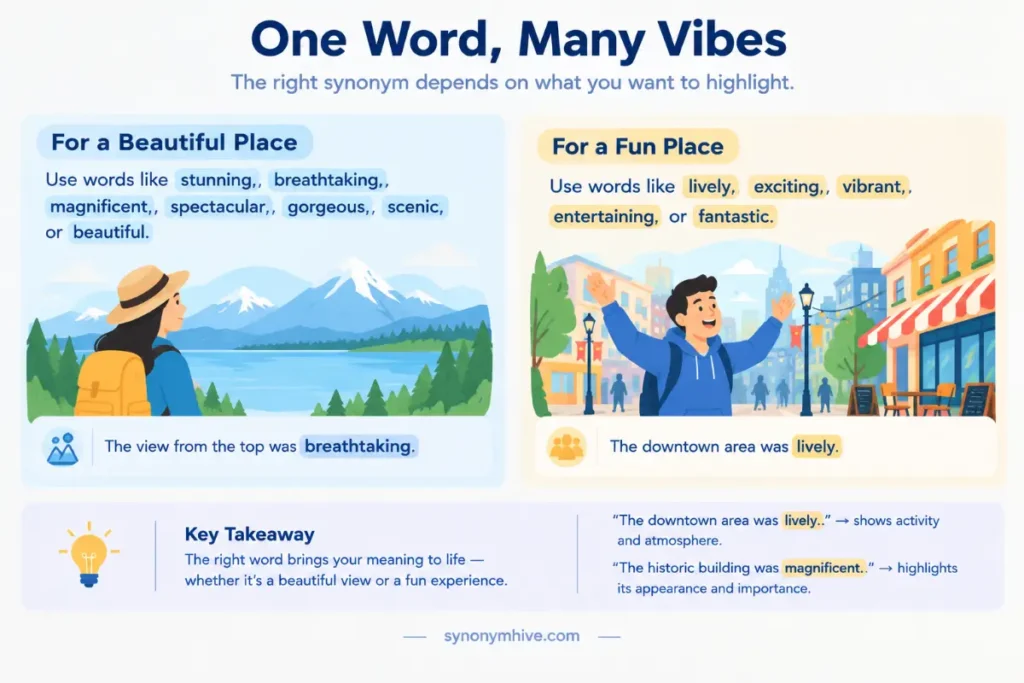
For a beautiful place, use stunning, breathtaking, magnificent, spectacular, gorgeous, scenic, or beautiful.
For a fun place, use lively, exciting, vibrant, entertaining, or fantastic.
“The downtown area was lively” highlights activity and atmosphere.
“The historic building was magnificent” highlights its appearance and importance.
What are common mistakes when using synonyms for awesome
One common mistake is using a synonym that is too strong. Calling a small improvement phenomenal can make the praise sound exaggerated.
Another mistake is using slang in a formal setting. A resume should not describe a project as fire or goated.
A third mistake is using a word that changes the meaning. Amazing usually means very impressive or surprising. It does not specifically mean beautiful.
A fourth mistake is repeating the same synonym throughout an article. Replacing every instance of awesome with amazing does not create strong writing. It simply swaps one repeated word for another.
A fifth mistake is ignoring the audience. Vocabulary should match the person reading your message.
A sixth mistake is using a word without checking its common usage. Some slang terms have meanings that shift quickly.
A seventh mistake is using a synonym when a specific description would be stronger. “She achieved an awesome result” tells less than “She increased customer retention by 18 percent.”
When should you not use awesome
You do not need to remove awesome from every sentence. It is a normal and useful word in casual English.
Still, consider replacing it when the writing needs precision.
A resume should focus on measurable accomplishments.
An academic essay should use specific descriptive language.
A professional report should explain quality through evidence.
A product review should identify what makes the product good.
A formal recommendation should give reasons rather than rely on broad praise.
In casual conversations, awesome is completely natural. The problem is not the word itself. The problem comes from using it when a more exact word would communicate your point better.
Check out more vocabulary ideas in another word for savage Best Choices In 2026.
What are the antonyms of awesome
The opposite of awesome depends on the meaning.
If awesome means excellent, possible opposites include poor, bad, weak, or disappointing.
If awesome means impressive, the opposite might be unimpressive, ordinary, or forgettable.
There is no single antonym that fits every use because awesome has several related meanings.
How can you choose the right synonym quickly
First, identify the reason something is awesome.
If it is very good, use excellent.
If it is casual slang, use fire, iconic, elite, or another expression that fits your audience.
This quick check prevents most synonym mistakes.
A simple synonym choice chart
| What you mean | Best choices |
|---|---|
| Very good | Excellent, fantastic, great |
| Very impressive | Amazing, incredible, phenomenal |
| High quality | Excellent, superb, outstanding |
| Great achievement | Impressive, remarkable, exceptional |
| Beautiful | Stunning, breathtaking, magnificent |
| Exciting | Thrilling, epic, spectacular |
| Memorable | Unforgettable, remarkable, iconic |
| Clever | Brilliant, ingenious, impressive |
| Casual praise | Cool, awesome, fantastic |
| Gen Z praise | Fire, elite, iconic, goated |
| Professional praise | Excellent, outstanding, exceptional |
| Something surprising | Amazing, incredible, remarkable |
| Something stylish | Cool, striking, iconic |
| Great music | Amazing, fire, incredible, sick |
| Great food | Fantastic, delicious, amazing |
| Great performance | Outstanding, brilliant, phenomenal |
The chart works as a quick reference, but always consider the full sentence before choosing a word.
How can you make your word choice more precise
A strong synonym should do more than sound different. It should add information.
Suppose you write, “The speaker gave an awesome presentation.” The reader knows you liked it, but not why.
You could write, “The speaker gave an impressive presentation that explained a complex topic clearly.”
Now the sentence tells the reader what made the presentation effective.
You can also choose a word based on the emotional reaction you want to show. Amazing expresses admiration. Incredible adds surprise. Outstanding emphasizes quality. Brilliant suggests intelligence or skill.
Precision makes writing more useful because readers do not have to guess what you mean.
How can you avoid repeating awesome
Start by identifying the reason you used the word. If you mean beautiful, use stunning. If you mean excellent, use outstanding.
You can also remove the adjective entirely and describe the result.
Instead of “She gave an awesome presentation,” write “She explained the topic clearly and kept the audience engaged.”
Instead of “The restaurant has awesome food,” write “The restaurant serves fresh food with bold flavors.”
Specific details often create stronger writing than a long list of synonyms.
How does audience affect synonym choice
Audience should guide your vocabulary.
A friend may understand “That movie was fire.”
A teacher may prefer “That movie was impressive.”
A hiring manager will respond better to specific evidence such as “I increased sales by 15 percent.”
A business client may appreciate “Your proposal was excellent and clearly explained the expected results.”
The meaning can stay positive while the vocabulary changes. Good communication means choosing language the reader will understand and accept naturally.
How can you use Gen Z slang without sounding forced
Use slang only when the setting already supports it.
If you are writing a casual social post, terms such as fire, iconic, elite, and goated may sound natural.
If you are writing a school essay, resume, business email, or formal article, standard vocabulary is usually safer.
Also avoid forcing several slang terms into one sentence. Using too much slang can make writing sound unnatural.
For example, “That album is fire and absolutely iconic” can work in a casual post.
A professional review could say, “The album is impressive and highly memorable.”
The second version communicates the praise without relying on current slang.
What is the difference between excellent and outstanding
Excellent means very high quality. Outstanding usually suggests that something stands out from others because of exceptional quality or performance.
For example, “She did an excellent job” is strong praise.
“She delivered an outstanding performance” suggests that her performance was especially notable.
The two words overlap, so the choice often depends on how much emphasis you want to place on distinction.
What is the difference between amazing and impressive
Amazing often expresses strong personal reaction, surprise, or admiration.
Impressive focuses more directly on the quality or achievement that deserves admiration.
For example, “The view was amazing” sounds emotional and personal.
“Her results were impressive” focuses on what she achieved.
Use amazing when you want to express a strong reaction. Use impressive when you want to highlight a quality or accomplishment.
What is the difference between fantastic and excellent
Fantastic is more enthusiastic and conversational. Excellent is more neutral and professional.
You might say, “We had a fantastic vacation.”
For a workplace email, you might say, “You did an excellent job.”
Both are positive. Fantastic adds more enthusiasm, while excellent often sounds more polished.
What is the difference between epic and iconic
Epic usually describes something extremely exciting, dramatic, large, or memorable.
Iconic describes something that has become highly recognizable or strongly associated with a person, style, moment, or culture.
A concert can be epic because it was huge and exciting.
A famous concert outfit might be iconic because people recognize it and remember it.
The words can overlap, but their focus is different.
What is the difference between fire and lit
Fire usually means something is excellent, impressive, or highly enjoyable.
Lit often describes an exciting, energetic, or lively situation.
For example, “That song is fire” focuses on the quality of the song.
“The party was lit” focuses on the energy and excitement of the event.
Both are casual slang and should be used with an audience that understands the expressions.
What is the difference between impressive and exceptional
Impressive means something deserves admiration. Exceptional means something is unusually high in quality and stands outside the normal range.
A strong presentation can be impressive.
A presentation that is far above the expected standard may be exceptional.
Use exceptional when you want stronger praise and the evidence supports it.
What is the difference between awesome and great
Great is one of the broadest positive words in English. It can mean good, enjoyable, successful, important, or impressive.
Awesome is also broad, but it often carries more enthusiasm in modern casual speech.
For example, “Great job” is common and simple.
“Awesome job” sounds slightly more energetic and informal.
Both are natural in everyday American English.
How can you use synonyms naturally in conversation
Natural speech does not require complicated vocabulary.
If a friend shows you a new design, you might say, “That looks amazing.”
If someone tells you about an achievement, you might say, “That’s impressive.”
The best spoken synonym is often the simplest one that communicates your reaction.
How can you use synonyms in social media writing
Social media gives you more freedom to use informal language.
Words such as epic, iconic, fire, elite, sick, and goated can create a casual tone.
Still, context matters. A professional LinkedIn post should use different language from a gaming post or personal Instagram caption.
For professional social content, impressive, excellent, remarkable, and outstanding are usually safer.
For casual posts, amazing, incredible, epic, iconic, and fire can sound natural.
How can you use synonyms in product reviews
Product reviews become stronger when you explain the specific quality behind your praise.
Instead of saying “This phone is awesome,” explain what works well.
You could say, “The camera produces sharp photos in low light.”
You could also write, “The battery life is impressive and easily lasts through a full day.”
These sentences provide useful information. A reader can understand exactly why the product deserves praise.
The same principle applies to restaurants, hotels, clothing, software, books, movies, and other products or services.
How can you use synonyms in school writing
School writing should favor clear and specific language.
Instead of “The experiment was awesome,” write “The experiment produced an unexpected result.”
Instead of “The setting was awesome,” explain the setting. You might say that it was dramatic, unusual, beautiful, or historically important.
Teachers usually get more value from precise descriptions than broad praise.
How can you use synonyms in workplace communication
Professional communication should be clear and respectful.
Instead of “Awesome work,” you can write “Excellent work on the report.”
Instead of “You did an awesome job,” write “You handled the project very well.”
Casual praise is not always wrong at work. The best choice depends on your company culture, relationship with the reader, and purpose of the message.
What are some stronger alternatives for praise
When you want to praise someone directly, these choices are useful.
Excellent works for quality.
Outstanding works for performance.
Impressive works for skill or achievement.
Exceptional works for unusually high ability.
Remarkable works for something notable.
Brilliant works for clever ideas or excellent work.
Phenomenal works for very strong results.
Superb works for high quality.
Exceptional and outstanding are especially useful in professional settings when the praise is supported by real results.
What are some alternatives for awesome ideas
For a good idea, use brilliant, clever, creative, smart, innovative, promising, practical, effective, or impressive.
Brilliant suggests intelligence or creativity.
Innovative suggests a new approach.
Practical suggests that the idea can work well in real situations.
Promising suggests that the idea has strong potential.
Effective suggests that the idea produces a useful result.
These choices communicate more than simply saying that an idea is awesome.
What are some alternatives for awesome experiences
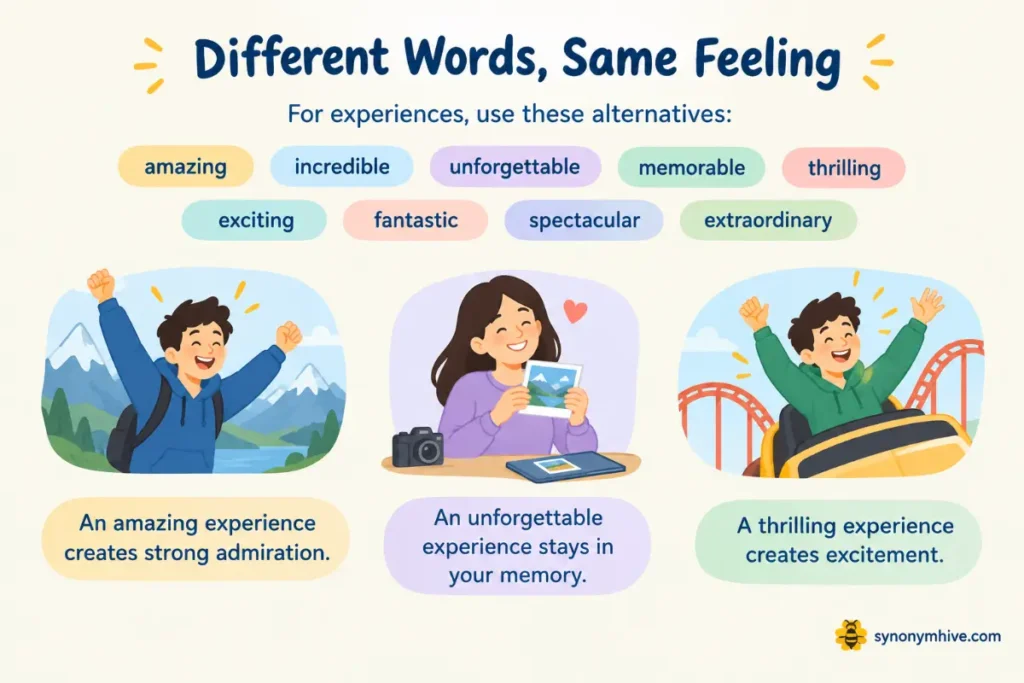
For experiences, use amazing, incredible, unforgettable, memorable, thrilling, exciting, fantastic, spectacular, or extraordinary.
An amazing experience creates strong admiration.
An unforgettable experience stays in your memory.
A thrilling experience creates excitement.
A spectacular experience creates a powerful visual or emotional reaction.
A memorable experience stands out from ordinary events.
Choose the word that matches the part of the experience you want readers to notice.
What are some alternatives for awesome people
When describing people, use kind, talented, inspiring, impressive, exceptional, remarkable, brilliant, generous, thoughtful, or admirable.
Avoid relying on a general compliment when you can name the quality.
For example, “She is awesome” is friendly but vague.
“She is an inspiring mentor who always makes time for new employees” tells the reader much more.
Specific praise sounds more sincere because it gives a reason for the compliment.
What are some alternatives for awesome food
For food, use delicious, excellent, flavorful, fantastic, incredible, satisfying, memorable, outstanding, or mouthwatering.
Delicious is direct and common.
Flavorful focuses on taste.
Mouthwatering is vivid and informal.
Outstanding can work in a restaurant review.
For example, “The pasta was flavorful and perfectly cooked” gives more useful information than “The pasta was awesome.”
What are some alternatives for awesome music
For music, use amazing, incredible, brilliant, powerful, memorable, catchy, excellent, fire, or iconic.
Catchy describes music that is easy to remember.
Powerful describes strong emotional or musical impact.
Iconic suggests that a song has become highly recognizable or culturally memorable.
Fire is a casual slang choice for music that someone thinks is excellent.
What are some alternatives for awesome movies
For movies, use amazing, brilliant, gripping, entertaining, memorable, outstanding, spectacular, incredible, or epic.
Gripping is useful when a movie keeps your attention.
Entertaining focuses on enjoyment.
Spectacular works for strong visual effects or large scale scenes.
Memorable focuses on the lasting impact of the movie.
Again, the strongest word depends on what made the movie stand out.
What are the most useful choices to remember
If you only want a small group of reliable alternatives, remember amazing, incredible, fantastic, excellent, impressive, outstanding, remarkable, exceptional, spectacular, and wild.
These words cover most common situations.
Use amazing for strong admiration.
Use incredible for surprise.
For Gen Z slang, remember fire, iconic, elite, goated, and out of pocket, but save these for informal settings.
Find similar expressions in Another Word For Vibe Best Synonyms And Uses In 2026.
Conclusion
Choosing another word for awesome starts with identifying the exact kind of praise you want to give. Amazing and incredible show strong admiration. Excellent and outstanding work well in professional settings. Impressive highlights skill or achievement, while stunning focuses on beauty. Words such as epic, fire, iconic, and goated add a casual Gen Z tone.
You don’t need to avoid awesome completely. It remains a natural word in everyday American English. The key is to avoid using one broad word for every situation.
When your sentence needs more detail, replace the general praise with a word that explains the quality. Better vocabulary is not about using bigger words. It is about saying exactly what you mean.
Frequently Asked Questions
What is another word for awesome?
Another phrase for awesome can be amazing, incredible, fantastic, excellent, impressive, outstanding, remarkable, or exceptional. The best option depends on the situation and the tone you want.
What’s another way to say awesome?
Another way to say awesome is amazing, fantastic, incredible, brilliant, impressive, epic, or excellent. For casual Gen Z speech, fire, iconic, elite, and goated can also work.
What is another term for awesome in Gen Z slang?
Gen Z slang alternatives include fire, iconic, elite, goated, sick, lit, and slaps. These words are informal and work best in texts, social media, and casual conversations.
What is a professional word for awesome?
Excellent, outstanding, exceptional, impressive, and remarkable are strong professional alternatives. They sound more precise than casual words and work well in resumes, emails, reports, and workplace communication.
What is another term for awesome in an essay?
Use excellent, impressive, remarkable, exceptional, extraordinary, or notable in an essay. Choose the word that describes the specific quality you want to emphasize.
Is amazing stronger than awesome?
Amazing can sound slightly stronger because it often suggests surprise or admiration, while awesome is broader and more casual. In everyday speech, however, the two words can often be used in the same situations.
What is a slang word for something really good?
Fire is a common slang expression for something considered very good or impressive. Other casual options include elite, iconic, goated, sick, and slaps depending on the subject and audience.