
You’re writing an email, finishing an essay, updating your resume, or texting a friend when the word weird suddenly doesn’t seem quite right. You may need another word for weird that sounds more natural, more polite, more formal, or more specific.
Weird can mean strange, unusual, unexpected, confusing, creepy, awkward, or simply different from what people normally expect. The right replacement depends on the exact idea you want to express.
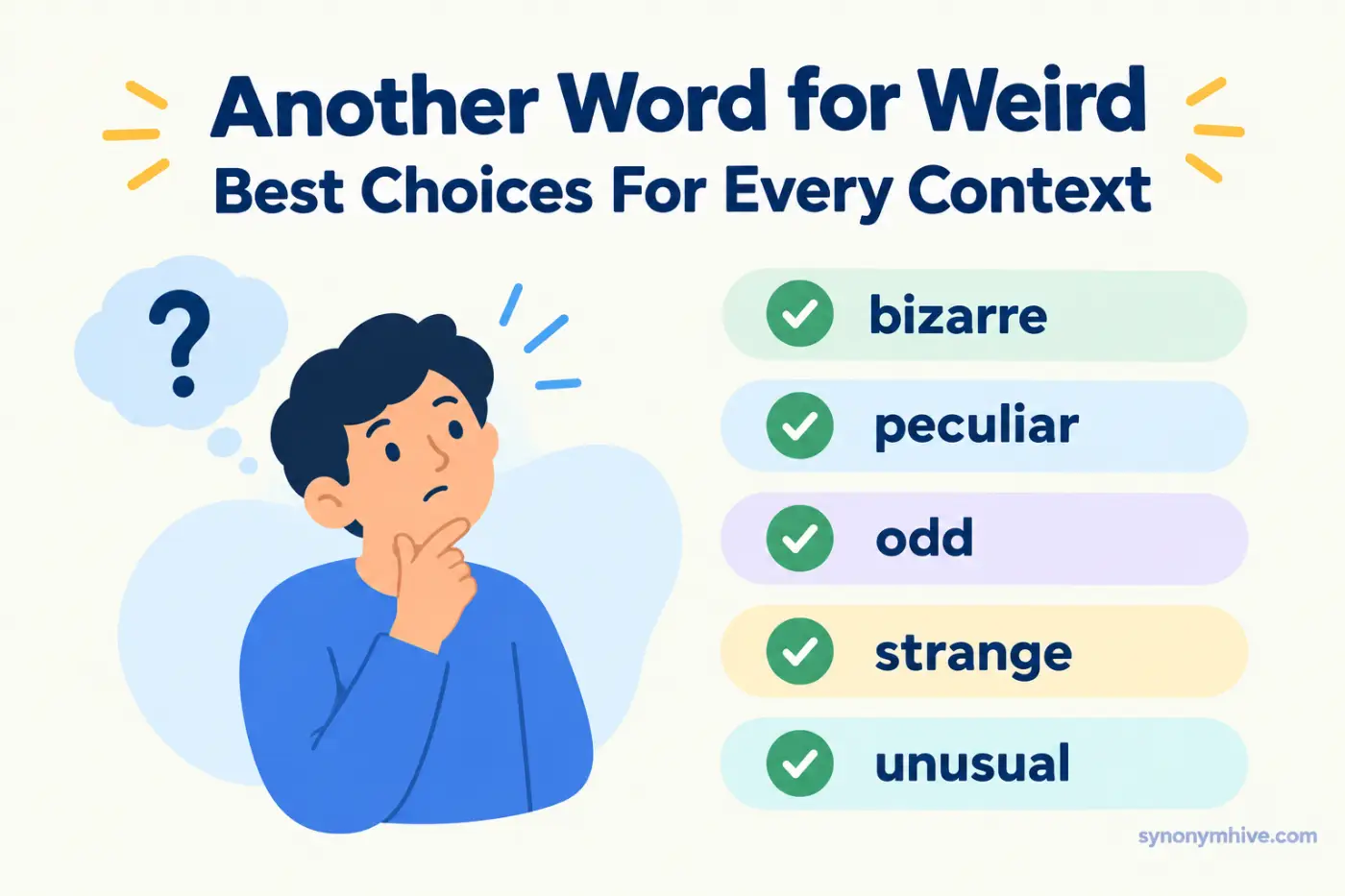
Another word for weird can be strange, unusual, odd, bizarre, peculiar, unconventional, eccentric, awkward, quirky, or surreal.
Some alternatives sound friendly. Others sound formal, humorous, negative, or mysterious. This guide explains the differences and shows how to choose the right word for resumes, essays, emails, texting, speaking, and Gen Z slang.
Compare more word options with another word for crazy Best Choices For Every Context.
What does weird mean in simple English
Weird usually means strange, unusual, unexpected, or different from what people consider normal. It is a flexible word, so its meaning changes with the situation.
For example, “That movie was weird” might mean the story was unusual or confusing. “That noise is weird” might mean the sound is unfamiliar. “He has a weird sense of humor” could mean his jokes are unusual or unexpected.
Weird can also have a negative meaning. Calling something weird may suggest that you do not understand it, dislike it, or think it does not fit normal expectations.
The word is common in everyday American English. It works well in casual conversation, texts, and informal writing. In a formal essay or professional email, a more precise alternative can make your meaning clearer.
Where does the word weird come from
Weird has an interesting history. It comes from an old English word connected with fate, destiny, or what was destined to happen.
The word appeared in older expressions related to fate and was later connected with supernatural ideas. Over time, its meaning changed. Modern English uses weird mainly for things that seem strange, unusual, or outside ordinary experience.
That history helps explain why weird can sometimes carry a mysterious tone. Today, however, most people use it much more casually.
A person might say that a new restaurant is weird, a dream was weird, a conversation was weird, or a situation was weird. These uses do not necessarily suggest anything supernatural.
What is another word for weird
The best replacement depends on what you mean by weird. Use strange or unusual when something simply differs from the norm. Choose odd or peculiar when something seems noticeably different. Use bizarre or surreal when something is extremely strange. Choose quirky or eccentric when the difference is interesting or amusing.
For professional writing, unusual, unconventional, distinctive, unexpected, or atypical can work well. For casual speech, strange, odd, weird, random, quirky, or wild may sound more natural.
Master synonym list
The following table gives you more than 30 alternatives. They are grouped by the kind of situation where they work best.
| Word | Meaning | Tone | Example |
|---|---|---|---|
| Surreal | Strange like a dream | Modern | The whole experience felt surreal. |
| Absurd | So unreasonable that it seems ridiculous | Strong | The rule was absurd. |
| Outlandish | Extremely unusual or unreasonable | Strong | He made an outlandish claim. |
| Strange | Not familiar or expected | Everyday | The situation became strange. |
| Curious | Unusual or interesting | Neutral | She noticed a curious detail. |
| Mysterious | Difficult to explain or understand | Neutral | There was a mysterious sound outside. |
| Unpredictable | Difficult to know in advance | Neutral | His behavior is unpredictable. |
| Random | Without an obvious connection or pattern | Casual | That was a random question. |
| Offbeat | Unusual in an interesting way | Casual | He has an offbeat sense of humor. |
| Peculiar | Odd or distinctive | Neutral | It was a peculiar choice. |
| Freakish | Extremely unusual or unnatural | Strong | The weather was freakish. |
| Unorthodox | Different from accepted methods | Formal | The coach used an unorthodox strategy. |
| Nontraditional | Different from common practice | Formal | They chose a nontraditional approach. |
| Unexpected | Not anticipated | Neutral | Her answer was unexpected. |
| Unsettling | Causing discomfort or concern | Strong | The silence was unsettling. |
| Creepy | Strange in a frightening way | Casual | That old house looks creepy. |
| Eerie | Strange and slightly frightening | Descriptive | The empty street was eerie. |
| Uncanny | Strangely familiar or difficult to explain | Formal | The resemblance was uncanny. |
| Unhinged | Extremely uncontrolled or unreasonable | Slang | That comment was unhinged. |
| Feral | Wild or uncontrolled in a humorous way | Slang | The group chat became feral. |
| Out of pocket | Unexpected or inappropriate | Slang | That comment was out of pocket. |
| Random | Unexpected or unrelated | Slang | That was so random. |
The words overlap, but they are not interchangeable in every sentence. Strange is broad. Quirky is often positive. Creepy suggests fear. Awkward suggests discomfort. Bizarre suggests a much stronger level of unusual behavior.
Which synonyms are mild
For a mild meaning, choose unusual, uncommon, different, unfamiliar, odd, or curious.
These words work when something simply stands out without being seriously negative.
For example, “She has an unusual way of organizing her desk” sounds neutral.
“Her way of organizing her desk is bizarre” sounds much stronger.
Unusual is one of the safest choices because it does not automatically praise or criticize the subject.
Odd is slightly more conversational. It can suggest that something does not quite seem right.
Curious can sound softer and more positive. It often suggests that something is interesting rather than bad.
Which synonyms are medium strength
For a stronger sense of difference, use strange, peculiar, quirky, eccentric, unconventional, or offbeat.
Strange is flexible and works in many situations.
Peculiar suggests that something is noticeably different from what you normally expect.
Quirky often has a positive or affectionate meaning. A quirky person may have unusual habits that make them interesting rather than unpleasant.
Eccentric usually describes a person, personality, style, or behavior that differs greatly from normal expectations.
Unconventional suggests a deliberate choice to avoid traditional methods.
Which synonyms are strong
For a very strong meaning, use bizarre, absurd, outlandish, uncanny, eerie, unsettling, or freakish.
Bizarre suggests something is extremely unusual.
Absurd suggests that something is so unreasonable that it seems ridiculous.
Outlandish often describes an idea, claim, appearance, or behavior that seems far outside normal expectations.
Uncanny describes something that is strangely familiar or difficult to explain.
Eerie and unsettling are useful when the strange quality creates discomfort or fear.
These words should be used carefully because they create a stronger reaction than weird.
Which synonyms are positive
Not every alternative has to sound negative.
Use quirky, distinctive, creative, unconventional, offbeat, unique, imaginative, or eccentric when the unusual quality is interesting or appealing.
For example, “She has a quirky sense of humor” often sounds friendly.
“She has an eccentric sense of humor” suggests a stronger and more unusual personality.
“She has a distinctive sense of humor” focuses on how clearly her style differs from others.
The choice changes the reader’s impression.
Which synonyms are negative
When you want to show concern or dislike, use unsettling, creepy, disturbing, inappropriate, bizarre, absurd, unreasonable, or uncomfortable.
Creepy usually involves something that causes fear or discomfort.
Unsettling suggests that something makes you uncomfortable without necessarily being frightening.
Disturbing is stronger and can suggest that something is upsetting or troubling.
Inappropriate focuses on behavior that does not fit the situation.
Choosing the right word lets you explain why something is negative instead of simply calling it weird.
How do the synonyms change by part of speech
Most alternatives to weird are adjectives because weird itself is usually an adjective.
You can say that a person is eccentric, a situation is unusual, a sound is eerie, or an idea is unconventional.
Some related forms are nouns. Strangeness, oddity, peculiarity, eccentricity, and unpredictability can describe qualities or conditions.
For example, “The oddity of the situation surprised everyone” uses oddity as a noun.
Other forms work as adverbs. Strangely, unusually, peculiarly, and unexpectedly can describe how something happens.
For example, “The room was strangely quiet” uses strangely to describe the level of silence.
Knowing the grammatical form helps you replace weird without creating an awkward sentence.

What is another word for weird in a resume
On a resume, avoid casual alternatives such as weird, random, creepy, unhinged, or bizarre.
A professional resume should explain what makes something different. Depending on the situation, use unconventional, innovative, distinctive, atypical, nontraditional, or unique.
For example, instead of writing, “I used a weird method to solve the problem,” write, “I developed an unconventional method that reduced processing time.”
The second sentence sounds professional and gives the reader useful information.
If you mean that your method was new, innovative may be better.
If you mean that your results stood out, exceptional or distinctive may fit.
Resume example
Weak: I used a weird approach to improve customer service.
Better: I developed an unconventional approach that improved customer response times.
The second sentence explains the value of the difference.
What is another word for weird in an essay
For essays, use unusual, strange, peculiar, unconventional, atypical, bizarre, surreal, eccentric, or unexpected depending on your meaning.
Academic writing benefits from precision. Weird can be too broad because the reader may not know exactly what you mean.
For example, “The character behaves weirdly” gives little detail.
“The character behaves unpredictably because he repeatedly changes his plans” is much clearer.
If you are analyzing a creative work, surreal may work when events resemble a dream.
If you are describing a social practice, unconventional or nontraditional may be more appropriate.
Essay example
Weak: The author presents a weird view of society.
Better: The author presents an unconventional view of society that challenges common assumptions.
The revised version gives the reader a clearer idea of what makes the view unusual.
What is another term for weird in a text
Texting allows casual language, so strange, odd, random, quirky, wild, unhinged, and out of pocket can all work.
If something is simply unexpected, say random.
If something is funny and unusual, say quirky.
For example, “That was so random” sounds natural in a text.
“That was highly unconventional” would sound much more formal.
What is another term for weird in an email
Professional emails should usually use neutral language.
Try unusual, unexpected, unconventional, unclear, confusing, inappropriate, or unexpected depending on the situation.
For example, instead of writing, “That request is weird,” you could write, “That request is unusual.”
If the problem is that the request does not make sense, write, “That request is unclear.”
If the request violates workplace expectations, write, “That request seems inappropriate.”
Specific language prevents misunderstandings.
What is another word for weird when speaking
In everyday speech, strange, odd, unusual, random, quirky, wild, and funny are all useful.
Strange is broad and natural.
Odd sounds slightly softer.
Random works when something appears unrelated or unexpected.
Quirky often suggests a positive type of unusual behavior.
Wild can describe a surprising or extreme situation.
Your tone also matters. The same word can sound friendly, amused, confused, or critical depending on how you say it.
What is another phrase for weird in Gen Z slang
Gen Z slang gives you several casual options, including unhinged, random, chaotic, feral, out of pocket, cursed, sus, and wild.
Unhinged often describes something extremely uncontrolled, unexpected, or ridiculous.
Random describes something that seems unrelated or unexpected.
Chaotic describes a person, conversation, situation, or event that lacks order.
Feral is often used humorously for behavior that seems uncontrolled or unusually energetic.
Out of pocket describes a comment or action that seems unexpected, inappropriate, or bold.
Cursed is often used online for something that looks wrong, unsettling, or strangely unpleasant.
Sus is short for suspicious. It does not simply mean weird, although people sometimes use it for behavior that seems questionable.
Wild is one of the broadest casual choices and can describe something surprising, dramatic, funny, or extreme.
These terms work best in casual online spaces. They can sound out of place in a resume, formal essay, or professional report.
What are the US and UK differences
Most basic synonyms for weird work in both American and British English.
Strange, odd, unusual, peculiar, bizarre, eccentric, quirky, and unconventional are widely understood in both varieties.
Some informal words may have different levels of popularity. Brilliant is especially common as praise in British English. Random and weird are very common in American casual speech.
Regional slang changes even more quickly. Online communities can spread slang across countries, but age, location, and platform still affect which words sound natural.
For a broad US audience, strange, unusual, odd, bizarre, quirky, and unconventional are safe choices.
If you are writing for an international audience, avoid relying too heavily on fast changing slang unless the audience expects it.
What is the best word for something simply different
Use unusual when you want a neutral word for something that differs from the norm.
For example, “She has an unusual study routine” does not say the routine is good or bad.
Use distinctive when the difference makes something recognizable.
For example, “The building has a distinctive shape.”
Use unconventional when the difference comes from a choice to reject common methods.
For example, “The teacher uses an unconventional approach.”
These three words are useful because they describe difference without automatically judging it.
What is the best word for something strange and confusing
Use strange, peculiar, mysterious, puzzling, confusing, or unusual.
If you do not understand why something happened, confusing may be more precise than weird.
If something is unusual but interesting, peculiar can work.
For example, “The machine made a strange noise” tells the reader that the sound was unfamiliar.
“The machine made a confusing noise” focuses more on the difficulty of understanding it.
Need a similar word? Read Another Word for Cool Best Synonyms In 2026.
What is the best word for something strange and scary
Use creepy, eerie, unsettling, disturbing, ominous, or uncanny.
Creepy is common in everyday speech.
Eerie suggests a strange atmosphere that creates unease.
Unsettling focuses on discomfort.
Disturbing is stronger and suggests that something is seriously troubling.
Ominous suggests that something seems to signal future danger.
For example, “The empty hallway was eerie” creates an atmospheric feeling.
“The message was disturbing” suggests that the content itself was troubling.
What is the best word for a strange person
Be careful when describing people. A broad label can sound insulting.
Use eccentric for someone with very unusual habits or personality traits.
Use quirky when the unusual behavior is interesting or appealing.
For example, “She is quirky” can sound friendly.
“She is unpredictable” focuses on behavior.
“She is eccentric” suggests a stronger difference in personality.
The best word depends on the actual trait you want to describe.
What is the best word for a strange idea
Use unconventional, unusual, creative, unexpected, radical, absurd, irrational, or outlandish.
Unconventional works when an idea differs from traditional thinking but may still be reasonable.
Creative works when the idea shows imagination.
Radical suggests a major departure from normal thinking.
Absurd suggests that the idea does not make sense.
Irrational focuses on poor reasoning.
Outlandish suggests something extreme or difficult to take seriously.
This distinction helps you avoid criticizing an idea simply because it is different.
What is the best word for a strange situation
Use unusual, unexpected, confusing, awkward, chaotic, bizarre, surreal, or unpredictable.
If you cannot predict what will happen next, unpredictable is useful.
If the whole situation seems extremely strange, bizarre can communicate the strength.
What are some examples of better word choices
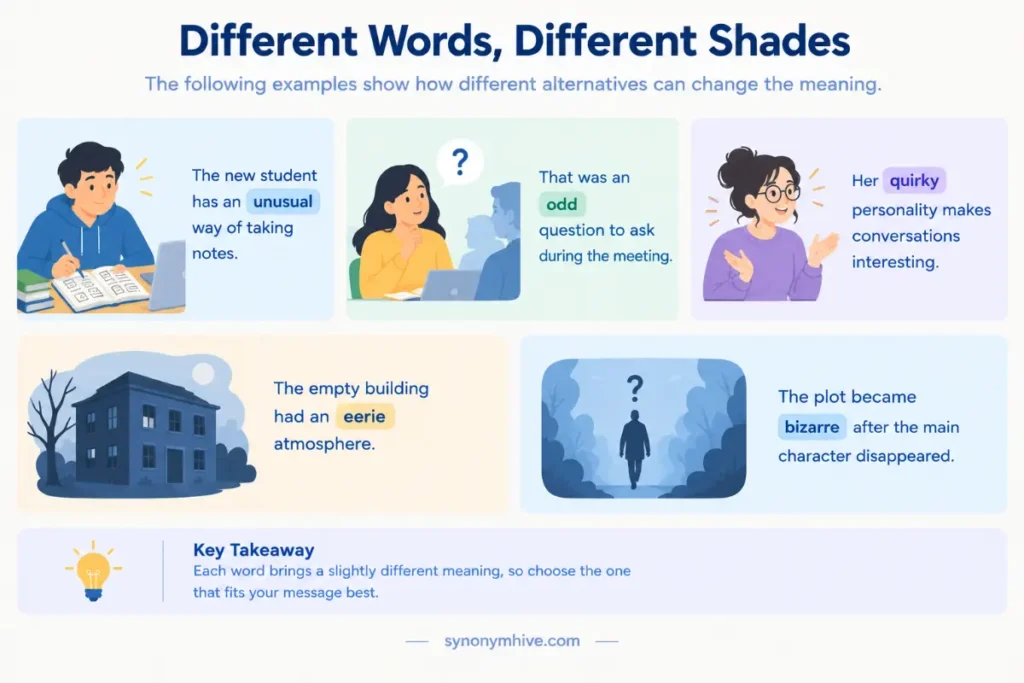
The following examples show how different alternatives can change the meaning.
The new student has an unusual way of taking notes.
That was an odd question to ask during the meeting.
Her quirky personality makes conversations interesting.
The empty building had an eerie atmosphere.
The plot became bizarre after the main character disappeared.
His unconventional teaching method helped students understand the topic.
The final scene felt surreal.
The manager gave an unexpected answer.
That comment was completely out of pocket.
The group chat became chaotic after midnight.
The artist has an eccentric style.
The situation became unsettling after the lights went out.
His response was unpredictable.
The claim sounded absurd.
The new design has a distinctive shape.
The entire experience was wild.
She has an offbeat sense of humor.
The decision was unusual but reasonable.
The character’s behavior became increasingly mysterious.
The idea seemed unconventional at first but worked well.
These examples show why replacing weird with a random synonym is not enough. You need the word that matches the specific meaning.
Is strange the same as weird
Strange and weird are close synonyms, but strange often sounds more neutral.
Weird can sound more personal or emotional. It may suggest that something makes you uncomfortable, confused, amused, or surprised.
Strange often focuses on the fact that something differs from normal expectations.
Compare the following.
That was a strange noise.
That was a weird noise.
Both sentences work. Strange sounds more neutral. Weird sounds more conversational and may show a stronger personal reaction.
Is odd the same as weird
Odd is another close synonym, but it often sounds milder.
If someone says, “That seems odd,” they may simply mean that something does not fit the situation.
“That seems weird” can sound more informal and more strongly judgmental.
Odd is useful when you want to point out something unusual without sounding too harsh.
For professional communication, odd can sometimes work better than weird because it has a slightly more neutral tone.
Is unusual the same as weird
Unusual is more neutral than weird.
Unusual simply means not common or not typical. It does not automatically suggest that something is bad, confusing, or unpleasant.
For example, “She has an unusual hobby” sounds neutral.
“She has a weird hobby” can sound judgmental.
This makes unusual a strong choice for school writing and professional communication.
Is quirky the same as weird
Quirky usually has a more positive or playful meaning.
A quirky person may have unusual habits, clothing, humor, or interests that make them memorable.
Weird can be positive in some situations, but it can also sound critical.
For example, “She has a quirky style” suggests charm or individuality.
“She has a weird style” may suggest that the speaker does not like the style.
If you want to describe difference without sounding negative, quirky is often a better choice.
Is bizarre stronger than weird
Yes, bizarre usually sounds stronger than weird.
Bizarre suggests that something is extremely unusual or difficult to explain.
For example, “The story was weird” gives a broad description.
“The story was bizarre” suggests that the story was far outside normal expectations.
Use bizarre when the unusual quality is obvious and strong.
What mistakes should you avoid
One common mistake is treating every synonym as an exact replacement. Strange, unusual, quirky, creepy, and bizarre all have different shades of meaning.
Another mistake is using a negative word when you only mean different. If an idea is simply new, unconventional may be better than bizarre.
A third mistake is using slang in formal writing. Terms such as unhinged, feral, cursed, and out of pocket belong mainly in casual settings.
A fourth mistake is describing a person with a broad label instead of explaining the behavior. Calling someone weird can sound dismissive.
A fifth mistake is confusing awkward with strange. Awkward usually involves social discomfort. Something can be strange without being socially uncomfortable.
A sixth mistake is confusing random with weird. Random usually means unexpected or unrelated. It does not always mean strange.
A seventh mistake is overusing strong words. Calling every unusual event bizarre makes the word lose its impact.
When should you not use weird
You do not have to remove weird from your vocabulary. It is a normal everyday English word.
However, replace it when the reader needs a more exact meaning.
In a resume, explain the unusual method or achievement.
In an academic essay, identify the specific quality that makes something unusual.
When discussing a person, avoid broad labels if you can describe the behavior instead.
For example, instead of saying, “His behavior was weird,” say, “His behavior was unpredictable because he changed the plan several times.”
The second sentence gives the reader evidence and avoids a vague judgment.
What are the antonyms of weird
The opposite of weird depends on the meaning.
If weird means unusual, the opposite can be normal, typical, ordinary, common, or familiar.
If weird means bizarre, the opposite can be ordinary or conventional.
There is no single antonym because weird covers several related ideas.
How can you choose the right synonym quickly
Start by asking one simple question: what exactly makes this thing weird?
If it is simply different, use unusual.
If it seems strange but not serious, use odd.
This approach makes synonym selection much easier than memorizing a list.
Quick guide for choosing the right word
| What you mean | Best choices |
|---|---|
| Simply different | Unusual, distinctive |
| Slightly strange | Odd, peculiar |
| Very strange | Bizarre, outlandish |
| Fun and unusual | Quirky, offbeat |
| Formal difference | Unconventional, atypical |
| Social discomfort | Awkward |
| Strange and scary | Creepy, eerie, unsettling |
| Dreamlike | Surreal |
| Hard to predict | Unpredictable |
| Difficult to explain | Mysterious, uncanny |
| Unreasonable | Absurd |
| Casual online slang | Unhinged, random, chaotic |
| Unexpected comment | Out of pocket |
| Wild behavior | Feral, wild |
| Neutral professional choice | Unusual, unexpected |
How can you make your writing more precise
Instead of searching for a replacement word immediately, identify the reason you used weird.
If you wrote, “The movie was weird,” ask what made it strange.
Was the story confusing?
Was the ending unexpected?
Did the movie feel like a dream?
Was the humor unusual?
Did the movie create fear?
Once you answer that question, your vocabulary becomes much more precise.
For example, “The movie was surreal” tells the reader that it had a dreamlike quality.
“The movie was unsettling” tells the reader that it created discomfort.
“The movie was unpredictable” tells the reader that the story was difficult to anticipate.
Each sentence gives a different picture.
How can you avoid repeating weird
Use specific descriptions instead of simply replacing weird with strange in every sentence.
For example, instead of saying, “The room was weird,” describe what you noticed.
“The room had no windows and was completely silent.”
Instead of saying, “His answer was weird,” explain the problem.
“His answer did not address the question.”
Specific details are often stronger than synonyms because they give readers actual information.
This is especially useful in articles, essays, reviews, resumes, and professional writing.
Why does precise vocabulary matter
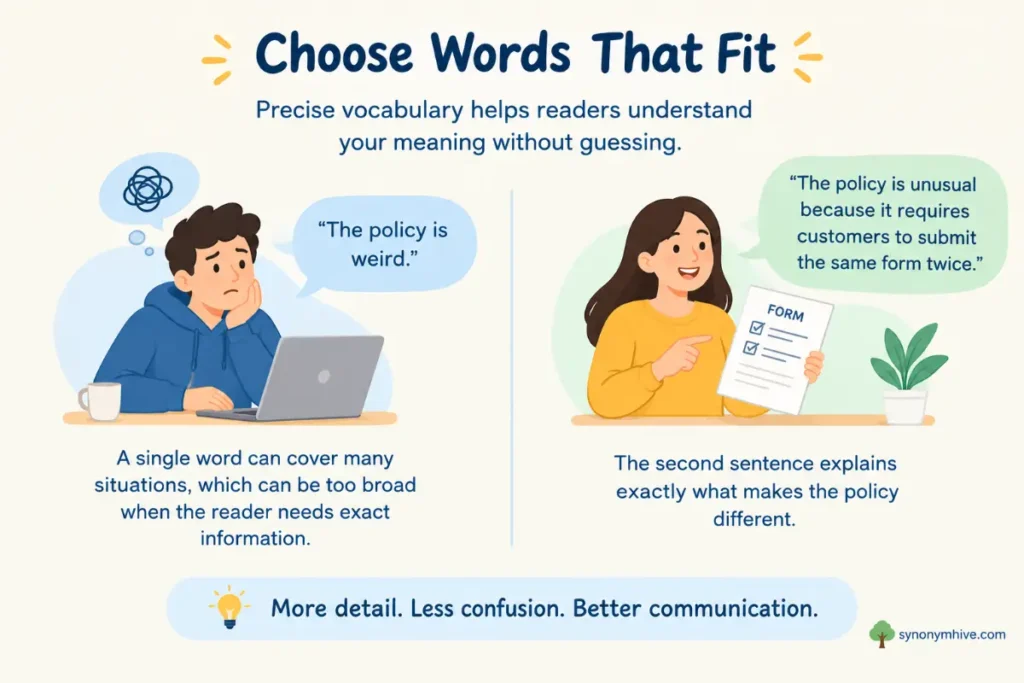
Precise vocabulary helps readers understand your meaning without guessing. A word like weird can cover many situations. That flexibility is useful in casual conversation, but it can be too broad when the reader needs exact information.
Compare “The policy is weird” with “The policy is unusual because it requires customers to submit the same form twice.” The second sentence explains the issue.
Strong writing does not depend on complicated words. It depends on choosing words that communicate the intended idea clearly.
Learn more useful word alternatives in Another Word For Lit Best Synonyms And Slang.
Final takeaway
Choosing another word for weird starts with identifying the exact type of difference you want to describe. Strange and odd work for general situations. Unusual is more neutral. Quirky can make an unusual quality sound positive. Bizarre and surreal create a stronger effect, while creepy and eerie add a sense of fear or unease.
Professional writing usually benefits from precise choices such as unconventional, atypical, unexpected, or distinctive. Casual conversations give you more room for words such as random, wild, unhinged, and out of pocket.
You don’t need the biggest synonym. You need the most accurate one. Once you know what makes something unusual, choosing the right word becomes much easier.
Frequently Asked Questions
What is another word for weird?
Another word for weird can be strange, unusual, odd, peculiar, bizarre, quirky, eccentric, unconventional, or surreal. The best choice depends on the exact meaning and tone.
What’s another way to say weird?
Another way to say weird is strange, odd, unusual, peculiar, quirky, bizarre, or unconventional. For casual Gen Z slang, words such as unhinged, random, chaotic, and out of pocket can work.
What is a good Gen Z word for weird?
Unhinged, chaotic, random, feral, cursed, and out of pocket can express different types of weirdness in Gen Z slang. The best choice depends on the situation.
What is a professional word for weird?
Unusual, unconventional, atypical, unexpected, distinctive, or peculiar can replace weird in professional writing. These words sound more precise and neutral.
Is quirky a positive word for weird?
Quirky usually has a positive or playful meaning. It can describe someone or something that is unusual in an interesting, charming, or memorable way.
What is a stronger word for weird?
Bizarre, surreal, uncanny, outlandish, eerie, and unsettling are stronger alternatives. Each adds a different meaning, so choose the one that matches the situation.
What is another word for weird in an essay?
Use unusual, unconventional, atypical, peculiar, bizarre, surreal, or unexpected depending on your meaning. Academic writing is usually stronger when you explain exactly what makes something different.