
You’re writing a resume and want to show that you work well with other people. You type teamwork into your skills section, but then you wonder if another word for teamwork could sound stronger and more specific.
Teamwork means working with other people toward a shared goal. It can involve communication, cooperation, support, shared responsibility, and trust. On a resume, though, simply saying you have teamwork skills doesn’t tell an employer much about what you actually did. Using a more specific term can help show how you worked with others and what you contributed to the team.
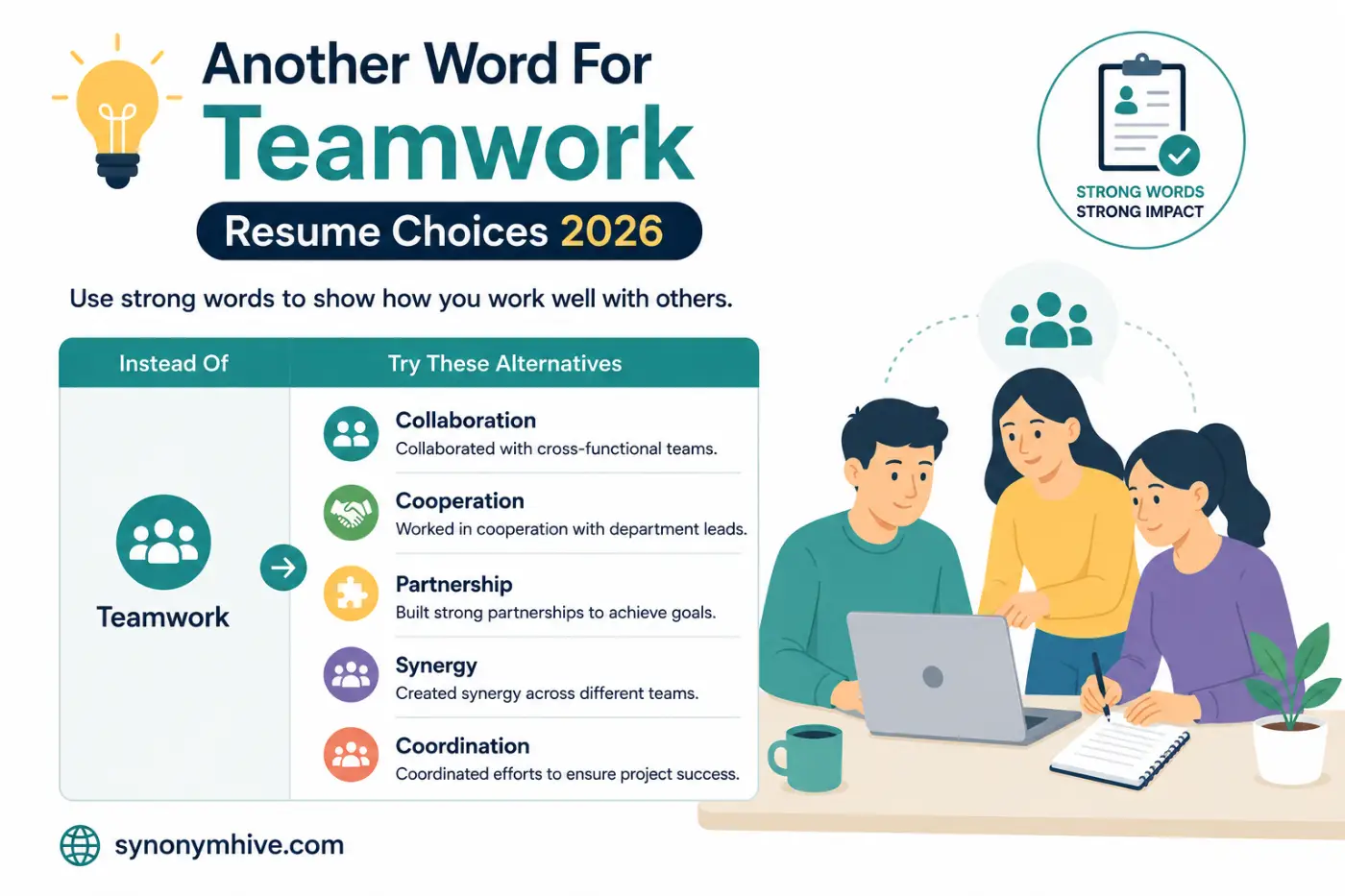
Another word for teamwork is collaboration, cooperation, partnership, coordination, or team effort.
The best choice depends on the situation. Collaboration often sounds professional and active. Cooperation highlights people working together smoothly. Partnership can show a close working relationship. Coordination fits roles where you organize people or tasks.
This guide explains the meaning and origin of teamwork, compares more than 30 useful alternatives, and shows how to use them in resumes, essays, emails, texts, and everyday speech. You’ll also see intensity levels, close synonym comparisons, examples, common mistakes, and practical tips.
Explore more word choices in Another Word For Achieved: Winning Resume Words 2026.
What Does Teamwork Mean In Plain English
Teamwork means people working together to reach the same goal.
It usually involves more than simply being around other people. Good teamwork requires people to communicate, share tasks, solve problems, support one another, and take responsibility for their part of the work.
Imagine five employees working on a product launch. One handles research. Another creates the presentation. Someone else manages the schedule. Another person works with customers. The final employee checks the results.
Each person has a different role, but everyone works toward the same outcome.
That is teamwork.
The word can describe a skill, a process, or a group effort.
For example, a resume might say:
Strong teamwork skills with experience supporting cross functional projects.
A stronger version could show the actual behavior:
Collaborated with sales and marketing teams to launch three customer campaigns.
The second sentence gives the reader something concrete. It shows who worked together and what the group achieved.
That distinction matters on a resume. Employers don’t just want to know that you can work with people. They want to see how you contribute to a group.
Where Did The Word Teamwork Come From
Teamwork combines the words team and work.
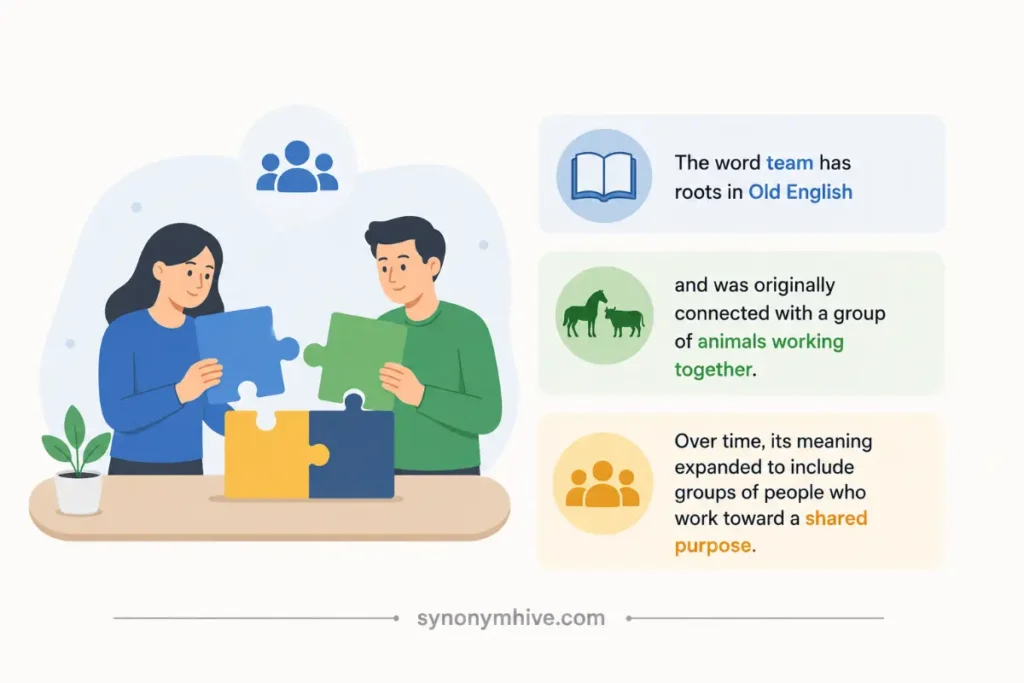
The word team has roots in Old English and was originally connected with a group of animals working together. Over time, its meaning expanded to include groups of people who work toward a shared purpose.
The word teamwork developed around the idea of people combining their efforts.
That basic meaning remains clear today.
In a workplace, teamwork can describe employees sharing knowledge and completing projects together. In sports, it describes players coordinating their actions to win.
The central idea stays the same.
People combine their skills and effort to accomplish something they may struggle to complete alone.
That also explains why some synonyms are stronger than others. Collaboration focuses on working together. Cooperation focuses on willingness to help. Coordination focuses on organizing separate efforts. Partnership can suggest a deeper or longer relationship.
Understanding those differences helps you choose a word that fits your experience instead of simply replacing one word with another.
What Are The Best Synonyms For Teamwork
There isn’t one perfect replacement for teamwork. The right word depends on the relationship, task, and result you want to describe.
| Word | Meaning | Tone | Example |
|---|---|---|---|
| Team Effort | Work completed by a group | Everyday | Delivered the project through a strong team effort. |
| Alliance | Groups joining efforts for a purpose | Formal | Built an alliance between community organizations. |
| Association | A connection between people or groups | Formal | Strengthened professional associations across the region. |
| Joint Effort | Work completed by multiple people | Everyday | Completed the project through a joint effort. |
| Group Effort | Work done by several people | Simple | Supported the group effort during the event. |
| Team Spirit | Positive energy and support within a group | Casual | Helped build strong team spirit. |
| Camaraderie | Trust and friendship among team members | Casual | Built camaraderie among new employees. |
| Fellowship | Friendly cooperation within a group | Formal | Encouraged fellowship among program participants. |
| Mutual Support | People helping one another | Professional | Created a culture of mutual support. |
| Collective Effort | Combined work from several people | Formal | Delivered the project through collective effort. |
| Support | Helping others reach a goal | Everyday | Provided support during major client projects. |
| Contribution | Work added to a shared goal | Professional | Made valuable contributions to product development. |
| Participation | Taking part in a group activity | Everyday | Increased employee participation in team projects. |
| Coalition | Groups joining for a shared purpose | Formal | Helped build a coalition of local partners. |
| Synergy | Combined effort producing a stronger result | Business | Improved synergy between creative and technical teams. |
| Camaraderie | Friendly trust within a group | Casual | Built camaraderie across remote employees. |
| Joint Contribution | Combined input from several people | Formal | Managed joint contributions from multiple departments. |
| Shared Effort | Work contributed by several people | Everyday | Completed the launch through shared effort. |
| Group Coordination | Organizing the work of a group | Professional | Improved group coordination during product testing. |
Some choices overlap, but they don’t all carry the same meaning.
Collaboration is usually one of the strongest general replacements for professional writing. Coordination is better when organizing people or tasks was a major part of your role. Partnership works well when two people, teams, or organizations built a close working relationship.
Which Teamwork Synonyms Are Mild Or Strong
Some alternatives make a simple statement. Others suggest deeper cooperation or a more important role.
Choosing the right level keeps your writing believable.
What Are Mild Alternatives To Teamwork
Mild choices include participation, support, group effort, shared effort, and team effort.
These words work when you want to show that you took part without claiming that you led the entire group.
For example:
Supported the team effort during a major customer event.
Or:
Provided support to colleagues during high volume service periods.
These statements are useful for entry level roles or positions where you contributed without managing others.
What Are Moderate Alternatives To Teamwork
Moderate choices include cooperation, collaboration, coordination, partnership, and shared responsibility.
These words show a more active role.
For example:
Collaborated with designers and developers to improve the customer portal.
This suggests that you actively worked with others.
Another example:
Coordinated with three departments to complete the annual reporting process.
This goes beyond simply participating. It shows that you helped organize the work.
What Are Strong Alternatives To Teamwork
Stronger terms include alliance, coalition, collective action, integration, and strategic partnership.
These words often fit senior roles or work involving multiple groups.
For example:
Built strategic partnerships with regional organizations to expand community programs.
That statement suggests a significant relationship and a broader responsibility.
Don’t choose a strong term just because it sounds impressive. Your experience should support the claim.
If you simply attended meetings with another department, partnership may sound too strong. If you negotiated a long term working relationship between two organizations, partnership may be exactly right.
What Part Of Speech Is Teamwork
Teamwork is a noun.
You can use it to describe the act or quality of working with others.
Teamwork helped us complete the project on time.
The role requires strong teamwork skills.
Most synonyms for teamwork are also nouns. These include collaboration, cooperation, partnership, coordination, unity, participation, and contribution.
Some related words have different grammatical roles.
Collaborate is a verb.
We collaborated with the engineering team.
Collaborative is an adjective.
She has a collaborative leadership style.
Cooperate is a verb.
The departments cooperated to solve the issue.
Cooperative is an adjective.
He has a cooperative approach to problem solving.
Coordinate is a verb.
She coordinated work between four departments.
Coordinated is an adjective or past participle.
She managed a coordinated response across several teams.
Using the right form makes your writing sound natural and professional.
What Is Another Phrase For Teamwork On A Resume
When choosing another term for teamwork on a resume, focus on what you actually did with other people.
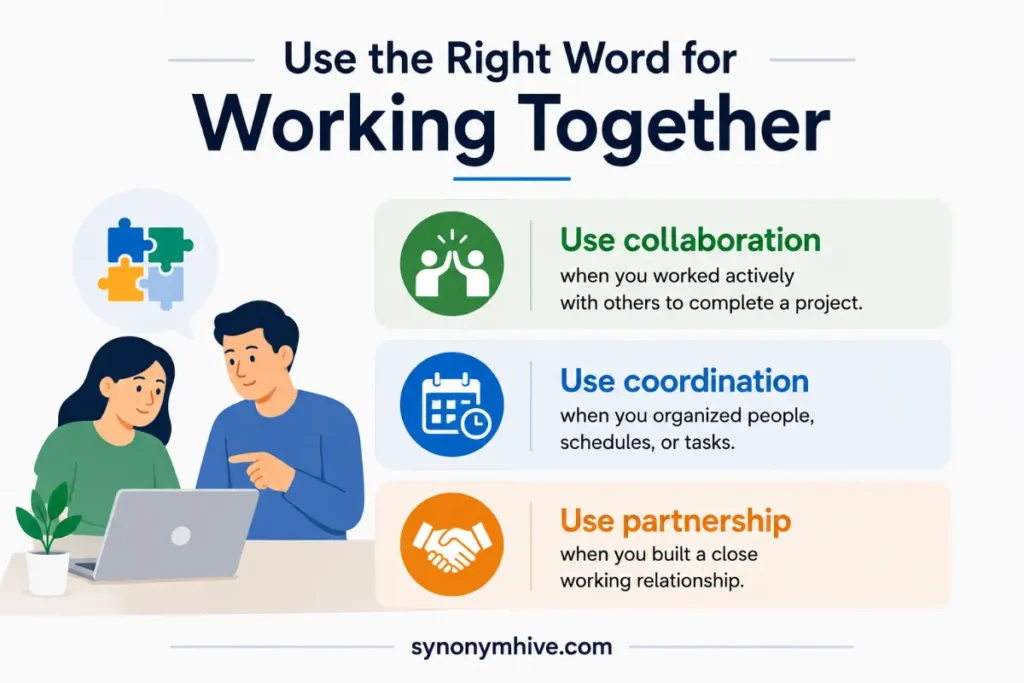
Choose collaboration when you worked actively with others to complete a project.
Pick coordination when you organized people, schedules, or tasks.
Describe it as partnership when you built a close working relationship.
Call it cooperation when people worked together willingly to solve a problem.
Highlight team effort when several people shared responsibility for a result.
Mention your contribution when you want to focus on your personal role within a larger group.
For example:
Strong teamwork skills.
This is clear but generic.
A stronger statement is:
Collaborated with five department leaders to improve customer service procedures.
The second version shows action and scope.
You can also combine a teamwork synonym with a measurable result.
Collaborated with the sales team to increase qualified leads by 18 percent.
Now the reader sees the relationship and the outcome.
What Is Another Expression For Teamwork In An Essay
In an essay, collaboration and cooperation are usually strong choices.
Collaboration works especially well when discussing schools, research, business, technology, or creative work.
For example:
Collaboration between researchers helped produce more reliable results.
Cooperation can work when the focus is on people willingly helping each other.
Cooperation between local groups helped the community recover faster.
Unity fits essays about groups sharing a common purpose.
The movement gained strength through unity among its members.
Collective effort works well in formal academic writing.
The project succeeded because of the collective effort of students and teachers.
Choose the word based on the idea you want to emphasize.
What Is Another Phrase For Teamwork In An Email
Emails usually benefit from simple and natural language.
Collaboration works well in professional emails.
For example:
I appreciate your collaboration on this project.
You could also say:
Thanks for working with me on this project.
The second option is more conversational.
For a client email you might write:
Our partnership has helped us complete the project ahead of schedule.
For a manager you could write:
Thanks for coordinating with the other teams to keep the launch on track.
Simple wording often works best in email because readers can understand it quickly.
What Is Another Term For Teamwork In A Text
Text messages usually call for casual language.
Good options include team effort, working together, cooperation, support, and team spirit.
For example:
Great team effort today.
Or:
Thanks for working together on this.
You could also say:
We couldn’t have finished it without everyone’s help.
Words such as alliance and collective action may sound too formal for an ordinary text.
The setting matters. A professional text to a manager may need more formal language than a message to a friend or coworker.
What Is Another Word For Teamwork In Speaking
Collaboration, cooperation, and working together are common choices in professional speech.
For example:
Our success came from strong collaboration across departments.
In casual conversation, you might simply say:
Everyone worked really well together.
You could also say:
It was a real team effort.
That phrase sounds natural in everyday American English.
If you’re speaking at a meeting, collaboration may sound more professional.
We need better collaboration between the product and customer service teams.
If you’re talking with friends after a game, team effort sounds more natural.
That was a great team effort.
Good spoken language should sound like something a person would actually say.
What Is The Difference Between Collaboration And Cooperation
Collaboration and cooperation are close but they emphasize different things.
| Collaboration | Cooperation |
|---|---|
| People actively work together | People willingly help each other |
| Often involves shared projects | Can happen without a shared project |
| Common in professional settings | Common in everyday and professional settings |
| Suggests active joint work | Suggests willingness and support |
Imagine two teams designing a new product together.
That is collaboration.
Now imagine one team gives another team information so they can finish their work.
That is cooperation.
The difference can be small, but it matters in precise writing.
If you actively created something with other people, collaboration is often the stronger choice.
If you mainly helped others or worked smoothly with them, cooperation may be more accurate.
How Are Teamwork And Coordination Different
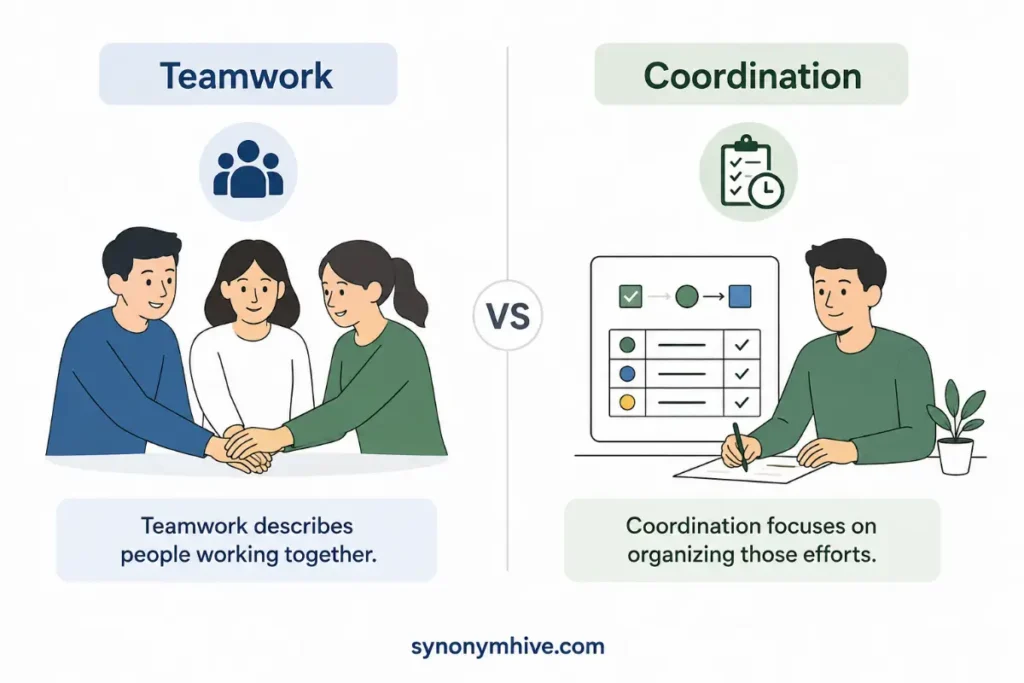
Teamwork describes people working together.
Coordination focuses on organizing those efforts.
A group can show excellent teamwork without one person coordinating everything.
For example, four designers may work together to create a campaign. That is teamwork.
A project manager who schedules meetings, assigns tasks, tracks deadlines, and connects the designers with the marketing team is coordinating the work.
On a resume, coordination can be stronger when organization was a major part of your role.
Compare these statements:
Demonstrated strong teamwork during product development.
Coordinated product development activities across design, engineering, and marketing teams.
The second statement gives more information about the person’s responsibility.
Expand your vocabulary with Another Word for Hardworking: Best Resume Choices (2026).
How Are Teamwork And Partnership Different
Teamwork usually describes people working together within a shared group or project.
Partnership often suggests a closer or longer relationship between individuals, teams, companies, or organizations.
For example:
The marketing and design teams showed strong teamwork during the campaign.
This describes a project.
Now consider:
Built a partnership with a regional marketing agency.
This suggests an ongoing professional relationship.
Partnership can also imply shared interests or shared responsibility.
Use it when the relationship itself is important.
Don’t use it simply because two people worked on the same task once.
What Are Real Examples Of Teamwork Synonyms
The strongest examples connect the word with an action and a clear outcome.
- Collaborated with five sales representatives to create a new client outreach process.
- Coordinated schedules across three departments to complete the project ahead of deadline.
- Built strong partnerships with local vendors to improve product availability.
- Worked closely with the customer service team to reduce response times by 20 percent.
- Supported a shared effort that helped the department exceed its quarterly target.
- Cooperated with warehouse staff to reduce order processing errors.
- Led collaboration between designers and developers during a major website update.
- Strengthened cooperation between regional offices through regular communication.
- Managed coordination between internal teams and external contractors.
- Contributed to a joint effort that increased customer retention.
- Promoted shared responsibility across the team to improve project ownership.
- Built camaraderie among new employees through peer training sessions.
- Encouraged team spirit during a high pressure product launch.
- Supported collective efforts to improve workplace safety procedures.
- Developed partnerships with community groups to expand program participation.
- Improved collaboration between technical and nontechnical teams.
- Coordinated a cross department response to a major customer issue.
- Contributed research and analysis to a joint product development project.
- Helped integrate newly hired employees into existing project teams.
- Used clear communication and shared responsibility to keep projects on schedule.
These examples show why specific language matters.
Instead of saying you are a team player, explain how you worked with people and what happened because of that effort.
How Can You Show Teamwork Without Using The Word
You don’t always need a direct synonym.
You can show teamwork through action verbs.
Strong verbs include collaborated, coordinated, partnered, supported, contributed, assisted, guided, communicated, facilitated, organized, mentored, and integrated.
For example:
Collaborated with engineers to test a new product feature.
Partnered with account managers to improve customer retention.
Coordinated five teams during a company wide software rollout.
Supported new employees through a structured training program.
These sentences show teamwork without simply naming it.
That approach can make a resume stronger because employers can see your behavior instead of reading a general claim.
How Can You Make Teamwork Sound Stronger On A Resume
Start with the basic statement.
Good teamwork skills.
Ask yourself what you did.
Maybe you worked with multiple departments.
Write:
Collaborated with sales and marketing teams to develop customer campaigns.
Maybe you organized people.
Write:
Coordinated work across four departments to meet a major product deadline.
Maybe you helped other employees.
Write:
Mentored new team members and helped reduce onboarding time by 15 percent.
Maybe you built outside relationships.
Write:
Partnered with community organizations to expand program participation.
The stronger sentence doesn’t depend on a fancy synonym. It gives the reader useful evidence.
That is the real goal of resume writing.
What Are Common Mistakes When Using Teamwork Synonyms
Using Team Player As A Complete Skill
Team player is common but vague.
Almost anyone can claim to be a team player.
Instead, explain how you worked with others.
Collaborated with a six person product team to launch a new service.
That gives the employer something to evaluate.
Using Collaboration When You Only Helped
Collaboration suggests active joint work.
If you only provided information once, cooperation or support may be more accurate.
Don’t exaggerate your role.
Using Partnership For A Short Task
Partnership often suggests a meaningful relationship.
If you worked with another employee for one afternoon, partnership may sound too strong.
Using Coordination When You Didn’t Organize Anything
Coordination implies some level of organization.
If you simply attended meetings, use participation or collaboration instead.
Repeating The Same Synonym
Using collaboration in every resume bullet can make the writing feel repetitive.
Vary your language based on the actual action.
Choose coordinated for organized work.
Pick partnered for close relationships.
Mention supported for helping others.
Highlight contributed for your personal input.
Listing Teamwork Without Evidence
A skills section can include teamwork, but your experience section should show it in action.
Employers learn more from accomplishments than from broad claims.
Using Overly Formal Words In Casual Writing
Words such as coalition and collective action can sound unnatural in a casual email or text.
Use language that matches your audience.
When Should You Not Use A Teamwork Synonym
Don’t replace teamwork just to make your writing sound more advanced.
Sometimes teamwork is the clearest and most natural word.
For example:
The role requires strong teamwork and communication skills.
That’s perfectly understandable.
You can also use teamwork when discussing sports, school activities, group projects, or general workplace culture.
A synonym becomes useful when you need greater precision.
If you’re describing active project work, collaboration may be clearer.
If you’re describing an ongoing business relationship, partnership may be the better choice.
Accuracy should come before variety.
What Are The Antonyms Of Teamwork
Common opposites include conflict, isolation, competition, division, disagreement, and noncooperation.
The best opposite depends on the situation.
Conflict describes serious disagreement.
Isolation describes working alone or being separated from others.
Division describes a lack of unity.
Noncooperation describes refusing to work with others.
For example:
Poor communication created division within the team.
Or:
A lack of cooperation delayed the project.
These words can help when you need to describe the problems that strong teamwork can prevent.
How Does US English Use Teamwork
Teamwork is common in American English and works naturally in professional settings.
Words such as collaboration, cooperation, partnership, coordination, and team effort are also widely used in the United States.
The meaning doesn’t change much across major English speaking regions.
Some workplace terms may vary in frequency by region or industry, but the core vocabulary remains easy to understand.
American resumes often favor direct action verbs over abstract descriptions.
For that reason, a phrase such as:
Collaborated with the product team to improve customer retention.
usually gives more value than:
Excellent teamwork skills.
The first statement shows what you did.
The second simply describes a quality.
How Can You Choose The Right Word For Teamwork
Start with the action.
Ask what actually happened.
When people created something together, choose collaboration.
For people helping each other, choose cooperation.
When you organized several groups, choose coordination.
For a long term working relationship, choose partnership.
When several people shared responsibility for a result, choose collective effort or team effort.
To highlight your personal role, choose contribution.
For people coming together around a common purpose, choose unity or alliance.
Then consider your audience.
A resume needs precise professional language.
An essay can use formal terms when they improve clarity.
An email usually needs simple direct language.
A text should sound natural and relaxed.
A spoken presentation should use words that feel comfortable when said aloud.
The best word is the one that makes your meaning obvious.
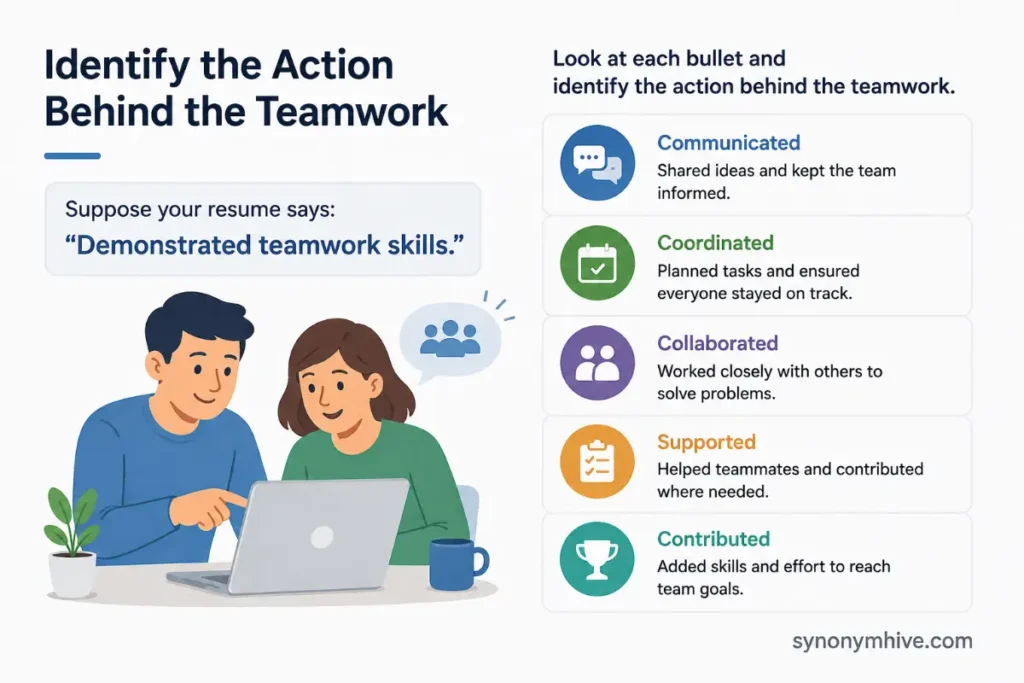
How Can You Avoid Repeating Teamwork On A Resume
Look at each bullet and identify the action behind the teamwork.
Suppose your resume says:
Demonstrated teamwork skills.
You can turn it into:
Collaborated with sales and marketing teams to improve campaign performance.
Another bullet might say:
Worked well with others.
Change it to:
Coordinated schedules across four departments to meet project deadlines.
Another might say:
Strong team player.
Change it to:
Supported new employees through peer training and mentoring.
Now each sentence shows a different form of teamwork.
This makes your resume more interesting and gives the employer a clearer picture of your abilities.
What Makes A Teamwork Claim Credible
A credible teamwork claim shows three things.
First, it shows who you worked with.
Second, it explains what you did together.
Third, it gives the result when a result is available.
For example:
Collaborated with eight customer service representatives to redesign the support process and reduce average response time by 18 percent.
The sentence has clear evidence.
You can see the group, the action, and the outcome.
You don’t need numbers in every bullet. Some teamwork achievements are difficult to measure.
You can still show scope.
Partnered with finance and operations teams to prepare the annual business plan.
Or:
Coordinated communication between remote employees and regional managers.
Specific details make general claims more believable.
What Are The Best Quick Tips For Choosing A Teamwork Word
- Use collaboration for active shared work.
- Use cooperation for willing support and joint action.
- Use coordination for organizing people or tasks.
- Use partnership for close professional relationships.
- Use contribution to highlight your personal input.
- Use team effort for simple everyday group work.
- Use collective effort for formal writing about shared work.
- Use unity when people act as one group.
- Use camaraderie when trust and friendly relationships matter.
- Use alliance when separate groups join for a common purpose.
- Use support when you helped others reach a goal.
- Use participation when you simply took part.
- Use integration when separate groups or systems were brought together.
- Use action verbs to show teamwork instead of only naming the skill.
- Add results when you can support them with real evidence.
- Match the strength of the word to your actual responsibility.
- Keep casual writing simple.
- Avoid impressive sounding words that don’t fit the situation.
- Don’t repeat one synonym throughout your resume.
- Focus on what you accomplished together rather than simply claiming that you work well with others.
Need a similar word? Read Another Word for Knowledgeable Best Resume Words 2026.
Conclusion
Choosing another word for teamwork starts with understanding the exact kind of group work you want to describe. Collaboration fits active shared projects. Cooperation focuses on people helping each other. Coordination works best when you organize tasks or groups. Partnership highlights a close professional relationship. Contribution shows what you personally added to a shared result.
If you need more options for your writing, explore our guide to another word for innovative and find the right word for different types of support.
For a resume, specific action usually beats a general skill label. Instead of simply saying you have teamwork skills, explain how you collaborated, coordinated, supported, or partnered with others. Add a result when you can. That small change can turn a vague statement into useful evidence. Pick the word that matches your real role and let your accomplishments carry the message.
Frequently Asked Questions
What is another term for teamwork?
Another term for teamwork can be collaboration, cooperation, partnership, coordination, or team effort. The best choice depends on the type of group work you want to describe.
What is another phrase for teamwork on a resume?
Another term for teamwork on a resume is often collaboration, coordination, partnership, or cooperation. Choose the word that best matches what you actually did.
What’s another way to say teamwork?
You can say collaboration, cooperation, team effort, joint effort, shared responsibility, or collective effort. Simple phrases such as working together can also sound natural.
What is a professional word for teamwork?
Collaboration is one of the strongest professional alternatives to teamwork. Coordination and partnership can also work when they accurately describe your role.
Is collaboration the same as teamwork?
Collaboration is a form of teamwork that focuses on people actively working together. Teamwork is broader and can include support, cooperation, coordination, and shared responsibility.
What is a stronger word for teamwork?
Collaboration, partnership, coordination, and collective effort can sound stronger when they describe a specific type of group work. The strongest choice depends on your responsibility and results.
What is the opposite of teamwork?
Common opposites include conflict, division, isolation, disagreement, and noncooperation. The right word depends on the problem you want to describe.