
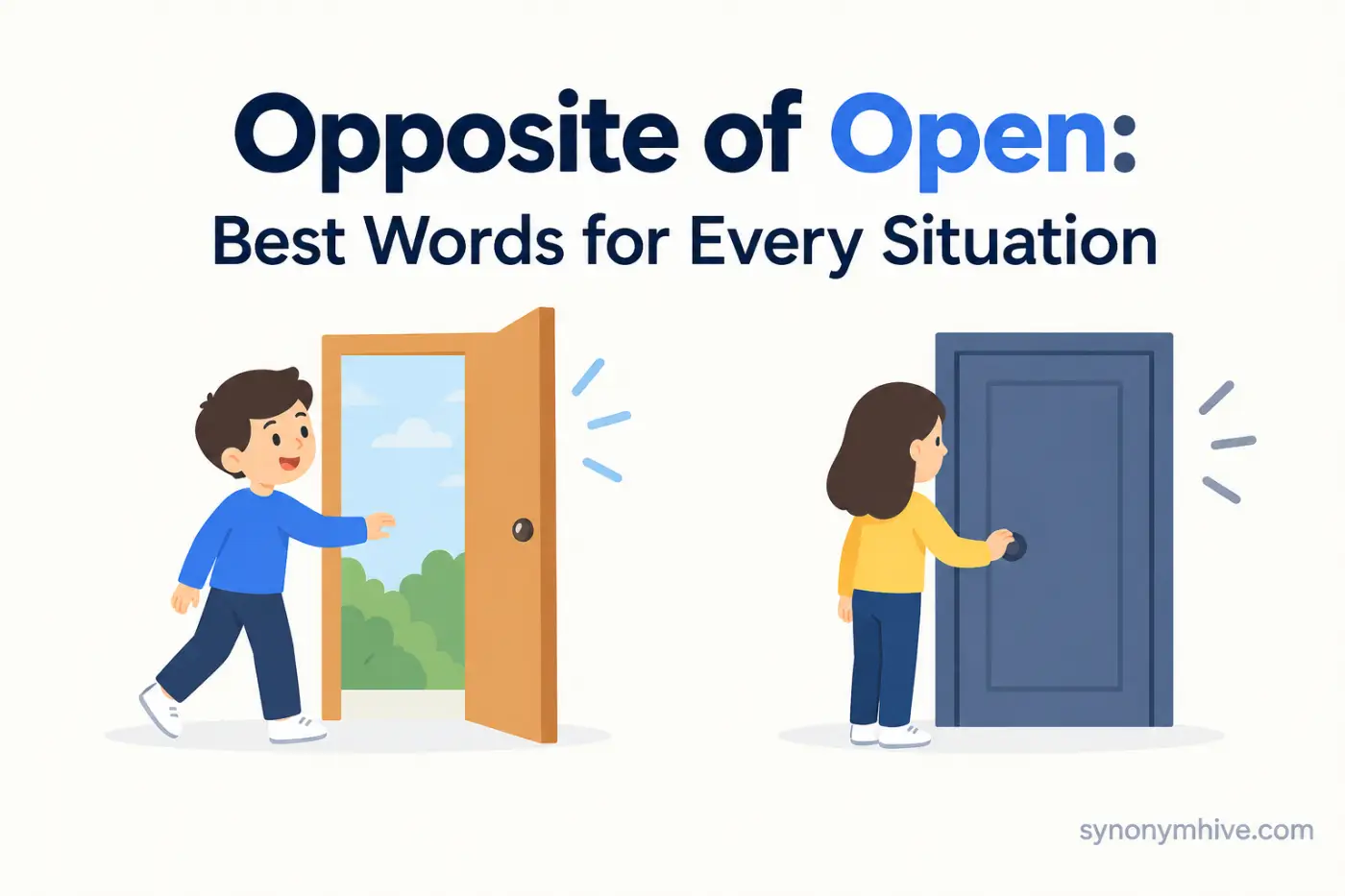
You are writing an email, polishing an essay, or updating your resume when you need a word that means the opposite of open. The right choice depends on what you mean. You can close a door, shut a store, keep your life private, or restrict a discussion. These words are related, but they do not always fit the same sentence.
The best opposite of open is usually closed. However, other words can be more accurate when you describe access, personality, business hours, communication, or rules.
In simple terms, the opposite of open is a word that describes something closed, unavailable, blocked, private, or unwilling to accept new ideas. The best choice depends on the situation.
This guide explains the word’s meaning and origin, compares more than 30 alternatives, and shows how to use each one naturally. You will also find examples for school, work, everyday conversations, and formal writing, along with common mistakes and answers to frequently asked questions.
You may also like Opposite of Full Best Words and Examples.
What Is the Opposite of Open?
The most common opposite of open is closed. Use it when a door, window, container, or other physical object is no longer open. For other meanings, words such as shut, sealed, private, restricted, unavailable, and secret may be more precise.
Consider these examples.
- The window is open. The window is closed.
- The shop is open. The shop is closed.
- The meeting is open to everyone. Only invited guests can attend the meeting.
- She is open about her feelings. She is private about her feelings.
- He is open to new ideas. He is resistant to new ideas.
Each pair expresses a different kind of contrast. That is why a single replacement does not work in every sentence.
What Does Open Mean in Plain English?
The word open has several common meanings. It can describe a physical position, access to a place or activity, a person’s attitude, the availability of a service, or an honest style of communication.
- Physical position. An open door has space for someone to pass through. A closed door blocks that passage.
- Access. An open event welcomes people who meet its entry conditions. A private or restricted event limits attendance.
- Availability. An open position is available for someone to fill. A filled position is no longer available.
- Attitude. An open-minded person considers new ideas. A narrow-minded person may reject them without fair consideration.
- Communication. An open person may speak honestly about thoughts or feelings. A guarded person shares less.
- Business status. An open business is operating and accepting customers. A closed business is not serving customers at that time.
The intended meaning matters more than finding a word that looks like a direct opposite in a dictionary.
Where Did the Word Open Come From?
The English word open has roots in Old English, where open described something not closed or not shut. It belongs to a long family of Germanic words with similar meanings. Over time, English speakers extended the word beyond physical objects.
For example, people began using open to describe opportunities, conversations, attitudes, and access. An open door could be a literal entrance, while an open opportunity could mean a chance that someone can take. An open conversation could mean a discussion in which people speak freely.
This growth in meaning explains why the opposite changes with context. Closed works well for a door because both words describe physical position. Restricted works better for access because it describes limits. Guarded fits a person who does not share much. Resistant describes someone who pushes back against a proposal.
How Did Open Develop So Many Meanings?
Many everyday English words gain broader meanings through common use. Open is a clear example.
A door that opens allows movement through a space. From there, the idea of allowing movement or access can apply to a website, a public meeting, a job opportunity, or a discussion. The same word can also describe a person who welcomes different viewpoints or communicates honestly.
These meanings relate to one another, but they are not identical. When you choose an antonym, identify the quality that open describes in your sentence. Is it physical position, access, availability, honesty, or willingness?
That simple check will help you choose a word that communicates the exact idea instead of a rough substitute.
What Are the Best Synonyms for the Opposite of Open?
The best word depends on the meaning you want to express. The table below groups common choices by style and shows how each word works in a sentence.
| Word | Meaning | Tone | Example |
|---|---|---|---|
| Closed | Not open or not operating | Simple | The office is closed today. |
| Shut | Closed firmly or completely | Everyday | Please keep the gate shut. |
| Locked | Secured with a lock | Everyday | The front door is locked. |
| Sealed | Closed tightly to prevent entry or escape | Neutral | Someone sealed the envelope. |
| Covered | Hidden by something | Simple | A cover hides the bowl. |
| Blocked | Prevented from passing through | Everyday | The entrance was blocked by boxes. |
| Barred | Not allowed to enter or take part | Formal | The site bars unauthorized visitors. |
| Restricted | Limited to certain people or uses | Formal | Access is restricted to staff. |
| Confidential | Meant to be kept secret | Formal | The report contains confidential information. |
| Resistant | Opposed to a change or suggestion | Neutral | The team resisted the new process. |
| Unreceptive | Unwilling to accept ideas or suggestions | Formal | The manager was unreceptive to feedback. |
| Secretive | Likely to hide information | Neutral, often negative | The company was secretive about its plans. |
| Tight-lipped | Unwilling to reveal information | Informal | The spokesperson stayed tight-lipped. |
| Mum | Silent or unwilling to speak | Informal, common in British English | She kept mum about the surprise. |
| Clammed up | Suddenly stopped talking | Slang or informal | He clammed up when asked about the mistake. |
| Off-limits | Not allowed to be entered or discussed | Informal | That topic is off-limits at work. |
| Out of service | Not currently working or available | Everyday | The elevator is out of service. |
Some entries describe a direct opposite, while others describe a related condition. For example, locked is not the opposite of every meaning of open. It describes a door or container that someone has secured. A door can be closed without being locked.
Likewise, private and confidential both limit access, but confidential often suggests a duty to protect information. Secret usually suggests that someone wants information to remain unknown.
Which Opposite of Open Should You Use by Situation?
Choosing a word becomes easier when you connect it to the meaning of the sentence. Use the following guide to avoid awkward or misleading substitutions.
For a Door or Window
Use closed for the most general meaning and shut for a common everyday alternative. Use locked when a lock prevents entry, and sealed when someone closes something tightly.
Examples.
- Please close the window before you leave.
- Someone had shut the back door when we arrived.
- Someone locked the gate after dark.
- The sender sealed the package before shipping it, and it arrived undamaged.
Do not use locked simply because a door is closed. A closed door may open easily when someone turns the handle.
For a Business or Public Place
Use closed when a business is not operating. Use shut down when an operation has stopped, especially for a longer period or because of a problem.
Examples.
- The pharmacy is closed on Sundays.
- The restaurant shut down for renovations.
- The public elevator is out of service.
- The visitor center is temporarily unavailable.
A business can be closed for the evening and still be operating as a company. Shut down can suggest a larger or more lasting interruption, so choose it carefully.
For Access or Permission
Use restricted, private, barred, or off-limits when people cannot freely enter, join, or use something.
Examples.
- The archive is restricted to approved researchers.
- The event is private and requires an invitation.
- The site bars unauthorized visitors.
- The storage room is off-limits to customers.
The difference is practical. Restricted means limits apply. Private means access is intended for a limited group. Barred emphasizes that rules prohibit entry or participation. Off-limits is a common informal way to say that something is not allowed.
For a Person’s Personality
Use reserved, guarded, or withdrawn when describing someone who shares little about personal thoughts or feelings. Use closed-minded when the person refuses to consider different viewpoints.
Examples.
- Maya is reserved when she meets new people.
- The candidate was guarded when discussing past conflicts.
- He became withdrawn after moving to a new city.
- The committee seemed closed-minded about alternative plans.
These words are not interchangeable. Reserved can describe a calm personality without suggesting a problem. Guarded often means a person is cautious about revealing information. Withdrawn suggests reduced social contact. Closed-minded criticizes someone’s unwillingness to consider ideas.
For Ideas and Opinions
Use resistant, unreceptive, or closed-minded when someone does not welcome a suggestion. Choose the word based on the strength and reason for the response.
Examples.
- The team resisted changing its schedule.
- The editor was unreceptive to the proposed ending.
- A closed-minded debate leaves little room for learning.
- She remained skeptical until the evidence became clear.
Skeptical does not always mean closed-minded. A skeptical person may ask for proof before accepting a claim. That can be reasonable and thoughtful, not stubborn.
For Information and Communication
Use confidential, secret, concealed, or tight-lipped when people do not share information. The right word depends on if people must protect the information, someone deliberately hides it, or people simply do not discuss it.
Examples.
- The employee records are confidential.
- The team kept the launch date secret.
- Someone concealed the wire behind the wall.
- The spokesperson stayed tight-lipped about the investigation.
Confidential often carries a professional or legal meaning. Secret is broader and works in everyday situations. Concealed describes something deliberately kept out of sight. Tight-lipped describes a person who refuses to give details.
For Job Openings and Opportunities
Use filled, unavailable, or closed when a position or opportunity can no longer be pursued.
Examples.
- The employer has filled the position.
- The employer has stopped accepting applications.
- The scholarship is unavailable for the next term.
- Registration closed after the deadline.
An open job means an employer is accepting candidates or still has a vacancy. A closed job posting may mean the employer stopped accepting applications. A filled position means an employer has hired someone. Those meanings are close, but not exactly the same.
How Do Opposite Words Change From Mild to Strong?
Some words express a small difference, while others suggest a complete barrier or a strong refusal. Matching the strength of the word to the situation helps your writing sound fair and accurate.
Which Words Express a Mild Difference?
Words such as reserved, private, and unavailable describe limits without always suggesting conflict or a permanent problem.
- Reserved. A reserved person may take time to speak freely with new people.
- Private. People intend a private conversation for a limited audience.
- Unavailable. You cannot use an unavailable service or reach an unavailable person at that moment.
- Covered. A cover hides an object from view, but you may still uncover it easily.
- Skeptical. A skeptical person wants evidence before accepting a claim.
These terms work well when you want a neutral description. Calling someone reserved, for example, sounds less critical than calling that person secretive. The first word describes a social style. The second can suggest deliberate concealment.
Which Words Express a Stronger Limit?
Words such as restricted, blocked, barred, and sealed suggest that access or movement is limited more firmly.
- Restricted. Only approved people may enter or take part.
- Blocked. Something prevents movement, access, or progress.
- Barred. A rule or decision prevents entry or participation.
- Sealed. Someone has closed a container or opening tightly.
- Inaccessible. People cannot reach or use a place, service, or resource easily.
These words are useful in instructions, workplace policies, safety notices, and technical writing. Use the one that explains the actual barrier. Fallen trees may block a road, while an official rule may restrict it.
Which Words Show Strong Opposition?
Words such as closed-minded, unreceptive, and resistant describe a stronger lack of willingness. Their meanings differ, so do not treat them as exact substitutes.
- Resistant. Someone pushes back against a proposal or change.
- Unreceptive. Someone does not respond positively to an idea or offer.
- Closed-minded. Someone refuses to give different viewpoints fair consideration.
- Secretive. Someone tends to hide information from others.
- Tight-lipped. Someone deliberately avoids sharing details.
A person who questions a new plan is not automatically closed-minded. They may have good reasons for asking questions. Use stronger language only when the evidence supports it.
What Is the Opposite of Open by Part of Speech?
The word open can work as an adjective, verb, or noun in different sentence structures. Its opposite changes along with its grammatical role.
What Is the Opposite of Open as an Adjective?
As an adjective, open can describe a physical position, access, availability, or attitude. The correct antonym depends on the noun it describes.
| Use of open | Suitable opposite | Example |
|---|---|---|
| An open door | Closed or shut | The door is closed. |
| An open shop | Closed | The shop is closed today. |
| An open event | Private or restricted | Only members can attend the event. |
| An open job | Filled or unavailable | The employer has filled the position. |
| An open person | Reserved or guarded | He is guarded with strangers. |
| An open mind | Closed-minded | She refused to consider other views. |
| An open secret | Not a secret or widely known | Everyone already knows the plan. |
| An open wound | Closed or healed, depending on the stage | The wound has healed. |
Notice that not every opposite is a single word with the same grammatical form. You can describe a wound as closed, but healed gives a clearer picture of recovery. An application system may label a job closed, but filled tells readers that an employer has hired someone for the position.
What Is the Opposite of Open as a Verb?
As a verb, open means to move something so it is no longer closed, begin an activity, or make something available. Common opposites include close, shut, seal, and block, depending on the action.
Examples.
- Please close the door behind you.
- Shut the lid before shaking the container.
- Seal the envelope before mailing it.
- The company closed applications at midnight.
- The barrier blocked the entrance.
The verb close can describe both a physical action and the ending of an activity. Shut often sounds more direct in everyday speech. Seal suggests a tight closure. Block means to prevent passage, which is not always the same as closing.
What Is the Opposite of Open as a Noun?
English speakers use open less often as a noun in everyday English, but the word appears in sports, competitions, and other named events. The opposite depends on the expression.
For example, an open tournament may allow a broad group of competitors to enter, while an invitational event admits people who receive invitations. In business and administration, the phrase open position is common, but position is the noun and open is the adjective.
When you need a noun to describe the opposite state, use a natural phrase rather than forcing a single word. A closed state, a restriction, a closure, or a lack of access may communicate the meaning more clearly.
Is the Opposite of Open Different in American and British English?
The main antonyms are similar in American and British English. Both varieties use closed, shut, locked, private, and restricted. The differences are more noticeable in everyday phrases, spelling conventions, and the situations in which people prefer certain words.
Which Words Sound Natural in American English?
American speakers commonly say that a store is closed, a door is shut, a person is reserved, or a service is unavailable. People commonly use out of service for equipment that does not work.
Examples.
- The grocery store is closed for the holiday.
- The elevator is out of service.
- The manager was guarded during the meeting.
- The employer has stopped accepting applications for this position.
These phrases are clear in conversation and professional writing. In a formal notice, restricted access or entry prohibited may be more useful than an informal phrase such as off-limits.
Which Words Sound Natural in British English?
British speakers also use closed and shut. The word shop is more common than store in many everyday contexts, and people commonly say out of order when equipment does not work. The informal word mum can mean staying silent or refusing to share information, as in keeping mum about a surprise.
Examples.
- The shop is shut for the bank holiday.
- The lift is out of order.
- She kept mum about the party.
- The public cannot enter the room.
These are tendencies, not strict rules. American speakers also use out of order, and British speakers also use closed and store. Choose the phrase that suits your audience and the object or situation you are describing.
Are There Regional Differences in Informal Speech?
Yes. Informal expressions vary by region, age group, and social setting. American English speakers use clammed up to describe someone who suddenly stops talking, while British English speakers often use keeping mum, which people elsewhere also understand. Speakers in both varieties widely understand tight-lipped.
For international readers, simple words usually work best. People widely understand closed, private, restricted, and unavailable. Slang can add personality, but it may confuse readers who do not know the expression.
Explore another synonym guide: Opposite of Easy Best Words and Examples 2026.
What Is the Best Opposite of Open for Different Types of Writing?
The best choice depends on the reader and the purpose of your message. A resume needs precise professional wording. An essay benefits from clear distinctions. A text message may sound more natural with everyday language.
What Word Should You Use on a Resume?
On a resume, describe the actual condition instead of using a vague opposite. If an employer no longer accepts applications for a role, say that the employer has closed applications. If an employer has hired someone for the position, say that the employer has filled it.
Examples.
- The employer has filled the position and no longer accepts applications.
- I maintain confidential records and share them only with authorized staff.
- I communicate clearly while respecting private information.
- I respond professionally to feedback instead of resisting new ideas.
Avoid calling yourself closed or guarded unless you are describing a relevant quality with care. Employers generally want to understand how you communicate, protect information, and work with others.
What Word Should You Use in an Essay?
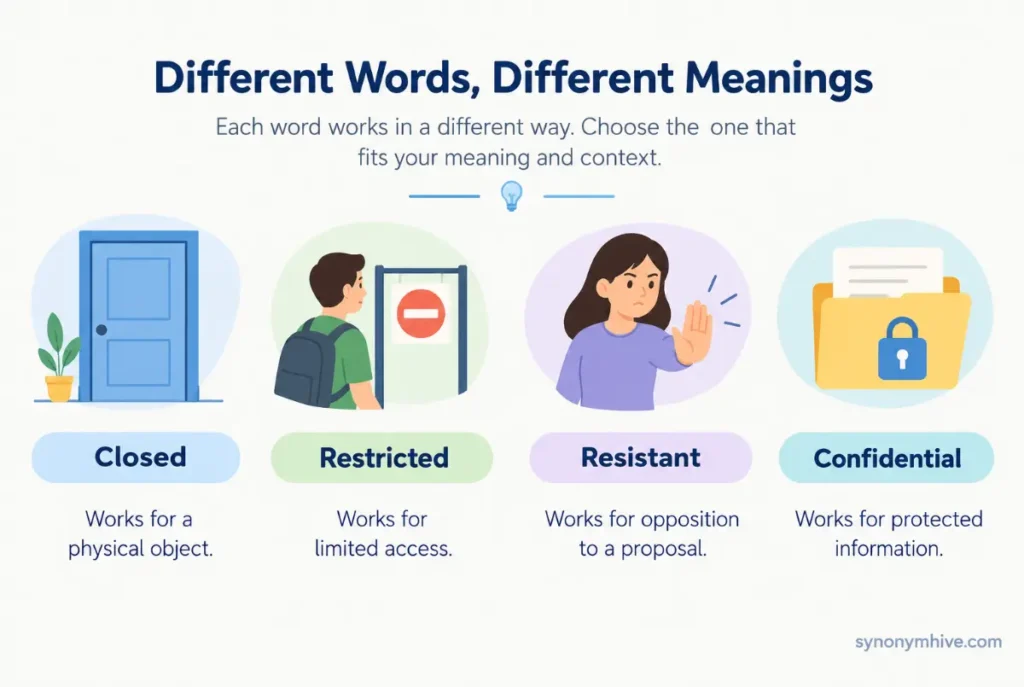
In an essay, choose words that explain the relationship between ideas. Closed works for a physical object. Restricted works for limited access. Resistant works for opposition to a proposal. Confidential works for protected information.
Examples.
- The museum remained closed during the repairs.
- The policy restricted access to sensitive records.
- Several departments resisted the proposed changes.
- The study team used confidential information about participants.
Formal writing benefits from precise language. If you mean that no one has shared a claim publicly, secret may be appropriate. If you mean that evidence is not available to the public, restricted or confidential may be more accurate.
What Word Should You Use in a Text Message?
Text messages usually sound better with short, familiar words. Use shut for a door, closed for a shop, private for a conversation, and off-limits for a topic or place that people should avoid.
Examples.
- The cafe is closed, so let’s try the place across the street.
- Keep the back gate shut, please.
- People cannot discuss that topic for now.
- My account is private, so only approved followers can see my posts.
Use slang when the person reading your message will understand it. A phrase such as clammed up works in a casual story, but closed or stopped talking is clearer when you write for a broad audience.
What Word Should You Use in an Email?
Work emails should make limits clear without sounding rude. Restricted, confidential, unavailable, and closed are useful when you need to explain access, privacy, or operating hours.
Examples.
- The training room is unavailable until the maintenance work is complete.
- Only the project team can access the shared folder.
- The attached file contains confidential information.
- The employer has stopped accepting applications and is reviewing the submissions.
When possible, explain what the reader can do next. Instead of writing that a service is simply unavailable, provide the expected return date or an alternative contact. Clear information helps readers act without guessing.
What Word Should You Use When Speaking?
In conversation, simple language usually sounds the most natural. Closed, shut, private, and unavailable work in many situations. Choose a stronger term only when it adds useful meaning.
Examples.
- The library is closed today.
- Please shut the window before you leave.
- I’d rather keep that conversation private.
- The manager was guarded when we asked about the change.
Tone also matters. Saying that someone is closed-minded can sound insulting. If you want to keep a conversation respectful, describe the action instead. For example, you could say that the person did not consider the other options.
What Are Some Examples of the Opposite of Open in Real Life?
Seeing the words in complete sentences makes their differences easier to remember. These examples cover home life, work, school, technology, public spaces, and personal relationships.
- At home. The kitchen window was shut because the wind was getting stronger.
- At a store. The bakery is closed today, but it will reopen tomorrow morning.
- At work. Only authorized employees can access the payroll folder.
- At school. The teacher kept the answer key confidential until everyone finished the test.
- In a friendship. Jordan is usually reserved around new people but speaks freely with close friends.
- During a meeting. The director was unreceptive to the proposal and asked the team to try another approach.
- On a website. The registration page is unavailable while technicians update the system.
- At a public event. The hosts limited the private reception to invited guests.
- On a road trip. Heavy rain caused a landslide that blocked the mountain road.
- In a family conversation. My brother stayed tight-lipped about the gift he had bought.
Notice how the choice changes from one example to the next. Closed is useful for a store, but restricted is more informative for a folder that only certain employees can access. The strongest choice is the one that tells readers exactly what has changed or what limit applies.
What Is the Difference Between Close Synonyms?
Several words may seem interchangeable at first. A closer look shows that each one carries a slightly different meaning.
Closed vs Shut. What Is the Difference?
Closed is a general term for something that is not open. Shut often sounds more direct and conversational, especially when someone closes a door, window, lid, or gate.
| Closed | Shut |
|---|---|
| The office is closed for the holiday. | Shut the door before you leave. |
| The shop was closed when we arrived. | The window was shut against the cold. |
| Works well for business hours and official status. | Works well for everyday physical actions. |
Both words can describe a door or a business. However, closed is common in signs and formal notices, such as Closed for Maintenance. Shut often appears in direct instructions, such as Shut the gate.
Private vs Confidential. What Is the Difference?
Private means people intend something for a limited group or personal use. Confidential means people must protect information from unauthorized sharing.
| Private | Confidential |
|---|---|
| We had a private conversation. | The report contains confidential information. |
| The club held a private event. | The employee records are confidential. |
| Often describes people, places, accounts, or events. | Often describes sensitive records, information, and discussions. |
A private event may not be open to the public, but it does not automatically involve sensitive information. Confidential information requires greater care because sharing it may break a rule, agreement, or duty.
Reserved vs Guarded. What Is the Difference?
Reserved often describes a person who speaks little or takes time to become comfortable. Guarded suggests that someone is careful about what they reveal.
| Reserved | Guarded |
|---|---|
| Lena is reserved when meeting new people. | Lena was guarded when asked about the dispute. |
| Can describe a normal personality trait. | Often suggests caution or a wish to protect information. |
| Does not automatically imply distrust. | May suggest concern, uncertainty, or a lack of trust. |
A reserved person may simply enjoy listening more than talking. A guarded person may be friendly but avoid discussing a sensitive subject.
Resistant vs Closed Minded. What Is the Difference?
Resistant means pushing back against a change, request, or proposal. Closed-minded means refusing to consider other viewpoints fairly.
| Resistant | Closed-minded |
|---|---|
| The staff resisted the new schedule. | The manager rejected every alternative without considering it fairly. |
| May result from practical concerns or uncertainty. | Suggests unwillingness to consider different ideas. |
| Can change after discussion or evidence. | Often criticizes a person’s approach to thinking. |
Resistance is not always unreasonable. Employees may oppose a plan because it costs too much or creates safety problems. Closed-mindedness is a stronger criticism because it suggests that the person will not give alternatives a fair hearing.
What Common Mistakes Should You Avoid?
The opposite of open is not always closed. A sentence can be grammatically correct and still communicate the wrong idea if the chosen word does not match the situation.
Mistake One. Using Closed for Every Meaning
Closed works for doors, shops, meetings, and some opportunities. It is not the best choice for every kind of limit.
Incorrect or unclear. The document is closed.
Clearer. The document is confidential if readers must protect its contents. Use inaccessible if readers cannot reach the file, or unavailable if they cannot use it at the moment.
The word closed may work in a specific technical system, but general readers need a more precise description.
Mistake Two. Confusing Closed With Locked
A door can be closed without being locked. A lock secures a door so people cannot open it normally without the right key, code, or access method.
Use closed to describe the position of the door. Use locked to describe its security state.
For example, the fact that someone closed the office door does not prove that the room was secure. The sentence The office door was locked gives readers more information.
Mistake Three. Calling Every Quiet Person Secretive
A person who speaks little may be reserved, shy, tired, or simply focused on listening. Secretive suggests a tendency to hide information, often on purpose.
If you do not know why someone is quiet, choose a neutral description. Reserved is often fairer than secretive because it describes behavior without assuming a motive.
Mistake Four. Treating Skepticism as Closed Mindedness
Skepticism means asking for evidence before accepting a claim. Closed-mindedness means refusing to consider other views fairly.
A careful researcher may question a result and still remain open to evidence. Calling that researcher closed-minded would misrepresent the situation.
Mistake Five. Using Slang in Formal Writing
Phrases such as clammed up, kept mum, and tight-lipped can work in casual conversation or a personal story. In a business report or academic essay, use clearer wording such as refused to comment, did not share the information, or remained silent.
The purpose of formal writing is to communicate clearly. Slang can distract readers when the setting calls for direct and neutral language.
Mistake Six. Ignoring the Difference Between Temporary and Permanent
Unavailable may mean something cannot be used right now. Closed may describe a temporary break or a business that no longer operates. Shut down can suggest a more substantial interruption.
For example, The website is temporarily unavailable suggests that access may return soon. The phrase The company shut down its website may suggest that the company discontinued the service.
Add a time reference when it helps readers understand the situation.
What Are the Antonyms of Closed?
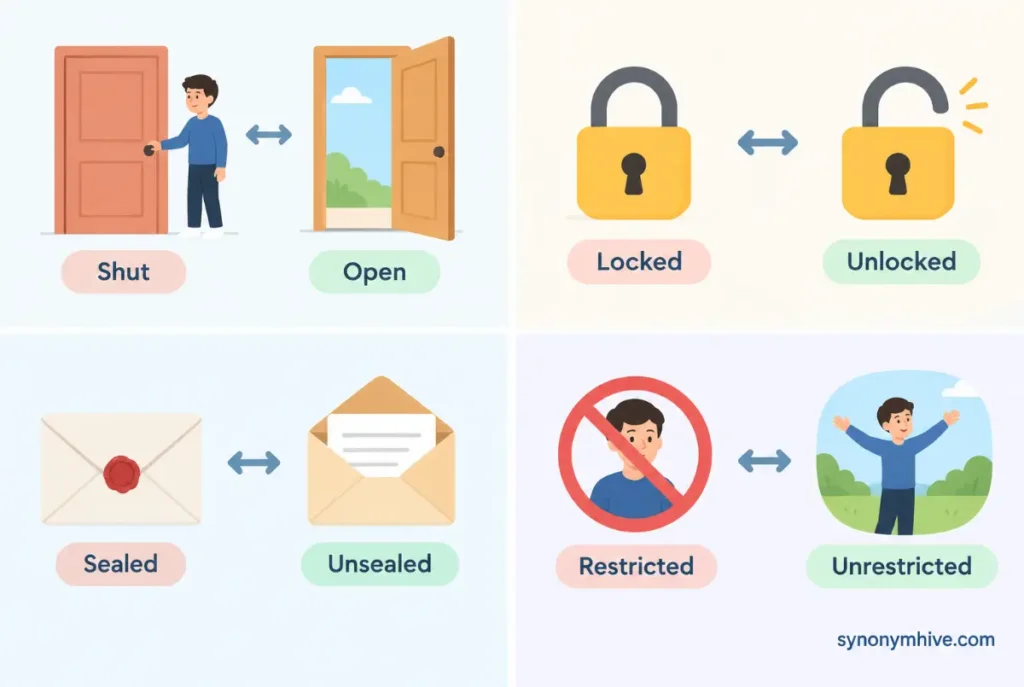
The main antonym of closed is open. The pair works well for physical objects, business hours, and many forms of access.
Other useful contrasts depend on the meaning.
| Word | Antonym |
|---|---|
| Shut | Open |
| Locked | Unlocked |
| Sealed | Unsealed |
| Restricted | Unrestricted |
| Private | Public |
| Confidential | Public or nonconfidential |
| Hidden | Visible |
| Blocked | Clear |
| Unavailable | Available |
| Guarded | Open or forthcoming |
| Reserved | Outgoing or expressive |
| Closed-minded | Open-minded |
| Resistant | Receptive or willing |
| Secretive | Open or forthcoming |
Some pairs are not exact opposites in every situation. Unlocked means a lock is not engaged, but the door may still be closed. Public contrasts with private in terms of access, while nonconfidential means information does not carry a confidentiality restriction. Choose the pair that matches the specific meaning you want to express.
How Can You Choose the Right Word Quickly?
Use these simple checks before replacing open with another word.
- Identify the subject. Is the sentence about a door, a shop, a person, an idea, a document, or an opportunity?
- Identify the meaning. Decide if open refers to position, access, availability, honesty, or willingness.
- Choose a precise word. Use closed for a physical position, restricted for limited access, confidential for protected information, and resistant for opposition to change.
- Check the tone. Reserved is often neutral, while closed-minded usually sounds critical.
- Check the time frame. Unavailable may describe a temporary situation, while filled describes a position that an employer has given to someone.
- Read the sentence aloud. A word may be technically correct but sound unnatural in everyday speech.
- Consider your audience. Use familiar words for casual messages and more precise terms for reports, essays, and workplace communication.
If two words seem equally suitable, choose the one that gives readers more useful information. A clear sentence is more valuable than a rare or complicated synonym.
Explore more word choices in Opposite of Beautiful Best Words and Examples 2026.
Conclusion
The best word for the opposite of open depends on the idea you want to express. Closed is the most common choice for a door, window, shop, or other physical space. Shut sounds natural in everyday instructions, while locked describes security. For access and information, private, restricted, and confidential communicate different kinds of limits. When describing a person’s attitude, reserved, guarded, resistant, and closed-minded each carry a distinct meaning.
Before choosing a synonym, look at the subject and the purpose of the sentence. Think about access, availability, personality, or communication, then select the word that fits. You do not need the most complicated option. A simple and accurate word will usually make your writing clearer. With practice, you can choose the right expression for emails, essays, resumes, and everyday conversations without relying on the same word every time.
Frequently Asked Questions
What is the most common opposite of open?
The most common opposite of open is closed. It works for doors, windows, shops, and many other things that are no longer open. Other words may be more precise when you mean limited access, protected information, or an unwilling attitude.
What is another way to say open?
You can use accessible, available, welcoming, receptive, or transparent when they match the intended meaning. For a physical object, open may describe a position. For a person, it can describe a willingness to communicate or consider new ideas.
What is the opposite of open in a relationship?
The answer depends on the behavior you mean. Guarded or reserved can describe someone who shares few personal details, while secretive suggests that the person deliberately hides information. These terms describe different behaviors and should not serve as proof of someone’s motives.
What is the opposite of open for a business?
Closed is the usual opposite when a business is not operating or accepting customers. If the business has permanently stopped operating, shut down may be more accurate. If an employer has hired someone for a job, say the employer has filled the position.
Is closed the opposite of open-minded?
No. The usual opposite of open-minded is closed-minded. Closed describes something that is not open, while closed-minded describes someone who is unwilling to consider different viewpoints fairly.
What is the opposite of open in formal writing?
Restricted, confidential, unavailable, and inaccessible are useful formal choices when they fit the meaning. Use restricted for limited access, confidential for information that people must protect, unavailable for something people cannot use, and inaccessible for something people cannot reach or access.
What is the opposite of open for a door?
Closed and shut are the most common choices for a door. Use locked if someone has secured the door against entry, and sealed if someone has closed it tightly to prevent air, liquid, or other material from passing through.