
You are writing a resume, preparing for a job interview, or sending an email when you need a word that means the opposite of confident. You might want to describe someone who doubts their abilities, hesitates before making a choice, or feels nervous about speaking in front of others. The right word helps you explain the situation without sounding rude or unfair.
The opposite of confident is often insecure, uncertain, or unsure. Each word has a slightly different meaning. An insecure person may doubt their worth, an uncertain person may lack a clear answer, and an unsure person may simply need more information before making a decision.
The most common opposite of confident is insecure or unsure, depending on the context. Insecure describes a lack of confidence in yourself, while unsure describes doubt about a choice, fact, or situation.
Choosing the right word matters because confidence can relate to personal worth, skill, knowledge, or trust in an outcome. This guide explains the meaning and origin of confidence, compares more than 30 alternatives, and shows how to use them in resumes, essays, emails, texts, and everyday conversations. You will also find real examples, useful word comparisons, common mistakes, and answers to frequently asked questions.
Need another vocabulary suggestion? Read Opposite of Hot Best Words for Every Situation.
What Is the Opposite of Confident?
The opposite of confident is a word that expresses doubt, uncertainty, insecurity, or a lack of trust in one’s own ability. The best choice depends on what causes the lack of confidence.
Insecure is a strong general option when someone doubts their value or abilities. Unsure works when a person does not know what to think or do. Uncertain describes a lack of certainty about an outcome, fact, or decision. Nervous focuses on worry or fear, especially before a challenging event.
Consider these examples.
- She felt insecure about her public speaking skills.
- I am unsure which course to choose.
- The manager was uncertain about the final results.
- He felt nervous before his first interview.
- The new employee seemed hesitant to share an idea.
Each sentence describes a different reason for a lack of confidence. A person may be nervous before a presentation but still believe in their skills. Someone can be uncertain about a decision without doubting their personal worth. A hesitant employee may need more time or encouragement before speaking.
Is Insecure the Best Opposite of Confident?
Insecure is often the best choice when you mean that someone lacks confidence in themselves. It can describe doubts about personal worth, appearance, relationships, social skills, or abilities.
For example, she feels insecure about her writing may mean she doubts the quality of her work. He became insecure after receiving criticism suggests that the feedback affected his self belief.
However, insecure can sound personal or harsh. It may imply a deeper concern than the situation supports. If someone simply does not know the answer, unsure is more accurate. If someone has not made a decision, undecided may fit better.
Compare these sentences.
| Word | What It Suggests | Example |
|---|---|---|
| Insecure | Doubt about personal worth or ability | She feels insecure about her presentation skills. |
| Unsure | Not knowing or not having decided | I am unsure which option is better. |
| Uncertain | Lacking certainty about a fact or outcome | We are uncertain about the results. |
| Nervous | Feeling worried or tense | He is nervous about meeting the client. |
| Hesitant | Pausing before acting or speaking | She was hesitant to ask for help. |
| Self conscious | Worried about how others see you | He felt self conscious while speaking to the group. |
The key is to identify what the person doubts. Confidence in yourself is different from confidence in a plan, a fact, or another person.
What Does Confident Mean in Plain English?
Confident means believing that you can do something, trusting your judgment, or feeling sure about a person, plan, or result. It can describe a person’s attitude, a decision, a prediction, or the way someone speaks and acts.
For example, a confident speaker trusts their preparation and communicates clearly. A confident job applicant can explain their skills without constantly apologizing. A confident prediction reflects a strong belief that something will happen, although that belief may still be wrong.
Confidence does not mean knowing everything. A confident person can admit a mistake, ask for help, and change their mind when new facts appear. Healthy confidence comes from a realistic view of your strengths and limits.
A lack of confidence can appear in several ways.
- Personal confidence. Someone may doubt their value, appearance, or ability to fit in.
- Social confidence. A person may struggle to start conversations or speak in a group.
- Professional confidence. An employee may hesitate to share ideas or take on new tasks.
- Decision confidence. Someone may find it hard to choose between several options.
- Confidence in knowledge. A person may be unsure about facts or lack enough information.
- Confidence in outcomes. Someone may doubt that a plan will succeed.
- Confidence in others. A person may not trust another person’s honesty or reliability.
These situations need different words. A person who doubts their abilities may be insecure or self doubting. Someone who lacks information may be uncertain. A person who does not trust a coworker may be distrustful rather than insecure.
What Is the Difference Between Confidence and Arrogance?
Confidence means having a reasonable belief in your abilities or judgment. Arrogance means having an exaggerated sense of your own importance or ability, often while showing little respect for others.
A confident employee can explain why an idea may work and still listen to feedback. An arrogant employee may dismiss other people’s ideas without considering them.
This distinction matters when choosing an opposite. Humble is not the same as unconfident. A humble person can recognize their strengths without acting superior. Likewise, quiet does not automatically mean insecure, and asking questions does not prove that someone lacks confidence.
A strong writer describes what a person does instead of making assumptions about their personality. If someone asks for feedback before a major presentation, that behavior may show care and preparation, not insecurity.

Where Did the Word Confident Come From?
The word confident entered English through French and Latin roots. It is linked to the Latin word confidere, meaning to trust or have faith in. The word confidence developed around the idea of trust, belief, and assurance.
That history helps explain why confidence can refer to more than a person’s attitude. You can have confidence in your own ability, confidence in a colleague, or confidence that a plan will work. In each case, the central idea is trust.
The related word insecure combines the idea of being without security or safety. Over time, it came to describe people who lack a sense of certainty, safety, or belief in themselves. Uncertain developed from the idea of not being sure, while hesitant is linked to pausing or holding back before acting.
These roots connect to modern meanings, but they do not make every word interchangeable. Insecure often describes a personal feeling. Uncertain focuses on doubt about something. Hesitant describes a pause or reluctance to act.
For example, a confident student may trust their preparation before an exam. An uncertain student may not know which topics will appear. A hesitant student may know the material but pause before answering a question. An insecure student may worry that classmates will judge their performance.
Understanding these differences makes word choice easier. You do not need to memorize the full history of each word. Remember the central idea behind it, then check if that idea matches your sentence.
What Words Mean the Opposite of Confident?
English offers many ways to describe doubt or a lack of self assurance. Some words are mild and neutral, while others suggest fear, low self esteem, or a strong lack of trust. The table below groups useful choices by tone and gives an example of how each word works in a sentence.
What Are the Best Simple Words for a Lack of Confidence?
Simple words are often the clearest choices for everyday writing. They work well in school assignments, personal messages, and conversations because most readers understand them right away.
| Word | Meaning | Tone | Example |
|---|---|---|---|
| Unsure | Not certain about something | Neutral | I am unsure how to answer the question. |
| Insecure | Doubting your worth or ability | Often negative | He feels insecure about his skills. |
| Uncertain | Not sure about a fact or result | Neutral | She is uncertain about the outcome. |
| Doubtful | Not convinced something is true or likely | Neutral to negative | They were doubtful about the plan. |
| Nervous | Worried or tense about what may happen | Emotional | I felt nervous before the interview. |
| Shy | Uncomfortable speaking or meeting people | Neutral | The shy student rarely spoke in class. |
| Afraid | Feeling fear about a possible danger or result | Strong emotional tone | She was afraid to make a mistake. |
| Hesitant | Slow to act because of doubt or concern | Neutral | He was hesitant to share his opinion. |
These words are not exact matches. A shy person may feel comfortable with their abilities but dislike attention. A nervous person may be confident in their skills and still worry about a high stakes event. Hesitant describes a delay in action, which may happen because someone needs more information.
What Are Everyday Alternatives to Unconfident?
Everyday alternatives help you describe a person’s behavior or state of mind more precisely. They can be useful in stories, personal writing, workplace feedback, and ordinary conversation.
| Word | Meaning | Tone | Example |
|---|---|---|---|
| Self doubting | Questioning your own ability or judgment | Often negative | She became self doubting after the criticism. |
| Self conscious | Worried about how others see you | Often negative | He felt self conscious in the new group. |
| Timid | Lacking boldness or courage | Often negative | The timid speaker barely raised her voice. |
| Reserved | Quiet and not quick to share thoughts | Neutral | He was reserved during the first meeting. |
| Reluctant | Unwilling or not eager to act | Neutral to negative | She was reluctant to lead the discussion. |
| Indecisive | Struggling to make a choice | Often negative | He was indecisive about which offer to accept. |
| Apprehensive | Worried that something unpleasant may happen | Concerned | They were apprehensive about the changes. |
| Tentative | Not fully certain or firmly decided | Neutral | She made a tentative suggestion. |
Self doubting is useful when someone questions their own judgment. Indecisive focuses on difficulty choosing. Reluctant means a person does not want to do something, but that reluctance may come from preference rather than low confidence.
Reserved deserves special care. It describes someone who does not share much at first. That person may be thoughtful, private, or simply quiet. Do not assume that a reserved person feels insecure.
What Are Formal Words for a Lack of Confidence?
Formal terms can help you explain uncertainty in essays, research, reports, or professional discussions. Choose a word that fits the evidence instead of using a complex term just to sound advanced.
| Word | Meaning | Tone | Example |
|---|---|---|---|
| Apprehensive | Worried about a possible future event | Formal or neutral | The staff were apprehensive about the merger. |
| Uncertain | Not sure about a fact, choice, or outcome | Formal or neutral | The report remains uncertain about the cause. |
| Ambivalent | Having mixed or conflicting feelings | Formal | She felt ambivalent about accepting the role. |
| Diffident | Lacking confidence in your own abilities | Formal, often literary | The diffident candidate spoke quietly. |
| Insecure | Lacking a sense of personal assurance or safety | Neutral to negative | The employee felt insecure about the change. |
| Tentative | Not final or firmly established | Formal or neutral | The committee reached a tentative agreement. |
| Skeptical | Doubting a claim or asking for evidence | Often neutral or positive | The reviewer was skeptical of the results. |
| Distrustful | Not trusting someone or something | Negative or neutral | The public remained distrustful of the promise. |
Diffident is a precise formal term for someone who lacks confidence, especially in social or professional settings. It is less common in everyday American English than unsure or insecure. Ambivalent is different because it means having mixed feelings, not simply lacking confidence. Skeptical can be a healthy response to weak evidence, so it should not automatically be treated as a personal weakness.
What Are Informal Words for Someone Who Lacks Confidence?
Informal language can work in a casual conversation or a character’s dialogue. Still, some expressions can sound insulting, so use them with care.
| Word or Phrase | Meaning | Tone | Example |
|---|---|---|---|
| Wobbly | Not steady or sure | Casual | I felt a little wobbly about my answer. |
| Shaky | Lacking certainty or strength | Casual | His explanation sounded shaky. |
| Scared | Feeling fear | Casual | She was scared to speak in front of everyone. |
| Not sure of yourself | Doubting your own ability or judgment | Conversational | He is not sure of himself in meetings yet. |
| Second guessing yourself | Doubting a decision after making it | Conversational | Stop second guessing yourself after every choice. |
| Chicken | An insulting term for someone seen as fearful | Harsh slang | Calling someone chicken can sound rude. |
| Wishy washy | Unable to take a clear position or make a firm choice | Informal, often critical | His wishy washy answer confused the group. |
| Shaky on something | Not fully certain or skilled in an area | Casual | I am still shaky on the last chapter. |
Some informal terms describe a specific problem rather than a general lack of confidence. Shaky on a subject means you do not know it well or do not trust your understanding. Wishy washy criticizes a person’s inability to take a clear position. Calling someone chicken is often rude and may make a normal fear sound like a character flaw.
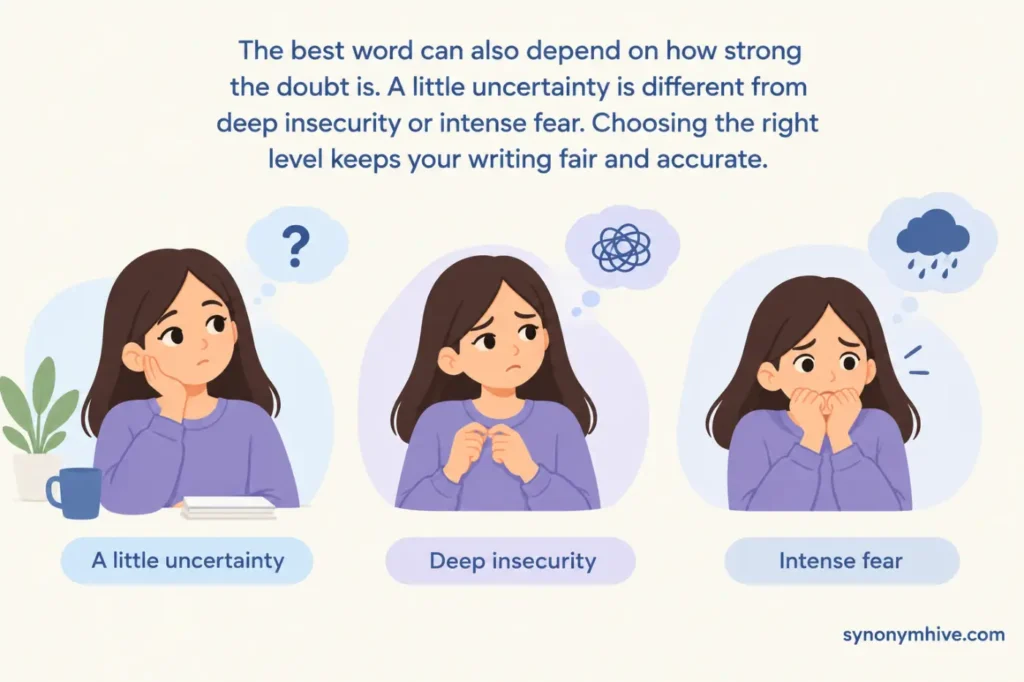
Which Words Describe Different Levels of Low Confidence?
The best word can also depend on how strong the doubt is. A little uncertainty is different from deep insecurity or intense fear. Choosing the right level keeps your writing fair and accurate.
What Is a Mild Word for a Lack of Confidence?
Use unsure, tentative, reserved, or hesitant when the doubt is limited or temporary.
Someone who is unsure may need more information. A tentative answer shows that the person is not ready to make a firm claim. A reserved person may take time to speak openly. A hesitant person may pause before acting.
For example, a student might give a tentative answer during a class discussion. A new employee might be hesitant to speak at the first team meeting. Neither example proves that the person has a lasting confidence problem.
Mild terms are especially useful in feedback because they describe a situation without making a sweeping judgment about someone’s personality.
What Is a Strong Word for a Lack of Confidence?
Use insecure, self doubting, diffident, or apprehensive when the situation supports a stronger description.
Insecure suggests a deeper concern about personal worth or ability. Self doubting focuses on questioning your own judgment. Diffident describes a lack of confidence, often in social situations. Apprehensive emphasizes worry about what may happen.
For example, an insecure employee may worry that a small mistake makes them unqualified. A self doubting writer may repeatedly question a paragraph that has already been checked. A diffident speaker may struggle to express an opinion in a group.
These words can carry emotional weight. Use them only when they fit the situation, and avoid treating a temporary reaction as a permanent personality trait.
What Is a Word for Extreme Fear or Doubt?
Frightened, terrified, and fearful describe strong fear. They are not direct replacements for every form of low confidence, because fear is an emotion rather than a general lack of self belief.
A person may be confident in their skills but terrified of a dangerous situation. Another person may feel insecure about their abilities without experiencing strong fear. The difference matters when you describe a character, explain a behavior, or discuss a real situation.
For example, she was terrified before the emergency procedure describes intense fear. She was insecure about her medical knowledge describes doubt about her abilities. The words point to different causes and should not be swapped without changing the meaning.
How Does Grammar Change the Word You Need?
The opposite of confident can take several grammatical forms. The right choice depends on whether you are describing a person, a feeling, an action, or a state of mind.
| Part of Speech | Word | Example |
|---|---|---|
| Adjective | Unsure | He is unsure about the decision. |
| Adjective | Insecure | She feels insecure in large groups. |
| Adjective | Uncertain | The result is uncertain. |
| Adjective | Hesitant | They were hesitant to respond. |
| Noun | Insecurity | Her insecurity made public speaking difficult. |
| Noun | Uncertainty | Uncertainty surrounded the final decision. |
| Noun | Doubt | He expressed doubt about the proposal. |
| Adverb | Uncertainly | She answered uncertainly. |
| Adverb | Hesitantly | He hesitantly raised his hand. |
| Verb phrase | Doubt yourself | Try not to doubt yourself after one mistake. |
What Is the Noun Form of Insecure?
The noun form is insecurity. It describes a state of lacking confidence, safety, or assurance. For example, insecurity about public speaking can make a presentation stressful.
Uncertainty is a different noun. It describes a lack of certainty about a fact, decision, or outcome. For example, uncertainty about the weather may affect travel plans.
Doubt is another useful noun. It can describe a question or concern about a claim, choice, or ability. You might have doubts about a plan without feeling personally insecure.
What Is the Adverb Form of Unconfident?
There is no single adverb that works as the standard form of unconfident in every sentence. You can use uncertainly, hesitantly, or nervously when describing how someone speaks or acts.
For example, she answered uncertainly describes how she gave an answer. He hesitantly offered an idea focuses on his pause or reluctance. They spoke nervously highlights worry or tension.
Do not force an adverb into a sentence if it sounds unnatural. Often, a direct sentence such as she was unsure is clearer than she acted unconfidently.
Explore another synonym guide: Opposite of Brave Best Words for Every Situation 2026.
What Is the Best Word for Lacking Confidence in Different Situations?
A word that works in one setting may sound wrong in another. A resume needs professional language, an essay needs precise descriptions, and a text message can use everyday expressions. The goal is to describe the lack of confidence accurately without making the sentence sound harsh or unnatural.
What Is the Best Word for a Resume?
On a resume, avoid describing yourself as insecure, timid, or unconfident. These labels focus on a weakness without explaining your skills or how you work. If you are discussing an area for improvement, describe the specific behavior and show how you are addressing it.
For example, instead of writing, I am not confident when speaking to clients, you could write:
I am developing my presentation skills through regular practice and client meetings.
This sentence shows that you recognize an area for growth and are taking action. It does not make a broad claim about your personality.
If you are describing a coworker’s professional behavior, choose a word that fits what you observed. Hesitant may describe someone who pauses before sharing an idea. Uncertain may describe someone who needs more information before making a decision.
For a performance review, you might write:
The employee was initially hesitant to lead meetings but became more comfortable with regular practice.
This statement describes a change over time rather than presenting the employee’s early hesitation as a permanent flaw.
What Is the Best Word for an Essay?
In an essay, choose words that explain the cause and type of doubt. Uncertain works well when the facts or outcome are unclear. Diffident describes a person who lacks confidence, while apprehensive describes someone who worries about a possible event.
For example, a literature essay might say:
The diffident character avoids speaking openly because she fears rejection.
A research essay might say:
The available evidence is uncertain, so the conclusion requires further study.
These sentences describe different issues. The first focuses on a character’s confidence. The second focuses on the strength of the evidence.
When writing an academic argument, do not use insecure to describe a claim simply because you disagree with it. A claim can be unsupported, questionable, or uncertain. Insecure usually describes a person or a situation involving a lack of security or assurance.
What Is the Best Word for a Text Message?
For texting, simple expressions often sound the most natural. Unsure, nervous, hesitant, and not sure of yourself work in many casual conversations.
Examples include these messages.
- I am still unsure about my choice.
- I was nervous before the interview, but it went well.
- Do not keep second guessing yourself.
- I felt hesitant about sending that message.
- I am a little shaky on the last topic.
Choose the phrase that explains your actual concern. If you are worried about an upcoming event, nervous is usually better than insecure. If you keep questioning a decision after making it, second guessing yourself is more specific.
Avoid calling a friend chicken or wishy washy when they express a normal fear or concern. Those terms can sound insulting, especially during a serious conversation.
What Is the Best Word for an Email?
Professional emails benefit from calm, specific language. Unsure, uncertain, hesitant, and concerned can help you explain a problem without blaming someone.
For example:
I am uncertain about the revised deadline and would appreciate confirmation before moving forward.
Or:
I was hesitant to approve the proposal because the cost estimates were incomplete.
Both examples explain the reason for doubt. They also leave room for discussion and clarification.
If you are writing to a customer, avoid saying that your team lacks confidence in its work unless that is truly the issue. You may mean that the final result is not confirmed, that the team needs more data, or that approval is still pending.
A clearer email might say:
We are still reviewing the figures and will confirm the final estimate once the checks are complete.
This version explains the status without creating unnecessary concern.
What Is the Best Word for Speaking?
In everyday speech, unsure is a good general choice. Nervous works when someone feels tense, hesitant describes a pause before acting, and self conscious fits someone who worries about how others see them.
For example, you could say, I was nervous before my first presentation. You could also say, She seemed hesitant to share her opinion. Both sentences sound natural because the words match the behavior.
If you are describing someone who speaks quietly, do not automatically call them insecure. They may be reserved, thoughtful, or simply more comfortable listening. Quiet behavior alone does not prove that someone lacks confidence.

What Are Real Examples of Words That Mean Unconfident?
These examples show how related words work in common situations. Notice how each sentence identifies the type of doubt instead of relying on one general label.
- Job interview. I felt nervous before the interview, but preparation helped me answer clearly.
- School. The student was unsure about the answer and checked the notes before responding.
- Workplace. The new manager seemed hesitant to challenge the team’s first proposal.
- Friendship. He became self conscious when everyone started discussing his appearance.
- Public speaking. The diffident speaker needed encouragement before addressing the audience.
- Decision making. She was indecisive because both job offers had important benefits.
- Research. The evidence remained uncertain because the sample size was too small.
- Customer service. The representative sounded tentative when explaining the new policy.
- Family discussion. He was reluctant to share his plans because he expected criticism.
- Personal growth. After several mistakes, she started doubting her abilities.
- Travel. We were apprehensive about driving through the storm.
- Technology. The technician was unsure which setting had caused the error.
- Business planning. The owner remained doubtful that the proposed budget would cover every expense.
- Classroom discussion. The shy student preferred to ask the teacher questions after class.
- Teamwork. The employee felt insecure about sharing ideas with more experienced colleagues.
- Writing. I was self doubting about the introduction, so I asked a classmate for feedback.
- Negotiation. The buyer was skeptical of the seller’s promise because no evidence supported it.
- New responsibilities. She felt uncertain about managing the project until she understood the process.
These examples also show why the opposite of confident does not always point to a personal flaw. Nervousness may be temporary. Uncertainty may come from missing information. Skepticism may be reasonable when a claim lacks evidence. The context tells you what the word should communicate.
What Is the Difference Between Similar Words?
Some words overlap in meaning, but their differences can change the tone of your writing. Use these comparisons to avoid choosing a term that sounds too harsh or describes the wrong problem.
Insecure vs Unsure
Insecure usually describes doubt about yourself, your abilities, or your personal worth. Unsure usually describes doubt about a specific fact, choice, or situation.
| Insecure | Unsure |
|---|---|
| She feels insecure about her appearance. | She is unsure which dress to wear. |
| Can suggest a deeper personal concern. | Often describes a temporary lack of certainty. |
| May sound sensitive or critical. | Usually sounds neutral. |
| He is insecure about his skills. | He is unsure how to complete the task. |
Use insecure when the concern is personal. Use unsure when the person simply lacks an answer or has not made a decision.
For instance, someone can be unsure which route to take without doubting their intelligence. Someone who feels insecure about their driving skills may question their ability even after choosing a route.
Nervous vs Hesitant
Nervous describes a feeling of worry or tension. Hesitant describes holding back or pausing before doing something.
| Nervous | Hesitant |
|---|---|
| She felt nervous before the speech. | She was hesitant to begin the speech. |
| Focuses on an emotional state. | Focuses on behavior or willingness to act. |
| Often relates to fear or pressure. | May result from doubt, caution, or reluctance. |
| He was nervous about the meeting. | He was hesitant to challenge the decision. |
A person may be nervous but still act immediately. Another person may be hesitant because they want more information, even if they do not feel afraid.
This distinction helps in workplace writing. If someone worries about presenting, nervous may fit. If they repeatedly delay sharing an idea, hesitant may describe the behavior more clearly.
Shy vs Insecure
Shy describes discomfort in social situations, especially around unfamiliar people or groups. Insecure describes doubt about personal worth, ability, or acceptance.
A shy person may take time to speak in a new group but feel comfortable with close friends. An insecure person may worry that others dislike them or that their contributions are not good enough.
Do not assume that all quiet people are insecure. Some prefer listening, need time to think, or simply have a reserved personality. The word should reflect what you know rather than what you guess.
Uncertain vs Skeptical
Uncertain means not knowing something for sure. Skeptical means questioning a claim or asking for stronger evidence.
For example, I am uncertain about the results means the results are not clear to you. I am skeptical of the results means you have reasons to question their accuracy or reliability.
Skepticism is not always a lack of confidence. It can be a sensible response to a weak argument, an unsupported claim, or information that conflicts with other evidence.
What Common Mistakes Should You Avoid?
Choosing a word for low confidence requires more than finding a synonym in a dictionary. You also need to consider tone, context, and the exact meaning you want to express.
Do Not Treat All These Words as Exact Matches
Insecure, unsure, nervous, shy, and hesitant describe different experiences. Using one in place of another can change the meaning of your sentence.
For example, calling someone insecure suggests personal doubt. Calling them hesitant describes a pause or reluctance. Calling them uncertain suggests that they do not know something for sure.
Check the cause of the behavior before choosing a word.
Do Not Confuse Quietness With Low Confidence
A quiet person is not automatically shy or insecure. They may prefer listening, think carefully before speaking, or choose not to share personal information.
If you know only that someone speaks very little in meetings, reserved is often safer than insecure. If the person says they worry about being judged, self conscious may be more accurate.
Describe what you observe and avoid guessing about private feelings.
Do Not Use a Harsh Word for a Small Doubt
Terms such as cowardly, weak, and spineless can sound insulting. They suggest serious faults in courage or character rather than ordinary uncertainty.
Someone who asks for advice before making a major choice is not necessarily weak. A person who feels nervous before an interview is not necessarily cowardly. These reactions are common, and the right word should match the situation.
Use unsure or hesitant for mild doubt. Reserve stronger terms for situations that genuinely support them.
Do Not Confuse Doubt With Lack of Skill
A person may know how to do a task and still feel nervous about performing it. Another person may feel confident but lack the skills needed to do it well.
Confidence and ability are related, but they are not the same thing. If someone needs more training, describe the skill gap. If someone has the required skills but struggles to trust their judgment, describe the confidence issue.
This distinction is especially useful in resumes, performance reviews, and educational feedback.
Do Not Use Uncertain When You Mean Unreliable
Uncertain describes a lack of certainty. Unreliable describes someone or something that cannot be depended on.
An uncertain estimate may need further checking. An unreliable source may repeatedly provide incorrect information. A person can be uncertain and still be honest and dependable.
Choose the word that describes the actual problem.
What Are the Antonyms of Confident?
The main antonyms of confident include insecure, unsure, uncertain, diffident, and unconfident. Other words may fit when the context involves fear, hesitation, or doubt.
| Word | Best Use | Example |
|---|---|---|
| Insecure | Doubt about personal worth or ability | He felt insecure about his performance. |
| Unsure | Doubt about a choice or answer | I am unsure which option to select. |
| Uncertain | Lack of certainty about an outcome | The outcome remains uncertain. |
| Diffident | Lack of self confidence, often in social settings | The diffident candidate spoke softly. |
| Hesitant | Holding back before acting | She was hesitant to ask a question. |
| Nervous | Worry or tension | He felt nervous before the exam. |
| Self conscious | Worry about how others see you | She felt self conscious in the crowd. |
Confident also has antonyms that depend on the type of confidence involved. If you mean trust in another person, distrustful may be the right contrast. If you mean certainty about a fact, doubtful or uncertain may fit better.

How Can You Choose the Right Word?
Use these practical tips to find a word that matches your sentence.
- Identify the source of doubt. Is the person worried about their abilities, unsure about a choice, or afraid of an outcome?
- Choose the right strength. Use hesitant for a pause, insecure for personal doubt, and fearful for a situation involving strong fear.
- Consider your audience. Unsure works in everyday conversation. Diffident may fit a formal description or literary analysis.
- Avoid judging the person. Describe the specific behavior instead of using labels such as weak or cowardly.
- Check the grammar. Use insecure or uncertain to describe a person or situation, insecurity or uncertainty to name a condition, and uncertainly to describe how someone answers.
- Think about the tone. Some words sound neutral, while others suggest a personal weakness or a strong emotional reaction.
- Use evidence. If someone speaks quietly, do not assume they lack confidence. Look for clear context before choosing a word that describes their feelings.
- Prefer clarity over complexity. A familiar word is often better than a formal word that readers may not know.
The best choice is the one that expresses the exact idea without adding an unfair judgment.
Expand your vocabulary with Opposite of Happy Best Words for Every Situation 2026.
Conclusion
The opposite of confident depends on the kind of doubt you want to describe. Insecure works for doubts about personal worth or ability. Unsure and uncertain fit a lack of knowledge or certainty, while nervous describes worry and hesitant describes holding back before acting. Other choices, such as diffident, self conscious, and apprehensive, add more specific meaning.
When choosing the opposite of confident, think about the cause of the doubt, the strength of the feeling, and the person who will read your sentence. A resume may need a constructive description of a skill you are developing, while a story may need a word that captures a character’s emotions. You do not need the most complicated term. Choose the clearest one that fits the facts, and your writing will sound more precise and respectful.
Frequently Asked Questions
What is the most common opposite of confident?
Insecure is a common opposite when confidence means belief in yourself or your abilities. Unsure is often better when you mean doubt about a choice, answer, or situation.
What is another way to say someone is not confident?
You can say the person is unsure, hesitant, self conscious, diffident, or insecure. The best phrase depends on whether the person doubts their abilities, worries about other people’s opinions, or hesitates before acting.
What is the opposite of confident in a resume?
For a resume, describe the specific skill or behavior instead of labeling yourself as unconfident. For example, you could say that you are developing presentation skills through practice and regular feedback.
Is insecure the same as shy?
No. Shy describes discomfort in social situations, while insecure describes doubt about personal worth, ability, or acceptance. A person can be shy without feeling insecure.
What is a formal word for lacking confidence?
Diffident is a formal word for lacking confidence, especially in social situations. Uncertain, apprehensive, and self doubting can also fit, depending on the reason for the doubt.
Can someone be confident and nervous at the same time?
Yes. A person can trust their skills and still feel nervous before a difficult event. Confidence is belief in your ability, while nervousness is a feeling of worry or tension.
What is the difference between uncertain and doubtful?
Uncertain means you do not know something for sure. Doubtful often suggests that you question a claim or think an outcome may be unlikely.