
Finding the right opposite of happy can make a big difference when you write an email, finish a school essay, update a resume, or send a text to a friend. You might want to describe a bad day, explain a disappointing result, or show how a character reacts to sad news. The word you choose helps readers understand exactly what happened and how someone responded.
The simplest opposite is sad. However, English has many other words for negative emotions, including unhappy, miserable, gloomy, disappointed, heartbroken, and distressed. Each word describes a different level of sadness or a different reason for feeling bad.
The opposite of happy is usually sad or unhappy. Other useful choices include miserable for deep unhappiness, disappointed when something falls short of your hopes, and heartbroken for intense emotional pain.
Choosing the right word depends on the situation, the strength of the emotion, and the tone you want. This guide explains the meaning and origin of these words, compares more than 30 alternatives, and shows how to use them naturally in everyday conversation, professional writing, and creative work.
Need another vocabulary suggestion? Read Opposite of Brave Best Words for Every Situation 2026.
What Is the Opposite of Happy in Simple English?
The most common opposite of happy is sad. Happy describes a positive emotional state, often linked to pleasure, satisfaction, or joy. Sad describes an unpleasant emotional state that may come from loss, disappointment, loneliness, or difficult news.
For example, a child may be happy after receiving a gift but sad when a friend moves away. The situation changes, and the emotion changes with it.
Unhappy is another common choice. It can describe a person’s emotional state or dissatisfaction with a situation. Someone might be unhappy with a test result, an office policy, or the way a conversation ended. The word does not always mean that the person is crying or deeply upset.
Here is a quick comparison.
| Word | Simple meaning | Example |
|---|---|---|
| Sad | Feeling sorrow or unhappiness | She felt sad after saying goodbye. |
| Unhappy | Not happy or satisfied | He was unhappy with the decision. |
| Miserable | Extremely unhappy | I felt miserable during the long delay. |
| Disappointed | Upset because something did not meet your hopes | They were disappointed by the result. |
| Gloomy | Sad or lacking cheer | The gloomy weather matched his mood. |
| Heartbroken | Deeply hurt by loss or emotional pain | She was heartbroken after the breakup. |
Sad is usually the safest word when you need a clear, direct description. Unhappy works well for both feelings and dissatisfaction. The stronger choices add detail, helping readers understand the reason or intensity of the emotion.
Where Did the Words Happy and Sad Come From?
The history of a word can explain why it carries its current meaning. Happy and sad have different histories, and those histories help explain how English uses them today.
What Is the Origin of Happy?
Happy comes from the Middle English word hap, which meant luck, chance, or fortune. The older word traces back to Old Norse happ, meaning luck or good fortune. Over time, happy developed from having good luck to experiencing pleasure, contentment, or joy.
You can still see this older connection in words such as happenstance, which refers to something that occurs by chance. The connection also appears in the word perhaps, which historically relates to what may happen.
Today, happy usually describes a positive emotional state. A person can be happy about a promotion, happy with a meal, or happy to see an old friend. The word can also describe a favorable result, as in a happy ending.
What Is the Origin of Sad?
Sad has a different history. It comes from the Old English word sæd, which originally meant satisfied, full, or having had enough. Its meaning gradually changed over centuries. By the Middle English period, sad had developed the sense of being sorrowful or unhappy.
This change shows that word meanings are not fixed forever. A word can begin with one meaning and develop another as people use it in new ways.
In modern English, sad usually refers to sorrow, disappointment, or emotional pain. It can describe a temporary mood, as in feeling sad after a difficult day, or a broader response to a serious loss.
Why Does the Opposite of Happy Depend on Context?
Happy can describe several related states, including joy, comfort, satisfaction, and good fortune. No single opposite covers every one of those meanings perfectly.
For example, the opposite of happy with a purchase may be dissatisfied. The opposite of happy about a friend’s success might be jealous, if envy is the actual emotion. A person who loses someone they love may be heartbroken rather than merely sad.
This is why word choice matters. If you are describing a general emotion, sad is usually enough. If you want to explain the cause or strength of the emotion, a more specific word can make the sentence clearer.

What Are the Best Words to Use Instead of Happy?
The best choice depends on the feeling you want to communicate. Some alternatives are simple and familiar. Others are more formal, intense, or casual.
The following list groups 36 useful words into four categories. The examples show how each word works in a complete sentence.
Simple Words for Everyday Use
These words are easy to understand and fit most everyday situations.
| Word | Meaning | Tone | Example |
|---|---|---|---|
| Sad | Feeling sorrow | Simple and direct | I felt sad when my friend left. |
| Unhappy | Not happy or satisfied | Neutral | She was unhappy with her grade. |
| Upset | Emotionally troubled or distressed | Everyday | He was upset about the argument. |
| Low | Feeling down or lacking cheer | Casual | I have been feeling low this week. |
| Blue | Sad or downhearted | Informal | She felt blue on a rainy afternoon. |
| Hurt | Emotionally wounded | Personal | His careless comment left her hurt. |
| Sorry | Feeling sorrow or regret | Context dependent | I was sorry to hear about their loss. |
| Lonely | Sad because of a lack of connection | Personal | He felt lonely after moving away. |
| Worried | Anxious about a problem | Neutral | She was worried about the interview. |
Sad is the most direct choice when you do not need extra detail. Upset works when the emotion may include anger, worry, or hurt as well as sadness. Lonely points to a lack of company or connection, while worried focuses on fear about something that may happen.
Everyday Words With More Meaning
These words add detail to the reason, depth, or appearance of an unhappy mood.
| Word | Meaning | Tone | Example |
|---|---|---|---|
| Disappointed | Sad because expectations were not met | Neutral | We were disappointed by the cancellation. |
| Miserable | Very unhappy or uncomfortable | Strong | She felt miserable with the flu. |
| Gloomy | Sad or lacking hope | Descriptive | He sounded gloomy on the phone. |
| Downhearted | Discouraged or sad | Gentle | The team was downhearted after the loss. |
| Discouraged | Losing confidence or hope | Practical | I felt discouraged after several rejections. |
| Frustrated | Annoyed because progress is blocked | Neutral | He was frustrated by the slow process. |
| Dejected | Sad and low in confidence | Descriptive | The player looked dejected after the match. |
| Distressed | Deeply upset or troubled | Serious | The family was distressed by the news. |
| Melancholy | Quiet, thoughtful sadness | Literary | A sense of melancholy filled the room. |
| Discontented | Dissatisfied with a situation | Formal leaning | Employees were discontented with the new rules. |
Disappointed is useful when something did not turn out as expected. Frustrated is more suitable when a problem blocks progress. Melancholy often suggests quiet sadness rather than a sudden emotional reaction.
Formal Words for School and Professional Writing
Formal words can make an essay, report, or professional message more precise. They work best when the meaning fits the situation.
| Word | Meaning | Tone | Example |
|---|---|---|---|
| Dissatisfied | Not pleased with a result or service | Professional | The customer was dissatisfied with the repair. |
| Displeased | Annoyed or unhappy about something | Formal | The manager was displeased with the delay. |
| Disheartened | Having lost hope or confidence | Formal | The volunteers were disheartened by the setback. |
| Dejected | Clearly discouraged or sad | Formal descriptive | The candidate appeared dejected after the interview. |
| Despondent | Having little hope | Serious | He became despondent after repeated failures. |
| Sorrowful | Full of sorrow | Formal or literary | The letter carried a sorrowful message. |
| Grief stricken | Overwhelmed by grief | Serious | The grief stricken family gathered at home. |
| Disconsolate | Unable to be comforted | Literary | She sat disconsolate beside the empty chair. |
| Dispirited | Lacking enthusiasm or hope | Formal | The group felt dispirited after the setback. |
Dissatisfied is often the best professional choice when discussing a product, service, policy, or outcome. Disheartened and dispirited describe a loss of confidence or enthusiasm. Despondent is much stronger and suggests a serious loss of hope, so it should not be used for a small inconvenience.
Slang and Casual Expressions
Casual language can make a message sound natural between friends. Some expressions are more common in certain communities or age groups, so consider your audience.
| Word or expression | Meaning | Tone | Example |
|---|---|---|---|
| Bummed | Disappointed or sad | Casual | I was bummed when the concert was canceled. |
| Down | Sad or discouraged | Casual | He has been down since the move. |
| Blue | Sad or low | Informal | I get a little blue in winter. |
| Crushed | Deeply disappointed | Informal and strong | She was crushed when she missed the final. |
| Beat | Exhausted or worn down | Casual | I am beat after that rough day. |
| Out of sorts | Not feeling like yourself | Conversational | He seemed out of sorts this morning. |
| In a funk | Stuck in a low mood | Casual | I have been in a funk all week. |
| Not feeling great | Feeling unwell or unhappy | Very casual | I am not feeling great about the news. |
| Down in the dumps | Feeling sad or discouraged | Informal | She was down in the dumps after the move. |
Some casual expressions describe more than sadness. Beat usually means tired or exhausted, although a difficult day can leave someone both tired and unhappy. Not feeling great can refer to physical health as well as emotions. Use the surrounding sentence to make your meaning clear.
Which Words Describe Different Levels of Sadness?
The strength of a word matters. Using a very strong term for a small problem can make your writing sound exaggerated. Choosing a mild word for a major loss can make it sound insensitive.
Mild Feelings
Use mild words for short periods of disappointment, low mood, or dissatisfaction.
- Blue describes a low mood that may pass.
- Down is a casual way to describe feeling sad or discouraged.
- Unhappy describes a lack of happiness or satisfaction.
- Disappointed works when the result does not meet your expectations.
- Dissatisfied describes a lack of satisfaction with a product, service, decision, or condition.
- Displeased suggests that something has annoyed or offended you.
Example: I was disappointed that the restaurant ran out of my favorite dish.
This sentence describes a small setback without making the reaction sound extreme.
Moderate Feelings
Moderate words describe stronger sadness, discouragement, or emotional discomfort.
- Upset suggests a noticeable emotional reaction.
- Hurt highlights emotional pain caused by an event or another person.
- Frustrated describes annoyance caused by a problem or obstacle.
- Gloomy describes a sad mood or an atmosphere without much hope.
- Downhearted suggests a loss of confidence.
- Dejected describes visible sadness after a setback.
- Distressed indicates serious worry or emotional trouble.
Example: The students were discouraged after their project received a low grade, but they decided to revise it.
Discouraged fits because the students lost some confidence. It does not suggest that they had given up completely.
Strong Feelings
Strong words suit major disappointments, deep sorrow, or intense emotional pain.
- Miserable means very unhappy or deeply uncomfortable.
- Crushed suggests a powerful reaction to a painful disappointment.
- Heartbroken describes intense sadness after loss, rejection, or a relationship ending.
- Grief stricken describes overwhelming grief, often after a death.
- Despondent suggests a serious loss of hope.
- Disconsolate describes someone who cannot easily be comforted.
- Devastated means emotionally overwhelmed by a deeply painful event.
Example: He was devastated when the fire destroyed the family home.
Devastated is appropriate because the loss is severe. It would be too strong for a minor inconvenience, such as missing a bus or receiving a meal you did not enjoy.
How Can You Choose the Right Intensity?
Think about three things before choosing a word. First, consider the event that caused the emotion. Second, decide how strong the reaction is. Third, think about how the reader should understand the person or situation.
A missed coffee date may leave someone disappointed. A broken promise may leave them hurt or upset. The end of a long relationship may leave someone heartbroken. A serious loss may cause deep grief.
The goal is not to choose the strongest word available. The goal is to choose the most accurate one.
What Is the Difference Between Similar Words?
Several words can describe sadness, but they do not mean exactly the same thing. Understanding the small differences helps you write more clearly and avoid choosing a word that sends the wrong message.
Sad vs Unhappy
Sad usually describes an emotional response. Unhappy can describe an emotion, but it can also describe dissatisfaction with a condition or experience.
| Sad | Unhappy |
|---|---|
| Often describes sorrow or emotional pain. | Often describes a lack of happiness or satisfaction. |
| May come from loss, loneliness, or bad news. | May come from an unsatisfactory situation or personal concern. |
| Often focuses on how someone feels. | Can focus on feelings, preferences, or conditions. |
Examples.
- Maya felt sad when her best friend moved to another state.
- Maya was unhappy with the school’s new attendance policy.
The first sentence describes an emotional reaction to separation. The second describes dissatisfaction with a rule. You could use unhappy in the first sentence, but sad gives the reader a more direct picture of the emotion.
Disappointed vs Frustrated
Disappointed means that something did not meet your expectations. Frustrated means that something is preventing you from reaching a goal or getting a result.
Imagine that you prepare for a job interview but do not receive an offer. You may feel disappointed because you hoped to get the job. If you cannot submit your application because the website keeps crashing, you may feel frustrated.
| Disappointed | Frustrated |
|---|---|
| Focuses on unmet hopes or expectations. | Focuses on obstacles and blocked progress. |
| Often follows an unwanted result. | Often happens during a difficult process. |
| Can involve quiet sadness. | Often includes irritation or annoyance. |
Examples.
- The team was disappointed when it lost the final match.
- The team was frustrated because the referee repeatedly stopped play.
Both words can describe the same event, but each highlights a different part of the experience.
Miserable vs Heartbroken
Miserable describes intense unhappiness or discomfort. Heartbroken describes deep emotional pain, often after a major loss or the end of an important relationship.
Someone may feel miserable after a week of poor sleep, illness, and stressful work. A person whose partner ends a long relationship may feel heartbroken.
Miserable can also describe physical discomfort. For example, a traveler might have a miserable flight because of turbulence, delays, and a lack of sleep. Heartbroken focuses much more directly on emotional pain.
Choose heartbroken when a serious personal loss is central to the sentence. Use miserable when the person is deeply unhappy or uncomfortable for a wider range of reasons.
Gloomy vs Melancholy
Gloomy often suggests sadness, darkness, or a lack of hope. It can describe a person’s mood, a room, a day, or even a prediction about the future.
Melancholy usually suggests a quiet or thoughtful sadness. It often appears in creative writing because it can describe a mood that is reflective rather than openly distressed.
Compare these sentences.
- The gloomy forecast warned of several days of heavy rain.
- A melancholy song reminded Elena of her childhood home.
The first example describes a dark or discouraging outlook. The second suggests a quiet sadness connected to memory. Gloomy can sound more negative, while melancholy may sound reflective or literary.

How Does the Opposite of Happy Work in Different Parts of Speech?
The most suitable word can depend on how the sentence is built. Sadness can appear as an adjective, noun, or verb. Choosing the right form makes a sentence easier to read.
Which Adjectives Describe an Unhappy Person?
Adjectives describe people, places, things, and emotional states. Most common alternatives to happy are adjectives.
Examples include sad, unhappy, miserable, disappointed, gloomy, lonely, distressed, and heartbroken.
Use an adjective after a linking verb such as is, seems, looks, or feels.
- The customer was dissatisfied with the service.
- My brother seemed upset after the phone call.
- The children looked disappointed when the trip was canceled.
- Her message sounded gloomy.
- He was heartbroken after losing his closest friend.
Adjectives can also appear before nouns. You might write a sad expression, a gloomy afternoon, a disappointed customer, or a distressed family.
Which Nouns Describe Unhappiness?
Nouns name emotions or conditions instead of describing them directly. They are useful when your sentence focuses on the experience itself.
| Noun | Meaning | Example |
|---|---|---|
| Sadness | The state of feeling sad | Her sadness became easier to manage with time. |
| Sorrow | Deep sadness, often connected to loss | The family shared their sorrow with friends. |
| Disappointment | Unhappiness after an unwanted result | His disappointment was clear after the announcement. |
| Frustration | Annoyance caused by a problem | The repeated errors caused frustration. |
| Grief | Deep sorrow after a major loss | The community offered support during her grief. |
| Misery | A state of severe unhappiness or discomfort | The long delay added to their misery. |
| Dissatisfaction | A lack of satisfaction | The survey showed widespread dissatisfaction with the service. |
| Melancholy | A quiet or thoughtful sadness | A sense of melancholy filled the story. |
For example, sad describes a person in the sentence She was sad. Sadness names the emotion in the sentence Her sadness was understandable. Both forms are useful, but they serve different grammatical purposes.
Which Verbs Express Sadness?
Verbs show actions, changes, or states. English has several verbs that communicate sadness or the actions that cause it.
- Mourn means to express or experience grief after a loss. The family gathered to mourn their grandfather.
- Grieve means to experience deep sorrow. He continued to grieve after the death of his friend.
- Lament means to express sorrow or regret. The writer lamented the loss of the old neighborhood.
- Disappoint means to fail to meet someone’s hopes or expectations. The final result disappointed the fans.
- Upset can mean to make someone unhappy or distressed. The sudden change upset the children.
- Sadden means to cause sadness. The news saddened everyone in the room.
These verbs do not all replace happy directly. Instead, they explain how sadness happens, how someone expresses it, or what causes it.
Can a Phrase Work Better Than One Word?
Yes. A short phrase may express an emotion more naturally than a single adjective.
Consider these examples.
- He was not in a good mood after the argument.
- She felt down after receiving the rejection email.
- The children were beside themselves with grief.
- I was not pleased with the final result.
- He had lost hope after several unsuccessful attempts.
The phrases communicate different levels and types of unhappiness. Not in a good mood is casual and broad. Beside themselves with grief is much stronger. Lost hope describes a change in outlook rather than sadness alone.
Discover related words in Opposite of Hard Best Words for Every Situation.
Are There Differences Between American and British English?
Most common words for sadness have the same basic meaning in American and British English. Sad, unhappy, miserable, disappointed, lonely, and heartbroken are widely understood in both varieties.
The main differences often involve casual expressions, spelling conventions, and how people use words in everyday conversation.
Which Expressions Sound Natural in American English?
In American English, people commonly say they are bummed, feeling down, upset, or down in the dumps. These expressions suit informal conversations and messages.
Examples.
- I was bummed when the game was canceled.
- She has been feeling down since her move.
- He was upset about the unexpected bill.
Bummed is casual. It works well with friends or coworkers in relaxed conversations, but a formal report would usually use disappointed or dissatisfied instead.
Which Expressions Are Common in British English?
British speakers also use sad, upset, disappointed, miserable, and down. Some casual expressions may be more familiar in certain British communities, including gutted, which often means deeply disappointed.
For example, a British speaker might say, I was gutted when our team lost the final. An American speaker would understand the meaning from context, but might be more likely to say, I was crushed when our team lost.
These are broad tendencies, not strict rules. People in both countries understand many expressions from the other variety because of shared media, travel, and online communication.
Do Regional Differences Change the Meaning?
Regional differences can affect how strong or casual a word sounds. The word gutted is usually informal and can express intense disappointment. Blue is widely understood as a word for sadness, though its frequency may vary by speaker and setting.
When writing for a broad American audience, simple words are often the safest choice. Use sad, disappointed, upset, or dissatisfied when you need a clear meaning. Save regional slang for dialogue or a message where the speaker’s voice matters.
What Is the Best Word for Each Writing Situation?
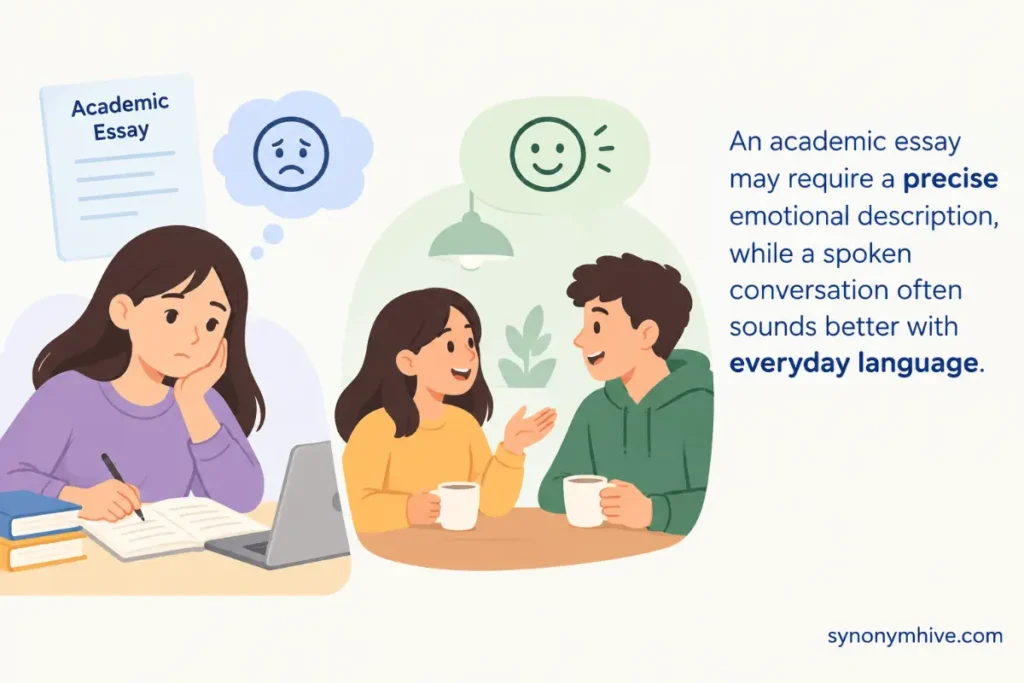
The best word depends on your audience and purpose. A resume needs a different tone from a text to a friend. An academic essay may require a precise emotional description, while a spoken conversation often sounds better with everyday language.
What Word Should You Use on a Resume?
A resume usually focuses on skills, achievements, and professional results. Words describing sadness rarely belong in a resume unless you are explaining a relevant experience or discussing a role that involves emotional support.
If you need to describe dissatisfaction with a past work situation, keep the language professional and focused on facts. Dissatisfied is often more appropriate than miserable or heartbroken.
Example.
I became dissatisfied with the limited opportunities for professional growth, so I began looking for a role with greater responsibility.
This sentence explains the concern without sounding overly emotional. In most resumes, though, it is better to focus on what you want to contribute rather than criticize a previous employer.
What Word Should You Use in an Essay?
For an essay, choose a word that matches the evidence and the subject. Sad and unhappy work in general writing. Disappointed, distressed, sorrowful, and despondent can add precision when the context supports them.
Example.
The main character becomes increasingly despondent as repeated failures weaken his hope for the future.
Despondent fits a serious literary analysis because it describes a loss of hope. If the character is only upset about one small event, the word may be too strong.
When analyzing literature, avoid labeling every negative emotion as sadness. A character might be angry, jealous, anxious, ashamed, or frustrated. Explain the emotion that the text actually supports.
What Word Should You Use in a Text Message?
Text messages are usually brief and conversational. Words such as sad, upset, down, bummed, and disappointed often sound natural.
Examples.
- I am a little down today.
- I was bummed that you could not make it.
- That message really hurt.
- I am disappointed, but I understand why you had to cancel.
- I have been feeling low lately.
The best choice also depends on how much you want to share. If you need support, a direct message such as I am having a hard day and could use someone to talk to may be clearer than a vague statement.
What Word Should You Use in a Professional Email?
Professional emails work best with precise and respectful language. Dissatisfied, disappointed, concerned, and displeased can describe problems without making the message sound overly personal.
Example.
I was disappointed that the delivery arrived two days late because the materials were needed for our scheduled presentation.
This wording explains the problem and its impact. It is more useful than saying the delivery made you miserable.
If you are writing to resolve a problem, describe the event, explain the effect, and state what you need next. That approach keeps the email constructive.
What Word Should You Use When Speaking?
In everyday conversation, sad, upset, disappointed, and frustrated are usually easy to understand. Use stronger words when the situation calls for them.
Examples.
- I was upset when I heard what happened.
- She was disappointed that her plans changed.
- He felt miserable after being sick for several days.
- We were thrilled about the result, but our friends were disappointed.
- I felt lonely after moving to a new city.
Spoken language also depends on tone of voice. The sentence I am fine can sound reassuring, sad, or annoyed depending on how someone says it. If clarity matters, explain the reason for the emotion rather than relying on a single adjective.
What Are Some Real Examples of Words That Mean the Opposite of Happy?
Examples make word meanings easier to remember. Each sentence below uses an alternative to happy in a realistic situation.
Examples From Family and Friendships
- Liam felt lonely after his family moved to a new town.
- Ava was heartbroken when her longtime friend ended their friendship.
- My sister was disappointed when nobody remembered her birthday.
- The children looked gloomy when the picnic was canceled.
- Daniel felt hurt by the joke because it touched on a personal subject.
- Grandma became sorrowful when she looked through old family photographs.
These examples show that sadness can come from separation, unmet expectations, hurtful words, or memories. The right adjective helps explain the reason behind the feeling.
Examples From School and Learning
- The student was discouraged after receiving a low score on the first test.
- I felt frustrated when I could not understand the final math problem.
- The class was disappointed when the science trip was postponed.
- She felt dejected after losing the spelling competition.
- He became more confident after asking his teacher for help.
The fifth example shows a change from a negative state to a more positive one. This kind of contrast can help readers understand a character’s development or a student’s progress.
Examples From Work and Business
- The customer was dissatisfied with the quality of the repair.
- The team felt disheartened after the proposal was rejected.
- The manager was displeased with the missed deadline.
- Employees were frustrated by the repeated software problems.
- The candidate looked dejected after learning that another applicant had been selected.
- The company addressed customer dissatisfaction by improving its support process.
Professional writing benefits from exact words. Dissatisfied identifies a problem with a service. Frustrated points to an obstacle. Disheartened describes a loss of confidence or enthusiasm.
Examples From Travel and Daily Life
- We were disappointed when heavy rain forced us to cancel the hike.
- The travelers were miserable after waiting for hours in the crowded station.
- I felt blue on my first evening away from home.
- The gloomy sky made the quiet beach look almost empty.
- She was upset when she realized she had left her passport at home.
- He felt relieved when the missing bag was finally found.
A word can describe the person’s emotion, the situation, or the mood of a place. Gloomy can describe a sky or an atmosphere, while upset generally describes a person or an emotional reaction.
Examples From Stories and Creative Writing
- The hero grew despondent as each attempt to save the village failed.
- A melancholy melody drifted through the empty house.
- The widow sat disconsolate beside the window.
- The character’s sorrow deepened when the letter revealed the truth.
- The gloomy streets reflected the town’s growing fear.
- The ending left readers heartbroken but hopeful.
Creative writing benefits from variety, but the words should still fit the scene. A character who is mildly annoyed does not need to be described as devastated. Strong words work best when the story gives readers a reason to believe them.
What Common Mistakes Should You Avoid?
Many words connected to sadness overlap, but using them as exact substitutes can create confusing or exaggerated sentences.
Do Not Use Miserable for Every Small Problem
Miserable describes intense unhappiness or discomfort. It can be appropriate for a painful experience, serious illness, or a deeply unpleasant situation. It may sound excessive when the problem is minor.
Instead of writing, I was miserable because the store was out of my favorite snack, consider I was disappointed. Save miserable for a situation that truly involves sustained or intense discomfort.
Do Not Confuse Sadness With Anger
Angry means feeling strong displeasure or hostility. Sad means feeling sorrow or unhappiness. A person can experience both emotions at the same time, but they are not interchangeable.
For example, she was angry when her coworker took credit for her work. She was sad when her friend moved away. Calling the first reaction sad might hide the sense of unfairness that caused it.
Do Not Confuse Disappointed With Dissatisfied
Disappointed usually connects to an expectation that was not met. Dissatisfied focuses on a lack of satisfaction with a result, service, or condition.
A customer may be disappointed because a promised delivery arrived late. The same customer may be dissatisfied with the overall service after several problems. Both words can be correct, but they emphasize different points.
Do Not Use Slang in Every Setting
Words such as bummed and gutted are useful in casual conversation. They may not suit an academic essay, a formal complaint, or a business report.
Choose a word that matches the reader. A message to a friend can sound relaxed, while a report usually benefits from a neutral word such as disappointed or dissatisfied.
Do Not Assume Everyone Is Sad for the Same Reason
A person who appears quiet might be tired, worried, distracted, or thoughtful. Avoid treating visible behavior as proof of a specific emotion.
Instead of writing, She was sad because she did not speak, consider She was quiet during the meeting. If the story later confirms sadness, you can explain it with evidence.
This distinction matters in reports, personal conversations, and fiction. Accurate descriptions leave room for what you know and avoid guessing at another person’s inner state.
What Are the Antonyms of Sad and Unhappy?
The opposite of sad is usually happy, joyful, or cheerful. The best choice depends on the meaning you want to express.
| Word | Opposite | Difference |
|---|---|---|
| Sad | Happy | A general contrast between negative and positive emotions. |
| Unhappy | Content | Content emphasizes satisfaction and peace of mind. |
| Miserable | Comfortable | Comfortable can contrast with misery caused by unpleasant conditions. |
| Disappointed | Pleased | Pleased describes satisfaction with a result. |
| Gloomy | Cheerful | Cheerful suggests a positive and lively mood. |
| Lonely | Connected | Connected emphasizes meaningful relationships or social support. |
| Discouraged | Encouraged | Encouraged suggests renewed confidence or hope. |
| Frustrated | Satisfied | Satisfied can describe a goal being achieved or a need being met. |
| Heartbroken | Comforted | Comforted describes receiving support or relief from emotional pain. |
| Despondent | Hopeful | Hopeful suggests belief in a better future. |
These pairs are useful for comparison, but they are not always perfect opposites. A person can be content without feeling excited, and someone can be comfortable without being happy. The right contrast depends on the specific meaning of the original word.

How Can You Choose the Right Word Quickly?
You do not need to memorize every alternative. A few practical questions can help you choose a precise word for almost any situation.
Identify the Main Emotion
Ask yourself what the person is experiencing. Is it sorrow, disappointment, worry, frustration, loneliness, or a loss of hope?
If the reason is unclear or the emotion is general, sad is a safe starting point. If a person is unhappy with a result, disappointed or dissatisfied may communicate more.
Think About the Cause
The cause can point you toward the right word. A broken promise may leave someone hurt. A missed goal may cause disappointment. A blocked task may create frustration. A major loss may lead to grief.
Naming the cause helps you avoid choosing an adjective that is too broad.
Match the Strength of the Feeling
Use mild words for small setbacks and strong words for serious experiences. Disappointed may suit a canceled dinner, while devastated may suit the loss of a home or a major personal tragedy.
Do not increase the intensity just to make a sentence sound dramatic. Accurate writing is usually more convincing than exaggerated writing.
Consider Your Audience
A school essay, work email, text message, and conversation have different expectations. Formal writing often benefits from dissatisfied, distressed, or discouraged. Casual messages may sound more natural with down, upset, or bummed.
When in doubt, choose a familiar word that readers can understand without stopping to interpret it.
Read the Sentence Out Loud
A word may be correct in a dictionary but still sound awkward in your sentence. Read the full line and check its tone.
For example, The staff were disconsolate about the delayed coffee order sounds exaggerated. The staff were disappointed by the delay is more natural. The stronger word would make sense only if the situation involved much deeper emotional pain.
Find more synonyms in Opposite of Beautiful Best Words and Examples 2026.
Conclusion
The opposite of happy is usually sad or unhappy, but the best choice depends on the situation. Disappointed describes unmet expectations, frustrated points to obstacles, lonely highlights a lack of connection, and heartbroken expresses deep emotional pain. Words such as gloomy, miserable, and despondent add further shades of meaning.
Start with the emotion you want to describe, then consider its cause and strength. Match the word to your audience, too. A casual text may call for bummed, while a professional email may need dissatisfied or disappointed. In an essay, a more precise word can help explain a character’s response.
You do not need the most dramatic word to write well. Choose the one that says what you mean clearly, and your writing will sound more natural and accurate.
Frequently Asked Questions
What is the most common opposite of happy?
The most common opposite of happy is sad. Unhappy is also widely used, especially when describing dissatisfaction with a situation.
What is a stronger word than sad?
Miserable, heartbroken, devastated, and despondent are stronger than sad in many contexts. The best choice depends on the cause and intensity of the emotion.
What is the difference between sad and unhappy?
Sad usually describes sorrow or emotional pain. Unhappy can describe sadness, but it can also mean that someone is dissatisfied with a result or situation.
What is another way to say someone is not happy?
You can say the person is sad, upset, disappointed, dissatisfied, or feeling down. Use disappointed for unmet expectations and dissatisfied for a lack of satisfaction.
What is the opposite of happy in a formal essay?
Sad, dissatisfied, disappointed, distressed, and despondent can work in formal writing. Choose the word that best matches the character’s emotion or the situation being discussed.
What word means extremely unhappy?
Miserable means very unhappy or uncomfortable. Heartbroken describes deep emotional pain after a loss, while despondent suggests a serious loss of hope.
Can gloomy describe a person and a place?
Yes. Gloomy can describe a person’s mood, a dark sky, a room, or an atmosphere that seems sad or discouraging.