

Writing about a sunset can be harder than watching one. You may be working on an essay, caption, travel post, poem, or short story and find yourself using the same words again and again. If you are searching for words to describe a sunset, you probably want something more useful than a basic list of pretty adjectives.
The best description depends on what you see and the mood you want to create. A sunset can be golden, glowing, fiery, soft, peaceful, dramatic, hazy, vivid, or breathtaking. Each word gives the reader a slightly different picture.
The right terms to describe a sunset should show color, light, movement, mood, and atmosphere. For example, a golden sunset suggests warm yellow or orange light, while a fiery sunset suggests strong reds and oranges. A tranquil sunset creates a calm mood, while a dramatic sunset suggests something bold or striking.
You can use this guide to choose the right word for an essay, email, text, caption, travel description, speech, or creative writing. It covers simple and advanced choices, levels of intensity, close synonyms, common mistakes, real examples, and practical ways to make your sunset descriptions more vivid.
Need another vocabulary suggestion? Read Words to Describe a Smile: Words for Stories and Poems 2026.
What does sunset mean in simple English
A sunset is the time when the sun appears to move below the horizon at the end of the day. The sky can change color as sunlight passes through the atmosphere, creating shades such as yellow, orange, pink, red, purple, and gold.
The word sunset can describe both the event itself and the colorful sky that appears around that time. Writers often use sunset descriptions to create a mood, show the passing of time, or make a scene more vivid.
What are the best words to describe a sunset
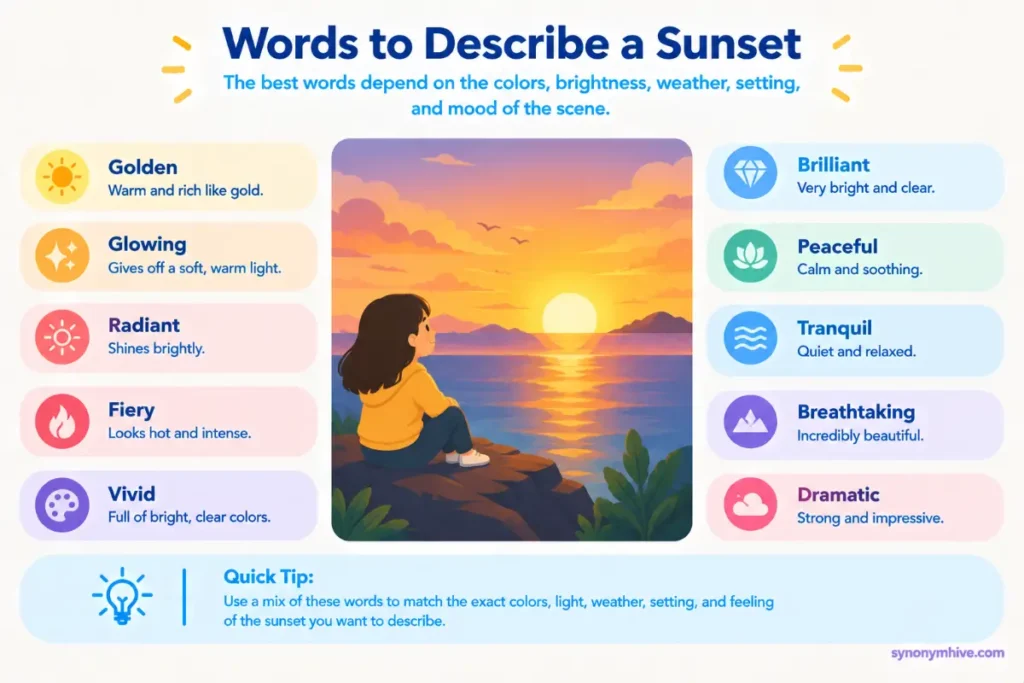
The best words depend on the colors, brightness, weather, setting, and mood of the scene. Strong choices include golden, glowing, radiant, fiery, vivid, brilliant, peaceful, tranquil, breathtaking, dramatic, colorful, and mesmerizing.
For simple writing, words such as beautiful, colorful, warm, bright, and peaceful work well. For creative writing, more specific choices such as crimson, amber, luminous, blazing, serene, or ethereal can create a stronger image.
Word Meaning Tone Example
| Word | Meaning | Tone | Example |
|---|---|---|---|
| Beautiful | Very pleasing to look at | Simple | The beautiful sunset covered the sky in pink and gold. |
| Golden | Filled with warm yellow or gold light | Everyday | A golden sunset stretched across the lake. |
| Glowing | Giving off a soft, warm light | Everyday | The glowing sunset made the clouds shine. |
| Colorful | Full of different colors | Simple | We watched a colorful sunset from the beach. |
| Bright | Full of strong light or color | Simple | The bright sunset lit the western sky. |
| Warm | Suggesting heat or rich orange and yellow tones | Everyday | Warm sunset light filled the room. |
| Radiant | Very bright and shining | Formal | The radiant sunset illuminated the distant hills. |
| Fiery | Strongly red, orange, or yellow | Dramatic | A fiery sunset burned across the horizon. |
| Vivid | Very clear, strong, and bright | Everyday | Vivid colors appeared as the sun disappeared. |
| Rosy | Pink or rose colored | Soft | Rosy clouds floated above the ocean. |
| Peaceful | Calm and restful | Simple | The peaceful sunset gave us time to slow down. |
| Enchanting | Charming and delightful | Literary | An enchanting sunset appeared beyond the trees. |
Which words describe a sunset by color
Color is one of the easiest ways to make a sunset description more precise. Instead of saying that the sunset was pretty, name the colors you actually see.
Words for yellow and gold sunsets
Use golden, amber, honeyed, warm, yellow, glowing, or luminous when yellow light dominates the sky.
A golden sunset often suggests warmth and comfort. Amber gives the scene a deeper orange or yellow tone. Luminous focuses more on the light itself.
Examples include:
- The golden sunset washed the mountains in warm light.
- Amber clouds floated above the quiet lake.
- A warm yellow glow spread across the fields.
- The luminous sky faded slowly into evening.
- Honeyed light rested on the tops of the trees.
Words for orange sunsets
Use orange, fiery, blazing, coppery, glowing, or vivid when orange is the main color.
Fiery sounds much stronger than orange. Coppery gives a more specific reddish orange image. Glowing suggests light as well as color.
Examples include:
- A fiery orange sunset filled the western sky.
- Coppery clouds gathered above the city.
- The glowing orange horizon reflected in the water.
- Vivid orange light covered the empty road.
- A blazing sunset appeared behind the mountains.
Words for red sunsets
Use crimson, scarlet, ruby, red, fiery, blazing, or blood red when the sunset has strong red tones.
Crimson is a deep red. Scarlet is usually a bright red. Ruby creates a rich and jewel like image. These words work especially well in creative writing.
Examples include:
- Crimson clouds stretched across the horizon.
- Scarlet light appeared behind the dark hills.
- Ruby colored clouds floated above the ocean.
- A fiery red sunset faded into purple.
- The sky turned deep crimson as evening arrived.
Words for pink sunsets
Use rosy, blush, soft pink, pastel, delicate, warm, or dreamy for a softer sunset.
Pink descriptions often create a gentle or romantic mood. Rosy works well for everyday writing. Pastel suggests light and soft colors.
Examples include:
- Rosy clouds drifted above the quiet beach.
- Soft pink light covered the horizon.
- Pastel colors appeared after the rain.
- A delicate pink glow spread across the sky.
- The dreamy pink sunset reflected in the lake.
Words for purple sunsets
Use purple, violet, lavender, plum, dusky, or deep when purple shades dominate.
Lavender creates a light and soft image. Violet sounds richer and more formal. Dusky connects the color with the coming night.
Examples include:
- Lavender clouds appeared above the hills.
- Violet light replaced the fading orange.
- A dusky purple sky marked the end of the day.
- Deep purple clouds gathered over the horizon.
- Plum colored shadows spread across the valley.
Which words describe a sunset by brightness
Not every sunset is bright. Some are soft and muted. Others are so strong that they seem to fill the entire sky.
Use bright, radiant, brilliant, dazzling, luminous, glowing, blazing, or vivid for strong light.
For softer light, choose gentle, muted, soft, faint, subtle, pale, or delicate.
The difference matters because brightness changes the mood.
A brilliant sunset feels powerful and energetic. A soft sunset feels quiet and gentle. A muted sunset can seem thoughtful or lonely.
Consider these examples:
- A brilliant sunset lit the entire coastline.
- Soft evening light rested on the water.
- The muted sunset faded behind a layer of clouds.
- A dazzling glow appeared between the mountains.
- Pale light remained after the sun disappeared.
- The radiant sky seemed to stretch forever.
- A subtle orange glow remained along the horizon.
Which words describe a sunset by mood
A sunset can suggest many emotions. Your word choice should match the feeling you want the reader to experience.
Peaceful and calm
Choose peaceful, tranquil, serene, quiet, gentle, soothing, restful, or still.
These words work well for nature writing, travel posts, personal essays, and reflective scenes.
Example:
The tranquil sunset reflected across the still lake.
Romantic and warm
Choose romantic, dreamy, tender, warm, lovely, enchanting, intimate, or magical.
These words can work in personal writing and captions.
Example:
A dreamy sunset painted the beach in soft pink and gold.
Powerful and dramatic
Choose dramatic, fiery, blazing, intense, striking, bold, spectacular, or explosive.
These choices fit a sunset with strong colors, dark clouds, lightning, or unusual light.
Example:
A dramatic sunset erupted behind the storm clouds.
Sad or reflective
Choose fading, lonely, somber, muted, melancholy, distant, quiet, or wistful.
These words can suggest that a character is thinking about change, loss, memory, or time.
Example:
The fading sunset reminded her that the day was almost gone.
Joyful and energetic
Choose vibrant, vivid, lively, bright, cheerful, brilliant, colorful, or radiant.
These words suggest energy and happiness.
Example:
A vibrant sunset filled the sky with orange, pink, and gold.
What are the strongest words to describe a sunset
The strength of your word matters. Some adjectives create a mild impression, while others make the sunset sound overwhelming.
Mild words
Use these when you want a simple and natural description:
- Pretty.
- Warm.
- Soft.
- Calm.
- Quiet.
- Gentle.
- Pleasant.
- Colorful.
These words are easy to understand but may not create a strong visual image on their own.
Medium strength words
These create a clearer picture:
- Glowing.
- Golden.
- Vivid.
- Radiant.
- Dreamy.
- Peaceful.
- Stunning.
- Serene.
- Dramatic.
- Captivating.
These are useful for most essays, descriptions, captions, and general writing.
Strong words
Choose these when the sunset is truly striking:
- Breathtaking.
- Spectacular.
- Magnificent.
- Dazzling.
- Blazing.
- Fiery.
- Mesmerizing.
- Extraordinary.
- Brilliant.
- Enchanting.
Strong adjectives work best when the scene supports them. Calling every sunset breathtaking can make the word lose its effect.
What words describe a sunset in creative writing
Creative writing gives you more freedom. You can describe not only what the sunset looks like but also what it seems to do.
A sunset can spill across the sky. It can burn behind the mountains. It can melt into the sea.
These descriptions use verbs and images instead of relying only on adjectives.
Try sentences such as:
- The sun spilled gold across the quiet lake.
- Orange light climbed the clouds before slowly fading.
- The last rays painted the mountains in crimson.
- The sun sank behind the hills, leaving a trail of pink.
- Evening light melted into the darkening horizon.
- Golden clouds floated above the sleeping town.
- The final glow lingered over the fields.
- Red light burned through the thin layer of clouds.
- The sunset faded into a deep violet sky.
- The last beam of sunlight touched the tops of the trees.
These examples give the reader something to picture.
What words describe a sunset in an essay
For an essay, choose clear words that support your main point. Avoid using too many dramatic adjectives.
Good choices include beautiful, colorful, golden, peaceful, vivid, radiant, warm, striking, and tranquil.
For example:
The golden sunset created a peaceful atmosphere along the shore.
The vivid colors of the sunset reflected the changing mood of the scene.
The radiant sunset marked the transition from day to night.
A strong essay description usually combines one or two precise adjectives with a clear noun or verb. You do not need five adjectives in one sentence.
What words describe a sunset in a resume
A resume usually isn’t the right place for sunset descriptions. However, you might need descriptive language in a creative portfolio, photography project, travel job application, or design presentation.
In those settings, words such as vivid, striking, dramatic, balanced, warm, atmospheric, and visually rich can be useful.
For example:
The project used vivid sunset colors to create a warm visual atmosphere.
The photographer captured a dramatic sunset over the coastal landscape.
Keep the language focused on the skill or result. A resume should show what you did rather than simply say that something was beautiful.
What words describe a sunset in a text
Text messages usually need simple and natural language.
Try:
That sunset was gorgeous.
The sky looks amazing right now.
This sunset is unreal.
The colors are incredible.
The sky is glowing.
That was such a peaceful sunset.
A short text does not need a fancy adjective. Natural language often sounds better than formal vocabulary.
What words describe a sunset in an email
Professional emails should stay clear and polite.
If you’re describing a travel event, company retreat, outdoor event, or photography project, use words such as beautiful, peaceful, colorful, memorable, striking, or impressive.
For example:
The team enjoyed a beautiful sunset during the evening event.
The coastal view was especially striking at sunset.
We ended the trip with a memorable sunset over the harbor.
Avoid overly dramatic words unless the tone of the email allows them.
What words describe a sunset when speaking
In conversation, simple words usually sound most natural.
You might say:
That sunset is beautiful.
Look at those colors.
The sky is glowing.
That’s such a peaceful view.
The sunset looks amazing tonight.
For everyday speech, words such as beautiful, gorgeous, amazing, colorful, bright, and peaceful are easy choices.
Formal words such as ethereal or luminous can sound unusual in casual conversation. They aren’t wrong, but they may feel more literary.
What are the best words to describe a sunset in a caption
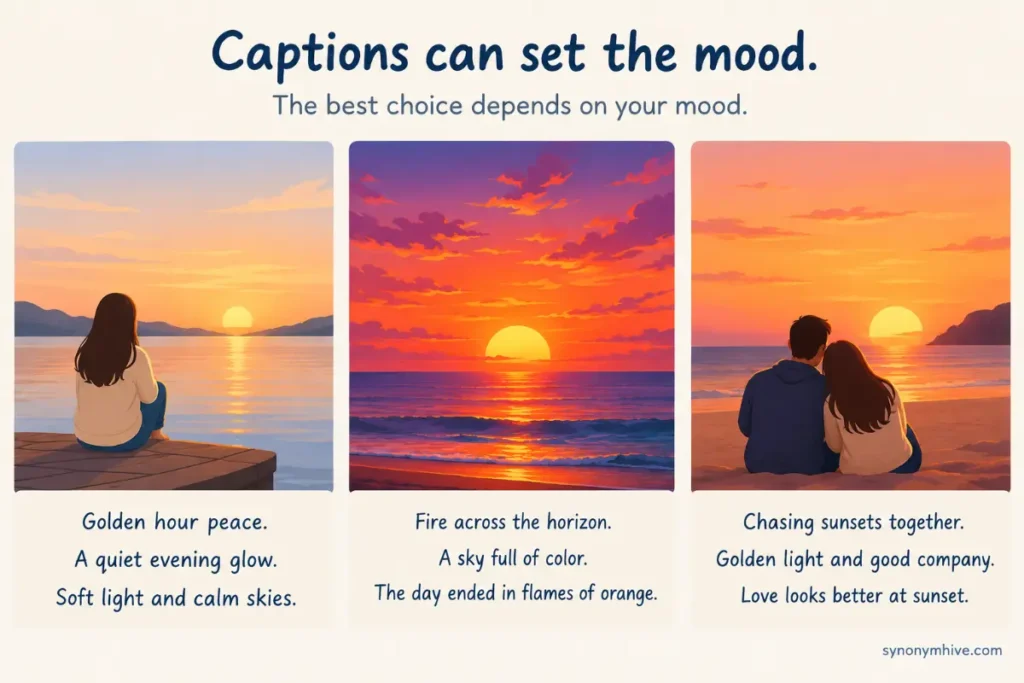
Captions can be short and expressive. The best choice depends on your mood.
For a peaceful photo:
Golden hour peace.
A quiet evening glow.
Soft light and calm skies.
For a dramatic photo:
Fire across the horizon.
A sky full of color.
The day ended in flames of orange.
For a romantic photo:
Chasing sunsets together.
Golden light and good company.
Love looks better at sunset.
For a travel photo:
Another unforgettable sunset.
Worth the long walk.
A perfect end to the day.
A caption doesn’t need a long description. One strong phrase can create the right mood.
Golden vs glowing when describing a sunset
Golden describes color. It suggests yellow, amber, or warm orange light.
Glowing describes light. It suggests something that appears to shine from within.
Compare these sentences:
The golden sunset covered the hills.
The glowing sunset lit the hills.
The first sentence focuses on color. The second focuses on brightness and light.
You can also use both:
The golden, glowing sunset covered the hills in warm light.
That combination works because the words describe different parts of the same scene.
Fiery vs dramatic when describing a sunset
Fiery usually suggests strong red, orange, or yellow colors. It can make the sunset sound hot, intense, or powerful.
Dramatic is broader. It can describe unusual clouds, sharp contrasts, powerful colors, changing light, or an impressive overall scene.
For example:
The fiery sunset burned orange above the ocean.
The dramatic sunset appeared behind thick storm clouds.
A sunset can be dramatic without being fiery. It can also be fiery without being especially dramatic.
You may also like Words to Describe Summer Ultimate Word List.
Beautiful vs breathtaking when describing a sunset
Beautiful is common and safe. It simply tells the reader that the sunset looks very pleasing.
Breathtaking is stronger. It suggests that the view is so impressive that it creates a powerful reaction.
Compare:
We watched a beautiful sunset from the beach.
We watched a breathtaking sunset from the mountain.
The second sentence gives the sunset more emotional force.
Use beautiful for everyday writing. Save breathtaking for scenes that truly deserve a stronger word.
What are common mistakes when describing a sunset
One common mistake is using too many adjectives. A sentence such as The beautiful, stunning, gorgeous, breathtaking, amazing sunset can sound forced.
Choose one or two strong words instead.
Another mistake is using vague words when a specific word would work better. Instead of saying the sunset was nice, describe its color or light.
The sunset was amber and glowing.
That sentence tells the reader much more.
A third mistake is choosing a word that does not match the scene. Calling a dark, cloudy sunset cheerful may confuse the reader unless you are deliberately creating contrast.
Another problem is repeating the same adjective. If every sentence says beautiful sunset, the description quickly becomes flat.
Change the focus instead. Describe the color in one sentence, the light in another, and the mood in a third.
When should you not use dramatic sunset words
Avoid very strong words when the scene is ordinary and the writing needs to stay factual.
A scientific report might say:
The sun appeared near the horizon, producing orange and red light across the sky.
It probably should not say:
The magnificent and breathtaking sun exploded into a magical sea of fire.
The second sentence is creative and emotional. It does not fit a scientific tone.
The same rule applies to professional writing. Match the vocabulary to the purpose.
What are the nouns and verbs you can use with sunset descriptions
Adjectives aren’t your only option. Strong nouns and verbs can make the description more natural.
Useful nouns include:
- Glow.
- Horizon.
- Rays.
- Light.
- Clouds.
- Sky.
- Colors.
- Shadows.
- Hues.
- Reflection.
- Horizon.
- Dusk.
- Twilight.
- Evening.
- Afterglow.
Useful verbs include:
- Glow.
- Fade.
- Shine.
- Spill.
- Paint.
- Reflect.
- Stretch.
- Burn.
- Drift.
- Linger.
- Melt.
- Darken.
- Illuminate.
- Spread.
- Disappear.
For example:
Golden rays spilled across the water.
The last orange light faded behind the hills.
Pink clouds reflected on the lake.
A warm glow lingered above the horizon.
These sentences often sound more vivid than adjective heavy descriptions.
How do sunset words change by region
Most common sunset vocabulary works across American and British English. Words such as golden, glowing, colorful, radiant, peaceful, dramatic, and beautiful are widely understood.
There are a few spelling differences that can appear in descriptive writing. American English uses colorful, while British English commonly uses colourful. American English also uses gray, while British English often uses grey.
The meaning stays the same.
If you are writing for a US audience, use American spellings such as colorful and gray. The vocabulary itself does not need major changes.
What are the best sunset words for different moods
| Mood | Useful words |
|---|---|
| Calm | Peaceful, serene, tranquil, gentle, quiet |
| Happy | Cheerful, bright, joyful, vibrant, colorful |
| Romantic | Dreamy, warm, lovely, enchanting, tender |
| Sad | Fading, lonely, muted, somber, wistful |
| Powerful | Fiery, blazing, intense, dramatic, striking |
| Magical | Enchanting, dreamy, ethereal, magical, mesmerizing |
| Elegant | Radiant, luminous, graceful, refined, delicate |
| Exciting | Vivid, brilliant, spectacular, dazzling, bold |
| Mysterious | Hazy, dusky, shadowy, distant, surreal |
Mood based word choice is useful because a sunset does not have one fixed emotional meaning. The same sky can seem peaceful to one person and lonely to another.
How to choose the right sunset word
Start by asking what you actually see.
Is the sky mostly orange? Use fiery, amber, coppery, or glowing.
Is it soft and pink? Try rosy, delicate, pastel, or dreamy.
Is it very bright? Use radiant, brilliant, luminous, or dazzling.
Is it quiet and calming? Choose peaceful, serene, tranquil, or gentle.
Is it unusual or striking? Try dramatic, spectacular, breathtaking, or mesmerizing.
Then think about your audience. A school essay may need clear language. A poem can use more unusual imagery. A text message should sound natural. A travel caption can be short and expressive.
Finally, check the sentence as a whole. The best adjective is not always the fanciest one. It is the word that gives the reader the clearest picture.
What are 15 original sunset description examples
Here are natural examples showing how different words can work in real situations.
- The golden sunset spread warm light across the quiet beach.
- A fiery sunset turned the clouds deep orange and red.
- The peaceful sunset reflected across the still lake.
- Vivid pink and purple colors filled the evening sky.
- A radiant glow remained above the mountains after the sun disappeared.
- The dramatic sunset appeared beneath a layer of dark storm clouds.
- Soft golden light covered the fields as evening approached.
- The breathtaking sunset made everyone stop and look toward the horizon.
- A hazy sunset faded behind the distant buildings.
- Crimson clouds floated above the ocean as the day ended.
- The dreamy sunset gave the small town a quiet, almost magical mood.
- Brilliant orange rays slipped through the clouds.
- A tranquil sunset brought a calm ending to the long day.
- The mesmerizing colors changed from gold to pink and then to purple.
- A spectacular sunset lit the mountain peaks before darkness arrived.
These examples show why precise vocabulary matters. Each sentence gives the reader a different version of the same basic event.
What are some less common words for a sunset
If you want your writing to sound more distinctive, consider words such as luminous, ethereal, amber, crimson, rosy, dusky, coppery, radiant, tranquil, and mesmerizing.
Use less common vocabulary with care. A rare word should make the picture clearer, not simply make the sentence sound more complicated.
For example, luminous is useful when light is the main focus.
The luminous sky reflected across the water.
Ethereal works when the sunset looks delicate, strange, or almost unreal.
An ethereal sunset appeared through the morning mist.
Dusky works especially well when the scene is moving toward night.
The dusky sky turned purple above the empty road.
What are the best words to describe a sunset in photography
Photography descriptions often focus on color, contrast, light, composition, and atmosphere.
Useful terms include warm, golden, vivid, saturated, dramatic, soft, muted, luminous, atmospheric, and striking.
For example:
The photograph captures a dramatic sunset with vivid orange clouds.
The image uses warm golden light to create a peaceful mood.
The soft sunset colors create a gentle contrast with the dark mountains.
Photography writing benefits from specific details. Instead of saying that the photo is beautiful, explain what makes it work.
You can mention the orange horizon, dark silhouette, reflected light, cloud patterns, or contrast between light and shadow.
What are the best phrases to describe a sunset over water
Water changes a sunset because it can reflect the sky. Words such as shimmering, glowing, mirrored, reflective, golden, sparkling, calm, and luminous work well.
Examples include:
- Golden light shimmered across the ocean.
- The glowing sky was mirrored in the lake.
- Orange clouds reflected across the calm water.
- A luminous horizon stretched over the sea.
- The sunset created a sparkling path across the waves.
These words help connect the sky with the landscape instead of treating them as separate objects.
What are the best terms to describe a sunset over mountains
For mountains, use words that show scale, contrast, and changing light.
Good choices include dramatic, majestic, golden, radiant, distant, glowing, fiery, spectacular, and breathtaking.
Examples:
The radiant sunset covered the mountain peaks in gold.
A fiery sky stretched behind the dark mountain range.
The spectacular sunset turned the highest peaks orange.
Golden light touched the distant mountains before fading into dusk.
The contrast between bright sky and dark mountains can make the scene especially striking.
What are the best words to describe a sunset at the beach
Beach sunsets often suggest warmth, peace, freedom, and beauty.
Useful words include golden, peaceful, glowing, warm, dreamy, romantic, serene, colorful, breathtaking, and tranquil.
Examples:
The peaceful sunset reflected across the quiet waves.
Golden light covered the beach as the tide moved in.
A dreamy sunset painted the clouds pink and orange.
The tranquil horizon faded from gold to purple.
For a beach caption, short language often works best. You do not need to explain every color.
What are the best words to describe a sunset after rain
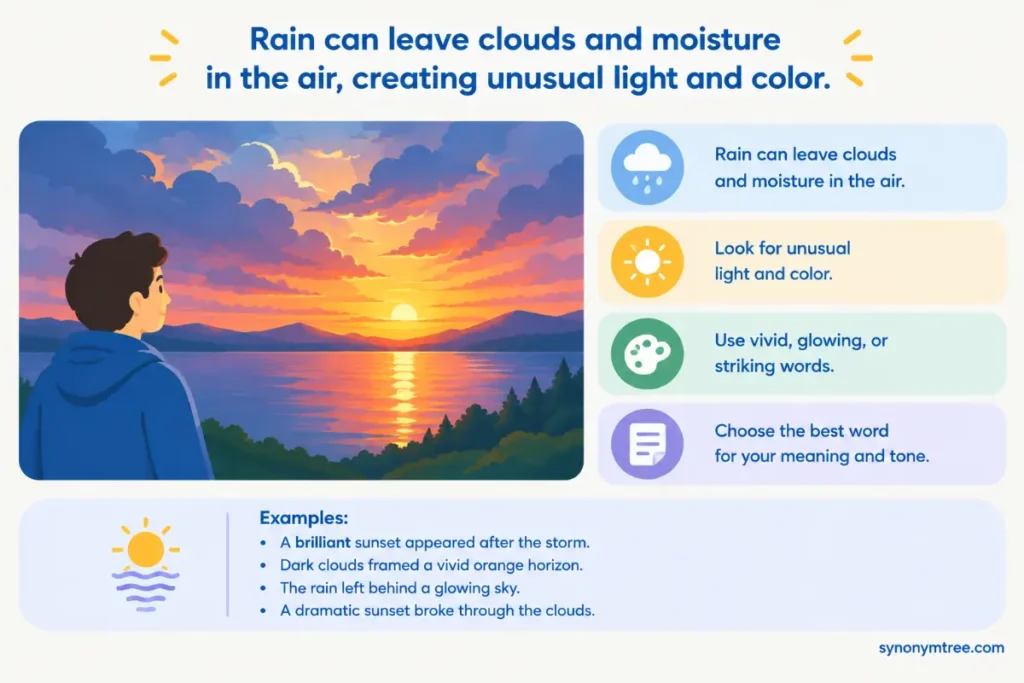
Rain can leave clouds and moisture in the air, creating unusual light and color.
Try dramatic, glowing, vivid, brilliant, fiery, colorful, radiant, or spectacular.
Examples:
A brilliant sunset appeared after the storm.
Dark clouds framed a vivid orange horizon.
The rain left behind a glowing sky.
A dramatic sunset broke through the clouds.
The contrast between dark clouds and bright light can make this kind of sunset especially memorable.
What are the antonyms of sunset description words
Antonyms can help you understand the meaning of descriptive words.
For warm, opposites include cool or cold.
For glowing, opposites include dull or dark.
These opposites are useful when you want to create contrast in writing. For example, a dull gray sky can make a sudden golden sunset seem even more powerful.
What are the best tips for describing a sunset
- Name the colors instead of relying on beautiful.
- Describe the light as well as the sky.
- Use one or two strong adjectives instead of a long string of them.
- Match the word to the mood.
- Add a clear verb such as glowing, fading, spreading, or reflecting.
- Mention the setting when it changes the image.
- Use specific nouns such as rays, clouds, horizon, shadows, and afterglow.
- Avoid using dramatic words for ordinary scenes.
- Read the sentence aloud to make sure it sounds natural.
- Choose clarity over complicated vocabulary.
- Change your word choice when the same adjective appears too often.
- Let the scene support the description.
Discover related words in Words to Describe Autumn Best Word List.
Conclusion
The best words to describe a sunset are specific enough to show the reader what makes the scene special. Golden and amber work well for warm colors. Fiery and blazing suggest strong orange or red light. Peaceful and tranquil create a calm mood, while dramatic and spectacular make the scene sound powerful.
You do not need the most complicated word. A simple word can be stronger when it fits the picture. Instead of writing that a sunset was beautiful, explain what the reader would actually see.
Think about color first, then light, then mood. Add a strong verb when you can. With that approach, your descriptions will sound natural and give readers a clear image of the sky, no matter if you’re writing an essay, caption, story, travel post, or personal message.
Frequently Asked Questions
What is another word for a beautiful sunset?
A beautiful sunset can be described as breathtaking, stunning, radiant, golden, spectacular, or mesmerizing. The best choice depends on the color and mood of the scene.
What are good words to describe a sunset?
Good words include golden, glowing, fiery, radiant, vivid, peaceful, tranquil, dramatic, breathtaking, and colorful. More specific words usually create a clearer picture than simply using beautiful.
What are some poetic words for a sunset?
Poetic choices include ethereal, crimson, amber, luminous, dreamy, enchanting, dusky, radiant, and mesmerizing. These words work well in poems, stories, creative essays, and artistic captions.
What is a strong word for sunset?
Breathtaking, spectacular, magnificent, dazzling, and mesmerizing are strong choices. Use them when the sunset is especially impressive so the description feels earned.
What are words to describe a sunset in an essay?
For an essay, use clear words such as golden, vivid, radiant, peaceful, dramatic, warm, colorful, and tranquil. Pick words that support the point of the paragraph instead of adding decoration without meaning.
How can I describe a sunset without saying beautiful?
Describe its color, light, setting, and mood instead. For example, you could say, The orange glow spread across the calm water and faded into soft pink clouds.
Can I use sunset descriptions in creative writing?
Yes. Creative writing gives you room to use imagery, comparisons, strong verbs, and emotional language. You can describe the sunset as glowing, spilling, burning, fading, painting, or melting across the horizon.