
Writing about the ocean can be harder than it looks. You may be describing a beach in an essay, writing a travel caption, or trying to explain what you saw from a boat. Saying the ocean was beautiful is correct, but it doesn’t tell the reader much. The right words can show its color, movement, sound, size, and mood.
The best words to describe the ocean depend on what you want the reader to picture. Words such as blue, calm, vast, peaceful, sparkling, powerful, mysterious, and turbulent each create a different image. Some describe what the ocean looks like, while others focus on how it sounds or makes a person feel.
Words to describe the ocean should help the reader picture its appearance, movement, sound, size, or mood. Strong choices include vast, tranquil, deep, rolling, sparkling, turbulent, majestic, mysterious, and powerful.
In this guide, you’ll find more than 30 useful choices grouped by tone and purpose. You’ll also learn how to choose the best word for an essay, text, email, caption, or conversation, plus common mistakes, close word comparisons, example sentences, and quick tips for making ocean descriptions more vivid.
Compare more word options with Words to Describe Winter Ultimate Word List.
What does ocean mean and where does the word come from
The word ocean refers to one of the large bodies of salt water that cover much of Earth’s surface. We also use ocean in a broader sense to describe the connected body of salt water that surrounds and separates continents.
The English word ocean comes through Old French and Latin from the Greek word Okeanos. In ancient Greek thought, Okeanos was the great body of water believed to surround the known world.
Today, ocean has both a literal and a figurative use. In a literal sentence, you might say, The boat crossed the ocean. In a figurative sentence, you might say, She faced an ocean of problems.
When describing the ocean, the word itself is only the starting point. A useful description adds details about what the water looks like, how it moves, what sounds it makes, and what kind of mood it creates.
For example, these sentences give very different impressions.
The ocean was vast and powerful.
The ocean was sparkling beneath the morning sun.
Each sentence points the reader toward a different picture.
What are the best words to describe the ocean
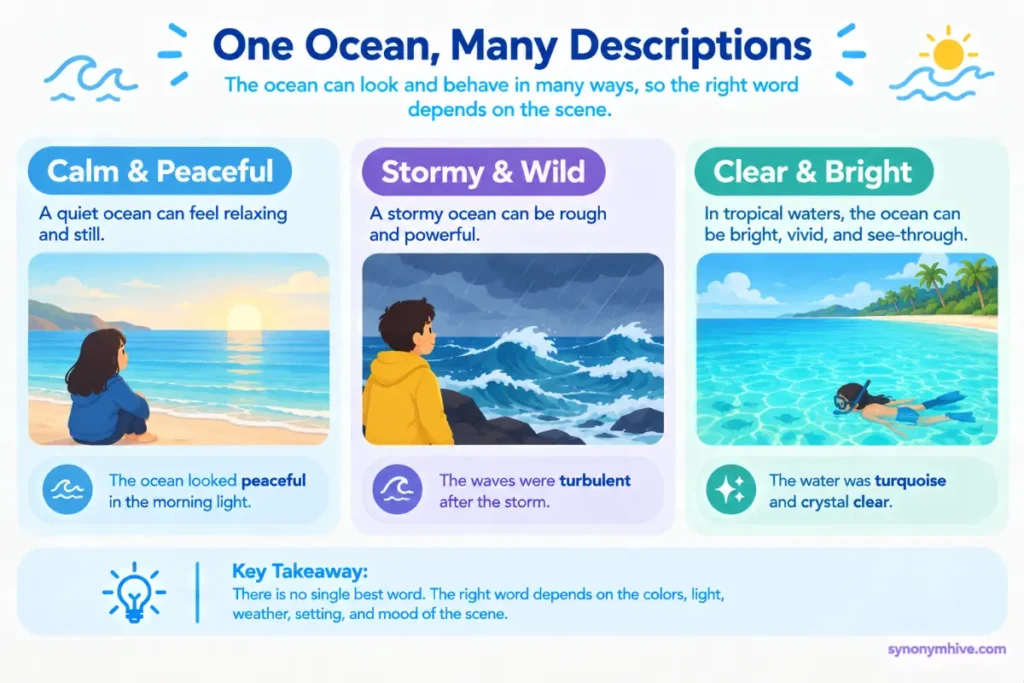
There is no single best word because the ocean can look and behave in many ways. A calm morning may call for peaceful or tranquil. A storm may call for turbulent or violent. A clear tropical sea may be turquoise, sparkling, or crystal clear.
Here is a broad list of useful choices.
| Word | Meaning | Tone | Example |
|---|---|---|---|
| Calm | Still and peaceful | Everyday | The calm ocean barely moved. |
| Soothing | Making someone feel calm | Positive | The soothing waves were easy to listen to. |
| Dramatic | Exciting or striking | Strong | The dramatic ocean rose beneath the storm clouds. |
| Wild | Untamed and forceful | Strong | The wild ocean crashed against the shore. |
| Fierce | Extremely strong or aggressive | Strong | Fierce waves struck the harbor wall. |
| Choppy | Full of short, uneven waves | Everyday | The choppy ocean made the ride uncomfortable. |
| Foamy | Covered with white bubbles | Vivid | Foamy waves rolled across the beach. |
| Salty | Containing or tasting of salt | Simple | The salty ocean air filled the morning. |
| Breezy | Having a light wind | Casual | The breezy shoreline felt cool and fresh. |
| Inviting | Appealing and welcoming | Positive | The warm, inviting ocean looked perfect for swimming. |
| Refreshing | Pleasantly cool or renewing | Positive | The refreshing ocean water cooled us down. |
| Breathtaking | Extremely beautiful or impressive | Strong | The breathtaking ocean view stopped everyone in their tracks. |
This list gives you choices for many situations. You don’t need to use the most unusual word. In most cases, the best word is the one that gives the clearest picture.
Which words describe a calm ocean
A calm ocean has little movement, gentle waves, and a peaceful appearance. The best choices include calm, peaceful, tranquil, serene, still, gentle, quiet, restful, soothing, and placid.
Calm is the simplest choice.
The calm ocean reflected the morning sky.
Peaceful adds an emotional meaning. It suggests that the scene makes people feel relaxed.
The peaceful ocean made the quiet beach feel even more inviting.
Tranquil is slightly more formal and often appears in travel writing and descriptive essays.
We sat beside the tranquil ocean as the sun rose.
Serene also suggests deep calm and quiet.
The serene ocean stretched beneath a cloudless sky.
Gentle works well when you are focusing on waves.
Gentle waves moved toward the shore.
Still suggests very little movement.
The still ocean looked like a sheet of blue glass.
These words overlap, but they aren’t exactly the same. Pick the word that matches the detail you want to highlight.
Which words describe a rough or stormy ocean
A storm changes the ocean completely. The water may become dark, loud, fast, rough, and dangerous.
Useful choices include rough, turbulent, wild, violent, fierce, restless, choppy, stormy, powerful, and raging.
Rough is a common everyday choice.
The rough ocean made it difficult for the fishing boat to stay on course.
Choppy describes many small, uneven waves.
The choppy water made the short trip uncomfortable.
Turbulent suggests unstable and violent movement.
The turbulent ocean crashed against the rocks.
Fierce emphasizes strength.
Fierce waves slammed into the harbor wall.
Raging is even stronger. It suggests intense and uncontrolled movement.
The raging ocean swallowed the lower part of the pier.
Wild can create a vivid picture without directly saying that the water is dangerous.
The wild ocean seemed impossible to control.
Restless is interesting because it can describe both physical movement and mood.
The restless ocean kept rolling toward the shore long after sunset.
Which words describe the color of the ocean
Color is one of the easiest ways to make an ocean description more specific. Blue is useful, but it is only one option.
Depending on the scene, you might use turquoise, teal, azure, navy, cobalt, deep blue, green blue, silver, gray, dark, or crystal clear.
Turquoise describes a bright blue green color. It works well for tropical water.
The turquoise ocean surrounded the small island.
Teal is a darker blue green.
The shallow water had a soft teal color.
Azure describes a bright, clear blue and has a more literary tone.
The azure ocean stretched beneath the bright sky.
Navy describes a very dark blue.
The ocean turned navy as the sun disappeared.
Silver works when sunlight or moonlight reflects on the water.
The silver ocean shimmered beneath the full moon.
Gray works well on cloudy or stormy days.
The gray ocean blended with the heavy sky.
Dark can create a sense of depth, mystery, or danger.
The dark ocean disappeared beneath the storm clouds.
You can also combine color words with other details.
The turquoise water sparkled near the shore.
The deep blue ocean looked endless from the cliff.
The silver waves moved beneath the moonlight.
The dark green water crashed against the rocks.
Which words describe ocean waves
Waves can be gentle, rolling, choppy, crashing, towering, foamy, powerful, or rhythmic.
Rolling describes waves that move in a smooth, rounded way.
Large rolling waves approached the beach.
Crashing emphasizes sound and force.
Crashing waves filled the air with a deep roar.
Foamy describes waves covered with white bubbles.
Foamy waves spread across the sand.
Rhythmic describes repeated movement that follows a pattern.
The rhythmic waves created a peaceful background sound.
Towering suggests waves that rise high above the surrounding water.
Towering waves formed beyond the breakwater.
You can also use verbs to make your description more active.
The waves rolled toward the shore.
The waves crashed against the cliffs.
These verbs often make writing stronger than simply saying the ocean was wavy.
Which words describe the sound of the ocean
The ocean can sound soft, loud, deep, rhythmic, soothing, powerful, or thunderous.
For a peaceful scene, try soothing, gentle, soft, quiet, rhythmic, or whispering.
The soothing sound of the waves filled the room.
The gentle waves made a soft sound against the sand.
For a dramatic scene, use roaring, thunderous, crashing, booming, or rumbling.
The roaring ocean echoed between the cliffs.
The thunderous waves shook the rocks below.
The crashing water filled the night with sound.
Be careful with words such as whispering. The ocean does not literally whisper. This is a form of figurative language called personification, where something nonhuman is described as if it were human.
The ocean whispered against the shore.
That sentence creates a soft, poetic image.
Which words describe the size of the ocean
The ocean is enormous, so words about size can help show scale.
Useful choices include vast, immense, enormous, expansive, endless, boundless, massive, wide, deep, and immense.
Vast is one of the strongest everyday choices.
The vast ocean stretched beyond the horizon.
Expansive is slightly more formal.
The expansive ocean surrounded the island on every side.
Endless suggests that the ocean seems to continue forever.
The endless ocean made the small boat seem tiny.
Boundless suggests a lack of limits and often has a poetic tone.
The boundless ocean stretched beneath the morning sun.
Immense emphasizes great size.
The immense ocean covered the horizon from every direction.
These words work especially well when you want to compare the ocean with a person, boat, island, or shoreline.
From the top of the cliff, the vast ocean made the fishing boats look like tiny dots.
That sentence does more than tell the reader the ocean is big. It gives the reader a sense of scale.
What are the best words for an ocean in a poem
Poetry gives you more freedom to use emotional and figurative language. Words such as endless, restless, mysterious, wild, lonely, silent, shimmering, boundless, ancient, and majestic can work well.
Ancient can suggest the long history of the sea.
The ancient ocean carried stories older than any city.
Restless can give the ocean a human quality.
The restless ocean refused to sleep.
Mysterious suggests that the ocean contains things we cannot easily understand.
The mysterious ocean hid its secrets beneath the waves.
Majestic suggests beauty combined with size and power.
The majestic ocean stretched beneath the fading light.
You can also use metaphors.
The ocean was a blue mirror.
The ocean was a restless giant.
The sea was a blanket of silver.
The waves were white horses racing toward the shore.
These descriptions aren’t literal. They help readers form a stronger mental image.
What are the best words for an essay
For school essays, clear words usually work better than rare or dramatic ones. Try calm, vast, powerful, peaceful, mysterious, deep, turbulent, expansive, and beautiful.
A strong essay sentence might say:
The vast ocean plays an important role in the lives of people who live along the coast.
Another example is:
The powerful ocean can shape beaches, cliffs, and other parts of the coastline over time.
If you’re writing about the environment, useful terms include polluted, threatened, fragile, diverse, living, vital, and interconnected.
The fragile ocean ecosystem supports thousands of forms of marine life.
If you’re writing about a personal experience, emotional words may work better.
The peaceful ocean helped me forget the stress of the week.
Choose words that support your main point instead of adding decoration.
What are the best words for a resume
An ocean description usually doesn’t belong on a resume unless your work involves travel, photography, marine science, tourism, writing, or another related field.
If you need to describe an ocean related project, use precise words such as expansive, coastal, marine, environmental, powerful, dynamic, or diverse.
For example:
Created educational content about marine ecosystems and coastal environments.
The word marine is especially useful in professional writing because it directly relates to the sea and ocean life.
If you’re describing photography, you might say:
Produced vivid coastal photographs showing changing light, waves, and ocean conditions.
The goal in a resume is clarity. Avoid overly poetic descriptions unless the job specifically calls for creative writing.
What are the best words for texting
Text messages are more casual, so simple words often sound most natural.
You might write:
The ocean was gorgeous today.
The water was insanely blue.
The waves were huge.
The beach was so peaceful.
The ocean looked unreal at sunset.
For a funny or casual message, slang can work too.
That ocean view was wild.
The waves were epic.
The water looked amazing.
Still, context matters. A phrase that sounds natural in a text may sound out of place in a school essay.
What are the best words for an email
Professional emails usually need clear and polite language. Words such as beautiful, peaceful, impressive, scenic, coastal, clear, and calm are safe choices.
For example:
The hotel offers an impressive view of the ocean.
Another option is:
The property has a peaceful coastal setting with direct ocean views.
If you are writing to a client, avoid overly dramatic language unless it fits the subject.
A phrase like breathtaking ocean view may work in a travel business email. A phrase like the wild ocean of dreams would usually sound too poetic for a normal professional message.
What are the best words for speaking
When speaking, choose words that are easy to say and easy for the listener to understand.
Calm, beautiful, huge, deep, blue, peaceful, rough, powerful, and wild all work well.
You might say:
The ocean was incredibly calm this morning.
Or:
The waves were huge, and the water looked dark.
You don’t need unusual vocabulary to sound intelligent. A clear word paired with a specific detail is often much stronger.
Instead of saying:
The ocean was beautiful.
Try:
The ocean was deep blue, and sunlight kept flashing across the waves.
The second sentence gives the listener something to picture.

What are the best words to describe the ocean by intensity
Not every ocean scene needs a strong word. Matching intensity to the scene keeps your writing believable.
Mild descriptions
Use these for ordinary or peaceful scenes.
Calm.
Quiet.
Gentle.
Blue.
Clear.
Soft.
Still.
Pleasant.
Medium descriptions
These create a stronger image without sounding extreme.
Sparkling.
Shimmering.
Vast.
Rolling.
Restless.
Powerful.
Deep.
Expansive.
Strong descriptions
These work when the scene is dramatic.
Turbulent.
Fierce.
Wild.
Raging.
Towering.
Thunderous.
Majestic.
Breathtaking.
A useful rule is simple. Don’t use a powerful word for a small detail.
For example, a calm shoreline doesn’t need the word raging. A stormy sea may need something much stronger than peaceful.
What are the different parts of speech used to describe the ocean
Most ocean descriptions use adjectives because adjectives tell readers what something is like.
Examples include:
Calm.
Deep.
Blue.
Vast.
Powerful.
Peaceful.
Mysterious.
Turbulent.
You can also use nouns to create a stronger image.
Waves.
Surf.
Tide.
Current.
Horizon.
Water.
Sea.
Storm.
Verbs make descriptions more active.
Rolls.
Crashes.
Surges.
Swells.
Shimmers.
Sparkles.
Roars.
Drifts.
Adverbs can add detail to actions.
The waves moved gently.
The ocean shimmered brightly.
The water crashed violently against the rocks.
Strong descriptive writing often combines several parts of speech.
The vast blue ocean shimmered beneath the morning sun.
Here, vast and blue are adjectives, ocean is a noun, shimmered is a verb, and morning describes the sun.
What is the difference between vast and endless
Vast and endless both describe something very large, but they create different ideas.
| Word | Main idea | Example |
|---|---|---|
| Vast | Extremely large | The vast ocean surrounded the island. |
| Endless | Seeming to have no end | The endless ocean disappeared beyond the horizon. |
Vast focuses on size.
Endless focuses on the impression that something continues without stopping.
You can use both together, but you usually don’t need to.
The vast ocean stretched across the horizon.
The endless ocean stretched across the horizon.
Both are correct. The second sounds more emotional and imaginative.
Find more synonyms in Words to Describe a Smile: Words for Stories and Poems 2026.
What is the difference between calm and serene
Calm and serene are close, but serene often suggests a deeper sense of peace.
| Word | Main idea | Example |
|---|---|---|
| Calm | Little movement or disturbance | The calm ocean barely moved. |
| Serene | Deeply peaceful and quiet | The serene ocean reflected the pale sky. |
Calm is common in everyday speech.
Serene sounds more polished and descriptive.
For a simple text, use calm. For creative writing or a formal description, serene may fit better.
What is the difference between rough and turbulent
Rough describes difficult or uneven water. Turbulent suggests stronger disorder and movement.
| Word | Main idea | Example |
|---|---|---|
| Rough | Strong or uneven waves | The rough ocean rocked the boat. |
| Turbulent | Violent or unstable movement | The turbulent ocean crashed against the shore. |
A rough sea may be uncomfortable but not dangerous.
A turbulent sea usually sounds more intense.
This distinction matters when you’re describing weather, boating conditions, or a storm.
What is the difference between sparkling and shimmering
Sparkling suggests many bright flashes of light. Shimmering suggests a softer, moving glow.
| Word | Main idea | Example |
|---|---|---|
| Sparkling | Bright flashes | The sparkling water reflected the sun. |
| Shimmering | Soft moving light | The shimmering ocean glowed at sunset. |
Sparkling often sounds brighter.
Shimmering often sounds softer and more graceful.
Both are useful for sunlight or moonlight reflecting on water.
What are common mistakes when describing the ocean
One common mistake is using the same basic adjectives again and again.
The ocean was beautiful. The beautiful ocean was blue. The beautiful blue ocean had beautiful waves.
This becomes repetitive very quickly.
Instead, focus on different features.
The ocean was deep blue. Gentle waves rolled toward the shore. Sunlight shimmered across the surface.
Another mistake is using words that don’t match the scene.
Calling a stormy ocean peaceful creates a confusing image unless you’re deliberately using contrast.
A third mistake is choosing words that are too strong.
The ocean was terrifying may be fine during a hurricane. It may sound strange for a calm afternoon at the beach.
Another problem is using poetic language in a setting that needs precision. A scientific report should describe water conditions, temperature, waves, currents, or marine life rather than relying on dramatic phrases.
Finally, avoid stacking too many adjectives.
The vast, majestic, breathtaking, beautiful, mysterious, sparkling, powerful ocean looked amazing.
That sentence has too much decoration. Choose two or three details that matter most.
The vast, sparkling ocean stretched beyond the quiet beach.
That version is cleaner and easier to picture.
When should you not use poetic ocean words
Poetic language isn’t always the best choice.
Avoid heavy imagery in technical writing, scientific reports, instructions, and formal documents unless the style allows it.
For example, a marine science report might say:
The water was clear, and visibility extended several meters below the surface.
It would not usually say:
The magical ocean revealed its hidden world beneath the waves.
The second sentence may work in a story, but not in a scientific report.
The right word depends on your goal. Creative writing can use emotion and imagery. Informational writing usually needs accuracy and clarity.
What are the antonyms of ocean description words
Knowing opposites can help you understand each word more clearly.
Calm is opposite to turbulent or rough.
Peaceful is opposite to violent or chaotic.
Clear is opposite to cloudy or murky.
Bright is opposite to dark.
Shallow is opposite to deep.
Gentle is opposite to fierce.
Still is opposite to moving or restless.
Quiet is opposite to loud or roaring.
Beautiful is opposite to ugly, although beauty is subjective.
Sparkling is opposite to dull.
These opposites can also help you create contrast in writing.
The ocean looked calm in the morning, but it became turbulent by evening.
The water was clear near the shore but dark and murky farther out.
Contrast gives a description movement and makes the scene more interesting.
How can you choose the right ocean word quickly
Start by asking what you actually see.
Is the weather clear or stormy.
Is the ocean close by or stretching to the horizon.
Then choose a word that answers that specific question.
If you want to show size, use vast, immense, expansive, endless, or boundless.
If you want to show mystery, use deep, dark, mysterious, or unknown.
Specific details usually matter more than impressive vocabulary.
How can you make an ocean description more vivid
A strong description often uses more than one sense.
Don’t only describe what the ocean looks like. Describe its sound, movement, smell, temperature, and effect on the person observing it.
For example:
The deep blue ocean shimmered beneath the afternoon sun. Gentle waves rolled across the sand while salty air drifted through the warm breeze. The steady sound of the water made the crowded beach seem quiet.
This works because the reader can see the color, hear the waves, and sense the air.
You can also show scale.
From the cliff, the vast ocean stretched beyond the horizon, making the boats below look like tiny specks.
Or show movement.
The restless ocean surged around the rocks, sending white foam into the air.
Or show emotion.
The peaceful ocean gave her a quiet place to think.
These approaches help you avoid flat descriptions.
How can you describe the ocean in different moods
The same ocean can create very different moods.
For a peaceful mood:
The tranquil ocean moved gently beneath the soft morning light.
For a romantic mood:
The shimmering ocean reflected the last golden light of the day.
For a mysterious mood:
The dark ocean disappeared beneath a layer of fog.
For a frightening mood:
The turbulent ocean crashed against the rocks as the storm grew stronger.
For an exciting mood:
Powerful waves surged toward the shore as surfers waited for the perfect ride.
For a lonely mood:
The endless ocean stretched around the small boat in every direction.
For a joyful mood:
The bright blue ocean sparkled as children ran through the shallow waves.
Mood words are especially useful in stories, poems, captions, and personal essays.
What are 15 natural sentences using ocean descriptions
- The calm ocean reflected the pale morning sky.
- A vast blue ocean stretched beyond the horizon.
- The turquoise water looked clear enough to reveal the rocks below.
- Gentle waves rolled across the quiet beach.
- The sparkling ocean caught the sunlight from every direction.
- The dark water became restless as the wind grew stronger.
- Powerful waves crashed against the rocky coastline.
- The peaceful ocean made the busy day seem far away.
- A shimmering path of moonlight crossed the surface of the water.
- The turbulent ocean forced the fishing boats back toward the harbor.
- The deep ocean looked almost black from the edge of the cliff.
- The majestic ocean filled the entire view from the mountain.
- Foamy waves curled around our feet before sliding back into the sea.
- The endless ocean made the small island seem even more remote.
- The mysterious ocean stretched beneath the cloudy evening sky.
Notice that each sentence gives the reader a different detail. Good description isn’t about finding one perfect adjective. It’s about choosing a word that fits the exact scene.
How do US and UK English differ when describing the ocean
The word ocean is standard in both US and UK English. The basic descriptive vocabulary is also largely the same.
One useful regional difference is the word sea. In American English, ocean is common when referring to the Atlantic Ocean, Pacific Ocean, Indian Ocean, and other named oceans. Sea is also widely used, especially for smaller areas of salt water.
British English often uses sea more broadly in everyday speech. Someone in the UK might naturally say, We went to the seaside, while an American speaker is more likely to say, We went to the beach.
The choice often depends on the place and context rather than a strict grammar rule.
The spelling of many descriptive words remains the same across both forms of English. Words such as calm, peaceful, vast, deep, blue, turbulent, and sparkling work naturally in both.
What words work best for ocean captions
Captions need to be short, clear, and easy to remember.
For a peaceful photo:
Ocean calm.
Lost in the blue.
Peace by the sea.
For a bright beach photo:
Blue skies and brighter seas.
Chasing the sunlight.
A little ocean therapy.
For a dramatic photo:
Wild water.
Where the waves roar.
Stormy seas ahead.
For a sunset photo:
Golden light over the ocean.
The sea beneath the fading sun.
A shimmering horizon.
You don’t need a long caption when the image already tells part of the story.
What words describe ocean water for travel writing
Travel writing often benefits from sensory and visual words.
Clear, turquoise, warm, refreshing, inviting, sparkling, peaceful, scenic, pristine, and breathtaking can all work.
For example:
The island is surrounded by clear turquoise water and soft white sand.
Another option is:
Visitors can enjoy warm, refreshing water along the quiet coastline.
Pristine can suggest that an area looks clean and untouched.
The resort sits beside a pristine stretch of coastline.
Be careful with words such as pristine if you don’t have evidence that the area is truly untouched or exceptionally clean. Descriptive writing should still be honest.
How can you avoid repeating the word beautiful
Beautiful is useful, but it is broad. It doesn’t tell the reader what kind of beauty you mean.
Instead, ask what creates the beauty.
If the color stands out, use turquoise, azure, or deep blue.
If the scene creates a strong emotional reaction, use breathtaking or awe inspiring.
For example:
The beautiful ocean was beneath the sunset.
can become:
The shimmering ocean reflected orange and gold beneath the sunset.
The second sentence gives a reason for the beauty. That makes the writing stronger.
How can you remember the best ocean words
A simple memory method is to group words by what they describe.
For mood, remember peaceful, serene, mysterious, dramatic, wild, and majestic.
For light, remember sparkling, shimmering, glowing, and bright.
This approach is easier than trying to memorize a long random list. When you need a word, think about the feature you want to describe first.
Quick tips for choosing better ocean words
- Describe the exact feature you see instead of using a broad adjective.
- Match the word to the mood of the scene.
- Use simple words when simple words are enough.
- Save strong words such as raging and turbulent for strong conditions.
- Mix adjectives with active verbs such as roll, crash, surge, shimmer, and drift.
- Add sensory details such as sound, smell, temperature, and movement.
- Avoid using beautiful in every description.
- Don’t stack too many adjectives together.
- Consider your audience and choose vocabulary that fits the setting.
- Read the sentence aloud. If it sounds forced, choose a simpler word.
The strongest ocean descriptions usually don’t depend on rare vocabulary. They depend on accurate details.
What is the best word for the ocean in different situations
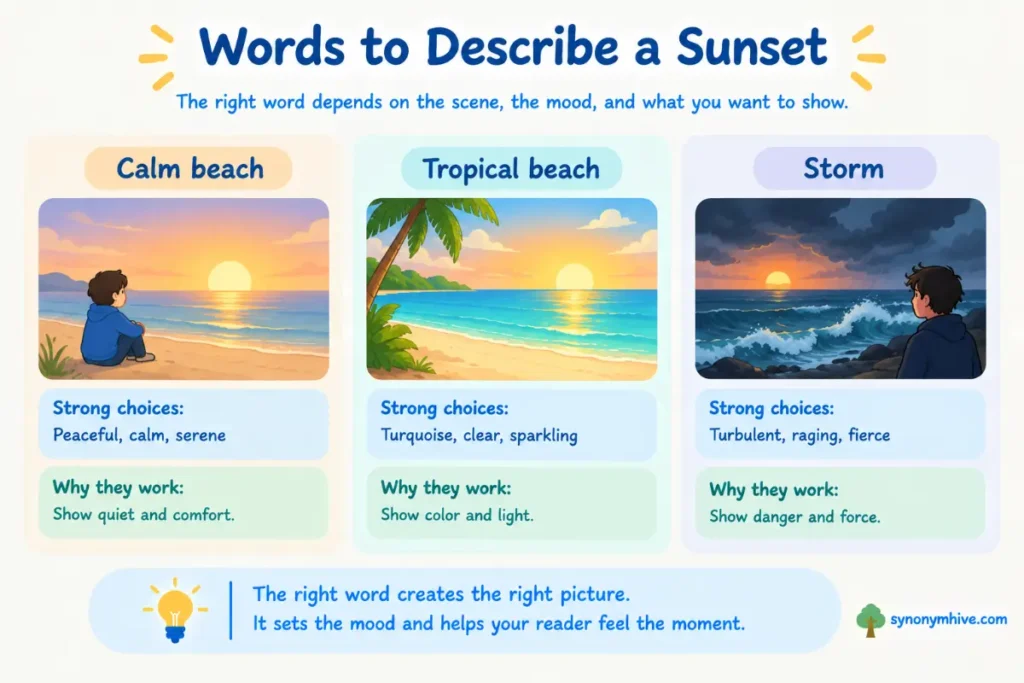
| Situation | Strong choices | Why they work |
|---|---|---|
| Calm beach | Peaceful, calm, serene | Show quiet and comfort |
| Tropical beach | Turquoise, clear, sparkling | Show color and light |
| Storm | Turbulent, raging, fierce | Show danger and force |
| Sunset | Shimmering, glowing, golden | Show changing light |
| Moonlight | Silver, shimmering, glowing | Show soft reflection |
| Essay | Vast, powerful, deep, expansive | Clear and useful |
| Poem | Endless, boundless, mysterious | More emotional |
| Text message | Gorgeous, wild, huge, amazing | Casual and natural |
| Travel writing | Scenic, breathtaking, pristine, inviting | Create a strong place image |
| Science writing | Marine, deep, coastal, saline | More precise and factual |
| Story | Restless, dark, wild, mysterious | Create mood |
| Caption | Blue, sparkling, peaceful, endless | Short and memorable |
The best word changes with the purpose of the sentence. A scientific report and a poem should not sound the same.
Expand your vocabulary with Words to Describe Eyes: Words for Eye Colors 2026.
Conclusion
The best ocean description gives the reader a clear picture instead of simply saying something is beautiful. Think about color, movement, sound, size, light, and mood before choosing your word. A calm sea may be serene or peaceful, while stormy water may be turbulent, fierce, or raging.
You can also make your writing stronger by combining a useful adjective with an active verb. The vast ocean shimmered is more vivid than the ocean was beautiful. Small details give readers something they can picture.
When choosing words to describe the ocean, always match the vocabulary to your purpose. A school essay needs clear language. A poem can be more imaginative. A text can be casual. A travel description can be vivid and inviting.
The easiest rule is to describe what makes the ocean stand out. Name the color, show the movement, capture the sound, and let the reader see the scene through your words.
Frequently Asked Questions
What are good words to describe the ocean?
Good choices include calm, vast, deep, peaceful, sparkling, turquoise, powerful, mysterious, turbulent, majestic, and endless. The best choice depends on the ocean’s appearance, movement, sound, and mood.
What’s another way to say the ocean is beautiful?
You can say the ocean is breathtaking, majestic, stunning, sparkling, serene, or mesmerizing. For stronger writing, explain what makes it beautiful instead of using a general word alone.
What are the best words to describe a calm ocean?
Calm, peaceful, tranquil, serene, still, gentle, soothing, and restful are strong choices. Use calm for simple writing and serene or tranquil when you want a more polished tone.
What words describe a stormy ocean?
Turbulent, rough, fierce, wild, raging, violent, choppy, and restless can describe a stormy ocean. Choose the word based on how strong and dangerous the water appears.
Can I use these words in a school essay?
Yes, many of these words work well in school essays. Clear choices such as vast, powerful, peaceful, deep, turbulent, and expansive are usually better than rare words that make the sentence harder to understand.
What are the best phrases to describe the ocean in poetry?
Poetry can use words such as endless, boundless, mysterious, restless, majestic, shimmering, wild, and ancient. Figurative language can also make the scene more memorable.
How do I choose the right terms to describe the ocean?
Start with what you can actually see, hear, or feel. Then choose a word that describes that exact detail instead of reaching for the most dramatic word.