

Writing a birthday message, personal essay, thank you note, or social post can make one simple question surprisingly hard: how do you describe joy without repeating the word happy? The phrase words to describe joy helps you find language that shows exactly how strong, warm, or playful the emotion is.
Joy can be quiet or overwhelming. You might feel peaceful after a long day, thrilled after good news, delighted by a small surprise, or deeply grateful for time with someone you love. Each word gives the reader a slightly different picture.
Words to describe joy are terms that show happiness, pleasure, delight, excitement, satisfaction, or deep emotional warmth. The best choice depends on the kind of joy you want to express and the situation in which you are writing.
This guide explains the meaning and history of joy, gives you more than 30 useful choices, compares close synonyms, and shows which words work best in essays, emails, texts, resumes, and everyday speech. You will also see examples that make the differences easier to understand.
Expand your vocabulary with Words to Describe Pain Best Guide In 2026.
What does joy mean in simple English?
Joy is a strong feeling of happiness, pleasure, or deep emotional satisfaction. It can come from a major event, a small moment, a close relationship, or a sense of peace and gratitude.
The word joy often suggests something deeper than ordinary happiness. Happiness can describe a general good mood, while joy can describe a powerful or meaningful sense of delight.
For example, you might be happy because you finished your work early. You might feel joy when you hear that a loved one is safe, welcome a new child into the family, or reach a goal you worked toward for years.
What are the best words to describe joy?
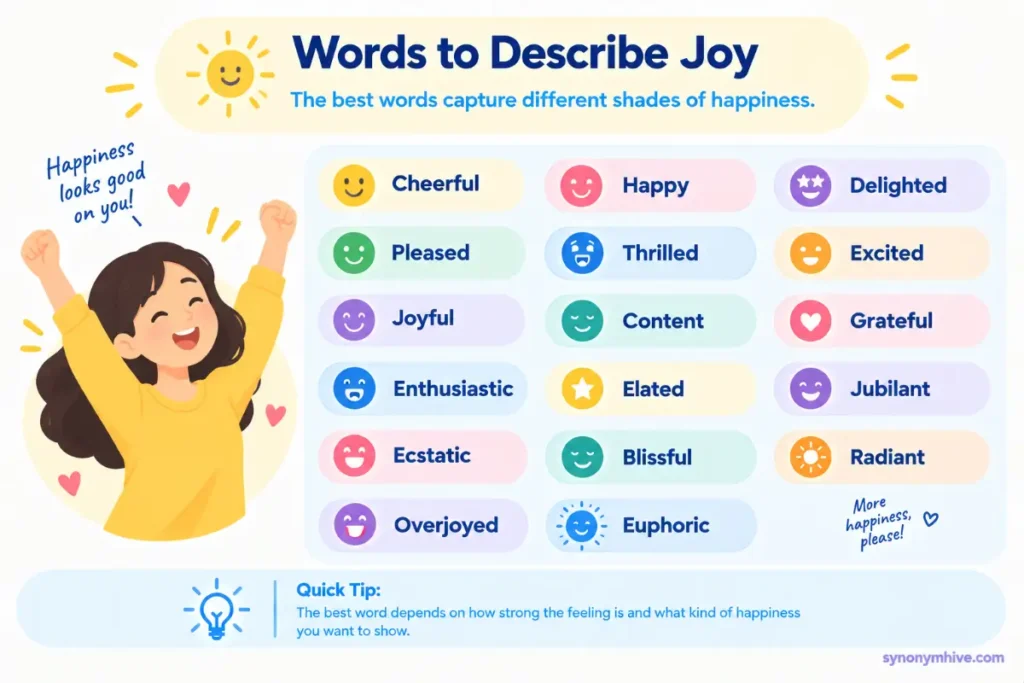
The best words to describe joy include cheerful, happy, delighted, pleased, thrilled, excited, joyful, content, grateful, enthusiastic, elated, jubilant, ecstatic, blissful, radiant, overjoyed, and euphoric.
The right word depends on intensity and context. A person can be quietly content, warmly delighted, extremely thrilled, or completely ecstatic. Choosing a precise word makes your writing more vivid.
Where does the word joy come from?
The English word joy has a long history. It came into English through Old French joie, which was connected to the Latin word gaudium. The Latin term referred to joy, delight, or a feeling of gladness.
The word has been used in English for many centuries. Over time, it developed a broad meaning that covers pleasure, happiness, delight, and deep emotional satisfaction.
Joy can describe an emotion, but it can also describe a source of pleasure. For example, you can say, “Music brings me great joy.” In that sentence, joy is not simply a passing reaction. It describes the pleasure that music gives the speaker.
The related adjective joyful means full of joy. The noun delight is close in meaning, but it often suggests pleasure caused by something specific. The adjective joyous can describe something marked by happiness or celebration.
This history helps explain why joy has such a warm meaning today. It is not limited to laughter or excitement. It can also describe a deep sense of gladness that lasts longer than a brief burst of pleasure.
What are 30 useful words to describe joy?
The following table gives you a wide range of choices. Some words are simple and natural. Others work better in formal writing or situations where you want a stronger emotional effect.
| Word | Meaning | Tone | Example |
|---|---|---|---|
| Elated | Extremely happy | Formal | She was elated after hearing the news. |
| Jubilant | Extremely joyful, often after success | Formal | The crowd was jubilant after the victory. |
| Ecstatic | Overwhelmingly happy | Formal | He was ecstatic about the result. |
| Blissful | Deeply peaceful and happy | Formal | They spent a blissful afternoon together. |
| Euphoric | Feeling intense happiness or excitement | Formal | The team felt euphoric after the win. |
| Exuberant | Full of lively energy and joy | Formal | Her exuberant personality filled the room. |
| Radiant | Showing happiness clearly | Formal | She had a radiant smile. |
| Buoyant | Cheerful and hopeful | Formal | He remained buoyant despite the setback. |
| Overjoyed | Extremely happy | Strong | The parents were overjoyed by the news. |
| Triumphant | Joyful because of success | Strong | She looked triumphant after finishing the race. |
| Gleeful | Very happy in a lively way | Casual | The children were gleeful when the game began. |
| Mirthful | Full of amusement and laughter | Literary | His mirthful laugh echoed across the room. |
| Blissful | Deeply happy and peaceful | Warm | The couple enjoyed a blissful weekend. |
| Upbeat | Positive and cheerful | Casual | She stayed upbeat throughout the busy day. |
| On cloud nine | Extremely happy | Informal | He was on cloud nine after the proposal. |
| Delighted | Very pleased | Everyday | I was delighted to hear from you. |
| Pumped | Very excited and energized | Slang | She was pumped for the concert. |
| Stoked | Very excited | Slang | He was stoked about the new opportunity. |
| Psyched | Very excited | Slang | We were psyched for the weekend. |
| Over the moon | Extremely happy | Informal | She was over the moon about her new job. |
The table includes words with different emotional strengths. That matters because saying someone is content creates a very different picture from saying they are ecstatic.
Which words describe mild joy?
Mild joy is usually calm, gentle, or controlled. It does not suggest a huge emotional reaction.
Good choices include:
- Content.
- Pleased.
- Glad.
- Satisfied.
- Cheerful.
- Comfortable.
- Peaceful.
- Grateful.
- Calm.
- Lighthearted.
Content is one of the best choices when you want to show quiet satisfaction. A person who is content does not need to be excited or energetic.
For example, “After dinner, she felt content sitting by the window” suggests a peaceful form of happiness.
Glad is more direct and common in everyday speech. You might say, “I am glad you made it home safely.”
Grateful adds a sense of appreciation. “He felt grateful for the chance to spend time with his parents” expresses more than simple happiness.
Which words describe strong joy?
Strong joy calls for stronger language. These words suggest a clear emotional high.
Useful choices include:
- Thrilled.
- Elated.
- Overjoyed.
- Ecstatic.
- Euphoric.
- Jubilant.
- Exuberant.
- Triumphant.
- Blissful.
- Radiant.
Thrilled works well in everyday writing. “She was thrilled when she got the job” sounds natural and clear.
Elated sounds more formal. It is useful in essays, reports, and polished personal writing.
Ecstatic describes extremely intense happiness. It can sound too strong for small events, so save it for moments that truly deserve it.
Jubilant often connects joy with success or celebration. A winning team can be jubilant after a major victory.
Triumphant has a similar connection to success. It suggests that the person has overcome something or achieved an important goal.
Which words describe quiet joy?
Not every joyful moment involves laughter, cheering, or excitement. Sometimes joy is soft and peaceful.
Words such as content, peaceful, grateful, satisfied, serene, comforted, and fulfilled can describe this kind of emotion.
Consider the difference between these two sentences.
“She was ecstatic after the concert.”
“She felt peaceful as she watched the sunset.”
Both describe positive emotions, but the first suggests high energy while the second suggests calm pleasure.
Fulfilled is especially useful when joy comes from meaning or achievement. Someone might feel fulfilled after helping another person, finishing a difficult project, or spending time on work that matters to them.
Which words describe joyful energy?
Sometimes joy is active. A person may laugh, talk quickly, smile often, or move with excitement.
Words that fit this kind of emotion include exuberant, enthusiastic, lively, animated, energetic, gleeful, excited, upbeat, and spirited.
Exuberant is useful when someone shows a lot of lively emotion. “Her exuberant greeting made everyone smile.”
Enthusiastic is a good choice when joy is connected to interest. “The students were enthusiastic about the science experiment.”
Gleeful often describes playful happiness. It can work especially well for children or someone enjoying a funny situation.
Upbeat is common in American English. It describes a positive attitude more than a single burst of emotion.
Which words describe joy after success?
Success can create a special kind of happiness. The person is not only pleased. They are proud, relieved, or excited because a goal has been reached.
Strong choices include:
- Triumphant.
- Jubilant.
- Elated.
- Overjoyed.
- Thrilled.
- Proud.
- Celebratory.
- Satisfied.
- Fulfilled.
- Victorious.
Triumphant is especially strong when someone has overcome difficulty.
“After months of training, Maya felt triumphant when she crossed the finish line.”
Elated is more focused on the feeling itself.
“Jordan was elated after learning that his application had been accepted.”
Satisfied works when the emotion is quieter.
“She felt satisfied after completing the final stage of the project.”
Which words describe joy caused by love or relationships?
Joy connected to another person often has warmth, affection, gratitude, and closeness.
Useful words include loving, affectionate, grateful, delighted, comforted, cherished, joyful, warm, blessed, and fulfilled.
For example, “He felt grateful to have his family around him” shows appreciation.
“She was delighted to spend the weekend with her best friend” shows pleasure connected to companionship.
“His face was radiant when he saw his daughter” shows joy through a visible reaction.
In personal writing, these words often work better than very strong terms such as ecstatic. A warm word can sound more sincere than an exaggerated one.
Which words describe joy in formal writing?
Formal writing usually benefits from precise and controlled language. Good options include delighted, elated, jubilant, content, fulfilled, grateful, enthusiastic, pleased, optimistic, and appreciative.
Avoid slang in school essays, professional reports, and formal emails unless the assignment or audience calls for casual language.
For example, “The team was stoked about the result” sounds casual.
“The team was enthusiastic about the result” is more suitable for formal writing.
“Stoked” is not wrong. It simply belongs to a different style.
How do words for joy change by part of speech?
Knowing the grammar of each word helps you place it correctly in a sentence.
Adjectives that describe a joyful person
Common adjectives include happy, cheerful, joyful, delighted, excited, thrilled, pleased, content, elated, ecstatic, grateful, enthusiastic, exuberant, and jubilant.
Examples:
“She was delighted by the gift.”
“He looked cheerful this morning.”
“They were thrilled with the result.”
Nouns that describe joyful feelings
Common nouns include joy, happiness, delight, pleasure, excitement, satisfaction, bliss, euphoria, gratitude, and enthusiasm.
Examples:
“The news brought him great joy.”
“Her excitement was obvious.”
“Everyone shared the same sense of satisfaction.”
Verbs that express joy
Common verbs include celebrate, rejoice, smile, laugh, enjoy, cheer, delight, appreciate, and rejoice.
Examples:
“They celebrated the victory.”
“She smiled when she saw the surprise.”
“He rejoiced when he learned the news.”
Adverbs that show joyful emotion
Words such as happily, cheerfully, joyfully, gladly, enthusiastically, and excitedly can describe how an action happens.
Examples:
“She gladly accepted the invitation.”
“He enthusiastically joined the discussion.”
“The children ran joyfully across the yard.”
Is there a difference between joy and happiness?
Yes. Joy and happiness overlap, but they can suggest different things.
Happiness is a broad word for a positive emotional state. It can describe a mood, a reaction, or a general sense of well being.
Joy often suggests a deeper or more intense feeling of delight. It can also describe a lasting source of emotional pleasure.
Compare these examples.
“I felt happy after getting a good grade.”
“I felt deep joy when my family came to visit.”
The first sentence describes a positive reaction. The second suggests a stronger emotional connection.
Still, these meanings are not strict rules. People use happy and joy in many of the same situations.
Joy vs delight: what is the difference?
Joy and delight are close, but delight often points to a particular source of pleasure.
| Joy | Delight |
|---|---|
| Can be deep or lasting | Often comes from a specific event |
| Can describe a general feeling | Often describes a reaction |
| Can sound emotional or meaningful | Often sounds lighter and more immediate |
| “She felt joy when she became a parent.” | “She was delighted by the surprise.” |
If the emotion is broad and meaningful, joy may fit better.
If something specific made you very pleased, delight can be more precise.
Joy vs happiness: what is the difference?
Happiness is the wider term. Joy can be more intense, meaningful, or lasting.
| Happiness | Joy |
|---|---|
| Broad positive feeling | Often stronger or deeper |
| Can describe a mood | Often describes a powerful emotion |
| Common in everyday speech | Can sound more emotional |
| “He felt happy today.” | “She felt great joy at the reunion.” |
Neither word is always stronger. Context matters.
A person can have a happy afternoon without experiencing deep joy. Someone can also feel joy during a difficult period because of love, hope, faith, friendship, or a meaningful moment.
Joy vs excitement: what is the difference?
Excitement usually includes energy and anticipation. Joy does not have to.
A person can feel joyful while sitting quietly. Excitement often makes people want to act.
For example:
“She felt joyful while listening to her baby sleep.”
“She felt excited about the trip tomorrow.”
The first sentence shows calm emotional warmth. The second suggests anticipation and energy.
Joy vs bliss: what is the difference?
Bliss usually suggests an unusually peaceful and complete form of happiness.
Joy is more flexible. It can be quiet, active, playful, grateful, or intense.
Bliss is often used for moments of deep peace.
“She felt blissful lying on the beach.”
Joy can work in a wider range of settings.
“She felt joy when her friends surprised her.”
Bliss can also sound more literary than ordinary conversation.
What words describe joy in a resume?
A resume rarely needs to say that you were happy. Instead, describe the positive quality that helped you work well.
Useful choices include enthusiastic, motivated, positive, optimistic, engaged, energetic, appreciative, committed, and collaborative.
For example:
“An enthusiastic team member who brings a positive attitude to group projects.”
“An engaged employee who enjoys helping customers solve problems.”
“An optimistic leader who keeps teams focused during difficult projects.”
The strongest resume language connects emotion to action. Instead of simply saying you are cheerful, show how your positive attitude helped the team or customer.
What words describe joy in an essay?
Essays often benefit from precise emotional language. Choose a word that matches the scene instead of repeating happy.
Good options include joyful, delighted, elated, peaceful, grateful, radiant, enthusiastic, jubilant, fulfilled, and content.
For example:
“Her face became radiant when she saw her family waiting at the station.”
“The students were jubilant after their team won the final match.”
“He felt a quiet sense of fulfillment after completing the volunteer project.”
These sentences show the emotion instead of simply naming it.
Find similar expressions in Words to Describe Struggle Best Guide In 2026.
What words describe joy in a text message?
Text messages can be casual and direct.
Try:
“That made me so happy.”
“I am so excited.”
“I am thrilled for you.”
For close friends, casual expressions such as pumped, stoked, or on cloud nine can work well.
The best choice depends on your relationship with the person. A formal word such as jubilant may sound strange in a quick text to a friend.
What words describe joy in an email?
Emails need a balance between warmth and clarity.
Good choices include pleased, delighted, grateful, excited, appreciative, and happy.
Examples:
“I was delighted to hear the good news.”
“I am pleased to confirm your invitation.”
“We are excited to welcome you to the team.”
“I am grateful for your help with this project.”
“I was very pleased with the final result.”
Delighted is especially useful in polite professional emails. It sounds warm without being too casual.
What words describe joy in everyday speech?
Everyday speech usually favors simple words.
Happy, glad, excited, pleased, thrilled, delighted, grateful, and relieved are natural choices.
You might say:
“I am so glad you came.”
“I am really excited about the trip.”
“She was thrilled when she got the news.”
“We were delighted to see them.”
“He looked happy all day.”
These words sound natural because people use them often in ordinary conversation.
What words describe joy without using happy?
If you want to avoid the word happy, you have many choices.
For calm joy, try content, peaceful, grateful, fulfilled, or satisfied.
For strong joy, try thrilled, elated, ecstatic, overjoyed, or euphoric.
This variety helps your writing sound more exact. Instead of using one general word again and again, choose the word that matches the reason and strength of the emotion.
What are examples of words to describe joy in real situations?
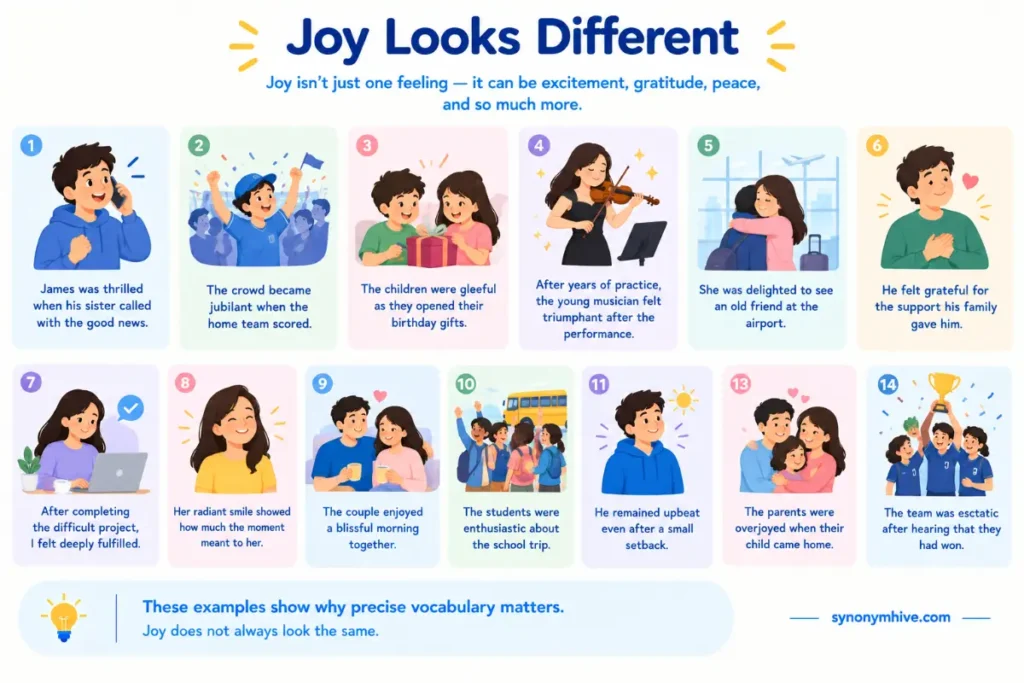
Context gives emotional words their full meaning. The same person may be content in one moment and ecstatic in another.
- After finishing a long book, Maria felt satisfied and peaceful.
- James was thrilled when his sister called with the good news.
- The crowd became jubilant when the home team scored.
- The children were gleeful as they opened their birthday gifts.
- After years of practice, the young musician felt triumphant after the performance.
- She was delighted to see an old friend at the airport.
- He felt grateful for the support his family gave him.
- After completing the difficult project, I felt deeply fulfilled.
- Her radiant smile showed how much the moment meant to her.
- The couple enjoyed a blissful morning together.
- The students were enthusiastic about the school trip.
- He remained upbeat even after a small setback.
- The parents were overjoyed when their child came home.
- She felt a quiet sense of joy while watching the rain from her window.
- The team was ecstatic after hearing that they had won.
These examples show why precise vocabulary matters. Joy does not always look the same.
What words describe joy in a person’s face?
Facial expressions can show emotion without directly naming it.
Useful descriptive words include radiant, bright, cheerful, glowing, smiling, delighted, gleeful, excited, and joyful.
For example:
“Her face was radiant when she heard the news.”
“His bright smile gave away his excitement.”
“She had a cheerful expression throughout the ceremony.”
“His eyes looked bright with delight.”
Radiant is especially useful when joy is clearly visible. It suggests that happiness seems to shine through a person’s appearance.
What words describe a joyful personality?
Some people seem naturally positive, warm, or energetic.
Good words include cheerful, upbeat, optimistic, lively, spirited, warm, friendly, enthusiastic, exuberant, and lighthearted.
Cheerful describes someone who is often happy and pleasant.
Optimistic describes someone who expects good things or looks for positive possibilities.
Enthusiastic describes strong interest and energy.
Warm describes a person who is kind, welcoming, and emotionally open.
Lighthearted describes someone who is relaxed and not weighed down by serious concerns.
These words are not exact replacements for one another. Each points to a different part of a positive personality.
What are common mistakes when describing joy?
One common mistake is using a word that is much stronger than the situation supports.
For example, saying “I was ecstatic because my coffee order was correct” may sound exaggerated unless you are joking.
Another mistake is repeating happy in every sentence. Repetition can make emotional writing flat.
A third mistake is choosing a word only because it sounds impressive. If you are not sure what ecstatic means, it is safer to use thrilled or delighted.
You should also avoid treating every positive emotion as the same. Relief, pride, gratitude, excitement, peace, and joy can overlap, but they have different meanings.
Consider the reason behind the emotion before choosing a word.
When should you not use a strong word for joy?
Avoid strong terms when the emotion is small or calm.
Ecstatic, euphoric, jubilant, and overjoyed suggest a high level of emotion. They may sound unnatural in ordinary situations.
For example, “I was euphoric because my package arrived” sounds exaggerated in most contexts.
“I was glad my package arrived” is more natural.
Strong words work best when the event supports them. Winning an important competition, receiving life changing news, seeing a loved one after a long separation, or reaching a major goal may justify a much stronger word.
What are the antonyms of joy?
Common opposites of joy include sadness, sorrow, misery, grief, disappointment, unhappiness, despair, gloom, distress, and frustration.
The best antonym depends on the situation.
Sadness is the broadest opposite.
Sorrow often suggests deeper emotional pain.
Grief usually connects to loss.
Misery suggests severe unhappiness.
Despair suggests a loss of hope.
Disappointment describes unhappiness caused by an outcome that was not what someone wanted.
Using the correct opposite can make emotional writing more precise.
How do US and UK English differ when describing joy?
Most common words for joy work the same way in American and British English. Happy, glad, delighted, thrilled, joyful, pleased, excited, and grateful are widely understood in both varieties.
Some informal expressions may have different levels of popularity by region. British speakers may use certain expressions more often than American speakers, while American slang changes quickly and can vary by age or social group.
For general writing, standard words such as delighted, pleased, joyful, thrilled, grateful, and cheerful are safe choices across English speaking regions.
The main difference is usually style, not meaning.
How can you choose the right word for joy?
Start by asking what caused the emotion.
If something made you pleased, try delighted or glad.
If you achieved something difficult, try proud, fulfilled, triumphant, or elated.
Then ask how formal your writing should sound. A text to a friend can use casual expressions. A school essay needs more careful word choice. A professional email should sound warm but controlled.
Finally, read the whole sentence aloud. The best word should sound natural with the rest of the sentence.
What is the easiest way to remember different levels of joy?
Think of joy as a scale.
At the gentle end, use glad, pleased, content, and satisfied.
In the middle, use happy, cheerful, delighted, excited, and enthusiastic.
At the strong end, use thrilled, elated, overjoyed, ecstatic, and euphoric.
For peaceful joy, remember blissful, content, fulfilled, and serene.
For playful joy, remember gleeful, lively, and exuberant.
This simple grouping makes vocabulary easier to recall when you are writing.
How can you make descriptions of joy more vivid?
A strong description does not always need a stronger adjective. Sometimes the best approach is to describe what the person does.
Instead of:
“She was very happy.”
Try:
“She could not stop smiling.”
Instead of:
“He was extremely joyful.”
Try:
“He laughed as soon as he heard the news.”
Instead of:
“She was delighted.”
Try:
“Her face lit up when she saw the gift.”
This technique is useful in stories and personal essays. Readers can picture an action more easily than a general label.
You can also combine an emotion word with a clear reason.
“She felt grateful because her friends stayed beside her during a difficult week.”
That sentence tells the reader both what she felt and why.
How do you avoid repeating the same emotional word?
Build a small group of related words instead of searching for one perfect replacement.
For a happy mood, use cheerful, upbeat, glad, or positive.
For pleasure, use delighted, pleased, satisfied, or content.
You can also change the sentence structure. One sentence can name the emotion. The next can show it through an action. The next can explain its cause.
That creates more natural writing without forcing new vocabulary into every sentence.
Which word should you use for quiet happiness?
Content is often the best choice for quiet happiness. It suggests that someone feels satisfied and at peace.
For example, “After dinner, he felt content as he listened to music.”
Peaceful works when calm matters more than excitement.
Grateful works when appreciation is central.
Fulfilled works when the feeling comes from purpose or achievement.
Blissful works when the peace and happiness are especially deep.
Which word should you use for extreme happiness?
For extreme happiness, strong choices include ecstatic, euphoric, overjoyed, elated, and jubilant.
Ecstatic is very strong and common enough for everyday use.
Euphoric can sound more intense and is often used to describe a powerful emotional high.
Overjoyed clearly means extremely happy.
Elated sounds somewhat more formal.
Jubilant is especially useful when the happiness is shared by a group or linked to a victory.
Choose based on the reason for the emotion, not just its strength.
Which word should you use for joy after good news?
Thrilled, delighted, overjoyed, excited, and elated are all useful.
Thrilled is natural in conversation.
“She was thrilled to hear that she got the job.”
Delighted works well in emails.
“We were delighted to hear the good news.”
Elated works well in formal writing.
“He was elated after learning that his application had been accepted.”
Overjoyed is useful when the news creates very strong happiness.
“The parents were overjoyed when they heard the news.”
Which word should you use for joy in creative writing?
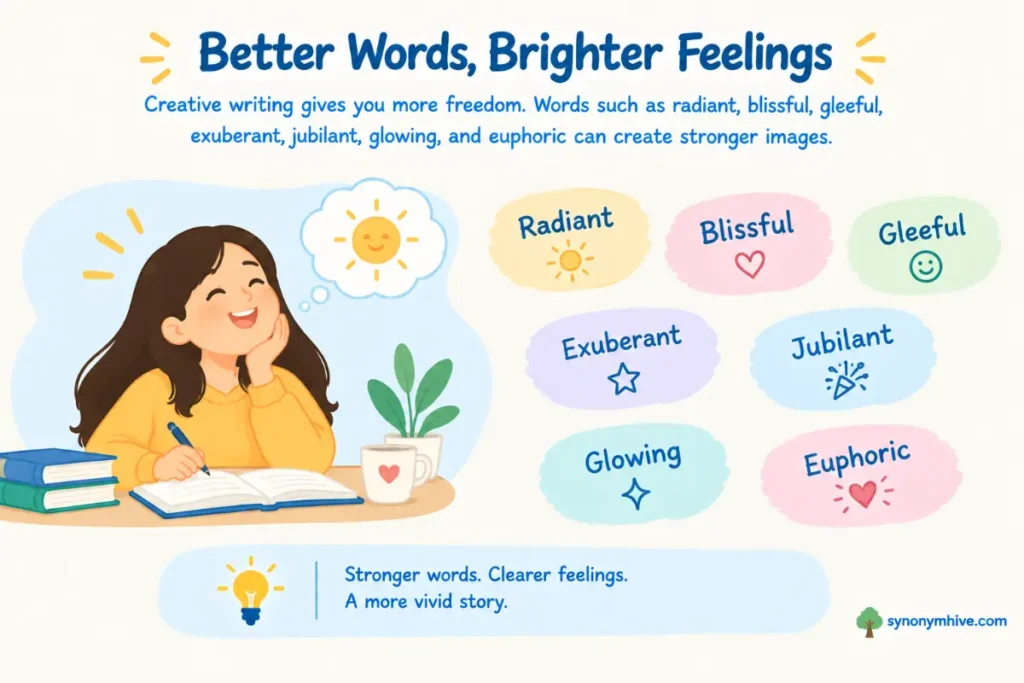
Creative writing gives you more freedom. Words such as radiant, blissful, gleeful, exuberant, jubilant, glowing, and euphoric can create stronger images.
Still, simple words can be powerful. A sentence such as “She smiled when she saw him” may be more effective than a sentence packed with emotional adjectives.
Try to show the emotion through behavior, setting, body language, and dialogue. A character who laughs, hugs someone, speaks quickly, or smiles quietly can communicate joy without directly naming it.
Looking for another word? See Words to Describe a Voice: Words for Every Voice 2026.
Conclusion
The best words to describe joy depend on the kind of emotion you want the reader to understand. Use glad, pleased, or content for gentle happiness. Choose delighted, thrilled, or excited for stronger everyday emotion. Words such as elated, ecstatic, jubilant, and euphoric work when the feeling is especially intense.
You should also think about the reason behind the emotion. Gratitude, pride, relief, excitement, peace, and fulfillment can all create joy, but they do not mean exactly the same thing.
For everyday writing, simple words are often the strongest choice. In formal writing, choose precise terms that match the tone. In creative writing, combine emotional vocabulary with actions, facial expressions, and details that let the reader see the feeling.
The easiest rule is simple: name the emotion, judge its strength, consider the setting, and pick the word that sounds natural in your sentence. That small step can make your writing clearer and much more expressive.
Frequently Asked Questions
What are the best words to describe joy?
The best choices include happy, glad, cheerful, delighted, thrilled, joyful, content, grateful, elated, ecstatic, blissful, and overjoyed. The best word depends on how strong the emotion is and what caused it.
What is a stronger word than happy?
Thrilled, elated, overjoyed, ecstatic, and euphoric can express stronger happiness. Each has a slightly different tone, so choose the one that matches the situation.
What’s another way to say joy?
Another way to say joy is happiness, delight, pleasure, bliss, gladness, or elation. For everyday writing, happiness and delight are usually the easiest choices.
What are some words to describe joy in writing?
Useful words to describe joy include cheerful, radiant, delighted, peaceful, grateful, enthusiastic, jubilant, fulfilled, and exuberant. Choose a word that shows the type of joy instead of using the strongest word every time.
How do you describe a person who is full of joy?
You can describe that person as joyful, cheerful, exuberant, upbeat, radiant, lively, or enthusiastic. Each word highlights a different quality of their personality or behavior.
What is a word for quiet joy?
Content, peaceful, grateful, fulfilled, and serene can describe quiet joy. These words suggest calm satisfaction instead of loud excitement.
What is the difference between joy and happiness?
Happiness is a broad term for positive emotion, while joy often suggests a deeper or stronger sense of delight. The two words overlap, and context determines which one sounds more natural.