
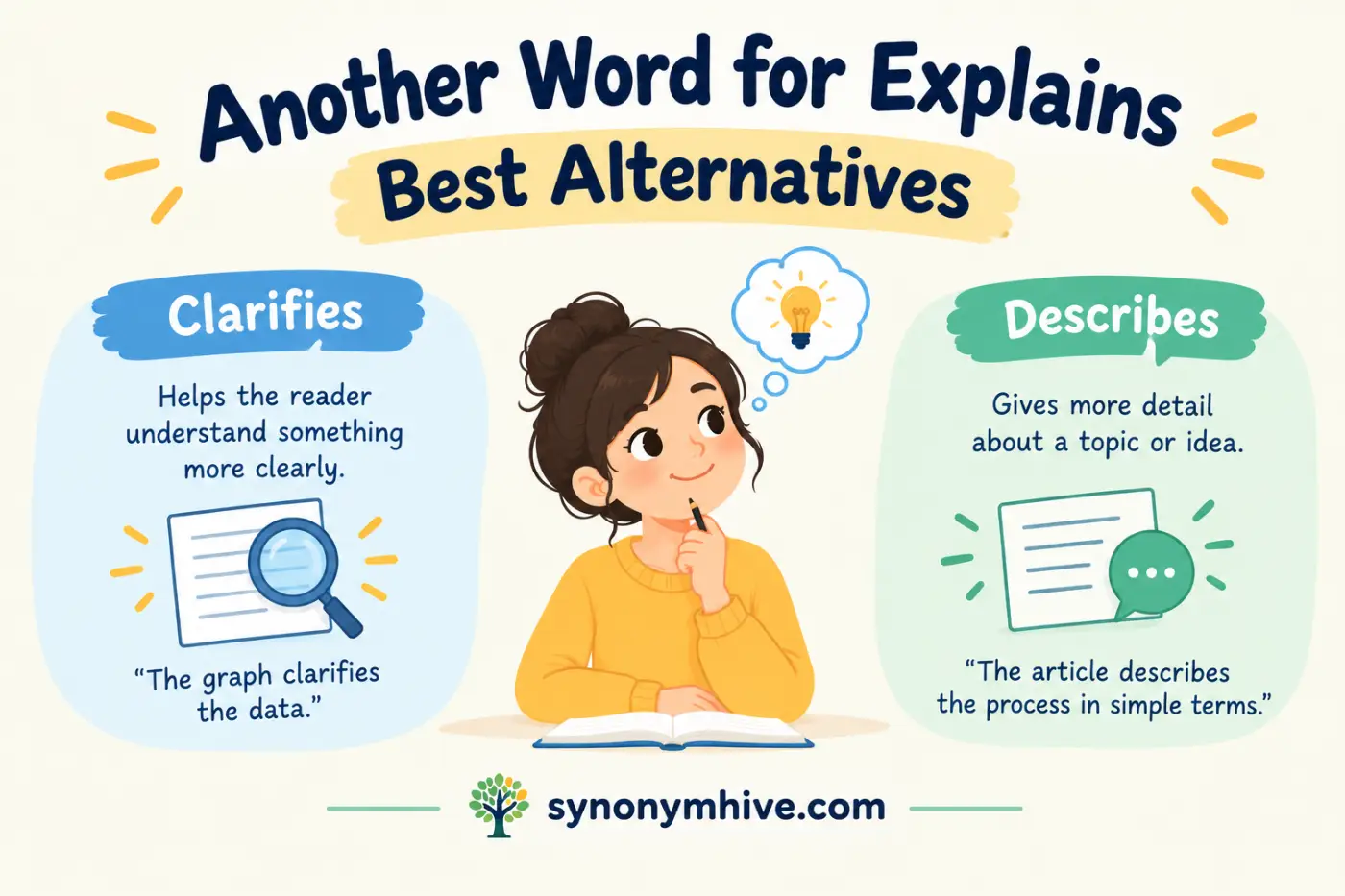
When you’re writing an essay, email, resume, or text, you may notice that you keep using the word explains. It works, but repeating the same word can make your writing sound flat. Finding another word for explains can help you show ideas more clearly and match the tone of your sentence.
The best replacement depends on what you mean. You might use describes for a simple explanation, clarifies when something becomes easier to understand, illustrates when an example makes an idea clear, or demonstrates when evidence shows how something works. In formal writing, terms such as elaborates, interprets, and defines can give your sentence more precision.
Answer Box: Another word for explains is describes, clarifies, illustrates, demonstrates, interprets, or defines. The best choice depends on the kind of information being presented and the tone of your writing.
This guide covers the meaning and origin of explains, more than 30 useful alternatives, differences in strength and tone, and the best choices for essays, resumes, emails, texts, and everyday speech. You’ll also find examples and simple tips for choosing the right word.
Need another vocabulary suggestion? Read Another Word for Furthermore Best Alternatives 2026.
What Does Explains Mean
Explains means to make something clear or understandable by giving information, details, reasons, examples, or evidence. It can describe an action where a person helps someone understand an idea, or it can describe something that gives a reason for a result.
For example, in the sentence, “The teacher explains the grammar rule,” explains means the teacher makes the rule easier for students to understand. In “This chart explains the results,” the chart provides information that helps the reader understand the results.
The word can also introduce a reason. “The report explains why sales increased” means the report gives reasons for the increase.
That makes explains a flexible word. It can refer to teaching, describing, interpreting, clarifying, showing causes, or making information easier to understand. The surrounding sentence tells you which meaning matters most.
Where Does Explains Come From
Explains comes from the verb explain. English adopted explain through Old French from the Latin explanare. The Latin word relates to making something plain or clear.
That history fits the modern meaning well. When you explain an idea, you take something that may seem unclear and make it easier to understand.
The word has remained useful because it works across many settings. Teachers explain lessons. Writers explain arguments. Scientists explain findings. Managers explain decisions. Friends explain confusing situations. A strong synonym should preserve that basic idea while adding the exact shade of meaning your sentence needs.
What Is Another Word for Explains
Another word for explains can be simple, formal, conversational, or highly specific. Here are useful choices grouped by tone and purpose.
| Word | Meaning | Tone | Example |
|---|---|---|---|
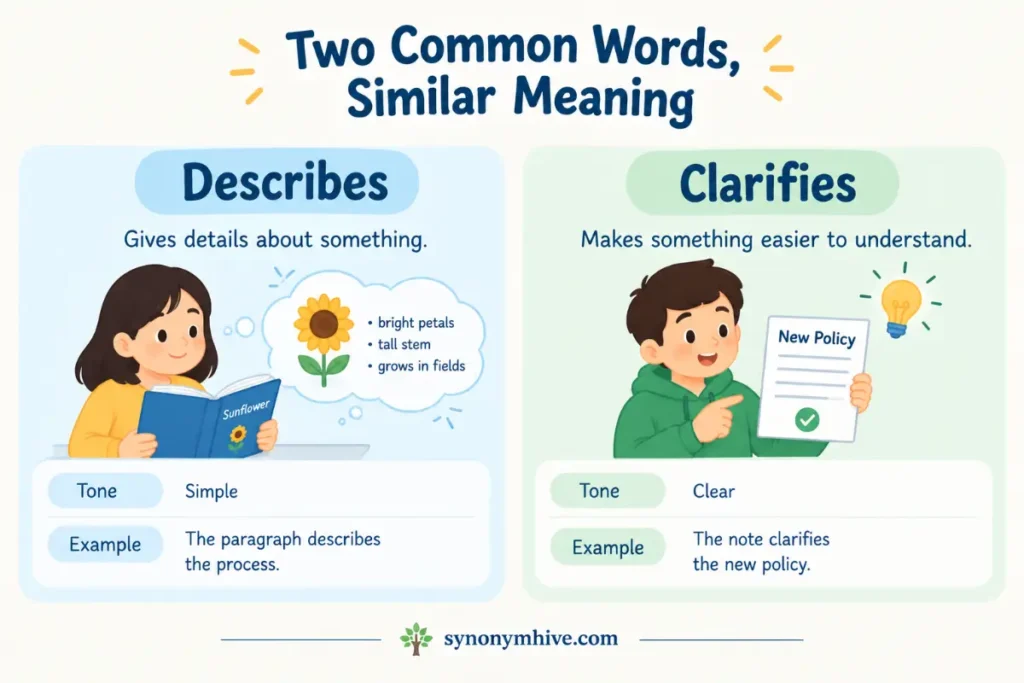
| Describes | Gives details about something | Simple | The paragraph describes the process. |
| Clarifies | Makes something easier to understand | Clear | The note clarifies the new policy. |
| Shows | Makes an idea or fact clear | Everyday | The graph shows the change. |
| Tells | Gives information | Casual | The story tells what happened. |
| Defines | States the exact meaning | Formal | The introduction defines the key term. |
| Illustrates | Makes an idea clear with an example | Formal | The example illustrates the main point. |
| Demonstrates | Shows clearly through evidence or action | Formal | The experiment demonstrates the effect. |
| Details | Gives specific information | Formal | The report details the steps taken. |
| Outlines | Gives the main points | Formal | The document outlines the new plan. |
| Expounds | Gives a detailed explanation | Formal | The speaker expounds on the theory. |
| Elaborates | Adds more information | Formal | The author elaborates on the issue. |
| Interprets | Explains the meaning of something | Formal | The researcher interprets the findings. |
| Deciphers | Makes something difficult easier to understand | Formal | The analyst deciphers the coded message. |
| Translates | Makes an idea understandable in another form | Everyday | The guide translates technical terms. |
| Reveals | Makes hidden information known | Strong | The investigation reveals the cause. |
| Discloses | Makes private or unknown information known | Formal | The report discloses the financial risks. |
| Justifies | Gives reasons that support a decision | Formal | The report justifies the recommendation. |
| Accounts for | Gives a reason for something | Formal | The data accounts for the sudden increase. |
| Spells out | States something very clearly | Casual | The guide spells out the rules. |
| Breaks down | Makes a complex idea simpler | Casual | The teacher breaks down the equation. |
| Walks through | Explains something step by step | Casual | The manager walks us through the process. |
| Points out | Draws attention to a fact | Everyday | The article points out a common mistake. |
Which Synonyms Are Simple And Everyday
Simple alternatives work best when your goal is clear communication. You don’t need a complicated word just to make your writing sound smarter.
- Describes works when you give information about what something is like or how it works.
- Shows works when information makes a fact or idea visible or understandable.
- Tells works in casual writing and everyday speech.
- Clarifies works when you’re removing confusion.
- Covers works when a text gives information about a subject.
- Discusses works when someone presents ideas about a topic.
- Points out works when you want to draw attention to a specific fact.
- Breaks down works when someone makes a complicated topic easier to understand.
These choices are especially useful for school writing, emails, blog posts, and everyday conversations.
Which Alternatives Sound More Formal
Formal writing often needs greater precision. Instead of using explains for every situation, select a verb that tells readers exactly what the writer or source does.
Defines works for terms and concepts. Interprets works for meaning or significance. Demonstrates works for evidence or proof. Illustrates works when an example helps make a point clear. Elaborates works when someone adds more detail to an existing explanation.
For example, compare these sentences.
The study explains the results.
The study interprets the results.
The second sentence tells readers something more specific. It suggests that the study gives meaning to the findings rather than simply presenting information.
How Do Synonyms Change In Intensity
Not every alternative has the same strength. Some simply provide information. Others suggest detailed analysis or strong proof.
Mild And Neutral Choices
Describes, tells, covers, discusses, and shows are generally mild or neutral. They don’t make a strong claim about the depth of the explanation.
The article describes the new process.
The article covers the new process.
Both sentences are straightforward. Neither suggests that the writer performed deep analysis.
Medium Strength Choices
Clarifies, illustrates, outlines, details, and addresses are more specific.
The diagram clarifies the process.
The report details the process.
The first sentence focuses on removing confusion. The second suggests that the report gives specific information.
Strong Choices
Demonstrates, proves, reveals, establishes, and substantiates can sound much stronger.
The experiment demonstrates the effect.
The evidence establishes a connection.
These verbs can imply solid evidence or a clear result. Use them only when the sentence supports that level of certainty.
What Part Of Speech Is Explains
Explains is a verb. It is the third person singular present form of explain.
The basic verb forms are explain, explains, explained, and explaining.
For example, you can write, “The teacher explains the lesson.” You can also write, “The teacher explained the lesson yesterday.”
Most synonyms in this guide are also verbs, but their grammatical patterns can differ.
You can say, “The article illustrates the problem with an example.”
You shouldn’t assume that every synonym can replace explains word for word. Check the rest of the sentence after making the change.
Is There A US And UK Difference
The core meaning of explains stays the same in American and British English. Most common alternatives also work naturally in both varieties.
Differences usually appear in style rather than meaning. Some formal terms may appear more often in academic or professional writing, while casual expressions such as breaks down or spells out may sound more conversational.
For US readers, simple choices such as describes, clarifies, shows, demonstrates, and outlines are safe in most general writing. Regional vocabulary matters far less here than tone and context.
What Is Another Term for Explains In A Resume
On a resume, demonstrates is often a strong choice when you’re showing a skill through an achievement. Describes can work for duties, while outlines can work for responsibilities or processes.
For example, instead of writing, “Explains technical issues to customers,” you could write, “Clarifies technical issues for customers.”
That version highlights a useful communication skill. It also sounds more focused.
Another option is, “Translates complex technical information into clear customer guidance.”
This version goes further because it shows how the communication skill creates value.
A resume should focus on what you did and what resulted from your work. Avoid replacing explains with an impressive sounding verb if the new word doesn’t accurately describe the action.
What Is Another Phrase for Explains In An Essay
For essays, clarifies, demonstrates, illustrates, describes, interprets, examines, and establishes can work well.
The best choice depends on your argument.
Use clarifies when a paragraph makes a confusing point easier to understand. Use illustrates when you support an idea with an example.
For example, “The example explains why social media affects attention” can become “The example illustrates why social media affects attention.”
The second version works well because the example is doing the explaining.
In analytical writing, “The evidence demonstrates the impact of the policy” may be stronger when the evidence clearly supports the claim.
What Is Another Word for Explains In Texting
Texting usually calls for simple and natural language. You don’t need formal terms such as explicates or elaborates.
Try shows, tells, clarifies, breaks down, or spells out.
For example, you might text, “Can you break down what this means?”
You could also say, “Can you explain this?” or “Can you clarify this?”
Breaks down sounds especially natural when you’re asking someone to make a difficult topic easier.
A casual message might read, “She broke down the whole situation for me.”
That sounds more conversational than “She elaborated on the situation.”
What Is Another Word for Explains In An Email
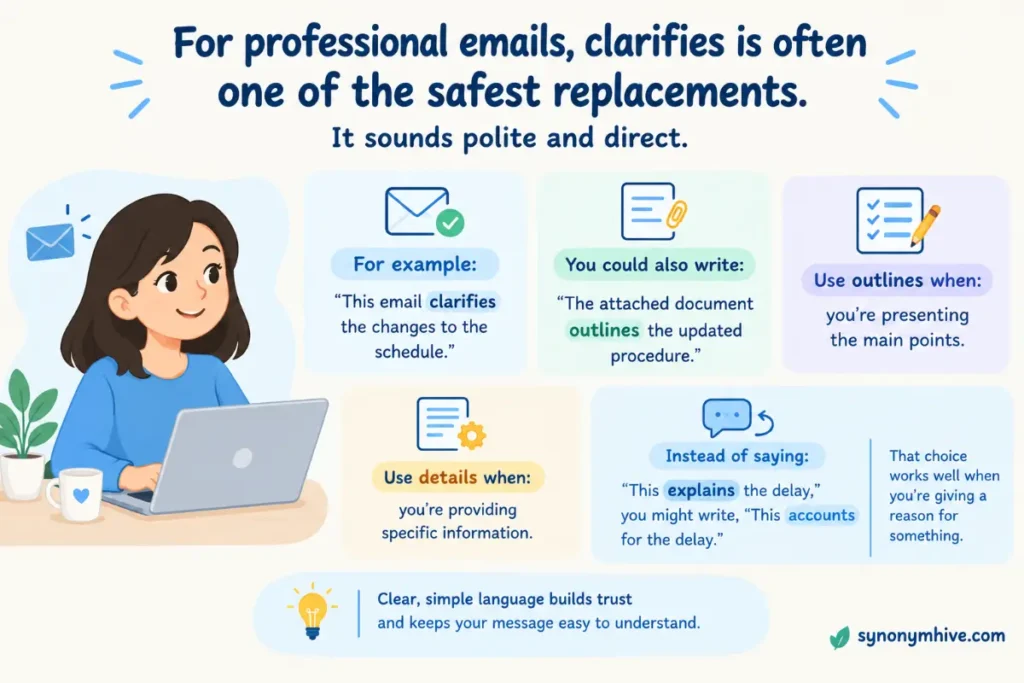
For professional emails, clarifies is often one of the safest replacements. It sounds polite and direct.
For example, “This email clarifies the changes to the schedule.”
You could also write, “The attached document outlines the updated procedure.”
Use outlines when you’re presenting the main points. Use details when you’re providing specific information.
Instead of saying, “This explains the delay,” you might write, “This accounts for the delay.”
That choice works well when you’re giving a reason for something.
What Is Another Term for Explains In Speaking
Everyday speech usually favors short and familiar words. Shows, tells, clarifies, describes, and breaks down all work well.
You might say, “Can you explain that again?”
A more conversational version is, “Can you break that down for me?”
If you’re correcting confusion, “Let me clarify” works naturally.
If you’re describing an event, “Let me tell you what happened” sounds more relaxed.
Good spoken English doesn’t need fancy synonyms. The clearest word is often the strongest choice.
What Are Some Examples Of Another Word for Explains
Seeing the words in real sentences makes their differences easier to spot.
- The teacher clarifies the grammar rule before the test.
- The diagram illustrates how the two systems connect.
- The report details the steps taken during the investigation.
- The chart shows a steady increase in online sales.
- The professor interprets the poem from a historical perspective.
- The experiment demonstrates how temperature affects the reaction.
- The introduction defines the key term before discussing the argument.
- The manager outlines the new schedule during the meeting.
- The guide describes the easiest route to the museum.
- The article examines the reasons behind the decision.
- The evidence reveals a pattern that wasn’t obvious at first.
- The email clarifies the deadline for submitting the form.
- The speaker elaborates on the main point during the second half of the presentation.
- The tutorial breaks down the process into simple steps.
- The report accounts for the sudden drop in revenue.
- The example illustrates why small changes can produce large results.
- The researcher interprets the findings in a different way.
- The document spells out the rules for new employees.
- The article addresses the most common questions about the topic.
- The evidence establishes a clear connection between the two events.
These examples show why synonym choice matters. Each verb adds a slightly different meaning to the sentence.
Describes Vs Clarifies What Is The Difference
Describes gives information about something. It can tell readers what something looks like, how it works, or what happened.
Clarifies removes confusion. It helps readers understand something that may already be known but isn’t fully clear.
Compare these examples.
The guide describes the application process.
The guide clarifies the application requirements.
The first sentence says the guide gives information about the process. The second suggests the guide makes confusing requirements easier to understand.
Choose describes when you’re providing details. Choose clarifies when you’re clearing up uncertainty.
Illustrates Vs Demonstrates What Is The Difference
Illustrates commonly uses an example, image, story, or comparison to make an idea easier to understand.
Demonstrates often points to evidence, action, or a clear display of how something works.
Consider these sentences.
The story illustrates the importance of patience.
The experiment demonstrates the importance of temperature control.
The story provides an example. The experiment provides evidence.
This difference matters in academic writing. If you’re using an example to support an idea, illustrates may be the better fit. If you’re describing a test or evidence that clearly shows a result, demonstrates may be more accurate.
Explore another synonym guide: Another Word for Influence Best Synonyms 2026.
Shows Vs Explains What Is The Difference
Shows is broader than explains. It can mean makes visible, provides evidence, reveals, or demonstrates.
Explains specifically focuses on making something understandable.
For example, “The graph shows higher sales in December” means the graph presents that information.
“The report explains why sales increased in December” means the report gives reasons for the increase.
A graph may show a result without explaining its cause. A report may explain the cause without directly displaying the result.
Use shows for visible information or evidence. Use explains for reasons, details, or understanding.
Defines Vs Explains What Is The Difference
Defines gives an exact meaning. Explains can provide a broader discussion.
For example, “The textbook defines inflation as a general rise in prices.”
“The textbook explains how inflation affects consumers.”
The first sentence gives a meaning. The second gives more information about the concept and its effects.
Use defines when your focus is the meaning of a word, term, or concept. Use explains when you need to give a fuller understanding.
What Are Common Mistakes With Explains Synonyms
The biggest mistake is choosing a synonym simply because it sounds more advanced.
A complicated verb doesn’t automatically make writing stronger. In fact, the wrong formal word can make a simple idea harder to understand.
Another common mistake is using demonstrates when you only have an example. Demonstrates can suggest clear evidence. If your sentence contains a simple illustration, illustrates may be more accurate.
Using clarifies when you’re introducing brand new information can also create a mismatch. Clarifies suggests that something was unclear. If you’re simply describing a topic, describes may work better.
Another problem occurs when writers use elaborates for every detailed explanation. Elaborates usually means adding more information to something already discussed. It isn’t always a direct replacement.
Finally, don’t replace a familiar word just to avoid repetition. Repetition isn’t automatically bad. If explains is the most accurate and natural word, keep it.
When Should You Not Replace Explains
Sometimes explains is already the best word.
If your sentence simply says that someone makes an idea clear, explains is direct and natural.
“The teacher explains the lesson clearly.”
Changing this to “The teacher elaborates on the lesson clearly” changes the meaning. The new sentence suggests the teacher is adding more detail rather than simply teaching the lesson.
Likewise, “She explains why she left” sounds natural. A formal alternative such as “She interprets why she left” would be incorrect in that context.
The goal isn’t to eliminate explains. The goal is to choose the most accurate verb for each situation.
What Are The Antonyms Of Explains
Antonyms are words that express an opposite or contrasting idea.
Common opposites include conceals, confuses, obscures, hides, withholds, and complicates.
Conceals means keeps information hidden.
Obscures means makes something harder to understand or see.
Confuses means makes understanding more difficult.
Withholds means keeps information from someone.
These words can help when you’re describing poor communication or a lack of clarity.
For example, “The unclear instructions confuse new users” expresses the opposite effect of a helpful explanation.
How Do You Choose The Right Synonym
Start with the exact job the word needs to perform. Ask yourself what the sentence is doing.
If you’re giving basic information, choose describes or discusses.
If you’re making something easier to understand, choose clarifies.
Tone matters too. A text message may sound natural with breaks down. A research paper may need interprets or demonstrates. A resume may benefit from clarifies or translates when describing communication skills.
Read the sentence aloud after changing the word. If it sounds forced, go back to a simpler choice. Good writing shouldn’t require readers to stop and decode your vocabulary.
Which Synonym Works Best For Different Purposes
| Purpose | Strong Choice | Why It Works |
|---|---|---|
| Simple writing | Describes | Clear and familiar |
| Everyday speech | Shows | Natural and flexible |
| Casual texting | Breaks down | Friendly and conversational |
| Professional email | Clarifies | Direct and precise |
| Resume | Demonstrates | Highlights evidence of skill |
| Academic essay | Illustrates | Works well with examples |
| Research writing | Demonstrates | Suggests supporting evidence |
| Definition | Defines | Gives exact meaning |
| Main points | Outlines | Shows the structure |
| Detailed report | Details | Emphasizes specific information |
| Interpretation | Interprets | Explains meaning or significance |
| Cause or reason | Accounts for | Gives a reason |
| Additional detail | Elaborates | Adds information |
| Hidden information | Reveals | Makes something known |
| Rules | Spells out | Makes requirements very clear |
This table can help you make a quick decision without forcing one word into every situation.
How Can You Avoid Repeating Explains
You don’t need to replace every repeated word. Instead, look at the relationship between the subject and the information that follows.
Suppose an essay contains these sentences.
“The first paragraph explains the problem. The second paragraph explains the cause. The final paragraph explains the solution.”
The repetition is noticeable.
You could revise it like this.
“The first paragraph describes the problem. The second examines its cause. The final section outlines a possible solution.”
Now each verb tells readers something about the role of that paragraph.
This is a better approach than randomly replacing every instance of explains. Strong writing uses vocabulary to create meaning, not just variety.
What Are The Best Synonyms For Academic Writing
Academic writing benefits from precise verbs. Some of the strongest choices include demonstrates, illustrates, examines, interprets, defines, establishes, identifies, outlines, analyzes, and clarifies.
For example, instead of saying, “The evidence explains the connection,” you could write, “The evidence demonstrates the connection.”
If the evidence doesn’t prove the connection but helps readers understand it, “The evidence illustrates the connection” may be safer.
If you’re studying the meaning of evidence, “The researcher interprets the connection” may fit better.
Academic writing should avoid overstating claims. Strong verbs are useful only when the evidence supports them.
What Are The Best Synonyms For Professional Writing
Professional writing values clarity. Readers usually want to understand the point quickly.
Clarifies, outlines, details, addresses, demonstrates, describes, and identifies are useful choices.
For example, “The attached document outlines the next steps” sounds clear and professional.
“The updated policy clarifies the approval process” tells the reader exactly what the policy does.
“The report details the reasons for the change” gives a stronger sense of specific information.
These choices work well because they communicate the action without adding unnecessary complexity.
What Are The Best Synonyms For Creative Writing
Creative writing gives you more freedom. The best verb depends on the scene and the effect you want.
Reveals can create suspense. Uncovers can suggest discovery. Shows can keep the prose simple. Describes can provide sensory details. Illustrates can connect an idea to an image or event.
For example, “The final chapter reveals the reason behind his decision” creates more tension than “The final chapter explains the reason behind his decision.”
The word reveals suggests that the information was hidden until that moment.
That small change can affect the mood of an entire passage.
What Are The Best Synonyms For Teachers
Teachers often explain concepts, but the most useful alternative depends on the teaching method.
A teacher defines a new term.
A teacher walks students through a process.
These verbs make lesson descriptions more specific. They also help students understand what actually happens during instruction.
How Can You Use These Words In An Essay Transition
Essay transitions should help readers understand how one idea connects to another. The verb you choose can make that connection clearer.
For example, you might write, “The evidence demonstrates that the policy had an effect.”
To introduce an example, you could write, “The following case illustrates this problem.”
To add clarification, you could write, “The next section clarifies why this result occurred.”
These choices do more than replace explains. They show the reader how the information functions within your argument.
Quick Reference For Choosing Another Word For Explains
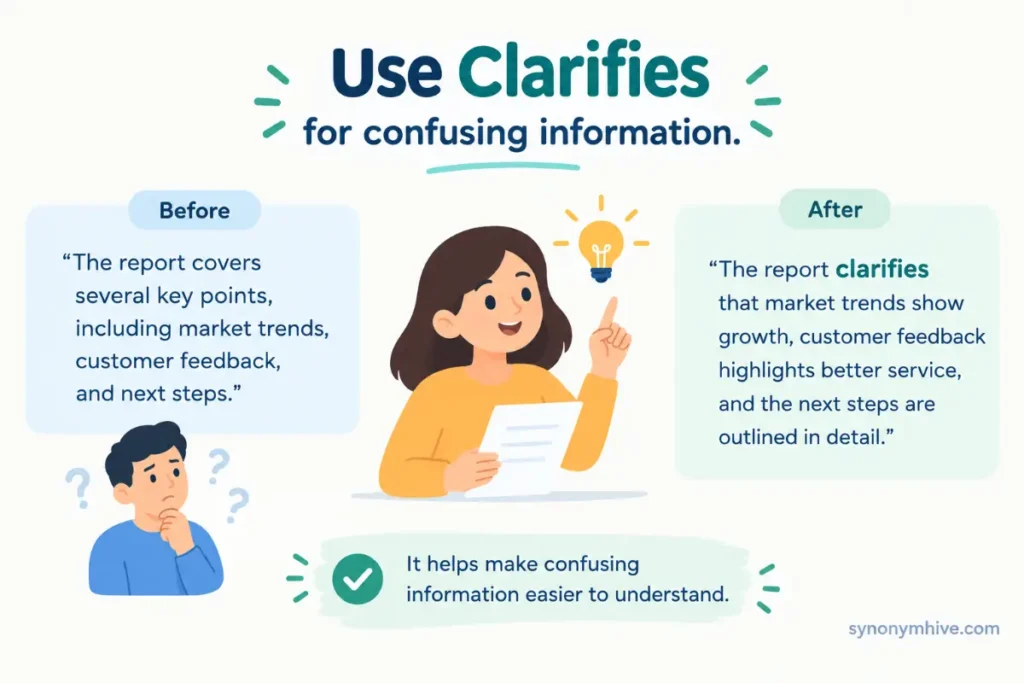
- Use clarifies for confusing information.
- Use shows for visible facts or broad evidence.
- Use describes for general details.
- Use illustrates for examples.
- Use details for specific information.
- Use spells out when making rules or instructions very clear.
- Use breaks down for simple conversational explanations.
- Use demonstrates for strong evidence or clear proof.
- Use defines for exact meanings.
- Use outlines for main points or steps.
- Use interprets for meaning or significance.
- Use elaborates for additional information.
- Use accounts for when giving a reason.
- Use justifies when supporting a decision or action.
- Use reveals when making hidden information known.
Why Context Matters More Than A Bigger Vocabulary
A strong synonym isn’t simply a fancier word. It should make the sentence more accurate.
Think of synonyms like tools in a toolbox. A hammer and screwdriver both belong in the same toolbox, but you wouldn’t use them for the same job.
The same principle applies to writing. Describes and demonstrates both relate to giving information, but they perform different jobs. Clarifies and defines both improve understanding, but one removes confusion while the other gives an exact meaning.
This is especially important for essays and professional writing. Readers notice precision. They may not consciously identify the verb choice, but a precise sentence usually communicates more smoothly.
Final Tips For Better Word Choice
Before replacing explains, look at the noun that comes before it and the information that comes after it.
If a chart comes before the verb, shows or illustrates may work well. If evidence supports a claim, demonstrates may be appropriate.
Keep your audience in mind. Simple words often work best for general readers. Formal terms have a place in academic and professional settings, but they shouldn’t make a sentence harder to read.
Most importantly, don’t chase variety at the expense of meaning. Repeating explains once or twice is better than using a synonym that changes your intended message.
Explore another synonym guide: Another Word for Impact: Better Terms 2026.
Conclusion
Finding another word for explains is mainly about choosing a verb that matches the exact job your sentence performs. Describes gives information, clarifies removes confusion, illustrates uses examples, demonstrates points to strong evidence, and defines gives a precise meaning. More specialized choices such as interprets, elaborates, outlines, and accounts for can add even more precision.
Good writing doesn’t replace familiar words just to sound sophisticated. Instead, it chooses the clearest word for the situation. Start with your meaning, consider your audience, and then select the verb that communicates your point naturally. With that approach, your essays, emails, resumes, and everyday writing will sound more varied without becoming complicated.
Frequently Asked Questions
What is another word for explains?
Another term for explains is describes, clarifies, illustrates, demonstrates, or defines. The best choice depends on the sentence and the type of information being presented.
What is another phrase for explains in an essay?
In an essay, useful alternatives include demonstrates, illustrates, clarifies, interprets, examines, and outlines. Choose the word that accurately describes the role of the evidence or idea.
What is another term for explains in a resume?
Demonstrates and clarifies are strong resume choices. They can show communication skills or describe how you make information easier for others to understand.
What is another term for explains in an email?
Clarifies, outlines, details, and accounts for work well in professional emails. Each choice gives the sentence a slightly different purpose.
What’s another way to say explains?
You can say describes, shows, clarifies, illustrates, demonstrates, defines, or breaks down. Use the simplest option that matches your intended meaning.
Is explains a formal word?
Explains is neutral and works in casual, professional, and academic writing. You don’t need to replace it simply because you’re writing formally.
Can I use demonstrates instead of explains?
You can use demonstrates when the sentence involves clear evidence, proof, an experiment, or a visible display of how something works. It isn’t a universal replacement for explains.