
Writing a resume can make a simple word feel surprisingly difficult. You might write that you’re confident in your skills and then stop because the sentence sounds too plain. Finding another word for confident can help you show the exact kind of self belief you mean without making your resume sound forced.
The best replacement depends on the situation. A person can be assured because they trust their judgment. They can be self assured because they feel secure in their abilities. They can be bold because they’re willing to take risks. Each word adds a slightly different shade of meaning.
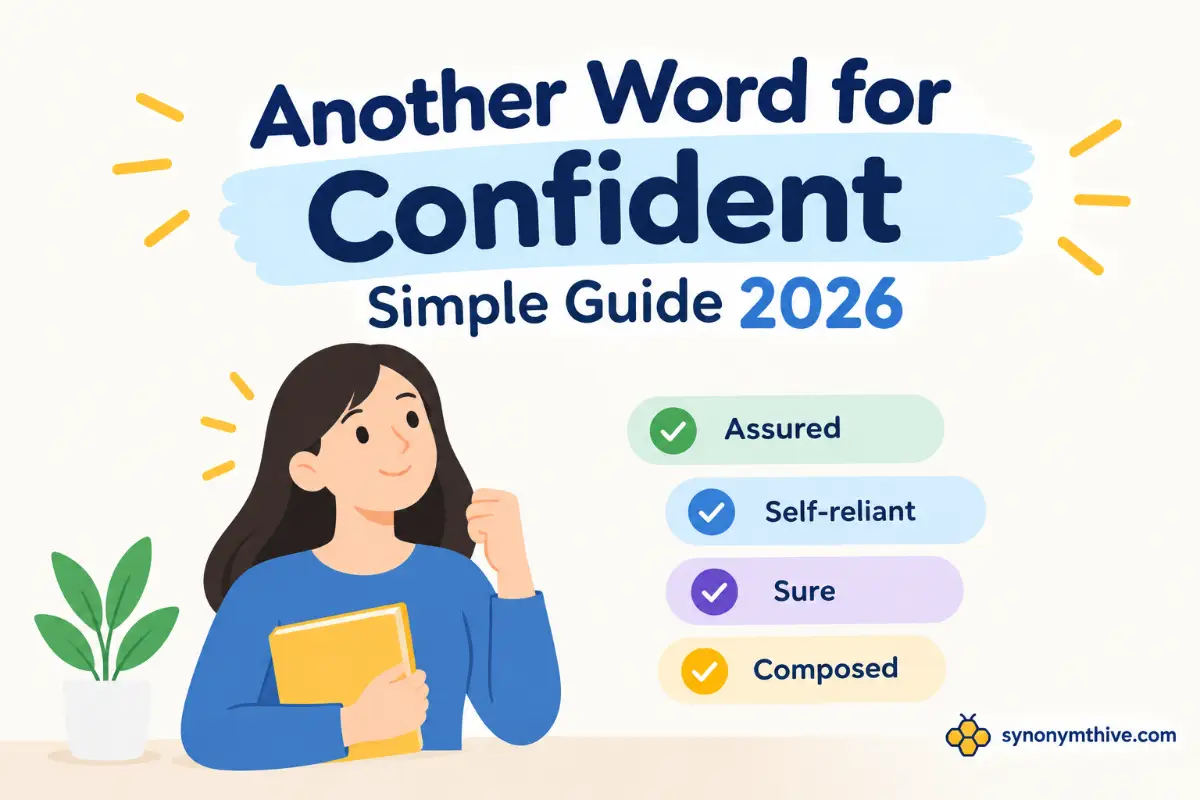
Answer: Another word for confident can be assured, self assured, certain, bold, fearless, capable, secure, or assertive. The best choice depends on the level and type of confidence you want to express.
This guide covers the meaning and origin of confident along with more than 30 useful alternatives. You’ll also see the best choices for resumes, essays, emails, texting, and everyday speech, plus examples and simple comparisons that make each word easier to choose.

Looking for a better alternative? Visit another word for efficient Resume Words 2026.
What Is Another Word For Confident
The word confident usually describes someone who believes in their ability, judgment, or value. A confident employee trusts their skills. A confident speaker feels ready to address an audience.
Confidence doesn’t always mean being loud. A quiet person can be highly confident. They may listen carefully, speak only when needed, and still trust their decisions.
The strongest replacement depends on the reason for the confidence. If someone knows a fact is true, certain may work better. If someone feels comfortable with their ability, capable may be more natural.
Where Did The Word Confident Come From
Confident comes from the Latin word confidere. It combines ideas connected to trust and faith. The word later moved through French before becoming part of English.
That history helps explain the modern meaning. Confidence involves trust. A confident person trusts their ability, judgment, knowledge, or preparation.
The noun confidence refers to the feeling itself. The adjective confident describes the person or their attitude. For example, you can say that a candidate has confidence or that the candidate is confident.
What Does Confident Mean In Plain English
In simple English, confident means believing that you can do something successfully or believing strongly in your own judgment.
A confident person doesn’t need to know everything. They simply trust themselves enough to act, learn, and handle challenges.
For example, a confident employee might say, “I can handle this project.” They don’t need to claim that they’re perfect. They’re showing trust in their skills.
This distinction matters when you choose a synonym. Some alternatives describe inner belief. Others describe behavior. A few describe certainty about facts rather than personal ability.
What Is Synonym For Confident In Different Situations
There are many useful alternatives to confident. Some sound simple and natural. Others work better in professional writing. A few belong mostly in casual speech.
| Word | Meaning | Tone | Example |
|---|---|---|---|
| Assured | Calmly certain about yourself or something | Professional | She sounded assured during the presentation. |
| Self assured | Secure in your own abilities | Professional | He is self assured when making decisions. |
| Certain | Having no doubt | Neutral | She is certain she can finish the task. |
| Sure | Feeling trust in your ability or choice | Everyday | I’m sure I can handle it. |
| Secure | Comfortable and confident in yourself | Neutral | He feels secure in his role. |
| Capable | Able to do something successfully | Professional | She is a capable team leader. |
| Competent | Having the needed skills | Professional | He is a competent manager. |
| Skilled | Having strong ability in an area | Professional | She is a skilled negotiator. |
| Assuredly | In a confident or certain manner | Formal | The plan will assuredly improve results. |
| Bold | Willing to act with courage | Strong | She made a bold decision. |
| Fearless | Not easily stopped by fear | Strong | He took a fearless approach to the challenge. |
| Self confident | Trusting your own ability | Neutral | She became more self confident with practice. |
| Unafraid | Not showing fear | Everyday | He was unafraid to ask questions. |
| Boldhearted | Brave and confident | Literary | The boldhearted leader accepted the challenge. |
| Cocky | Too confident in an annoying way | Negative | His cocky attitude upset the team. |
| Arrogant | Acting as though you’re better than others | Negative | His arrogant behavior hurt the discussion. |
| Sure of yourself | Comfortable trusting your own judgment | Everyday | She is sure of herself during interviews. |
| On top of things | Feeling in control of a situation | Casual | He feels on top of things at work. |
The table shows why simply replacing one word with another can sometimes miss the point. Confident has a broad meaning. Its alternatives can describe calmness, skill, courage, certainty, control, or even excessive pride.
Which Simple Words Mean Confident
For everyday writing and conversation, simple words often sound best.
Sure is one of the easiest choices. It works when you want to show that someone has no doubt.
Capable focuses on ability. It says that a person has the skills needed to get something done.
Secure focuses more on inner comfort and self trust.
Certain usually describes strong belief in an answer, fact, or outcome.
Strong can work in informal writing when you want to describe someone’s mental attitude.
These words are useful because they don’t make ordinary sentences sound dressed up. A simple word often feels more natural than a fancy synonym.
Which Everyday Words Can Replace Confident
Everyday English gives you several natural options.
Sure of yourself describes someone who trusts their own judgment. It can sound positive when used carefully.
Poised describes someone who stays calm and controlled. It often works well for interviews, presentations, and public speaking.
Bold describes someone willing to act with courage or take a risk.
Direct describes a communication style rather than confidence itself. Still, a direct person often sounds confident because they speak clearly.
Positive works when confidence comes from expecting a good result.
These choices can make casual writing sound more natural without losing the main idea.
Which Formal Words Work Best
Professional writing needs precision. Capable, competent, assured, assertive, decisive, poised, and authoritative can all work in the right setting.
Capable is especially useful on resumes because it focuses on ability rather than personality.
Competent sounds practical and reliable. It tells the reader that you have the skills needed to perform a task.
Assertive works when you want to show that you communicate clearly and stand up for your ideas.
Decisive highlights strong decision making.
Poised suggests calm confidence under pressure.
Authoritative suggests expertise and control. Use it carefully because it can sound stronger than confident.
How Can You Choose Another Synonym For Confident By Intensity
Confidence comes in different levels. The right synonym should match the strength of the idea.
Mild Confidence
Use sure, comfortable, positive, secure, or capable when you want a gentle sense of confidence.
For example, “She feels comfortable leading small meetings” sounds calm and believable. It doesn’t suggest that she wants to dominate the room.
Capable is also mild. It tells the reader that someone can do the job without making a dramatic claim.
Moderate Confidence
Use assured, self assured, poised, assertive, or decisive when you want a stronger impression.
These words work well in professional settings because they describe visible qualities. An assured speaker stays calm. An assertive employee communicates clearly. A decisive manager makes choices without unnecessary delay.
Strong Confidence
Use bold, fearless, daring, or authoritative when you want a powerful impression.
These words carry more weight. They can describe someone who takes action despite risk or pressure.
Strong words can be useful in creative writing and persuasive content. On a resume, however, they can sound exaggerated if you don’t support them with evidence.
Excessive Confidence
Not every synonym has a positive meaning.
Cocky suggests that someone thinks too highly of themselves. Arrogant goes further and can suggest that someone believes they’re better than others.
These words are useful when the goal is criticism. They aren’t good replacements when you want to present yourself positively.
How Does Another Alternative For Confident Change By Part Of Speech
Confident is an adjective. Many direct alternatives are also adjectives, but related forms can help you write more naturally.
Confidence is the noun.
Confidently is the adverb.
Assurance is a noun connected to confidence and certainty.
Assured is an adjective.
Assertiveness is the noun related to assertive.
Assertively is the adverb.
Certainty is the noun related to certain.
Capability is the noun related to capable.
Competence is the noun related to competent.
For example, instead of writing “She spoke with confidence,” you could write “She spoke confidently.” Both are correct, but the second version puts more focus on how she spoke.
Using different word forms can also help prevent repetitive writing.
What Is Another Word For Confident On A Resume
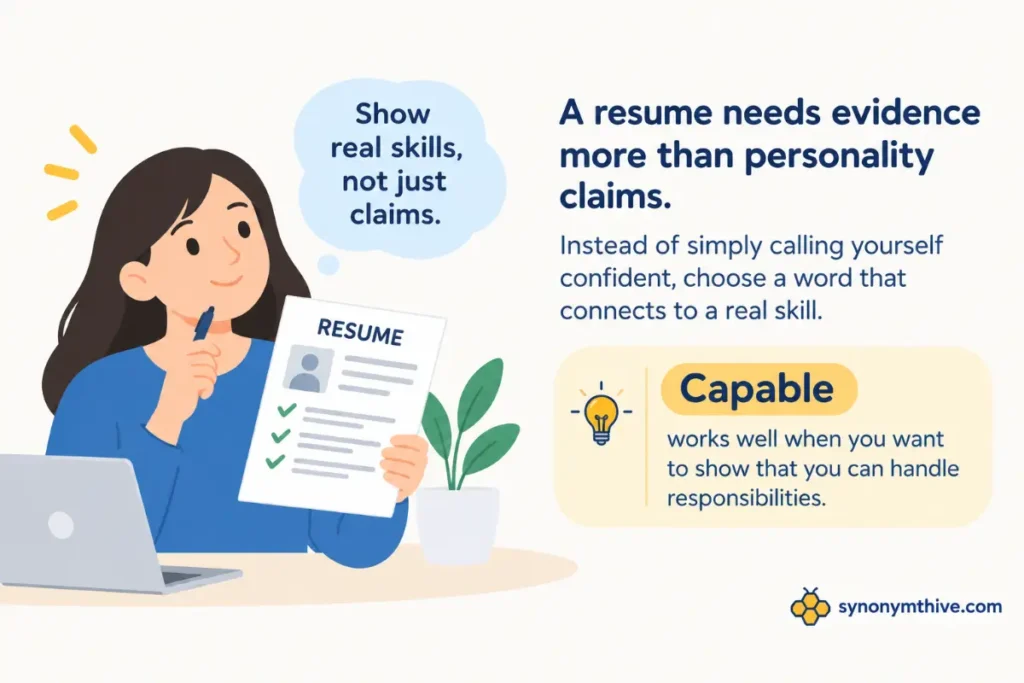
A resume needs evidence more than personality claims. Instead of simply calling yourself confident, choose a word that connects to a real skill.
Capable works well when you want to show that you can handle responsibilities.
Skilled works when you have specific abilities.
Proficient can describe strong ability with a tool, process, or subject.
Assertive can work for leadership and communication roles.
Decisive fits positions that require judgment and quick choices.
Poised works well for roles that involve presentations, clients, interviews, or public communication.
Resume Example
Instead of writing:
“I’m a confident employee who works well with teams.”
Try this:
“I’m a capable team member who communicates clearly and takes ownership of assigned projects.”
The second sentence gives the reader more useful information. It doesn’t simply claim confidence. It shows the qualities behind it.
What Is Another Term For Confident In An Essay
Essays need precise language. Your choice should match the point you’re making.
Use certain when discussing a strong belief about a fact.
Use assured when describing a speaker or character who appears calm and sure.
Essay Example
“Her self assured response showed that she had prepared carefully for the debate.”
This sentence gives the reader a clear picture. The person isn’t simply confident. Her preparation supports her attitude.
What Is Another phrase For Confident In A Text
Text messages usually need simple language.
Sure is often the best choice.
For example:
“I’m sure we can finish it tonight.”
“You’ve got this.”
“I know I can handle it.”
“I feel good about the plan.”
“You can count on me.”
These phrases sound natural because people use them in everyday conversation. A formal word such as authoritative would feel strange in most casual texts.
What Is Another Term For Confident In An Email
Email language depends on the relationship and purpose.
In a professional email, assured, confident, capable, certain, or comfortable can work well.
For example:
“I’m confident that our team can complete the project by Friday.”
A more specific version could be:
“Our team has the skills and experience needed to complete the project by Friday.”
The second sentence is stronger because it gives a reason for the confidence.
For a casual email, you might write:
“I’m sure we can work this out.”
That sounds friendly and natural.
What Is Another Phrase For Confident In Speaking
When you describe someone’s speaking style, poised, assured, clear, assertive, and composed can all work.
Poised focuses on calm control.
Assertive focuses on clear and firm communication.
Assured focuses on certainty and self trust.
Composed focuses on staying calm under pressure.
Clear focuses on understandable communication rather than confidence itself.
For example:
“She remained composed while answering difficult questions.”
This tells the reader more than simply saying she was confident.
What Are Some Examples Of Confident Synonyms In Real Life
Real examples make word choice easier. The best synonym changes with the situation.
- Job interview. She sounded assured when she explained how she handled the difficult client.
- Classroom. The student gave a confident answer after reviewing the material carefully.
- Work meeting. Marcus was assertive when he explained why the team needed more time.
- Public speaking. The speaker remained poised throughout the presentation.
- Leadership. The manager was decisive when the project ran into trouble.
- Sports. The player looked fearless during the final minutes of the game.
- Writing. The author used an authoritative tone when explaining the research.
- Friendship. She seemed secure in her decision and didn’t need approval from everyone.
- Business. The founder made a bold move after studying the market.
- School project. He felt capable of completing the assignment without extra help.
- Customer service. The representative gave a firm answer while staying polite.
- Presentation. She spoke clearly and calmly in front of the audience.
- Personal growth. After months of practice, he became more self assured.
- Difficult conversation. She was direct without being rude.
- Career change. He felt positive about moving into a new field.
The key lesson is simple. Don’t search for a synonym just to avoid repeating a word. Choose one that adds useful meaning.
How Are Assured And Confident Different
Assured and confident are close, but they don’t always create the same image.
| Confident | Assured |
|---|---|
| Broad and common | More polished |
| Can describe inner belief | Often suggests calm certainty |
| Works in casual and formal settings | Often sounds more formal |
| Can describe general self belief | Often highlights how someone appears |
For example, “She is confident” gives a broad description.
“She is assured” suggests that she appears calm and certain.
In professional writing, assured can sometimes sound more refined. In everyday speech, confident remains the more natural choice.
How Are Assertive And Confident Different
Assertive describes behavior. Confident describes belief and self trust.
A confident person may still speak quietly. An assertive person communicates their needs and opinions clearly.
Someone can also be confident without being assertive.
For example, a person may feel sure about their idea but hesitate to share it. Another person may speak firmly even when they have some doubts.
| Word | Main idea | Example |
|---|---|---|
| Confident | Trusting yourself | She felt confident about the presentation. |
| Assertive | Speaking or acting firmly | She was assertive when discussing the deadline. |
This difference matters on resumes. If a job needs strong communication, assertive may tell the employer more than confident.
How Are Confident And Arrogant Different
Confident and arrogant sit on opposite sides of a useful line.
Confidence means trusting yourself.
Arrogance means acting as though you’re superior to others.
A confident manager might say, “I believe this plan will work.”
An arrogant manager might dismiss everyone else’s ideas without listening.
Confidence can build trust. Arrogance can damage it.
That distinction is important because strong language can accidentally make your writing sound negative. If you want to describe healthy self belief, choose words such as assured, capable, poised, or self assured.
Looking for another word? See Another Word For Contributed Resume Choices 2026.
How Are Confident And Certain Different
Confident often describes personal ability or belief. Certain usually describes a lack of doubt about a fact, choice, or outcome.
For example:
“I’m confident I can finish the project.”
“I’m certain the meeting starts at nine.”
The first sentence focuses on ability. The second focuses on factual certainty.
Sometimes both words can work. The best choice depends on what you want to emphasize.
What Are The US And UK Differences
The basic meaning of confident stays the same in American and British English.
The bigger difference comes from style and context. American workplace writing often favors direct and practical language. British writing may sometimes use more restrained expressions of confidence.
Words such as assured, capable, poised, certain, and assertive work across both varieties of English.
Regional slang can change more than standard vocabulary. A casual expression that sounds natural in one area may feel unusual somewhere else.
For broad professional content, standard English remains the safest choice.
What Mistakes Should You Avoid With Confident Synonyms
A good synonym can become a poor choice when its meaning doesn’t match the sentence.
Don’t Use Certain For Every Situation
Certain often describes facts or strong belief. It doesn’t always describe personality.
“She is certain” can sound incomplete without context.
“She is confident during interviews” clearly describes her behavior and attitude.
Don’t Use Assertive As A Direct Replacement Every Time
Assertive suggests firmness. It can imply that someone speaks up or sets boundaries.
Calling a quiet but highly skilled person assertive may not describe them accurately.
Don’t Use Arrogant When You Mean Confident
These words have very different emotional meanings.
Arrogant is negative. Confident is usually positive.
Don’t Use Fearless For Ordinary Confidence
Fearless suggests a lack of fear or a willingness to face danger. It sounds much stronger than confident.
Use it when the situation supports that level of intensity.
Don’t Use Cocky As A Positive Word
Cocky usually suggests too much confidence.
It can work in dialogue or character descriptions, but it can make a person sound annoying or disrespectful.
Don’t Choose A Fancy Word Just To Sound Smart
Simple language often communicates better.
If capable says exactly what you mean, there’s no need to replace it with a more unusual word.
What Are The Antonyms Of Confident
The main opposite of confident is insecure.
Other useful antonyms include uncertain, doubtful, hesitant, unsure, timid, nervous, fearful, and self conscious.
These words also have different shades of meaning.
Insecure suggests a lack of self trust.
Uncertain suggests doubt about an answer or outcome.
Hesitant describes someone who struggles to act.
Timid suggests a lack of boldness.
Nervous describes emotional discomfort or worry.
Doubtful suggests that someone doesn’t believe something is likely or true.
Choosing the right opposite matters just as much as choosing the right synonym.
How Can You Pick Another Word For Confident Quickly
Start by asking what kind of confidence you mean.
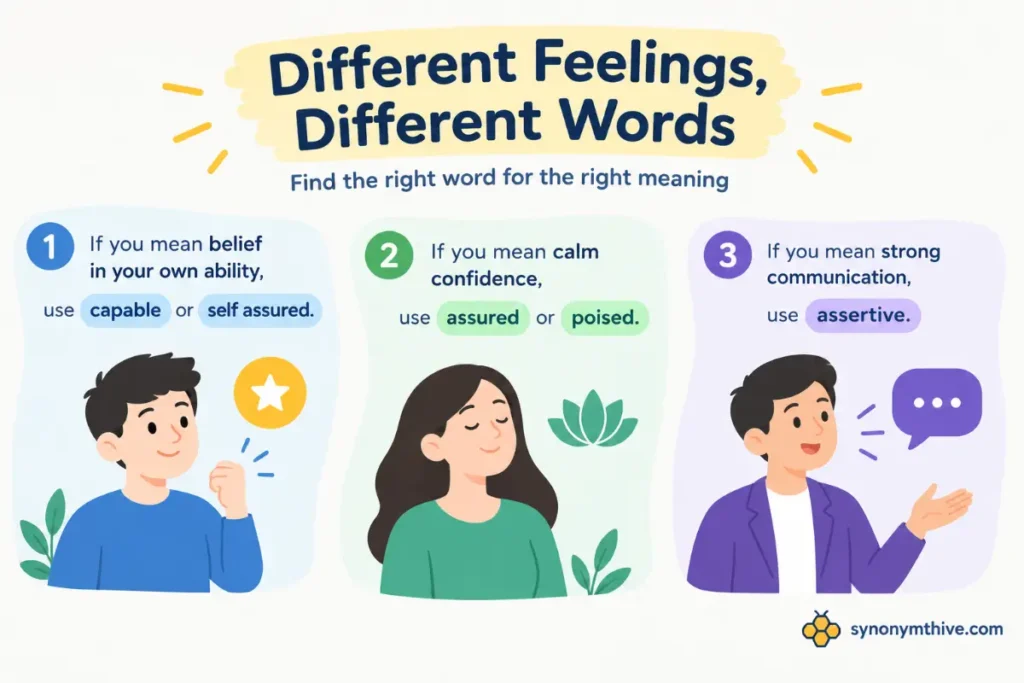
- If you mean belief in your own ability, use capable or self assured.
- If you mean calm confidence, use assured or poised.
- If you mean strong communication, use assertive.
- If you mean quick and firm decisions, use decisive.
- If you mean courage, use bold or fearless.
- If you mean certainty about a fact, use certain.
- If you mean professional skill, use competent or skilled.
- If you mean confidence that has gone too far, use cocky or arrogant.
- If you mean casual confidence, use sure or sure of yourself.
- If you mean confidence supported by expertise, use authoritative.
A useful test is to remove the original word and read the sentence aloud. Ask yourself what the new word adds. If it adds a clear shade of meaning, keep it. If it only sounds fancier, use the simpler option.
How Can You Make Confidence Sound More Natural
Strong writing doesn’t always need a synonym. Sometimes the best move is to rewrite the sentence.
Instead of:
“I am a confident leader.”
Try:
“I lead teams calmly and make clear decisions under pressure.”
Instead of:
“She was confident in her ability.”
Try:
“She trusted her ability to handle the challenge.”
Instead of:
“He sounded confident during the meeting.”
Try:
“He spoke clearly and answered every question without hesitation.”
These versions show confidence instead of simply naming it.
That approach is especially useful for resumes and professional writing. Employers usually care more about what you can do than what adjective you use to describe yourself.
How Can You Show Confidence Without Saying Confident
Actions often communicate confidence better than adjectives.
A person who listens and then speaks firmly can show maturity and self trust.
A person who handles criticism calmly can show emotional strength.
This style makes writing feel more real. Instead of telling readers that someone is confident, you give them evidence they can picture.
For example:
“She accepted the challenging assignment and created a clear plan for completing it.”
That sentence suggests confidence without using the word itself.
What Makes A Good Confidence Word For A Resume
The best resume language connects confidence with measurable ability.
Capable works well for broad ability.
Skilled works well for specific expertise.
Proficient works well when you have strong working knowledge.
Decisive works well for leadership.
Assertive works well for communication.
Poised works well for public facing roles.
Authoritative can work when deep knowledge is central to the position.
Still, evidence should come first. A strong resume might say:
“Led a five person team through a six week product launch.”
That statement shows leadership more effectively than saying:
“I’m a confident leader.”
Specific results carry more weight than self praise.
How Can You Avoid Sounding Overconfident
Use evidence. Keep your claims realistic. Let your actions support your description.
Instead of saying you’re the best person for a role, explain what you’ve accomplished.
Instead of saying you always make the right decision, explain how you evaluate problems and choose solutions.
Confidence sounds believable when it has something behind it.
A useful rule is this. Show the skill and let the reader notice the confidence.
That approach creates stronger resumes, essays, emails, and professional profiles.
What Is Another Expression For Confident When You Want A Positive Tone
If you want a positive but natural tone, assured, capable, poised, self assured, and secure are strong options.
Assured sounds calm.
Capable sounds practical.
Poised sounds controlled.
Self assured sounds secure.
Secure sounds emotionally grounded.
Bold works when the person takes risks.
Assertive works when the person speaks clearly and firmly.
The right choice depends on the exact picture you want the reader to see.
What Is Another Phrase For Confident When You Want A Strong Tone
For stronger writing, consider bold, fearless, daring, authoritative, decisive, and courageous.
Bold suggests courage and willingness to act.
Fearless suggests little or no fear.
Daring suggests a willingness to take risks.
Authoritative suggests expertise and control.
Decisive suggests strong judgment.
Courageous suggests bravery in the face of difficulty.
These words have more energy than confident. Use them when the context supports that strength.
What Is Another Word For Confident In Professional Writing
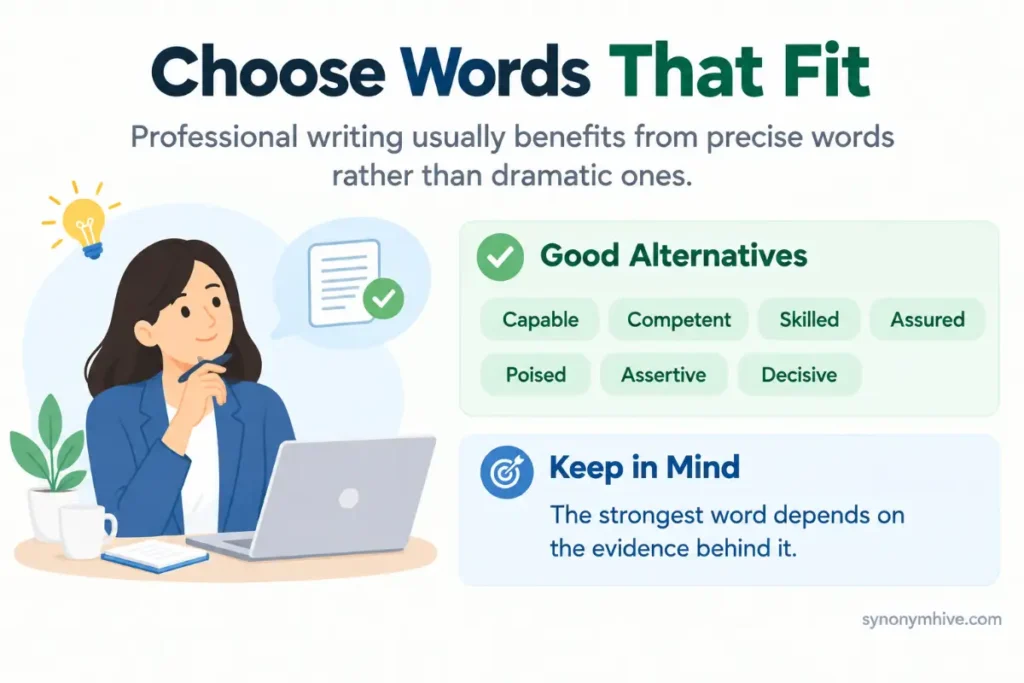
Professional writing usually benefits from precise words rather than dramatic ones.
Capable, competent, skilled, assured, poised, assertive, and decisive are often safer choices.
The strongest word depends on the evidence behind it.
For technical ability, skilled or proficient may fit.
When you manage people, decisive or assertive may fit.
If you speak to clients, poised or assured may fit.
When you make important choices, decisive may be the clearest option.
Professional writing works best when the word matches the actual skill.
Final Tips For Choosing The Right Word
Choosing the right alternative becomes much easier when you focus on meaning first and style second.
Think about the exact quality you want to describe. Is it courage, certainty, skill, calmness, communication, or self trust?
Then choose the simplest word that carries that meaning.
Also consider your audience. A text message can sound natural with sure. A resume may benefit from capable or skilled. An essay may need precise language such as assured or certain. A character description may call for bold or fearless.
Finally, read the sentence aloud. If the word feels unnatural, replace it. Good writing should sound like something a real person would say.
The strongest choice isn’t always the most impressive word. It’s the word that makes the meaning clear.
Explore another synonym guide: Another Word for Coordinated Best Resume Choices 2026.
Conclusion
Finding another word for confident becomes easier once you identify the kind of confidence you want to express. Use capable for ability. Choose assured for calm certainty. Pick assertive for firm communication. Use decisive for strong judgment. Choose bold or fearless when courage and risk matter.
For resumes and professional writing, focus on evidence instead of relying on praise. A clear example of what you did can communicate confidence better than any adjective.
Keep your audience and situation in mind. Simple words often sound more natural and convincing than fancy ones. When the word fits the person and the context, your writing feels stronger without trying too hard.
Frequently Asked Questions
What’s another way to say confident?
Another way to say confident is assured, capable, self assured, poised, certain, assertive, bold, or secure. The best choice depends on the exact meaning you want.
What is another term for confident on a resume?
A strong resume alternative is capable, skilled, competent, assured, assertive, or decisive. Choose the word that matches a real skill you can support with experience or results.
Is assured the same as confident?
Assured is close to confident but often suggests calm certainty and control. It can sound slightly more polished in professional writing.
What is the best synonym for confident in an essay?
The best synonym depends on the sentence. Assured works for calm self belief. Certain works for strong belief in a fact. Assertive works for firm communication.
What’s another way to say confident in a text?
Sure, sure of yourself, positive, and comfortable are natural choices for a text. Keep the wording simple so it sounds like normal conversation.
Can confident have a negative meaning?
Yes. Confidence can sound negative when it becomes excessive. Words such as cocky and arrogant describe confidence that can appear disrespectful or superior.
What is the opposite of confident?
The main opposite is insecure. Other choices include unsure, uncertain, hesitant, timid, doubtful, nervous, and self conscious.