
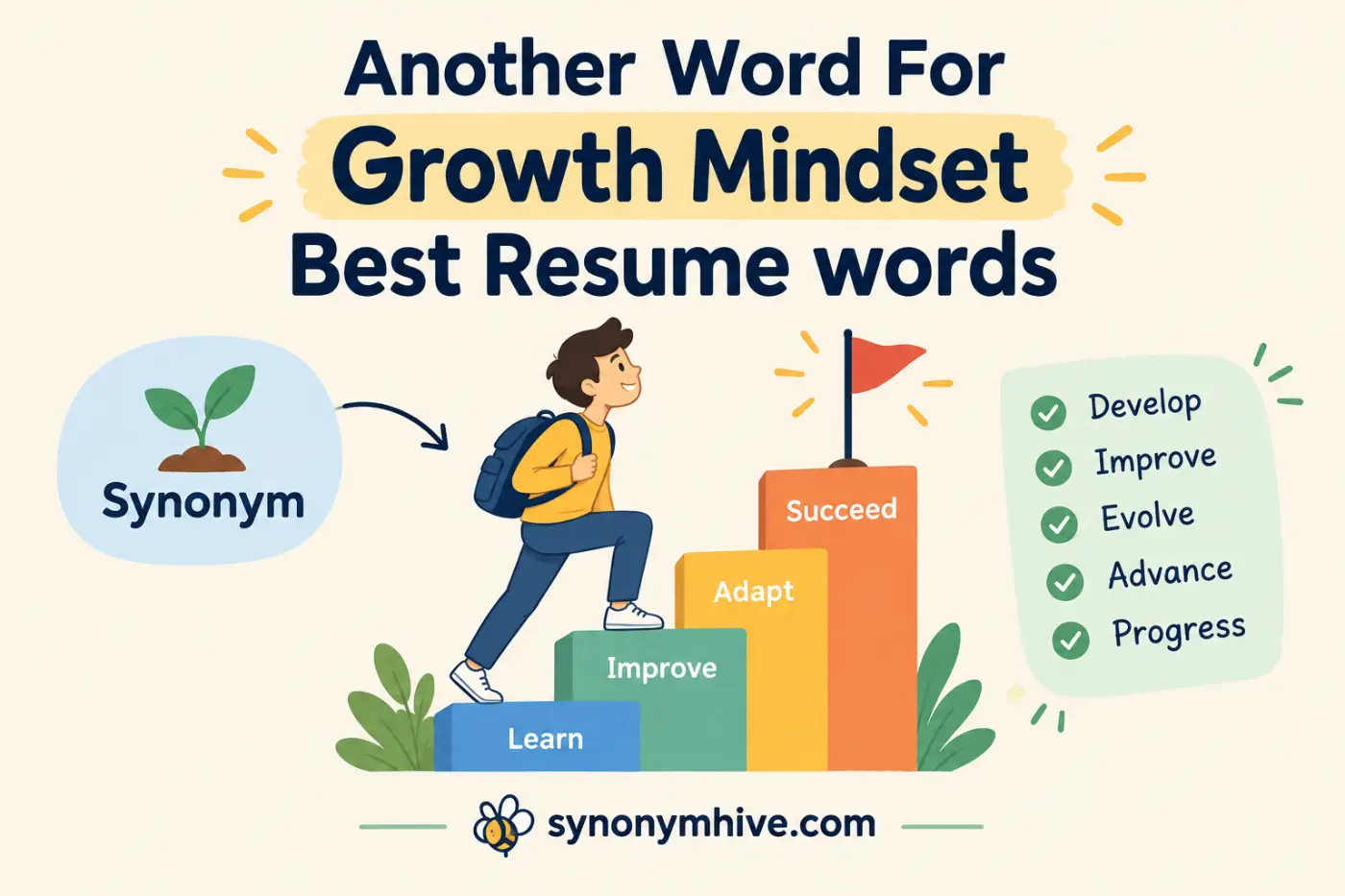
When you’re writing a resume and want to show that you keep learning and improving, the phrase growth mindset can feel a little too common. You may wonder if there’s a stronger way to describe that quality without sounding repetitive. Finding another word for growth mindset can help you make your resume sound more specific and professional.
The best choice depends on what you want to emphasize. You might want to show that you’re adaptable, eager to learn, open to feedback, resilient, ambitious, or committed to personal development. Each word carries a slightly different meaning.
Another word for growth mindset is adaptability when you want to show that you can learn from change and adjust your approach.
This guide explains the meaning and origin of the phrase. You’ll also find more than 30 useful alternatives grouped by tone plus examples for resumes, essays, emails, texts, and everyday conversations. You’ll learn how to choose the right word without making your writing sound forced.
Need a similar word? Read Another Word for Skills: Best Choices (2026).
What does growth mindset mean in simple English
A growth mindset is the belief that your abilities can improve through learning, practice, effort, feedback, and experience.
The idea contrasts with a fixed mindset. A person with a fixed mindset may see talent or intelligence as something mostly set from the beginning. A person with a growth mindset sees skills as things they can develop over time.
For example, imagine someone who struggles with public speaking. A fixed mindset might lead that person to think they’re simply bad at speaking in front of people. A growth mindset leads to a different response. The person may practice presentations, ask for feedback, study effective speakers, and improve with experience.
On a resume, the phrase often points to qualities employers value. These include:
- A willingness to learn.
- Openness to feedback.
- Adaptability during change.
- Persistence after setbacks.
- Curiosity about new ideas.
- Commitment to professional development.
- A habit of improving skills.
The strongest replacement depends on the specific quality you want to highlight.
Where did the phrase growth mindset come from
The term growth mindset is strongly associated with psychologist Carol Dweck and her research on motivation and beliefs about ability.
Dweck’s work helped popularize the distinction between growth and fixed mindsets. Her research examined how people respond to challenges and how their beliefs about ability can affect motivation and learning.
The plain English idea is simple. Skills can develop.
That doesn’t mean effort alone guarantees success. Effective learning also involves useful strategies, practice, feedback, support, and changes in approach. This distinction matters when you use growth mindset language in professional writing.
For a resume, you can turn the broader idea into a specific strength. Instead of simply saying you have a growth mindset, you can show that you’re adaptable, curious, resilient, coachable, or committed to learning.
That approach often sounds more natural because it tells the reader what you actually do.
What is another word for growth mindset
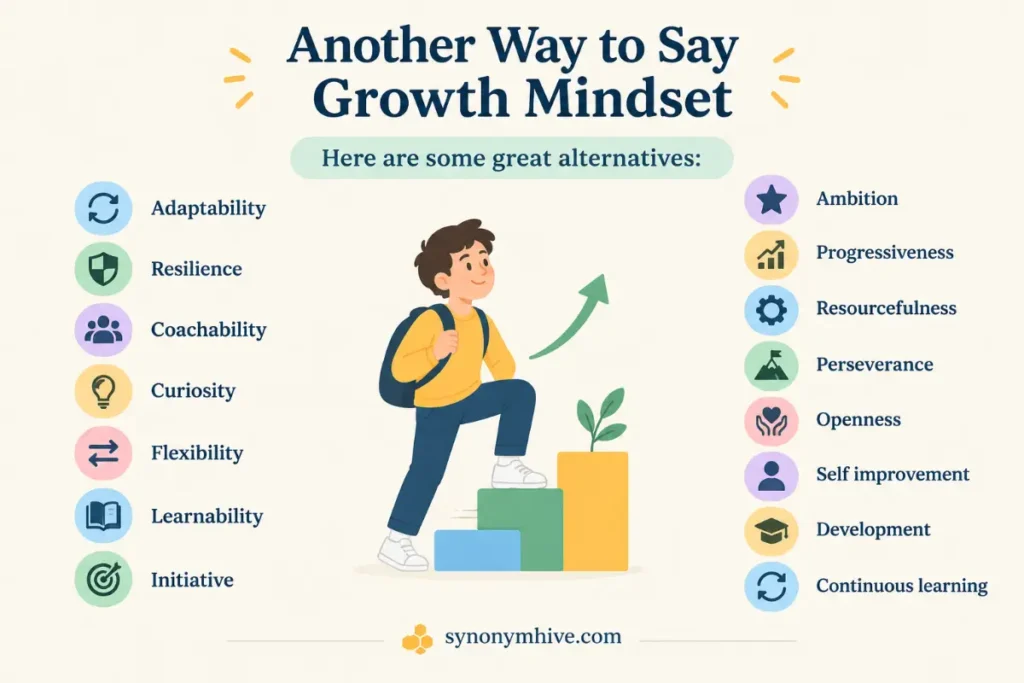
The best alternatives include adaptability, resilience, coachability, curiosity, flexibility, learnability, initiative, ambition, progressiveness, resourcefulness, perseverance, openness, self improvement, development, and continuous learning.
However, these words aren’t perfect substitutes in every sentence. Each one focuses on a different part of the idea.
For example, adaptability highlights your ability to adjust. Resilience highlights your response to setbacks. Coachability shows that you accept guidance and use feedback. Curiosity emphasizes your desire to learn.
Choosing a precise word gives your writing more impact.
What are the best synonyms for growth mindset
The following list gives you a broad range of choices. Some work well on resumes. Others sound more natural in casual conversation or personal writing.
| Word | Meaning | Tone | Example |
|---|---|---|---|
| Adaptability | Ability to adjust and learn | Professional | Her adaptability helped her succeed in a changing role. |
| Resilience | Ability to recover from setbacks | Professional | His resilience helped him handle difficult projects. |
| Coachability | Willingness to accept and use feedback | Professional | Her coachability helped her improve quickly. |
| Curiosity | Strong desire to learn | Everyday | His curiosity led him to explore new tools. |
| Learnability | Ability to learn new skills | Professional | The role requires strong learnability and initiative. |
| Perseverance | Continued effort despite difficulty | Formal | Her perseverance helped her complete the demanding course. |
| Persistence | Continued effort toward a goal | Everyday | His persistence paid off after several failed attempts. |
| Resourcefulness | Ability to find useful solutions | Professional | Her resourcefulness helped solve the problem quickly. |
| Openness | Willingness to consider ideas and feedback | Everyday | His openness to feedback improved his work. |
| Self improvement | Active effort to become better | Everyday | She focuses on self improvement through regular training. |
| Development | Process of building skills | Formal | Professional development remains one of his priorities. |
| Continuous learning | Ongoing effort to gain knowledge | Professional | She values continuous learning throughout her career. |
| Progress | Movement toward improvement | Everyday | The team made steady progress after reviewing its process. |
| Advancement | Movement toward a higher level | Formal | He seeks advancement through skill development. |
| Improvement | Becoming better over time | Everyday | Her focus on improvement helped raise team performance. |
| Evolution | Gradual change and development | Formal | His career shows steady professional evolution. |
| Open mindedness | Willingness to consider new ideas | Everyday | Her open mindedness helps her work with different teams. |
| Growth oriented | Focused on development and improvement | Professional | He brings a growth oriented approach to leadership. |
| Teachable | Willing and able to learn | Everyday | She is highly teachable and responds well to feedback. |
Which alternatives sound simple and natural
Some words work because people use them often. They don’t make the reader stop and think about what you mean.
For everyday writing, strong choices include:
- Curious.
- Adaptable.
- Flexible.
- Teachable.
- Motivated.
- Persistent.
- Open minded.
- Driven.
- Resourceful.
- Eager to learn.
These words are especially useful when you want clear language instead of formal business vocabulary.
For example, saying that you’re eager to learn usually feels more natural than saying you demonstrate a continuous development orientation.
Simple language often makes a stronger impression.
Which alternatives work best on a resume
A resume needs specific language. You want words that communicate a useful workplace quality without making unsupported claims.
Strong resume choices include:
- Adaptable.
- Resilient.
- Coachable.
- Resourceful.
- Curious.
- Self directed.
- Teachable.
- Growth oriented.
- Improvement focused.
- Committed to continuous learning.
- Open to feedback.
- Quick to learn.
These terms work best when you connect them to evidence.
Instead of writing that you’re highly adaptable, show what you adapted to.
For example:
- Adapted quickly to a new customer management system and helped teammates learn the updated process.
- Learned new reporting software within two weeks and used it to improve monthly reporting.
- Applied manager feedback to improve presentation skills and client communication.
Specific evidence makes a resume more convincing than a long list of personality claims.
What words show a mild growth mindset
Sometimes you don’t want to sound extremely ambitious. You may simply want to show that you’re willing to learn and improve.
Good mild choices include:
- Curious.
- Teachable.
- Open.
- Flexible.
- Receptive.
- Willing to learn.
- Open to feedback.
- Interested in development.
These words suggest a positive attitude without making a dramatic claim.
For example:
I’m open to feedback and enjoy learning new ways to improve my work.
That sentence works well in an email or interview response.
What words show a strong growth mindset
If you want a stronger sense of drive and determination, choose words such as:
- Resilient.
- Persistent.
- Ambitious.
- Driven.
- Resourceful.
- Proactive.
- Determined.
- Enterprising.
- Improvement focused.
- Growth oriented.
These words suggest more than simple interest in learning. They imply action and determination.
For example:
She’s a resilient professional who uses feedback and setbacks as opportunities to improve.
That sentence communicates a stronger quality than simply saying she likes learning.
What are the parts of speech for these alternatives
Most alternatives appear as nouns or adjectives. Knowing the difference helps you build grammatically correct sentences.
Nouns
Common noun choices include:
- Adaptability.
- Resilience.
- Curiosity.
- Flexibility.
- Initiative.
- Perseverance.
- Persistence.
- Resourcefulness.
- Development.
- Improvement.
Example:
His adaptability helped him succeed during the company transition.
Adjectives
Adjective choices describe a person or approach.
- Adaptable.
- Resilient.
- Curious.
- Flexible.
- Resourceful.
- Persistent.
- Teachable.
- Motivated.
- Driven.
- Progressive.
Example:
She’s an adaptable employee who learns new systems quickly.
Phrases
Some of the most useful alternatives are short phrases.
- Eager to learn.
- Open to feedback.
- Committed to learning.
- Focused on improvement.
- Open to new ideas.
- Committed to professional development.
Example:
I’m committed to continuous learning and regularly update my technical skills.
What is the best word for a resume
For most resumes, adaptability is one of the safest and most useful choices.
It shows that you can respond to new situations and keep performing when circumstances change.
However, the best choice depends on the evidence behind your claim.
Choose adaptability when you learned a new process or handled major change.
Select resilience when you recovered from setbacks.
Consider coachability when feedback played an important role in your improvement.
Pick curiosity when learning and exploration are central to your work.
Highlight initiative when you independently developed a new skill.
Choose resourcefulness when you solve unfamiliar problems.
Mention continuous learning when you regularly build professional knowledge.
What should I use on a resume
A strong resume sentence could say:
I’m an adaptable professional who learns new systems quickly and applies feedback to improve performance.
Another option is:
I bring curiosity and initiative to every project and actively seek opportunities to develop new skills.
These examples sound stronger because they connect the quality with an action.
What is the best word for an essay
An essay often needs a more thoughtful word.
Good choices include:
- Growth.
- Development.
- Resilience.
- Adaptability.
- Perseverance.
- Curiosity.
- Self improvement.
- Personal development.
For an academic essay you might write:
Personal development often begins when people recognize that mistakes can become useful learning experiences.
That sentence gives the idea without repeating the phrase growth mindset.
How can I use the idea in an essay
Try focusing on behavior instead of labels.
For example:
A student who responds to poor grades by changing study habits demonstrates a strong commitment to improvement.
This sounds more analytical than simply saying the student has a growth mindset.
What is the best word for an email
For a professional email, adaptability, openness, and willingness to learn usually sound natural.
For example:
I’m always open to feedback and happy to learn a better way to handle the process.
You could also write:
I’m looking forward to learning the new system and adapting to the updated workflow.
These sentences feel friendly and professional without sounding like resume jargon.
What is the best word for texting
Text messages usually need simple language.
Try:
- Open minded.
- Curious.
- Willing to learn.
- Always improving.
- Teachable.
- Flexible.
For example:
I’m still learning, but I’m always willing to improve.
Another natural text could be:
I messed up this time, but I know I can get better with practice.
The second example communicates the idea without using any formal vocabulary.
What is the best word for speaking
In everyday speech, adaptable, open minded, curious, and willing to learn are easy choices.
For example:
I’m pretty adaptable. If something isn’t working, I’ll try a different approach.
You could also say:
I like learning new things and getting better at what I do.
Simple spoken English often sounds more confident than complicated wording.
What are 10 real life examples of this idea
The best way to understand these alternatives is to see them in realistic situations.
- After receiving feedback from her manager, Maya changed her presentation style and became a stronger speaker.
- James learned a new software program on his own after his team changed its workflow.
- The student treated a low test score as a signal to change his study habits.
- Sarah asked her coworkers for advice because she wanted to improve her customer service skills.
- The new employee adapted quickly after the company introduced a different scheduling system.
- Daniel stayed persistent after several job applications were rejected.
- Maria showed curiosity by taking an online course outside her normal area of work.
- The team remained resourceful when its original plan stopped working.
- Alex used feedback from a writing instructor to improve his next essay.
- The manager encouraged employees to stay open minded when testing new ideas.
- The designer learned a new tool because the old software no longer met the project needs.
- The teacher praised the student for being willing to learn from mistakes.
These examples show why a precise alternative can be more useful than repeating one broad phrase.
Learn more useful word alternatives in Another Word For Improved: Winning Resume Words 2026.
Adaptability vs resilience
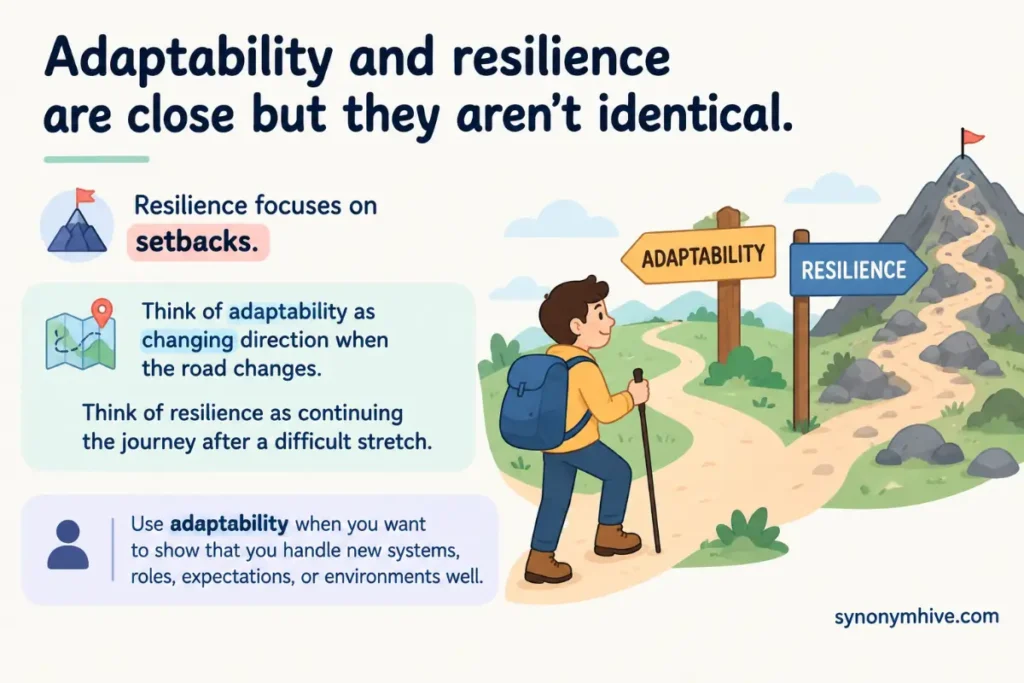
Adaptability and resilience are close but they aren’t identical.
Resilience focuses on setbacks.
Think of adaptability as changing direction when the road changes. Think of resilience as continuing the journey after a difficult stretch.
Use adaptability when you want to show that you handle new systems, roles, expectations, or environments well.
Use resilience when you want to show that you recover after failure, criticism, stress, or disappointment.
Compare these examples:
| Adaptability | Resilience |
|---|---|
| She adapted quickly to the new software. | She recovered quickly after the project failed. |
| He adjusted to a new leadership structure. | He stayed focused after losing an important client. |
| They changed their approach when customer needs shifted. | They continued working after several setbacks. |
Both qualities can support a growth oriented approach. They simply emphasize different behaviors.
Curiosity vs ambition
Curiosity and ambition also overlap but point in different directions.
Ambition focuses on achievement.
A curious person wants to understand something. An ambitious person wants to reach a goal.
For example:
Her curiosity led her to study data analysis.
His ambition pushed him to pursue a management position.
Choose curiosity when learning matters most. Choose ambition when progress and achievement matter most.
A resume can use both when the evidence supports them.
For example:
Curious and ambitious professional who actively develops new skills and takes on challenging projects.
Coachability vs teachability
Coachability usually fits professional settings better. It suggests that someone accepts feedback and uses it to improve performance.
Teachability has a broader meaning. It can describe someone who is receptive to instruction in many situations.
For a resume, coachability may work well in fields such as sales, sports, management, customer service, education, and other roles where feedback matters.
Example:
Highly coachable team member who applies feedback quickly and consistently improves performance.
The key is to support the claim with an example whenever possible.
What are the US and UK differences
There isn’t a major US versus UK difference in the core meaning of growth mindset.
The phrase is widely understood in both varieties of English.
Some related vocabulary may vary in frequency or style. For a USA focused resume, words such as adaptable, resilient, coachable, proactive, curious, and eager to learn are natural choices.
You should also match the vocabulary used in the job description. If an American employer repeatedly mentions adaptability or continuous learning, using the same relevant term can make your resume easier to scan.
Don’t copy every phrase from the posting. Use only language that accurately describes your experience.
What mistakes should you avoid
One common mistake is using a synonym that sounds impressive but doesn’t match the actual meaning.
For example, ambition isn’t always a good replacement. A growth mindset centers on learning and development. Ambition centers more on achievement.
Another mistake is stacking too many related words.
A sentence like this feels crowded:
I’m adaptable, resilient, curious, driven, ambitious, proactive, resourceful, teachable, flexible, and growth oriented.
The reader may stop paying attention.
Pick one or two qualities that matter most for the situation.
A third mistake is making broad claims without evidence.
Instead of saying:
I have a strong growth mindset.
Show the behavior:
I learned a new reporting system and created a guide that helped the team adopt it.
The second version gives the reader something concrete.
When should you not use a synonym
Don’t replace the phrase simply to avoid repetition.
If growth mindset is the exact concept you need and your audience understands it, using the original phrase can be perfectly fine.
You also shouldn’t choose a complicated synonym just because it sounds more professional.
For example, progressive may suggest support for new ideas or social change rather than personal learning. Evolution may describe gradual development but can sound abstract in a resume. Aspirational can suggest future goals but may not clearly communicate learning.
Precision matters more than variety.
What are the antonyms of growth mindset
The clearest opposite is fixed mindset.
Other related opposites include:
- Resistance to change.
- Closed mindedness.
- Rigidity.
- Inflexibility.
- Stagnation.
- Complacency.
- Defeatism.
These words don’t always mean exactly the same thing.
A fixed mindset relates specifically to beliefs about the ability to develop. Rigidity describes resistance to changing methods or ideas. Complacency describes a lack of concern about improving.
Use the specific term that matches your meaning.
How do you choose the right word
Start with the behavior you want to describe.
When the person adjusts well to change, choose adaptability.
Whenever the person recovers from failure, choose resilience.
As the person accepts feedback, choose coachability.
When the person loves learning, choose curiosity.
If the person acts independently, choose initiative.
Whenever the person keeps going despite obstacles, choose perseverance.
When the person finds creative solutions, choose resourcefulness.
As the person wants to achieve ambitious goals, choose ambition.
When the person regularly builds skills, choose continuous learning.
This simple approach helps you avoid vague language.
How can you make your resume sound more human
A resume becomes stronger when you connect qualities to actions.
Instead of:
Growth minded professional.
Try:
Adaptable professional who quickly learns new systems and applies feedback to improve results.
Instead of:
I have a growth mindset.
Try:
I actively seek feedback and use it to improve my work.
Instead of:
Committed to personal growth.
Try:
I regularly develop new skills through training and hands on projects.
The second versions give the reader evidence of behavior. That creates a more credible picture of you.
How can you avoid resume buzzwords
Some words have become so common that they can lose their impact.
Words such as motivated, hardworking, passionate, and driven can still be useful. The problem starts when you use them without proof.
A better approach is to replace broad claims with specific actions.
Instead of:
Hardworking and motivated employee.
Try:
Completed additional training while managing a full workload and used the new skills to improve the reporting process.
That sentence demonstrates the quality instead of simply naming it.
What is another word for growth mindset in a resume
For most resumes, adaptability is a strong choice because it communicates the ability to learn and respond to change.
Still, the best option depends on your evidence.
When feedback helped you improve, use coachability. After overcoming setbacks, use resilience. When learning drives your work, use curiosity. If you developed skills independently, use initiative. When you solve unfamiliar problems, use resourcefulness.
If you want to keep the exact concept while making it more concrete, try continuous learning or improvement focused.
The goal isn’t to find the fanciest synonym. The goal is to choose the word that tells the truth about how you work.
What is another word for growth mindset in professional writing
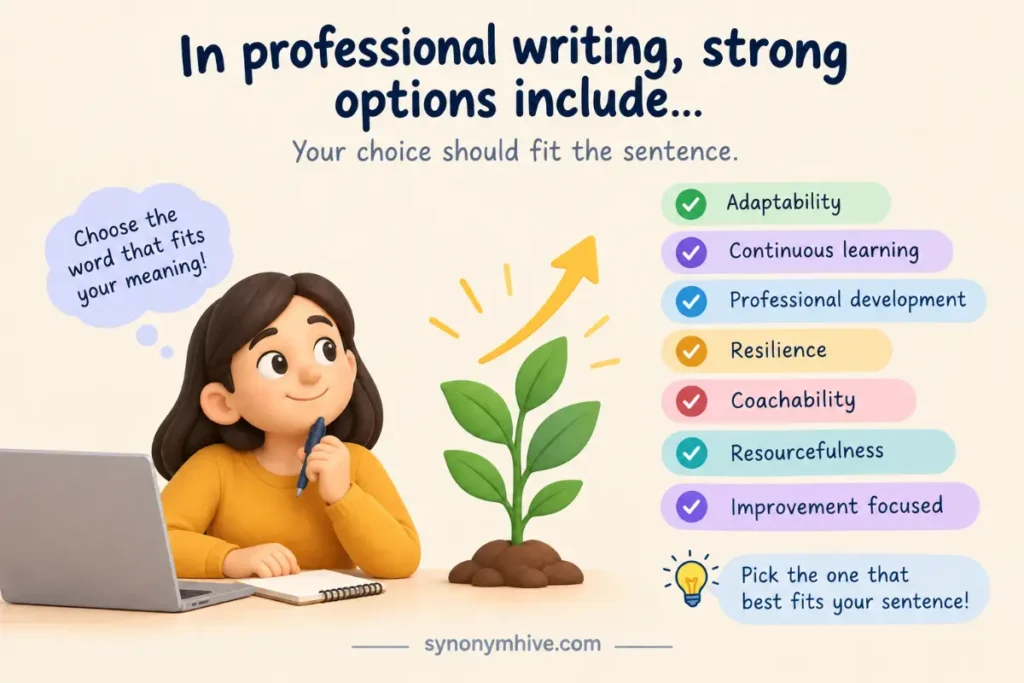
In professional writing, strong options include adaptability, continuous learning, professional development, resilience, coachability, resourcefulness, and improvement focused.
Your choice should fit the sentence.
For example:
Our team values continuous learning and encourages employees to develop new skills.
Or:
Her adaptability helped the department respond quickly to changing customer needs.
These sentences communicate specific professional qualities without relying on vague language.
What is another word for growth mindset in simple English
If you need plain English, use phrases such as eager to learn, willing to improve, open to feedback, always learning, adaptable, curious, or willing to try new things.
For example:
I’m always willing to learn and improve.
That sentence is easy to understand and sounds natural in conversation.
Simple words often work best when your audience doesn’t need specialized terminology.
Quick tips for choosing the right synonym
Use these quick rules when you’re stuck.
- Choose adaptability for change.
- Choose resilience for setbacks.
- Choose curiosity for learning.
- Choose coachability for feedback.
- Choose initiative for independent action.
- Choose resourcefulness for problem solving.
- Choose perseverance for long term effort.
- Choose ambition for achievement.
- Choose continuous learning for ongoing skill development.
- Choose open mindedness for new ideas.
- Choose flexibility for changing plans.
- Choose improvement for becoming better.
The strongest word is the one that fits your actual experience.
Find more synonyms in Another Word For Teamwork Resume Choices 2026.
Conclusion
The best alternative depends on the quality you want your reader to notice. Another word for growth mindset might be adaptability when you want to highlight change. It could be resilience when setbacks are the focus. Curiosity works well for learning while coachability fits situations where feedback matters.
For resumes, specific language usually beats broad claims. Don’t simply tell employers that you want to grow. Show how you’ve learned a skill, handled a challenge, used feedback, or improved a process.
The right word should feel natural and accurate. You don’t need complicated vocabulary to sound professional. A clear word backed by real experience will always carry more weight than a polished buzzword with no evidence.
Frequently Asked Questions
What’s another way to say growth mindset?
Adaptability is one of the strongest alternatives when you want to show that someone learns and adjusts as circumstances change. Other options include resilience, curiosity, coachability, initiative, and continuous learning.
What is another word for growth mindset on a resume?
Adaptability is a strong resume choice because it shows that you can learn and respond to change. Coachability, resilience, curiosity, and continuous learning can work better in specific situations.
What is a professional way to say growth mindset?
You can say continuous learning, adaptability, improvement focused, professional development, or open to feedback. Choose the phrase that best matches the behavior you want to show.
What word describes someone who is always learning?
Curious, teachable, adaptable, and committed to continuous learning can describe someone who keeps developing new knowledge and skills.
What is a simple word for someone who wants to improve?
Teachable, motivated, curious, or adaptable can work depending on the exact meaning. Willing to learn is also a clear and natural phrase.
What is the opposite of a growth mindset?
Fixed mindset is the clearest opposite. Related ideas include rigidity, resistance to change, closed mindedness, and stagnation.
How do I show a growth mindset on my resume?
Show specific actions instead of simply claiming the quality. Mention new skills you learned, feedback you used, challenges you handled, or improvements you made.