
Writing a resume can make simple words feel surprisingly difficult. You may have strong skills but keep using the same word in every section. If you’re searching for another term for skills you have many options that can make your resume sound clearer and more specific.
Skills can mean abilities you learn through study and practice. They can also describe talents you develop through work or everyday life. The best replacement depends on the type of ability you want to describe.
Another word for skills can be abilities, strengths, expertise, talents, competencies, capabilities, or qualifications. The best choice depends on the context and the level of ability you want to show.
This guide explains the meaning and origin of skills and gives you more than 30 useful alternatives. You’ll also see the best choices for resumes, essays, emails, texts, interviews, and everyday speech. The examples show how each word works in a real sentence.
Learn more useful word alternatives in Another Word for Delivered Best Resume Choices 2026.
What does skills mean in plain English
Skills are abilities that help you do something well.
You can learn skills through school, training, practice, work, hobbies, or life.
For example:
She has strong writing skills.
He developed leadership skills at work.
Maria has excellent communication skills.
In each sentence, skills refers to abilities that help someone perform a task.
Skills can be physical.
Cooking, driving, painting, typing, and playing an instrument all require skills.
Skills can also be mental.
Problem solving, planning, analysis, research, and decision making are examples.
Some skills are personal.
Communication, patience, teamwork, adaptability, and organization can affect how well someone works with others.
This makes the word skills broad and useful. It also explains why one replacement doesn’t work for every situation.
A resume might need competencies.
A job interview might call for strengths.
An academic paper might use abilities or capabilities.
A casual conversation might simply use talents or things you know how to do.
The strongest choice always depends on your meaning.
Where did the word skills come from
The word skill has roots in Old Norse and Old English. It developed from words connected to knowledge, discernment, and the ability to understand or do something.
Over time, skill became closely linked with practical ability.
The basic idea remains simple.
A skill is something you can do because you have learned how to do it.
That learning can happen in many ways.
You might learn to write through school.
You might develop leadership by managing a team.
Skills therefore connect knowledge with action.
Knowing something is not always the same as being skilled at it.
Someone may understand the rules of basketball without being a skilled basketball player.
Someone may know grammar rules without being a strong writer.
Skill usually involves the ability to apply what you know.
What is another term for skills
Here is a larger list with useful differences.
| Word | Meaning | Tone | Example |
|---|---|---|---|
| Abilities | Things a person can do | Simple | She has strong writing abilities. |
| Strengths | Areas where someone performs well | Professional | Communication is one of his strengths. |
| Expertise | Advanced knowledge or ability | Formal | She has expertise in data analysis. |
| Competencies | Skills needed for a role or task | Professional | The role requires strong leadership competencies. |
| Capabilities | What someone is able to do | Professional | His capabilities include project planning. |
| Talents | Natural or developed abilities | Everyday | Her artistic talents are impressive. |
| Proficiency | A strong level of ability | Formal | He has proficiency in Spanish. |
| Aptitude | Natural ability or potential | Formal | She has an aptitude for mathematics. |
| Qualifications | Training or abilities that support a role | Professional | His qualifications match the position. |
| Know how | Practical knowledge | Casual | She has the know how to fix the issue. |
| Competence | Ability to perform something properly | Formal | His competence helped the team succeed. |
| Mastery | Very high level of ability | Strong | She has mastery of the craft. |
| Strength | An area of strong performance | Neutral | Organization is her biggest strength. |
| Ability | Capacity to perform an action | Simple | His ability to solve problems impressed us. |
| Competence | Reliable ability to perform well | Formal | Her competence was clear during the project. |
| Expertise | Deep specialized knowledge | Professional | His expertise helped solve the problem. |
| Facility | Natural ease with a task | Formal | She has a facility for languages. |
| Gift | Natural ability | Casual | He has a gift for storytelling. |
| Knack | Natural ability to do something well | Casual | She has a knack for explaining difficult ideas. |
| Strengths | Personal areas of ability | Professional | Leadership and planning are his strengths. |
| Methods | Ways of doing something effectively | Neutral | Her methods improved team productivity. |
This list shows an important point. These words are related but they aren’t identical. Expertise is stronger than basic ability. Aptitude focuses on potential. Training focuses on learning. Experience focuses on practice and real situations. Strengths focus on areas where you perform well. Qualifications can include skills but often involve formal education or credentials too. Choosing the right word makes your writing more precise.
What are simple synonyms for skills
If you want plain English, use abilities, strengths, talents, knowledge, or things you can do.
For example:
She has strong communication skills.
You could say:
She has strong communication abilities.
Or:
Communication is one of her strengths.
You could also make the sentence more natural.
She communicates clearly with customers and coworkers.
The last version doesn’t use a synonym at all. Instead, it shows the ability directly.
That can make writing stronger.
What are everyday synonyms for skills
Everyday language gives you several natural options.
Abilities.
Talents.
Strengths.
Know how.
Experience.
Practice.
A knack.
For example:
He has good computer skills.
In casual speech, you might say:
He’s good with computers.
That’s often more natural.
You could also say:
He knows his way around computers.
That version is casual and conversational.
The best choice depends on your audience.
What are formal synonyms for skills
Professional and academic writing can use competencies, capabilities, proficiency, expertise, qualifications, aptitude, competence, and specialties.
For example:
The position requires strong communication skills.
A formal version could be:
The position requires strong communication competencies.
However, don’t use a formal word simply because it sounds impressive.
Competencies can sound natural in a job description.
In ordinary conversation, abilities or strengths may be better.
Clear writing usually beats complicated writing.
What are casual alternatives for skills
Casual speech often avoids abstract nouns.
Instead of:
I have strong negotiation skills.
You could say:
I’m good at negotiating.
Instead of:
She has excellent cooking skills.
You could say:
She’s a great cook.
Instead of:
He has strong technical skills.
You could say:
He’s good with technology.
These sentences sound natural because they focus on what the person can actually do.
What are slang alternatives for skills
Some informal expressions describe skill without using the word directly.
Know how is one common example.
A knack for something suggests a natural ability.
Being good at something is another simple choice.
Being a pro suggests a high level of ability in casual speech.
For example:
She has a knack for fixing things.
He’s a pro at editing videos.
He really knows his way around computers.
These expressions are useful in conversation.
They usually don’t belong in a formal resume unless the tone is intentionally relaxed.
What are skills synonyms by intensity
Different words suggest different levels of ability.
Some describe basic ability.
Others suggest advanced knowledge.
| Level | Word | Meaning |
|---|---|---|
| Mild | Familiarity | Basic understanding |
| Mild | Exposure | Some contact with a subject |
| Mild | Aptitude | Natural potential |
| Moderate | Ability | General capacity to do something |
| Moderate | Competence | Reliable ability |
| Moderate | Proficiency | Strong working ability |
| Strong | Expertise | Advanced specialized knowledge |
| Strong | Mastery | Exceptional control or understanding |
| Strong | Specialization | Focused ability in a field |
| Very strong | Authority | High recognized knowledge or expertise |
Don’t exaggerate your ability. If you’ve used a program twice, calling yourself an expert may hurt your credibility. If you’ve used it daily for years and solve complex problems with it, expertise may be accurate. Good professional writing should be confident and honest at the same time.
How do skills change by part of speech
Skill is mainly used as a noun.
You can use related adjectives and verbs to vary your writing.
Skilled is an adjective.
For example:
She is a skilled designer.
Skillful is another adjective.
For example:
He gave a skillful presentation.
Capable is an adjective that means able to do something.
For example:
She’s capable of handling difficult customers.
Proficient is another adjective.
For example:
He is proficient in Excel.
Competent is an adjective related to competence.
For example:
She is a competent project manager.
Talented describes someone with strong natural or developed ability.
For example:
He’s a talented writer.
These words help you avoid repeating skills throughout a document.
What is another phrase for skills on a resume
The strongest resume alternatives are competencies, abilities, strengths, expertise, proficiency, qualifications, and capabilities.
The best choice depends on the resume section.
A skills section can simply be called:
Core Competencies.
Key Strengths.
Professional Expertise.
Technical Abilities.
Areas of Expertise.
Core Qualifications.
These headings can make your resume more specific.
For example:
Core Competencies.
Project management.
Customer communication.
Data analysis.
Team leadership.
Budget planning.
Or:
Key Strengths.
Client relations.
Problem solving.
Team coordination.
Content planning.
Research.
Choose a heading that matches the information below it.
What is another phrase for skills on a job application
Abilities, qualifications, competencies, and strengths work well.
For example:
List your skills.
You might write:
List your key qualifications.
Or:
Describe your main strengths.
Or:
List the competencies that match this position.
If the application asks for specific technical abilities, use the exact names of those abilities.
For example:
Microsoft Excel.
Python.
Data analysis.
Project management.
Customer service.
Specific terms help employers understand your background quickly.
What is the best word for skills on a resume
Competencies and strengths are often strong choices.
Expertise works when you have advanced knowledge.
Qualifications works when your abilities are supported by training or credentials.
Proficiency works for specific technical abilities.
For example:
Technical Proficiency.
Excel.
SQL.
Python.
Power BI.
Another option is:
Areas of Expertise.
Data analysis.
Market research.
Financial reporting.
Customer insights.
The right heading depends on the type of resume.
What is another word for skills in an essay
Abilities, talents, capabilities, strengths, knowledge, and expertise can work in essays.
For example:
The character’s leadership skills helped the group survive.
You could write:
The character’s leadership abilities helped the group survive.
Or:
The character’s leadership strengths helped the group survive.
If you’re discussing a professional person, expertise may be better.
For example:
Her expertise in medicine shaped her decisions.
If you’re discussing natural ability, talent or aptitude may fit.
For example:
His aptitude for mathematics became clear at an early age.
What is another expression for skills in texting
Texting usually works best with simple language.
You might say:
I’m good at it.
I’m pretty good with computers.
I know how to do that.
I’ve done it before.
That’s one of my strengths.
She’s really talented at drawing.
These phrases sound more natural than formal terms.
You wouldn’t normally text a friend:
I possess considerable proficiency in graphic design.
You’d probably say:
I’m pretty good at graphic design.
Natural language matters.
What is another term for skills in an email
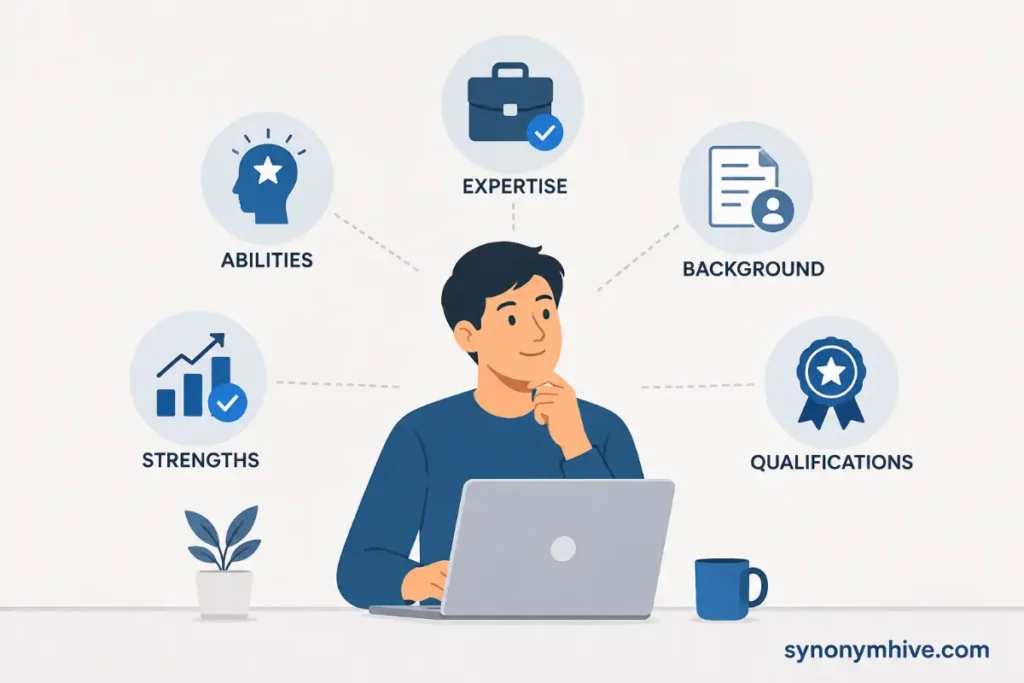
The best choice depends on the relationship and purpose. For a professional email use abilities, expertise, background, strengths, or qualifications.
For example:
My background in customer research may be useful for this project.
Or:
My expertise in data analysis could help us review the results.
For a casual email you might say:
I’m good with spreadsheets if you need help.
The goal is to match the tone to the reader.
What is another alternative for skills when speaking
Abilities and strengths are easy to use when speaking.
You can also avoid the noun completely.
Instead of:
My strongest skill is communication.
Say:
I’m good at communicating with people.
Instead of:
My skills include project management.
Say:
I’ve managed several projects from start to finish.
Speaking often sounds better when you use direct verbs.
What is another synonym for skills on LinkedIn
Professional expertise, core competencies, strengths, capabilities, and specialties work well on LinkedIn.
For example:
Areas of Expertise.
Content strategy.
SEO.
Market research.
Customer analysis.
Another option is:
Core Competencies.
Team leadership.
Project planning.
Client relations.
Data analysis.
Keep your profile specific.
Instead of listing ten broad skills, show how you use them.
What are the best synonyms for technical skills
Technical abilities, technical expertise, proficiency, capabilities, competencies, and know how can work.
For example:
Strong technical skills in Excel and SQL.
A more specific version is:
Proficiency in Excel and SQL with experience building automated reports.
The second sentence gives the reader more information.
You can also name the tools directly.
Python.
SQL.
Adobe Photoshop.
AutoCAD.
Microsoft Excel.
Specific skills are easier to understand than broad labels.
Looking for another word? See Another Word For Implemented Resume Choices 2026.
What are the best synonyms for soft skills
Soft skills can include interpersonal strengths, people skills, communication abilities, personal strengths, and professional qualities.
For example:
Strong interpersonal skills.
You could write:
Strong communication and relationship building abilities.
Or:
Strong interpersonal strengths with a focus on teamwork and customer service.
Again, specificity makes the statement stronger.
What are the best synonyms for leadership skills
Leadership abilities, management strengths, leadership competencies, team management capabilities, and leadership expertise can work.
For example:
Strong leadership skills.
You could write:
Strong team leadership abilities.
Or:
Proven leadership track record.
Or:
Expertise in team development and performance management.
The last choices give more detail.
What are the best synonyms for communication skills
Communication abilities, interpersonal strengths, presentation abilities, writing abilities, and relationship building skills can work.
But you can often be more specific.
Instead of:
Strong communication skills.
Try:
Clear written and verbal communication.
Or:
Strong presentation and client communication abilities.
Or:
Skilled at explaining complex ideas in simple language.
Specific wording helps the reader understand exactly what you do well.
What are the best synonyms for problem solving skills
Analytical ability, critical thinking, reasoning, decision making, troubleshooting, and strategic thinking can all work.
They aren’t perfect synonyms.
Problem solving is broad.
Analytical ability focuses on examining information.
Troubleshooting focuses on finding and fixing problems.
Decision making focuses on choosing an action.
Strategic thinking focuses on long term planning.
Pick the term that matches your actual ability.
How are skills and abilities different
Skills and abilities are close in meaning.
A skill usually suggests something you have learned or developed.
An ability can be broader.
For example:
She has strong writing skills.
This suggests she developed writing through learning and practice.
She has the ability to communicate clearly.
This focuses on her capacity to communicate.
Abilities can be natural or developed.
Skills often involve practice.
The difference is small in many everyday sentences.
How are skills and talents different
Skills are usually developed through learning and practice.
Talents often suggest natural ability.
For example:
She has strong writing skills.
This suggests developed ability.
She has a talent for writing.
This suggests that writing comes naturally to her.
A person can have talent without much training.
A person can also become highly skilled through practice.
The two ideas can overlap.
How are skills and strengths different
Skills describe abilities.
Strengths describe areas where someone performs particularly well.
For example:
Writing is one of my skills.
Writing is one of my strengths.
The second statement suggests writing is one of your better abilities.
On a resume, strengths can sound more personal.
Skills are more neutral and direct.
How are skills and expertise different
Expertise is much stronger.
Skills can be basic, intermediate, or advanced.
Expertise usually means advanced knowledge.
For example:
I have skills in graphic design.
I have expertise in graphic design.
The second statement makes a much stronger claim.
Use expertise when you can support it with training, experience, results, or recognized knowledge.
How are skills and qualifications different
Qualifications can include skills but often refer to formal evidence.
A qualification might be a degree, certification, license, training program, or professional credential.
For example:
Her qualifications include a teaching certificate and five years of classroom work.
Skills are the abilities themselves.
Qualifications are evidence or credentials that can support those abilities.
What are common mistakes when using skills synonyms
One common mistake is using competencies when abilities would be clearer.
Competencies is common in professional settings but can sound formal.
Another mistake is calling every ability expertise.
Expertise suggests depth.
Don’t use it for basic knowledge.
A third mistake is confusing talent with skill.
Talent often suggests natural ability.
Skill usually suggests something developed.
A fourth mistake is using qualifications as a direct replacement for skills.
Qualifications can include credentials and education.
They aren’t always the same thing.
A fifth mistake is using vague terms.
Words such as dynamic, professional, and capable may sound positive but don’t tell the reader much.
Specific abilities are better.
When should you not use skills
Don’t use skills when you mean results.
Say achievements or accomplishments.
Don’t use skills when you mean education.
Say training, education, or qualifications.
Don’t use skills when you mean advanced knowledge.
Say expertise.
Don’t use skills when you mean previous work.
Say background or experience.
Don’t use skills when you mean natural ability.
Say talent or aptitude.
The right word depends on what you are trying to communicate.
What are the antonyms of skills
The opposite depends on context.
Inability is a direct opposite.
Incompetence can describe a lack of ability.
Inexperience refers to limited practice.
Weakness can describe an area where someone performs poorly.
Lack of knowledge means someone doesn’t understand a subject.
Unfamiliarity means someone doesn’t know something well.
For example:
She has strong technical skills.
She has limited technical ability.
He has extensive experience.
He is inexperienced in this area.
The best antonym changes with the sentence.
What are useful examples of skills synonyms
Here are examples from real situations.
- Communication is one of her strongest abilities.
- Customer service is one of his key strengths.
- She has expertise in financial analysis.
- His technical proficiency helped the team solve the issue.
- The role requires strong project management competencies.
- She has a natural aptitude for languages.
- His qualifications match the requirements of the position.
- He has the know how to manage difficult customers.
- Her artistic talents developed through years of practice.
- Data analysis is one of his specialties.
- Her leadership capabilities helped the company grow.
- His problem solving ability impressed the hiring manager.
- She developed strong presentation abilities through regular practice.
- His interpersonal strengths make him a strong team leader.
- Her writing proficiency improved through years of editing.
- He has strong research capabilities.
- Her technical expertise helped reduce errors.
- His organizational strengths keep projects on schedule.
- She has a knack for explaining complex ideas.
- He is highly capable of managing competing priorities.
These examples show how small changes can make writing more specific.
How can you show skills instead of simply naming them
Don’t just list an ability.
Show how you used it.
For example:
Communication.
That tells the reader very little.
Instead write:
Explained technical information to customers and reduced support requests.
Now the reader can see communication in action.
Instead of:
Leadership.
Write:
Led a team of 12 employees and improved project completion rates.
Instead of:
Problem solving.
Write:
Identified a recurring process issue and helped reduce processing time by 25 percent.
Instead of:
Organization.
Write:
Managed multiple client projects while meeting weekly deadlines.
Evidence makes skills believable.
How can you choose the right synonym quickly
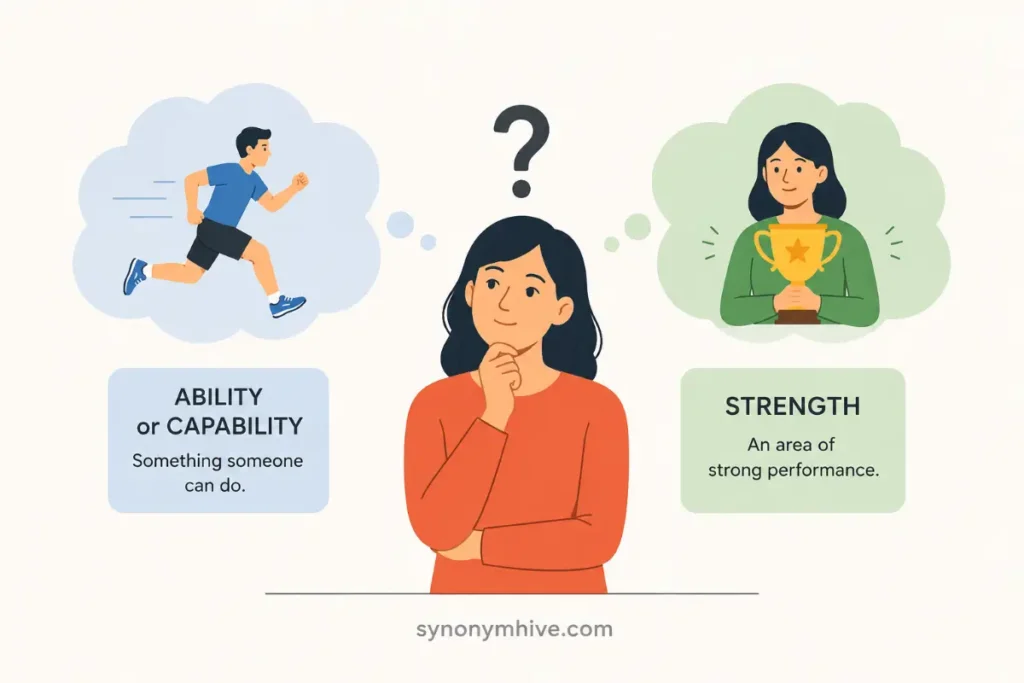
Ask what kind of ability you mean.
If you mean something someone can do use ability or capability.
If you mean exceptional ability use mastery.
This simple approach keeps your vocabulary accurate.
What should you remember when replacing skills
The best synonym isn’t always the most advanced word.
Sometimes abilities is better than competencies.
Sometimes strengths is better than expertise.
Instead of saying:
I have strong customer service skills.
Say:
I help customers solve problems quickly and clearly.
Instead of:
I have excellent leadership skills.
Say:
I lead teams through complex projects and keep work on schedule.
Instead of:
I have strong writing skills.
Say:
I write clear articles, reports, and marketing content for different audiences.
Specific language gives your reader proof.
That matters on resumes and professional profiles.
How can another phrase for skills improve a resume
Using another alternative for skills can help you avoid repetition and make each section more precise. But vocabulary alone won’t make a weak resume strong.
The real improvement comes from matching words to evidence.
Use competencies for role specific abilities.
Use proficiency for measurable ability.
Then support those claims with examples and results.
A hiring manager should quickly understand what you can do and how you’ve used it.
That is more valuable than a long list of impressive sounding words.
What is the final takeaway about skills synonyms
Skills is a broad word, so the best replacement depends on what you mean.
Use abilities when you want a simple general term.
Choose strengths when you want to highlight areas where you perform well.
Use expertise for advanced knowledge.
Choose competencies for professional role requirements.
Use capabilities for what someone can accomplish.
Choose proficiency for a strong level of ability.
Use aptitude for natural potential.
Choose qualifications when education or credentials support the claim.
Use know how for practical knowledge in casual writing.
Use mastery only for exceptional ability.
Most importantly, don’t replace skills just for the sake of variety. Good writing isn’t about finding the fanciest synonym. It’s about choosing the clearest word and showing the reader what you can actually do.
Explore more word choices in Another Word for Flexible: Best Resume Choices 2026.
Conclusion
Good writing about skills starts with choosing the right words. If you’re looking for another word for skills, the best choice depends on the exact ability you want to describe. Abilities, strengths, expertise, competencies, capabilities, talents, and qualifications each carry a slightly different meaning.
When you write a resume or professional profile, choose a word that matches your real experience. Use expertise for advanced knowledge, strengths for areas where you perform well, competencies for role related abilities, and qualifications for formal education or credentials.
Most importantly, show your skills instead of simply naming them. A sentence such as I lead teams through complex projects gives readers useful proof. Clear examples and real results make your abilities more believable and help your writing stand out.
Frequently Asked Questions
What’s another way to say skills?
Another term for skills can be abilities, strengths, talents, competencies, capabilities, expertise, proficiency, or qualifications. The best choice depends on the type and level of ability.
What is another term for skills on a resume?
Another phrase for skills on a resume can be competencies, strengths, expertise, qualifications, abilities, or professional capabilities. Use the term that accurately describes the information in your resume.
What is a professional word for skills?
Competencies, capabilities, expertise, proficiency, and qualifications are professional alternatives. Competencies works especially well when discussing abilities required for a specific role.
What is a simple word for skills?
Abilities is one of the simplest alternatives to skills. Strengths and talents can also work in everyday writing.
What is another word for technical skills?
Technical abilities, technical expertise, proficiency, technical competencies, and practical know how are useful alternatives. Specific tools and technologies are often stronger than broad labels.
What is another word for soft skills?
Interpersonal abilities, personal strengths, communication abilities, and professional qualities can describe soft skills. The best option depends on the specific quality you want to show.
What is a stronger word for skills?
Expertise, proficiency, mastery, and specialized capabilities can sound stronger than skills. Use stronger terms only when they accurately reflect your level of ability.