
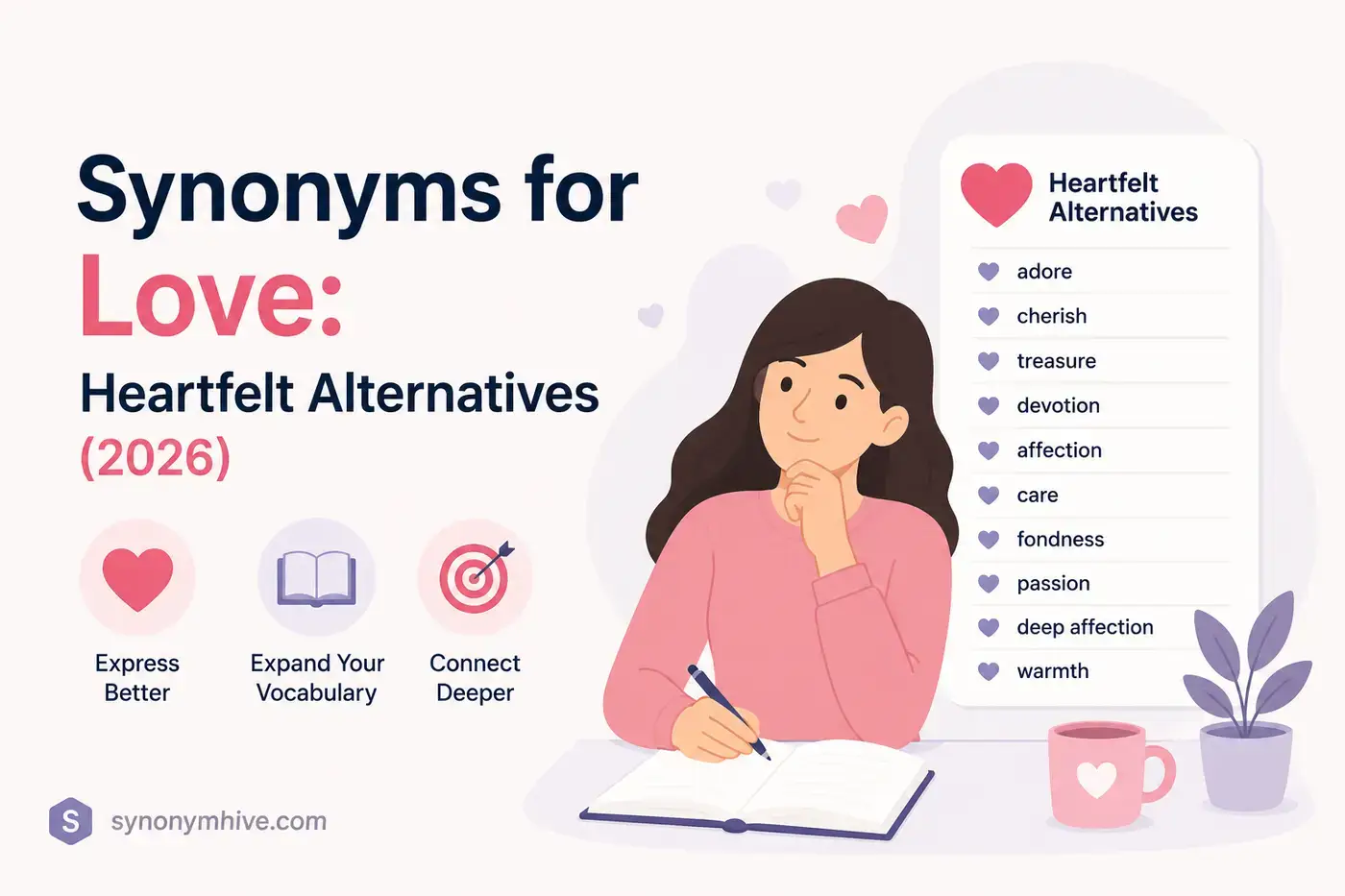
Have you ever written an email, birthday card, essay, or text message and felt that the word love didn’t fully express what you meant? Learning synonyms for love helps you describe affection, care, admiration, and deep emotions with more accuracy. The right word can make your writing warmer, more personal, and easier to connect with.
Synonyms for love are words that express affection, attachment, care, admiration, or strong positive feelings. Some fit romantic relationships, while others work better for family, friendships, hobbies, or professional writing. Using different words also keeps your writing from sounding repetitive. Instead of saying love again and again, you can choose a word that better matches the feeling you want to share.
This guide explains the meaning and history of the word, lists dozens of useful alternatives, compares similar words, and shows you how to choose the best one for every situation.
Need another vocabulary suggestion? Read Synonyms For Safe Simple Guide Top Picks (2026).
What Does Love Mean
The word love describes a deep feeling of affection, care, attachment, or appreciation toward someone or something. People use it in many different ways.
- Romantic relationships.
- Family connections.
- Friendships.
- Favorite hobbies.
- Personal interests.
- Pets.
- Places and experiences.
For example:
- I love spending time with my family.
- She loves reading mystery novels.
- They have loved each other for many years.
- We all love our hometown.
The exact meaning depends on the situation, but the central idea stays the same. Love expresses a strong positive feeling that goes beyond simply liking something.
Word Origin And Plain English Meaning
The word love has been part of English for hundreds of years. It comes from the Old English word lufu, which meant deep affection, care, friendship, or devotion. Similar words appeared in other early Germanic languages, showing that people have used this idea for centuries to describe strong emotional bonds.
Over time, the meaning expanded. Today, people use love for romantic partners, close friends, family members, favorite activities, food, music, sports, and many everyday experiences.
In plain English, love means:
- To care deeply about someone.
- To enjoy something very much.
- To feel strong affection.
- To value someone or something greatly.
- To have a lasting emotional connection.
Think about your favorite childhood memory. Maybe it’s baking cookies with your grandparents, playing outside with friends, or reading bedtime stories with your parents. Those warm feelings often reflect love in one form or another. Love doesn’t always mean romance. It can describe kindness, loyalty, appreciation, friendship, and lifelong support.
Synonyms For Love Master Word List
Many online lists include only a handful of alternatives. Real communication needs more choices because every relationship and every situation is different. The table below groups useful words into simple, everyday, formal, and casual language.
| Word | Meaning | Tone | Example |
|---|---|---|---|
| Like | Enjoy something | Simple | I like this book. |
| Care for | Feel affection | Simple | I care for my neighbors. |
| Cherish | Hold dear | Everyday | I cherish our friendship. |
| Treasure | Value deeply | Everyday | She treasures family traditions. |
| Adore | Love very much | Everyday | They adore their daughter. |
| Appreciate | Value someone or something | Everyday | I appreciate your kindness. |
| Admire | Respect greatly | Everyday | We admire her honesty. |
| Enjoy | Take pleasure in | Everyday | I enjoy hiking on weekends. |
| Respect | Hold in high regard | Everyday | I respect his opinion. |
| Affection | Warm feelings | Formal | The puppy showed affection. |
| Revere | Respect deeply | Formal | Many people revere the leader. |
| Idolize | Admire greatly | Formal | Young athletes often idolize champions. |
| Appreciate | Recognize value | Formal | We appreciate your support. |
| Fancy | Like romantically | UK Everyday | He fancies his classmate. |
| Be into | Enjoy something | Casual | I’m really into jazz music. |
| Be fond of | Like warmly | Everyday | I’m fond of old movies. |
| Dig | Like a lot | Slang | I dig this song. |
| Be hooked on | Enjoy constantly | Casual | He’s hooked on chess. |
| Be obsessed with | Strong interest | Casual | She’s obsessed with baking. |
| Have a soft spot for | Feel affection | Everyday | I have a soft spot for rescue animals. |
| Treasure | Keep with care | Everyday | They treasure every family photo. |
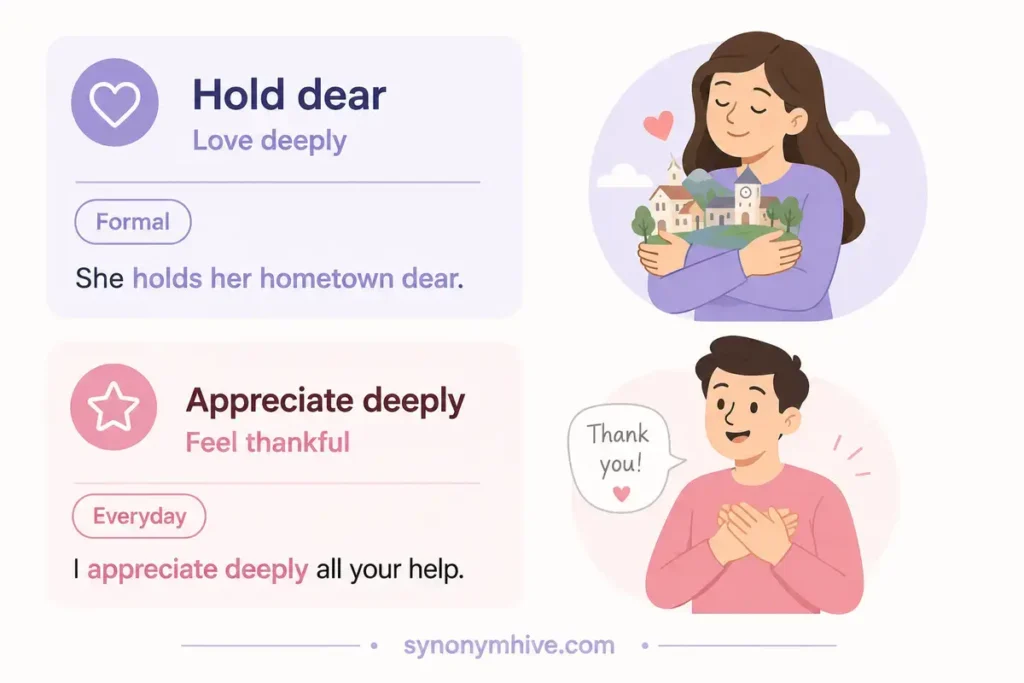
| Hold dear | Love deeply | Formal | She holds her hometown dear. |
| Appreciate deeply | Feel thankful | Everyday | I appreciate deeply all your help. |
This collection gives you choices for school assignments, personal messages, speeches, articles, and daily conversations.
Synonyms By Intensity
Not every situation calls for the strongest word. Sometimes a gentle expression sounds more natural.
Mild Affection
These words describe positive feelings without sounding emotional.
| Word | Best Use |
|---|---|
| Like | Everyday conversation. |
| Enjoy | Hobbies and activities. |
| Appreciate | Gratitude. |
| Value | Professional writing. |
| Respect | Work and school. |
Moderate Affection
These words express warmer feelings.
| Word | Best Use |
|---|---|
| Care for | Relationships. |
| Be fond of | Friends and hobbies. |
| Admire | Personal qualities. |
| Cherish | Memories and family. |
| Treasure | Meaningful experiences. |
Deep Affection
These words describe very strong emotional connections.
| Word | Best Use |
|---|---|
| Adore | Family and romance. |
| Devotion | Long term commitment. |
| Worship | Dramatic writing. |
| Idolize | Great admiration. |
| Hold dear | Personal relationships. |
Matching the strength of your word to the situation makes your writing feel sincere instead of exaggerated.
Synonyms By Part Of Speech
Most people know love as both a noun and a verb, which makes it more flexible than many emotion words. Learning its related forms helps you write with more variety.
Verbs
| Word | Example |
|---|---|
| Love | I love spending time outdoors. |
| Adore | They adore their grandchildren. |
| Cherish | We cherish every memory together. |
| Treasure | She treasures handwritten letters. |
| Appreciate | I appreciate your honesty. |
| Admire | We admire her courage. |
Nouns
| Word | Example |
|---|---|
| Love | Love brings people together. |
| Affection | The child showed affection for the puppy. |
| Devotion | His devotion never changed. |
| Fondness | She has a fondness for classic books. |
| Admiration | They spoke with admiration about their coach. |
| Respect | Mutual respect strengthens friendships. |
Adjectives
| Word | Example |
|---|---|
| Loving | She has a loving family. |
| Caring | He’s a caring friend. |
| Affectionate | The puppy is very affectionate. |
| Devoted | She’s a devoted mother. |
| Loyal | Loyal friends stay through hard times. |
| Warm | They received a warm welcome. |
Using different parts of speech keeps your writing smooth and prevents repeating the same word too often.
Do Americans And British People Use Different Words
Most alternatives for love are understood in both American and British English. Words like adore, cherish, care for, admire, and treasure sound natural almost everywhere. Some informal expressions are more common in one country.
| Word Or Phrase | More Common In | Notes |
|---|---|---|
| Fancy | UK | Often means romantic interest or attraction. |
| Quite keen on | UK | Means to like something very much. |
| Be into | US | Common for hobbies and interests. |
| Crazy about | US | Everyday way to show strong affection. |
| Dig | US | Informal way to say you like something. |
| Have a soft spot for | US and UK | Common in both regions for gentle affection. |
If you’re writing for an American audience, simple choices like love, care for, cherish, adore, and appreciate usually sound the most natural. If your audience includes readers from different countries, avoid local slang unless you’re sure they’ll understand it.
You may also like Synonyms for Hate: Powerful Alternatives (2026).
Which Synonym Fits Your Situation Best
The best word depends on your audience and your goal. A resume, essay, text message, and wedding speech all need a different tone. The sections below help you choose the right word with confidence.
Best Word For A Resume
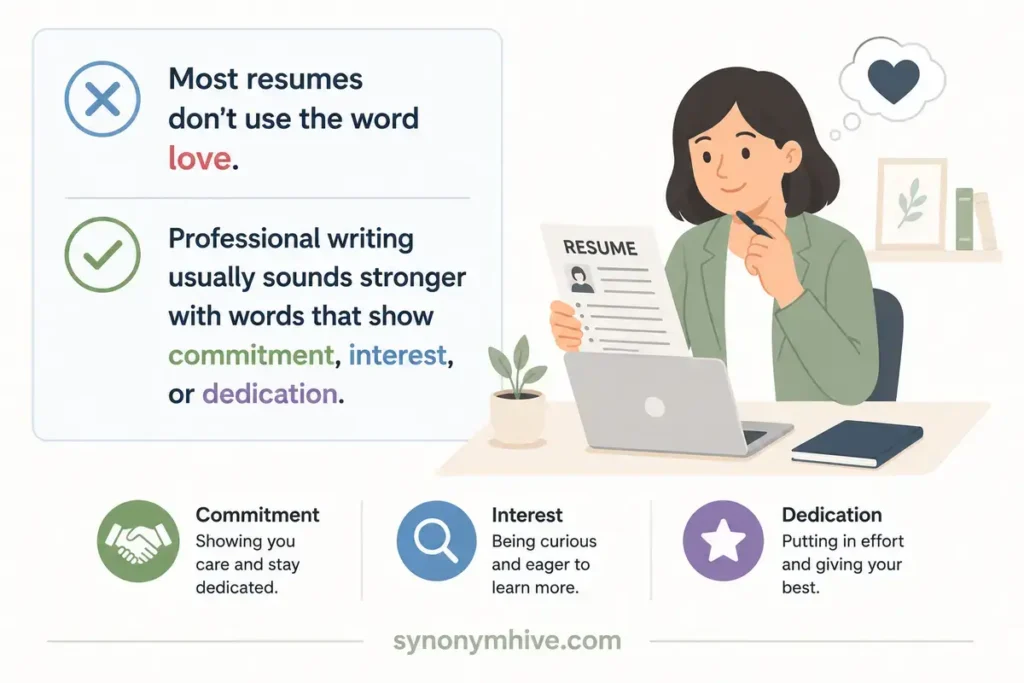
Most resumes don’t use the word love. Professional writing usually sounds stronger with words that show commitment, interest, or dedication.
| Best Word | Why It Works | Example |
|---|---|---|
| Passionate about | Shows enthusiasm. | Passionate about helping customers solve problems. |
| Dedicated to | Shows commitment. | Dedicated to improving team performance. |
| Committed to | Sounds professional. | Committed to delivering quality work. |
| Value | Shows priorities. | I value honesty and teamwork. |
| Appreciate | Shows gratitude. | I appreciate opportunities to learn and grow. |
These choices sound polished without becoming overly formal.
Best Word For An Essay
Essays often need clear and thoughtful language. The best synonym depends on the topic.
| Best Word | Best Use | Example |
|---|---|---|
| Cherish | Personal writing. | Many people cherish family traditions. |
| Admire | Describing people. | Students admire great leaders. |
| Appreciate | Explaining value. | We should appreciate cultural diversity. |
| Devotion | History or literature. | The character showed complete devotion to her family. |
| Affection | Academic writing. | The novel explores affection and loyalty. |
These words make your writing sound natural and mature.
Best Word For A Text Message
Friends usually prefer short and relaxed language.
| Best Word | Example |
|---|---|
| Love | I love this song. |
| Adore | I adore your new puppy. |
| Be into | I’m really into this show. |
| Crazy about | She’s crazy about coffee. |
| Dig | I dig that jacket. |
Simple words often sound warmer than formal ones.
Best Word For An Email
Emails can be professional or personal. Match your vocabulary to the person you’re writing to.
| Situation | Best Word | Example |
|---|---|---|
| Business | Appreciate | We appreciate your continued support. |
| Customer | Value | We value your feedback. |
| Teacher | Admire | I admire your dedication to teaching. |
| Friend | Love | I love hearing your stories. |
| Family | Cherish | I cherish every moment we spend together. |
A thoughtful word choice helps your message feel genuine.
Best Word For Speaking
People naturally use familiar words when they talk. These choices sound comfortable in everyday conversations.
| Word | Example |
|---|---|
| Love | I love spending time outdoors. |
| Adore | We adore this little restaurant. |
| Like | I really like that idea. |
| Appreciate | I appreciate everything you’ve done. |
| Care for | We care for each other. |
Speaking naturally always sounds better than trying to impress people with difficult vocabulary.
Original Example Sentences
Examples make it easier to understand how each synonym works.
- I cherish every photo from our family vacations.
- She adores spending weekends with her grandchildren.
- We appreciate your kindness during a difficult time.
- The students admire their science teacher for making learning fun.
- He treasures every letter his grandfather wrote.
- My parents have always shown endless devotion to our family.
- I have a soft spot for old bookstores.
- She’s really into hiking and camping.
- The community values honesty and respect.
- They care for their neighbors like family.
- I enjoy helping new coworkers feel welcome.
- He idolizes his favorite basketball player.
- We prize trust in every friendship.
- She holds her hometown dear even after moving away.
- I respect people who stay true to their values.
Every sentence shows a different shade of meaning. That’s why choosing the right synonym matters.
Love Vs Adore
These words are closely related, but they aren’t identical.
| Love | Adore |
|---|---|
| Can describe many kinds of affection. | Shows stronger affection or admiration. |
| Common in everyday language. | Sounds more expressive. |
| Works in almost every situation. | Often used for family, partners, children, or favorite things. |
Examples.
Love.
I love spending time with my grandparents.
Adore.
I absolutely adore my little niece.
The second sentence sounds warmer and more emotional.
Love Vs Cherish
People often use these words together, but they focus on different ideas.
| Love | Cherish |
|---|---|
| Describes deep affection. | Highlights appreciation and protecting something valuable. |
| Focuses on emotion. | Focuses on gratitude and lasting memories. |
Examples.
I love my family.
I cherish every moment we spend together.
One expresses affection. The other emphasizes how much those moments mean to you.
Love Vs Admire
These words share positive feelings, but they describe different relationships.
| Love | Admire |
|---|---|
| Shows emotional connection. | Shows respect and appreciation. |
| Often involves close relationships. | Can describe people you don’t know personally. |
Examples.
I love my sister.
I admire her determination.
You can admire someone without having a close personal relationship.
Love Vs Appreciate
These words are sometimes interchangeable, but they aren’t the same.
| Love | Appreciate |
|---|---|
| Expresses affection. | Expresses gratitude or recognition. |
| Emotional. | Respectful and thankful. |
Examples.
I love spending time with my family.
I appreciate everything you’ve done for me.
One focuses on emotion. The other focuses on thankfulness.
Common Mistakes People Make
Many writers use the same word over and over.
These simple changes make your writing stronger.
- Repeating love in every sentence.
Mix in words like cherish, adore, care for, treasure, and appreciate.
- Choosing words that are too dramatic.
Worship and idolize can sound exaggerated in everyday conversations.
- Using slang in formal writing.
Words like dig or crazy about don’t belong in business reports or school essays.
- Confusing admiration with affection.
You can admire someone’s talent without loving them.
- Forgetting the audience.
A text message, wedding speech, thank you note, and work email all call for different vocabulary.
When You Should Not Use Love
Even though synonyms for love help you write with more variety, the word love isn’t always the best choice.
Avoid using it when:
- A professional tone is expected.
- You simply mean that you enjoy something a little.
- You’re trying to sound objective.
- The same word appears too many times in one piece of writing.
- Another word explains your meaning more accurately.
Choosing the right level of emotion makes your writing feel honest instead of exaggerated.
Which Synonym Fits Your Situation Best
The best word depends on your audience and your goal. A resume, essay, text message, and wedding speech all need a different tone. The sections below help you choose the right word with confidence.
Best Word For A Resume
Most resumes don’t use the word love. Professional writing usually sounds stronger with words that show commitment, interest, or dedication.
| Best Word | Why It Works | Example |
|---|---|---|
| Passionate about | Shows enthusiasm. | Passionate about helping customers solve problems. |
| Dedicated to | Shows commitment. | Dedicated to improving team performance. |
| Committed to | Sounds professional. | Committed to delivering quality work. |
| Value | Shows priorities. | I value honesty and teamwork. |
| Appreciate | Shows gratitude. | I appreciate opportunities to learn and grow. |
These choices sound polished without becoming overly formal.
Best Word For An Essay
Essays often need clear and thoughtful language. The best synonym depends on the topic.
| Best Word | Best Use | Example |
|---|---|---|
| Cherish | Personal writing. | Many people cherish family traditions. |
| Admire | Describing people. | Students admire great leaders. |
| Appreciate | Explaining value. | We should appreciate cultural diversity. |
| Devotion | History or literature. | The character showed complete devotion to her family. |
| Affection | Academic writing. | The novel explores affection and loyalty. |
These words make your writing sound natural and mature.
Best Word For A Text Message
Friends usually prefer short and relaxed language.
| Best Word | Example |
|---|---|
| Love | I love this song. |
| Adore | I adore your new puppy. |
| Be into | I’m really into this show. |
| Crazy about | She’s crazy about coffee. |
| Dig | I dig that jacket. |
Simple words often sound warmer than formal ones.
Best Word For An Email
Emails can be professional or personal. Match your vocabulary to the person you’re writing to.
| Situation | Best Word | Example |
|---|---|---|
| Business | Appreciate | We appreciate your continued support. |
| Customer | Value | We value your feedback. |
| Teacher | Admire | I admire your dedication to teaching. |
| Friend | Love | I love hearing your stories. |
| Family | Cherish | I cherish every moment we spend together. |
A thoughtful word choice helps your message feel genuine.
Best Word For Speaking
People naturally use familiar words when they talk.
These choices sound comfortable in everyday conversations.
| Word | Example |
|---|---|
| Love | I love spending time outdoors. |
| Adore | We adore this little restaurant. |
| Like | I really like that idea. |
| Appreciate | I appreciate everything you’ve done. |
| Care for | We care for each other. |
Speaking naturally always sounds better than trying to impress people with difficult vocabulary.
Original Example Sentences
Examples make it easier to understand how each synonym works.
- I cherish every photo from our family vacations.
- She adores spending weekends with her grandchildren.
- We appreciate your kindness during a difficult time.
- The students admire their science teacher for making learning fun.
- He treasures every letter his grandfather wrote.
- My parents have always shown endless devotion to our family.
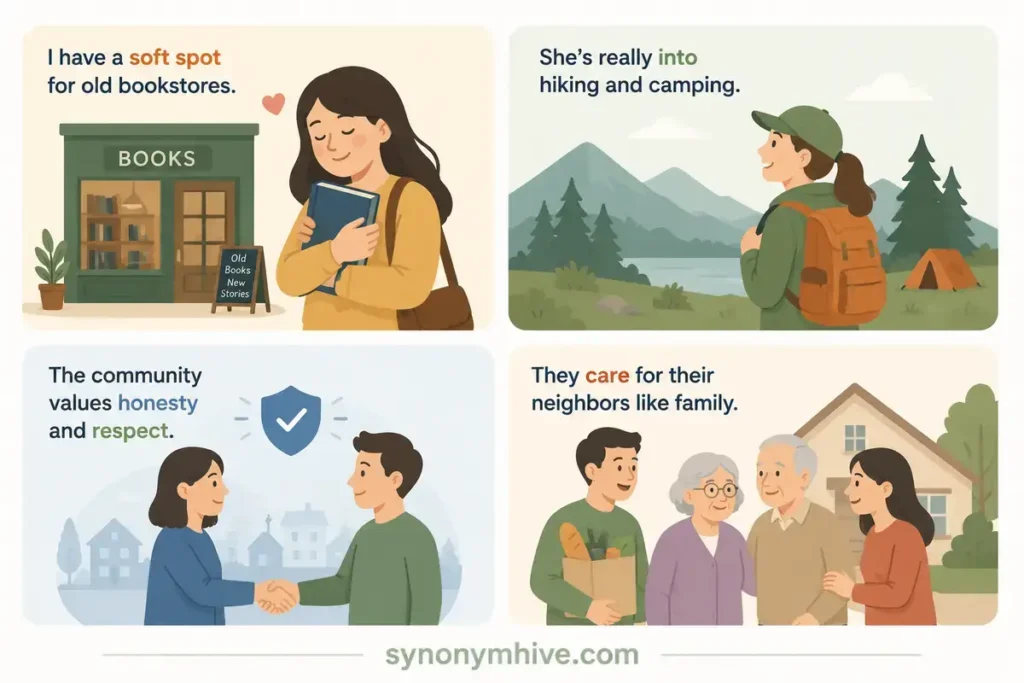
- I have a soft spot for old bookstores.
- She’s really into hiking and camping.
- The community values honesty and respect.
- They care for their neighbors like family.
- I enjoy helping new coworkers feel welcome.
- He idolizes his favorite basketball player.
- We prize trust in every friendship.
- She holds her hometown dear even after moving away.
- I respect people who stay true to their values.
Every sentence shows a different shade of meaning. That’s why choosing the right synonym matters.
Love Vs Adore
These words are closely related, but they aren’t identical.
| Love | Adore |
|---|---|
| Can describe many kinds of affection. | Shows stronger affection or admiration. |
| Common in everyday language. | Sounds more expressive. |
| Works in almost every situation. | Often used for family, partners, children, or favorite things. |
Examples.
Love.
I love spending time with my grandparents.
Adore.
I absolutely adore my little niece.
The second sentence sounds warmer and more emotional.
Love Vs Cherish
People often use these words together, but they focus on different ideas.
| Love | Cherish |
|---|---|
| Describes deep affection. | Highlights appreciation and protecting something valuable. |
| Focuses on emotion. | Focuses on gratitude and lasting memories. |
Examples.
I love my family.
I cherish every moment we spend together.
One expresses affection. The other emphasizes how much those moments mean to you.
Love Vs Admire
These words share positive feelings, but they describe different relationships.
| Love | Admire |
|---|---|
| Shows emotional connection. | Shows respect and appreciation. |
| Often involves close relationships. | Can describe people you don’t know personally. |
Examples.
I love my sister.
I admire her determination.
You can admire someone without having a close personal relationship.
Love Vs Appreciate
These words are sometimes interchangeable, but they aren’t the same.
| Love | Appreciate |
|---|---|
| Expresses affection. | Expresses gratitude or recognition. |
| Emotional. | Respectful and thankful. |
Examples.
I love spending time with my family.
I appreciate everything you’ve done for me.
One focuses on emotion. The other focuses on thankfulness.
Common Mistakes People Make
Many writers use the same word over and over.
These simple changes make your writing stronger.
- Repeating love in every sentence.
Mix in words like cherish, adore, care for, treasure, and appreciate.
- Choosing words that are too dramatic.
Worship and idolize can sound exaggerated in everyday conversations.
- Using slang in formal writing.
Words like dig or crazy about don’t belong in business reports or school essays.
- Confusing admiration with affection.
You can admire someone’s talent without loving them.
- Forgetting the audience.
A text message, wedding speech, thank you note, and work email all call for different vocabulary.
When You Should Not Use Love
Even though alternatives for love help you write with more variety, the word love isn’t always the best choice.
Avoid using it when:
- A professional tone is expected.
- You simply mean that you enjoy something a little.
- You’re trying to sound objective.
- The same word appears too many times in one piece of writing.
- Another word explains your meaning more accurately.
Choosing the right level of emotion makes your writing feel honest instead of exaggerated.
Antonyms For Love
Looking at opposite words helps you understand the meaning of love more clearly. Not every relationship is built on affection or care. Sometimes a different word better matches the situation.
| Antonym | Meaning | Example |
|---|---|---|
| Hate | Feel very strong dislike. | He hates waking up early. |
| Dislike | Not enjoy something. | I dislike bitter coffee. |
| Detest | Hate strongly. | She detests unfair treatment. |
| Despise | Feel deep disrespect or hatred. | They despise dishonesty. |
| Loathe | Strongly dislike. | I loathe wasting food. |
| Reject | Refuse to accept. | The proposal was rejected. |
| Ignore | Pay no attention. | He ignored the warning signs. |
| Avoid | Stay away from. | We avoid unnecessary arguments. |
| Neglect | Fail to care for. | The old building was neglected. |
| Resent | Feel bitterness. | She resented the unfair decision. |
Choosing the right opposite word creates stronger contrast and helps readers understand your message more clearly.
How Do You Choose The Right Synonym
A long list of words is helpful, but selecting the best one is what makes writing stand out.
Use these simple tips.
- Think about your relationship with the person.
Words that fit a romantic partner may not fit a coworker, teacher, or friend.
- Match the emotion.
Use gentle words for everyday conversations and stronger words for meaningful moments.
- Keep your tone consistent.
Formal writing should use words like appreciate, value, or admire. Casual conversations can use love, adore, or be into.
- Read your sentence aloud.
If the word feels awkward, try another option that sounds more natural.
- Don’t repeat the same word.
A mix of related words keeps your writing smooth and enjoyable to read.
- Choose clarity over drama.
Simple words often create a stronger connection than overly emotional language.
- Focus on the exact meaning.
Some words express gratitude. Others show admiration, loyalty, friendship, or romance. Pick the one that matches your message.
Quick Reference Table
This table helps you choose the right word in seconds.
| If You Mean | Best Choice |
|---|---|
| Deep affection | Love |
| Strong admiration | Adore |
| Warm appreciation | Cherish |
| Respect someone | Admire |
| Feel thankful | Appreciate |
| Value highly | Treasure |
| Gentle affection | Be fond of |
| Strong commitment | Devotion |
| Respect deeply | Revere |
| Enjoy a hobby | Be into |
Everyday Situations And The Best Choice
The same feeling can be described in many different ways. These examples show how the best word changes with the situation.
| Situation | Better Word | Example |
|---|---|---|
| Talking about family | Cherish | I cherish every family gathering. |
| Writing a thank you email | Appreciate | We appreciate your continued support. |
| Describing a close friend | Care for | I care for my friends deeply. |
| Talking about a favorite hobby | Be into | I’m really into photography. |
| Writing an essay | Admire | Many people admire her leadership. |
| Speaking about a partner | Adore | I adore the way she makes everyone smile. |
| Remembering childhood | Treasure | We treasure those happy memories. |
| Discussing teamwork | Value | We value honesty and respect. |
| Talking about a role model | Revere | Many athletes revere their coaches. |
| Casual conversation | Love | I love spending time at the beach. |
Small word choices can make a big difference. They help readers understand your feelings without adding unnecessary detail.
Why A Bigger Vocabulary Makes Your Writing Better
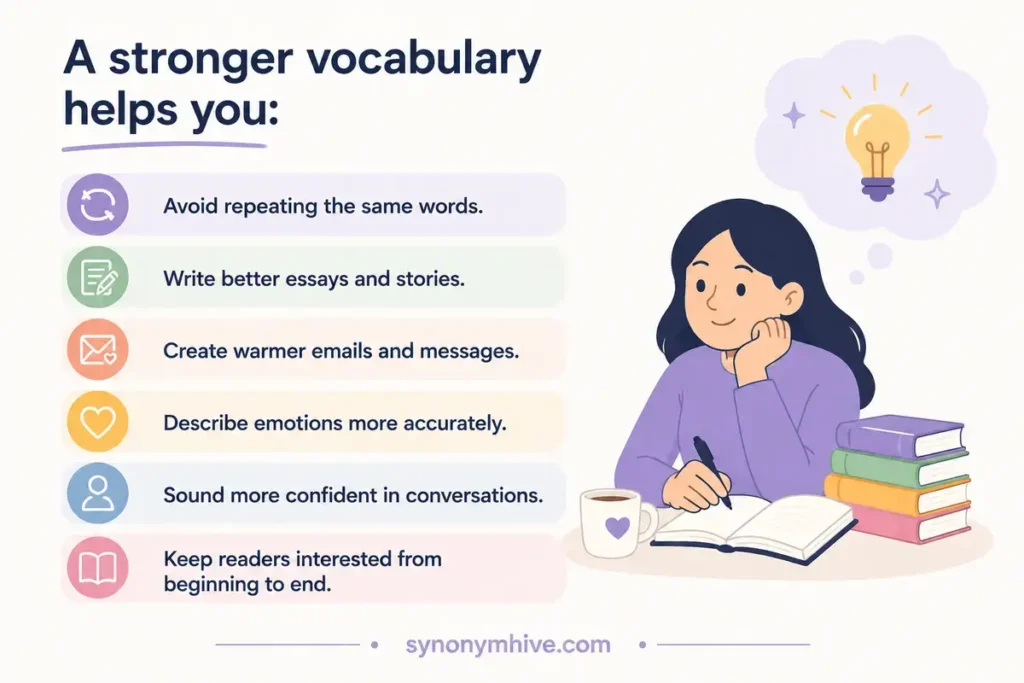
Learning new words isn’t about sounding smarter. It’s about expressing yourself more clearly and naturally. A stronger vocabulary helps you:
- Avoid repeating the same words.
- Write better essays and stories.
- Create warmer emails and messages.
- Describe emotions more accurately.
- Sound more confident in conversations.
- Keep readers interested from beginning to end.
That’s why learning phrases for love is so useful. Every alternative gives you another way to express care, appreciation, admiration, or affection without making your writing feel repetitive.
Need another vocabulary suggestion? Read Synonyms for Horrible Ultimate Guide 2026.
Conclusion
Learning synonyms for love helps you communicate with more warmth, clarity, and confidence. Every synonym has its own meaning. Cherish highlights appreciation. Adore expresses deep affection. Admire focuses on respect. Treasure shows lasting value, while care for reflects kindness and concern. Choosing the right word makes your writing more personal and more memorable.
Keep this guide nearby when you’re writing emails, essays, speeches, greeting cards, or everyday messages. As you practice using different words, your vocabulary will grow naturally. The strongest writing doesn’t rely on complicated language. It comes from choosing words that fit the moment and honestly express what you feel.
Frequently Asked Questions
What’s Another Way To Say Love
There are many great alternatives. expressions for love include adore, cherish, treasure, care for, admire, appreciate, value, be fond of, devotion, and affection. The best choice depends on the situation and the relationship.
What’s The Best Synonym For Love In Formal Writing
Appreciate, value, admire, esteem, and respect work well in essays, reports, and professional communication because they sound sincere and professional.
What’s The Difference Between Love And Cherish
Love expresses deep affection. Cherish means you deeply value someone or something and hold it close to your heart. It often emphasizes gratitude and lasting memories.
Can I Use Love In A Business Email
Usually, no. In professional writing, words like appreciate, value, or respect are more appropriate because they match the tone of the workplace.
What’s Another Way To Say Love In A Text Message
Simple choices like adore, care for, be into, or crazy about work well in casual conversations with friends and family.
Is Love Always Romantic
No. Love can describe affection for family, friends, pets, hobbies, places, communities, or meaningful experiences. The context determines its meaning.
How Do I Stop Repeating Love In My Writing
Use phrases for love naturally and choose the word that best matches your meaning. Small changes in vocabulary make your writing smoother, clearer, and more engaging.