
You’re writing an email to a coworker or finishing an essay for school. You type the word safe, then notice you’ve already used it three times. It feels repetitive, and now you’re looking for a better choice. Learning synonyms for safe helps you write with more variety while keeping your meaning clear. The good news is that English offers many words that can replace safe. Some fit formal writing, while others sound more natural in everyday conversations. The right choice depends on the situation.
alternatives for safe include secure, protected, harmless, reliable, sheltered, guarded, sound, and risk free. Each word carries a slightly different meaning, so choosing the right one depends on the context.
In this guide, you’ll discover the meaning and history of the word safe, explore more than 30 useful alternatives, learn which synonym fits different situations, and avoid common mistakes that many English learners and writers make.
Looking for a better alternative? Visit Synonyms for Grateful: Better Words 2026.
Where Does The Word Safe Come From
The word safe comes from the Latin word salvus, which means unharmed or healthy. It later entered Old French as sauf before becoming the English word safe. Its meaning has stayed surprisingly consistent over hundreds of years. Today, safe describes someone or something protected from danger, injury, loss, or harm. You can use it for people, places, ideas, technology, money, and even emotions.
Examples.
The children are safe inside the house.
Keep your password safe.
This neighborhood feels safe at night.
The documents are stored in a safe location.
What Does Safe Mean In Plain English
In simple words, safe means protected from danger or harm. It can describe physical protection, emotional security, financial stability, or something that carries very little risk.
For example.
A safe driver follows traffic rules.
Safety is provided by a place that protects people from danger.
A safe investment has lower risk.
A safe choice is unlikely to cause problems.
Because the word has several meanings, picking the best synonym helps readers understand your exact message.
Master List Of Synonyms For Safe
The table below groups the most useful phrases for safe by tone and everyday use.
| Word | Meaning | Tone | Example |
|---|---|---|---|
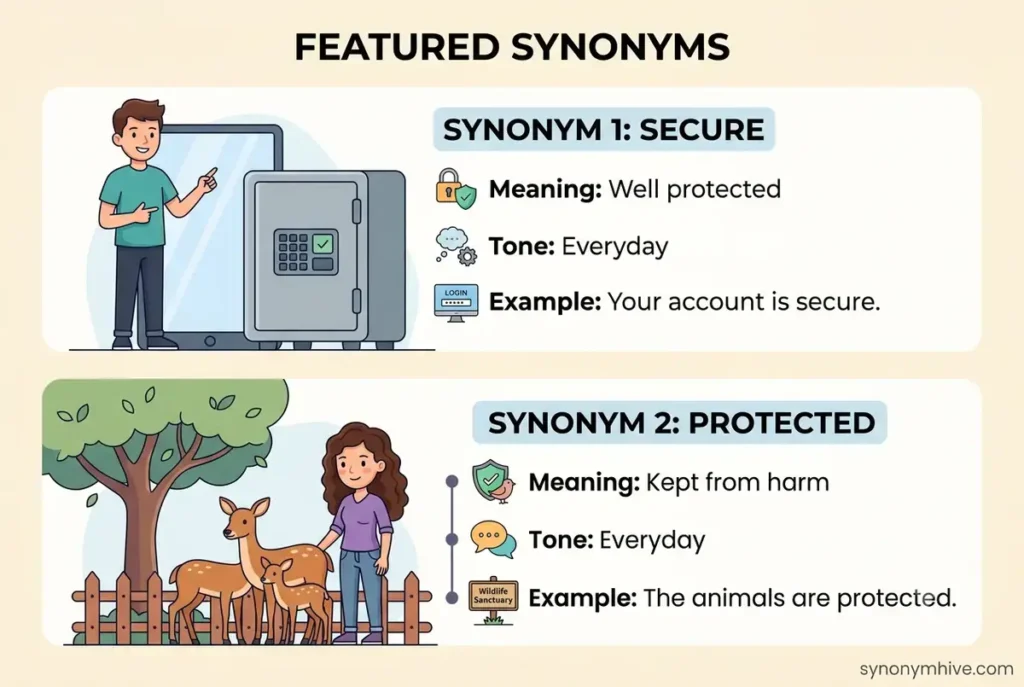
| Secure | Well protected | Everyday | Your account is secure. |
| Protected | Kept from harm | Everyday | The animals are protected. |
| Harmless | Not dangerous | Everyday | The snake is harmless. |
| Guarded | Watched carefully | Everyday | The entrance is guarded. |
| Protected | Free from danger | Everyday | Sensitive data is protected. |
| Securely Locked | Fully protected | Everyday | The door is securely locked. |
| Risk Free | Without danger | Everyday | It’s a risk free trial. |
| Defended | Protected from attack | Formal | The city was well defended. |
| Shielded | Covered from harm | Formal | The cables are shielded. |
| Preserved | Kept in good condition | Formal | Historic records were preserved. |
| Insulated | Protected from outside effects | Formal | The pipes are insulated. |
| Fortified | Strongly protected | Formal | The walls were fortified. |
| Covered | Included or protected | Formal | The repair is covered by warranty. |
| Assured | Guaranteed to be secure | Formal | Your payment is assured. |
| Low Risk | Unlikely to fail | Formal | It’s a low risk investment. |
| Foolproof | Difficult to fail | Informal | It’s a foolproof plan. |
| Rock Solid | Extremely dependable | Informal | Their friendship is rock solid. |
| Good To Go | Ready without concern | Slang | You’re good to go now. |
| In The Clear | Out of danger | Slang | We’re in the clear. |
| Out Of Harm’s Way | Safe from danger | Everyday | The children are out of harm’s way. |
| Protected By Law | Legally secure | Formal | The species is protected by law. |
| Untouched | Free from damage | Everyday | The package arrived untouched. |
| Well Built | Strong and dependable | Everyday | It’s a well built bridge. |
| Securely Stored | Properly protected | Everyday | The files are securely stored. |
| Safe And Sound | Completely unharmed | Everyday | Everyone arrived safe and sound. |
| Bulletproof | Extremely secure | Informal | Their security system is bulletproof. |
This collection covers casual conversations, school writing, professional communication, and creative storytelling.
Synonyms For Safe By Strength
Not every synonym carries the same level of protection. Some suggest mild safety, while others describe complete protection.
| Level | Synonyms | Best Use |
|---|---|---|
| Mild | Stable Reliable Sound | Everyday situations |
| Moderate | Secure Protected Guarded Sheltered | Homes people property |
| Strong | Safeguarded Shielded Defended Fortified | Security legal military |
| Very Strong | Bulletproof Foolproof Risk Free Safe and Sound | Maximum protection or informal emphasis |
Matching the strength of the word to the situation helps your writing sound more accurate.
Synonyms For Safe By Part Of Speech
The word safe is usually an adjective, but related words can function as nouns or verbs.
Adjectives
These directly replace safe.
- Secure.
- Protected.
- Harmless.
- Stable.
- Reliable.
- Sheltered.
- Guarded.
- Defended.
- Shielded.
- Sound.
Example.
The building is secure.
Nouns
These refer to safety itself.
- Safety.
- Protection.
- Security.
- Shelter.
- Defense.
Example.
Their safety comes first.
Verbs
These describe the action of making something safe.
- Protect.
- Guard.
- Shield.
- Secure.
- Preserve.
- Defend.
Example.
Please secure the equipment before leaving.
Using different parts of speech helps your writing flow naturally without repeating the same word.
Do Americans And British People Use Different Words
American and British English both use safe in the same way. Still, some related words appear more often in one region than the other.
| American English | British English | Notes |
|---|---|---|
| Secure | Secure | Common in both. |
| Safe and sound | Safe and sound | Common in both. |
| Protected | Protected | Used equally. |
| Risk free | Risk free | Common in business writing. |
| Secure location | Secure location | Common in both countries. |
| Sheltered housing | Sheltered housing | Heard more often in the UK. |
| Safety deposit box | Safe deposit box | American English often drops the word safety. |
Most alternatives work well on both sides of the Atlantic, so you usually don’t need to change your wording unless you’re writing for a specific audience.
What Is The Best Word For A Resume
On a resume, the word safe rarely shows your skills. Stronger alternatives sound more professional and describe your strengths more clearly.
Good choices include.
- Reliable.
- Dependable.
- Secure.
- Responsible.
- Trustworthy.
Example sentences.
Maintained secure company records.
Provided reliable support to customers.
Handled confidential information responsibly.
Built dependable processes that reduced errors.
Protected sensitive business data.
These words help employers understand your abilities instead of simply saying something was safe.
What Is The Best Word For An Essay
Essays often require more precise vocabulary. The best synonym depends on what you’re describing.
Good choices include.
- Secure.
- Protected.
- Stable.
- Harmless.
- Safeguarded.
Example sentences.
The organization created a secure online system.
The wildlife remained protected inside the reserve.
Scientists developed a harmless alternative.
The government safeguarded important historical sites.
The country’s economy became more stable over time.
What Is The Best Word For Text Messages
Casual conversations usually call for simple words.
Good choices include.
- Safe.
- Good.
- Fine.
- Okay.
- In the clear.
Example sentences.
I’m home safe.
Don’t worry. I’m fine.
Everything’s okay now.
We’re in the clear.
The kids are safe at school.
Simple language sounds more natural in everyday texting.
What Is The Best Word For Emails
Professional emails should sound clear and confident.
Good choices include.
- Secure.
- Protected.
- Reliable.
- Safeguarded.
- Confidential.
Example sentences.
Your information is securely stored.
The documents remain protected.
Our system provides secure access.
All customer data is safeguarded.
Your personal details stay confidential.
These alternatives sound polished without becoming overly formal.
What Is The Best Word For Speaking
Everyday conversations usually use familiar words.
Good choices include.
- Safe.
- Secure.
- Fine.
- Protected.
- Good.
Example sentences.
The neighborhood feels safe.
Your bike is secure in the garage.
Everyone made it home safely.
The children are protected inside.
You’ll be fine.
These words sound natural in daily conversations.
Real Life Examples Using Different Synonyms
Seeing words in context makes them easier to remember.
- Our passwords are secure.
- The children stayed protected during the storm.
- The bridge is structurally sound.
- This medicine is harmless for most adults.
- The hikers reached camp safe and sound.
- Her investments remain stable.
- The files are securely stored online.
- The firefighters moved everyone out of harm’s way.
- The museum carefully safeguarded its artwork.
- We chose the low risk option.
- The neighborhood feels secure after dark.
- His reliable advice helped everyone stay calm.
- The animals are protected by law.
- The backup system keeps your data secure.
- Their home remained untouched by the flood.
Secure Vs Safe
These words are close in meaning but are not always interchangeable.
| Safe | Secure |
|---|---|
| Free from danger. | Protected against threats or unauthorized access. |
| Used for people places and situations. | Often used for technology buildings and information. |
| More general. | More specific. |
Examples.
The children are safe.
Your online account is secure.
Safe Vs Protected
Both words describe safety, but they focus on different ideas.
| Safe | Protected |
|---|---|
| Describes the final condition. | Describes the action or result of protection. |
| General meaning. | Shows someone or something is actively guarded. |
| Common in daily speech. | Common in formal writing. |
Examples.
The hikers are safe.
The hikers were protected by experienced guides.
Learn more useful word alternatives in Synonyms for Confidence Ultimate Guide Quick List (2026).
Safe Vs Secure
Many people confuse these words because they often appear together.
Safe means free from danger.
Secure means protected against possible threats.
For example.
A child can be safe at home.
A computer network can be secure against hackers.
Sometimes both words work together.
The building is safe because it is secure.
Common Mistakes To Avoid
Choosing the wrong synonym can confuse readers.
Using Secure For Every Situation
Secure works well for passwords, buildings, and systems.
For emotions or people, safe usually sounds more natural.
Using Harmless For People
Harmless means something does not cause danger.
It should not replace safe in every sentence.
Incorrect.
The children are harmless.
Correct.
The children are safe.
Confusing Stable With Safe
Stable means something is steady or unlikely to change.
It does not always mean protected from danger.
Thinking Every Synonym Means The Same Thing
Each word has its own shade of meaning.
Protected suggests active defense.
Reliable describes trustworthiness.
Harmless means not dangerous.
Safeguarded implies careful protection.
What Are The Opposite Words Of Safe
Sometimes you need the opposite meaning.
| Antonym | Meaning |
|---|---|
| Dangerous | Likely to cause harm. |
| Unsafe | Not protected. |
| Risky | Involves possible danger. |
| Hazardous | Dangerous to health or safety. |
| Threatening | Suggests possible harm. |
| Perilous | Extremely dangerous. |
| Vulnerable | Easy to harm or attack. |
Choosing the correct opposite helps create stronger comparisons in writing.
Quick Tips For Choosing The Right Word
- Use safe for general situations.
- Choose secure for technology buildings and passwords.
- Use protected when someone actively provides safety.
- Pick reliable for people products or services you trust.
- Choose harmless when something causes no danger.
- Use stable for finances structures or conditions.
- Select safeguarded in legal or professional writing.
- Match the synonym to your audience and context instead of replacing every use of safe with the same alternative.
Using the right synonym makes your writing clearer, more natural, and easier for readers to understand.
Which Synonyms For Safe Sound Most Natural In Everyday English
Native English speakers don’t always use the word safe. They often choose different words based on the situation.
Here are some common alternatives.
- Secure.
- Fine.
- Protected.
- Good.
- Out of harm’s way.
- Safe and sound.
- In the clear.
Examples.
The kids are safe and sound.
Your package is secure.
Don’t worry. We’re in the clear.
She’s fine now.
These expressions sound natural in conversations with friends, family, and coworkers.
Which Synonyms For Safe Are Too Formal
Some words are accurate but rarely appear in everyday conversations.
Examples include.
- Safeguarded.
- Fortified.
- Defended.
- Preserved.
- Insulated.
These words fit legal documents, technical writing, military topics, or academic papers much better than casual speech.
How Can You Avoid Repeating Safe In Your Writing
Repeating the same word can make your writing feel dull. Replace safe with alternatives that match the meaning of each sentence.
Instead of writing.
The neighborhood is safe. The school is safe. The park is safe.
Try this.
The neighborhood feels secure.
The school keeps students protected.
The park is a peaceful place for families.
This small change keeps readers interested and makes your writing sound more polished.
Which Synonyms Fit Different Situations Best
The best synonym depends on what you’re talking about.
| Situation | Best Synonym |
|---|---|
| Online account | Secure |
| Child at home | Safe |
| Wildlife reserve | Protected |
| Investment | Low risk |
| Reliable employee | Dependable |
| Building | Sound |
| Military base | Fortified |
| Private information | Safeguarded |
| Vacation destination | Safe |
| Dangerous weather | In the clear |
Choosing words that match the context helps readers understand your message without stopping to think.
Common Idioms That Mean Safe
English has many expressions that suggest safety without using the word safe.
- Safe and sound.
- Out of harm’s way.
- In the clear.
- On solid ground.
- Out of the woods.
Examples.
Everyone arrived safe and sound.
The firefighters moved residents out of harm’s way.
After the storm passed we were in the clear.
The company is finally on solid ground.
The patient is out of the woods.
These idioms make conversations and stories sound more natural.
Which Synonyms Describe Emotional Safety
Sometimes safe is about feelings instead of physical protection. In these situations, different words communicate comfort and trust more naturally.
| Synonym | Best Use | Example |
|---|---|---|
| Comfortable | Feeling relaxed | I feel comfortable sharing my ideas. |
| Reassured | Feeling less worried | Her kind words left me reassured. |
| Accepted | Feeling welcomed | Everyone felt accepted in the group. |
| Supported | Receiving help and encouragement | He felt supported by his family. |
| At Ease | Relaxed and free from stress | She was finally at ease after the meeting. |
| Secure | Feeling emotionally stable | Children need to feel secure at home. |
Choosing emotional words instead of simply saying safe creates a stronger connection with readers.
Which Synonyms Fit Health And Medical Topics
Health related writing often calls for more precise vocabulary.
| Situation | Best Synonym |
|---|---|
| Approved medicine | Safe |
| Treatment with few risks | Low risk |
| Food that won’t cause harm | Harmless |
| Clean drinking water | Safe |
| Protected patient records | Secure |
| Well tested procedure | Reliable |
Using the correct term helps readers understand the level and type of protection involved.
Which Synonyms Work Best In Business Writing
Professional writing benefits from words that sound clear and trustworthy.
- Secure for systems and accounts.
- Reliable for products and services.
- Protected for customer information.
- Stable for business growth and finances.
- Dependable for employees and partners.
Examples.
Our platform provides secure online payments.
We offer reliable customer support.
Customer information remains protected.
The company maintained stable growth throughout the year.
These alternatives sound more professional than repeating safe in every sentence.

Which Synonyms Create Stronger Descriptions In Stories
Creative writing becomes more vivid when you choose descriptive alternatives instead of repeating safe.
Instead of writing.
The family found a safe place.
Try using.
The family found a sheltered cabin.
The travelers reached a secure campsite before sunset.
The children rested in a protected valley.
The hikers discovered a secluded refuge away from the storm.
These choices paint a clearer picture and help readers imagine the scene more easily.
Looking for another word? See Synonyms for Anger Simple Guide Find the Perfect Word (2026).
Conclusion
Learning synonyms for safe gives you more ways to express the same idea without repeating one word. Instead of relying on safe every time, you can choose secure for technology, protected for people and places, reliable for someone you trust, harmless for something that causes no danger, or safeguarded for formal writing. Picking the right synonym makes your message clearer and more engaging. Keep practicing these alternatives in emails, essays, conversations, and creative writing. Before long, you’ll choose the perfect word naturally and confidently.
Frequently Asked Questions
What’s Another Way To Say Safe
Some of the best expressions for safe include secure, protected, reliable, harmless, safeguarded, sheltered, stable, and sound. The right choice depends on the context.
What Is The Difference Between Safe And Secure
Safe means free from danger. Secure means protected against possible threats such as theft, damage, or unauthorized access.
Which Word Is Best For Online Security
Secure is the best choice for websites, passwords, accounts, and digital information because it emphasizes protection.
Can Safe Describe Feelings
Yes. People often say they feel safe when they feel protected, comfortable, or free from danger.
Which Synonym Works Best In Professional Writing
Words like secure, protected, reliable, and safeguarded usually fit business and academic writing.
What Is The Opposite Of Safe
Common opposites include dangerous, unsafe, hazardous, risky, perilous, and vulnerable.
Which Synonyms Do Native English Speakers Use Most
Native speakers commonly use safe, secure, fine, protected, safe and sound, and in the clear because they sound natural in everyday conversations.