
Have you ever finished writing an email, essay, or social media post and noticed you used the word especially again and again? It happens more often than you might think. That’s why many people search for synonyms for especially to make their writing sound smoother and less repetitive. The word especially is common in everyday English. It helps you point out something that deserves extra attention or has more importance than the rest. Since it can be used in different situations, there isn’t one perfect replacement for every sentence.
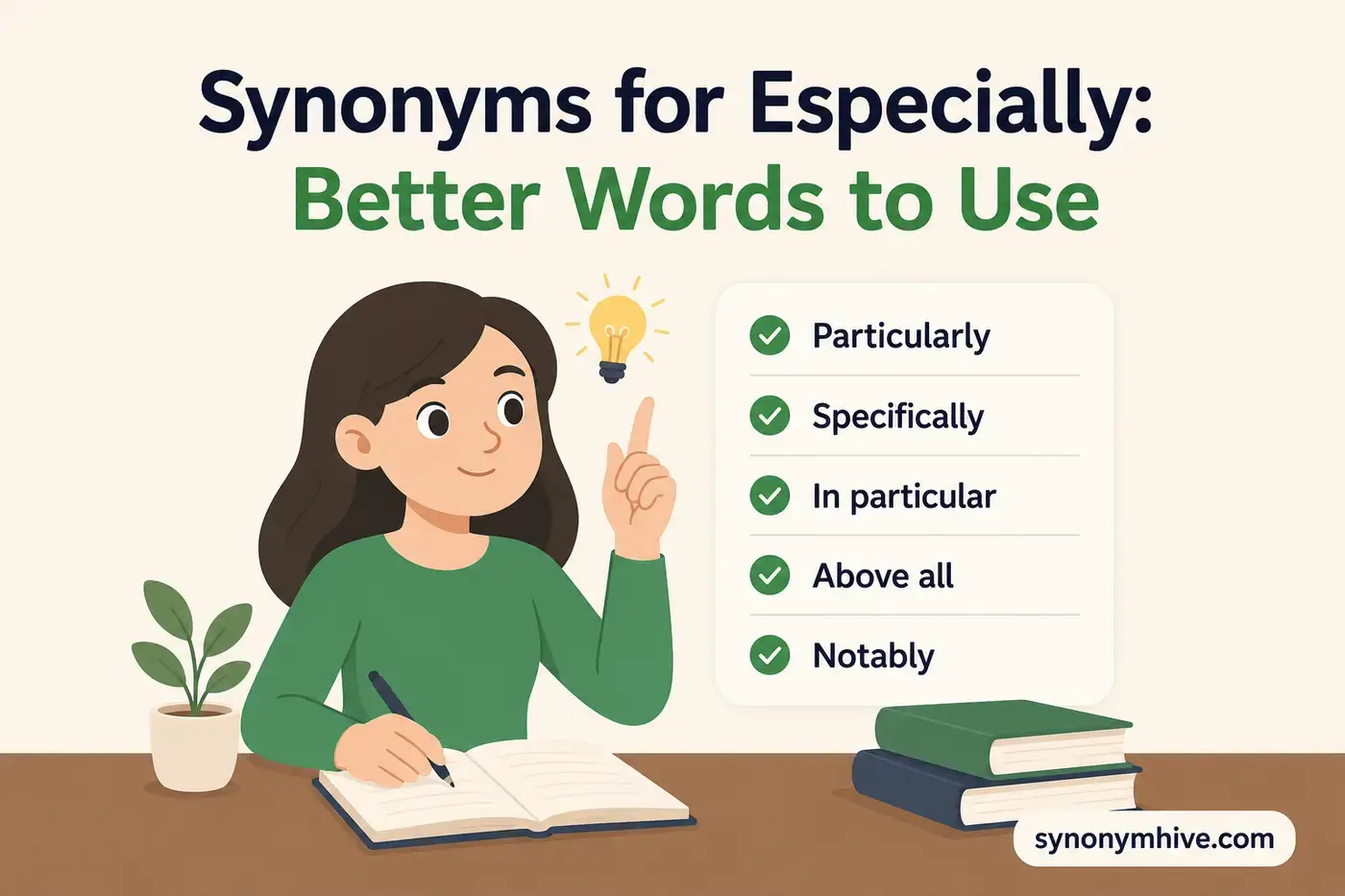
Synonyms include particularly, notably, mainly, chiefly, primarily, specifically, above all, most of all, in particular, and remarkably. The best choice depends on the meaning and tone of your sentence.
This guide explains what especially means, where it came from, and how to choose the right alternative for school assignments, work emails, resumes, blog posts, and everyday conversations. You’ll also find practical examples, comparison tables, and simple tips that help you choose the best word with confidence.
Find more synonyms in Synonyms for Understand Simple Guide Top Replacements (2026).
What Does Especially Mean?
The word especially means more than usual or more than anything else. It highlights one person, thing, or idea as more important than the others.
Here are a few examples.
- I enjoy reading, especially mystery novels.
- She likes all kinds of fruit, especially strawberries.
- Exercise is important, especially as you get older.
- The park looks beautiful, especially in the spring.
In each example, especially draws attention to one specific thing. That is why many writers look for synonyms instead of repeating the same word.
Where Did The Word Especially Come From?
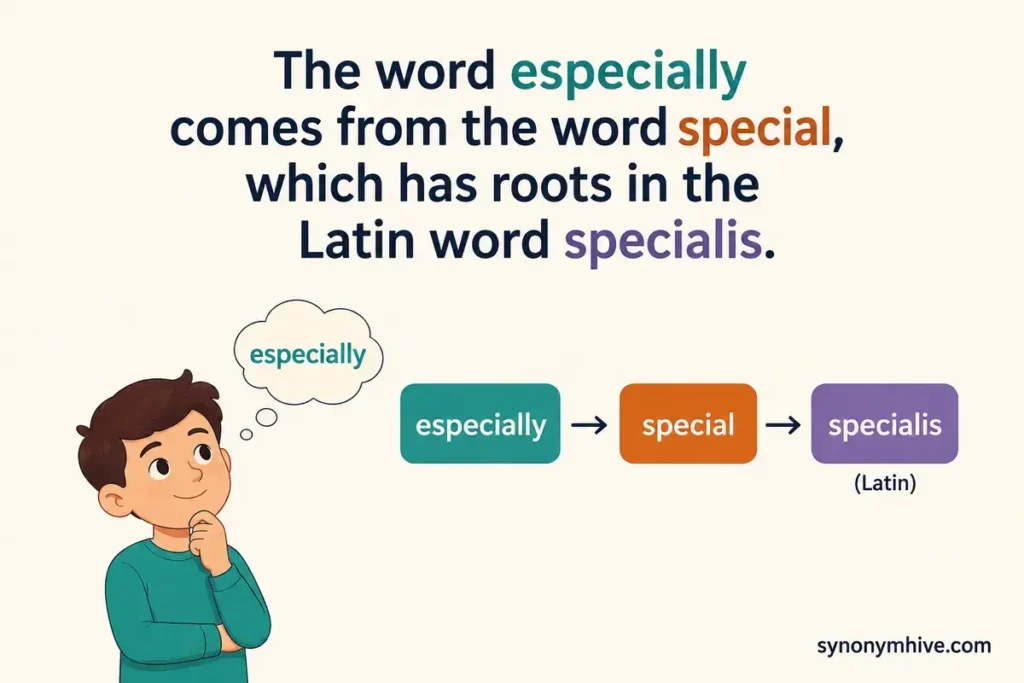
The word especially comes from the word special, which has roots in the Latin word specialis. It entered English hundreds of years ago and has always carried the idea of giving extra attention or importance to something. Over time, people began using it in conversations, books, speeches, and business writing. Today, it remains one of the most common words for emphasizing a particular person, object, or idea.
Why Do People Search For Synonyms For Especially?
Using especially once or twice sounds natural.
Using it in every paragraph can make your writing feel repetitive.
Look at this example.
The restaurant is popular, especially on weekends. It gets busy, especially during dinner. Families visit especially on holidays.
Now compare it with this version.
The restaurant is popular, particularly on weekends. It gets busy, mainly during dinner. Families visit most of all on holidays.
The second version flows better because the same word is not repeated.
That is why synonyms are useful for students, teachers, professionals, bloggers, and anyone who wants more natural writing.
Can Every Use Of Especially Be Replaced?
No. The best replacement depends on what you mean.
Look at these examples.
- I love all desserts, especially cheesecake.
- Be careful, especially at night.
- This rule applies especially to beginners.
- She enjoys outdoor activities, especially hiking.
Each sentence uses especially a little differently.
Some emphasize a favorite.
Some highlight an important situation.
Some point to a specific group.
The best synonym changes with the context.
Master List Of Synonyms For Especially.
The table below groups useful alternatives by tone and everyday use.
Simple Alternatives.
| Word | Meaning | Tone | Example |
|---|---|---|---|
| Mainly | For the most part | Everyday | We travel mainly during summer. |
| Mostly | In most cases | Everyday | She works mostly from home. |
| Mostly all | More than anything else | Everyday | He enjoys sports, mostly soccer. |
| Above all | More than anything | Everyday | Above all, stay safe. |
| Most of all | More than the rest | Everyday | I miss my family most of all. |
| Really | To a great degree | Everyday | I really enjoy this book. |
| Truly | Genuinely | Everyday | She truly appreciates your help. |
| Very much | To a great extent | Everyday | He likes music very much. |
| Chiefly | Mainly | Everyday | The group consisted chiefly of students. |
| Primarily | Mainly | Everyday | The program is primarily for beginners. |
Everyday Alternatives.
| Word | Meaning | Tone | Example |
|---|---|---|---|
| Particularly | More than others | Neutral | I particularly enjoyed the ending. |
| In particular | Specifically | Neutral | I liked the desserts, in particular the pie. |
| Specifically | In an exact way | Neutral | This rule applies specifically to new members. |
| Notably | Worth noticing | Neutral | Attendance increased notably this year. |
| Remarkably | In a surprising way | Neutral | The weather was remarkably warm. |
| Clearly | In an obvious way | Neutral | She was clearly excited. |
| Significantly | To an important degree | Neutral | Costs dropped significantly. |
| Even more | To a greater extent | Neutral | I enjoyed the sequel even more. |
| Most importantly | More than anything else | Neutral | Most importantly, be honest. |
| Above everything | More than all else | Neutral | Above everything, protect your health. |
Formal Alternatives.
| Word | Meaning | Tone | Example |
|---|---|---|---|
| Predominantly | Mainly or chiefly | Formal | The audience was predominantly local. |
| Principally | Mainly | Formal | The report focuses principally on education. |
| Exclusively | Only or mainly | Formal | The event was exclusively for members. |
| Exceptionally | To an unusual degree | Formal | She performed exceptionally well. |
| Distinctly | In a clear way | Formal | The difference was distinctly noticeable. |
| Markedly | Noticeably | Formal | Sales increased markedly. |
| Expressly | For a specific purpose | Formal | The room was built expressly for meetings. |
| Uniquely | In a special way | Formal | The artist was uniquely talented. |
| Specially | For a particular purpose | Formal | These tools were specially designed. |
| Preeminently | More than anything else | Formal | He was preeminently qualified for the role. |
These alternatives cover many different situations. The best choice depends on what you want to emphasize and how formal your writing needs to be.
Slang And Informal Alternatives For Especially.
Friends and family rarely use formal words in everyday conversations. They usually choose simple expressions that sound relaxed and natural.
| Word Or Phrase | Meaning | Tone | Example |
|---|---|---|---|
| More than anything | Above everything else | Casual | I love pizza more than anything. |
| Most of all | More than the rest | Casual | I miss my hometown most of all. |
| Out of everything | Compared with everything else | Casual | Out of everything on the menu I liked the tacos best. |
| More so | To a greater degree | Casual | I like winter even more so after the holidays. |
| Above all | More than anything else | Casual | Above all be kind to others. |
| Best of all | Better than everything else | Casual | Best of all the event was free. |
| More than ever | To a greater degree now | Casual | I appreciate your help more than ever. |
| Of all things | More than any other thing | Casual | Of all things she picked chocolate. |
| Really | To a great degree | Casual | I really enjoy live music. |
| Big time | Very much | Casual | He likes basketball big time. |
These expressions work well in conversations and text messages. Most of them are not the best fit for academic writing or formal reports.
Synonyms By Intensity.
Some words add only a little emphasis. Others make your point much stronger.
Mild Alternatives.
These fit everyday conversations.
- Mainly.
- Mostly.
- Primarily.
- Chiefly.
- Generally.
- Largely.
Example.
We travel mainly during the summer.
Moderate Alternatives.
These place stronger focus on one thing.
- Particularly.
- In particular.
- Specifically.
- Notably.
- Most of all.
- Above all.
Example.
I enjoyed the concert particularly because of the live orchestra.
Strong Alternatives.
These create the greatest emphasis.
- Exceptionally.
- Remarkably.
- Preeminently.
- Most importantly.
- More than anything.
- Uniquely.
Example.
She was exceptionally prepared for the interview.
Use stronger words only when they match the situation. Too much emphasis can make your writing feel exaggerated.
What Part Of Speech Is Especially.
The word especially is an adverb. It modifies adjectives, verbs, and other adverbs by adding extra emphasis.
Examples.
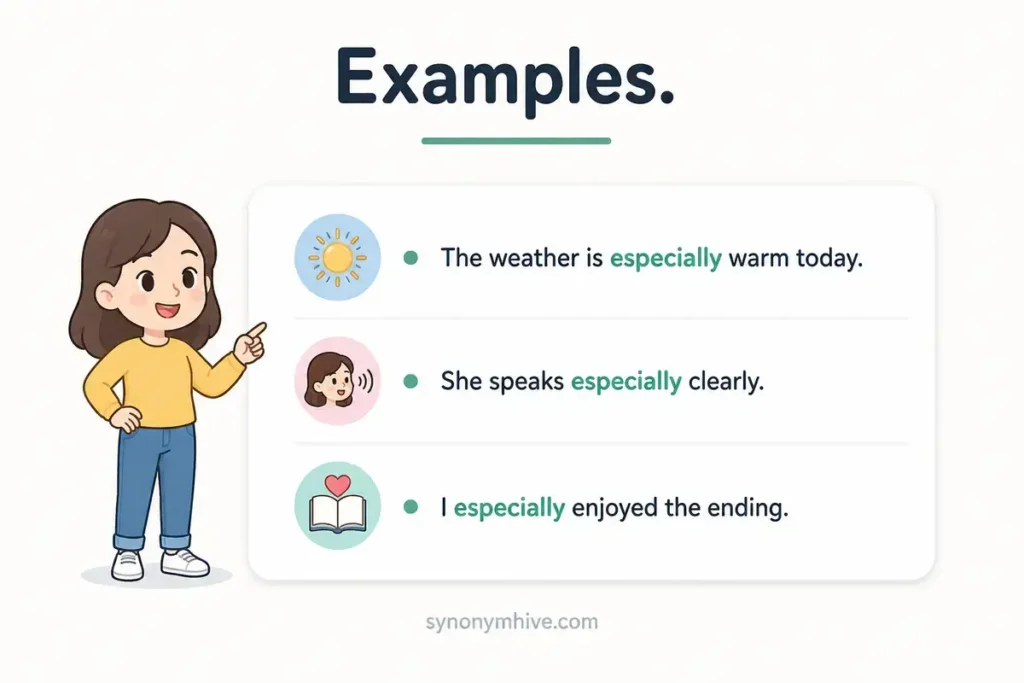
- The weather is especially warm today.
- She speaks especially clearly.
- I especially enjoyed the ending.
Most alternatives for especially are also adverbs, which makes replacing the word much easier.
Looking for another word? See Synonyms for Clear: Better Words to Use (2026).
Do Americans And British People Use Different Alternatives.
American and British English use nearly all the same alternatives. A few expressions are simply more common in one region.
| Situation | American English | British English |
|---|---|---|
| More than others | Especially | Especially |
| More than others | Particularly | Particularly |
| Mainly | Mainly | Chiefly |
| For one specific thing | In particular | In particular |
The differences are very small. Readers in both countries will understand almost every synonym in this guide.
Which Synonym Works Best For Different Types Of Writing.
The best word depends on your audience and purpose.
Best Word For A Resume.
A resume should sound professional and direct.
Good choices include.
- Particularly.
- Specifically.
- Primarily.
- Notably.
- Chiefly.
Example.
Worked primarily with customer support and client communication.
Best Word For An Essay.
Essays should sound natural and clear.
Good choices include.
- Particularly.
- Specifically.
- In particular.
- Notably.
- Remarkably.
Example.
The novel is particularly effective in its final chapter.
Best Word For Text Messages.
Simple language feels the most natural.
Good choices include.
- Especially.
- Mostly.
- Most of all.
- Really.
- More than anything.
Example.
I miss everyone especially you.
Best Word For Emails.
Professional emails should stay clear and polite.
Good choices include.
- Particularly.
- Specifically.
- Primarily.
- Most importantly.
- Notably.
Example.
Thank you particularly for your quick response.
Best Word For Speaking.
Conversations usually sound better with everyday language.
Good choices include.
- Especially.
- Mostly.
- Mainly.
- Most of all.
- Above all.
Example.
I enjoy hiking especially in the fall.
Real Life Example Sentences.
These examples show how different alternatives fit different situations.
- I particularly enjoyed the final presentation.
- She mainly works from home during the week.
- We visit the beach mostly in July.
- Above all remember to stay calm.
- The teacher specifically thanked the volunteers.
- I miss my grandparents most of all.
- The museum is especially popular during the summer.
- Sales increased remarkably after the new product launch.
- He primarily focuses on customer service.
- The children were exceptionally excited about the trip.
- We liked every dessert especially the cheesecake.
- The report notably improved after the final edits.
These examples show that finding synonym is about choosing the expression that matches your meaning instead of replacing the word automatically.
Especially Vs Particularly.
These two words are very close in meaning, but they are not always the best choice for the same sentence.
| Especially | Particularly |
|---|---|
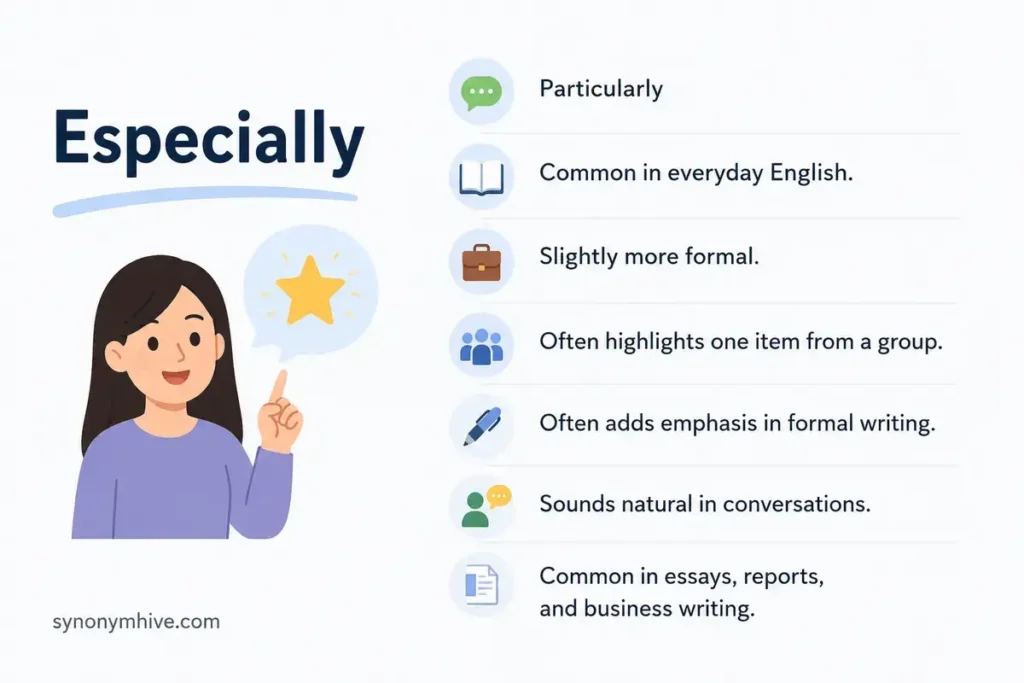
| Common in everyday English. | Slightly more formal. |
| Often highlights one item from a group. | Often adds emphasis in formal writing. |
| Sounds natural in conversations. | Common in essays, reports, and business writing. |
Examples.
- I enjoy all kinds of music, especially jazz.
- I particularly enjoyed the speaker’s final point.
If you’re writing a text message or talking with friends, especially usually sounds more natural. If you’re writing an essay or a report, particularly is often a stronger choice.
Especially Vs Specifically.
These words are sometimes confused because both draw attention to something.
| Especially | Specifically |
|---|---|
| Gives extra importance to something. | Points to one exact person, thing, or detail. |
| Focuses on emphasis. | Focuses on precision. |
| Works in casual and formal writing. | More common in technical and professional writing. |
Examples.
- I like outdoor activities, especially hiking.
- This training is designed specifically for new employees.
Choose specifically when you need to identify something exact. Choose especially when you simply want to give extra emphasis.
Common Mistakes To Avoid.
Many people search for synonyms because they want smoother writing. These mistakes are worth avoiding.
- Replacing especially without checking the meaning of the sentence.
- Using specifically when you simply want to add emphasis.
- Choosing formal words like preeminently in everyday conversations.
- Repeating the same synonym throughout an entire paragraph.
- Adding emphasis where it is not needed.
- Using complicated words to sound more professional.
- Forgetting that rewriting the sentence is sometimes better than replacing one word.
The strongest writing sounds natural, not forced.
Antonyms Of Especially.
The opposite depends on the sentence, but these words often express the opposite idea.
| Word | Best Use |
|---|---|
| Generally | Refers to most situations. |
| Usually | Happens most of the time. |
| Commonly | Happens often. |
| Broadly | Covers a wide area or group. |
| Equally | Gives the same importance to everything. |
| Similarly | Shows no special emphasis. |
Examples.
- The rule generally applies to everyone.
- All team members were treated equally.
- We usually meet on Friday afternoons.
Quick Tips For Choosing The Right Word.
Choosing the right synonym becomes much easier when you focus on the meaning.
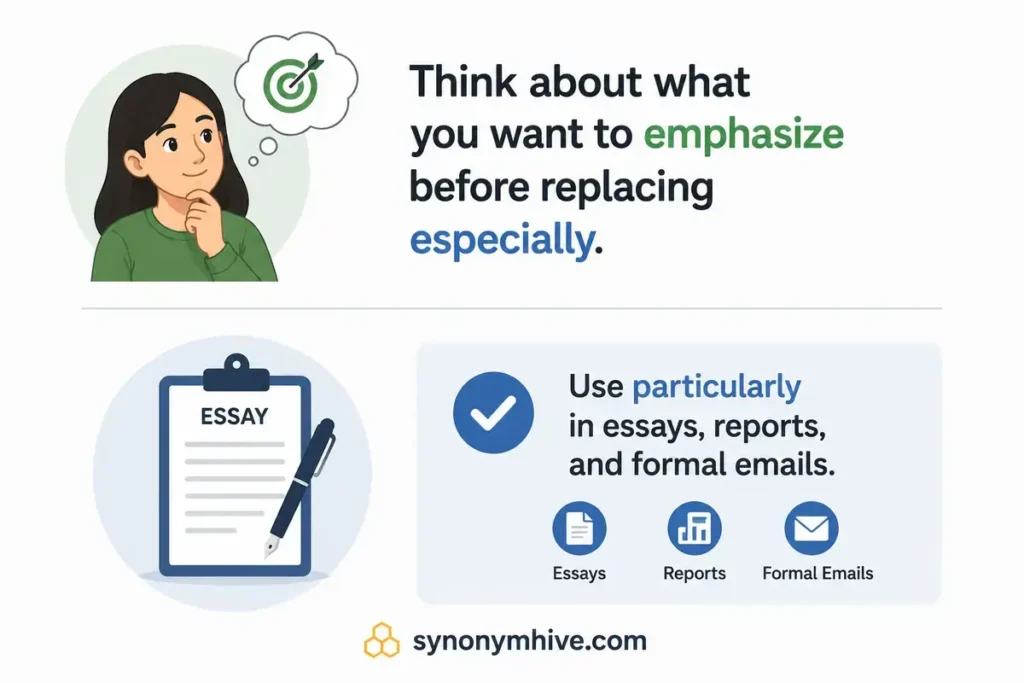
- Think about what you want to emphasize before replacing especially.
- Use particularly in essays, reports, and formal emails.
- Choose mainly or primarily when talking about the main reason.
- Pick specifically when pointing to one exact detail.
- Use most of all and above all in conversations and personal writing.
- Keep your wording simple whenever possible.
- Read your sentence aloud to check if it sounds natural.
- Don’t replace every use of especially. Sometimes it is already the best choice.
Explore another synonym guide: Synonyms for Maybe: Stronger Word Choices(2026).
Conclusion.
Choosing the right synonyms for especially can make your writing smoother, clearer, and more engaging. The best alternative depends on your sentence and the tone you want to create. Words like particularly, mainly, primarily, specifically, notably, and most of all each have their own purpose. Instead of picking the longest word, choose the one that fits your message. That simple habit will improve your essays, emails, blog posts, and everyday conversations without making your writing sound forced.
Frequently Asked Questions.
What’s another way to say especially?
Some of the best alternatives include particularly, mainly, primarily, specifically, notably, most of all, above all, and in particular. The best choice depends on your sentence.
What is the best synonym for especially?
There isn’t one perfect answer. Synonyms change with the context. Particularly is one of the most flexible choices because it works well in both formal and everyday writing.
Can I replace especially in every sentence?
No. Some alternatives change the meaning slightly. Always choose a word that matches your exact purpose instead of replacing especially automatically.
What’s the difference between especially and particularly?
Especially is more common in everyday conversations. Particularly has a slightly more formal tone and often appears in essays, reports, and professional writing.
Which synonym works best in professional writing?
Words like particularly, specifically, primarily, notably, and chiefly usually fit business writing, reports, and formal emails.
Is especially an adverb?
Yes. Especially is an adverb that adds emphasis to a verb, adjective, or another adverb.
How do I choose the right synonym?
Start by asking what you want to emphasize. Then choose a word that matches the meaning and tone of your sentence instead of replacing especially just to avoid repetition.