
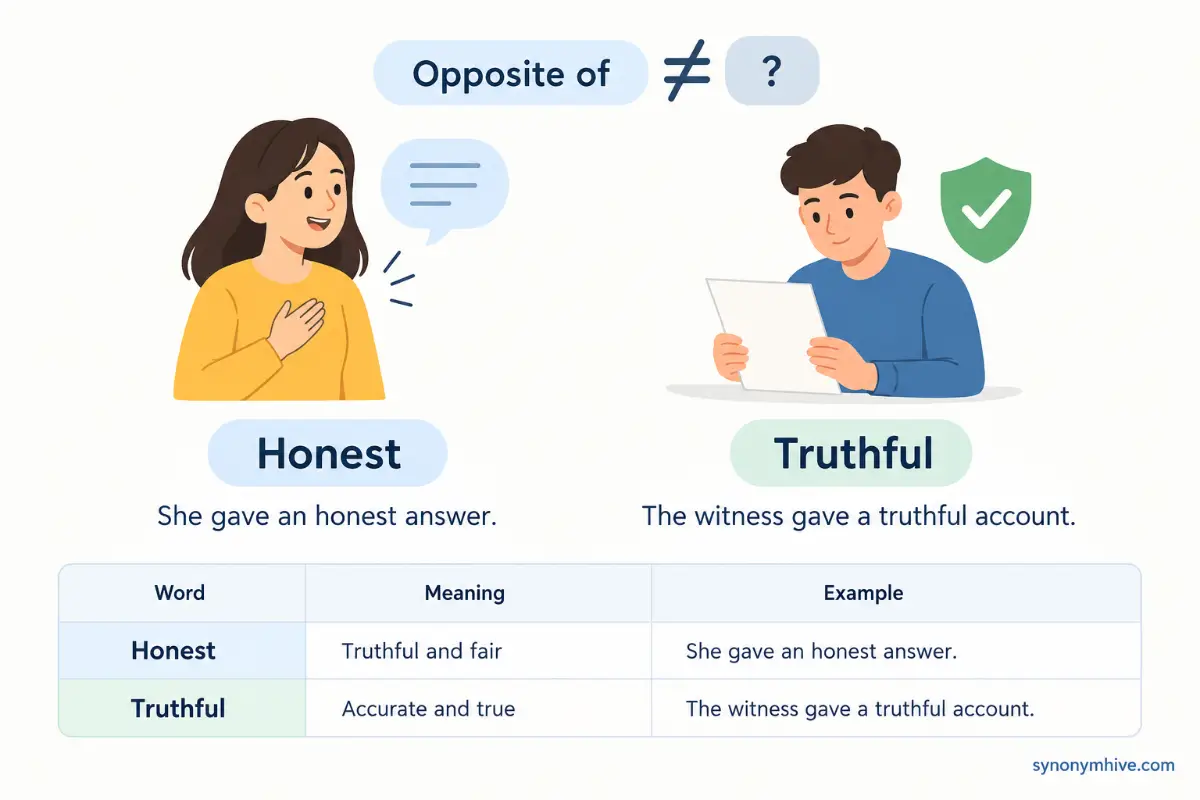
You are writing an email, polishing a school essay, or trying to describe someone’s behavior in a text. You know the person did not tell the truth, but honest does not seem like the right word to repeat. So what should you say instead.
The opposite of honest is usually dishonest. It describes someone who lies, hides the truth, cheats, or tries to mislead others. Other words can be more exact, though. A person who lies is not always doing the same thing as a person who cheats, tricks someone, or keeps a secret.
The best opposite of honest is dishonest, but the strongest choice depends on the action. Use lying for a false statement, deceptive for behavior meant to mislead, and fraudulent for dishonest conduct involving fraud.
Choosing the right word helps you explain what happened without sounding vague or unfair. This guide covers the meaning and history of the main terms, more than 30 useful alternatives, differences in strength and tone, and examples for essays, resumes, emails, and everyday conversations.
Find more synonyms in Opposite of Open: Best Words for Every Situation.
What Is the Opposite of Honest
The most direct opposite is dishonest. An honest person tells the truth, acts fairly, and does not try to mislead others. A dishonest person does the reverse by lying, cheating, hiding important facts, or giving others a false impression.
Still, dishonest is a broad word. It can describe many actions, from telling a small lie to taking part in serious fraud. If you know exactly what the person did, a more specific word can make your meaning clearer.
For example, a student who copies another person’s work is cheating. A seller who gives a buyer false details is being deceptive. A worker who changes financial records to steal money may be committing fraud. All three actions involve dishonesty, but they are not the same.
Why the exact word matters
Words carry different levels of force. Calling someone dishonest makes a serious claim about their behavior. Calling someone misleading may focus on a statement or message rather than the person’s whole character. Calling a business fraudulent is even stronger and may suggest illegal conduct.
Use the mildest word that accurately describes the facts. If someone gave you incorrect information by mistake, dishonest may be unfair. If they knowingly gave you false information, the word may fit. The goal is to describe the behavior clearly, not to make the accusation sound bigger than the evidence supports.
Where the Word Dishonest Comes From
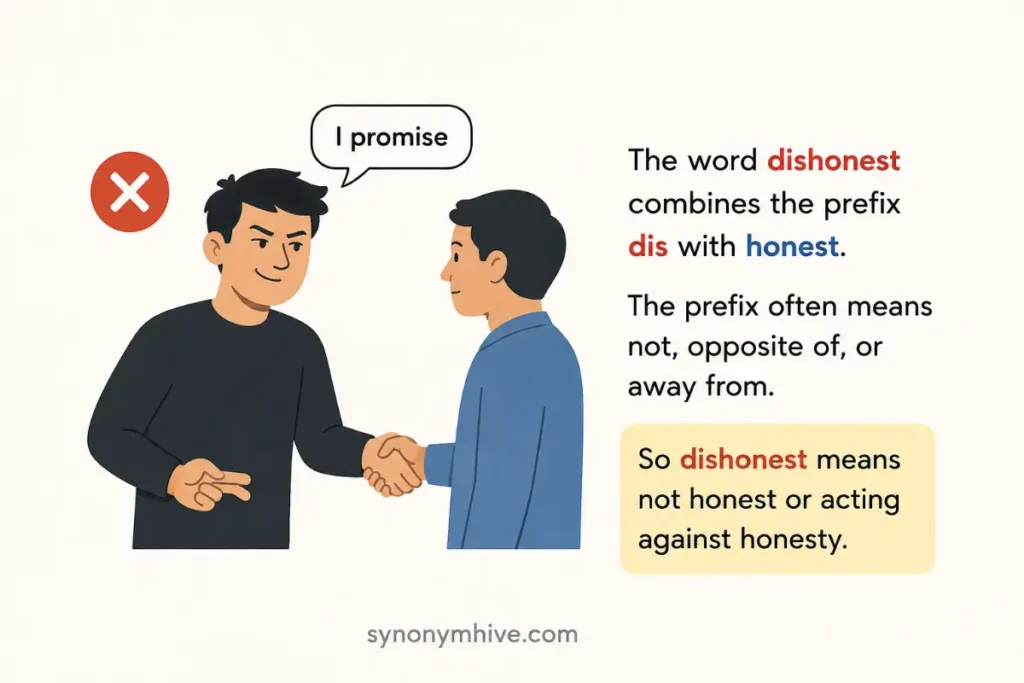
The word dishonest combines the prefix dis with honest. The prefix often means not, opposite of, or away from. So dishonest means not honest or acting against honesty.
Honest came into English through Old French and Latin roots linked to honor, respect, and good character. Over time, honest came to describe people who tell the truth and act fairly. Dishonest developed as its direct negative.
This history explains why dishonest is the clearest answer to the question. The word is built to express the opposite of honest. It works in everyday conversation, school writing, professional communication, and many formal settings.
What honest means in plain English
Honest means truthful, fair, and sincere. An honest person does not knowingly tell lies or trick others for personal gain. Honesty can also mean admitting a mistake, giving a fair account of events, or sharing information someone needs to make a sound choice.
For example, an honest student admits that a homework answer came from a classmate. An honest seller explains that a used phone has a damaged screen. An honest friend tells you when they disagree instead of pretending to support you.
Honesty does not mean saying every thought out loud. You can be honest and still protect someone’s privacy or choose kind words. The key is not to create a false impression or hide facts that matter.
What dishonest means in plain English
Dishonest means not truthful or not fair in a way that misleads others. It often describes a person, statement, action, plan, or system.
A dishonest answer gives a false account of what happened. A dishonest business practice hides important costs from customers. A dishonest employee may change a record to make their work look better.
The word can describe one action or a repeated pattern. Someone who tells one lie has acted dishonestly. If a person keeps lying to gain an advantage, you may reasonably describe the pattern as dishonest behavior.
Is dishonest always a serious accusation
Dishonest is a strong word, but the seriousness depends on the situation. Calling a small excuse dishonest may sound harsh if the details are minor. Using the same word for a person who deliberately changes a contract or steals money may be fitting.
When you are unsure, describe the specific action. Instead of saying, He is dishonest, you could write, He told the team that the report was finished even though he had not completed it. The second sentence gives readers facts they can assess.
This approach is useful in work reports, school discussions, and personal disagreements. It reduces guesswork and keeps your language fair.
Which Words Mean the Opposite of Honest
Dishonest is the main answer, but it is not your only option. The best synonym depends on what happened and how formal your writing needs to sound. Some words describe a lie, others describe a trick, and others point to cheating or a lack of moral principles.
The table below groups useful choices by tone and common use. These words overlap, but they are not perfect substitutes for one another.
Simple words for everyday use
| Word | Meaning | Tone | Example |
|---|---|---|---|
| Dishonest | Not truthful or fair | Direct and general | The seller was dishonest about the phone’s condition. |
| Lying | Saying something you know is false | Direct and personal | He was lying about where he had been. |
| False | Not true or correct | Neutral and clear | The message contained false information. |
| Untruthful | Not telling the truth | Mildly formal | Her untruthful answer caused confusion. |
| Deceitful | Willing to mislead others | Strong and critical | His deceitful plan hurt the whole team. |
| Misleading | Giving the wrong idea or impression | Often measured | The headline was misleading. |
| Unfair | Not treating people in a just way | Broad and everyday | It was unfair to blame someone else. |
| Fake | Made to look real when it is not | Informal | The website used a fake customer review. |
These words work well in everyday conversation because most readers understand them at once. Dishonest is the broadest choice. Lying focuses on a false statement, while misleading can describe words, pictures, ads, or actions that lead people to a wrong conclusion.
Everyday words with a more exact meaning
| Word | Meaning | Tone | Example |
|---|---|---|---|
| Sneaky | Hiding actions to avoid being noticed | Informal and critical | It was sneaky to change the rules without telling anyone. |
| Two faced | Acting friendly while hiding hostile or false feelings | Informal and personal | He seemed two faced when he praised her in public and mocked her later. |
| Shady | Suspicious or not fully trustworthy | Informal | The company made a shady offer with unclear fees. |
| Crooked | Dishonest, often in money or power matters | Informal and strong | The report exposed a crooked deal. |
| Tricky | Designed to confuse or catch someone out | Informal and context dependent | The tricky wording hid the extra charge. |
| Untrustworthy | Not deserving of trust | Direct and critical | The source proved untrustworthy after several claims failed. |
| Underhanded | Secret and unfair, often to gain an advantage | Critical | The rival used underhanded tactics to win the contract. |
| Devious | Clever at hiding plans or intentions | Strong and critical | She found a devious way to avoid taking responsibility. |
These terms add more detail, but they also carry stronger feelings. Shady may work in a casual text about a suspicious offer. Underhanded sounds more pointed and suits a serious complaint. Two faced usually describes a person’s behavior toward others, not a simple factual error.
Formal words for essays and reports
| Word | Meaning | Tone | Example |
|---|---|---|---|
| Deceptive | Likely to make someone believe something false | Formal and precise | The report identified deceptive sales claims. |
| Fraudulent | Involving deliberate deception, often for gain | Very strong and formal | The bank investigated fraudulent transactions. |
| Unethical | Against accepted moral or professional standards | Formal and measured | The committee found the practice unethical. |
| Corrupt | Using power or a position dishonestly | Strong and serious | The inquiry uncovered corrupt conduct. |
| Misrepresentative | Presenting something in a way that gives a wrong picture | Formal and less common | The summary was misrepresentative of the full results. |
| Disingenuous | Not fully sincere, often while pretending to be open | Formal and nuanced | His disingenuous reply avoided the main issue. |
| Mendacious | Habitually or deliberately lying | Very formal | The article described the official’s mendacious claims. |
| Unprincipled | Not guided by moral rules | Formal and critical | The firm faced criticism for its unprincipled choices. |
In formal writing, precision matters more than sounding impressive. Fraudulent should usually be reserved for conduct that involves fraud or a clear basis for that claim. Corrupt often refers to the misuse of power or position. Disingenuous suggests a lack of sincerity, but it does not always mean a direct lie.
Mendacious is accurate in some contexts, but it is rare in everyday English. In most essays and reports, dishonest, deceptive, or untruthful will be easier for readers to understand.
Slang and casual expressions
| Word or phrase | Meaning | Tone | Example |
|---|---|---|---|
| Shady | Suspicious or not trustworthy | Casual | That deal sounds shady. |
| Sketchy | Not reliable or safe, with reasons for doubt | Casual | The seller gave sketchy details about the product. |
| Full of it | Lying or talking nonsense | Very informal | I think he’s full of it about the whole story. |
| A phony | A person pretending to be something they are not | Informal and insulting | The customers called the fake expert a phony. |
| A fake | Someone or something that is not genuine | Casual and critical | She said the online profile was a fake. |
| Lying through your teeth | Telling a bold lie | Informal and forceful | He was lying through his teeth when he denied taking the money. |
| Playing dirty | Using unfair tactics to win | Informal | The team accused its rival of playing dirty. |
| Pulling a fast one | Tricking someone | Informal | The shop tried to pull a fast one with the hidden fee. |
Slang can work well with friends, in dialogue, or in a casual post. It may sound rude or unclear in a job application, school essay, complaint, or formal report. Choose it only when the audience and situation fit.

Which Synonym Is Strongest
Not every dishonest action has the same level of harm. A person might leave out a small detail, tell a direct lie, cheat someone, or carry out a serious fraud. The word should match the action rather than simply sound forceful.
Mild words for a small or unclear issue
Use misleading, inaccurate, untruthful, or not fully honest when you want to describe a problem without making the strongest accusation. These terms can be useful when you have evidence that a statement is wrong but do not know the speaker’s intent.
For example, The advertisement was misleading about the product’s size. This says that the ad gave customers the wrong impression. It does not automatically prove that the company meant to deceive them.
The summary was inaccurate is even more neutral. It states that the information was wrong, but it does not claim that anyone lied on purpose. That difference matters in school, business, and public communication.
Medium strength words for deliberate deception
Use dishonest, deceptive, deceitful, or underhanded when the behavior seems designed to mislead or gain an unfair advantage.
For example, The employee gave a dishonest account of the meeting. The company used deceptive language in its offer. The candidate relied on underhanded tactics to weaken a rival.
These words point to more than an ordinary mistake. Still, they differ in focus. Dishonest is broad, deceptive highlights the effect on another person’s beliefs, and underhanded suggests hidden or unfair methods.
Strong words for serious wrongdoing
Words such as fraudulent, corrupt, and fraudulent can carry serious legal or moral meaning. Use them only when the facts support them. A false claim is not automatically fraud, and a bad decision is not automatically corruption.
For example, The company was accused of fraudulent billing. This sentence makes clear that an accusation exists, rather than presenting the claim as proven. The audit found evidence of corrupt payments is stronger because it describes what the audit found.
If you are writing about a real person or business, avoid turning suspicion into a fact. State what the evidence shows, name the source if needed, and use the right level of certainty.
What Is the Best Word for Each Situation
The most useful synonym depends on what you are writing and what you want readers to understand. A word that works in a text to a friend may sound too casual in an essay. A formal term may sound stiff in a simple email.
What is the opposite of honest on a resume
On a resume, avoid labeling yourself or another person with a broad character judgment unless the situation clearly calls for it. If you need to describe a past problem, focus on the action and its effect. Words such as inaccurate, misleading, or unethical may fit a professional discussion, but they should reflect the facts.
For example, you could write, I corrected inaccurate records and introduced a review process to improve reporting. This sentence describes the issue and your response without making an unsupported claim about someone’s character.
If you are explaining a lesson from a mistake, be clear and responsible. You might say, I learned to report project delays early rather than leave the team with an incorrect impression. This shows professional growth without using harsh labels.
What word should I use in an essay
For an essay, dishonest is often the clearest choice. Use deceptive if you are discussing an action that causes people to believe something false. Use unethical if the main issue is a breach of moral or professional standards.
For example, The character is dishonest because he lies to protect his reputation. The advertisement is deceptive because it hides the true cost. The company’s decision was unethical because it put profit ahead of customer safety.
These sentences give each word a distinct job. They also help the reader understand the reason behind your judgment. In an academic essay, explain the evidence instead of relying on strong labels alone.
What is a good word for an email
For a work email, measured language can help you address a problem without making the exchange more hostile. If a message leaves out a key fact, say that it is incomplete or misleading. If someone knowingly gave false information, dishonest may be appropriate.
For example, I am concerned that the summary is misleading because it leaves out the latest figures. This wording names the problem and gives a reason. It is more useful than simply saying, Your message is dishonest.
For a more direct email, you could write, The information in your last message was not accurate. Please send the correct figures so we can update the report. This approach keeps the focus on the work that needs to be done.
What should I say in a text message
In a casual text, simple words often work best. Lying, fake, shady, and misleading are easy to understand, but some can sound insulting. Think about the result you want before choosing one.
For example, You said you were there, but I found out that wasn’t true. Can you explain what happened. This message points to the problem without calling the other person names.
If the situation is less serious, you might say, That story sounds a little off to me. It expresses doubt without claiming that the person deliberately lied. A direct but calm message can make it easier to get a useful answer.
What word works best when speaking
In conversation, use a word that sounds natural and matches the seriousness of the situation. Dishonest works in most settings. Lying is more direct when you know a statement was false. Shady is casual and suggests that something seems suspicious.
For example, That was dishonest because you knew the answer was wrong. You could also say, I think that explanation is misleading. The second version focuses on the explanation rather than judging the entire person.
If you are talking about a serious event, avoid slang that could make your point sound careless. A calm, specific statement usually carries more weight than a string of insults.
Close Synonyms and Their Differences
Some words look like perfect replacements for dishonest, but each one has its own meaning. Learning the difference can help you write with more care.
Dishonest vs deceptive
Dishonest is a broad word for behavior that goes against truth or fairness. Deceptive focuses on causing someone to believe something that is not true.
A person who lies about finishing a task is dishonest. A website that hides a fee until the last step is deceptive. The website may use confusing design or selective information rather than a direct spoken lie.
Use dishonest when you want to describe the overall behavior. Choose deceptive when the main issue is the false impression created by words, actions, images, or design.
Dishonest vs untruthful
Untruthful means not telling the truth. It often sounds more measured than dishonest because it focuses on the truth of a statement.
For example, His account of the event was untruthful points to an inaccurate account. His conduct was dishonest suggests a wider problem with how he acted.
Untruthful is useful in formal reports when you need a clear description without adding extra judgment. Dishonest may be better when the behavior also involves unfairness or an attempt to gain an advantage.
Dishonest vs disingenuous
Disingenuous describes someone who appears open or sincere but is not fully honest about their real thoughts or aims. It can suggest that a person is pretending not to understand something or hiding their true position.
For example, Her reply was disingenuous because she acted surprised by a rule she had helped write. The word suggests a lack of sincerity, but it does not always mean that the person told a direct lie.
Dishonest is easier for most readers to understand. Disingenuous is more precise when someone presents a false appearance of innocence, openness, or agreement.
Dishonest vs unethical
Dishonest means not truthful or fair. Unethical means going against accepted moral or professional standards. An action can be unethical even when it does not include a lie.
For example, A manager who lies about sales figures is dishonest. A manager who pressures staff to work in unsafe conditions may be acting unethically, even if the manager tells the truth about the schedule.
Use dishonest when truth or deception is central to the problem. Use unethical when the issue is about right and wrong, professional duty, or harm to others.
You may also like Opposite of Hard Best Words for Every Situation.
How the Word Changes by Part of Speech
The idea of dishonesty can appear as an adjective, noun, or adverb. Choosing the right form helps a sentence sound natural.
| Part of speech | Word | Meaning | Example |
|---|---|---|---|
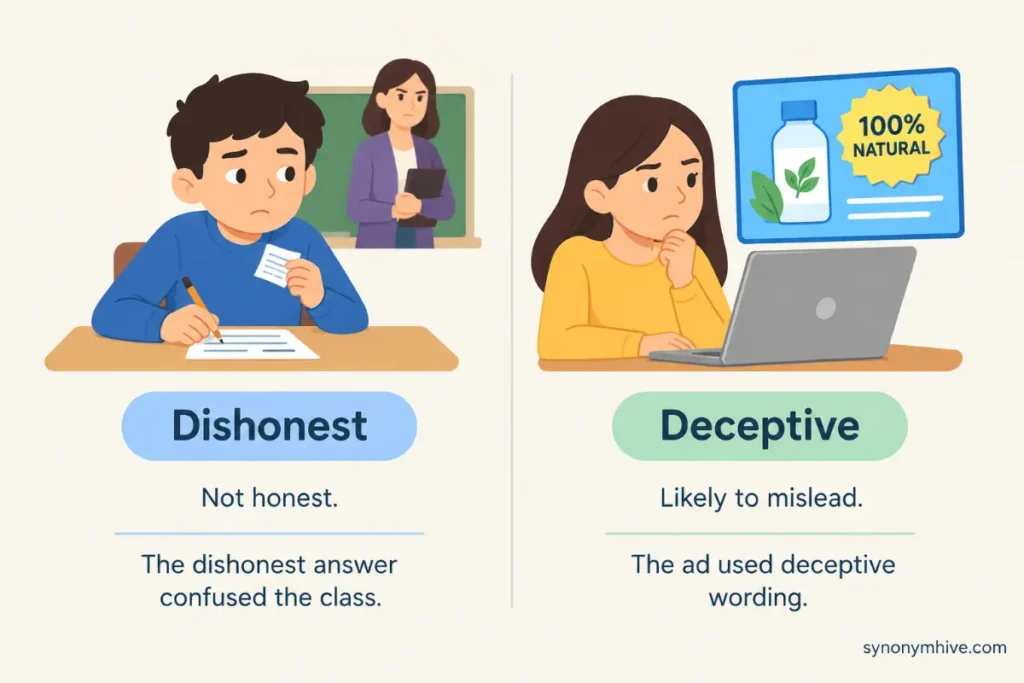
| Adjective | Dishonest | Not honest | The dishonest answer confused the class. |
| Adjective | Deceptive | Likely to mislead | The ad used deceptive wording. |
| Adjective | Untruthful | Not telling the truth | His untruthful account raised concerns. |
| Noun | Dishonesty | The quality or act of being dishonest | The review found signs of dishonesty. |
| Noun | Deception | An act of misleading someone | The deception damaged their trust. |
| Noun | Fraud | Deception used to gain money or another benefit unlawfully | The case involved financial fraud. |
| Adverb | Dishonestly | In a dishonest way | The records were dishonestly changed. |
| Adverb | Deceptively | In a way that creates a false impression | The offer was deceptively simple. |
When should you use dishonesty
Use dishonesty when you need a noun rather than an adjective. For example, The report raised concerns about dishonesty describes the issue itself. The report described a dishonest manager describes a person.
When should you use deception
Deception is useful when you want to emphasize the act of misleading someone. For example, The company used deception to hide the extra charge focuses on the method. The word can apply to spoken lies, hidden facts, misleading images, and false appearances.
When should you use dishonestly
Dishonestly is an adverb. It describes how an action was carried out. For example, He dishonestly changed the figures tells readers how he changed them. If you want to describe the person or the figures, use an adjective instead.
Does American English Use Different Words From British English
Most common terms for dishonesty are used in both American and British English. Dishonest, deceitful, deceptive, untruthful, fraudulent, and disingenuous are understood in both places.
Differences tend to appear in casual expressions, spelling preferences, and how strongly a phrase sounds. Shady is common in American informal speech. British speakers may also use it, but phrases such as dodgy are often heard in casual British English to describe something suspicious or unreliable.
For example, an American might say, That deal looks shady. A British speaker might say, That deal looks dodgy. Both statements suggest that the deal seems questionable, but neither word proves that fraud has occurred.
In formal writing, the same general advice applies on both sides of the Atlantic. Choose a clear word, match it to the evidence, and avoid slang in settings where it may sound unprofessional.
Common Mistakes When Choosing the Opposite of Honest
A good word choice does more than sound strong. It tells readers what happened and how certain you are about it.
Calling every mistake a lie
A false statement is not always a lie. Someone may share incorrect information because they misunderstood a question or relied on an old source. Lying usually means that the person knowingly said something false.
If you do not know the person’s intent, you can say the information was incorrect or misleading. If you have clear evidence that the person knew the truth and chose to hide it, dishonest or lying may be more accurate.
Using fraud too casually
Fraud is a serious term. It often refers to deliberate deception used to obtain money, property, services, or another benefit. A broken promise or an ordinary mistake does not automatically count as fraud.
If you are discussing a legal matter, use careful wording and rely on verified facts. You can say the conduct appeared deceptive or that a complaint alleged fraud when the facts have not been established.
Choosing a formal word just to sound smart
Rare words can make simple ideas harder to understand. Mendacious may be correct, but dishonest is clearer for most readers. Disingenuous can be useful when it describes a specific kind of false sincerity, but it is not a better choice in every sentence.
Use the word that communicates your point with the least confusion. Clear language is a strength, not a weakness.
Confusing secrecy with dishonesty
Keeping information private is not automatically dishonest. People can protect personal details, respect confidentiality, or wait for the right time to share news without misleading anyone.
The problem arises when a person hides important facts to create a false impression or gain an unfair advantage. A private medical detail, for example, is not the same as a false claim about a product’s safety.
Making a personal attack instead of describing an action
Calling someone a liar may start an argument without explaining the problem. If you can name the specific action, your point becomes easier to understand.
Instead of writing, You are dishonest, try, You told me the payment had been sent, but the bank record shows it was not. The second sentence gives the other person a clear claim to address.
What Are the Antonyms of Dishonest
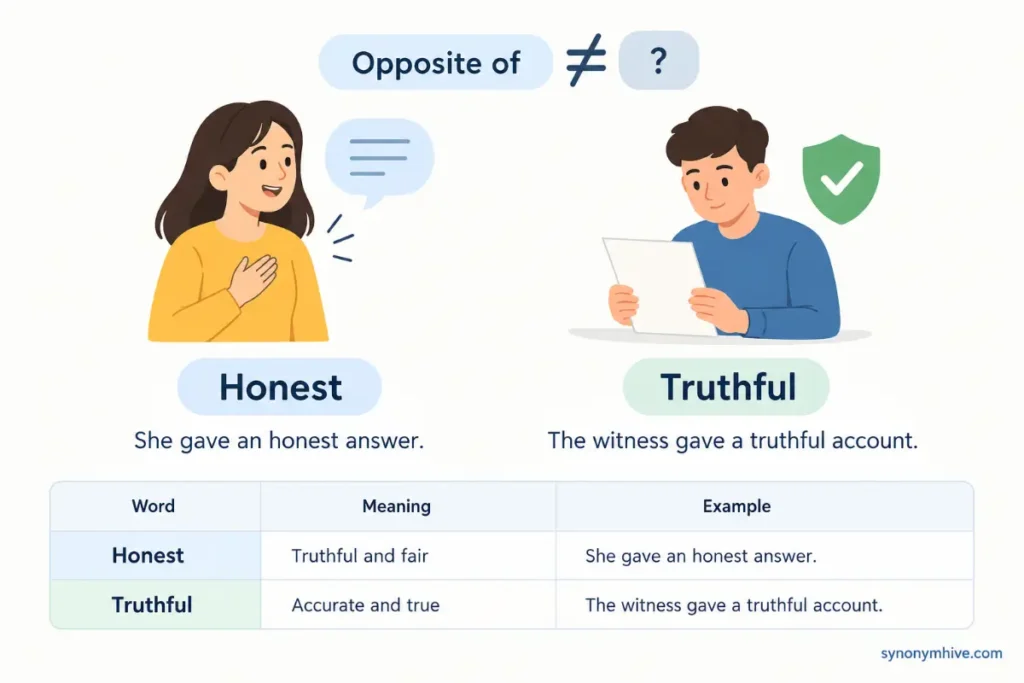
The main antonym of dishonest is honest. Other related words include truthful, sincere, trustworthy, fair, upright, and candid.
| Word | Meaning | Example |
|---|---|---|
| Honest | Truthful and fair | She gave an honest answer. |
| Truthful | Accurate and true | The witness gave a truthful account. |
| Sincere | Genuine in thought or feeling | He offered a sincere apology. |
| Trustworthy | Deserving of trust | The trustworthy employee handled the records carefully. |
| Fair | Just and impartial | The judge made a fair decision. |
| Upright | Guided by strong moral principles | The upright leader refused the bribe. |
| Candid | Open and direct | She gave a candid opinion about the plan. |
These words are related, but they are not identical. A person can be sincere about a belief that turns out to be wrong. A person can be candid without sharing every private detail. Choose the word that matches the quality you want to express.
Quick Tips for Choosing the Right Word
When you need a synonym, ask yourself what kind of dishonesty you are describing.
- If someone knowingly says something false, use lying or dishonest.
- If a message creates a false impression, use misleading or deceptive.
- If someone cheats to gain an advantage, use cheating or underhanded.
- If the conduct breaks moral or professional standards, use unethical.
- If the act involves proven or alleged fraud, use fraudulent or fraud, with care.
- If someone pretends to be sincere, consider disingenuous.
- If the situation is casual, shady or sketchy may fit, but avoid them in formal reports.
- If you are unsure about intent, describe the statement or action rather than judging the person’s character.
- If the claim could affect someone’s reputation, be precise and support it with facts.
- If a simpler word works, choose it over a rare or overly formal term.
Compare more word options with Opposite of Strong Best Words and Examples 2026.
Conclusion
The clearest answer to the question about the opposite of honest is dishonest. It covers lies, unfair behavior, and attempts to mislead others. Still, a more exact word can make your writing stronger. Use lying for a false statement, deceptive for a false impression, disingenuous for false sincerity, and fraudulent for conduct involving fraud.
Think about the action before choosing a label. A mistake is not always a lie, and keeping a private detail to yourself is not automatically dishonest. When the facts are unclear, describe what happened and let the evidence support your point.
In essays and professional writing, simple words usually work best. In casual conversation, expressions such as shady or dodgy can sound natural. Choose the term that fits your audience, tone, and evidence, and your meaning will be clearer.
Frequently Asked Questions
What is the opposite of honest in one word?
Dishonest is the most direct one word opposite of honest. It describes someone or something that is not truthful or fair. Depending on the situation, deceptive, untruthful, or deceitful may be more precise.
What’s another way to say someone is dishonest?
You can say the person is lying, deceitful, deceptive, or untruthful. The best choice depends on the behavior. Lying points to a false statement, while deceitful suggests a willingness to mislead.
Is dishonest the same as lying?
No. Lying usually means knowingly making a false statement, while dishonest can include cheating, hiding important facts, or other unfair actions. A lie is one form of dishonesty.
What is a formal word for dishonest?
Deceptive, disingenuous, and mendacious are formal alternatives, but they have different meanings. Deceptive focuses on misleading others, disingenuous suggests a lack of sincerity, and mendacious means lying. For most formal writing, dishonest is still clear and appropriate.
What is the opposite of honest on a resume?
Dishonest is the direct opposite, but a resume usually needs more specific language about work behavior. If you are describing a problem, terms such as inaccurate, misleading, or unethical may fit, as long as they accurately describe the facts.
Is shady a synonym for dishonest?
Shady is an informal word for something suspicious or not fully trustworthy. It can suggest dishonesty, but it does not prove that someone has lied or committed fraud. Use it in casual speech rather than formal reports.
What is the noun form of dishonest?
The noun form is dishonesty. For example, The investigation raised concerns about dishonesty describes the quality or behavior. Deception and fraud are related nouns with more specific meanings.