
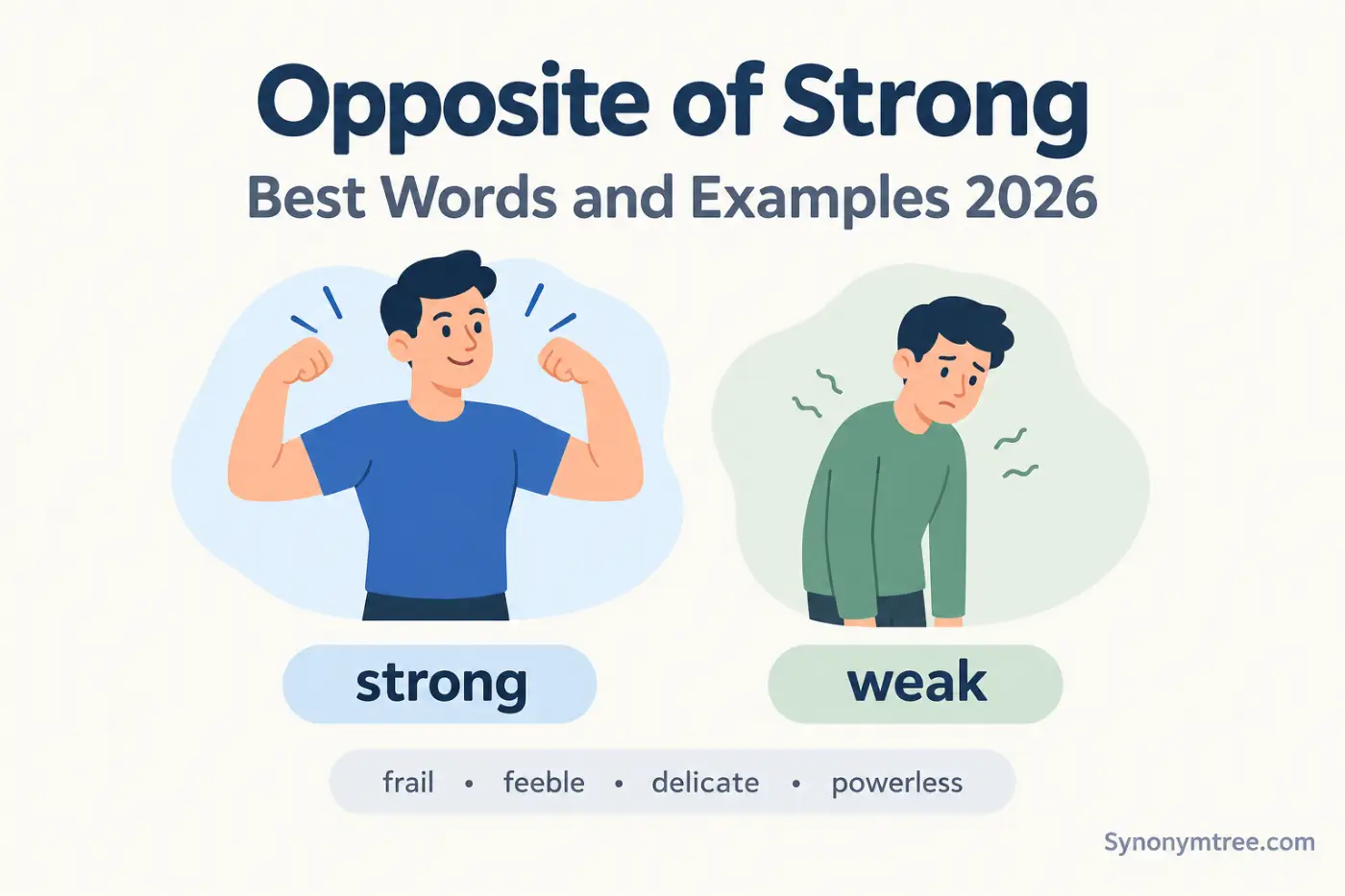
The opposite of strong can be tricky to choose when you are writing a school essay, updating a resume, or sending a quick message. A person can be physically weak, a team can be ineffective, an argument can be unconvincing, and a flavor can be mild. Each word expresses a different kind of weakness, so the best choice depends on what you want to describe.
The most common opposite of strong is weak. However, weak does not fit every situation. A weak password needs better security, a weak economy has financial problems, and a weak argument lacks convincing evidence. Words such as fragile, feeble, powerless, and ineffective can express these differences more clearly.
The opposite of strong is usually weak. Weak describes a person, object, quality, or system that lacks strength, power, force, or effectiveness.
This guide explains the meaning and origin of strong, compares more than 30 alternatives, and shows how to choose the right word for different situations. You will also find examples for everyday conversations, professional writing, school assignments, and common word choice mistakes.
Looking for another word? See Opposite of Love Best Words and Examples 2026.
What Is the Opposite of Strong in Plain English?
The best answer depends on the type of strength you mean. Strong can describe physical power, emotional resilience, a solid structure, a convincing argument, a powerful flavor, or a reliable system. Each meaning has its own natural opposite.
For example, a weak athlete may lack physical power, while a fragile glass may break easily. An ineffective plan may fail to produce results, and an unconvincing argument may not persuade anyone. All these words can contrast with strong, but they are not interchangeable.
What Does Strong Mean?
Strong is an adjective that describes something with a high degree of physical power, force, intensity, ability, or effectiveness.
A strong person may lift heavy objects or perform demanding physical work. A strong leader may guide a team through difficult decisions. Strong coffee has a powerful flavor, while a strong bridge can support heavy loads.
The word can also describe emotional or mental qualities. Someone with strong determination keeps working toward a goal despite setbacks. A strong relationship may include trust, respect, and reliable support.
These meanings matter because the opposite should match the quality being described. Calling a bridge weak makes sense if it cannot support enough weight. Calling it sad or shy would not express the same idea.
What Is the Origin of the Word Strong?
The word strong comes from Old English strang, which meant powerful, forceful, or physically capable. It is related to older Germanic words that expressed similar ideas of strength and power.
Over time, strong developed a wider range of meanings. English speakers began using it for more than physical ability. Today, the word can describe arguments, evidence, emotions, relationships, flavors, signals, economies, and many other things.
Its opposite developed a similarly broad range. Weak can describe a lack of physical power, but English also uses it for poor reasoning, low intensity, limited influence, and reduced performance.
This history helps explain why no single alternative works in every sentence. English has different words for different kinds of limited strength, and those distinctions make writing more precise.

What Words Can Replace Weak as the Opposite of Strong?
The simplest word is often the best one, but a more specific alternative can make your meaning clearer. Use the following groups to find a word that matches your situation.
Simple Words for Everyday Use
These words work well in basic conversations, school assignments, and general writing.
| Word | Meaning | Tone | Example |
|---|---|---|---|
| Weak | Lacking strength or power | Neutral | The weak branch broke in the wind. |
| Feeble | Lacking physical strength or force | Slightly formal | He gave a feeble push against the door. |
| Frail | Physically delicate or easily harmed | Gentle or serious | The frail puppy needed extra care. |
| Soft | Not hard, firm, or forceful | Neutral | The soft material tore easily. |
| Mild | Not strong in taste, effect, or intensity | Neutral | This sauce has a mild flavor. |
| Thin | Having little thickness or density | Neutral | The thin wall offered little protection. |
| Light | Low in weight, force, or intensity | Neutral | A light breeze moved the leaves. |
| Low | Limited in amount, level, or intensity | Neutral | The radio picked up a low signal. |
These words do not all mean physically weak. A mild flavor has less intensity, while a thin wall has little thickness. Choose the term that describes the specific quality you mean.
Everyday Alternatives
Everyday alternatives add more detail than weak. They can describe people, objects, plans, performance, and other common situations.
| Word | Meaning | Tone | Example |
|---|---|---|---|
| Fragile | Easily broken or damaged | Neutral | The fragile vase needs careful handling. |
| Delicate | Easily damaged or requiring care | Neutral | The delicate fabric tore at the seam. |
| Powerless | Unable to control or change a situation | Serious | Residents felt powerless during the outage. |
| Helpless | Unable to act or provide help | Emotional | The child felt helpless when the bike broke. |
| Ineffective | Failing to produce the desired result | Practical | The ineffective plan wasted time. |
| Inefficient | Using more time or resources than needed | Practical | The inefficient process slowed the team. |
| Unstable | Not steady or reliable | Neutral | The unstable shelf leaned to one side. |
| Vulnerable | Open to harm, attack, or damage | Serious | The exposed cables were vulnerable to rain. |
Use fragile for something that can break, powerless for a lack of control, and ineffective for an action that fails to work. These distinctions help readers understand the exact problem.
Formal Words for Essays and Professional Writing
Formal alternatives can make an argument, report, or analysis more accurate. They are especially useful when the word weak sounds too broad.
| Word | Meaning | Tone | Example |
|---|---|---|---|
| Inadequate | Not good enough for a particular need | Formal | The report offered inadequate evidence. |
| Insufficient | Not enough in amount or degree | Formal | The team had insufficient funding. |
| Deficient | Lacking a needed quality or element | Formal | The proposal was deficient in detail. |
| Ineffectual | Unable to produce the intended effect | Formal | The warning proved ineffectual. |
| Unconvincing | Not persuasive or believable | Formal | The writer presented an unconvincing claim. |
| Unsound | Based on poor reasoning or faulty principles | Formal | The committee rejected the unsound argument. |
| Impotent | Lacking power or ability to create an effect | Formal and strong | The outdated policy was impotent against the problem. |
| Substandard | Below an accepted level of quality | Formal | Inspectors found substandard materials. |
In formal writing, match the word to the evidence. Insufficient means there is not enough of something. Deficient suggests a missing quality or feature. Unsound is a good choice for reasoning that rests on faulty logic.
Slang and Informal Alternatives
Informal language can make a text or conversation sound natural. These choices are less suitable for academic essays and formal reports.
| Word | Meaning | Tone | Example |
|---|---|---|---|
| Wimpy | Lacking courage, strength, or toughness | Informal | The flimsy plastic handle felt wimpy. |
| Spineless | Lacking courage or willingness to stand firm | Critical | He called the response spineless. |
| Limp | Lacking firmness, force, or energy | Informal | She gave him a limp handshake. |
| Flimsy | Thin, weakly made, or poorly supported | Informal | The flimsy box split at the bottom. |
| Lame | Weak, poor, or unimpressive in slang use | Casual and potentially dismissive | That excuse sounded lame. |
| Mushy | Soft or lacking firmness | Informal | The old cardboard had turned mushy. |
| Pathetic | So poor or weak that it invites pity or contempt | Harsh | The team made a pathetic attempt to defend its lead. |
| Gutless | Lacking courage | Harsh | Fans described the decision as gutless. |
Slang can be expressive, but some terms insult the person rather than describe the problem. Wimpy, gutless, and spineless may sound disrespectful when used about a colleague, student, or family member. In those situations, a more neutral word is usually better.
Which Opposite of Strong Fits Each Level of Intensity?
Words for limited strength range from gentle descriptions to forceful criticism. The best choice depends on how serious the weakness is and how strongly you want to express it.
Mild Alternatives
Use mild words when the problem is small, temporary, or limited to one quality.
- Soft describes a lack of hardness or firmness.
- Light describes low weight, force, or intensity.
- Mild describes a low degree of taste, effect, or severity.
- Slight describes a small amount of strength or influence.
- Delicate describes something that needs careful treatment.
- Thin describes limited thickness or density.
For example, a light breeze is not powerful, but it is not necessarily harmful. A mild flavor may be pleasant. A delicate object can be valuable and well made even if it breaks easily.
Moderate Alternatives
These words describe a more noticeable lack of strength or ability.
- Weak is the broad, common choice.
- Fragile suggests a risk of breaking or damage.
- Feeble describes limited physical force or effort.
- Ineffective describes something that does not achieve its purpose.
- Inadequate means something falls short of a specific need.
- Vulnerable highlights exposure to harm or attack.
A weak password may be easy to guess. An inadequate budget may not cover expected costs. A vulnerable computer system may be open to security threats. Each word explains a different kind of problem.
Stronger Alternatives
Use stronger terms when the lack of strength is severe or when the situation calls for a direct assessment.
- Powerless describes a lack of control or influence.
- Helpless suggests an inability to take effective action.
- Deficient points to a serious lack of a needed feature.
- Ineffectual describes an action or effort that achieves little.
- Spineless criticizes a lack of courage or resolve.
- Pathetic expresses harsh disapproval of a very poor effort or result.
These words carry more emotional weight. In a professional report, deficient or ineffectual may be appropriate. In a personal conversation, helpless may describe a real emotional state. Harsh slang can damage trust, so reserve it for contexts where that tone is intentional.

Which Opposite of Strong Should You Use by Part of Speech?
Strong is usually an adjective, so its direct opposite is often another adjective. However, the idea of limited strength can also be expressed with nouns, verbs, and adverbs.
Adjectives
Adjectives describe people, objects, conditions, and qualities. They are the most direct way to express the opposite of strong.
Examples include weak, fragile, feeble, powerless, ineffective, inadequate, and unconvincing.
- The weak rope snapped under pressure.
- The fragile container needed extra padding.
- The ineffective method failed to solve the issue.
- Her unconvincing explanation left the audience with questions.
Use an adjective when you want to describe what something is like.
Nouns
Nouns name a lack of strength or the condition that causes it. They can help you discuss the problem itself rather than label a person or object.
| Noun | Meaning | Example |
|---|---|---|
| Weakness | A lack of strength or ability | The report identified a weakness in the design. |
| Frailty | Physical delicacy or weakness | Age had increased his physical frailty. |
| Vulnerability | Exposure to harm or damage | The audit revealed a vulnerability in the network. |
| Ineffectiveness | Failure to produce the intended result | The review questioned the policy’s ineffectiveness. |
| Deficiency | A missing or inadequate quality | The test revealed a deficiency in the material. |
| Instability | A lack of steadiness or reliability | Instability made the structure unsafe. |
Nouns can also make professional writing more measured. Instead of calling a process weak, you can identify a specific weakness in its design or execution.
Verbs
Verbs describe an action or change. They can show that something is losing strength, becoming less effective, or failing to hold up.
| Verb | Meaning | Example |
|---|---|---|
| Weaken | To make or become less strong | Repeated use may weaken the material. |
| Falter | To lose strength, confidence, or progress | Her confidence began to falter. |
| Deteriorate | To become worse in condition or quality | The old roof continued to deteriorate. |
| Crumble | To break apart or lose stability | The damaged wall began to crumble. |
| Waver | To become less firm or certain | His commitment did not waver. |
These verbs are not exact substitutes for strong. They describe changes or actions rather than a fixed quality. Use weaken when something loses strength, falter when performance or confidence declines, and crumble when a structure or plan breaks down.
Adverbs
Adverbs explain how an action happens. Some can describe a lack of force or confidence.
- Weakly means with little strength or force.
- Feebly means with very little power or effort.
- Ineffectively means without producing the desired result.
- Hesitantly means with uncertainty or reluctance.
For example, the runner pushed weakly against the final stretch, while the manager argued ineffectively for the proposal. Hesitantly does not mean weakly in every context, but it can describe uncertain action.
Is There a Difference Between US and UK Usage?
Most common opposites of strong work in both American and British English. Words such as weak, fragile, feeble, and powerless have the same basic meanings in both varieties.
The main differences involve spelling, regional vocabulary, and tone rather than the core meaning.
Which Words Sound Natural in American English?
American English speakers commonly use weak, flimsy, wimpy, and ineffective in everyday speech.
Examples include the following.
- The cheap chair looks flimsy.
- That excuse sounds weak.
- The team needs a more effective strategy.
- The old battery has a weak charge.
Wimpy is informal and can sound insulting when used to describe a person. Flimsy is more neutral when it describes an object, excuse, or argument.
Which Words Sound Natural in British English?
British speakers also use weak, feeble, fragile, and ineffective. Some informal choices vary by region and situation, but there is no separate British rule for the basic opposite of strong.
For example, a British speaker might call a poorly built shelf flimsy or describe a person as feeble. Both expressions are understood in American English as well.
The word poorly can also describe something made or performed to a low standard. However, poorly is an adverb in many uses, so it does not replace weak in every sentence.
Does the Meaning Change by Region?
The core meaning stays much the same. The main difference comes from context and tone.
A word such as pathetic can sound strongly critical in both countries. Spineless is also a harsh judgment about someone’s courage. In professional writing on either side of the Atlantic, inadequate, insufficient, or ineffective usually communicates a problem with less personal criticism.
What Is the Best Opposite of Strong for a Resume?
Resume language should describe a specific gap or challenge without making you sound incapable. If you are writing about a skill, result, or business process, avoid calling yourself weak. Explain the area that needs improvement and show how you are addressing it.
Better Words for Professional Experience
Use these alternatives when you need to discuss a limitation honestly.
| Situation | Better word or phrase | Example sentence |
|---|---|---|
| A skill needs improvement | Developing | I am developing my public speaking skills through regular presentations. |
| A result missed its target | Below target | The first campaign performed below target, so I revised the audience strategy. |
| A process wastes resources | Inefficient | I improved an inefficient reporting process by automating routine tasks. |
| A plan lacks detail | Inadequate | The initial plan had inadequate cost estimates, so I prepared a more detailed budget. |
| A result lacks proof | Unsupported | The proposal included unsupported claims that needed reliable evidence. |
| A team needs more resources | Understaffed | I helped an understaffed team meet its deadline by reorganizing daily tasks. |
Notice that these examples focus on the situation rather than attacking a person. That approach is more useful in a resume, performance review, or job interview.
How Can You Describe a Professional Weakness?
Choose a clear phrase that names the issue and shows what you did about it.
Instead of writing, My leadership is weak, try this sentence.
My leadership skills are developing, and I have improved them by leading weekly team meetings.
Instead of writing, I am bad at organization, try this sentence.
I am improving my planning skills by setting weekly priorities and tracking deadlines.
These examples are direct without making the weakness sound permanent. They also show initiative, which matters to employers.
What Is the Best Opposite of Strong in an Essay?
In an essay, the right word depends on the point you are making. Academic writing benefits from precise terms that explain the evidence, reasoning, or result.
Use Weak for a General Lack of Strength
Weak works when you need a broad and familiar description.
Example: The research provides weak support for the proposed explanation.
This sentence says the evidence does not strongly support the claim. It does not automatically mean the research is worthless.
Use Unconvincing for an Argument
Unconvincing describes a claim that fails to persuade the reader.
Example: The author presents an unconvincing argument because the main claim lacks reliable evidence.
This choice focuses on persuasion rather than physical or general strength.
Use Insufficient for Evidence or Information
Insufficient means not enough for the purpose.
Example: The study provides insufficient evidence to support a firm conclusion.
This is often more precise than saying the study is weak. It identifies the shortage of evidence rather than making a broad judgment about the entire study.
Use Unsound for Faulty Reasoning
Unsound describes reasoning, plans, or methods that rest on poor principles or errors.
Example: The conclusion is unsound because it assumes that two events occurring together must share a cause.
This term works well in critical analysis, debate, and formal essays.
Use Fragile for Something Easily Damaged
Fragile is appropriate when a system, relationship, or structure can be damaged by small changes or pressure.
Example: The agreement remained fragile because both sides continued to disagree about its main terms.
In this context, fragile suggests that the agreement could break down. It does not simply mean that the agreement lacks persuasive force.

Check out more vocabulary ideas in Opposite of Full Best Words and Examples.
What Should You Say Instead of Strong in a Text or Email?
Everyday messages usually need clear and natural language. The best choice should fit your relationship with the reader and the seriousness of the situation.
In Text Messages
Short, familiar words usually work best in texts.
Examples include the following.
- My phone signal is weak.
- The Wi Fi connection is unstable.
- This box feels flimsy.
- That excuse sounds unconvincing.
- The coffee tastes mild today.
You do not need a formal word when a simple one communicates the point. In a casual message, weak or flimsy is usually easier to understand than ineffectual or deficient.
In Work Emails
A work email should explain the problem without sounding rude or overly dramatic.
Instead of writing, Your proposal is weak, try this.
The proposal needs more supporting evidence before we can approve it.
Instead of writing, Our system is weak, try this.
Our current system has a few reliability issues that need attention.
Instead of writing, The plan is ineffective, try this.
The current plan has not produced the expected results, so I suggest reviewing the next steps.
These alternatives identify the problem and point toward a solution. That makes them more productive than a broad criticism.
When Speaking in Person
Spoken language can be more direct, but tone still matters.
You might say, This handle feels flimsy, if you are discussing a product. If a coworker struggles with a task, you could say, This process seems inefficient. If a friend feels unable to handle a problem, powerless or helpless may describe the situation more accurately.
Try to describe the specific issue instead of labeling someone’s character. Calling a person weak can sound personal, even when you only mean that they lack experience or confidence in one area.
What Are Some Examples of the Opposite of Strong in Real Life?
Examples make the differences easier to remember. The following sentences cover physical strength, emotional resilience, technology, schoolwork, business, and everyday conversations.
Physical Strength and Objects
- The weak rope snapped when the climber placed too much weight on it.
- The fragile glass needed extra padding before shipping.
- A feeble gust moved the curtain but barely disturbed the leaves.
- The flimsy table shook when someone placed a heavy bag on it.
- The old bridge looked unstable after years of neglect.
- The thin plastic cover offered little protection against sharp objects.
Weak describes limited strength. Fragile suggests that something can break easily. Flimsy often points to poor construction or a lack of firmness. Unstable describes something that may not remain steady or safe.
Health and Personal Ability
- The exhausted runner gave a feeble attempt to finish the race.
- The elderly man appeared frail after his long illness.
- She felt powerless when the decision was made without her input.
- The injured bird seemed helpless until a wildlife worker arrived.
- His confidence began to falter during the difficult presentation.
These examples show why the alternatives need care. Frail can describe physical delicacy, especially in health related contexts. Powerless refers to a lack of control. Helpless suggests that someone cannot act effectively in a particular situation.
School and Academic Writing
- The student offered a weak explanation of the poem’s central theme.
- The essay included insufficient evidence to support its main claim.
- The argument was unconvincing because it ignored important facts.
- The conclusion was unsound because it relied on a false assumption.
- The report was deficient in detail and needed more examples.
For academic work, choose the term that identifies the exact problem. A weak explanation may lack clarity. Insufficient evidence means the support is not enough. An unsound conclusion contains a reasoning problem.
Business and Technology
- The ineffective advertising campaign failed to attract new customers.
- The company faced an inadequate budget for the planned expansion.
- A weak password can make an account easier to access without permission.
- The unstable internet connection interrupted the video meeting.
- The outdated backup system left important files vulnerable to loss.
- The inefficient approval process delayed the project by several days.
The words here describe different kinds of performance. Ineffective means something fails to achieve its goal. Inefficient means it wastes time, money, or effort. Vulnerable focuses on exposure to harm, while unstable suggests that a service or system may fail to work consistently.
Relationships and Communication
- Their fragile agreement broke down after another disagreement.
- The manager gave a weak response to a reasonable concern.
- The team made an ineffectual effort to solve the scheduling problem.
- His hesitant answer suggested that he was unsure of the facts.
- The speaker gave an unconvincing explanation for the missed deadline.
A relationship can be fragile without being bad. A response can be weak because it does not address the issue. A hesitant answer shows uncertainty, but it does not prove that the speaker lacks knowledge.
Weak vs Feeble vs Fragile What Is the Difference?
Weak, feeble, and fragile all contrast with strong, but they emphasize different qualities.
| Word | Main idea | Best use | Example |
|---|---|---|---|
| Weak | General lack of strength or effectiveness | People, objects, arguments, signals | The weak signal dropped repeatedly. |
| Feeble | Very limited physical force or effort | Movement, attempts, voices | He made a feeble attempt to lift the lid. |
| Fragile | Easily broken, harmed, or damaged | Objects, health, relationships, systems | The fragile package needed careful handling. |
It can describe a person, argument, password, flavor, or business result.
Feeble often sounds more specific and sometimes more severe. It suggests very little force or ability. A feeble attempt is not simply an imperfect attempt. It is an attempt with little power or effort.
Fragile focuses on the risk of damage. A fragile relationship may still be loving, and a fragile object may still be valuable. The word describes vulnerability rather than worth.
Powerless vs Helpless What Is the Difference?
Powerless and helpless are close in meaning, but they highlight different situations.
| Word | Main idea | Example |
|---|---|---|
| Powerless | Lacking control, authority, or influence | Residents felt powerless to change the decision. |
| Helpless | Unable to take effective action or provide help | The child felt helpless after losing the group. |
A person can be powerless because someone else controls the outcome. They may know exactly what needs to happen but lack the authority to make it happen.
Helpless often describes a situation in which a person cannot act effectively or solve an immediate problem. It can carry a stronger emotional meaning.
For example, an employee may feel powerless to change a company policy but not helpless when dealing with daily tasks. A bystander may feel helpless when witnessing an accident and not knowing how to assist.
What Common Mistakes Should You Avoid?
Choosing a word that seems like an opposite can still produce an awkward or misleading sentence. Watch for these common problems.
Treating Every Alternative as an Exact Match
Weak, mild, fragile, and ineffective do not mean the same thing.
A mild sauce has a low level of heat or flavor. It is not necessarily weak in quality. A fragile vase can be expensive and beautifully made. An ineffective policy may be well written but fail to solve the problem.
Choose the word that matches the quality being discussed.
Using Harsh Words in Professional Writing
Words such as gutless, spineless, pathetic, and wimpy can sound insulting. They may be suitable in a fictional dialogue or a strongly worded personal opinion, but they rarely help in a professional report.
Instead of saying that a coworker is spineless, explain that the person avoided making a difficult decision. Rather than calling a proposal pathetic, identify its missing evidence or unrealistic goals.
Confusing Weak With Inefficient
Weak and inefficient describe different problems.
A weak signal may not reach far enough. An inefficient system may complete its task but waste too much time or money.
For example, a team can be highly skilled but work with an inefficient process. Calling the team weak would blame the wrong thing.
Calling Someone Weak When You Mean Inexperienced
A new employee may lack experience without lacking intelligence, courage, or ability. Describing the person as inexperienced is clearer and fairer.
Similarly, someone may need more training in public speaking without being weak overall. Identify the specific skill rather than making a broad judgment about the person.
Using Fragile for Anything That Performs Poorly
Fragile suggests a risk of breaking or damage. It is suitable for delicate equipment, a vulnerable agreement, or a system that can fail under pressure.
It is less suitable when you simply mean that an argument is poorly supported. In that case, weak, unconvincing, or unsound is more accurate.
What Are the Antonyms of Strong Besides Weak?
Weak is the most common antonym of strong, but several other words can express the opposite idea.
- Fragile is the opposite of strong when something breaks or gets damaged easily.
- Feeble works when physical force or effort is very limited.
- Powerless describes a lack of control or influence.
- Ineffective describes an action or method that fails to produce the desired result.
- Unconvincing describes an argument that does not persuade.
- Mild contrasts with strong when discussing flavor, scent, or intensity.
- Unstable contrasts with strong when a structure or system lacks steadiness.
- Insufficient means there is not enough of something for the task.
These are contextual antonyms rather than perfect replacements in every sentence. Strong coffee may have a mild flavor, while a strong password may be the opposite of a weak or easy to guess password. The meaning of strong determines the best contrast.

How Can You Choose the Right Word Quickly?
Use these practical tips when editing an email, essay, report, or text.
- Identify the kind of strength. Decide if you mean physical power, emotional resilience, reliability, persuasion, or intensity.
- Use weak when you need a general term. It is familiar, direct, and works in many settings.
- Choose a precise word for a specific problem. Use fragile for easy damage, ineffective for poor results, and insufficient for an amount that falls short.
- Match the tone to your audience. Formal writing often benefits from inadequate, deficient, or unsound. Casual speech may suit flimsy or wimpy.
- Avoid judging people when describing a situation. Describe a missing skill, limited authority, or poor process instead of labeling someone.
- Read the sentence aloud. If the word sounds too harsh or too formal, choose a simpler alternative.
- Check the meaning in context. Replace the word and see if the sentence still says exactly what you intend.
The goal is not to find the fanciest synonym. It is to make your meaning clear with the fewest words needed.
Learn more useful word alternatives in Opposite of Loud The Best Words to Use.
Conclusion
The best opposite of strong is usually weak, but a more precise word can make your writing clearer. Use fragile when something can break easily, feeble when force or effort is limited, powerless when control is missing, and ineffective when an action fails to work. In academic writing, insufficient and unsound can explain specific problems with evidence or reasoning. In everyday conversations, simple words are often enough.
When choosing the opposite of strong, focus on what is actually lacking. Is it power, stability, confidence, quality, or effectiveness? Once you identify that detail, the right word becomes easier to find. A precise word helps readers understand your point without making the sentence sound harsh or complicated.
Frequently Asked Questions
What is the most common opposite of strong?
The most common opposite of strong is weak. It can describe limited physical power, poor performance, low intensity, or a lack of effectiveness.
What is a more formal word for weak?
Inadequate, deficient, insufficient, and ineffective can work as formal alternatives. The best choice depends on the issue you are describing.
What is the opposite of strong in a resume?
For a resume, it is usually better to describe the specific limitation than to label a skill weak. Phrases such as developing my presentation skills or improving an inefficient process sound more constructive and precise.
What is the difference between weak and fragile?
Weak describes a general lack of strength or effectiveness, while fragile describes something that can be damaged or broken easily. A fragile object may still be valuable or well made.
What’s another way to say strong when you mean physically powerful?
Powerful, sturdy, robust, and muscular can describe different kinds of strength. Their opposites may include weak, fragile, feeble, or frail, depending on the context.
Can ineffective be the opposite of strong?
Yes, when strong means effective or successful. An ineffective method fails to achieve its purpose, while a weak method may simply lack force, quality, or support.
What is the opposite of strong in taste?
Mild is a common opposite when strong refers to taste or flavor. Light can also describe a less intense flavor or scent, depending on the sentence.