

Imagine you’re writing an essay about your favorite song or sending a friend a message about a concert you loved. You know the music made you feel something, but words like good and nice don’t quite capture the experience. Finding the right words to describe music can help you explain its sound, mood, rhythm, and emotional impact in a way that feels clear and personal.
The best descriptive words for music explain how it sounds, how it makes you feel, and what makes it memorable. Words such as melodious, soothing, energetic, soulful, and powerful help listeners picture the experience and understand your reaction.
Music can sound gentle and peaceful one moment, then loud and intense the next. A song might have a catchy melody, a deep bass line, a haunting voice, or a rhythm that makes you want to dance. Each detail gives you a different way to describe what you hear.
This guide covers simple and advanced vocabulary for describing music, including words grouped by mood, intensity, and purpose. You’ll also find examples for essays, emails, texts, conversations, and music reviews, along with comparisons that help you choose the most accurate word.
Compare more word options with words to describe a sunset Best Guide.
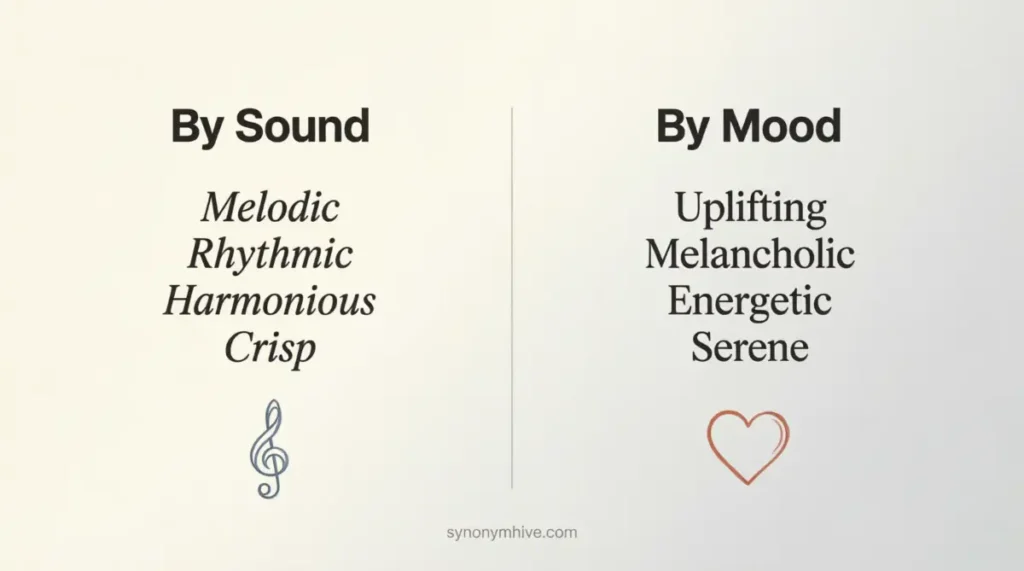
Words to Describe Music by Sound and Mood
The best word depends on the part of the music you want to explain. Some words describe the sound itself, while others focus on the feelings a song creates. A few can do both.
For example, soft describes low volume or a gentle sound. Soothing describes music that helps someone feel calm. A song can be soft without being soothing, especially if its melody feels tense or sad.
Here are useful words to start with.
| Word | Meaning | Best Used For | Example |
|---|---|---|---|
| Melodious | Pleasant and rich in melody | Songs with an appealing tune | The melodious song stayed in my mind all day. |
| Soothing | Calm and comforting | Relaxing music | The soothing piano music helped me unwind. |
| Upbeat | Cheerful and lively | Happy songs and dance music | The upbeat track lifted everyone’s mood. |
| Rhythmic | Having a clear pattern of beats | Music with a noticeable beat | The rhythmic drums made the song exciting. |
| Soulful | Full of deep feeling | Emotional singing and expressive music | Her soulful voice gave the song real warmth. |
| Powerful | Strong in sound or emotional effect | Big vocals and dramatic arrangements | The powerful chorus gave me chills. |
| Haunting | Beautiful or unsettling in a lasting way | Mysterious or emotional music | The haunting melody stayed with me for hours. |
| Catchy | Easy to remember | Popular songs and memorable hooks | The catchy chorus made everyone sing along. |
| Mellow | Soft and relaxed | Easy listening and gentle songs | We played mellow music during dinner. |
| Energetic | Full of energy and movement | Fast songs and lively performances | The energetic beat kept the crowd moving. |
| Melancholic | Filled with thoughtful sadness | Reflective or sad music | The melancholic melody suited the rainy evening. |
| Uplifting | Making people feel hopeful or happy | Inspirational songs | The uplifting lyrics gave me fresh motivation. |
What Does the Word Music Mean and Where Did It Come From?
The English word music comes through Old French and Latin from the Greek word mousikē, which referred to the art associated with the Muses. In ancient Greek culture, the Muses were linked to artistic and intellectual pursuits.
In everyday English, music means an organized combination of sounds, often involving melody, rhythm, harmony, and changes in tone. People create it with voices, instruments, electronic sounds, or combinations of these elements.
Music can serve many purposes. It can entertain, tell stories, support celebrations, express grief, create tension in a film, or help people relax. Because music does so many things, one adjective rarely captures every part of it.
Consider the difference between these descriptions.
1. The song is loud.
2. The song is energetic and full of driving rhythms.
3. The song is loud and aggressive with heavy drums and sharp guitar sounds.
All three sentences describe sound, but each creates a different impression. The first gives a basic fact about volume. The second focuses on movement and energy. The third gives the reader more information about the style and texture.
Understanding a few basic musical terms can also help you choose better adjectives.
You don’t need formal music training to use these ideas. Simply noticing the melody, beat, speed, and sound quality can make your description more accurate.
For instance, The song has a slow tempo, a warm guitar tone, and a gentle melody gives a more useful picture than The song sounds good.
How to Choose Expressions to Describe Music by Intensity
Sometimes a basic word is enough. Other times, you need a stronger description to match the experience. Thinking about intensity helps you choose words that fit the music instead of making every song sound equally impressive.
Mild Words for Gentle or Simple Music
Mild words work well when you want to describe music without making a strong emotional claim.
- Soft. The sound is gentle or low in volume.
- Light. The music feels easy and not too heavy.
- Pleasant. The sound is enjoyable.
- Gentle. The music feels mild and tender.
- Relaxed. The performance has an easy and unhurried feel.
- Simple. The arrangement has few complicated elements.
For example, The gentle guitar music played softly in the background while we talked.
These words are useful in everyday conversation and basic school assignments. They also work well when music serves as background sound rather than the main focus.
Medium Strength Words for Noticeable Music
Choose these words when the music has a clear quality that stands out.
- Expressive. The music communicates emotion clearly.
- Engaging. It holds the listener’s attention.
- Vibrant. It sounds lively and full of energy.
- Captivating. It strongly attracts attention.
- Moving. It creates a strong emotional response.
- Dynamic. It changes in energy, volume, or intensity.
- Atmospheric. It creates a strong sense of place or mood.
For example, The expressive vocals and dynamic arrangement made the performance captivating.
These words help explain why a song stands out without relying on vague praise.
Strong Words for Music That Leaves a Lasting Impression
Strong words suit music that creates a powerful emotional or physical response.
- Electrifying. The music creates intense excitement.
- Stirring. It awakens strong feelings.
- Exhilarating. It creates a thrilling sense of energy.
- Spellbinding. It holds the listener’s attention almost completely.
- Triumphant. It sounds victorious and celebratory.
- Thunderous. It has a very loud and forceful sound.
- Awe inspiring. It creates wonder or deep admiration.
For example, The orchestra delivered a stirring performance that ended with a thunderous final note.
Strong words are most effective when they match a specific moment. A quiet acoustic song may be spellbinding because of its delicate performance, while a live rock show may be electrifying because of its volume and energy.
Words for Music That Feels Sad or Intense
Music can create difficult or mixed emotions. These words help describe those experiences with greater care.
| Word | Meaning | Example |
|---|---|---|
| Bittersweet | Mixing happiness with sadness | The bittersweet song reminded me of old friendships. |
| Somber | Serious and sad | The somber music suited the scene. |
| Plaintive | Expressing sadness or longing | The plaintive violin sounded full of sorrow. |
| Anguished | Showing deep emotional pain | The anguished vocals made the lyrics feel raw. |
| Ominous | Suggesting danger or trouble | The ominous music built tension before the scene began. |
| Intense | Strong in feeling or sound | The intense finale left the audience silent. |
| Dramatic | Full of contrast or strong emotion | The dramatic arrangement made the chorus stand out. |
These terms are especially useful when writing about film scores, classical music, emotional ballads, or songs that explore grief and conflict.

A Master List of Words to Describe Music
The following vocabulary covers different styles, moods, and listening experiences. The table groups words into simple, everyday, formal, and casual language so you can choose terms that fit your audience.
Simple Words for Everyday Descriptions
These words are easy to understand and work well in schoolwork, conversations, and short reviews.
| Word | Meaning | Tone | Example |
|---|---|---|---|
| Good | Enjoyable or pleasing | Neutral | The song has a good melody. |
| Nice | Pleasant to hear | Casual | The nice guitar sound makes the song relaxing. |
| Loud | High in volume | Neutral | The loud drums filled the room. |
| Soft | Gentle or low in volume | Neutral | The soft music helped me relax. |
| Fast | Moving at a high speed | Neutral | The fast song made everyone dance. |
| Slow | Moving at a low speed | Neutral | The slow melody created a calm mood. |
| Sweet | Gentle and pleasant | Warm | Her sweet voice made the song feel personal. |
| Sad | Expressing sorrow | Direct | The sad song reminded me of home. |
Everyday Words for Clearer Descriptions
These terms help you explain what makes a song enjoyable, memorable, or distinctive.
| Word | Meaning | Tone | Example |
|---|---|---|---|
| Catchy | Easy to remember | Casual | The catchy chorus stayed in my head. |
| Groovy | Having a strong and enjoyable rhythm | Casual | The groovy bass line made the track fun. |
| Catching | Attracting attention or spreading easily | Informal | The song has a catching tune that people remember. |
| Melodic | Having a clear or appealing melody | Neutral | The melodic guitar line carries the song. |
| Rhythmic | Built around a noticeable beat | Neutral | The rhythmic percussion gives the track movement. |
| Lively | Full of energy | Positive | The lively music brought the party to life. |
| Dreamy | Soft and imaginative in mood | Casual | The dreamy sounds made the song feel otherworldly. |
| Soulful | Deeply emotional and expressive | Positive | His soulful singing brought out the meaning of the lyrics. |
Catchy is more natural than catching when describing a tune that’s easy to remember. You can still use catching in other contexts, but catchy melody is the stronger everyday choice.
Formal Words for Reviews and Essays
Formal vocabulary can help you describe musical qualities with greater precision. These words are useful in essays, thoughtful reviews, and discussions of performances.
| Word | Meaning | Tone | Example |
|---|---|---|---|
| Melodious | Pleasant and musical | Formal | The melodious flute line gave the piece a gentle character. |
| Harmonic | Related to harmony or musical relationships between notes | Technical | The harmonic structure supports the main melody. |
| Resonant | Rich, deep, or lingering in sound | Formal | The resonant cello filled the concert hall. |
| Evocative | Bringing memories or feelings to mind | Formal | The evocative score recalled the beauty of the countryside. |
| Intricate | Detailed and carefully arranged | Formal | The intricate composition rewards careful listening. |
| Ethereal | Light, delicate, and almost otherworldly | Literary | The ethereal vocals floated above the soft instruments. |
| Dissonant | Containing notes that sound tense or clash | Technical | The dissonant chords created a feeling of unease. |
| Orchestral | Involving the sound or style of an orchestra | Descriptive | The orchestral ending gave the song a grand scale. |
Use technical terms when they add meaning. Dissonant is more precise than strange if the notes create tension. However, if you’re writing for readers who don’t study music, a brief explanation may make the description easier to follow.
Slang and Casual Words for Music
Informal expressions work well in texts, social posts, and conversations with friends. Some describe the sound, while others express your reaction to it.
| Word or Expression | Meaning | Tone | Example |
|---|---|---|---|
| Banger | An especially exciting or enjoyable song | Slang | That new track is a banger. |
| Fire | Excellent or exciting | Slang | The live performance was fire. |
| Chill | Relaxed and easygoing | Casual | I put on some chill music while studying. |
| Vibey | Creating a distinctive mood | Informal | The track has a dreamy and vibey sound. |
| Trippy | Strange, surreal, or mind bending | Casual | The trippy sound effects made the song unusual. |
| Jam | A song someone really enjoys | Casual | This old song is still my jam. |
| Epic | Grand or impressive | Casual | The epic ending made the concert unforgettable. |
| A bop | A catchy and enjoyable song | Slang | That cheerful pop song is a bop. |
Slang changes over time and varies among age groups and communities. Expressions such as fire and banger can sound natural in casual conversation but may feel out of place in a formal music review.
For most writing, choose the word that communicates your meaning clearly. Use slang when the audience and setting make it appropriate.
How Do Different Words Describe Musical Styles and Instruments?
Music style affects the words that fit best. A jazz performance may sound improvisational and swinging, while a classical piece may sound intricate and orchestral. Electronic music can feel futuristic, pulsing, or atmospheric.
You don’t need to know every musical genre to describe what you hear. Start with the sounds and patterns that stand out.
Words for Classical Music
Classical music often features detailed arrangements, changes in dynamics, and a wide range of instruments. The following words can help describe its sound.
- Orchestral. The music has the scale or sound of an orchestra.
- Majestic. It sounds grand and dignified.
- Delicate. The performance feels light and carefully controlled.
- Intricate. The composition has many connected details.
- Graceful. The melody or performance moves smoothly.
- Solemn. The music feels serious and dignified.
- Grand. The arrangement feels large in scale or impressive.
For example, The graceful violin melody rises above the majestic orchestral arrangement.
Words for Rock and Metal Music
Rock and metal often use electric guitars, drums, bass, and strong vocals. Their sound can range from melodic and restrained to loud and aggressive.
Useful words include gritty, distorted, driving, thunderous, raw, rebellious, and explosive.
For example, The gritty guitar tone and driving drums gave the rock song a rebellious edge.
For heavy metal, aggressive may describe the forceful sound, while technical may describe complex guitar playing or drum patterns. Neither word automatically means the music is unpleasant. They describe particular qualities of the performance.
Words for Jazz and Blues
Jazz and blues often rely on expressive performances, distinctive rhythms, and changes in musical phrasing.
Useful descriptions include improvisational, swinging, soulful, smoky, bluesy, syncopated, and expressive.
For example, The smoky saxophone tone and swinging rhythm created an intimate jazz club atmosphere.
The word syncopated describes rhythms that place emphasis on unexpected beats or parts of a beat. It’s useful when you want to explain why a rhythm feels playful, surprising, or different from a steady pattern.
Words for Pop and Electronic Music
Pop and electronic music can feature catchy hooks, repeated patterns, electronic textures, and carefully produced sounds.
Useful words include polished, infectious, pulsing, futuristic, danceable, sparkling, and synth driven.
For example, The polished production and infectious chorus made the pop song easy to remember.
You can also describe the production itself. Layered suggests that several sounds work together, while minimalist describes an arrangement that uses only a few elements. Both can be effective, depending on what you hear.
Words for Acoustic and Folk Music
Acoustic and folk music often highlight natural instrument sounds, storytelling, and a close connection between the performer and listener.
Words such as earthy, rustic, intimate, heartfelt, organic, gentle, and unplugged may fit these styles.
For example, The intimate acoustic performance made the heartfelt lyrics feel like a personal story.
These words describe common qualities rather than strict rules. Any genre can be gentle, intense, complex, or emotionally powerful.
Which Words to Describe Music Work Best in Different Situations?
The same song can sound different depending on why you’re talking about it. A school essay may need clear descriptive language, while a text to a friend can use casual expressions. A professional review may need more detail about the performance and arrangement.
What Words Should You Use to Describe Music in a Resume?
A resume usually focuses on your skills and experience rather than your personal opinion of a song. However, descriptive music vocabulary can be useful when you’re applying for work in music education, performance, production, audio engineering, or entertainment.
Useful terms include technical, expressive, collaborative, versatile, rhythmic, and detail oriented.
For example, a musician might write:
Performed expressive vocal arrangements and collaborated with instrumentalists to deliver engaging live performances.
An audio producer could write:
Created balanced and detailed mixes with clear vocals and carefully controlled dynamics.
A music teacher might write:
Developed engaging lessons that helped students improve rhythm, listening skills, and musical expression.
Keep resume descriptions tied to real skills and results. Words such as exceptional or outstanding won’t add much unless your experience supports them.
What Words Work Best in an Essay About Music?
An essay often needs a balance of sound, emotion, and evidence. Instead of saying that a song is good or bad, explain what creates that impression.
Useful words include melodic, rhythmic, expressive, moving, haunting, energetic, and thought provoking.
For example:
The song creates a reflective mood through its slow tempo, gentle piano melody, and heartfelt lyrics. As the chorus grows louder, the music becomes more powerful and expresses the singer’s growing confidence.
This approach works because it connects the description to musical details. The reader can understand why the song feels reflective at first and powerful later.
If you’re writing a school assignment, choose words you can explain. A simple, accurate description is stronger than a complicated sentence full of unfamiliar terms.
What Words Should You Use in a Text Message?
Texts usually sound better when the wording is short and natural. You can describe your reaction without explaining every musical detail.
Try expressions such as catchy, chill, upbeat, soulful, fire, epic, and a bop.
For example:
- This song is so catchy. I can’t stop listening to it.
- The beat is fire.
- I love the chill vibe of this playlist.
- That singer has such a soulful voice.
- The ending was epic.
Choose casual expressions that suit your usual way of speaking. If you wouldn’t use a phrase in real conversation, it may sound forced in a text.
What Words Work Best in an Email About Music?
An email may be about a concert, a music lesson, a performance, or a recommendation. Choose words that make your message clear and respectful.
For a concert review or thank you email, terms such as moving, impressive, expressive, memorable, and well performed can work well.
For example:
Thank you for the wonderful performance. The expressive vocals and carefully arranged music made the evening memorable.
If you’re asking someone for a recommendation, you could write:
I’m looking for calm instrumental music with a gentle melody and a peaceful atmosphere. Please let me know if you have any suggestions.
Specific descriptions help the other person understand what you want without needing to guess.
What Words Should You Use When Speaking About Music?
When speaking, use words that are easy to understand and comfortable to say. You can describe the overall mood first, then mention one detail that makes the music distinctive.
For example:
The song is really uplifting. I love how the melody builds during the chorus.
Or:
The music sounds mysterious because of the low notes and the slow, steady rhythm.
These descriptions sound natural because they express an opinion and explain its source. You don’t need technical vocabulary unless it helps you make a clearer point.
Looking for another word? See Words to Describe Eyes: Words for Eye Colors 2026.
Ten Original Examples of Music Descriptions
Examples show how descriptive vocabulary works in real situations. The sentences below cover different genres, moods, performances, and everyday experiences.
1. A morning playlist. The cheerful pop song filled the kitchen with upbeat rhythms and a catchy chorus.
2. A quiet evening. The gentle piano melody created a soothing atmosphere while rain tapped against the window.
3. A live rock concert. The thunderous drums and gritty guitar riffs gave the performance an electrifying energy.
4. A school music essay. The haunting melody and melancholic lyrics express the sadness of losing someone close.
5. A film scene. The ominous soundtrack built tension as the character approached the dark hallway.
6. A family celebration. The lively music encouraged everyone to dance and sing along.
7. A jazz performance. The expressive saxophone solo moved freely over a swinging rhythm.
8. A romantic moment. The soulful vocals and warm guitar sounds gave the song an intimate feeling.
9. A workout playlist. The fast tempo and driving beat made the track energetic enough to keep me moving.
10. A classical concert. The graceful violin melody blended with a rich orchestral arrangement to create a majestic sound.
11. A rainy afternoon. The mellow instrumental track made the afternoon feel calm and reflective.
12. A dance party. The infectious beat filled the room and kept the crowd moving until the final song.
Notice how each example pairs a descriptive word with a musical feature or real situation. This gives the sentence a clear purpose and helps readers imagine the sound.
Catchy vs Melodious and Soothing vs Relaxing
Some words overlap in meaning, but they emphasize different qualities. Understanding these differences helps you choose language that fits the music more accurately.
Catchy vs Melodious
| Catchy | Melodious |
|---|---|
| Means the music is easy to remember or stays in your head. | Means the melody sounds pleasant and musical. |
| Often describes pop songs, hooks, choruses, and jingles. | Can describe songs, instrumental passages, and vocal lines across genres. |
| Example. The catchy chorus made everyone sing along. | Example. The melodious flute line gave the piece a gentle sound. |
A song can be catchy without being especially melodious. Likewise, a beautiful classical melody can sound melodious without being easy to remember after one listen.
Use catchy when memorability is the main point.
Soothing vs Relaxing
| Soothing | Relaxing |
|---|---|
| Suggests that music calms, comforts, or eases distress. | Suggests that music helps someone rest or reduce tension. |
| Often suits gentle vocals, soft instruments, and comforting melodies. | Can describe background music, slow instrumentals, or familiar songs. |
| Example. Her soothing voice made the song feel reassuring. | Example. I listened to relaxing music after work. |
These words often work in the same sentence, but their emphasis differs. Soothing can suggest emotional comfort, while relaxing focuses more broadly on rest and reduced tension.
For example, a gentle song about hope may feel soothing because it offers comfort. A slow instrumental playlist may be relaxing because it helps someone unwind.
Phrases to Describe Music by Genre and Emotion
Music can express joy, grief, love, anger, hope, and many other feelings. The same genre can create very different moods, so it’s helpful to focus on what you hear rather than assuming every song in a style sounds the same.
What Words Describe Happy Music?
Happy music often sounds cheerful, playful, bright, or uplifting. It may have a lively rhythm, a major key, a catchy melody, or lyrics that celebrate friendship and good times.
Useful words include joyful, cheerful, vibrant, playful, spirited, sunny, and buoyant.
For example, The cheerful melody and spirited vocals made the song perfect for a summer celebration.
A song with an infectious rhythm may encourage dancing, clapping, or singing along.
What Words Describe Sad Music?
Sad music may sound melancholic, mournful, wistful, plaintive, or sorrowful. These words describe different forms of sadness.
- Melancholic. A thoughtful or lingering sadness.
- Mournful. Deep sadness connected with loss.
- Wistful. A gentle longing for something past or out of reach.
- Plaintive. A sound that expresses sadness or a desire for comfort.
- Sorrowful. Full of grief or unhappiness.
- Heartbreaking. So sad that it causes strong emotional pain.
For example, The wistful melody reminded me of childhood summers and friends I no longer see.
Use wistful when sadness mixes with fond memories. Use mournful when the music feels more closely connected to grief or loss.
What Words Describe Romantic Music?
Romantic music often feels tender, intimate, passionate, or affectionate. It may use gentle melodies, expressive vocals, rich harmonies, or lyrics about love.
Useful words include tender, heartfelt, dreamy, passionate, intimate, warm, and devoted.
For example, The tender vocals and dreamy piano melody made the song feel deeply romantic.
Not every romantic song sounds soft. A passionate love song can be loud and dramatic while still expressing affection. Choose the word that matches the song’s emotional character rather than relying on the subject of the lyrics alone.
What Words Describe Scary or Mysterious Music?
Music used in suspense films, thrillers, and horror stories often creates tension through unusual sounds, dissonant notes, silence, and changes in volume.
Useful words include eerie, ominous, unsettling, sinister, suspenseful, haunting, and mysterious.
For example, The eerie background music and dissonant strings made the scene feel unsettling.
These words aren’t identical. Eerie suggests something strange or frightening. Ominous hints that something bad may happen. Suspenseful describes music that keeps the listener waiting to discover what comes next.
What Words Describe Energetic Music?
Energetic music often feels lively, driving, explosive, vigorous, or exhilarating. It may have a fast tempo, strong percussion, heavy bass, or a forceful performance.
For example, The explosive drum pattern and vigorous vocals gave the song an exhilarating finish.
You can use driving for a beat that pushes the music forward. Vigorous emphasizes force and energy, while exhilarating describes the excitement the music creates.
Common Mistakes When Describing Music
Good vocabulary helps only when you use it accurately. A few common mistakes can make a description vague, exaggerated, or confusing.
Using Good or Bad for Every Song
The words good and bad are understandable, but they don’t explain much. Instead of writing The song is good, identify the quality you enjoy.
For example, The song has a memorable melody and expressive vocals.
If you dislike the song, explain why. You might find the vocals strained, the arrangement repetitive, or the rhythm difficult to follow. Specific observations make your opinion more useful.
Confusing Loud With Powerful
Loudness refers to volume. Power can come from volume, emotion, performance, or musical arrangement.
A quiet singer can deliver a powerful performance through expressive phrasing and emotional control. A loud song can still feel weak if its arrangement lacks energy or purpose.
Use loud when volume is the main point. Use powerful when the music creates a strong effect.
Calling Every Sad Song Melancholic
Melancholic suggests thoughtful or lingering sadness. A song expressing intense grief may be better described as anguished or mournful. A song about a lost friendship that brings back fond memories may feel wistful or bittersweet.
Think about the kind of sadness the music creates before choosing your word.
Using Technical Terms Without Understanding Them
Words such as syncopated, dissonant, harmonic, and timbre have specific musical meanings. Don’t use them simply because they sound sophisticated.
. For example, The beat emphasizes unexpected parts of the rhythm may be clearer than using syncopated without knowing what it means.
Adding Too Many Adjectives
A sentence such as The song is beautiful, amazing, wonderful, emotional, powerful, and incredible repeats the same general idea.
A stronger version would be The powerful vocals and haunting melody make the song unforgettable.
Choose two or three words that describe different qualities.

Words to Describe Music With More Precision
Clear descriptions help readers understand what makes a song distinctive. Instead of choosing the first adjective that comes to mind, think about the sound, the emotion, and the details that support your impression.
How Can You Describe Music Without Repeating Yourself?
Start by separating your description into three parts.
- Sound. Describe the melody, rhythm, tempo, instruments, vocals, or production.
- Mood. Explain if the music feels joyful, tense, peaceful, mysterious, or sad.
- Effect. Describe how it affects the listener or supports a scene.
For example, The slow piano melody creates a peaceful mood and helps the listener relax.
The sentence includes a musical feature, an emotional quality, and an effect.
You can also vary your vocabulary by focusing on different musical features.
What Are the Opposite Words for Music Descriptions?
Antonyms help you describe contrasting sounds and moods. They’re useful in comparisons, reviews, and essays about musical performances.
| Word | Opposite | Difference |
|---|---|---|
| Melodious | Discordant | Pleasantly musical compared with clashing or harsh sounding notes. |
| Upbeat | Somber | Cheerful and lively compared with serious or sad. |
| Soothing | Agitating | Calming compared with disturbing or upsetting. |
| Rhythmic | Irregular | Having a clear beat pattern compared with lacking a steady pattern. |
| Gentle | Forceful | Mild in sound compared with strong or intense. |
| Clear | Muffled | Easy to hear distinctly compared with dull or unclear. |
| Harmonious | Dissonant | Blending pleasantly compared with creating tension through clashing notes. |
| Energetic | Lethargic | Full of energy compared with lacking energy. |
| Joyful | Mournful | Expressing happiness compared with expressing deep sadness. |
| Simple | Complex | Uncomplicated compared with having many connected elements. |
Although these pairs provide useful guidance, they are not always perfect opposites in every situation. For example, complex music can still be soothing, while a simple song can be equally powerful.
Do Music Descriptions Change Between American and British English?
Most music adjectives are shared across American and British English.Additionally, words such as melodious, soulful, catchy, soothing, powerful, and haunting are commonly used to describe music in both varieties of English. However, everyday expressions may differ between the two varieties. For example, people may use different phrases to describe the same musical feeling or experience.
| Expression | Typical Use | Example |
|---|---|---|
| Awesome | Common in casual American English and widely understood elsewhere | That was an awesome performance. |
| Brilliant | Often used in British English to mean excellent | The band gave a brilliant performance. |
| Banger | Informal term for a very exciting song | This track is a real banger. |
| Tune | Common informal word for a song in British English and also used elsewhere | That’s a great tune. |
| Jam | Informal American expression for a favorite song | This old track is my jam. |
| Lovely | Common in both varieties but especially familiar in some British expressions of praise | The singer has a lovely voice. |
These are general tendencies rather than strict regional rules. People in both countries understand most of these expressions, and usage varies by age, community, and personal style.
For an American audience, catchy, awesome, chill, and a bop can sound natural in casual writing. For a formal review, words such as expressive, melodic, dynamic, and evocative usually offer more precise descriptions.
How Can You Choose the Right Word Quickly?
When you’re stuck, ask yourself a few simple questions.
- Does the music sound fast or slow?
- Is the sound soft, loud, clear, rough, or layered?
- Does the song feel happy, sad, tense, peaceful, or mysterious?
- Does it make you want to dance, think, cry, relax, or sing along?
- Which musical detail creates that reaction?
Your answers will narrow the choices. A fast song with a strong beat might be energetic or driving. A slow song with gentle vocals might be soothing or tender. A song with unusual sounds and tense chords might be eerie or unsettling.
If you’re still unsure, choose a familiar word and support it with a specific detail. Clear and honest language works better than a complicated adjective that doesn’t quite fit.
You may also like Words to Describe Summer Ultimate Word List.
Conclusion
Describing music becomes easier when you know which qualities you want to highlight. The right words to describe music can explain its melody, rhythm, mood, energy, and emotional effect without making your writing sound complicated.
Start with familiar words such as catchy, soulful, peaceful, or energetic. Then add a detail that supports your choice. You might mention a gentle piano melody, a driving drumbeat, expressive vocals, or lyrics that bring back a special memory.
For essays and reviews, choose precise words and explain your reasoning. For texts and conversations, keep your language relaxed and natural. Most importantly, describe what you actually hear and feel. You don’t need fancy vocabulary to make a strong impression. A clear observation and a well chosen word can bring a song to life for your reader.
Frequently Asked Questions
What Are the Best Expressions to Describe Music?
The best words include melodic, catchy, soulful, soothing, energetic, haunting, and uplifting. Choose a word that matches the music’s sound or the emotion it creates.
What’s Another Way to Say Music Sounds Good?
You can say the music sounds melodious, captivating, harmonious, expressive, or beautiful. For a casual conversation, catchy or amazing may sound more natural.
How Can I Describe Music in an Essay?
Describe the melody, rhythm, instruments, vocals, and mood. Support your opinion with a specific detail so readers understand what makes the music distinctive.
What Words Describe Music That Makes You Feel Happy?
Words such as joyful, cheerful, upbeat, vibrant, uplifting, and lively describe music that creates a happy feeling. Infectious also works for music that makes people want to sing or dance.
What Are Some Words for Beautiful and Emotional Music?
Soulful, moving, evocative, haunting, tender, and stirring are useful choices. These words describe music that creates a strong emotional response or stays in your memory.
How Do You Describe Music Without Using the Word Good?
Focus on a specific quality. You might call the melody captivating, the vocals expressive, the rhythm infectious, or the arrangement intricate.
What Words Describe Music That Helps You Relax?
Soothing, mellow, peaceful, gentle, tranquil, and calming are good choices. These words work well for soft instrumentals, quiet piano pieces, and other music that creates a restful mood.
Meta Description: Find the best terms to describe music with 30+ useful terms, clear meanings, real examples, and easy tips for better writing.