
Writing about a kind person sounds easy until you need the right words. You might be writing a school essay, describing a friend in a text, praising a coworker in an email, or trying to explain why someone’s actions meant so much. That is when you start searching for words to describe kindness and realize that nice does not always say enough.
Kindness can take many forms. Someone may be gentle, caring, generous, thoughtful, compassionate, patient, or warm. Another person may show kindness by helping quietly, standing up for someone, giving their time, or offering comfort during a hard moment. The best word depends on the kind of kindness you want to describe.
Words to describe kindness are words that show a person’s caring nature, helpful actions, compassion, generosity, patience, or concern for others. Strong word choice makes your description more specific and helps readers understand what makes someone kind.
This guide covers the meaning and history of kindness, more than 30 useful descriptive words, differences between similar terms, levels of kindness, examples for school and work, and tips for choosing the right word. You will also see which choices work best in a resume, essay, text, email, or everyday conversation.
Discover another helpful synonym list in words to describe change Best Guide in 2026.
What Does Kindness Mean in Plain English?
Kindness means treating people with care, respect, and consideration. It can appear in small actions, such as listening to someone, sharing something, offering help, or speaking gently. It can also involve bigger acts of compassion, generosity, or support.
The noun kindness comes from the adjective kind. In English, kind has a long history connected to the idea of being of the same nature or type. Over time, its meaning developed to include being friendly, caring, considerate, and helpful toward others.
That history helps explain why kind can describe both a person and an action. You can have a kind person, a kind word, a kind gesture, a kind response, or a kind decision.
The word is broad, so it does not always tell the whole story. Saying someone is kind gives a positive impression, but words such as compassionate, generous, thoughtful, or selfless can explain exactly how that person shows care.
What Are the Best Words to Describe Kindness?
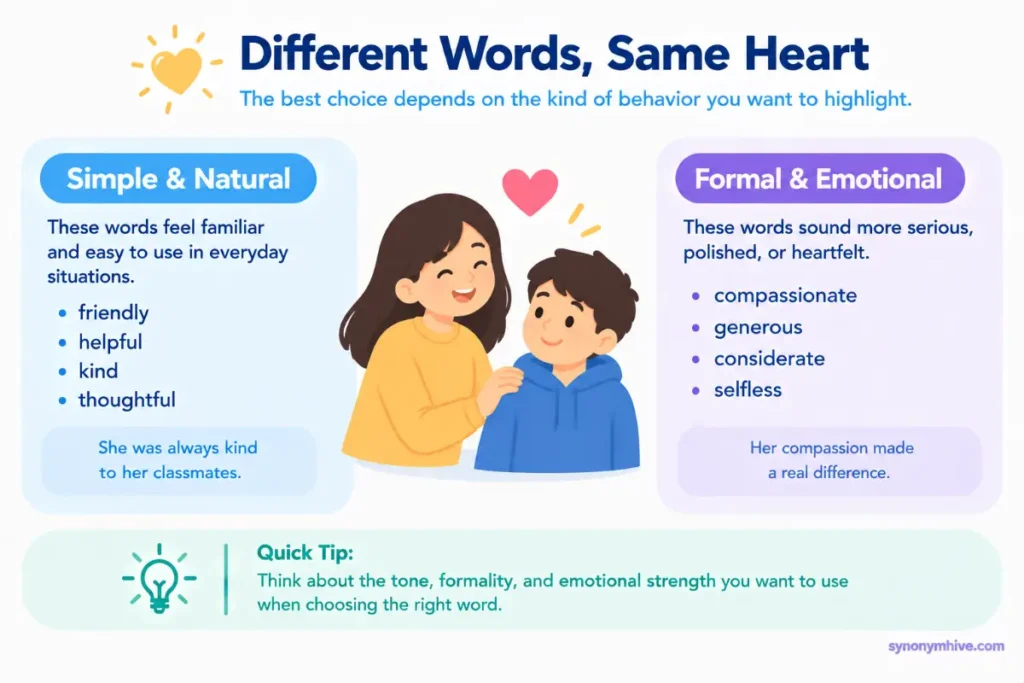
The best choice depends on the kind of behavior you want to highlight. Some words are simple and natural, while others sound more formal or emotional.
| Word | Meaning | Tone | Example |
|---|---|---|---|
| Nice | Pleasant and friendly | Simple | She was nice to the new student. |
| Gentle | Calm, soft, and careful | Everyday | He gave the child a gentle reply. |
| Helpful | Willing to give assistance | Everyday | Maria is helpful when someone needs support. |
| Benevolent | Wanting to do good for others | Formal | The organization was founded by a benevolent donor. |
| Altruistic | Acting mainly to help others | Formal | His altruistic work benefited many families. |
| Bighearted | Very generous and caring | Warm | She is a bighearted person who helps quietly. |
| Sweet | Pleasant, caring, and affectionate | Casual | That was such a sweet gesture. |
| Loving | Showing strong affection and care | Emotional | His loving support helped her recover. |
| Nurturing | Helping others grow or feel safe | Everyday | She has a nurturing way of teaching children. |
| Encouraging | Giving hope or confidence | Everyday | His encouraging words helped me keep going. |
| Accommodating | Willing to adjust to another person’s needs | Formal | The host was accommodating and helpful. |
| Merciful | Showing forgiveness or compassion | Formal | The judge was merciful in his decision. |
| Courteous | Polite and respectful | Formal | The staff remained courteous throughout the visit. |
| Humane | Showing concern for human welfare | Formal | The shelter provides humane care for animals. |
| Goodhearted | Naturally kind and caring | Warm | Everyone knew him as a goodhearted neighbor. |
This list gives you more than one way to say kind. The differences matter because each word points to a slightly different quality.
For example, generous focuses on giving. Patient focuses on calm behavior. Compassionate focuses on concern for suffering. Thoughtful focuses on noticing what someone needs. Selfless suggests that a person puts others before themselves.
Which Words Show Different Levels of Kindness?
Not every kind action has the same emotional strength. You may need a mild word for a small friendly gesture or a stronger word for someone who gives up a great deal to help another person.
Mild Kindness
Use these words for everyday positive behavior.
- Nice.
- Friendly.
- Pleasant.
- Polite.
- Courteous.
- Helpful.
- Gentle.
For example, you might say, “The receptionist was friendly and helpful.” There is no strong emotional claim in that sentence. It simply tells the reader that the person treated others well.
Moderate Kindness
These words suggest a deeper level of care.
- Caring.
- Thoughtful.
- Supportive.
- Considerate.
- Patient.
- Understanding.
- Warm.
- Encouraging.
- Nurturing.
- Respectful.
These choices work well when describing a friend, teacher, parent, manager, coworker, or community member.
Strong Kindness
These words suggest a powerful or lasting form of care.
- Compassionate.
- Selfless.
- Altruistic.
- Benevolent.
- Bighearted.
- Generous.
- Loving.
- Merciful.
- Charitable.
A strong word should match the action. Calling someone selfless makes a bigger claim than calling them helpful. Use it when the person clearly puts another person’s needs before their own.
Which Words Describe Different Types of Kindness?
Kindness is not one single behavior. The right word can show exactly what a person does for others.
Words for Emotional Kindness
Use compassionate, empathetic, understanding, caring, loving, and tender when the person responds to emotions or pain.
For example, a friend who listens after a breakup may be described as compassionate and understanding. A parent who comforts a frightened child may be described as tender and caring.
Words for Helpful Kindness
Use helpful, supportive, accommodating, dependable, considerate, and encouraging when the person takes action.
A coworker who stays late to help you finish a project is supportive. Someone who changes their schedule to help you may be accommodating.
Words for Generous Kindness
Use generous, giving, charitable, selfless, and bighearted when the person gives time, money, resources, or effort.
A volunteer who spends every weekend helping at a food bank may be described as generous or selfless.
Words for Gentle Kindness
Use gentle, patient, warm, tender, respectful, and gracious when the kindness comes through a person’s manner.
A teacher who corrects a student without embarrassing them may be gentle and respectful.
Which Part of Speech Should You Use?
Most descriptions of a kind person use adjectives because adjectives describe people, actions, or qualities.
For example:
“She is compassionate.”
“He is generous.”
“They are thoughtful.”
You can also use nouns when you want to name the quality itself.
Examples include kindness, compassion, generosity, patience, empathy, warmth, and consideration.
Verbs can describe the action that shows kindness.
Examples include help, support, comfort, encourage, assist, forgive, listen, share, and care.
Adverbs can explain how the action happens.
Examples include kindly, gently, patiently, generously, thoughtfully, and compassionately.
This gives you several ways to build a sentence. Instead of saying, “She is kind,” you could write, “She patiently listened to everyone and offered thoughtful advice.”
The second sentence gives the reader evidence. That usually makes a description stronger.
What Is the Difference Between Kind and Nice?
Kind and nice are close, but they are not exactly the same.
Nice is a broad word for pleasant behavior. It can describe someone who is friendly, polite, or enjoyable to be around. It does not always suggest deep concern for another person.
Kind usually carries a stronger sense of care or helpful action.
| Kind | Nice |
|---|---|
| Often shows care or concern | Often describes pleasant behavior |
| Can involve helping someone | Can simply mean friendly or polite |
| More specific emotionally | Broader and more general |
| Works well in serious descriptions | Common in casual speech |
Compare these sentences.
“She was nice to me at lunch.”
“She was kind enough to stay after lunch and help me finish my project.”
The second sentence gives a clear action. It shows why the person deserves the word kind.
That does not make nice a bad word. It simply makes it less specific.
What Is the Difference Between Kind and Compassionate?
Compassionate is more specific than kind. It usually involves concern for someone who is suffering, struggling, or facing a difficult situation.
A person can be kind by holding a door open. A person can be compassionate by sitting with a grieving friend and offering comfort.
| Kind | Compassionate |
|---|---|
| Broad positive quality | Focuses on suffering or hardship |
| Can describe small actions | Often describes deeper emotional care |
| Common in everyday speech | More formal or serious |
| Works in many situations | Best for emotional or difficult situations |
For example:
“Sarah is kind to her coworkers.”
“Sarah is compassionate toward coworkers who are going through difficult times.”
The first sentence gives a general description. The second tells you more about the kind of care Sarah provides.
What Is the Difference Between Generous and Selfless?
Generous means willing to give. Selfless means putting another person’s needs before your own.
Someone can be generous with money, time, advice, food, or attention. Selfless usually suggests a greater personal sacrifice.
Consider these examples.
“David is generous with his time.”
“David made a selfless choice and gave up his weekend to care for his sick neighbor.”
The first sentence shows giving. The second suggests personal sacrifice.
Use generous when you want to highlight what someone gives. Use selfless when you want to highlight the fact that they put another person first.
What Are the Best Words to Describe Kindness in a Resume?
A resume should use clear, professional words. Avoid vague praise such as nice or sweet because those words do not show a workplace skill very well.
Good choices include:
- Compassionate.
- Supportive.
- Considerate.
- Empathetic.
- Collaborative.
- Patient.
- Respectful.
- Helpful.
- Dependable.
- Accommodating.
Instead of writing:
“I am a nice person.”
Try:
“I am a supportive team member who listens carefully and helps coworkers solve problems.”
That sentence connects a personal quality to workplace behavior.
Another option is:
“Known for a patient and respectful approach when working with customers.”
The best resume descriptions show the behavior behind the quality. A hiring manager learns more from a real action than from a list of positive adjectives.
What Are the Best Terms to Describe Kindness in an Essay?
An essay gives you more room to be precise. Choose a word based on the person’s actions and the point you are making.
For someone who makes others feel safe, use warm or nurturing.
For example:
“Mrs. Carter was a compassionate teacher who noticed when students were struggling and quietly offered help.”
That sentence does more than call her kind. It gives the reader a reason for the description.
In literary writing, you can also combine two related words.
“The character is gentle but strong, showing compassion without asking for praise.”
This creates a fuller picture without repeating the same adjective.
What Are the Best Words to Describe Kindness in a Text?
Text messages usually need natural, casual language. Sweet, caring, thoughtful, kind, supportive, and bighearted can work well.
Examples include:
“That was really thoughtful of you.”
“You are such a caring friend.”
“That was so kind of you.”
“You’re seriously the sweetest.”
“Thanks for being so supportive.”
The best choice depends on your relationship with the person. Sweet may sound warm and personal. Supportive sounds more serious. Thoughtful focuses on the care behind an action.
What Are the Best Terms to Describe Kindness in an Email?
Professional emails need polite and clear language. Considerate, helpful, thoughtful, generous, supportive, and gracious are useful choices.
For example:
“Thank you for your thoughtful response.”
“I appreciate your generous offer to help.”
“Your support during the project was incredibly helpful.”
“Thank you for being so considerate of my schedule.”
These phrases sound natural without becoming overly emotional.
A professional email usually works better when you describe the action instead of making a large personal claim. “Thank you for your thoughtful feedback” is often stronger than “You are an extremely kind person.”
What Are the Best Words to Describe Kindness When Speaking?
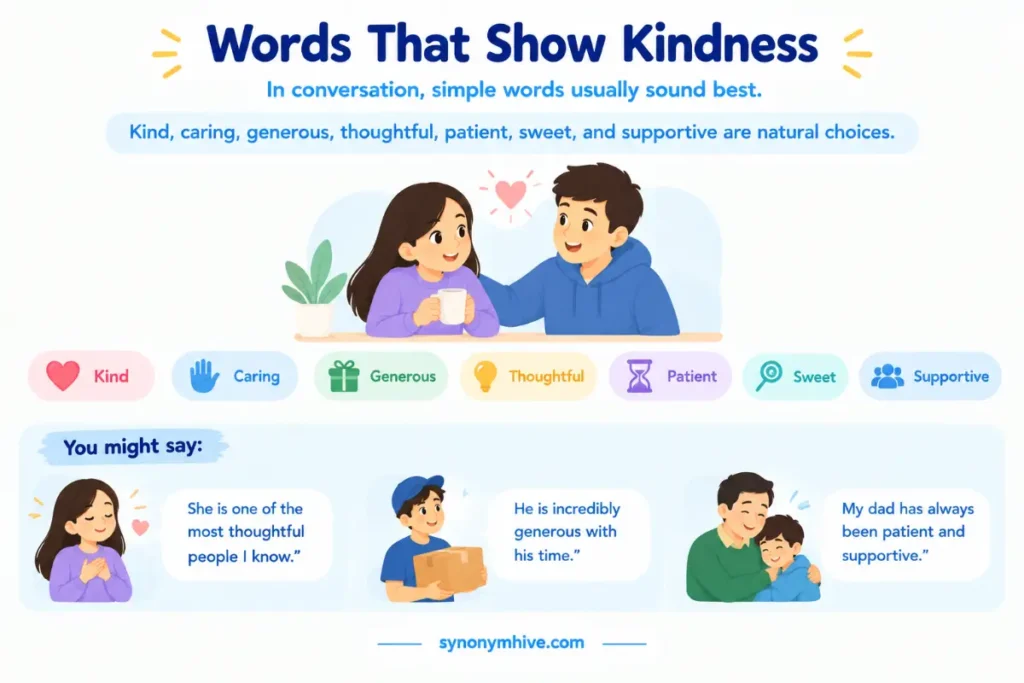
In conversation, simple words usually sound best. Kind, caring, generous, thoughtful, patient, sweet, and supportive are natural choices.
You might say:
“She is one of the most thoughtful people I know.”
“He is incredibly generous with his time.”
“My dad has always been patient and supportive.”
“That was such a kind thing to do.”
Speaking does not require complicated vocabulary. A clear word used naturally is better than an impressive word that sounds forced.
How Can You Describe Kindness Without Using the Word Kind?
You can describe the action instead of naming the quality.
Instead of:
“She was kind to me.”
Try:
“She stayed with me until I felt better.”
Instead of:
“He is kind to his coworkers.”
Try:
“He always notices when someone needs help.”
Instead of:
“Maria is kind and caring.”
Try:
“Maria listens without judging and offers help when people need it.”
This method makes your writing stronger because readers can see the behavior for themselves.
Check out more vocabulary ideas in Words to Describe Joy Best Guide In 2026.
What Are Some Natural Examples of Kindness?
Here are examples that show different types of caring behavior.
- The teacher stayed after class to explain the lesson again to a student who was confused.
- My neighbor brought dinner to our family when my mother was sick.
- James noticed that his coworker was overwhelmed and offered to handle part of the workload.
- Sarah listened quietly while her friend talked about a difficult problem.
- The older student helped the new student find the right classroom.
- My grandmother always made visitors feel welcome and comfortable.
- The manager gave the employee extra time to finish the task after learning about the problem at home.
- Daniel shared his lunch with a classmate who had forgotten theirs.
- The nurse spoke gently to the nervous child before the procedure.
- Maria thanked the cleaning staff and treated them with the same respect she showed everyone else.
- The volunteer spent Saturday helping families receive food and supplies.
- My friend checked on me the next day because she remembered that I had been worried.
- The coach encouraged the player after a poor performance instead of embarrassing him.
- The librarian helped an elderly visitor find books in large print.
- The student apologized sincerely after realizing that his words had hurt someone.
Notice that these examples do not all use the word kind. The actions themselves communicate kindness.
How Do You Choose the Right Word for a Kind Person?
Start with the action. Ask what the person actually did.
If they gave something, consider generous or giving.
If they helped someone through pain, consider compassionate.
This simple approach prevents vague descriptions. Instead of searching for the strongest word, search for the most accurate word.
What Are Common Mistakes When Describing Kindness?
One common mistake is using nice for every situation. Nice is correct, but it is broad. If you know the exact quality, a more specific word can make your writing clearer.
Another mistake is using selfless too freely. Selfless suggests that someone gives up something or puts another person first. A person who simply holds a door open is helpful or courteous, but calling that action selfless may sound exaggerated.
Using compassionate for every kind action can also miss the mark. Compassion is closely tied to concern for suffering. It is not the best word for every friendly gesture.
Some writers also confuse empathetic with sympathetic. Empathy involves understanding or sharing another person’s emotional experience. Sympathy means feeling concern or sorrow for someone. The two can overlap, but they are not identical.
Finally, avoid stacking too many similar adjectives.
“She is kind, caring, compassionate, thoughtful, generous, warm, loving, and supportive.”
That sentence sounds crowded. Choose two or three strong words and show the behavior that supports them.
Which Words Should You Avoid in Formal Writing?
Some casual terms are fine in texts but may sound too informal in academic or professional writing.
Sweet is warm and natural in conversation, but it may not fit a formal report.
Awesome is positive, but it does not explain a person’s character.
Nice is acceptable, but it may be too general for a detailed essay.
Super kind can work in casual speech, but compassionate, considerate, or generous may be stronger in formal writing.
The goal is not to use the biggest word. The goal is to use the clearest word for the situation.
What Are the Antonyms of Kindness?
Antonyms are words with opposite or contrasting meanings.
Common opposites of kindness include:
- Cruelty.
- Harshness.
- Selfishness.
- Unkindness.
- Meanness.
- Rudeness.
- Hostility.
- Indifference.
- Callousness.
- Insensitivity.
These words describe different forms of negative behavior.
Cruel describes causing pain or suffering. Rude describes a lack of politeness. Selfish describes putting your own needs first. Callous describes a lack of concern for other people’s feelings.
Choosing the right opposite works the same way as choosing the right positive word. Think about the exact behavior first.
Are There Regional Differences in Kindness Vocabulary?
The basic vocabulary is very similar across American and British English. Words such as kind, caring, generous, thoughtful, compassionate, friendly, and considerate are common in both varieties.
Some casual expressions can differ by region, but the main descriptive words are widely understood.
In American English, nice, sweet, caring, and kind are common in everyday speech.
British English also uses kind and nice very often, along with words such as thoughtful, considerate, generous, and lovely. Lovely can sometimes describe a person in a warm way, although its meaning depends heavily on context.
You generally do not need to change your vocabulary just because your audience is from the United States or the United Kingdom. Standard words such as kind, thoughtful, generous, and compassionate work well across English speaking regions.
What Are Some Better Alternatives to Nice?
If nice feels too basic, choose a word based on the quality you want to show.
| If you mean | Try |
|---|---|
| Friendly behavior | Friendly |
| Care for others | Caring |
| Giving time or money | Generous |
| Noticing small needs | Thoughtful |
| Understanding feelings | Empathetic |
| Concern for suffering | Compassionate |
| Staying calm | Patient |
| Helping someone | Helpful |
| Giving encouragement | Supportive |
| Putting others first | Selfless |
| Making people feel welcome | Warm |
| Treating people carefully | Considerate |
This makes your writing more precise without making it harder to read.
How Can You Describe Kindness in One Strong Sentence?
A strong sentence usually combines a descriptive word with evidence.
“She is compassionate and always makes time for people who are struggling.”
“He is generous with his time and never makes others feel like a burden.”
“Her thoughtful nature shows in the small details she remembers about her friends.”
“His patient approach helps nervous students feel safe asking questions.”
“She is supportive, especially when someone needs honest advice.”
These examples work because the adjective has a clear reason behind it.
What Are the Best Words for a Kind Friend?
For a friend, caring, loyal, thoughtful, supportive, understanding, dependable, generous, warm, and compassionate are useful choices.
You can make the description more personal by explaining what the friend does.
“She is thoughtful because she remembers the little things that matter to me.”
“He is supportive and always listens before giving advice.”
“She is generous with her time and never makes me feel bad for asking for help.”
A friendship description becomes stronger when the reader can picture the behavior.
What Are the Best Words for a Kind Teacher?
A teacher can be described as patient, encouraging, supportive, understanding, compassionate, respectful, caring, or nurturing.
The best choice depends on the teacher’s behavior.
A teacher who notices emotional struggles is compassionate.
A teacher who helps students develop over time may be described as nurturing.
For an essay, combine the word with an example.
“Ms. Lee is an encouraging teacher who reminds students that mistakes are part of learning.”
What Are the Best Words for a Kind Leader?
A kind leader may be supportive, considerate, empathetic, fair, respectful, understanding, or compassionate.
Leadership adds another layer to the description. The person is not only kind in personal relationships but also has an effect on a group.
For example:
“Her considerate leadership helps employees feel heard.”
“He is a supportive manager who gives clear feedback without putting people down.”
“The director is empathetic when employees face personal difficulties.”
These descriptions connect kindness to leadership skills instead of making a general personal claim.
How Can You Make a Kindness Description More Specific?
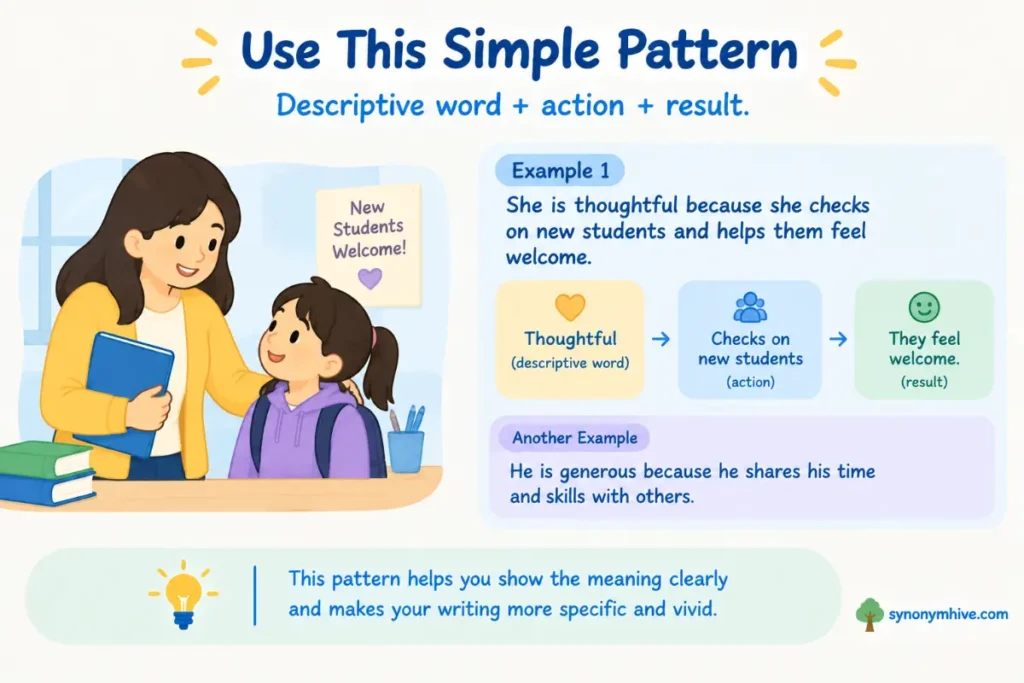
Use this simple pattern:
Descriptive word + action + result.
For example:
“She is thoughtful because she checks on new students and helps them feel welcome.”
The word is thoughtful. The action is checking on new students. The result is that they feel welcome.
Another example is:
“He is patient when teaching beginners, which helps them feel comfortable asking questions.”
This pattern works in essays, resumes, personal statements, recommendation letters, and speeches.
You can also use:
Quality + specific example.
“His generosity was clear when he donated his weekend to help the community center.”
This method gives your writing more detail without making it complicated.
Quick Tips for Choosing the Right Word
Use these tips when you are stuck.
- Think about the action first, not the adjective.
- Use kind for a broad description.
- Use thoughtful when someone notices small needs.
- Use generous when someone gives freely.
- Use compassionate when someone responds to suffering.
- Use empathetic when someone understands another person’s feelings.
- Use patient when someone stays calm while helping others.
- Use supportive when someone provides encouragement or practical help.
- Use considerate when someone thinks about how their actions affect others.
- Use selfless when someone puts another person’s needs before their own.
- Use warm when someone creates a friendly and welcoming atmosphere.
- Use gentle when the person’s manner is calm, soft, or careful.
- Use formal vocabulary in professional or academic writing when it improves precision.
- Use simple vocabulary in texts and everyday conversations.
- Support a strong adjective with an example whenever possible.
The strongest description is not always the most dramatic one. Accuracy matters more than intensity.
Why Specific Word Choice Makes Your Writing Stronger
Good word choice helps readers build a clear picture.
Compare these two sentences:
“Tom is a nice person.”
“Tom is a thoughtful friend who remembers when people have important events and checks in afterward.”
The first sentence is positive but general. The second gives evidence.
That difference matters in school writing. Teachers usually want more than a string of positive adjectives. They want details that support your point.
The same idea applies to professional writing. Instead of saying that a coworker is kind, explain how they work with people.
“She is a considerate team member who listens carefully and makes sure quieter coworkers have a chance to speak.”
Now the reader knows what considerate means in that situation.
Specific language also makes personal writing sound more genuine. Instead of trying to make someone sound perfect, describe the small actions that reveal their character.
Find more synonyms in words to describe success Best Guide in 2026.
Conclusion
Choosing the right words to describe kindness starts with identifying the behavior behind the quality. A person who gives freely may be generous. Someone who understands another person’s pain may be compassionate. A person who notices small needs may be thoughtful, while someone who puts others first may be selfless.
You do not need complicated vocabulary to make a description strong. Simple words such as caring, patient, supportive, and considerate can say a lot when they match the situation.
The best descriptions also give readers evidence. Instead of saying someone is kind, explain what they did and how it helped. That small change can make an essay, email, resume, recommendation, or personal message much more vivid.
When you need the right word, start with the action. Then choose the adjective that explains it most clearly. That approach will help you describe people with accuracy, warmth, and confidence.
Frequently Asked Questions
What are the best words to describe kindness?
The best words include kind, caring, thoughtful, generous, compassionate, considerate, empathetic, patient, supportive, gentle, selfless, and warm. The right choice depends on the type of behavior you want to describe.
What’s another way to say someone is kind?
You can say someone is caring, thoughtful, generous, compassionate, considerate, supportive, or warm. Choose the word that matches what the person actually does.
What is a stronger word for kind?
Compassionate, selfless, generous, benevolent, and altruistic can sound stronger than kind. Each one has a different meaning, so use the word that best matches the person’s actions.
What words describe a kind person in an essay?
Useful choices include compassionate, considerate, generous, empathetic, thoughtful, patient, supportive, and selfless. Add a specific example to show why the person deserves that description.
What is a good word for a kind and caring person?
Caring, compassionate, warmhearted, thoughtful, or goodhearted can describe someone who regularly treats others with care. Compassionate is especially useful when the person responds to someone who is suffering.
What are some words to describe kindness in a resume?
Professional choices include supportive, empathetic, considerate, patient, collaborative, respectful, and accommodating. Connect the quality to a workplace action instead of simply listing the adjective.
What is the difference between kind and compassionate?
Kind is a broad word for caring or helpful behavior, while compassionate usually focuses on concern for someone who is suffering or facing hardship. A compassionate person is kind, but a kind action does not always involve suffering.