

Writing a resume, finishing an essay, or sending a work email can leave you with a simple problem: how do you describe success without using the same word again and again? The right words to describe success can show what happened, how well it happened, and why the result mattered.
Success can mean many things. You might want to describe a small personal win, a major career achievement, a strong business result, or years of steady progress. Each situation calls for a slightly different word.
The best words to describe success include accomplished, successful, thriving, victorious, prosperous, effective, outstanding, impressive, remarkable, and accomplished. The strongest choice depends on the result you want to describe and the tone you need.
This guide explains the meaning behind these words, groups useful choices by tone and strength, and shows how to use them in resumes, essays, emails, texts, and everyday speech. You’ll also see examples and clear comparisons so you can pick a word that fits instead of simply choosing the biggest sounding word.
Discover another helpful synonym list in Words to Describe a Voice: Words for Every Voice 2026.
What does success mean in simple English?
Success means reaching a goal, getting a desired result, or doing something well. It can describe an achievement, a positive outcome, personal progress, financial growth, or a goal that has been completed.
The word success comes from the Latin word successus, meaning an advance, good result, or favorable outcome. It entered English through Old French and Middle English forms related to the idea of following after or coming next.
That history helps explain why success is not limited to winning. A successful result can come from steady effort, good planning, skill, or persistence. Someone can succeed by finishing a difficult project, improving a skill, helping a team, or reaching a personal goal.
What are the best words to describe success?
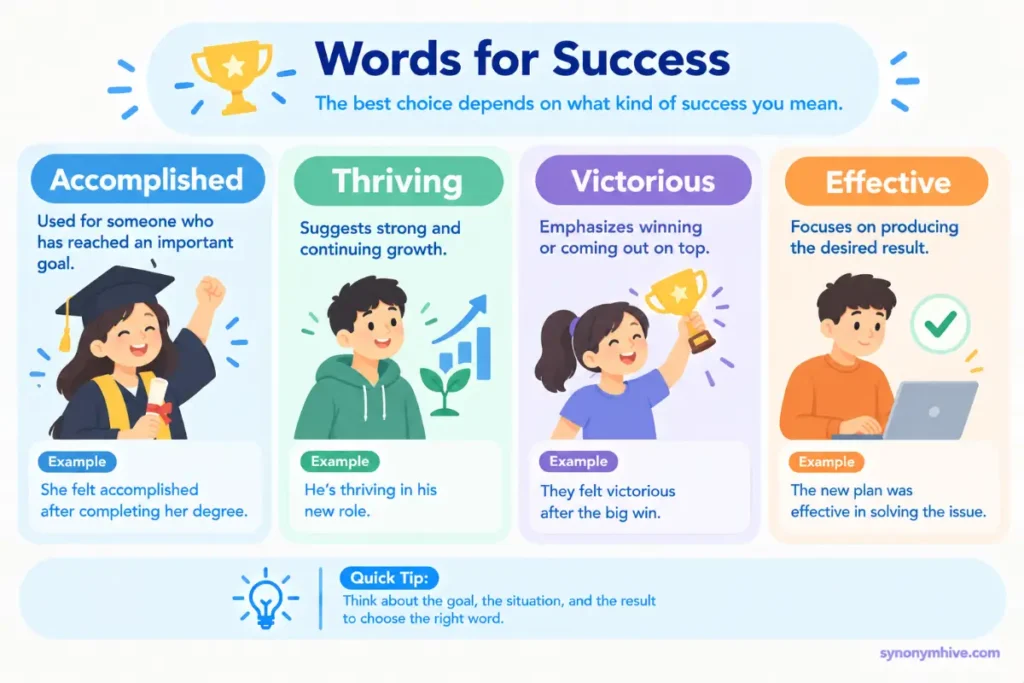
The best choice depends on what kind of success you mean. Accomplished works well for a person who has reached an important goal. Thriving suggests strong and continuing growth. Victorious emphasizes winning. Effective focuses on producing the desired result.
Here is a broad list of useful options.
| Word | Meaning | Tone | Example |
|---|---|---|---|
| Accomplished | Having achieved a goal | Positive | She is an accomplished writer. |
| Successful | Achieving a desired result | Neutral | The campaign was successful. |
| Successful | Producing a good result | Neutral | Their launch was successful. |
| Fruitful | Producing useful results | Formal | The meeting was fruitful. |
| Productive | Producing a useful amount of work | Professional | It was a productive quarter. |
| Rewarding | Providing value or satisfaction | Warm | Teaching has been rewarding. |
| Satisfying | Giving a sense of fulfillment | Personal | Completing the course was satisfying. |
| Effective | Working as intended | Professional | The new plan was effective. |
| Accomplished | Skilled and successful | Professional | She is an accomplished leader. |
| Advancing | Moving toward a better position | Neutral | His career is advancing quickly. |
| Flourishing | Growing strongly and successfully | Formal | The arts community is flourishing. |
| Booming | Growing very quickly | Casual | The local market is booming. |
| Winning | Showing strong performance or success | Casual | They have a winning strategy. |
| Stellar | Extremely good | Casual | She had a stellar performance. |
| Superb | Excellent | Positive | The project produced superb results. |
| Triumphant | Showing great success after difficulty | Strong | The team made a triumphant return. |
| Celebrated | Widely admired or respected | Formal | He became a celebrated author. |
| Distinguished | Respected because of achievements | Formal | She had a distinguished career. |
| Notable | Worth attention or recognition | Formal | He made a notable contribution. |
| Proven | Shown to work successfully | Professional | She has a proven record of success. |
| Goal oriented | Focused on reaching goals | Professional | He is a goal oriented manager. |
This list gives you choices for many situations. A resume may need precise and professional language. A text to a friend can sound much more relaxed.
Which words describe success from mild to strong?
Not every success needs a powerful word. Sometimes a simple term is more accurate.
A mild success may be described as satisfactory, positive, useful, productive, or encouraging. These words work when the result was good but not extraordinary.
For a clear and solid result, use successful, effective, accomplished, rewarding, productive, or impressive. These choices show that something went well without making the result sound dramatic.
For major success, stronger words include exceptional, outstanding, remarkable, triumphant, victorious, distinguished, and extraordinary. These words suggest a result that stands above normal expectations.
Consider these levels.
| Strength | Useful words | Best use |
|---|---|---|
| Mild | Positive, useful, satisfactory, encouraging | Small wins and early progress |
| Moderate | Successful, effective, productive, rewarding | Clear positive results |
| Strong | Impressive, notable, accomplished, excellent | Important achievements |
| Very strong | Outstanding, exceptional, remarkable, triumphant | Major achievements |
| Winning | Victorious, champion, triumphant, undefeated | Competitions and contests |
The strength of a word should match the result. Calling a routine task extraordinary can make your writing sound exaggerated. A strong word works best when the achievement supports it.
What are the parts of speech for success words?
Many words connected to success can work as adjectives, nouns, verbs, or adverbs. Knowing the difference helps you build cleaner sentences.
Adjectives
Adjectives describe a person, project, result, career, or event.
Examples include successful, accomplished, effective, impressive, remarkable, exceptional, productive, prosperous, and victorious.
You can write:
She is an accomplished manager.
The campaign was highly successful.
They delivered an impressive result.
Nouns
Nouns name the achievement or result itself.
Useful nouns include achievement, accomplishment, victory, triumph, progress, breakthrough, milestone, growth, success, and advancement.
For example:
The promotion was a major achievement.
The team celebrated its victory.
Finishing the program was an important milestone.
Verbs
Verbs describe the action of reaching a goal or producing a good result.
Common choices include achieve, accomplish, succeed, win, advance, improve, grow, prosper, excel, and complete.
For example:
She achieved her sales goal.
He excelled in the final round.
The company grew rapidly.
Adverbs
Adverbs explain how something was done.
Useful choices include successfully, effectively, exceptionally, efficiently, brilliantly, consistently, and skillfully.
For example:
The team successfully completed the project.
She handled the situation effectively.
He consistently performed at a high level.
Choosing the right form keeps your sentence natural. Instead of writing that someone is success, write that the person is successful. Instead of saying someone had a successful, use a noun such as achievement or victory.
What are the best words to describe success on a resume?
For a resume, choose words that connect success to action and results. Employers usually learn more from a specific achievement than from a general claim that you were successful.
Words such as accomplished, proven, effective, productive, efficient, results driven, recognized, and high performing can work well in professional writing.
For example:
She is an accomplished project manager with experience leading large teams.
He has a proven record of improving customer retention.
The sales team delivered exceptional results during the fourth quarter.
Maya developed an effective training program that reduced onboarding time.
A strong resume also gives evidence. Instead of saying, “I was successful at increasing sales,” write, “I increased annual sales by 18 percent.” The number gives the reader something concrete.
The word accomplished can describe a person who has reached meaningful goals. Proven works well when you want to show that a skill or method has already produced results. Effective is useful when the focus is on how well an action worked.
Best resume words for major achievements
Use accomplished when describing a person with a record of meaningful achievements.
Use exceptional when the performance was clearly above normal expectations.
A resume should not sound like a list of compliments. Specific verbs and facts usually make a stronger impression than a long string of positive adjectives.
What are the best words to describe success in an essay?
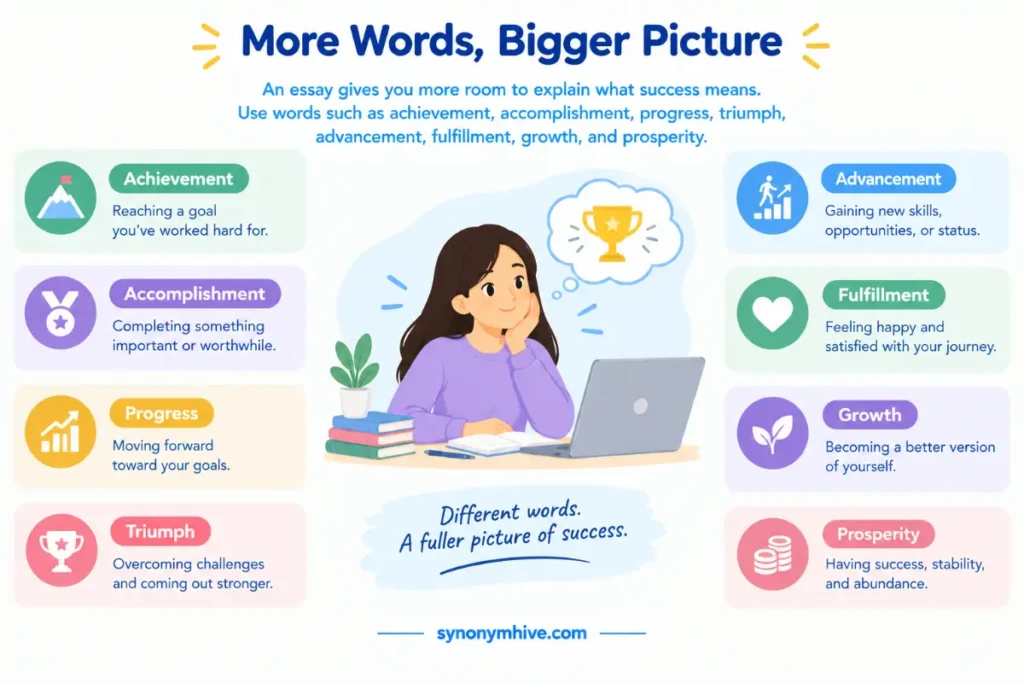
An essay gives you more room to explain what success means. You can use words such as achievement, accomplishment, progress, triumph, advancement, fulfillment, growth, and prosperity.
For example:
Her success came from years of steady practice.
The achievement changed how he viewed failure.
The team’s progress showed that patience can lead to strong results.
The athlete’s triumph was especially meaningful because of the setbacks she had faced.
Academic writing often benefits from precise language. If you mean that someone reached a goal, use achieved or accomplished. If you mean that someone won a contest, use victorious or triumphant.
This difference matters because similar words do not always carry the same meaning.
What are the best words to describe success in an email?
Professional emails usually work best with clear and polite words. Successful, positive, impressive, excellent, strong, effective, and productive are useful choices.
For example:
The launch was highly successful, and the team handled the process well.
We had a productive meeting and agreed on the next steps.
Your presentation was impressive and clearly explained the main findings.
The project produced excellent results.
You can also describe someone else’s achievement without sounding overly dramatic.
Congratulations on this impressive achievement.
Your team delivered a strong result under a tight deadline.
Thank you for your effective work on this project.
A simple word often sounds more sincere than an exaggerated one. If a project went well, successful may be enough.
What are the best words to describe success in a text?
Texts are usually less formal, so you can use shorter and more relaxed words. Great, awesome, amazing, impressive, huge, winning, and stellar can work depending on the relationship.
For example:
That was a huge win.
You absolutely nailed it.
Your presentation was amazing.
That’s a stellar result.
You crushed the interview.
The last example is informal. It works well in a text to a friend but would usually sound too casual in a formal email.
Slang can make a message warmer and more natural, but it also depends on the person receiving it. A phrase that sounds friendly in one conversation may sound too casual in another.
What are the best words to describe success when speaking?
In everyday speech, simple words usually sound best. Successful, great, impressive, amazing, accomplished, proud, rewarding, and exciting are easy to understand.
You might say:
She’s had a very successful career.
That was an impressive performance.
Finishing the race was a huge achievement.
He’s proud of what he accomplished.
The experience was really rewarding.
Speaking gives you more freedom to use tone and emphasis. A short phrase such as “That was a huge win” can communicate excitement without needing a formal word such as triumphant.
What are 10 examples of describing success?
The best way to understand these terms is to see them in real sentences. The examples below cover work, school, sports, business, personal goals, and everyday situations.
- After years of practice, she became an accomplished pianist.
- The new marketing plan was successful and brought in more customers.
- His performance was outstanding, especially under pressure.
- The small business is thriving after two years of steady growth.
- Winning the scholarship was a major achievement for the student.
- The team enjoyed a triumphant finish after a difficult season.
- Her training program was highly effective and easy for new employees to follow.
- Completing the marathon was a rewarding personal accomplishment.
- The company had a prosperous year after expanding into new markets.
- His steady progress showed that small steps can lead to major results.
- The students had a productive study session before the exam.
- Her remarkable improvement came from regular practice and careful feedback.
- The athlete was victorious after a close final match.
- The project was fruitful because it helped the team find several useful solutions.
- He built a distinguished career through years of service and strong leadership.
Notice that each word adds a slightly different idea. Successful gives a broad positive meaning. Thriving suggests continued growth. Victorious focuses on winning. Rewarding focuses on personal value or satisfaction.
What is the difference between successful and accomplished?
Successful and accomplished are close, but they do not focus on exactly the same thing.
Successful usually describes a good result. It can refer to a project, event, person, business, plan, or attempt.
Accomplished often describes a person who has achieved a high level of skill or has reached several important goals.
Compare these sentences:
The event was successful.
She is an accomplished surgeon.
The first sentence focuses on the event and its result. The second focuses on the person’s record, skill, and achievements.
You can also use accomplished for a completed task, but it is especially common when describing a person.
What is the difference between successful and effective?
Successful means something achieved the desired result. Effective means something worked well to produce that result.
A project can be successful because it met its goal. A method can be effective because it helped the team reach that goal.
For example:
The campaign was successful.
The new advertising strategy was effective.
The campaign describes the overall result. The strategy describes the method that produced the result.
This distinction is useful in professional writing. Effective often sounds more precise because it explains how something worked.
What is the difference between achievement and accomplishment?
Achievement and accomplishment are very close. Both can describe something important that a person has successfully completed or reached.
Achievement often highlights something earned through skill, effort, or ability. Accomplishment can have a similar meaning but often stresses the completion of a difficult goal.
For example:
Graduating from college was a major achievement.
Completing the research project was a personal accomplishment.
Both sentences are natural. The best choice depends on the exact tone and context.
What is the difference between victory and triumph?
Victory means winning, especially in a contest, competition, election, battle, or other direct challenge.
Triumph can also mean a win, but it often suggests a stronger emotional victory after difficulty.
For example:
The team celebrated its victory.
Her return to competition was a personal triumph.
The first sentence simply says the team won. The second suggests that the person overcame something difficult before succeeding.
Use victory when the fact of winning matters most. Use triumph when the struggle behind the success matters too.
Check out more vocabulary ideas in words to describe darkness Best Guide in 2026.
What is the difference between progress and success?
Progress means moving forward. Success means reaching a desired result or goal.
You can make progress without fully succeeding.
For example:
He has made great progress in learning Spanish.
She successfully passed the final exam.
The student may still have more to learn, so progress is the better word. Once the student reaches a clear goal, success may be the better choice.
This distinction is useful when describing long projects. Progress shows movement. Success shows an achieved result.
How do US and UK English differ when describing success?
Most common success words are the same in US and UK English. Words such as successful, accomplished, effective, outstanding, remarkable, achievement, victory, and progress work naturally in both forms of English.
Some related terms can vary in spelling or usage. For example, British English often uses “programme” where American English uses “program.” The core vocabulary for success remains largely shared.
The bigger difference is often tone rather than region. Words such as brilliant may be common in casual British speech when praising something, while American speakers may be more likely to say great, excellent, or amazing in the same situation.
Formal writing should focus on clarity rather than trying to sound distinctly American or British.
What words describe different kinds of success?
Success takes many forms, so the best description depends on the result.
Career success
Use accomplished, distinguished, respected, successful, established, influential, or high performing.
Example:
She built a distinguished career in public education.
Academic success
Use accomplished, outstanding, high achieving, excellent, successful, scholarly, or impressive.
Example:
The student achieved outstanding academic results.
Financial success
Use prosperous, profitable, thriving, growing, wealthy, financially secure, or lucrative.
Example:
The business became profitable within its first year.
Business success
Use successful, thriving, profitable, productive, effective, competitive, established, or growing.
Example:
The company has built a thriving customer base.
Sports success
Use victorious, winning, triumphant, dominant, accomplished, competitive, or undefeated.
Example:
The team finished the season undefeated.
Personal success
Use fulfilling, rewarding, meaningful, satisfying, accomplished, proud, or transformative.
Example:
Learning to play the guitar was a rewarding personal achievement.
Creative success
Use acclaimed, celebrated, recognized, accomplished, influential, original, or successful.
Example:
The artist became widely recognized for her work.
The word should match the kind of success. Profitable makes sense for a business. Victorious makes sense for a competition. Rewarding may fit a personal goal better than profitable.
What are the most useful synonyms by tone?
Tone changes the way a success word sounds.
Simple words
These are easy to understand and work in almost any setting.
Successful, good, effective, strong, positive, useful, productive, and accomplished.
Everyday words
These sound natural in conversation.
Great, amazing, impressive, excellent, winning, huge, rewarding, and exciting.
Formal words
These fit essays, reports, professional writing, and serious discussions.
Distinguished, prosperous, exceptional, notable, fruitful, accomplished, triumphant, and celebrated.
Informal words
These fit casual speech and texts.
Awesome, stellar, huge win, winning, nailed it, crushing it, and crushing the competition.
Informal expressions need care. They can make a message sound friendly, but they may not belong in a formal report or job application.
What words should you avoid when describing success?
Some words are not wrong, but they can become weak when used too often.
Amazing is common and can lose force if every achievement is amazing.
Great is useful but very broad. It tells the reader that something was good without explaining why.
Awesome is casual and may sound too informal in professional writing.
Perfect is very strong. Use it only when something truly had no meaningful flaws or when the context clearly supports the claim.
Best can also make a claim sound larger than the evidence supports. If you say someone delivered the best performance, readers may expect proof that no other performance was better.
Specific language often creates a stronger impression than exaggerated praise.
Instead of:
She had an amazing year.
Try:
She increased annual sales by 22 percent and led three major client projects.
The second sentence shows the achievement instead of simply praising it.
What are common mistakes when describing success?
One common mistake is choosing a word that does not match the type of achievement.
For example, victorious usually implies a contest or direct competition. It sounds strange to say, “The company was victorious after completing its annual report.” Successful or accomplished would fit better.
Another mistake is using too many strong adjectives at once.
“She had an incredible, amazing, outstanding, exceptional, remarkable career” sounds forced. One or two precise words are enough.
A third mistake is making vague claims without evidence. Saying “He was extremely successful” gives little information. Saying “He led the team to a 30 percent increase in sales” gives the reader a clear reason to see him as successful.
A fourth mistake is using casual slang in formal writing. Expressions such as nailed it and crushing it can work in a friendly message but usually do not belong in a formal resume.
A final mistake is treating all success as winning. Success can mean improvement, completion, growth, skill, service, satisfaction, or reaching a personal goal.
When should you not use the word successful?
Successful is useful, but it can be too general when a more exact word is available.
If something grew quickly, thriving or booming may be clearer.
If someone overcame a major challenge, triumphant may express more meaning.
The general word is still useful when you do not need to explain the exact kind of success.
For example:
The meeting was successful.
This works because the reader does not need to know exactly why it went well.
What are the antonyms of success words?
Antonyms describe failure, lack of progress, poor results, or an unfinished goal.
Common opposites include unsuccessful, ineffective, unproductive, disappointing, failed, defeated, stagnant, declining, struggling, and fruitless.
The best opposite depends on the original word.
Successful can contrast with unsuccessful.
Effective can contrast with ineffective.
Productive can contrast with unproductive.
Victorious can contrast with defeated.
Thriving can contrast with struggling.
Prosperous can contrast with struggling or declining.
For example:
The first plan was ineffective, but the revised plan worked well.
The team was defeated in the final round.
The business struggled during its first year.
Using the right antonym makes the comparison clearer.
How can you choose the right word for success?
Start by asking what actually happened.
Did the person reach a goal? Use accomplished or successful.
Did someone win a competition? Use victorious or triumphant.
Did something work as planned? Use effective.
Did a business grow strongly? Use thriving or prosperous.
Did someone improve over time? Use progressing, advancing, or improving.
Did the achievement provide personal value? Use rewarding or fulfilling.
Did the result stand far above normal expectations? Use exceptional or outstanding.
Did the achievement receive public praise? Use celebrated or recognized.
This simple test prevents many word choice problems.
Match the word to the evidence
Think about what you can prove.
If you have personal satisfaction, rewarding or fulfilling may fit.
If you have steady growth, thriving or flourishing may fit.
Good word choice does not mean choosing the most impressive word. It means choosing the most accurate one.
How can you make success sound more specific?
Add the reason behind the success.
Instead of saying:
She was successful.
Write:
She successfully led a team of twelve employees through a major software launch.
Instead of:
The business had a successful year.
Write:
The business increased revenue, added new customers, and opened two locations.
Instead of:
He had a successful presentation.
Write:
His presentation clearly explained the research and answered the audience’s main questions.
Specific details give the reader context. They also make your writing more believable.
What are some strong phrases for describing success?
You do not always need a single adjective. A short phrase can communicate the result more clearly.
Strong phrases include:
Achieved a major milestone.
Reached an important goal.
Delivered outstanding results.
Produced measurable improvements.
Built a strong track record.
Reached a new level of performance.
Made significant progress.
Earned widespread recognition.
Exceeded expectations.
Reached a record high.
Completed a difficult project.
Overcame a major challenge.
Built lasting success.
Created measurable value.
These phrases work especially well in professional writing because they connect success to an action or result.
How should you describe success without sounding boastful?
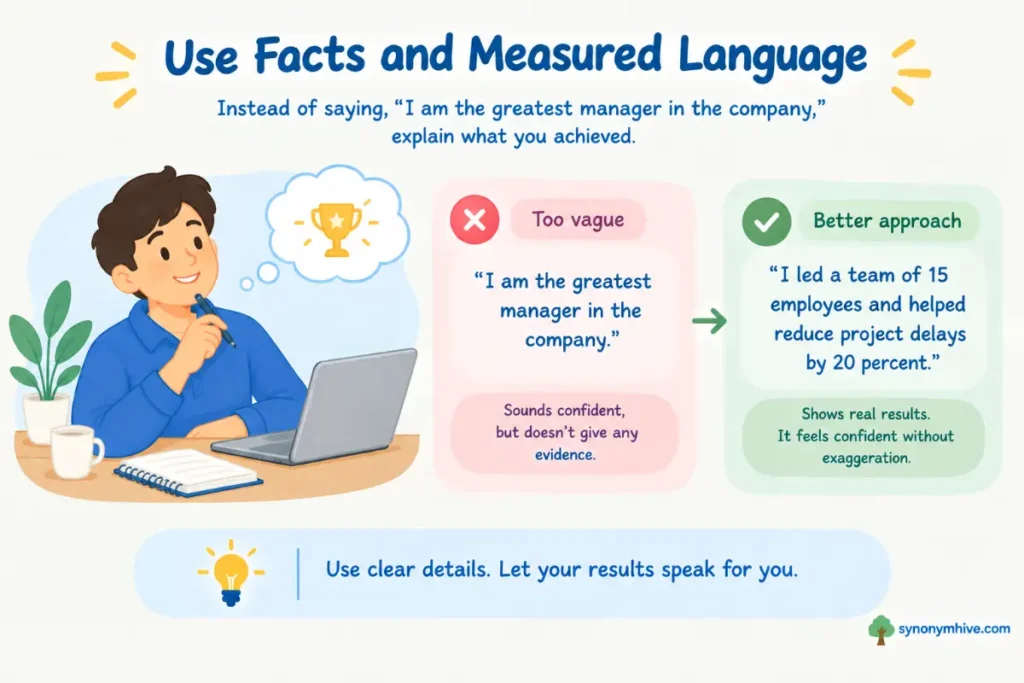
Use facts and measured language.
Instead of saying, “I am the greatest manager in the company,” explain what you achieved.
For example:
I led a team of 15 employees and helped reduce project delays by 20 percent.
This statement sounds confident because it gives evidence. It does not need exaggerated praise.
The same idea works in essays and personal statements. Let the result show the value of the achievement.
You can also use words such as effective, accomplished, consistent, productive, and proven. These terms sound confident without making an extreme claim.
Quick tips for choosing the right success word
- Match the word to the result.
- Use victorious for winning.
- Use effective for something that works.
- Use accomplished for a person with meaningful achievements.
- Use thriving for strong ongoing growth.
- Use prosperous for financial or material success.
- Use rewarding for personal value or satisfaction.
- Use exceptional for performance far above normal.
- Use remarkable for something unusually worthy of attention.
- Use proven when you can show that a skill or method has worked.
- Use specific numbers on resumes when possible.
- Avoid stacking too many praise words together.
- Choose simple language when the audience needs a quick answer.
- Use formal vocabulary only when the setting calls for it.
- Let evidence support strong claims.
The strongest writing often uses one clear word plus one specific fact. That combination tells the reader both what happened and why it matters.
Explore another synonym guide: Words to Describe Fear Best Guide In 2026.
Conclusion
Choosing the right words to describe success starts with identifying what kind of success you mean. A person can be accomplished, a plan can be effective, a business can be thriving, and a competitor can be victorious. These words overlap, but each one adds a different shade of meaning.
Simple words are often best when the point is clear. Stronger terms such as exceptional or remarkable work when the result truly stands out. In professional writing, specific facts can make your language much stronger than praise alone.
Before choosing a word, ask what happened, how strong the result was, and where you are using the sentence. Then pick the term that fits those three points.
The practical rule is simple: don’t search for the biggest word. Search for the most accurate word. When your language matches the achievement, your writing sounds confident, clear, and believable.
Frequently Asked Questions
What are good words to describe success?
Good choices include successful, accomplished, effective, impressive, outstanding, remarkable, thriving, prosperous, productive, and rewarding. The best word depends on the kind of achievement you want to describe.
What are the best words to describe success on a resume?
Use words such as accomplished, proven, effective, productive, recognized, exceptional, and results driven. Pair these terms with measurable results whenever possible.
What is a stronger word for successful?
Stronger choices include accomplished, outstanding, exceptional, remarkable, triumphant, and distinguished. Pick the word that matches the specific kind of success instead of simply choosing the strongest sounding term.
What’s another way to say successful?
You can say accomplished, effective, thriving, prosperous, productive, victorious, or successful depending on the context. For a person, accomplished may work better than effective. For a plan, effective is often more precise.
What words describe a person who has achieved a lot?
Accomplished, distinguished, successful, respected, celebrated, influential, and high achieving can describe someone with many achievements. Accomplished is one of the most useful general choices.
What is a good word for a successful result?
Effective, positive, impressive, excellent, outstanding, notable, or successful can describe a strong result. Effective is especially useful when the result came from a plan, method, or action.
How can I describe success without saying successful?
Use a more specific term such as accomplished, thriving, victorious, productive, prosperous, effective, or rewarding. You can also describe the actual result, such as “exceeded the goal” or “increased sales by 20 percent.”