
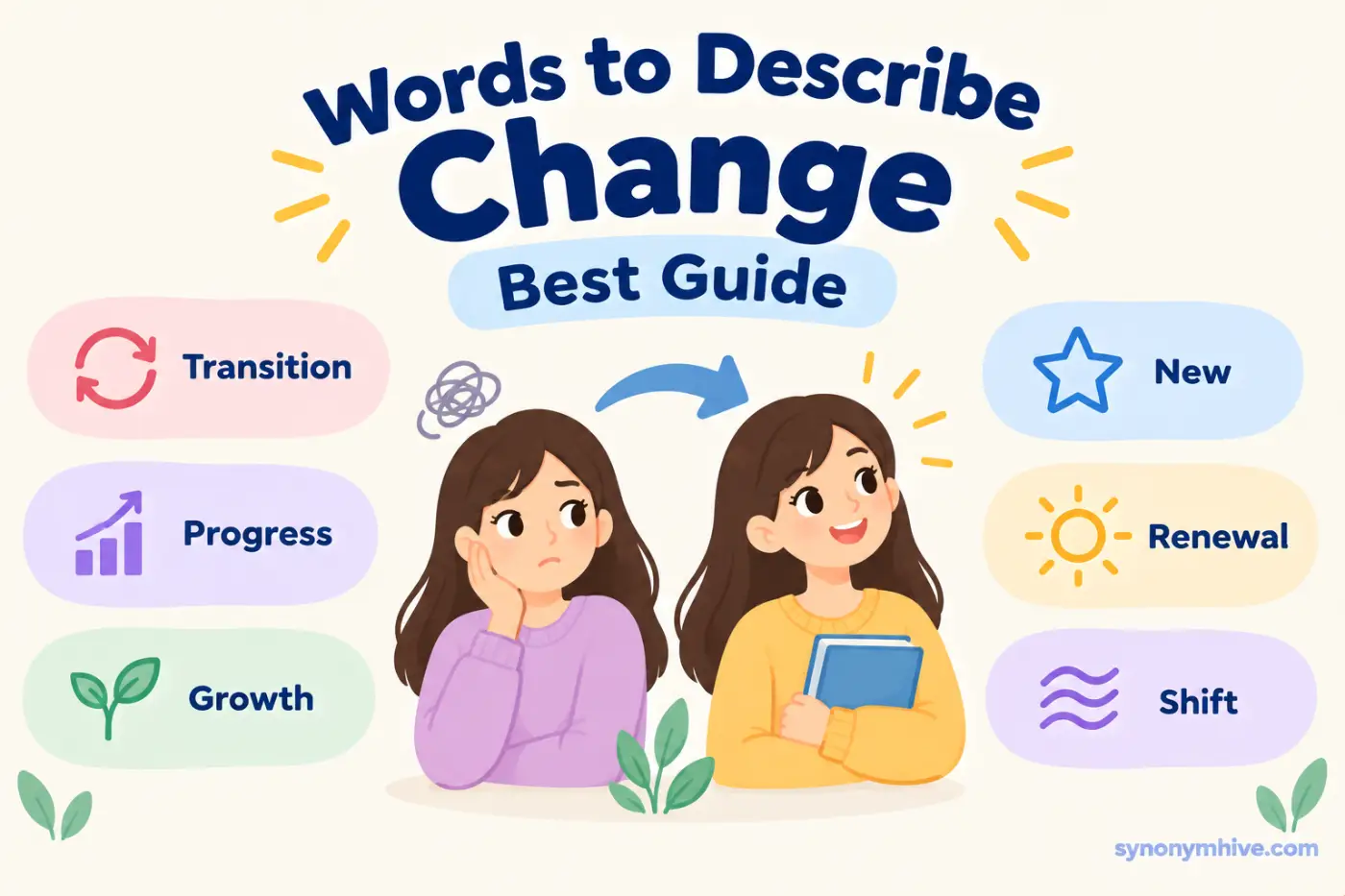
Writing about change can be harder than the change itself. You may know that something is different, but the word you choose can make that difference sound positive, negative, sudden, slow, small, or dramatic. That is why finding the right words to describe change matters.
Words to describe change help you explain how something becomes different over time, in size, condition, direction, style, or behavior.
The best word depends on the kind of change you mean. A company can expand, a plan can shift, a person can mature, a system can evolve, and a situation can transform. These words are related, but they do not all mean the same thing.
This guide covers the meaning and origin of change related words, more than 30 useful choices, intensity levels, grammar, regional notes, writing examples, close synonym differences, common mistakes, and practical tips. You will also see which terms work best in resumes, essays, emails, texts, and everyday speech.
Discover another helpful synonym list in words to describe light Best Guide in 2026.
What does change mean in simple English
Change means becoming different from an earlier state. It can describe a small adjustment or a major transformation.
The noun change can refer to the difference itself. For example, you might say, The change in weather was sudden. The verb change means to make something different or to become different. For example, The company changed its policy.
The word can describe physical, personal, social, emotional, financial, and organizational differences. That broad meaning explains why English has so many related words.
A change can happen slowly or quickly. It can be planned or unexpected. It can improve something, make it worse, or simply make it different.
What are the best words to describe change
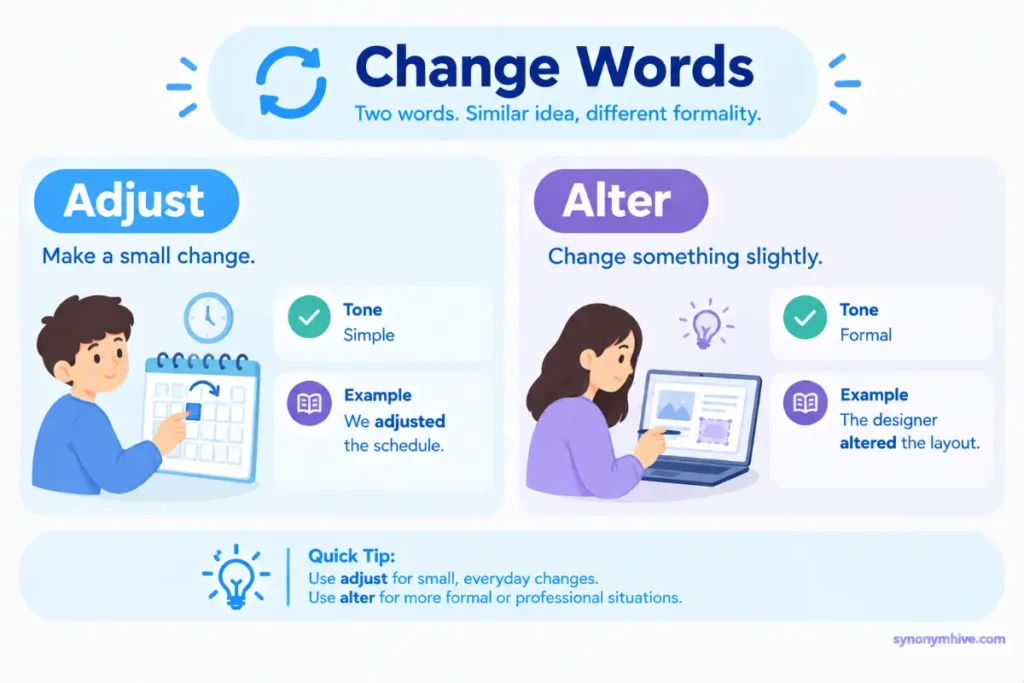
The best choice depends on the kind of change you want to show. Use adjust for a small change, improve for a positive change, decline for a negative change, evolve for gradual development, and transform for a major change.
Here are useful choices grouped by tone and meaning.
| Word | Meaning | Tone | Example |
|---|---|---|---|
| Adjust | Make a small change | Simple | We adjusted the schedule. |
| Alter | Change something slightly | Formal | The designer altered the layout. |
| Adapt | Change to fit new conditions | Everyday | She adapted to her new role. |
| Shift | Move from one position or idea to another | Everyday | Public opinion shifted quickly. |
| Modify | Make controlled changes | Formal | We modified the plan. |
| Improve | Make something better | Positive | The update improved the service. |
| Develop | Grow or become more advanced | Everyday | His skills developed over time. |
| Evolve | Change gradually | Neutral | The idea evolved over several years. |
| Grow | Become larger or stronger | Simple | The business grew quickly. |
| Expand | Become larger or wider | Neutral | The team expanded last year. |
| Progress | Move forward or improve | Positive | The project progressed well. |
| Advance | Move forward or become more developed | Formal | Technology continues to advance. |
| Transform | Change greatly | Strong | The program transformed the school. |
| Revolutionize | Change something in a major way | Very strong | The invention revolutionized medicine. |
| Reshape | Change the form or structure | Strong | The merger reshaped the company. |
| Renew | Make fresh or active again | Positive | The campaign renewed public interest. |
| Revise | Change something to improve it | Formal | The author revised the report. |
| Update | Bring something up to date | Everyday | We updated the website. |
| Replace | Remove one thing and use another | Neutral | They replaced the old system. |
| Reduce | Make smaller or less | Neutral | The company reduced costs. |
| Decline | Become smaller, weaker, or worse | Formal | Sales declined during the quarter. |
The table shows why simply using the word change again and again can make writing less clear. A more specific verb tells the reader what actually happened.
Where does the word change come from
The word change has a long history in English and is connected to the idea of exchanging or making something different. It came into Middle English through Old French, with roots connected to Latin words related to exchanging.
Over time, its meaning became much broader. Today, change can describe an action, a result, a difference, a transition, or the process of becoming different.
That history helps explain why the word works in so many settings. You can change a shirt, change a decision, change a habit, change a policy, change direction, or change your life.
The basic idea stays the same. Something is not exactly as it was before.
Other words developed more specific meanings around this broad idea. Adapt focuses on fitting new conditions. Improve focuses on making something better. Decline focuses on becoming weaker or smaller. Transform suggests a major difference.
Which words describe small changes
Small changes usually do not replace the whole system or situation. They make something slightly different.
Use words such as adjust, alter, tweak, modify, revise, refine, and update when the difference is limited.
Adjust
Adjust suggests a small change made to improve fit, timing, position, or function.
For example:
The teacher adjusted the lesson plan to give students more practice.
We adjusted the meeting time by thirty minutes.
Alter
Alter is slightly more formal than adjust. It means to change part of something without replacing the entire thing.
For example:
The tailor altered the jacket to fit better.
The editor altered two sentences for clarity.
Modify
Modify is common in formal and technical writing. It suggests a controlled change.
For example:
The team modified the training program after reviewing the results.
Revise
Revise is especially useful for writing, plans, policies, and ideas. It means to review something and make changes.
For example:
She revised her essay before submitting it.
The committee revised the proposal after receiving feedback.
Refine
Refine means to improve something by making small, careful changes.
For example:
The designer refined the logo until the shape looked cleaner.
This word often suggests care and attention to detail.
Which words describe gradual change
Some changes happen little by little. They may be hard to notice at first, but the difference becomes clear over time.
The strongest choices include evolve, develop, grow, mature, progress, advance, and transform.
Evolve
Evolve suggests gradual development over time. It often works well for ideas, systems, businesses, relationships, and technology.
For example:
The company’s approach evolved as customer needs changed.
The meaning of the word has evolved over time.
Develop
Develop means to grow or become more advanced. It can describe skills, people, plans, products, relationships, and ideas.
For example:
She developed strong leadership skills during college.
The plan developed into a larger project.
Mature
Mature can describe a person, idea, business, market, or process becoming more developed and stable.
For example:
His writing matured after years of practice.
The market has matured considerably.
Progress
Progress suggests movement toward a goal or better state.
For example:
The students made steady progress throughout the semester.
The project progressed faster than expected.
Advance
Advance often sounds more formal than move forward. It works well when talking about knowledge, technology, science, or a cause.
For example:
Medical research continues to advance.
Which words describe major change
When something becomes very different, a stronger word can make your writing more precise.
Useful choices include transform, reshape, reinvent, revolutionize, overhaul, and convert.
Transform
Transform means to change something greatly in form, appearance, function, or character.
For example:
The new program transformed the way students learned.
A major career change transformed his daily life.
Reshape
Reshape suggests changing the structure, direction, or form of something.
For example:
The new law reshaped the industry.
The experience reshaped her view of success.
Reinvent
Reinvent means to create a new version of something that already exists.
For example:
The company reinvented its brand for a younger audience.
She reinvented her career after leaving the industry.
Revolutionize
Revolutionize is a very strong word. It suggests a major change that affects how something is normally done.
For example:
The invention revolutionized communication.
Use this word carefully. A small improvement does not usually deserve the word revolutionize.
Overhaul
Overhaul means to make major changes to a system, product, plan, or organization.
For example:
The school overhauled its technology policy.
The company overhauled its hiring process.
Which words describe positive change
If the change makes something better, choose a word that shows improvement.
Strong options include improve, enhance, strengthen, upgrade, advance, progress, develop, and flourish.
Improve
Improve is the clearest general word for positive change.
For example:
The new system improved customer service.
Enhance
Enhance means to improve quality, value, appearance, or effectiveness.
For example:
The new lighting enhanced the room.
The training enhanced employees’ communication skills.
Strengthen
Strengthen means to make something stronger.
For example:
The new policy strengthened workplace safety.
The experience strengthened their friendship.
Upgrade
Upgrade suggests replacing or improving something with a better version.
For example:
We upgraded the computer system last year.
Flourish
Flourish means to grow or develop in a healthy and successful way.
For example:
The small business flourished after moving downtown.
Which words describe negative change
Negative change needs language that clearly shows decline or damage.
Useful choices include worsen, decline, weaken, deteriorate, shrink, fade, fall, deteriorate, and collapse.
Worsen
Worsen is simple and direct.
For example:
The traffic worsened after the accident.
Decline
Decline often sounds more formal. It can describe sales, health, quality, numbers, interest, or performance.
For example:
Customer satisfaction declined after the policy change.
Deteriorate
Deteriorate means to become worse in condition or quality.
For example:
The building deteriorated after years without repairs.
Weaken
Weaken means to become less strong or make something less strong.
For example:
The storm weakened the bridge.
The team’s confidence weakened after several losses.
Collapse
Collapse describes a sudden or complete failure.
For example:
The old structure collapsed during the storm.
The agreement collapsed after both sides rejected the proposal.
How can you describe sudden change
Sudden change happens quickly. Words such as shift, spike, plunge, surge, switch, turn, and erupt can show speed or force.
A spike is a sharp increase.
A plunge is a sharp decrease.
A surge is a sudden strong increase.
A shift is a movement from one position, opinion, or condition to another.
For example:
Interest in the product spiked after the video went viral.
Temperatures plunged overnight.
Demand surged during the holiday season.
Public opinion shifted after the debate.
These words work especially well in reports, news writing, business writing, and data analysis.
How can you describe slow change
Slow change needs words that show time and gradual movement.
Good choices include evolve, develop, mature, grow, progress, fade, strengthen, weaken, and transform.
For example:
The neighborhood slowly evolved into a busy business district.
Her confidence grew as she gained experience.
The old tradition gradually faded from daily life.
His approach to leadership matured over the years.
Words such as slowly, gradually, steadily, little by little, and over time can also help the reader understand the pace.
Which words describe change in direction
Sometimes the main change is not size or quality. The direction itself becomes different.
Use shift, turn, switch, redirect, pivot, reverse, or change course.
Shift
Shift is useful when an opinion, focus, position, or direction moves.
For example:
The team’s focus shifted toward customer service.
Pivot
Pivot is common in business and everyday professional speech. It means to change direction or strategy.
For example:
The startup pivoted after the first product failed.
Reverse
Reverse means to move in the opposite direction or undo a previous decision.
For example:
The company reversed its earlier decision.
Redirect
Redirect means to send attention, money, effort, or movement toward a different place.
For example:
The manager redirected the team’s effort toward the most urgent task.
What are the best words to describe change in a resume
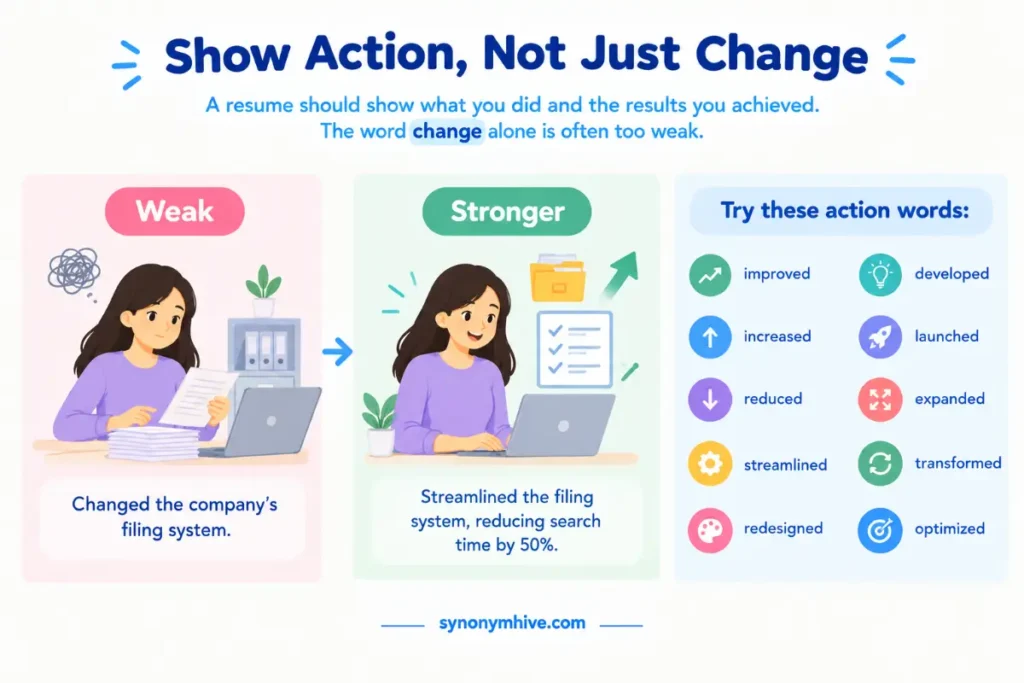
A resume should show action and results. The word change alone is often too weak.
Choose words such as improved, increased, reduced, streamlined, redesigned, developed, launched, expanded, transformed, and optimized.
For example:
Weak:
Changed the company’s filing system.
Stronger:
Redesigned the filing system and reduced search time.
Weak:
Changed the training process.
Stronger:
Revamped the training process and improved employee onboarding.
A good resume verb should tell the reader what you did. It should also show the result when you can.
Try to connect the action with a clear outcome.
Improved customer service.
Reduced processing time.
Expanded the client base.
Reorganized team workflows.
Developed a new training program.
These verbs give your resume more detail without adding unnecessary words.
What words work best in an essay
Essays often need more formal vocabulary. The right choice depends on your topic.
Use evolve, develop, transform, reshape, influence, alter, shift, expand, decline, and strengthen when they fit the meaning.
For example:
The Industrial Revolution transformed urban life.
Public attitudes toward the policy gradually shifted.
The author’s view develops throughout the novel.
Technology has reshaped the way people communicate.
The meaning of a tradition can evolve over time.
Avoid using very dramatic words simply to sound academic. Revolutionize may sound impressive, but transform or reshape may be more accurate.
What words work best in a text message
Text messages usually need simple, natural language.
Good choices include change, switch, adjust, update, fix, improve, move, shift, grow, and change up.
For example:
I had to change the time.
Can we switch the meeting to Friday?
I updated the plan.
Things have changed a lot.
She has really grown this year.
In casual writing, you do not need a formal synonym for every common word. Clear language usually works best.
What words work best in an email
Professional emails need clear but natural language. The best term depends on the subject.
Use adjust for small changes.
Use update for new information.
For example:
We adjusted the schedule to allow more time for testing.
I revised the proposal based on your feedback.
The project is transitioning into its next phase.
The team’s priorities have shifted since the last meeting.
These choices sound professional without becoming stiff.
What words work best when speaking
Everyday speech favors simple words. Change, switch, move, grow, improve, get better, get worse, and turn are common choices.
You might say:
The plan changed.
We switched locations.
Things got better.
His attitude changed.
The weather turned cold.
The business grew quickly.
Formal terms can work in conversation, but they may sound unusual if a simpler word does the job.
For example, saying The situation underwent a transformation is formal. Saying The situation changed a lot sounds more natural in casual speech.
Explore another synonym guide: words to describe darkness Best Guide in 2026.
What are the best words to describe change by intensity
Not all changes have the same strength. Choosing the right level helps your writing sound accurate.
| Intensity | Useful words | Example |
|---|---|---|
| Very mild | adjust, tweak, alter | We adjusted the settings. |
| Mild | modify, revise, update | She revised the plan. |
| Moderate | shift, develop, adapt | The team adapted to the new rules. |
| Noticeable | expand, improve, strengthen, decline | Sales improved during the summer. |
| Major | reshape, overhaul, reinvent | The company overhauled its system. |
| Extreme | transform, revolutionize, collapse | The invention revolutionized the field. |
The safest approach is to match the word to the actual size of the change.
Calling a small edit a transformation can make your writing sound exaggerated. Calling a major change an adjustment can make it sound too weak.
What are the different parts of speech for change
Change can work as both a noun and a verb.
As a noun, it names a difference or transition.
For example:
The change was unexpected.
The company went through several changes.
As a verb, it describes the act of becoming different or making something different.
For example:
The company changed its policy.
Her priorities changed.
Related words can also appear as nouns, verbs, adjectives, and adverbs.
Change, changing, changed, and changeable are related forms.
Transform, transformation, transformative, and transformed are another word family.
Develop, development, developing, and developed form another useful group.
Understanding these forms helps you choose the right word for a sentence.
Are there US and UK differences
Most common change related words work the same way in US and UK English.
There are some differences in preferred vocabulary, spelling, or business style. For example, both American and British English use change, shift, alter, modify, revise, adapt, evolve, and transform.
Some terms may sound more common in one region or industry, but they are usually understood across English speaking regions.
The bigger issue is tone, not geography. A word such as overhaul may sound more business focused, while change is neutral and widely used.
Spelling can also differ in related words. For example, British English often uses organisation, while American English uses organization. That difference does not change the basic meaning of change related vocabulary.
What is the difference between change and adjust
Change is the broad term. Adjust suggests a smaller, more controlled change.
| Change | Adjust |
|---|---|
| Very broad | More specific |
| Can be small or major | Usually small |
| Can be planned or unplanned | Often planned |
| Works in almost any context | Often relates to settings, timing, position, or fit |
Compare these sentences:
The company changed its business model.
The company adjusted its meeting schedule.
The first sentence suggests a broad difference. The second suggests a limited modification.
If you are not sure which word to use, change is usually the safer choice. Use adjust when you want to show that the difference was small.
What is the difference between change and transform
Change can describe any difference. Transform suggests a much greater difference.
For example:
The teacher changed the lesson plan.
The teacher transformed the entire course.
The first sentence could describe a few edits. The second suggests a major shift in structure or experience.
Transform is stronger and more dramatic. It should support a sentence where the result is clearly significant.
What is the difference between change and evolve
Change can happen at any speed. Evolve usually suggests gradual development over time.
For example:
The company changed its logo.
The company evolved from a small local store into a national brand.
The first sentence does not tell us how the change happened. The second suggests a longer process.
Use evolve when the development happens step by step and the later form grows out of the earlier one.
What is the difference between improve and change
Improve means change for the better. Change itself does not say if the result is good or bad.
For example:
The system changed.
The system improved.
The first sentence only tells us that the system became different. The second clearly tells us that the new condition is better.
This distinction matters in reports and professional writing. If you know the result was positive, improve is more precise.
What is the difference between adapt and adjust
Adapt usually involves responding to new conditions. Adjust often means making a smaller change to fit a situation.
For example:
She adjusted her chair.
She adapted to her new workplace.
You adjust a setting, plan, schedule, or position. You adapt to a new environment, role, condition, or situation.
The two words can overlap, but adapt usually suggests a broader response.
What are some original examples of change related words
The best way to understand these words is to see them in natural sentences.
- The company expanded its services after customer demand increased.
- Maria adjusted her study schedule before the final exams.
- The new manager improved communication across the department.
- Public opinion shifted after the report was released.
- His confidence developed through years of practice.
- The small business grew into a regional brand.
- The old building deteriorated after years without repairs.
- The team revised its strategy after reviewing the results.
- Technology has transformed the way people work.
- The neighborhood has evolved over the past decade.
- The school upgraded its computer system.
- The new policy reshaped the company’s hiring process.
- The manager redirected the team’s effort toward the most urgent project.
- Sales declined during the winter months.
- The organization reorganized its departments to improve efficiency.
- Her writing matured as she gained more experience.
- The company reinvented its brand after losing market share.
- The weather worsened during the afternoon.
- The team adapted quickly to the new rules.
- The updated design enhanced the product’s appearance.
- The town rebuilt its main street after the flood.
- The program progressed steadily throughout the year.
- The new evidence altered the direction of the investigation.
- The company made several small changes before launching the product.
- His priorities shifted after he became a parent.
Notice how each verb gives a slightly different picture. That is the main reason strong writing uses specific change related vocabulary.
What are common mistakes when describing change
One common mistake is using a strong word for a small difference.
For example, The company revolutionized its schedule sounds excessive if the only change was moving a meeting from Monday to Tuesday.
Another mistake is using a negative word when the result is simply different. Changed does not mean worsened.
The opposite problem also happens. Writers sometimes use a weak word for a major event.
For example, The new law adjusted the industry may sound too mild if the law completely changed how businesses operate. Reshaped or transformed may be better.
Another mistake is choosing a synonym based only on its dictionary meaning. Context matters. Adapt and adjust both involve change, but they describe different kinds of change.
You should also avoid repeating the same verb in every sentence. If a paragraph says changed five times, the reader learns very little about the type of change.
Instead, explain the exact action.
The policy was replaced.
The policy was strengthened.
These sentences give the reader much more information.
When should you not use a synonym for change
Sometimes change is the best word.
Do not replace a simple word just to make your writing sound advanced. If the meaning is broad and no more specific detail is needed, change is clear and correct.
For example:
People change over time.
That sentence does not need a stronger synonym.
You could write People evolve over time, but the meaning becomes slightly different. Evolve suggests gradual development. Change does not make that extra claim.
The same rule applies to business writing. If you are simply reporting that a schedule is different, changed may be better than transformed.
Good word choice is not about choosing the longest or most formal word. It is about choosing the word that gives the reader the right picture.
What are the antonyms of change
Antonyms are words that express the opposite or near opposite of a concept.
For change, useful opposites include:
- Remain
- Stay
- Preserve
- Maintain
- Keep
- Continue
- Stabilize
- Retain
- Sustain
- Freeze
The best choice depends on the sentence.
For example:
The company changed its policy.
The company maintained its policy.
The weather changed throughout the day.
The weather remained stable.
The design was changed.
The original design was preserved.
Notice that these words do not all mean exactly the same thing. Maintain suggests keeping something as it is. Remain suggests continuing in the same state. Preserve suggests protecting something from change or damage.
How can you choose the right word for change
Start by asking what actually happened.
Did something become better? Try improve, enhance, strengthen, or upgrade.
Did something become worse? Try worsen, decline, weaken, or deteriorate.
Did something become larger? Try grow or expand.
Did something become smaller? Try reduce, shrink, decrease, or contract.
Did something develop slowly? Try evolve, develop, mature, or progress.
Did something change direction? Try shift, pivot, redirect, or reverse.
Did something become very different? Try transform, reshape, reinvent, or overhaul.
Was the change small? Try adjust, alter, tweak, modify, or revise.
Was the change sudden? Try shift, spike, plunge, surge, or switch.
This simple method can help you avoid vague writing.
What should you remember about choosing change words
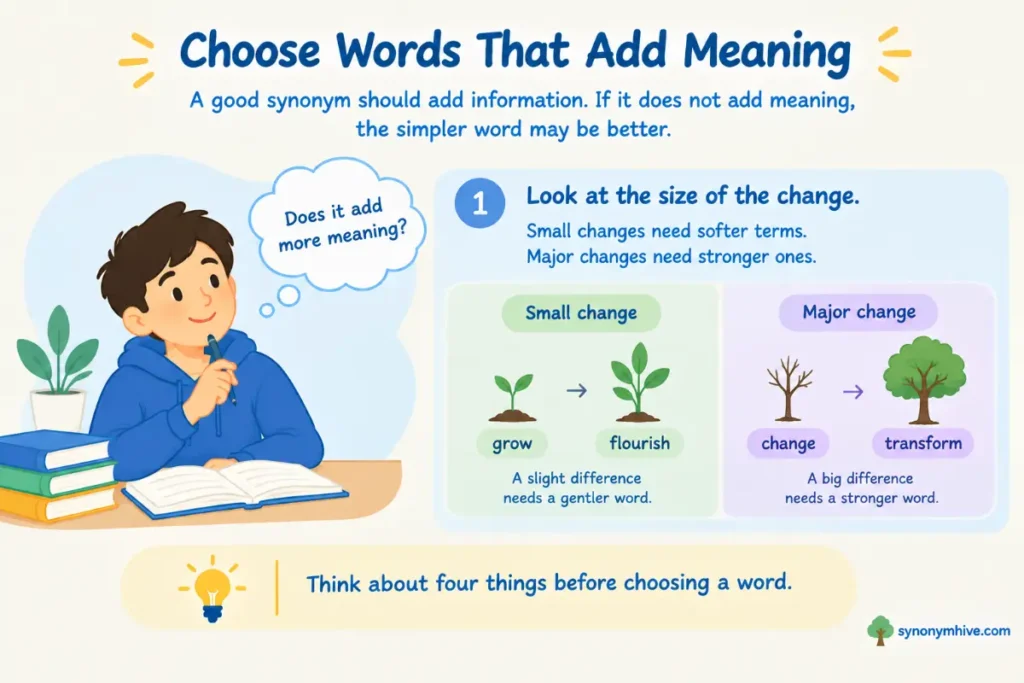
A good synonym should add information. If it does not add meaning, the simpler word may be better.
Think about four things before choosing a word.
First, consider the size of the difference. Small changes need softer terms. Major changes need stronger ones.
Second, consider the direction. A positive change needs a word such as improve. A negative change may need decline or worsen.
Third, consider speed. Gradual change works well with evolve or develop. Sudden change may call for shift, spike, plunge, or surge.
Fourth, consider the setting. A text message can use simple language. A report may need more precise formal vocabulary. A resume should favor strong action verbs.
The goal is not to avoid the word change. The goal is to make your meaning clearer when a more exact word is available.
How can you remember the main change words
A simple memory system is to group words by the question they answer.
Ask: Did it get better?
Use improve, enhance, strengthen, upgrade, or advance.
Ask: Did it get worse?
Use worsen, decline, weaken, deteriorate, or collapse.
Ask: Did it get bigger?
Use grow, expand, increase, or extend.
Ask: Did it get smaller?
Use reduce, shrink, decrease, or contract.
Ask: Did it become different over time?
Use evolve, develop, mature, or transform.
Ask: Did the direction change?
Use shift, pivot, redirect, reverse, or switch.
Ask: Was the change small?
Use adjust, alter, modify, revise, or refine.
Ask: Was the change major?
Use transform, reshape, overhaul, reinvent, or revolutionize.
This approach is easier than memorizing a long list without context.
How can you make change sound more precise
Instead of writing only about the change, describe what moved from one state to another.
Weak:
The company changed.
Better:
The company expanded into three new markets.
Weak:
Her attitude changed.
Better:
Her attitude became more positive after the training.
Weak:
The plan changed.
Better:
The team revised the plan after reviewing the budget.
Weak:
The neighborhood changed.
Better:
The neighborhood developed from a quiet residential area into a busy commercial district.
Specific details make the sentence stronger. The synonym then supports the meaning instead of doing all the work.
Expand your vocabulary with Words to Describe a Voice: Words for Every Voice 2026.
Conclusion
Choosing the right words to describe change is mostly about precision. Change is a broad word, so it works well when you simply need to show that something became different. A more specific term can show how that difference happened.
Use adjust or modify for small changes. Choose evolve or develop for gradual growth. Use improve when the result is better and decline when it is worse. For major changes, transform, reshape, overhaul, and reinvent can give your sentence more force.
The easiest way to choose is to ask four questions. How big was the change? Was it positive or negative? Did it happen slowly or quickly? What exactly became different? Answer those questions first, then pick the word that matches the facts. That simple habit will make your writing clearer and more natural.
Frequently Asked Questions
What are the best words to describe change?
The best words depend on the type of change. Useful choices include adjust, adapt, shift, evolve, develop, improve, expand, decline, transform, reshape, and reinvent. Pick the word that shows the size, speed, direction, and result of the change.
What’s another way to say change?
Another way to say change is adjust, alter, shift, modify, adapt, evolve, develop, transform, revise, or transition. The best choice depends on what became different and how much it changed.
What words describe positive change?
Words such as improve, enhance, strengthen, upgrade, advance, progress, grow, flourish, and develop can describe positive change. They show that the new condition is better or stronger than the earlier one.
What words describe major change?
Transform, reshape, overhaul, reinvent, revolutionize, and rebuild can describe major change. These words suggest that the difference is large enough to affect the structure, purpose, direction, or identity of something.
What words describe gradual change?
Evolve, develop, mature, grow, progress, strengthen, and fade can describe gradual change. These words work well when a difference happens over time instead of all at once.
What is a strong word for change?
Transform is a strong general word for major change. Revolutionize is even stronger and suggests a major shift that changes how something is normally done.
How do I describe change in a resume?
Use action verbs such as improved, expanded, redesigned, streamlined, developed, launched, reorganized, upgraded, and transformed. Whenever possible, connect the action to a measurable result so the reader can see the effect of your work.