

Finding the right words to describe a friend can be harder than it sounds. You may be writing a birthday message, a school essay, a social media caption, or a personal note, and suddenly words like nice and good seem far too simple. You know what makes your friend special.
The best terms to describe a friend show more than basic kindness. They can describe how someone treats you, how they act around others, how they handle hard times, and what makes the friendship special. A loyal friend, for example, gives you a very different picture from a funny friend or an ambitious friend.
The best words to describe a friend are specific adjectives that show the person’s character, behavior, personality, or role in your life. Words such as loyal, caring, honest, supportive, thoughtful, funny, dependable, and trustworthy can describe different qualities of a good friend.
This guide gives you a large collection of useful descriptive words, from simple everyday choices to stronger and more formal terms. You’ll also see examples, close word comparisons, context based suggestions, common mistakes, and quick tips for choosing a word that actually fits the person.
Looking for another word? See words to describe yourself best guide in 2026.
What Does It Mean to Describe a Friend?
To describe a friend means to use words that explain who the person is and what makes that person stand out. You can describe personality, character, habits, behavior, appearance, emotional qualities, or the way the person treats you.
For example, calling someone kind tells the reader that the person treats others well. Calling that same person compassionate suggests a deeper concern for other people’s struggles. Calling someone dependable shows that you can count on that person.
Good description is specific. Instead of saying, “My friend is great,” you can say, “My friend is patient, honest, and dependable.” The second sentence gives the reader a much clearer picture.

What Are the Best Words to Describe a Friend?
The strongest choices depend on the quality you want to highlight. For loyalty, use words such as loyal, devoted, faithful, and dependable.
For personality, you might choose cheerful, funny, outgoing, calm, confident, curious, or adventurous.
There is no single perfect adjective for every friend. The right word should match the person and the situation.
Where Do These Descriptive Words Come From?
Many words used to describe people began as ordinary words that developed a special meaning for human behavior or character. Words such as kind, honest, and loyal have long histories in English, while newer informal words continue to appear in everyday speech.
The word friend itself comes from Old English frēond, which was related to the verb meaning to love or care for. Its history connects friendship with affection, trust, and personal connection.
Adjectives have their own histories. Loyal came into English through French and is linked to the idea of being faithful. Honest came through French from Latin roots connected with honor. Compassionate comes from Latin roots associated with suffering with another person.
You do not need to know these histories to choose a good adjective. Still, knowing that descriptive language often grows from ideas such as care, trust, honor, courage, and affection can help you understand why certain words carry stronger meanings than others.
What Words Can Describe a Friend?
The following table gives you a broad collection of useful choices. The groups are based on common use and tone rather than strict dictionary categories.
| Word | Meaning | Tone | Example |
|---|---|---|---|
| Kind | Caring and considerate toward others | Simple | My friend is kind to everyone. |
| Nice | Pleasant and friendly | Simple | She is always nice to new students. |
| Generous | Willing to give time, help, or resources | Everyday | My friend is generous with her time. |
| Sincere | Genuine and honest in feeling | Formal | Her apology was sincere. |
| Considerate | Thinks about other people’s needs | Formal | He is considerate of everyone around him. |
| Cheerful | Usually happy and positive | Everyday | Her cheerful personality lifts the group. |
| Confident | Believes in personal abilities | Everyday | He is confident without being rude. |
| Courageous | Willing to face fear or difficulty | Strong | She was courageous during a difficult time. |
| Selfless | Puts others’ needs before personal gain | Strong | His selfless actions helped the whole team. |
| Dependable | Consistently reliable | Strong | She is dependable when things get difficult. |
| Genuine | Real and sincere | Everyday | He is a genuine friend who never pretends. |
| Outgoing | Comfortable meeting and talking to people | Everyday | My outgoing friend makes new people feel welcome. |
| Laid back | Calm and relaxed | Informal | He has a laid back personality. |
| Fun loving | Enjoys having fun | Informal | She is fun loving and easy to be around. |
| Cool | Pleasant, calm, or impressive | Informal | He is a cool friend who never judges me. |
| Awesome | Extremely good or enjoyable | Informal | She is an awesome friend. |
This list works for many situations, but context still matters. A word that sounds natural in a text message may sound too casual in a school essay.
What Words Describe a Friend From Mild to Strong?
Not every positive adjective has the same strength. You can choose a mild word when you want simple praise or a stronger word when you want to show deep admiration.
Mild Words for a Friend
Mild words are easy to use in everyday conversation. They work well when you do not want your description to sound dramatic.
Good examples include:
- Nice.
- Friendly.
- Pleasant.
- Helpful.
- Kind.
- Cheerful.
- Funny.
- Calm.
- Polite.
- Easygoing.
For example, “My friend is friendly and helpful” gives a simple positive description without making a very strong claim.
Strong Words for a Friend
Stronger adjectives suggest a deeper quality or a more lasting trait.
Examples include:
- Loyal.
- Trustworthy.
- Dependable.
- Compassionate.
- Selfless.
- Courageous.
- Devoted.
- Sincere.
- Generous.
- Supportive.
Compare these two sentences.
“My friend is nice.”
“My friend is incredibly loyal and always stands by me.”
The second sentence gives the reader more information about the friendship.
Very Strong Words for a Close Friend
Some friendships involve deep trust and emotional support. In these cases, words such as devoted, steadfast, selfless, compassionate, and unwavering may fit.
Use these words when the person’s behavior supports the meaning. Strong praise works best when it is specific.
Instead of writing, “She is the most selfless person ever,” you could write, “She is selfless because she regularly gives her time to help friends who need support.”
That sentence gives evidence for the adjective.
Which Words Describe a Friend’s Personality?
Personality words explain how someone usually acts, thinks, or interacts with others. They can make a description much more vivid.
Friendly and Social Personality Words
Use these when your friend enjoys meeting people or makes others feel comfortable.
- Outgoing.
- Sociable.
- Friendly.
- Talkative.
- Warm.
- Welcoming.
- Approachable.
- Cheerful.
- Lively.
- Energetic.
Example: “My friend is outgoing and can start a conversation with almost anyone.”
Calm Personality Words
Some friends are quiet, steady, and easy to be around.
Useful choices include:
- Calm.
- Patient.
- Relaxed.
- Peaceful.
- Easygoing.
- Composed.
- Gentle.
- Thoughtful.
Example: “When everyone else is stressed, my calm friend helps us think clearly.”
Fun Personality Words
For someone who makes ordinary moments enjoyable, try:
- Funny.
- Playful.
- Cheerful.
- Witty.
- Lively.
- Humorous.
- Energetic.
- Adventurous.
- Spontaneous.
- Fun loving.
Example: “She is playful and always finds a way to make us laugh.”
Serious and Responsible Personality Words
Some friends are known for maturity and responsibility.
Useful words include:
- Responsible.
- Reliable.
- Dependable.
- Mature.
- Practical.
- Disciplined.
- Focused.
- Organized.
- Sensible.
- Careful.
Example: “He is responsible and never forgets a promise.”
Which Words Describe a Friend’s Character?
Personality and character are related, but they are not exactly the same. Personality describes how someone tends to act or interact. Character focuses more on values and moral qualities.
Strong character words include:
- Honest.
- Loyal.
- Trustworthy.
- Respectful.
- Fair.
- Responsible.
- Sincere.
- Dependable.
- Compassionate.
- Courageous.
- Generous.
- Humble.
- Patient.
- Considerate.
- Selfless.
A person can be quiet but still have excellent character. Someone can also be funny and outgoing while being highly responsible.
For example, “My friend is funny” describes personality. “My friend is honest” describes character. “My friend is loyal” can describe both a character trait and the way the person behaves in a friendship.
Which Words Describe a Friend’s Loyalty?
Loyalty is one of the most important qualities in a close friendship. If you want to focus on this trait, choose words that show faithfulness and trust.
Good options include:
- Loyal.
- Faithful.
- Devoted.
- Dependable.
- Steadfast.
- Committed.
- Trustworthy.
- Supportive.
- Reliable.
- Constant.
Loyal vs Dependable
Loyal focuses on staying faithful to someone or supporting them over time.
Dependable focuses on being someone you can count on.
For example, a friend may be loyal because she defends you when others criticize you. She may be dependable because she always shows up when she says she will.
These qualities often overlap, but they are not identical.
Which Words Describe a Caring Friend?
If your friend notices when people are struggling and tries to help, caring words are a strong choice.
Consider:
- Caring.
- Compassionate.
- Kind.
- Thoughtful.
- Considerate.
- Gentle.
- Supportive.
- Understanding.
- Empathetic.
- Generous.
- Selfless.
- Warmhearted.
Caring vs Compassionate
Caring is broad and easy to use. It means someone shows concern for others.
Compassionate is stronger and often suggests concern for someone who is suffering or having a hard time.
For example, “She is a caring friend who checks on me after a long day.”
You could write, “She is compassionate toward people who are struggling.”
The second sentence gives a more specific picture.
Which Words Describe a Funny Friend?
A funny friend can be described in several ways depending on the kind of humor they have.
Use funny for a general description. Use witty for someone who makes clever remarks.
Other useful words include:
- Witty.
- Playful.
- Humorous.
- Amusing.
- Cheerful.
- Comical.
- Clever.
- Lively.
- Entertaining.
- Spirited.
Example: “My friend has a witty sense of humor and always knows when to make a clever joke.”
Which Words Describe a Supportive Friend?
A supportive friend helps you keep going. That support may come through advice, encouragement, listening, or practical help.
Strong choices include:
- Supportive.
- Encouraging.
- Understanding.
- Patient.
- Caring.
- Reliable.
- Helpful.
- Compassionate.
- Motivating.
- Uplifting.
Example: “My friend is supportive whenever I face a difficult decision.”
The word supportive is especially useful because it can describe emotional support, practical support, or both.
Which Words Describe a Friend Who Is Honest?
Honesty is about truth and sincerity. It does not always mean saying everything that comes to mind. A truly honest person can tell the truth with care.
Useful words include:
- Honest.
- Sincere.
- Genuine.
- Truthful.
- Frank.
- Open.
- Direct.
- Trustworthy.
- Straightforward.
- Authentic.
Honest vs Frank
Honest means truthful and sincere.
Frank means direct and open, sometimes in a way that may sound blunt.
For example:
“She is honest about her mistakes.”
“He is frank about what he thinks needs to change.”
Both can be positive, but frank can sound less gentle.
Which Words Describe a Friend on a Resume?
A resume usually needs professional language. Personal friendship descriptions do not belong on most resumes, but you may need to describe someone in a recommendation, testimonial, volunteer application, or professional reference.
Strong professional choices include:
- Dependable.
- Responsible.
- Reliable.
- Collaborative.
- Respectful.
- Motivated.
- Organized.
- Trustworthy.
- Dedicated.
- Supportive.
- Adaptable.
- Professional.
Example: “She is a dependable team member who communicates clearly and completes tasks on time.”
This is stronger than saying, “She is a really nice person.”
Professional writing should focus on observable qualities and actions.
Which Words Describe a Friend in an Essay?
An essay usually benefits from precise language. Avoid using the same basic adjective over and over.
Good choices include:
- Compassionate.
- Courageous.
- Thoughtful.
- Dependable.
- Ambitious.
- Generous.
- Patient.
- Confident.
- Sincere.
- Respectful.
- Determined.
- Considerate.
Example: “My friend Maya is compassionate because she notices when others need help and takes time to listen.”
This gives both a description and a reason.
Which Words Describe a Friend in a Text?
Text messages usually allow casual and warm language. You can use words that sound natural between friends.
Try:
- Awesome.
- Amazing.
- Funny.
- Sweet.
- Kind.
- Loyal.
- Caring.
- Genuine.
- Supportive.
- Amazing.
- Fun.
- Chill.
- Thoughtful.
- Reliable.
Example: “You’re such a loyal and thoughtful friend. I’m lucky to have you.”
A casual message does not need formal vocabulary. Natural language usually sounds better.
Which Words Describe a Friend in an Email?
The best choice depends on the type of email. A personal email can sound warm and relaxed. A professional email should use more formal language.
For a personal email, try:
- Kind.
- Caring.
- Thoughtful.
- Supportive.
- Reliable.
- Generous.
For a professional message, consider:
- Dependable.
- Responsible.
- Respectful.
- Trustworthy.
- Dedicated.
- Helpful.
Example: “I’m grateful to have such a thoughtful and supportive friend.”
Which Words Describe a Friend When Speaking?
When speaking, simple words often sound the most natural.
You might say:
“My friend is really kind.”
“She’s incredibly loyal.”
“He’s funny and easy to talk to.”
“She’s one of the most dependable people I know.”
“He’s thoughtful and always checks in.”
Speaking does not require complicated vocabulary. A clear word with a real example usually makes a stronger impression.
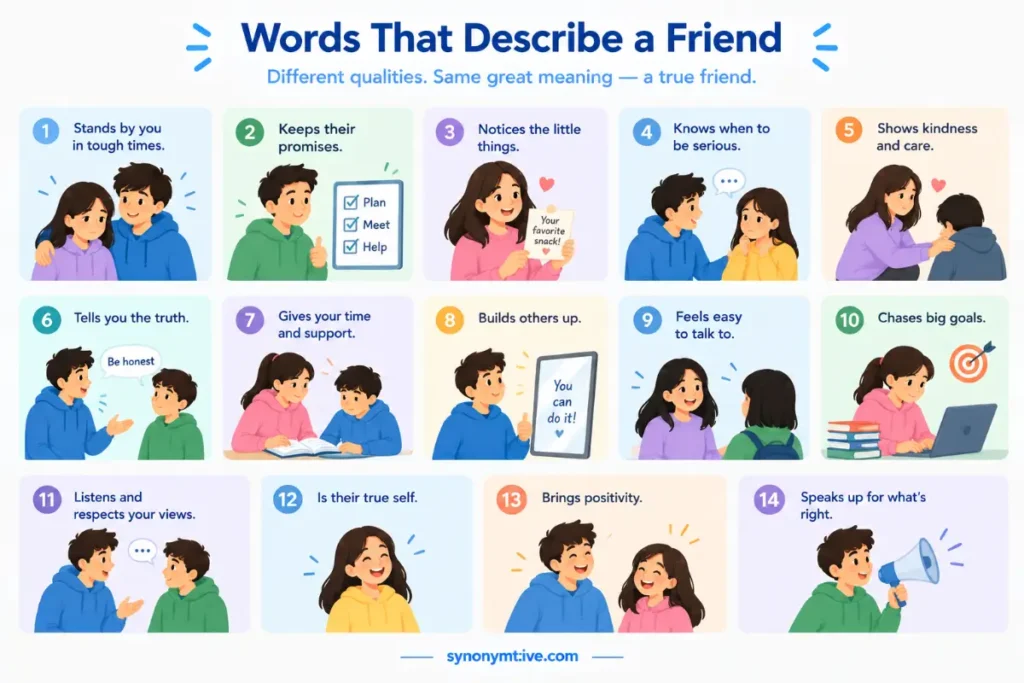
What Are 10 Real Examples of Describing a Friend?
The following examples show how descriptive words work in real situations.
- My friend is loyal because she stands by me when life gets difficult.
- He is dependable and always does what he says he will do.
- She is thoughtful and remembers small details that other people often forget.
- My friend is funny, but he also knows when someone needs a serious conversation.
- She is compassionate toward people who are having a difficult time.
- He is honest enough to tell me the truth, even when it is not what I want to hear.
- My friend is patient when I need time to explain what is bothering me.
- She is generous with her time and always tries to help when she can.
- He is confident without making other people feel small.
- My friend is approachable, so new people quickly feel comfortable around her.
- She is ambitious and works hard toward the goals she has set for herself.
- He is respectful during disagreements and listens before giving his opinion.
- My friend is genuine because she never changes her personality just to impress people.
- She is cheerful and can brighten a difficult day with a simple joke.
- He is courageous because he speaks up when he sees something unfair.
These examples show an important writing rule. A strong adjective becomes more useful when you connect it to behavior.
What Are the Best Words for a Best Friend?
A best friend often deserves words that express trust, closeness, and long term support.
Consider:
- Loyal.
- Trustworthy.
- Devoted.
- Dependable.
- Caring.
- Understanding.
- Supportive.
- Genuine.
- Thoughtful.
- Compassionate.
- Selfless.
- Faithful.
- Honest.
- Kind.
- Encouraging.
For a heartfelt message, you could write:
“You are one of the most loyal and caring people I know. You listen when I need to talk, celebrate my wins, and stay beside me during difficult days.”
That description feels personal because it explains what the friend actually does.
What Are the Best Words for a New Friend?
A new friendship may not have the same history as a lifelong friendship. Choose words that describe what you already know.
Good options include:
- Friendly.
- Welcoming.
- Kind.
- Funny.
- Open.
- Approachable.
- Respectful.
- Cheerful.
- Helpful.
- Easygoing.
- Interesting.
- Sociable.
For example:
“She is friendly and easy to talk to, so I felt comfortable around her right away.”
That sentence makes a positive claim without pretending you know the person deeply.
What Are the Best Words for a Close Friend?
For a close friend, stronger words can show trust and emotional connection.
Try:
- Loyal.
- Trustworthy.
- Understanding.
- Supportive.
- Dependable.
- Compassionate.
- Sincere.
- Thoughtful.
- Selfless.
- Devoted.
- Genuine.
- Faithful.
The strongest word depends on the relationship. Devoted sounds deeper than friendly. Trustworthy focuses on trust. Supportive focuses on encouragement.
What Are the Best Words for a Friend Who Always Helps?
A friend who regularly helps others can be described as helpful, generous, supportive, considerate, dependable, or selfless.
These words are close, but each adds a different idea.
Helpful means the person gives useful assistance.
Generous focuses on giving time, effort, attention, or resources.
Supportive focuses on encouragement and emotional or practical help.
Selfless suggests that the person puts other people’s needs ahead of personal gain.
Example: “She is generous with her time and always makes room for people who need help.”
What Are the Best Words for a Friend Who Gives Good Advice?
A friend who gives good advice may be:
- Wise.
- Thoughtful.
- Understanding.
- Practical.
- Honest.
- Sensible.
- Patient.
- Supportive.
- Insightful.
- Mature.
Wise suggests good judgment based on knowledge or experience.
Practical suggests advice that can actually be used.
Thoughtful shows that the person considers the situation carefully.
For example, “My friend gives thoughtful and practical advice instead of rushing to judge me.”
What Is the Difference Between Kind and Nice?
Kind usually carries more meaning than nice.
Nice is a broad word for something pleasant or agreeable. Kind suggests that a person treats others with care and goodwill.
Compare these sentences.
“She is nice.”
“She is kind to people who are often left out.”
The second sentence tells the reader more about her behavior.
Nice is not a bad word. It is simply less specific. If you want stronger writing, replace nice with a more precise quality when you know what makes the person pleasant.
You may also like Words to Describe a Teacher Best Guide In 2026.
What Is the Difference Between Friendly and Outgoing?
Friendly describes how someone treats or interacts with other people. Outgoing describes a person who is comfortable being social and meeting people.
An outgoing person may enjoy parties, conversations, and new groups. A friendly person may be quiet but still warm and welcoming.
For example:
“My friend is friendly but quiet.”
“My friend is outgoing and loves meeting new people.”
Both descriptions can be positive. They simply focus on different traits.
What Is the Difference Between Honest and Trustworthy?
Honest means a person tells the truth and avoids deception. Trustworthy means you can safely rely on the person to be truthful, responsible, and dependable.
Honesty is one part of trustworthiness.
For example, someone may be honest but still unreliable. A trustworthy person usually combines honesty with consistent behavior.
“She is honest about her mistakes.”
“I trust him because he is honest and dependable.”
The second sentence gives a broader reason for trust.
What Is the Difference Between Caring and Thoughtful?
Caring means showing concern for another person. Thoughtful often means noticing someone’s needs or remembering details and acting on them.
A caring friend may listen when you are upset. A thoughtful friend may remember your important exam and text you good luck.
The two words overlap, but thoughtful often points to specific actions.
How Do Adjectives Work When Describing People?
Most words in this guide are adjectives. An adjective describes a noun.
For example:
“My friend is loyal.”
“She is a thoughtful person.”
“He is a funny friend.”
You can place the adjective after a linking verb such as is or before a noun.
You can also combine adjectives:
“She is a kind, patient, and dependable friend.”
Try not to overload one sentence with too many adjectives. Three strong words usually create a clearer description than ten weak ones.
Are There Different English Choices in the US and UK?
Most common descriptive words work the same way in American and British English. Words such as kind, loyal, honest, funny, caring, supportive, and dependable are widely understood in both varieties.
Some informal expressions can vary by region. Words such as mate are common in British English and can mean a friend, while buddy and pal are common in American English.
Spelling can also vary in some descriptive words. For example, empathetic is common in American English, while empathic is also used in both varieties.
For a general audience, standard words such as friendly, kind, loyal, honest, supportive, and trustworthy are safe choices.
Which Parts of Speech Can Describe a Friend?
Adjectives are the most common choice, but other parts of speech can help build a description.
Adjectives
Examples include:
Kind, loyal, honest, funny, patient, caring, brave, generous, thoughtful, and dependable.
Nouns
Nouns can identify a person’s role or quality.
Examples include:
Friend, supporter, helper, mentor, companion, confidant, leader, and encourager.
For example:
“She has always been a strong supporter.”
Adverbs
Adverbs describe how someone acts.
Examples include:
Kindly, honestly, patiently, generously, warmly, and thoughtfully.
Example:
“She patiently listened while I explained the problem.”
Adjectives usually provide the strongest and simplest description, but combining different word types can make your writing more natural.
What Are Some Positive Words for a Friend?
If you need a quick list, these are among the most useful positive choices:
- Kind.
- Caring.
- Loyal.
- Honest.
- Funny.
- Thoughtful.
- Supportive.
- Dependable.
- Trustworthy.
- Generous.
- Respectful.
- Patient.
- Compassionate.
- Sincere.
- Genuine.
- Cheerful.
- Confident.
- Courageous.
- Responsible.
- Understanding.
- Friendly.
- Helpful.
- Considerate.
- Encouraging.
- Reliable.
Choose based on the actual quality you want to show.
What Are Some Words for a Friend Who Is Always There?
When someone consistently supports you, the best choices include loyal, dependable, reliable, supportive, faithful, devoted, and trustworthy.
A strong sentence could be:
“She is a loyal and dependable friend who is always there when I need someone to talk to.”
The phrase always there is common and natural, but a more precise adjective can make formal writing stronger.
What Are Some Words for a Friend Who Never Judges You?
Use words such as understanding, accepting, compassionate, patient, open minded, supportive, and nonjudgmental.
These words describe different parts of the same quality.
Understanding focuses on empathy and patience.
Accepting focuses on respecting people without demanding that they change.
Nonjudgmental means the person avoids unfair criticism.
Example:
“My friend is understanding and nonjudgmental, so I can talk openly with her.”
What Are Some Words for a Friend Who Inspires You?
A friend can be described as inspiring, motivating, encouraging, ambitious, determined, courageous, confident, positive, or driven.
Use inspiring when the person makes you want to improve or act.
Use motivating when the person encourages action.
Example:
“My friend is determined and inspiring because she keeps working toward her goals even after setbacks.”
What Are Some Words for a Friend Who Is Intelligent?
If intelligence is the main quality, choose the word based on the kind of intelligence you mean.
Useful options include:
- Intelligent.
- Smart.
- Bright.
- Clever.
- Knowledgeable.
- Thoughtful.
- Insightful.
- Wise.
- Sharp.
- Creative.
- Curious.
- Analytical.
Smart is common and informal. Intelligent is more direct and neutral. Wise suggests good judgment, not simply strong academic ability.
What Are Some Words for a Friend Who Is Brave?
Use courageous, brave, bold, fearless, determined, strong, resilient, or adventurous.
These words are not identical.
Brave means willing to face fear or difficulty.
Courageous has a similar meaning but often sounds stronger or more formal.
Resilient describes someone who recovers and keeps going after difficulty.
Example:
“She is courageous because she speaks up even when she knows the conversation will be difficult.”
What Are Some Words for a Friend Who Is Humble?
A humble friend does not act as if they are better than everyone else.
Useful words include:
- Humble.
- Modest.
- Down to earth.
- Grounded.
- Unassuming.
- Respectful.
- Gracious.
- Self aware.
Humble is the most direct choice.
Modest can describe someone who does not brag about achievements.
Down to earth is informal and describes someone who is practical, relaxed, and easy to talk to.
Example:
“Despite winning several awards, she remains humble and treats everyone with respect.”
What Words Should You Avoid When Describing a Friend?
Some words are too vague, too strong, or too casual for certain situations.
Avoid Overused Words When You Can Be More Specific
Words such as good, nice, great, and awesome are useful in casual speech, but they do not tell the reader much.
Instead of:
“My friend is good.”
Try:
“My friend is patient, honest, and dependable.”
Avoid Strong Claims Without Evidence
Words such as perfect, flawless, selfless, and incredible make strong claims.
They can work in personal writing, but they should fit the situation.
If you call someone selfless, explain what they do that supports the description.
Avoid Insults When the Purpose Is Positive Description
Words such as selfish, rude, lazy, and unreliable may be accurate in some situations, but they change the purpose and tone of your writing.
Use negative terms only when you truly need to describe a weakness or difficult behavior.
What Are the Antonyms of Positive Friend Descriptions?
Antonyms are words with opposite meanings. They can help you understand the difference between positive qualities.
| Positive Word | Opposite |
|---|---|
| Kind | Cruel |
| Honest | Dishonest |
| Loyal | Disloyal |
| Friendly | Unfriendly |
| Patient | Impatient |
| Generous | Selfish |
| Dependable | Unreliable |
| Respectful | Disrespectful |
| Caring | Uncaring |
| Calm | Nervous or agitated |
| Humble | Arrogant |
| Brave | Cowardly |
| Thoughtful | Thoughtless |
| Supportive | Unsupportive |
| Sincere | Insincere |
These opposites can also help you choose a more precise word. If you know what your friend is not like, think about the positive quality that sits on the other side.
How Can You Choose the Right Descriptive Word?
Start with the exact quality you want to communicate. Do not begin by searching for the fanciest word.
Ask yourself what the person actually does.
If your friend keeps promises, try reliable or dependable.
If your friend tells you the truth, try honest.
Specific behavior makes word choice much easier.
How Many Descriptive Words Should You Use?
There is no fixed number, but fewer strong words are usually better than a long string of weak adjectives.
Three or four well chosen words can create a strong description.
For example:
“My friend is loyal, thoughtful, funny, and dependable.”
That sentence is clear. Each word adds a different quality.
A longer sentence might say:
“My friend is kind, caring, thoughtful, supportive, loyal, dependable, honest, sincere, generous, funny, cheerful, patient, respectful, brave, and wonderful.”
The second sentence may sound impressive at first, but the reader learns less because many qualities overlap.
Choose words that add something new.
How Can You Make a Friend Description Sound More Personal?
Add an example after the adjective.
Instead of:
“My friend is thoughtful.”
Write:
“My friend is thoughtful because she remembers small things that matter to me.”
Instead of:
“He is loyal.”
Write:
“He is loyal and never disappears when I am going through a hard time.”
Instead of:
“She is funny.”
Write:
“She is funny and can make the whole group laugh without making anyone the target of the joke.”
This method makes your writing sound personal rather than copied from a word list.
What Are Good Words for a Birthday Message About a Friend?
Birthday messages usually sound best when they combine warmth with specific qualities.
Good choices include:
Kind, loyal, caring, funny, thoughtful, amazing, supportive, genuine, wonderful, dependable, and special.
Example:
“Happy birthday to one of the most thoughtful and loyal people I know. You always know how to make people laugh, and I’m grateful for every memory we’ve made together.”
The message works because it combines praise with a clear reason for that praise.
What Are Good Words for a School Essay About a Friend?
A school essay benefits from clear and specific language.
Useful choices include:
Kind, loyal, honest, responsible, patient, confident, generous, courageous, respectful, thoughtful, determined, and compassionate.
Try to support each important adjective with an example.
For instance:
“My friend is responsible because she takes her schoolwork seriously and helps her classmates when they need assistance.”
That gives the reader evidence instead of simply making a claim.
How Can You Describe a Friend in One Sentence?
A useful one sentence description should combine a few distinct qualities.
For example:
“My friend is a loyal, thoughtful, and dependable person who always makes time for the people she cares about.”
Another option is:
“He is funny, honest, and supportive, which makes him someone I can trust.”
These sentences work because the adjectives do different jobs. One describes loyalty. Another describes behavior. Another explains trust.
How Can You Remember the Best Words?
Think in categories rather than trying to memorize one huge list.
For character, remember honest, loyal, trustworthy, respectful, and responsible.
For care, remember kind, caring, compassionate, thoughtful, and considerate.
This makes word choice faster because you can first identify the quality and then choose the word that fits.
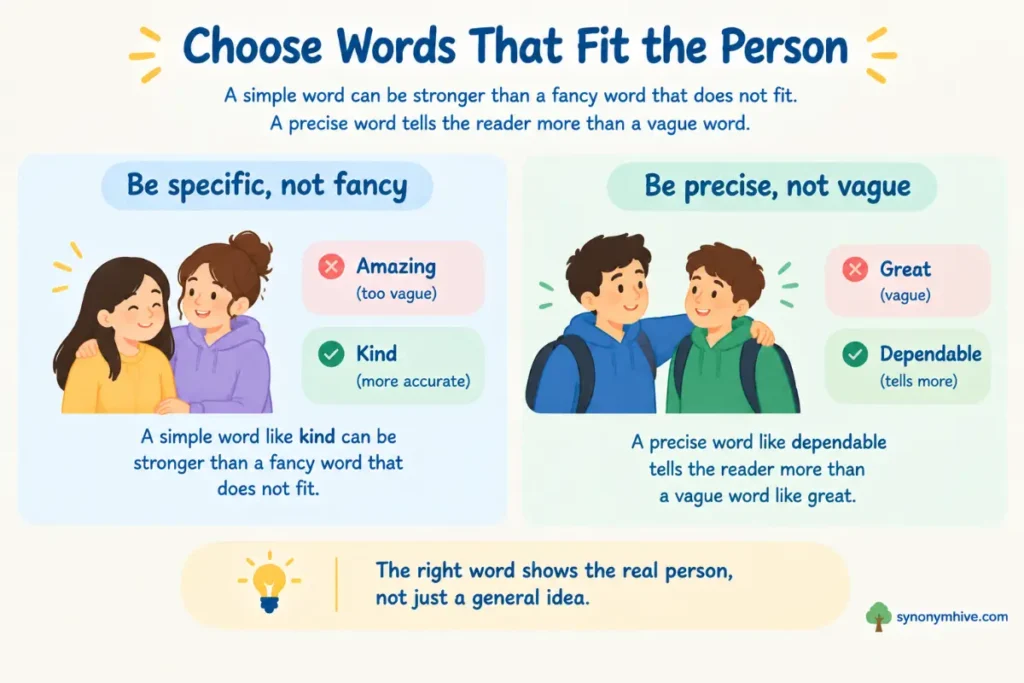
What Is the Best Overall Advice for Describing a Friend?
Choose accuracy over impressive vocabulary.
A simple word such as kind can be stronger than a fancy word that does not fit. A precise word such as dependable tells the reader more than a vague word such as great.
Think about the person’s actions. Then choose the adjective that best explains those actions.
If possible, add a short example. That turns a basic description into a memorable one.
The best words to describe a friend are not simply the most positive words. They are the words that show the person clearly and honestly.
Need another vocabulary suggestion? Read Words To Describe A Person Best Guide In 2026.
Conclusion
The best words to describe a friend depend on the quality you want to highlight. Kind and caring work for warmth. Loyal and dependable show that someone can be counted on. Honest and trustworthy focus on character. Funny, outgoing, calm, and adventurous describe personality.
Strong writing becomes more personal when you connect each word to something the person actually does. Instead of saying that a friend is thoughtful, explain how they remember important details. Instead of saying they are loyal, show how they stay beside people during hard times.
When you need to describe someone, start with their actions, identify the quality behind those actions, and choose the simplest accurate word. That approach will give you a description that sounds natural, specific, and sincere.
Frequently Asked Questions
What are the best phrases to describe a friend?
The best choices include kind, loyal, caring, honest, funny, thoughtful, supportive, dependable, trustworthy, and genuine. Pick words that match the person’s actual qualities.
What are some unique words to describe a friend?
Consider compassionate, steadfast, sincere, resilient, considerate, warmhearted, approachable, insightful, courageous, and selfless. These words can add more detail than basic choices such as good or nice.
What is another way to say a good friend?
You can say loyal friend, trusted friend, close friend, dependable friend, supportive friend, faithful friend, or valued friend. The best choice depends on the quality you want to emphasize.
How do I describe my best friend in one sentence?
Focus on two or three qualities that make the friendship special. For example, you could say, “My best friend is loyal, thoughtful, and dependable, and I can always count on her.”
What are good words to describe a friend in an essay?
Use precise words such as honest, compassionate, responsible, courageous, thoughtful, dependable, respectful, and determined. Add examples that show why each word fits.
What words describe a loyal friend?
Loyal, faithful, devoted, dependable, steadfast, supportive, committed, and trustworthy can describe a loyal friend. Loyal is the simplest and most direct choice.
Can I use these terms to describe a friend in a text message?
Yes. Casual words such as funny, awesome, sweet, kind, caring, loyal, genuine, and supportive work well in personal messages. Formal words can sound less natural in a casual text.