
Writing an email can make a simple word feel harder than it should. You might type awkward and then wonder if there’s a better choice. The same problem comes up when you’re writing an essay, a resume, a text, or a message to someone you don’t know well. If you need another word for awkward, the right choice depends on what makes the situation awkward in the first place.
Awkward can describe a social moment, a person, a movement, a design, a conversation, or a situation that doesn’t work smoothly. You might have an awkward silence after asking a difficult question. You might make an awkward movement when you trip over a chair. A piece of furniture can also be awkward if it is difficult to move or use.
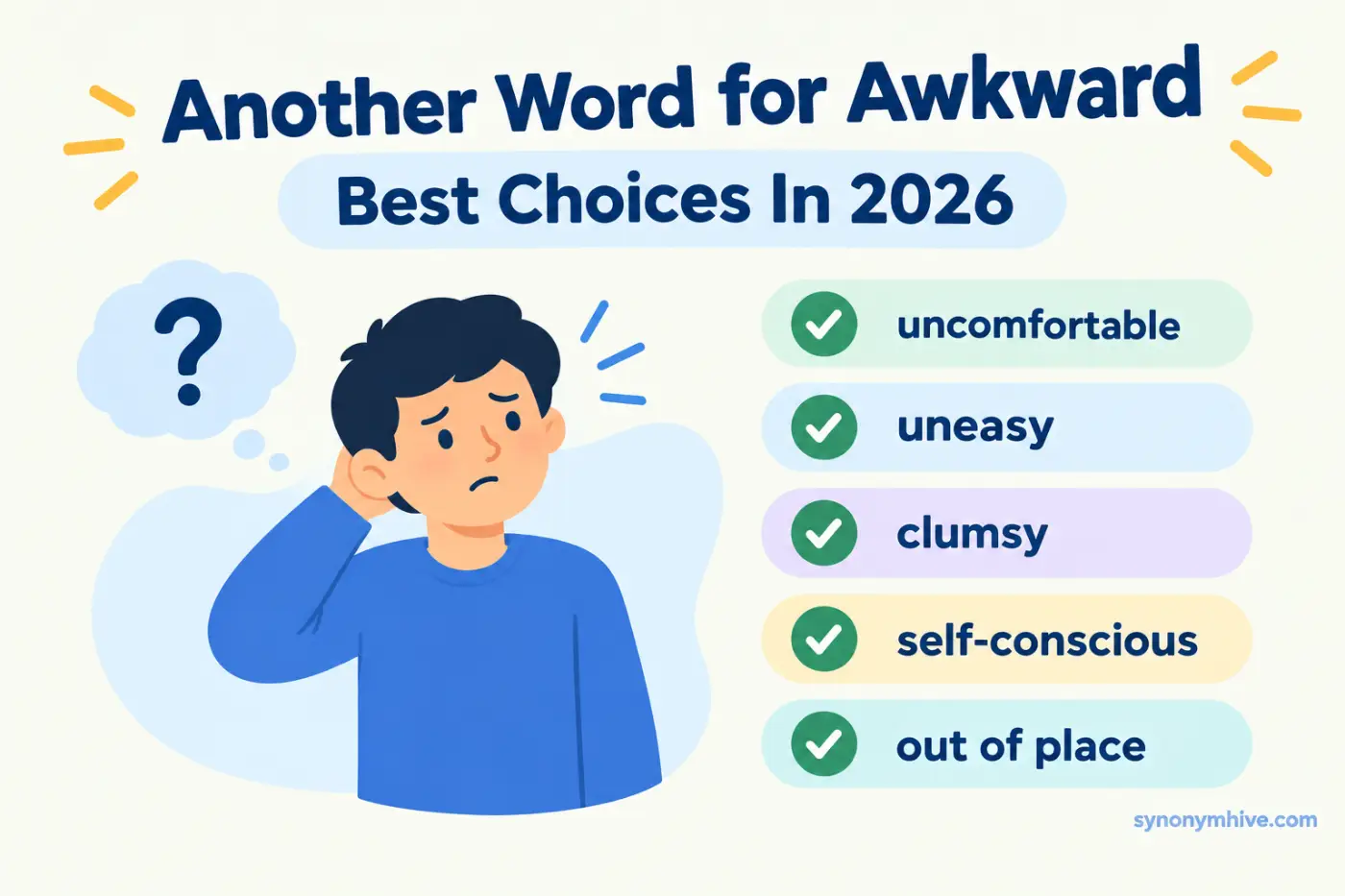
Another word for awkward can be uncomfortable, embarrassing, clumsy, uneasy, unnatural, or inconvenient. More specific choices include tense, stiff, strange, cumbersome, hesitant, or out of place. Casual speech also gives you options such as cringe, weird, sus, or off, but these words have their own meanings.
The best choice depends on your purpose and audience. This guide explains the meaning and origin of awkward, gives you more than 30 useful alternatives, compares close synonyms, covers Gen Z slang, and shows you which words work best in resumes, essays, emails, texts, and everyday speech.
Discover related words in another word for crazy Best Choices For Every Context.
What does awkward mean in simple English
Awkward means uncomfortable, difficult, unusual, or lacking ease. It can describe a moment that makes people uncomfortable, a person who has trouble acting naturally, or something that is hard to handle.
The word has several related meanings. Social awkwardness involves discomfort during an interaction. Physical awkwardness involves movement that lacks ease or control. Practical awkwardness means something is difficult to use, carry, arrange, or manage.
For example, you could say, “There was an awkward silence after the question.” Here, awkward describes social discomfort.
You could also say, “The box was awkward to carry.” In this sentence, awkward means difficult to handle.
You might say, “He made an awkward attempt to apologize.” That example suggests the person struggled to act naturally.
Context gives the word its exact meaning. That’s why a good replacement should match the kind of awkwardness you want to describe.
Where does the word awkward come from
Awkward has an interesting history. The word developed from older English words connected with the wrong or opposite direction. Over time, its meaning shifted from something being turned the wrong way to something that was difficult, clumsy, uncomfortable, or out of place.
The modern meaning grew from this idea of something not fitting smoothly.
That connection still makes sense today. An awkward movement doesn’t flow naturally. An awkward conversation doesn’t flow comfortably.
The word has been part of English for centuries, and its meanings have expanded over time. Modern speakers use it in both serious and casual situations.
Today, awkward is common in everyday American English. It also appears in school writing, workplace communication, social media, and conversations about relationships.
What is another word for awkward
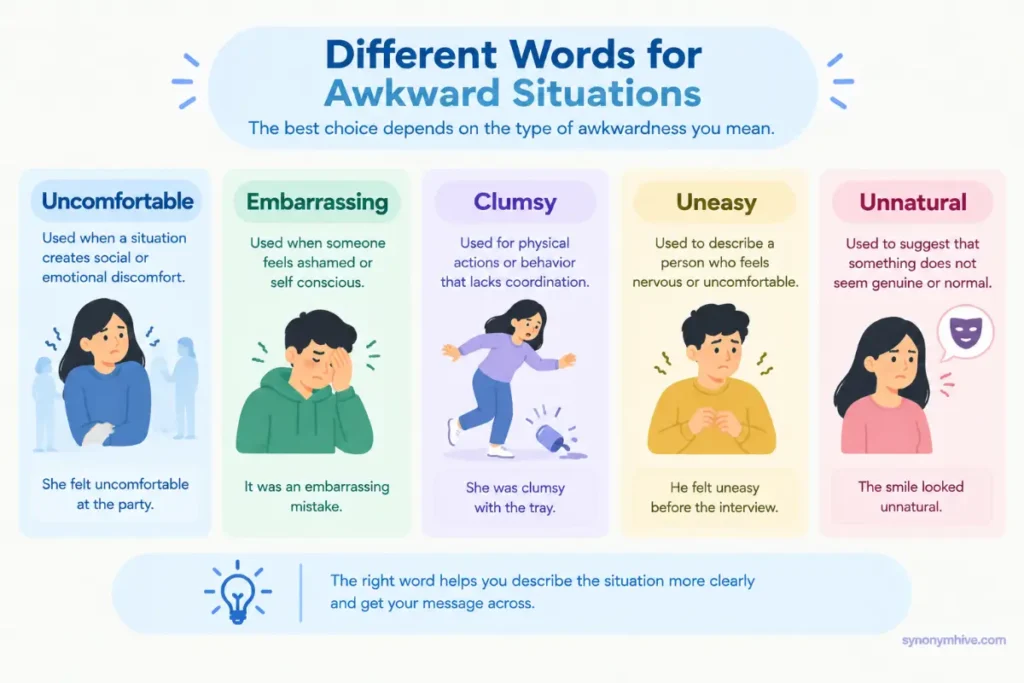
The best replacement depends on the type of awkwardness you mean. Use uncomfortable when a situation creates social or emotional discomfort. Choose embarrassing when someone feels ashamed or self conscious. Clumsy works for physical actions or behavior that lacks coordination. Uneasy describes a person who feels nervous or uncomfortable. Unnatural suggests that something does not seem genuine or normal.
For practical problems, inconvenient, cumbersome, unwieldy, or difficult may be better. For a tense conversation, strained or tense can be more precise.
Casual speakers may use cringe, weird, off, or sus. These expressions can work in texts and online conversations, but they do not have the same meaning as awkward in every situation.
What are the best synonyms for awkward
The table below gives you a wide range of alternatives. Some are close matches. Others describe one specific type of awkwardness.
| Word | Meaning | Tone | Example |
|---|---|---|---|
| Uncomfortable | Causing discomfort | Neutral | The conversation became uncomfortable. |
| Embarrassing | Causing shame or self consciousness | Everyday | The mistake was embarrassing. |
| Tense | Full of stress or discomfort | Neutral | The room became tense. |
| Difficult | Hard to do or manage | Neutral | The position was difficult to maintain. |
| Forced | Not natural or sincere | Neutral | Her laugh sounded forced. |
| Out of place | Not fitting the setting | Everyday | His joke felt out of place. |
| Uncomfortable | Creating unease or embarrassment | Everyday | The silence was uncomfortable. |
| Painful | Difficult or unpleasant to experience | Strong | The conversation was painful. |
| Cringe | Embarrassing or socially uncomfortable | Slang | That video was cringe. |
| Weird | Unusual or strange | Casual | That interaction was weird. |
| Off | Not quite right or normal | Casual | Something about the conversation felt off. |
| Sus | Suspicious or questionable | Slang | That explanation sounds sus. |
| Forced | Lacking natural ease | Everyday | The conversation felt forced. |
| Rigid | Not flexible or relaxed | Formal | His speaking style was rigid. |
| Shy | Nervous around others | Everyday | He was shy at first. |
| Reserved | Quiet and less open | Neutral | She was reserved during the meeting. |
| Self conscious | Worried about how others see you | Everyday | He became self conscious after the mistake. |
| Nervous | Worried or uneasy | Everyday | She was nervous before speaking. |
| Awkwardly | In an uncomfortable or clumsy way | Adverb | He awkwardly changed the subject. |
| Uncomfortably | In a way that causes discomfort | Neutral | They sat uncomfortably close. |
| Clumsily | In a way that lacks physical skill | Everyday | He clumsily picked up the box. |
| Tactless | Lacking care about other people’s feelings | Formal | His tactless remark changed the mood. |
| Inarticulate | Unable to express ideas clearly | Formal | He became inarticulate under pressure. |
The strongest choice comes from meaning rather than word count. You don’t need the fanciest synonym. You need the one that tells your reader what happened.
Which words describe mild awkwardness
For mild awkwardness, try unusual, uncomfortable, uneasy, off, or slightly strange.
Uncomfortable is one of the safest choices. It works in both casual and professional settings.
For example, “The conversation became uncomfortable” sounds natural and clear.
Uneasy is useful when the awkwardness comes from nervousness or doubt.
For example, “I felt uneasy after his sudden change in tone.”
Unusual is more neutral. It tells the reader that something differs from normal without saying that the situation was bad.
The casual word off works well when something seems wrong but you don’t want to explain the exact reason.
For example, “Something about that conversation felt off.”
Which words describe strong awkwardness
When the situation creates strong discomfort, embarrassing, painful, cringe, strained, or tense may work better.
Embarrassing focuses on shame or self consciousness.
A person may make an embarrassing mistake in front of a large group.
Painful can describe an interaction that is extremely difficult to watch or experience.
Cringe is a casual slang choice for behavior that causes embarrassment or secondhand discomfort.
Strained suggests that a relationship or conversation lacks natural ease.
Tense suggests stress or conflict.
These words make your writing more precise because they show what kind of discomfort is involved.
Which words describe physical awkwardness
Physical awkwardness often calls for clumsy, uncoordinated, unwieldy, cumbersome, or difficult.
Clumsy usually describes a person or movement.
For example, “He made a clumsy attempt to catch the ball.”
Uncoordinated focuses on poor control of movement.
For example, “Her first few dance steps looked uncoordinated.”
Unwieldy describes something difficult to carry, move, hold, or control.
For example, “The large box was unwieldy.”
Cumbersome often describes an object, process, or system that is difficult to manage because of its size, design, or complexity.
For example, “The old filing process was cumbersome.”
Which words describe social awkwardness
Social awkwardness can be described with uncomfortable, embarrassing, uneasy, tense, strained, hesitant, shy, reserved, or self conscious.
A person who struggles to start conversations may be shy or reserved.
Someone who worries about how others judge them may be self conscious.
A conversation with conflict may be tense or strained.
A joke that makes everyone uncomfortable may be embarrassing or cringe.
The distinction matters because social awkwardness can come from many causes.
Someone may be quiet because they are shy. Another person may seem stiff because they are nervous. Someone else may create an awkward moment by saying something tactless.
Which words describe awkward communication
When someone’s speech sounds unnatural, consider stiff, stilted, forced, hesitant, unclear, or inarticulate.
Stilted describes language that sounds too formal or unnatural.
For example, “The dialogue sounded stilted.”
Forced suggests that someone is trying too hard to create a particular reaction.
For example, “His joke felt forced.”
Hesitant describes speech that includes pauses or uncertainty.
For example, “She gave a hesitant answer.”
Inarticulate describes difficulty expressing ideas clearly.
These words can be especially useful when writing about speeches, interviews, conversations, books, movies, or public speaking.
Which word means awkward in a professional setting
Professional writing needs clear and respectful language. Awkward can sometimes sound vague, so a more specific word often works better.
If a design is difficult to use, use inconvenient, cumbersome, or unwieldy.
If a message sounds unnatural, use unclear, stiff, or overly formal.
For example, instead of saying, “The process is awkward,” you could write, “The process requires several unnecessary steps.”
That version gives the reader useful information.
What is another term for awkward on a resume
A resume should focus on facts and results rather than personal reactions.
Words such as cumbersome, inefficient, unclear, complex, time consuming, or difficult can work when they accurately describe a process.
For example, instead of writing, “The old system was awkward,” write, “The old system required several manual steps and slowed data entry.”
That sentence shows what the problem was.
Another example is, “The previous workflow was cumbersome and created unnecessary delays.”
The word cumbersome can work well on a resume because it describes difficulty without sounding emotional.
What is another word for awkward in an essay
Essays often need precise descriptions.
Use uncomfortable for social situations. Use embarrassing for moments involving shame.
For example, “The character’s apology was awkward” is broad.
A stronger sentence might say, “The character’s apology sounded forced because he avoided taking responsibility.”
The second sentence explains the awkwardness instead of simply labeling it.
What is another phrase for awkward in an email
In an email, polite wording matters.
If you need to describe an uncomfortable situation, use uncomfortable, difficult, unclear, or inconvenient.
For example, “I realize the schedule change may be inconvenient.”
That sounds much better than saying, “The schedule is awkward.”
If a conversation is difficult, you could write, “This is a difficult topic to discuss.”
If instructions are confusing, say, “The current instructions are unclear.”
Specific wording can prevent your email from sounding critical or rude.
What is another word for awkward in a text
Texts allow more casual language.
You can use weird, cringe, off, sus, uncomfortable, embarrassing, or forced.
For example, “That whole conversation was so awkward” is natural.
You could also say, “That conversation was so cringe.”
The second version has a stronger social and emotional meaning. It suggests embarrassment or secondhand discomfort.
Another casual option is, “That was so off.”
This means something seemed wrong or unusual, but it does not clearly explain why.
What is another term for awkward when speaking
In everyday speech, uncomfortable, weird, strange, embarrassing, clumsy, and tense are useful.
If you want a simple replacement, uncomfortable is usually a safe choice.
For example, “That was an uncomfortable conversation.”
If something seems unusual, use strange or weird.
If someone moves without much coordination, clumsy works better.
Spoken English gives you room to use simple words. You don’t need a formal synonym just to sound intelligent.
What is another word for awkward in Gen Z slang
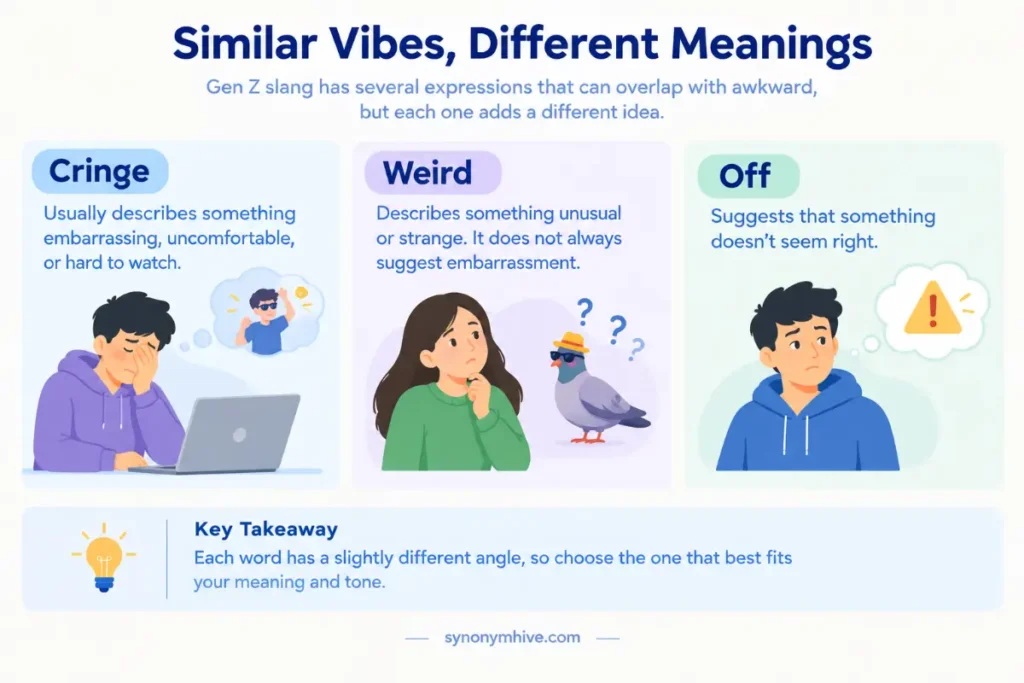
Gen Z slang has several expressions that can overlap with awkward, but each one adds a different idea.
Cringe is one of the closest casual choices. It usually describes something embarrassing, uncomfortable, or hard to watch.
Weird describes something unusual or strange. It does not always suggest embarrassment.
Off suggests that something doesn’t seem right.
Sus means suspicious. It can describe a situation that seems questionable, but it does not simply mean awkward.
Extra describes behavior that seems excessive or dramatic.
Unhinged can describe behavior that seems wildly uncontrolled or extreme. It is often used humorously online.
Out of pocket describes a comment or action that is unexpected, inappropriate, or surprising.
These expressions work best in casual conversations. They may sound out of place in a formal essay or business email.
How does awkward differ from uncomfortable
Awkward and uncomfortable overlap, but uncomfortable is often more direct about the emotional effect.
Awkward can describe the situation itself.
“There was an awkward silence.”
Uncomfortable focuses on how someone experiences the situation.
“The silence made everyone uncomfortable.”
A situation can also be awkward without causing serious discomfort.
For example, two people may briefly forget each other’s names. That moment is awkward, but it may not be deeply uncomfortable.
Use awkward for the social situation and uncomfortable for the reaction when that distinction matters.
How does awkward differ from embarrassing
Embarrassing involves shame or self consciousness.
Awkward is broader.
You can have an awkward silence without anyone doing anything embarrassing.
You can also have an embarrassing mistake that creates an awkward moment.
For example, forgetting someone’s name may be embarrassing for you and awkward for both people.
The two words often appear together because embarrassment can create social awkwardness.
How does awkward differ from clumsy
Clumsy usually refers to physical movement or handling objects.
Awkward can also describe physical actions, but its meaning is broader.
For example, “He was clumsy with the glass” suggests poor coordination.
“He made an awkward movement” could suggest that the movement looked unusual, uncomfortable, or difficult.
Clumsy focuses more strongly on physical skill.
Awkward can describe physical, social, emotional, and practical situations.
How does awkward differ from weird
Weird means unusual or strange.
Awkward usually means uncomfortable, difficult, or lacking ease.
A strange painting can be weird without being awkward.
A long silence can be awkward without being weird.
Sometimes something can be both.
For example, an unusual conversation may seem weird and awkward at the same time.
Choose weird when unusualness is the main idea. Choose awkward when discomfort or lack of ease is the main idea.
How does awkward differ from strange
Strange focuses on something being unusual.
Awkward focuses on something not working or happening smoothly.
A strange sound is unusual.
An awkward conversation is uncomfortable.
The words can overlap when an unusual situation also creates discomfort.
Still, strange does not automatically carry the social discomfort that awkward often carries.
How does awkward differ from uncomfortable
| Word | Main idea | Example |
|---|---|---|
| Awkward | A situation lacks ease or natural flow | The silence was awkward. |
| Uncomfortable | Someone experiences discomfort | The silence made me uncomfortable. |
The difference is small but useful.
If you are describing the moment itself, awkward often fits.
If you are describing a person’s reaction, uncomfortable may fit better.
How does awkward differ from inconvenient
Awkward can sometimes mean difficult to manage. Inconvenient focuses more directly on trouble caused by timing, location, arrangement, or practical circumstances.
An awkward chair may be hard to sit in.
An inconvenient appointment may happen at a difficult time.
An awkward package may be difficult to carry.
An inconvenient package might simply arrive when nobody is home.
The words overlap in some situations, but inconvenience is mainly practical.
What are natural examples of awkward synonyms
Here are examples from everyday situations.
- The silence became uncomfortable after nobody answered the question.
- His apology sounded forced and unnatural.
- The meeting became tense after the disagreement.
- She gave a hesitant answer because she wasn’t sure what to say.
- The old software was cumbersome and took too many steps to use.
- His movements looked clumsy during the dance.
- The large package was unwieldy and difficult to carry.
- That joke was embarrassing because everyone heard the wrong name.
- The conversation felt strained after their argument.
- The dialogue sounded stilted and overly formal.
- Something about the message seemed off.
- That video was so cringe that I stopped watching.
- His explanation sounded sus to everyone in the group chat.
- The seating arrangement was inconvenient for older guests.
- The character seemed self conscious during the interview.
- Her response was tactless and made the room uncomfortable.
- His writing sounded stiff because every sentence used formal language.
- The physical task was difficult because the equipment was too large.
- The sudden question made me uneasy.
- His attempt to start a conversation felt unnatural.
- The joke seemed out of place during the serious meeting.
- The repeated pauses made his speech sound hesitant.
- The old process was inefficient and difficult to manage.
- The social situation became embarrassing after the mistake was noticed.
- The conversation was strange but not necessarily uncomfortable.
These examples show why context matters. A single replacement cannot cover every meaning of awkward.
Expand your vocabulary with Another Word For Vibe Best Synonyms And Uses In 2026.
What are the best words for awkward silence
Use uncomfortable, tense, strained, quiet, or uneasy.
An awkward silence often happens when people don’t know what to say.
If the silence follows an argument, tense may be better.
If the silence simply feels uncomfortable, uncomfortable is the clearest choice.
For example, “A tense silence filled the room after the announcement.”
That sentence tells the reader that the silence carries emotional pressure.
What are the best words for an awkward person
Be careful here because labeling a person can sound harsh.
If someone is quiet around others, shy or reserved may be kinder.
If someone struggles with social situations, socially uncomfortable or self conscious may be more precise.
A person can be awkward in one situation and confident in another. Avoid treating a temporary behavior as a permanent personality trait.
What are the best words for awkward behavior
Use inappropriate, embarrassing, tactless, forced, strange, intrusive, or uncomfortable depending on the action.
An intrusive question crosses a personal boundary.
A tactless comment ignores another person’s feelings.
An inappropriate joke doesn’t fit the setting.
A forced reaction doesn’t seem natural.
An embarrassing action causes shame.
This approach makes your writing more respectful and more exact.
What are common mistakes when using awkward synonyms
One common mistake is treating every synonym as interchangeable.
They aren’t.
Clumsy describes poor physical coordination.
Embarrassing describes shame or self consciousness.
Uncomfortable describes emotional discomfort.
Weird describes something unusual.
Inconvenient describes practical difficulty.
Tense describes stress or conflict.
Cringe describes embarrassing or uncomfortable social behavior in casual speech.
Another mistake is using slang in formal writing.
A phrase such as “That was so cringe” may work in a text message. It usually doesn’t belong in a formal report.
Using a stronger word than the situation deserves is another problem.
Calling a small social mistake painful or humiliating can sound dramatic.
Choose a word that matches the actual situation.
When should you not use awkward
Avoid awkward when you can describe the problem more clearly.
If something is hard to carry, use unwieldy.
If a process takes too many steps, use cumbersome.
Specific language gives your reader more information than a broad label.
How can you sound polite instead of rude
When describing a person’s behavior, focus on what happened.
Instead of saying, “That was awkward,” you could say, “That was a little uncomfortable.”
Instead of saying, “Your message was weird,” you could say, “I wasn’t sure what you meant by that message.”
These versions give the other person room to respond.
They also reduce the chance of turning a small misunderstanding into a larger conflict.
How can you sound more professional
Professional writing benefits from facts and specific descriptions.
Instead of saying, “The meeting was awkward,” explain the problem.
“The discussion became tense after the proposal was rejected.”
Instead of saying, “The software is awkward,” say, “The software requires several unnecessary steps.”
Instead of saying, “The instructions are awkward,” say, “The instructions are unclear and difficult to follow.”
These sentences are stronger because they tell the reader what needs attention.
How can you sound more natural
Natural writing usually uses the simplest accurate word.
Don’t choose cumbersome when difficult is enough.
Don’t use formal language just to sound smart.
For everyday situations, uncomfortable, strange, embarrassing, clumsy, and uneasy are often better than rare synonyms.
Good writing isn’t about using the biggest word. It’s about using the right word.
What are the opposite words of awkward
The opposite depends on the meaning.
Smooth can describe easy physical movement.
Natural can describe behavior or speech that feels genuine.
Comfortable can describe a relaxed social situation.
Graceful can describe controlled and attractive movement.
Easy can describe something that isn’t difficult to manage.
Convenient can describe something that works well in practice.
Confident can describe a person who acts without visible hesitation.
For example, an awkward conversation can become a natural conversation.
An awkward movement can become a graceful movement.
An inconvenient arrangement can become a convenient arrangement.
How should you choose the right synonym
Start by asking what kind of awkwardness you mean.
If someone feels uncomfortable, use uncomfortable.
If someone feels ashamed, use embarrassing.
This method makes word choice much easier because you begin with meaning instead of simply searching for synonyms.
Which synonym works best by situation
| Situation | Strong choice | Reason |
|---|---|---|
| Awkward conversation | Uncomfortable | Shows social discomfort |
| Awkward silence | Tense | Shows emotional pressure |
| Awkward mistake | Embarrassing | Shows shame |
| Awkward movement | Clumsy | Shows poor coordination |
| Awkward object | Unwieldy | Shows difficulty handling it |
| Awkward process | Cumbersome | Shows too many steps or difficulty |
| Awkward relationship | Strained | Shows loss of ease |
| Awkward speech | Stilted | Shows unnatural language |
| Awkward reaction | Forced | Shows lack of natural emotion |
| Awkward person | Shy or reserved | Can sound kinder and more specific |
| Awkward question | Intrusive | Shows a boundary problem |
| Awkward joke | Embarrassing or cringe | Shows social discomfort |
| Awkward email | Unclear | Focuses on the communication problem |
| Awkward design | Inelegant | Focuses on poor design |
| Awkward online comment | Out of pocket | Casual and socially focused |
How can you remember the main differences
Think about the reason the situation doesn’t work smoothly.
Uncomfortable means it doesn’t sit well emotionally.
Embarrassing means it creates shame.
Clumsy means movement lacks control.
Uneasy means someone feels nervous.
Strange means something is unusual.
Tense means stress is present.
Strained means a relationship or interaction lacks ease.
Cumbersome means something is hard to manage.
Unwieldy means something is hard to hold or move.
Stilted means speech sounds unnatural.
Forced means behavior doesn’t seem genuine.
Cringe means something causes social embarrassment in casual language.
This simple set of meanings can help you pick the right word without checking a dictionary every time.
Why context matters when choosing another word
Imagine writing, “The interview was awkward.”
That sentence tells the reader very little.
Now compare these versions.
“The interview was embarrassing after the candidate forgot the company’s name.”
“The interview felt forced because the conversation never became natural.”
Each sentence gives a different reason.
That is the real value of choosing a precise synonym. You aren’t just replacing a word. You’re giving the reader a clearer picture.
What should you use in formal writing
For formal writing, prefer clear words that describe the specific issue.
Use uncomfortable for emotional situations.
Use strained for difficult relationships.
These choices are usually stronger than casual slang because they explain the issue without sounding overly informal.
What should you use in casual writing
Casual writing allows more personality.
You can say something was weird, cringe, off, awkward, strange, or uncomfortable.
The exact word depends on your meaning.
“That was weird” means the situation was unusual.
“That was cringe” suggests embarrassment.
“That felt off” suggests something didn’t seem right.
“That was awkward” suggests the interaction lacked natural ease.
These differences are small in casual speech, but they still matter when you want to express yourself clearly.
What should you use in Gen Z conversations
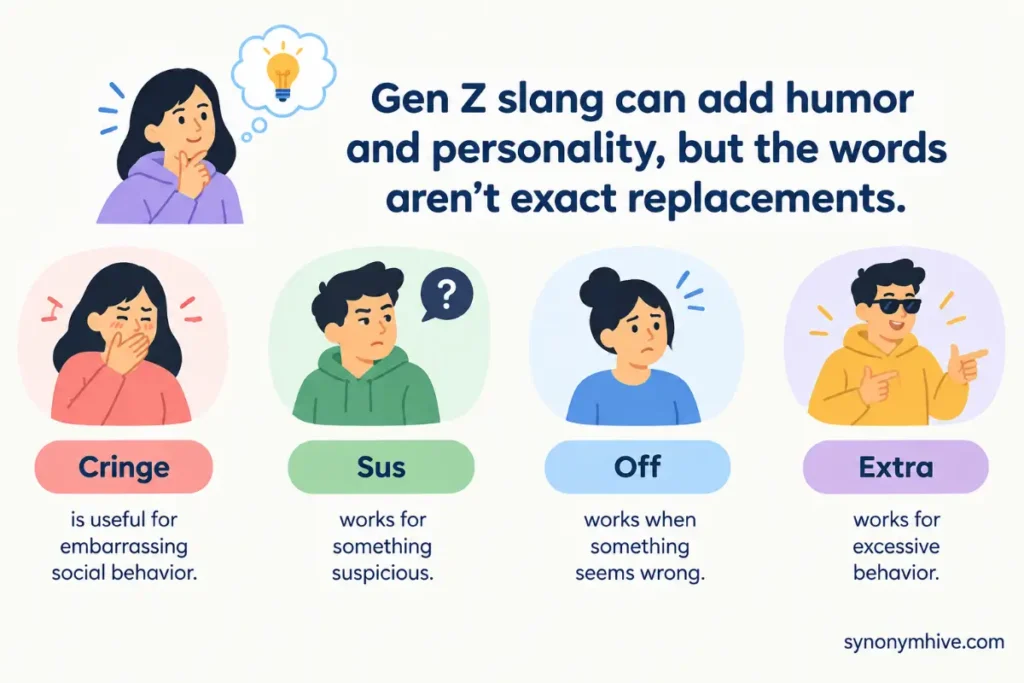
Gen Z slang can add humor and personality, but the words aren’t exact replacements.
Cringe is useful for embarrassing social behavior.
Sus works for something suspicious.
Off works when something seems wrong.
Extra works for excessive behavior.
Out of pocket works for an unexpected or inappropriate comment.
Unhinged can describe extreme or uncontrolled behavior in a humorous way.
Weird remains useful because it is simple and flexible.
The safest approach is to use slang naturally. If the word doesn’t sound like something you would normally say, a plain English alternative will probably work better.
What are the best quick replacements
If you need a fast choice, use this guide.
- Use uncomfortable for social discomfort.
- Use embarrassing for shame.
- Use clumsy for physical awkwardness.
- Use uneasy for nervousness.
- Use strange for unusual situations.
- Use tense for conflict.
- Use strained for difficult relationships.
- Use cumbersome for difficult processes.
- Use unwieldy for difficult objects.
- Use stilted for unnatural speech.
- Use forced for unnatural behavior.
- Use inconvenient for practical trouble.
- Use intrusive for unwanted personal behavior.
- Use tactless for careless comments.
- Use cringe for casual social embarrassment.
This gives you a quick answer without forcing every situation into the same word.
How can you make your writing more precise
Replace the general word with the reason behind it.
Instead of saying, “The design is awkward,” say, “The design is difficult to use.”
Instead of saying, “His response was awkward,” say, “His response sounded forced.”
This technique works in almost every kind of writing.
Find more synonyms in Another Word For Lit Best Synonyms And Slang.
Conclusion
Choosing another word for awkward starts with identifying the reason something feels difficult or uncomfortable. Uncomfortable works well for social situations. Embarrassing fits moments that create shame. Clumsy describes poor physical coordination. Strange points to something unusual. Tense and strained work well for difficult conversations or relationships.
For professional writing, more precise words such as cumbersome, inconvenient, stilted, unclear, or intrusive can make your message stronger. Casual conversations give you more freedom to use words such as cringe, weird, off, or sus.
The easiest rule is to describe the exact problem instead of reaching for a random synonym. If the issue is social discomfort, use uncomfortable. That small change can make your writing clearer and more natural.
FAQs
What is another word for awkward?
Another word for awkward can be uncomfortable, embarrassing, clumsy, uneasy, strange, tense, strained, or inconvenient. The best option depends on the exact meaning.
What’s another way to say awkward?
Another way to say awkward is uncomfortable when you mean a socially difficult or uneasy situation. You can use clumsy for physical behavior or embarrassing for a moment that causes shame.
What is a professional word for awkward?
A professional alternative depends on the situation. Cumbersome, inconvenient, unclear, strained, stilted, or difficult can describe the specific problem more clearly.
What is a Gen Z word for awkward?
Cringe is one of the closest Gen Z slang choices for socially awkward or embarrassing behavior. Weird, off, sus, and out of pocket can also work in specific casual situations.
Is awkward the same as uncomfortable?
Awkward and uncomfortable are closely related but not identical. Awkward often describes a situation that lacks natural ease, while uncomfortable focuses more on the discomfort someone experiences.
What is a stronger word for awkward?
Embarrassing, painful, tense, strained, or cringe can sound stronger depending on the situation. The best choice depends on the kind of discomfort you want to describe.
Is weird a synonym for awkward?
Weird can sometimes replace awkward in casual speech, but the meanings are different. Weird means unusual, while awkward usually suggests discomfort, difficulty, or a lack of natural ease.