
You’re writing an email, finishing an essay, updating your resume, or sending a text when annoying suddenly seems too basic. You may need another word for annoying that sounds kinder, stronger, more professional, or more natural.
Annoying describes something or someone that bothers you, irritates you, or makes a situation harder to enjoy. Still, not every irritating situation has the same meaning. A person can be bothersome without being rude. A noise can be distracting without being irritating. A repeated action can be frustrating without being offensive.
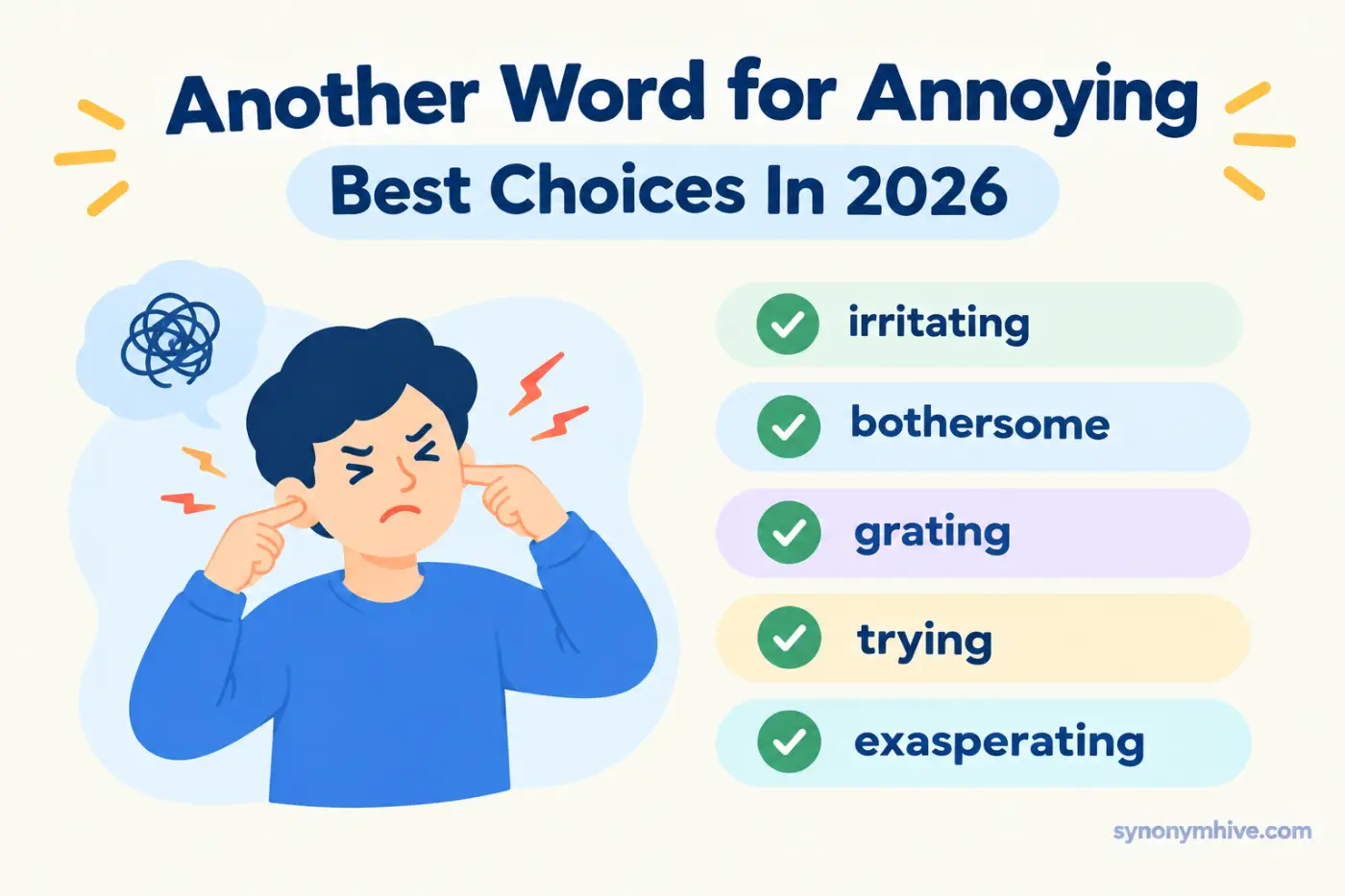
Another word for annoying can be irritating, bothersome, frustrating, aggravating, troublesome, distracting, pesky, or obnoxious.
The best choice depends on your meaning and audience. This guide covers everyday synonyms, formal choices, Gen Z slang, intensity levels, examples, close word comparisons, and the best options for resumes, essays, emails, texts, and conversations.
Discover another helpful synonym list in Another Word For Vibe Best Synonyms And Uses In 2026.
What does annoying mean in simple English
Annoying means causing irritation, bother, inconvenience, or frustration. It describes something that gets on your nerves or makes a situation less pleasant.
For example, a loud alarm can be annoying because it interrupts your morning. A person who keeps interrupting you can be annoying because the behavior makes conversation difficult. A website that keeps showing popups can be annoying because it interrupts what you are trying to do.
The word usually expresses a negative reaction. However, the strength can vary. Saying that a tiny delay is annoying is mild. Calling someone’s behavior obnoxious is much stronger.
What is another word for annoying
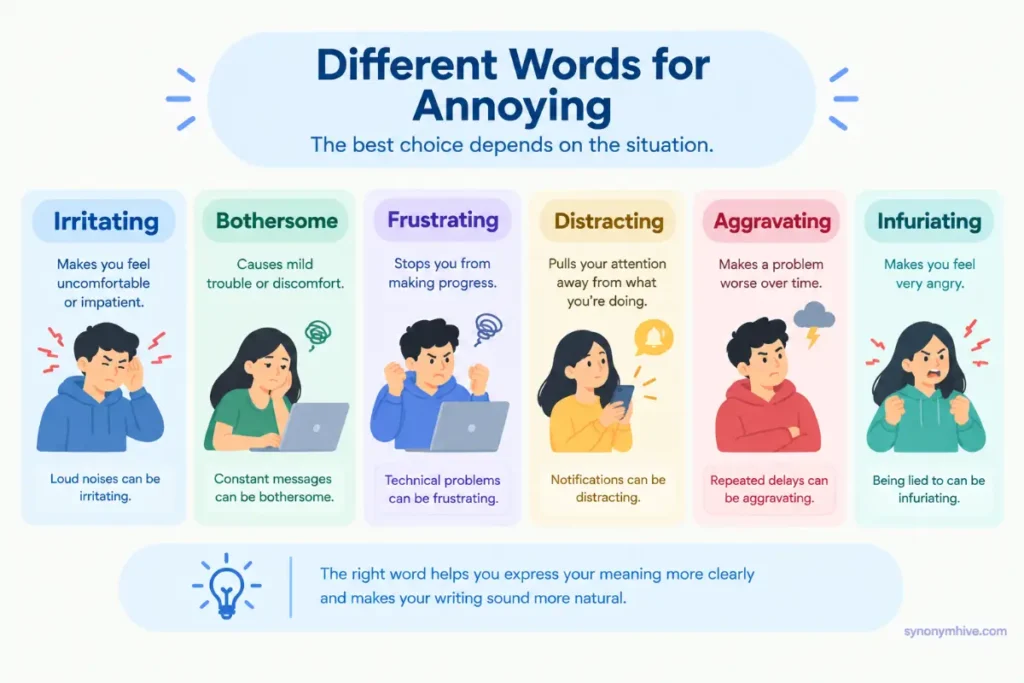
The best replacement depends on the kind of annoyance you mean. Use irritating or bothersome for general situations. Choose frustrating when something blocks your progress. Use distracting when something takes your attention away. Try aggravating when something repeatedly makes a problem worse. For stronger criticism, obnoxious, unbearable, or infuriating may fit.
Casual speech also gives you choices such as pesky, nagging, cringe, extra, or doing too much. Slang changes quickly, so casual expressions work best with people who understand the style.
Where does the word annoying come from
Annoying comes from the verb annoy. The word has a long history in English and traces back through French to Latin roots connected with causing trouble, harm, or vexation.
Over time, annoy developed into the familiar modern meaning of causing irritation or bother. The word now appears in everyday speech, school writing, workplace communication, product reviews, and casual online conversations.
The related forms are easy to recognize. Annoy is the verb. Annoying is the adjective used for something that causes irritation. Annoyed describes the person experiencing the irritation. Annoyance is the noun for the feeling or problem.
Consider these sentences.
The constant noise annoys me.
The constant noise is annoying.
I am annoyed by the constant noise.
The constant noise is a major annoyance.
The basic idea stays connected, but the grammar changes.
What are the best synonyms for annoying
The English language has many ways to describe irritation. Some words are mild and polite. Others are blunt and emotional. A few are mainly used in casual speech.
| Word | Meaning | Tone | Example |
|---|---|---|---|
| Irritating | Causing mild or strong irritation | Neutral | The repeated alerts are irritating. |
| Bothersome | Causing trouble or discomfort | Mild | The constant buzzing is bothersome. |
| Frustrating | Making it hard to achieve something | Neutral | The slow website is frustrating. |
| Aggravating | Making a problem more irritating | Strong | The repeated error is aggravating. |
| Troublesome | Causing difficulty or problems | Formal | The faulty system is troublesome. |
| Distracting | Taking attention away | Neutral | The loud music is distracting. |
| Pesky | Small but repeatedly bothersome | Casual | A pesky fly kept landing nearby. |
| Obnoxious | Very unpleasant or offensive | Strong | His obnoxious behavior upset everyone. |
| Exasperating | Causing strong frustration | Formal | The repeated delays were exasperating. |
| Vexing | Difficult and irritating | Formal | The technical issue was vexing. |
| Exasperating | Making someone very frustrated | Formal | The repeated mistakes were exasperating. |
| Cringe | Embarrassing or uncomfortable | Slang | That post was cringe. |
| Extra | Excessive or unnecessarily dramatic | Slang | His reaction was extra. |
| Doing too much | Acting in an excessive way | Slang | She is doing too much over a small issue. |
This list shows why one simple synonym does not always work. Irritating is broad. Frustrating points to blocked progress. Distracting focuses on attention. Obnoxious suggests behavior that is strongly unpleasant. Infuriating points to intense anger.
Which words are mild alternatives
Choose bothersome, unpleasant, pesky, irksome, or tiresome when the annoyance is real but not severe.
Bothersome is especially useful when something causes minor trouble. It can describe a sound, task, habit, or small problem.
For example, “The loose button is bothersome” tells the reader that the problem is inconvenient without making it sound serious.
Pesky has a playful quality. It often describes small things that keep causing trouble.
For example, “A pesky fly kept buzzing around my desk.”
Unpleasant is even more neutral. It simply says that something is not enjoyable.
Tiresome focuses on something that becomes tiring or boring because it continues for too long.
These choices work well when you want to complain without sounding overly harsh.
Which words are medium strength
Irritating, frustrating, aggravating, distracting, disruptive, grating, and inconsiderate usually sit in the middle.
Irritating is one of the easiest replacements because it closely matches the basic meaning.
Frustrating is better when something prevents you from getting what you need.
Aggravating suggests that something makes an existing problem worse or keeps testing your patience.
Distracting is more specific. It describes something that pulls your attention away from what matters.
Disruptive describes something that interrupts an activity, process, meeting, class, or routine.
Grating often describes a sound, voice, manner, or behavior that becomes more unpleasant the longer it continues.
Inconsiderate describes behavior that fails to respect other people’s needs.
Which words are strong alternatives
Use obnoxious, infuriating, unbearable, maddening, offensive, or exasperating when the situation creates a much stronger reaction.
Obnoxious often describes behavior, noise, attitudes, or people who are extremely unpleasant.
Infuriating means something makes you very angry.
Unbearable means the situation has become too unpleasant to tolerate.
Maddening describes something that causes intense frustration.
Offensive has a different focus. It means something causes anger, insult, or hurt because of what was said or done.
Exasperating describes deep frustration caused by repeated problems or behavior.
These words should not replace annoying automatically. They can make your statement sound much stronger.
What is another word for annoying in formal writing
Formal writing needs precise language. Instead of using annoying, consider irritating, troublesome, disruptive, distracting, inconvenient, problematic, or frustrating.
The best option depends on the issue.
If a sound interrupts work, use distracting or disruptive.
If a process creates repeated problems, use troublesome or frustrating.
For example, instead of writing, “The software has an annoying error,” you could write, “The software has a recurring error that disrupts the workflow.”
The second version gives the reader more useful information.
What is another term for annoying on a resume
A resume usually should not describe a person, task, or workplace as annoying. That kind of wording can sound emotional or negative.
Instead, describe the actual challenge. Words such as challenging, demanding, repetitive, time consuming, inefficient, distracting, or difficult can work better.
For example, avoid writing, “I handled annoying customer complaints.”
A stronger resume sentence would be, “I handled challenging customer concerns while maintaining a professional response.”
If you are describing a process that caused delays, say, “I improved an inefficient process that slowed customer service.”
The goal is to show what happened and how you responded. A resume works better when it focuses on facts and results.
Resume example
Weak: The old system was annoying to use.
Better: The outdated system created repeated delays in daily operations.
Best: I helped streamline an outdated system and reduced delays in daily operations.
The final sentence turns a complaint into an achievement.
What is another word for annoying in an essay
An essay usually benefits from words that explain the exact problem.
Use irritating when something causes repeated discomfort.
Use distracting when something interrupts attention.
For example, “The character’s annoying behavior” is vague.
“The character’s repeated interruptions create tension during the discussion” is much more precise.
Academic writing does not require complicated vocabulary. It needs clear vocabulary that tells the reader exactly what is happening.
What is another phrase for annoying in an email
Professional emails require care because tone can be easy to misread.
Instead of calling something annoying, describe the problem.
Say “The repeated notifications are distracting” if they interrupt your work.
Say “The repeated requests are becoming difficult to manage” if someone keeps asking for the same thing.
These choices sound more professional because they focus on the situation rather than attacking a person.
Email example
Instead of saying, “The constant emails are annoying,” write, “The frequent emails are making it difficult to keep up with the current project.”
That sentence explains the effect without sounding hostile.
What is another word for annoying in a text
Texts allow much more freedom.
You can use irritating, frustrating, bothersome, pesky, exhausting, ridiculous, cringe, extra, chaotic, or doing too much depending on your tone.
For example, “That notification is annoying” is simple and natural.
“That notification is getting on my nerves” sounds more expressive.
“That notification is so extra” gives it a slang tone.
“That whole situation is exhausting” focuses on the emotional effect.
“That was cringe” works when something was embarrassing or uncomfortable.
The right choice depends on your relationship with the person and the style of the conversation.
What is another word for annoying when speaking
In conversation, irritating, frustrating, bothersome, aggravating, pesky, ridiculous, and obnoxious are common.
You can also use short phrases.
“That gets on my nerves.”
“That drives me crazy.”
“That really bothers me.”
“That’s starting to wear me out.”
“That’s getting old.”
These expressions often sound more natural than formal synonyms.
Still, the phrase you choose should match the situation. “That gets on my nerves” works well for everyday conversation. “That behavior is unacceptable” is better when you need to make a serious complaint.
What are the best Gen Z slang words for annoying
Gen Z slang does not have one perfect replacement for annoying. Different words highlight different kinds of behavior.
Cringe can describe something embarrassing or uncomfortable.
Extra can describe someone who is being dramatic or excessive.
Doing too much suggests that someone is overreacting or taking something too far.
Out of pocket can describe a comment or action that seems inappropriate or unexpectedly bold.
Unhinged can describe behavior that seems wildly unreasonable or uncontrolled.
Chaotic describes disorderly or unpredictable behavior.
Corny can describe something that seems overly sentimental, predictable, or embarrassing.
These words are casual. They work best in texts, social media, chats, and conversations with people who understand current slang.
They are poor choices for resumes and most professional emails.
How do synonyms change by part of speech
Annoying is an adjective. It describes the thing that causes irritation.
Annoy is a verb.
Annoyed is an adjective that describes the person experiencing irritation.
Annoyance is a noun.
For example, “The noise is annoying” describes the noise.
“The noise annoys me” uses the verb.
“I am annoyed by the noise” describes the person’s reaction.
“The noise is a constant annoyance” uses the noun.
The same pattern appears with several related words.
Irritating describes the cause.
Irritated describes the person.
Irritation describes the feeling.
Frustrating describes the cause.
Frustrated describes the person.
Frustration describes the feeling.
This difference matters because using the wrong form can change the meaning of your sentence.
What are examples of annoying synonyms in real sentences
The best way to understand synonyms is to see them in natural situations.
The construction noise outside my window is distracting.
That repeated error message is frustrating.
The constant buzzing became irritating after a few minutes.
His repeated interruptions were inconsiderate.
The slow checkout process was bothersome.
A pesky fly kept landing on my food.
The loud music was disruptive during the meeting.
Her repeated complaints became tiresome.
The endless paperwork was tedious.
His behavior at dinner was obnoxious.
The constant delays were aggravating.
That alarm became unbearable after an hour.
The unfair decision was infuriating.
The speaker’s tone was grating.
The sudden change in plans was frustrating.
The intrusive advertisements made the website difficult to use.
The repeated questions became exasperating.
That comment was offensive rather than simply irritating.
His reaction was extra for such a small problem.
That video was cringe.
The group chat became chaotic within minutes.
His response was completely out of pocket.
She was doing too much over a simple mistake.
These examples show how the meaning shifts. A distracting noise takes attention away. A frustrating problem blocks progress. An offensive comment causes hurt or anger. An obnoxious person creates a stronger negative reaction.
Is irritating stronger than annoying
Irritating and annoying are very close in meaning.
Irritating often sounds a little more direct or descriptive. Annoying is more common in casual speech.
For example, “That noise is annoying” sounds natural and conversational.
“That noise is irritating” sounds slightly more deliberate.
Neither word always means something stronger. The context determines the force.
If you want a simple everyday word, annoying works well. If you want a slightly more polished alternative, irritating is often a good choice.
Is frustrating the same as annoying
Frustrating and annoying overlap, but frustration usually involves an obstacle.
A slow website can be annoying because it takes longer than expected.
It can be frustrating because the delay prevents you from completing your task.
That difference matters.
Annoyance is about irritation.
Frustration is often about blocked progress or unmet expectations.
A child repeatedly tapping a pencil may be annoying.
A computer that crashes just before you save your work is frustrating.
The same event can be both.
Is aggravating the same as irritating
Aggravating means causing irritation, but it can also suggest that a problem becomes worse.
For example, “The delay was irritating” simply describes your reaction.
“The delay was aggravating the situation” means the delay made the existing problem worse.
In casual American English, aggravating can also mean very irritating.
That gives the word two closely related uses. Context tells you which meaning the speaker intends.
Is bothersome a polite word for annoying
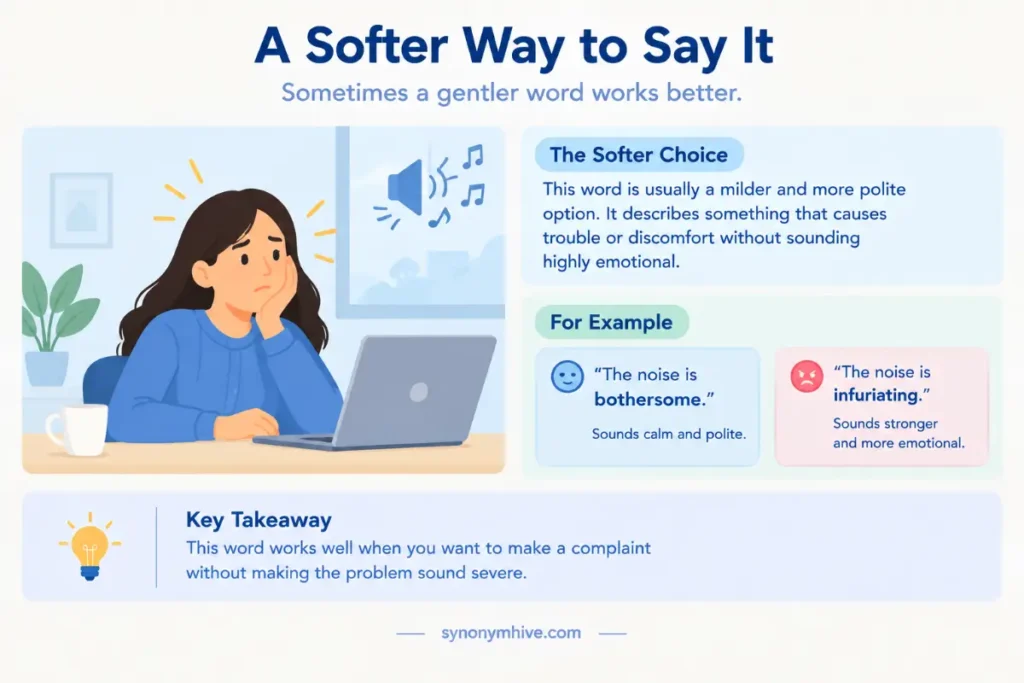
Yes. Bothersome is usually a softer and more polite choice.
It describes something that causes trouble or discomfort without sounding highly emotional.
For example, “The noise is bothersome” sounds calmer than “The noise is infuriating.”
Bothersome works well when you want to make a complaint without making the problem sound severe.
It is especially useful in polite conversations and mild criticism.
Is obnoxious stronger than annoying
Yes. Obnoxious usually carries a stronger negative judgment.
Calling a person obnoxious suggests that their behavior is very unpleasant, offensive, loud, rude, or attention seeking.
Calling the same person annoying is less severe.
For example, “His jokes are annoying” simply says the jokes bother you.
“His jokes are obnoxious” suggests that his behavior is much harder to tolerate.
Use obnoxious carefully because it can sound personal and insulting.
Looking for another word? See Another Word For Lit Best Synonyms And Slang.
Is distracting the same as annoying
No. Distracting focuses on attention rather than irritation.
A loud fan can be distracting because it makes it hard to concentrate.
It may also be annoying, but the two words describe different effects.
Something can be distracting without being irritating. A fascinating conversation outside your office can distract you even if you enjoy listening to it.
Something can also be annoying without distracting you. A slightly uncomfortable chair may bother you while you continue working.
Is tedious the same as annoying
Tedious means boring because something is long, repetitive, or dull.
A task can be tedious without being annoying.
For example, entering hundreds of names into a spreadsheet may be tedious because the work is repetitive.
It becomes annoying if the process also causes frustration or irritation.
Tedious is therefore a useful replacement only when boredom or repetition is the main issue.
What are common mistakes with these words
One common mistake is using strong words for small problems.
Calling a short delay infuriating may sound dramatic if the delay had little effect.
Another mistake is using obnoxious for a simple inconvenience. Obnoxious usually carries a judgment about behavior or character.
A third mistake is using frustrating when you only mean unpleasant. Frustrating suggests that something prevents progress or creates a sense of failure.
A fourth mistake is using distracting when you mean irritating. Something can interrupt attention without actually bothering you.
A fifth mistake is using slang in formal writing. Words such as cringe, extra, unhinged, and out of pocket can sound out of place in school or workplace documents.
A sixth mistake is describing people with vague labels. Instead of saying someone is annoying, explain the behavior when the context is serious.
For example, “He is annoying” tells the reader very little.
“He repeatedly interrupts other people during meetings” gives a clear reason for the criticism.
When should you not use annoying
Annoying is perfectly normal in casual English. You do not need to avoid it just because another synonym exists.
However, you should choose a more precise word when the situation calls for it.
Use distracting when attention is the main problem.
Use frustrating when progress is blocked.
Specific words make your writing clearer and more credible.
What are the antonyms of annoying
The opposite of annoying depends on the situation.
Pleasant describes something enjoyable.
Enjoyable describes something that gives you pleasure.
Helpful describes something that makes a task easier.
Convenient describes something that saves effort or time.
Calming describes something that reduces stress.
Comforting describes something that provides emotional support or ease.
Considerate describes someone who thinks about other people’s needs.
Polite describes behavior that follows good social manners.
Interesting can also work when the opposite of boring is what you mean.
For example, the opposite of an annoying sound may be a pleasant sound. The opposite of an annoying person may be a considerate person. The opposite of an annoying task may be an enjoyable or easy task.
How can you choose the right synonym quickly
Start with the reason something bothers you.
If it simply bothers you, choose irritating.
If it causes inconvenience, choose bothersome.
The fastest way to pick the right word is to ask what effect the thing has on you or other people.
How can you make your writing more precise
Instead of searching for a synonym first, identify the exact problem.
Suppose you write, “The meeting was annoying.”
Ask yourself what made it annoying.
Maybe the speaker repeated the same point.
Maybe nobody made a decision.
Each problem needs a different word.
If the room was noisy, the environment was distracting.
If nobody made a decision, the meeting was frustrating.
This method creates better writing because you are explaining the problem instead of placing one broad label on it.
How can you sound polite when something bothers you
Polite language often focuses on the situation instead of attacking a person.
Instead of saying, “You are annoying,” say, “I’m having trouble concentrating with the noise.”
Instead of saying, “That question is annoying,” say, “Could we focus on the main issue first?”
These sentences still communicate a problem. They simply reduce the chance of creating conflict.
How can you sound stronger without sounding rude
Choose a word that explains the specific effect.
“Annoying” can sound vague.
“Irritating” makes the discomfort clearer.
“Frustrating” explains that progress is being blocked.
“Disruptive” shows that something is interrupting normal activity.
“Inconsiderate” points to a lack of thought for others.
“Unacceptable” goes further and signals that a behavior should stop.
This approach is stronger than simply using a harsher adjective.
How can you use annoying synonyms in conversation
Natural conversation does not always require a fancy synonym.
A person might say, “That’s annoying.”
Another person might say, “That’s getting on my nerves.”
Someone else might say, “That’s really frustrating.”
A friend might say, “That’s so extra.”
A coworker might say, “That’s pretty disruptive.”
All of these can work because the speakers have different goals.
Casual speech often favors short familiar words. Professional speech usually benefits from precise and neutral wording. Academic writing needs clear descriptions that support the writer’s point.
Quick guide to the best choices
| Situation | Best choice | Why |
|---|---|---|
| General irritation | Irritating | Close to annoying |
| Small inconvenience | Bothersome | Soft and polite |
| Blocked progress | Frustrating | Shows an obstacle |
| Worsening a problem | Aggravating | Shows added irritation |
| Loss of attention | Distracting | Focuses on concentration |
| Interrupted activity | Disruptive | Shows interference |
| Repetitive work | Tedious | Focuses on boredom |
| Repeated complaints | Tiresome | Shows mental fatigue |
| Rude behavior | Inconsiderate | Shows lack of thought |
| Very unpleasant behavior | Obnoxious | Strong negative judgment |
| Strong anger | Infuriating | Shows intense emotion |
| Hard to tolerate | Unbearable | Shows extreme discomfort |
| Embarrassing online behavior | Cringe | Casual slang |
| Overly dramatic behavior | Extra | Casual slang |
| Wild online behavior | Unhinged | Casual slang |
| Excessive behavior | Doing too much | Casual slang |
How do you avoid repeating the same synonym
Avoid replacing annoying with irritating in every sentence. That simply creates a new form of repetition.
Instead, describe different parts of the situation.
For example, you could write that a software update was distracting because of constant alerts. The repeated installation failures were frustrating. The long setup process was tedious. The unexpected restart was disruptive.
Now each word adds information.
Good word choice is not about finding one perfect replacement. It is about choosing the word that tells the reader something useful.
Why context matters more than the biggest synonym
A stronger word is not always a better word.
If a minor inconvenience is called unbearable, readers may think the writer is exaggerating.
If a creative method is called weird, the word may make something positive sound negative.
Context controls meaning.
A good writer chooses the word that fits the situation, audience, and purpose. That is why unusual vocabulary should not replace plain English just for the sake of variety.
What should you use in professional communication
Professional communication usually benefits from neutral words.
Use inconvenient for problems involving time or effort.
Use distracting for interruptions to concentration.
These choices are more useful than saying something is annoying because they explain what needs to change.
What should you use when describing a person
Think about the behavior rather than labeling the person.
If someone talks over others, call the behavior interruptive or inconsiderate.
If someone ignores social rules, rude or inappropriate may fit.
A specific description usually sounds more fair than a broad insult.
What should you use for a sound
Different sounds call for different words.
Use irritating for a sound that bothers you.
Use distracting when it makes concentration difficult.
For example, “The alarm was annoying” works in everyday speech.
“The alarm was shrill and distracting” tells the reader much more.
What should you use for a task
A task can be annoying for many reasons.
Use tedious if it is repetitive.
Use frustrating if it is difficult because of obstacles.
These words give a reader information that annoying cannot provide on its own.
What should you use for technology
Technology often creates several types of problems.
A constant notification can be distracting.
A slow application can be frustrating.
A confusing menu can be difficult to use.
A repeated error can be aggravating.
An intrusive advertisement can interrupt the user experience.
A system that crashes repeatedly can be unreliable.
This kind of precise language is especially useful in product reviews, support messages, and workplace reports.
What should you use for social situations
Social annoyance often involves behavior.
Someone who constantly interrupts may be inconsiderate.
Someone who talks loudly in a quiet place may be disruptive.
The exact word depends on the behavior you want to highlight.
What should you use for social media
Social media language can be casual.
Cringe is useful for embarrassing posts or behavior.
Extra works for exaggerated reactions.
Chaotic works for messy or unpredictable situations.
Unhinged works for extremely wild behavior.
Out of pocket works for unexpected or inappropriate comments.
Doing too much works when someone seems to be overreacting.
Still, slang has a short shelf life. A phrase that sounds natural today may sound dated later. Use current slang when it fits your audience rather than forcing it into every sentence.
What is the easiest way to remember these words
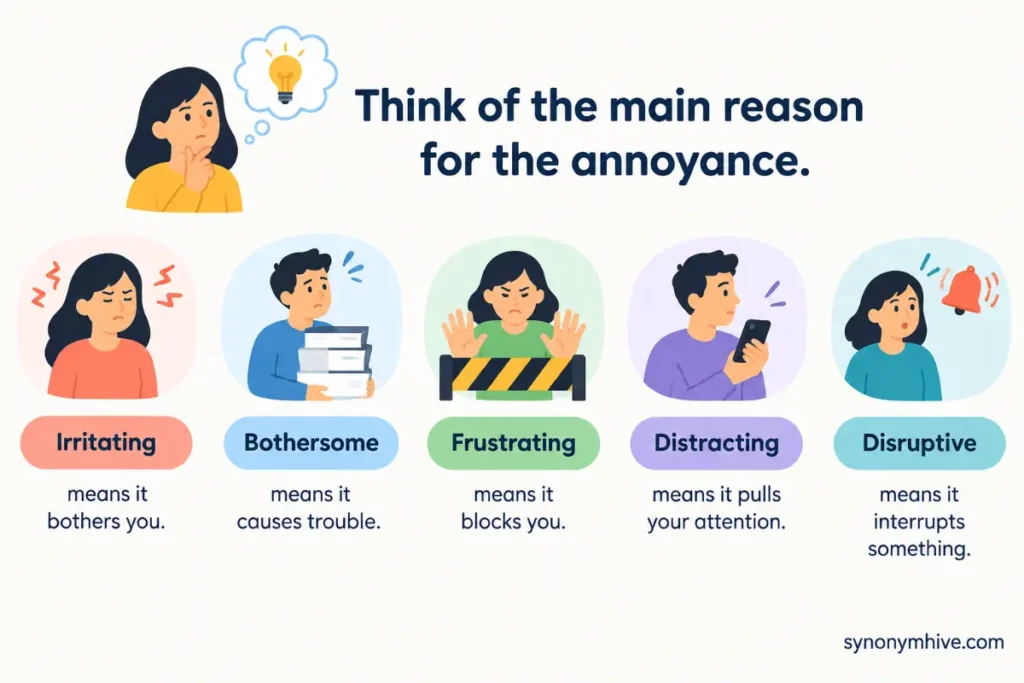
Think of the main reason for the annoyance.
Irritating means it bothers you.
Bothersome means it causes trouble.
Frustrating means it blocks you.
Distracting means it pulls your attention.
Disruptive means it interrupts something.
Tedious means it bores you.
Inconsiderate means someone failed to think about others.
Obnoxious means the behavior is strongly unpleasant.
Infuriating means it makes you very angry.
Unbearable means you cannot tolerate it.
This simple system is easier to remember than a long list of isolated synonyms.
Need another vocabulary suggestion? Read another word for crazy Best Choices For Every Context.
Conclusion
Choosing another word for annoying becomes easier when you identify the exact reason something bothers you. Irritating works as a close everyday replacement. Frustrating fits problems that block progress. Distracting describes something that takes your attention away, while disruptive describes an interruption to normal activity. For stronger reactions, words such as aggravating, obnoxious, infuriating, and unbearable carry more force.
Professional writing usually works best with precise and neutral language. Casual texts give you more freedom to use slang such as cringe, extra, chaotic, or doing too much.
You don’t need the strongest synonym. You need the clearest one. Ask what is actually happening, choose the word that describes it, and let the context guide your tone.
Frequently Asked Questions
What is another word for annoying?
Another word for annoying is irritating, bothersome, frustrating, aggravating, distracting, disruptive, troublesome, or obnoxious. The best choice depends on the exact reason something bothers you.
What’s another way to say annoying?
Another way to say annoying is irritating or bothersome for a general situation. Frustrating works for blocked progress, while distracting works for something that interrupts your attention.
What is a professional word for annoying?
Professional alternatives include irritating, distracting, disruptive, troublesome, inconvenient, frustrating, and problematic. Choose the word that describes the actual issue instead of using a broad label.
What is a Gen Z word for annoying?
Gen Z slang can use words such as cringe, extra, chaotic, unhinged, out of pocket, and doing too much. These expressions are casual and work best in texts, chats, and social media.
Is frustrating the same as annoying?
Frustrating and annoying are related but not identical. Annoying means something causes irritation, while frustrating usually means something prevents progress or fails to meet expectations.
Is obnoxious stronger than annoying?
Yes. Obnoxious usually expresses a stronger negative judgment about behavior, a person, noise, or an attitude. It can sound insulting, so use it with care.
What is a polite word for annoying?
Bothersome is often a polite alternative to annoying. Unpleasant, inconvenient, distracting, or troublesome can also work depending on the situation.