
You’re writing an essay and suddenly notice that you’ve used example several times. The word works, but repeating it can make your writing feel flat. That’s when finding another word for example can help you make your point with more variety and precision.
The best replacement depends on what you mean. You might need a simple word such as sample or case. In academic writing, instance or illustration may fit better. In casual speech, you might simply say like or say when introducing an idea. The best alternatives to example include instance, sample, case, illustration, model, specimen, demonstration, and scenario. Use the word that matches your meaning, tone, and context.
Good word choice isn’t about using the fanciest synonym you can find. It’s about helping the reader understand your point without stopping to decode your language. This guide covers the origin and meaning of example, more than 30 alternatives, differences between close synonyms, and the best choices for essays, resumes, emails, texts, and everyday speech.
You may also like Another Word for Explains Best Alternatives 2026.
another word for example In Simple English
What does example mean?
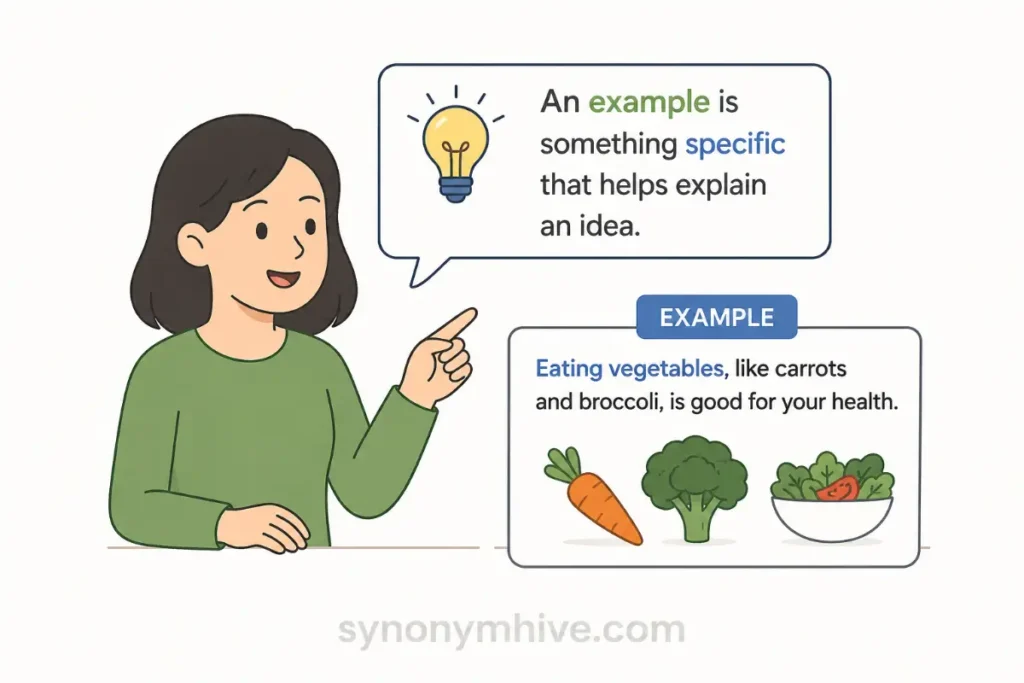
An example is a person, thing, situation, or action that helps explain an idea. It gives the reader something specific to look at instead of leaving the idea as a general statement.
Think about the difference between these two sentences.
Healthy foods can improve your diet.
For example, fresh fruit, vegetables, beans, and whole grains can improve your diet.
The second sentence gives the reader something concrete. It turns a broad idea into something easier to understand.
Example can also mean a person or action that others can follow.
Her patience is an example of good leadership.
In that sentence, her behavior represents a quality that other people can learn from.
The word can also describe something that represents a larger group.
This painting is an example of modern American art.
So the meaning changes slightly with context. Sometimes example means a specific case. Sometimes it means a model.
Where did example come from?
Example comes from the Old French word exemple. It ultimately traces back to the Latin word exemplum, which meant a sample, pattern, model, or illustration.
That history explains why example has several related meanings today. An example can show what something looks like. It can serve as a model to follow. It can also represent a larger idea.
English has used example for centuries, and it remains one of the most common words for introducing evidence or explaining a concept.
Because the word is so common, writers often repeat it without noticing. Repetition isn’t always bad. Sometimes repeating a familiar word keeps writing clear. Still, changing the word at the right moment can make your writing smoother.
Why do writers use examples?
Examples give ideas a real shape.
Suppose you write this sentence.
Good communication matters at work.
The statement is true but broad. A reader might wonder what good communication actually looks like.
Now consider this.
For instance, a manager who explains a project clearly can help employees avoid costly mistakes.
The second sentence gives the reader a real situation. The abstract idea becomes easier to picture.
Examples are especially useful in essays because they connect claims with evidence. They’re also useful in teaching, business writing, presentations, emails, and everyday conversation.
A good example should support the point rather than distract from it.
What is the simplest replacement?
The simplest replacement is often sample, case, or instance.
Sample works well when you mean one item that represents a larger group.
Case works well when you mean a particular situation.
Instance works well when you mean one occurrence or specific case.
For example.
The survey included a sample of 500 customers.
This is a different meaning from.
This case shows why careful planning matters.
And it differs again from.
In one instance, the company changed its policy.
Choosing the right word starts with understanding the exact idea behind the sentence.
What are the most useful alternatives?
Here are some of the most useful choices.
Sample means one item or group that represents something larger.
Instance means a particular occurrence or case.
Case means a specific situation.
Illustration means something that helps explain an idea.
Model means something that can represent or guide others.
Specimen means a specific item used for study or inspection.
Demonstration means an action or presentation that shows how something works.
Scenario means a possible or imagined situation.
Exhibit means an object or item displayed for viewing or study.
Pattern means an example that shows a repeated form or behavior.
Prototype means an early version used as a model for something that may be developed later.
Representation means something that stands for or depicts another idea.
Case study means a detailed examination of a particular person, group, event, or situation.
Instance is especially useful in formal writing when you want to identify one specific occurrence.
Sample is especially useful in research when one group represents a larger population.
Master Synonyms For Example
The table below groups useful alternatives by tone and purpose. Some words can fit more than one group depending on the sentence.
| Word | Meaning | Tone | Example |
|---|---|---|---|
| Sample | A small part that represents a larger group. | Simple | This sample shows the main trend. |
| Case | A particular situation or event. | Everyday | This case shows why planning matters. |
| Instance | One specific occurrence. | Formal | In one instance the policy failed. |
| Illustration | Something that makes an idea clearer. | Formal | The story is an illustration of courage. |
| Model | Something used as a pattern or guide. | Neutral | Her work is a model of good writing. |
| Specimen | An individual item used for study. | Formal | The scientist examined the specimen. |
| Illustration | A clear explanation through a specific case. | Academic | The event provides an illustration of risk. |
| Model | A standard that can be copied or followed. | Professional | The project became a model for others. |
| Case | A situation considered on its own. | Neutral | This case deserves further attention. |
| Like | An informal way to introduce a similar item. | Casual | Try something like this. |
| Say | An informal way to introduce a possible case. | Casual | Say you miss the deadline. |
| Demo | A short informal form of demonstration. | Casual | The app has a quick demo. |
| Sample case | A specific situation used for explanation. | Everyday | Let’s look at a sample case. |
| Comparison | Something used to explain by showing similarities. | Neutral | The comparison makes the idea clearer. |
| Instance | A single occurrence that supports a point. | Academic | This instance supports the main claim. |
| Use case | A situation showing how something can be used. | Professional | The report gives a useful use case. |
| Application | A practical situation where an idea is used. | Formal | The application shows the theory in practice. |
| Scenario | A possible situation used for discussion. | Neutral | This scenario shows the risk involved. |
| Case study | A focused real world example. | Academic | The case study provides useful evidence. |
Which synonyms work best in simple writing?
For simple writing, choose sample, case, model, like, or say.
These words are easy to understand and don’t make the sentence sound overly formal.
Try this.
Here is a simple sample.
Or.
Consider this case.
Or.
Try something like this.
The best choice depends on what you’re explaining.
If you’re writing for a general audience, clarity should come first. A reader shouldn’t need a dictionary to understand your sentence.
Which synonyms work best in everyday writing?
In everyday writing, case, sample, instance, scenario, and like are useful.
For example.
That case shows why we need a better plan.
Or.
Here’s a sample of what the finished report will look like.
Or.
Imagine a scenario where everyone arrives at the same time.
These choices sound natural without becoming too casual.
Which synonyms work best in formal writing?
Formal writing often uses instance, illustration, demonstration, representation, application, and case study.
For example.
This instance demonstrates the importance of careful preparation.
Or.
The case study provides an illustration of how the policy affected local businesses.
Still, don’t assume formal means better. If a simple word communicates the idea clearly, use it.
another word for example By Intensity
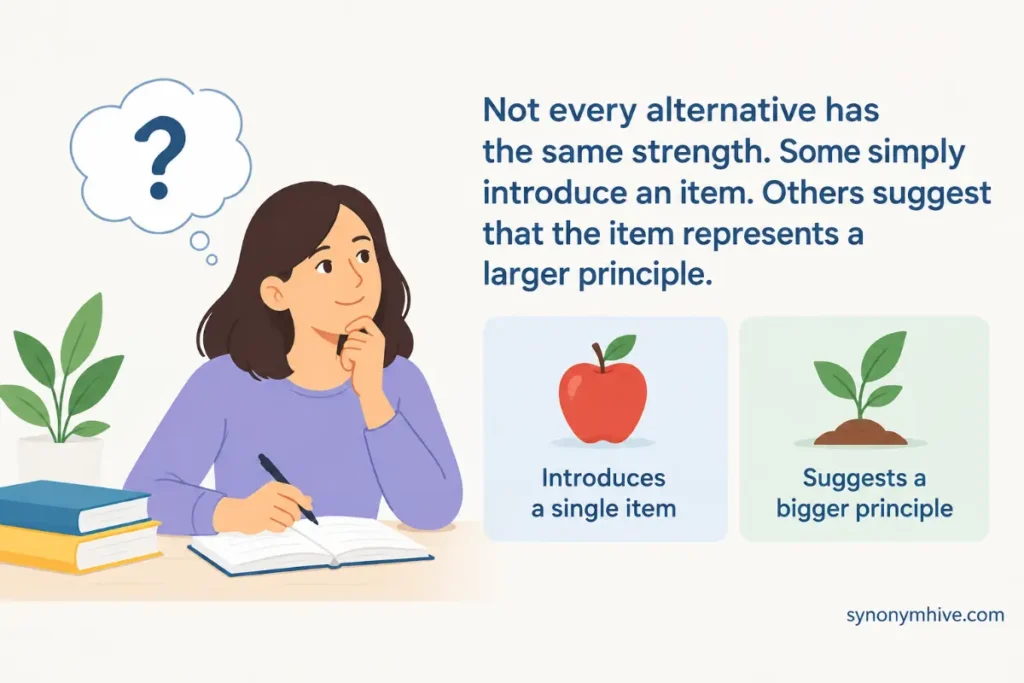
Not every alternative has the same strength. Some simply introduce an item. Others suggest that the item represents a larger principle.
What are the mild alternatives?
Sample, case, instance, and scenario are generally mild and neutral.
They don’t make a strong claim about what the example proves.
For instance, you might write.
Consider a case where a student misses an important deadline.
You’re introducing a situation for discussion. You’re not claiming that it proves anything by itself.
Which alternatives have more explanatory power?
Illustration, demonstration, case study, and model often carry more meaning.
An illustration helps explain an idea.
A demonstration shows how something works.
A case study gives detailed evidence from a particular situation.
A model can show a standard or structure that others can follow.
These words do more than simply point to an item.
Which alternatives suggest strong evidence?
Words such as demonstration, case study, and proof can suggest strong support. But proof should be used carefully.
A single example doesn’t always prove a general claim.
For example.
One successful student doesn’t prove that every student will benefit from the same study method.
A better sentence might be.
One successful student provides an illustration of how the method can work.
That distinction matters in academic writing. One case can support an argument without proving a universal rule.
How does context affect strength?
Imagine you’re writing about customer service.
A sample might be one customer response.
A case might be one customer complaint.
A case study might examine an entire customer service problem in detail.
A model might describe the ideal customer service process.
A demonstration might show an employee handling a difficult customer.
The basic idea stays connected, but the meaning becomes more specific.
Which Part Of Speech Should You Use
Example is mainly a noun. Most of its direct alternatives are also nouns.
You can use sample, case, instance, illustration, model, scenario, and specimen as nouns.
Some related words can work as verbs or adjectives when you restructure the sentence.
For example.
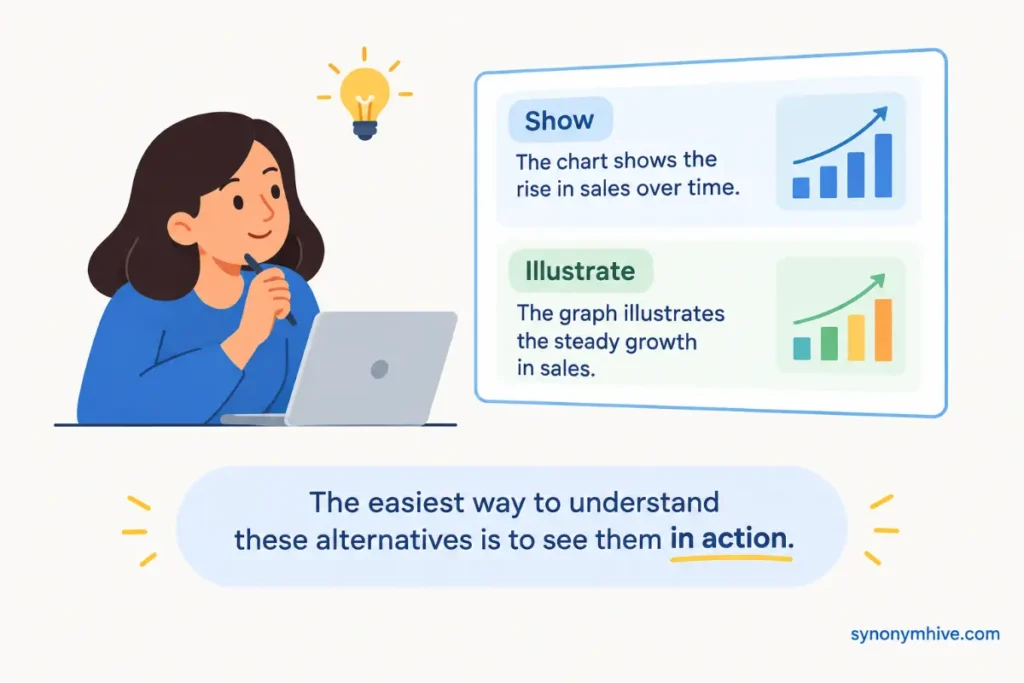
The chart illustrates the trend.
Here, illustrates is a verb.
You could also write.
The chart provides an illustration of the trend.
Now illustration is a noun.
This kind of sentence change can help you avoid awkward repetition.
Instead of writing.
The study gives an example.
The next sentence doesn’t need to say.
Another example shows.
You might write.
The study illustrates the same pattern.
Or.
A similar case appears in the second section.
Or.
The findings provide further support for the claim.
Changing the structure is often better than simply replacing one word.
Can you use phrases instead of single words?
Yes. Sometimes a phrase sounds more natural than a single synonym.
Useful phrases include for instance, such as, to illustrate, as an illustration, consider this case, take this situation, and one case is.
For example.
Many foods contain protein, such as eggs, beans, and fish.
The phrase such as introduces examples without repeating example.
You can also write.
To illustrate, imagine a student preparing for a major exam.
That works well in essays and explanatory writing.
another term for example By Context
What should you use in a resume?
On a resume, model, case study, sample, and demonstration can work, but specific action words are often stronger.
Try this.
Created a model workflow that reduced processing time.
This is stronger than saying.
Created an example workflow.
A resume should show what you achieved. Don’t fill it with vague statements.
You can also use example when describing a portfolio item.
For example.
Portfolio includes sample designs for small business clients.
Here, sample sounds natural because you’re presenting representative work.
What should you use in an essay?
For an essay, instance, illustration, case, case study, and example are useful.
Try this.
This instance shows how social pressure can influence personal choices.
Or.
The novel provides a clear illustration of the conflict between duty and freedom.
Or.
Consider the case of a student who must balance work and school.
Academic writing benefits from precision. Pick a word based on the relationship between your evidence and your argument.
What should you use in texting?
Texting usually calls for simple language.
Use like, case, sample, or simply restructure the sentence.
Try this.
Try something like this.
Or.
Look at this sample.
Or.
Consider this case.
In casual messages, you don’t need formal words just to sound intelligent. Natural language usually works better.
What should you use in an email?
For emails, example, sample, case, and illustration can all work.
Try this.
I’ve attached a sample of the updated report.
Or.
This case shows why we should review the process.
Or.
The chart provides a useful illustration of the results.
For most workplace emails, simple language is the safest choice.
What should you use when speaking?
In conversation, like, say, case, and example sound natural.
Try this.
Take a case where the customer calls after business hours.
Or.
Say you have an important meeting tomorrow.
Or.
You could do something like this.
These expressions sound relaxed and familiar.
What should you use in academic research?
For research writing, instance, case study, sample, illustration, and application can be especially useful.
Be precise about the evidence.
A sample represents part of a population.
A case study examines a particular situation.
An instance identifies one occurrence.
An illustration helps explain an idea.
An application shows how a concept works in practice.
These distinctions can make research writing much more credible.
What should you use in business writing?
Business writing often benefits from case, use case, sample, model, and scenario.
For example.
This use case shows how the new system can reduce manual work.
Or.
The sample report gives managers a clear view of the proposed format.
Or.
Consider this scenario before approving the change.
These terms can make professional writing more specific without making it harder to read.
What should you use in presentations?
For presentations, case study, scenario, demonstration, and illustration can work well.
Try this.
Let’s look at a real case study.
Or.
Consider this scenario.
Or.
I’ll give you a quick demonstration.
The best choice depends on what your audience needs to see or understand.
How Do US And UK Writers Use These Words
There is no major difference between American and British English in the basic meaning of example or its common alternatives.
Words such as sample, case, instance, illustration, model, and scenario work in both varieties of English.
The bigger difference is often style. American professional writing tends to favor direct and accessible language. British writing may sometimes use more formal vocabulary in academic or professional settings.
Still, these are broad tendencies rather than strict rules.
For US readers, sample, case, example, and instance are familiar choices. You can use more formal alternatives when they add useful meaning.
Regional speech can also change casual choices. In conversation, someone might use like to introduce an example.
For example.
You could choose something like a simple notebook.
That sounds natural in casual American English.
In formal writing, however, such as or for instance is usually a better choice.
Find more synonyms in Another Word for Furthermore Best Alternatives 2026.
another word for example In Real Sentences
The easiest way to understand these alternatives is to see them in action.
How can you use sample?
A sample is useful when one part represents a larger group.
Try this.
The teacher gave us a sample paragraph before we started the assignment.
The store sent a sample product to potential customers.
The researchers selected a sample of adults from several cities.
How can you use case?
Case works well for a particular situation.
Try this.
This case shows why clear communication matters.
In this case, the customer received a full refund.
The lawyer studied each case carefully before the hearing.
How can you use instance?
Instance sounds more formal and points to one occurrence.
Try this.
In one instance, the company corrected the mistake within an hour.
This is an instance of careful decision making.
The report documents several instances of poor communication.
How can you use illustration?
Illustration works when something helps explain an idea.
Try this.
The story is a useful illustration of personal courage.
The chart provides a clear illustration of the trend.
The teacher used a simple illustration to explain the concept.
How can you use model?
Model works when something serves as a standard or pattern.
Try this.
Her leadership style became a model for new managers.
The program offers a useful model for future projects.
The design provides a model that other teams can follow.
How can you use scenario?
Scenario is useful for possible or imagined situations.
Try this.
Imagine a scenario where the system stops working during a busy period.
The training covers several common workplace scenarios.
This scenario helps explain why preparation matters.
How can you use demonstration?
Demonstration works when something is shown through action.
Try this.
The instructor gave a demonstration of the new equipment.
The experiment provides a clear demonstration of the principle.
The workshop included a live demonstration.
How can you use case study?
Case study is especially useful for detailed academic and professional analysis.
Try this.
The report includes a case study of a small business that improved customer retention.
The case study gives students a practical way to understand the theory.
The professor assigned a case study for the final paper.
How can you use like?
Like is common in casual speech and informal writing.
Try this.
You could use something like this.
I want a jacket like the one you showed me.
Avoid this choice in formal academic writing when a clearer alternative is available.
How can you use say?
Say can introduce a hypothetical situation.
Try this.
Say you receive an email from a customer who needs help immediately.
Say the project takes twice as long as expected.
This use is natural in conversation but usually sounds too casual for a formal essay.
Close Synonym Comparisons
Choosing between similar words can be difficult because several alternatives may look correct.
Sample vs case
| Sample | Case |
|---|---|
| Usually represents a larger group. | Usually refers to a particular situation. |
| Common in research and general writing. | Common in analysis and discussion. |
| Focuses on representation. | Focuses on circumstances. |
| Example: a sample of 1,000 voters. | Example: a case involving one voter. |
If you’re talking about part of a larger population, choose sample.
If you’re talking about one particular situation, choose case.
Instance vs illustration
| Instance | Illustration |
|---|---|
| Means one occurrence. | Helps explain an idea. |
| Often sounds formal. | Often sounds academic. |
| Focuses on what happened. | Focuses on what the situation explains. |
| Example: one instance of failure. | Example: an illustration of failure. |
Instance is about the event itself.
Illustration is about how the event helps explain something.
Model vs example
| Model | Example |
|---|---|
| Can serve as a pattern to follow. | Mainly helps explain or represent an idea. |
| Often suggests a standard. | Has a broader meaning. |
| Can be copied or adapted. | May simply provide evidence. |
| Example: a model employee. | Example: an example of good teamwork. |
A model often carries an extra idea of quality or structure. An example doesn’t always do that.
Demonstration vs illustration
A demonstration usually shows how something works. An illustration usually helps explain what something means.
For example.
The teacher gave a demonstration of the experiment.
The teacher gave an illustration of why the experiment matters.
The first focuses on action. The second focuses on explanation.
Common Mistakes With Example
Don’t replace example just for the sake of variety.
Changing a word isn’t always an improvement.
If example sounds natural, keep it.
Writers sometimes force formal words into simple sentences. That can make their writing harder to read.
For example.
The professor provided an instance of the theory.
This may be correct, but if you’re simply talking about a clear example, the original word might be better.
The professor provided an example of the theory.
Simple doesn’t mean weak.
Don’t confuse sample with example.
A sample usually represents a larger group. An example doesn’t need to represent anything larger.
For instance, a survey may use a sample of 500 people.
A teacher may give an example using one person.
Those words aren’t always interchangeable.
Don’t use specimen for ordinary examples.
Specimen is usually used for scientific, medical, biological, or technical objects.
You might say.
The laboratory examined a specimen.
You probably wouldn’t say.
Here is a specimen of good writing.
That sentence sounds strange unless you’re using the word in a very specific formal sense.
Don’t use model when you only mean example.
Model often suggests something worth copying or following.
If you simply want to show one possibility, sample or example may be better.
Don’t use slang in formal writing.
Words such as like and say can sound natural in conversation but may weaken an academic essay.
Instead of.
Say you have two choices.
Write.
Consider a situation in which you have two choices.
The formal version makes the purpose clearer.
Don’t assume every synonym has the same meaning.
Synonyms are more like close relatives than identical twins. They share traits but still have their own personalities.
Case isn’t exactly the same as sample.
Instance isn’t exactly the same as illustration.
Model isn’t exactly the same as example.
Scenario isn’t exactly the same as case.
Understanding those small differences helps you write with confidence.
What Are The Antonyms
Example doesn’t have one perfect opposite because its meaning changes by context.
Still, several words can express opposite ideas.
Exception can contrast with a typical example.
Generalization can contrast with a specific case.
Abstraction can contrast with a concrete example.
Original can contrast with a copy or model.
Theory can contrast with a practical illustration in some contexts.
For example, a specific case gives readers something concrete. A generalization moves away from one specific case and describes a broader idea.
The exact opposite depends on what you mean in the sentence.
Quick Tips For Choosing The Right Word As Another Word for Example
Good word choice becomes easier when you ask a few simple questions.
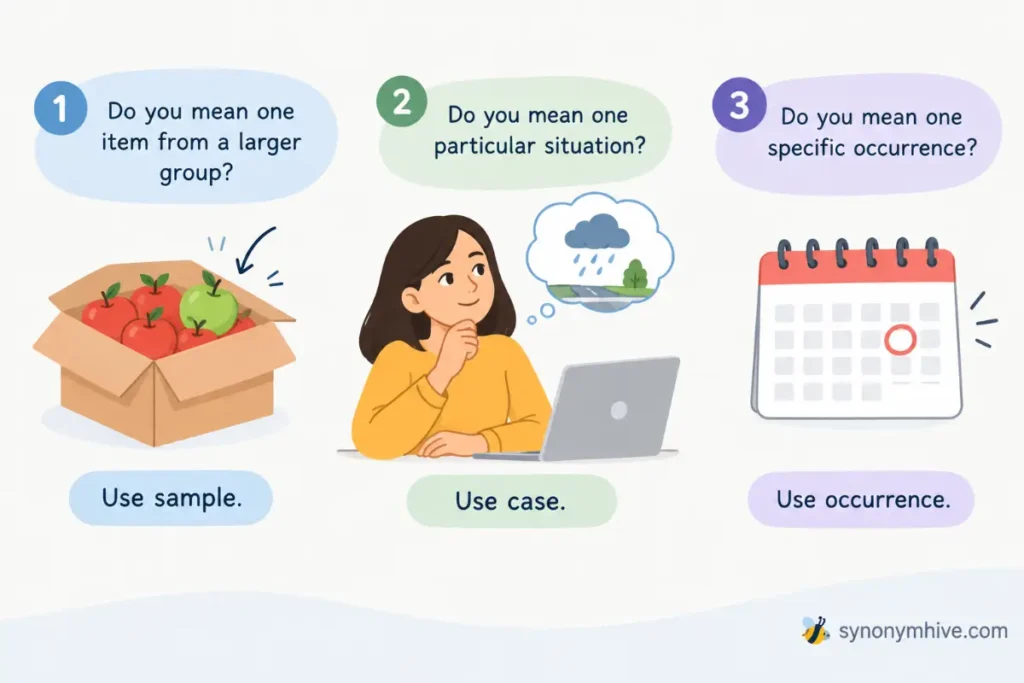
- Do I mean one item from a larger group?
Use sample.
- Do I mean one particular situation?
Use case.
Words such as like or say can work.
- Am I writing academically?
Choose precise terms such as instance, illustration, case study, or sample when they fit the meaning.
- Am I writing for a general audience?
Prefer familiar words.
- Am I changing the word only to avoid repetition?
First check if the original word is still the clearest choice.
Clarity should always win.
Compare more word options with Another Word for Shows Best Alternatives 2026.
Conclusion
Finding the right replacement comes down to meaning rather than vocabulary size. If you need another word for example, start with the simple choices and move toward more specific ones. Use sample for a representative part, case for a particular situation, instance for one occurrence, illustration for explanation, model for something worth following, and scenario for a possible situation. In academic writing, precise choices can make your argument clearer and more credible. In casual writing, simple words often sound more natural. Don’t force a synonym just to avoid repetition. Read the sentence again and ask what you really want the reader to understand. When the word fits the idea, your writing becomes sharper, easier to follow, and more convincing.
Frequently Asked Questions
What’s another way to say example?
Common alternatives include sample, case, instance, illustration, model, scenario, demonstration, and specimen. The right choice depends on the meaning and tone of your sentence.
What is another word for example in an essay?
For an essay, useful choices include instance, illustration, case, case study, sample, and demonstration. Choose the word that clearly explains how your evidence supports your main point.
Is sample the same as example?
No. A sample usually represents a larger group, while an example can simply explain or represent an idea. The two words overlap in some situations but aren’t always interchangeable.
What is a formal word for example?
Instance, illustration, case study, specimen, and demonstration can sound more formal than example. The best option depends on the exact meaning you need.
Can I use like instead of example?
Yes, but like is mainly useful in casual speech and informal writing. Formal essays usually benefit from words such as instance, illustration, or case.
What’s another way to introduce an example?
You can use phrases such as for instance, such as, to illustrate, consider this case, or take this situation. These phrases can make transitions smoother without repeating the same noun.
Which synonym is best for academic writing?
Instance, illustration, case study, sample, and demonstration are strong academic choices when they match the meaning. Don’t choose a formal word simply to sound more advanced.