
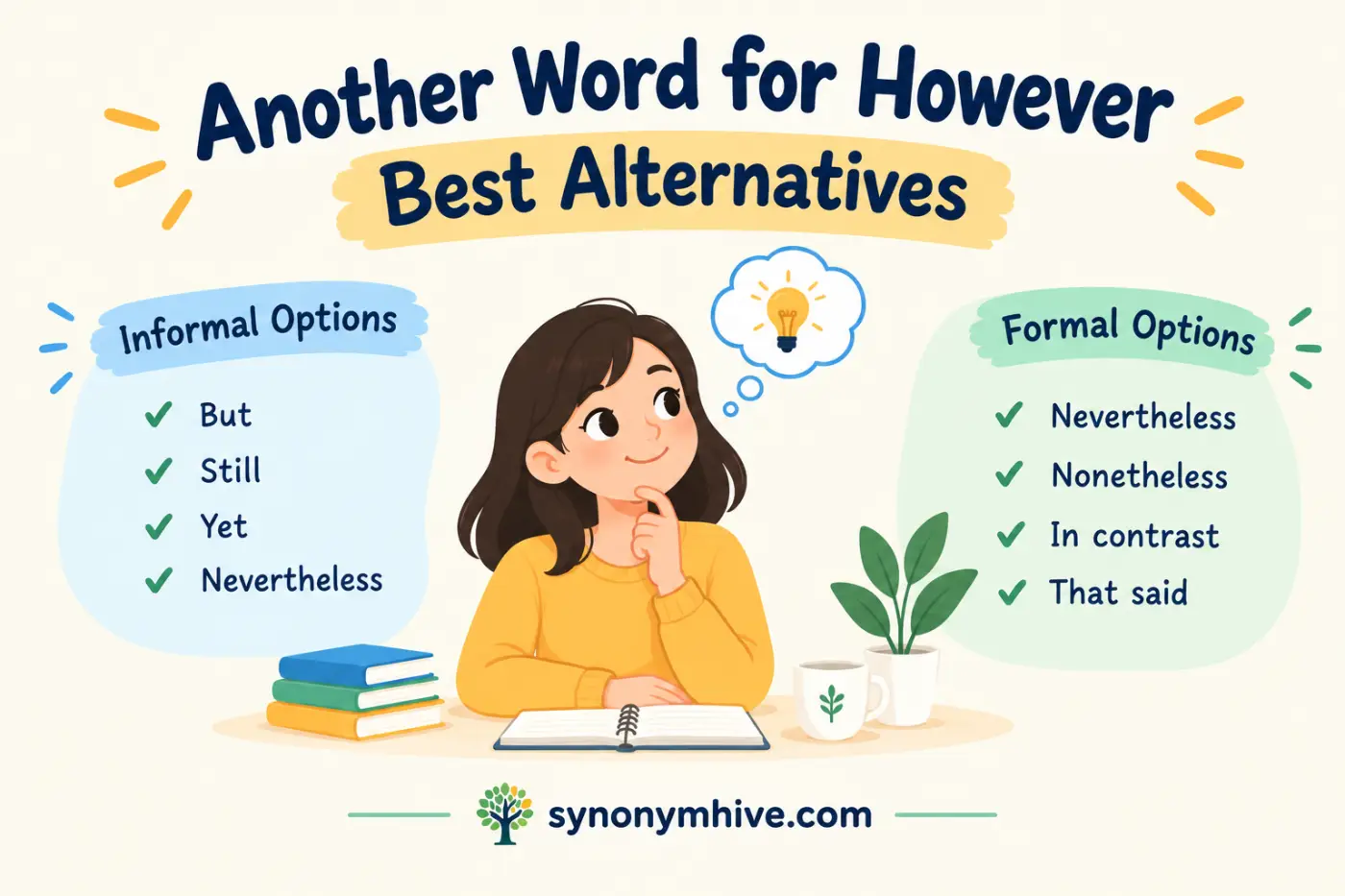
You may use the word however so often that your writing starts to sound repetitive. This happens a lot in essays, emails, reports, resumes, and everyday messages. You may have a good sentence ready, but you need a transition that shows a contrast without repeating the same word again. That is when looking for another word for however can help you choose a phrase that matches your meaning and tone instead of simply swapping one word for another.
The best alternatives to however include but, yet, though, still, even so, nevertheless, nonetheless, in contrast, by contrast, and that said. The right choice depends on the sentence, level of formality, and kind of contrast you want to show.
A strong replacement should do more than make your writing look different. It should preserve the relationship between your ideas. Some alternatives sound casual, while others work better in academic writing. Some show a simple contrast, while others highlight an unexpected result, introduce another point of view, or compare two different things. This guide explains those differences, shows how each option works, and gives practical examples for essays, resumes, emails, texts, and speech.
Expand your vocabulary with Another Word for Because: Best Synonyms 2026.
What Does However Mean
However usually introduces a contrast between two ideas. It tells the reader that the second idea differs from or limits the first idea. For example, you might write, “The restaurant was expensive. However, the food was excellent.” The first sentence points to a negative feature, while the second sentence presents a positive point that contrasts with it.
In simple English, however often means but, still, even so, or nevertheless. The exact meaning depends on the sentence. It can show that something remains true despite an earlier fact, introduce an opposing idea, or qualify a statement. This makes however useful, but it also means that not every alternative will work perfectly in every sentence.
There is another use of however that has a different meaning. In a sentence such as “However did you solve that problem so quickly?” it means something closer to “how” or “in what way.” In that construction, words such as but, yet, or nevertheless cannot replace it. Most searches for alternatives to however, though, focus on its contrast meaning.
Where Did However Come From
The word however developed from older English combinations built from how and ever. Its early use was connected to ideas such as “in whatever way” or “in whatever manner.” Over time, it developed another important use that signals contrast.
That history helps explain why however can still appear in different grammatical roles. In modern English, its contrast use is especially common in formal and academic writing. Writers often use it to connect two ideas that do not completely agree.
Today, however remains one of the most useful contrast transitions in English. It appears in school essays, business writing, journalism, research writing, emails, reports, and everyday communication. Still, using it repeatedly can make your writing sound predictable. Choosing a more precise alternative can give your sentences a smoother rhythm.
What Is Another Word for However
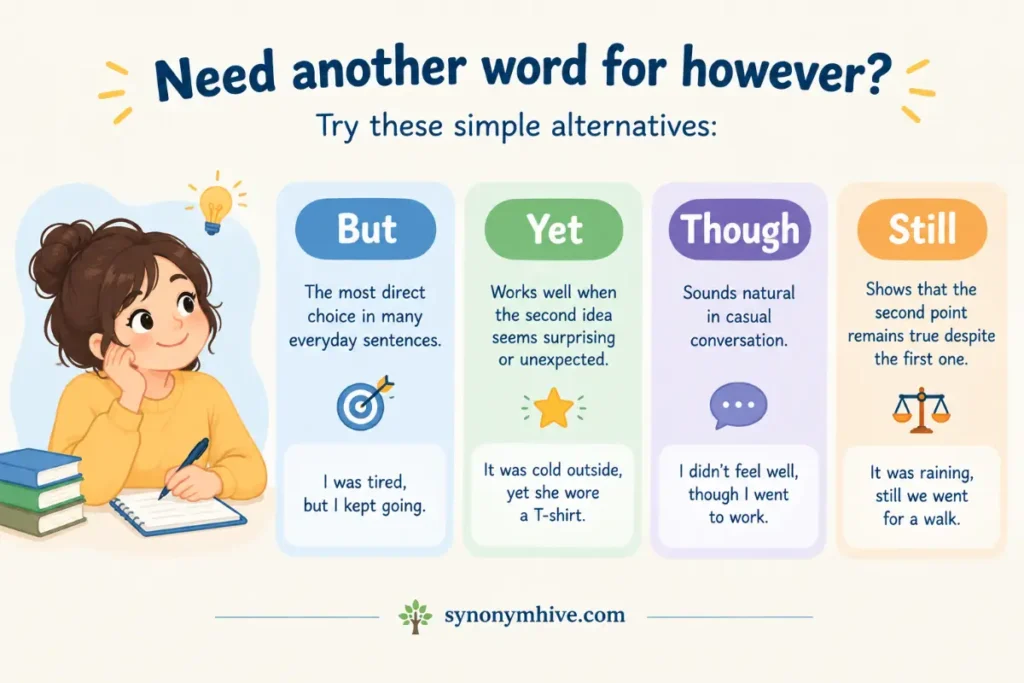
If you need another word for however, start with the simplest alternatives. But is the most direct choice in many everyday sentences. Yet works well when the second idea seems surprising or unexpected. Though sounds natural in casual conversation. Still shows that the second point remains true despite the first one.
For formal writing, nevertheless and nonetheless are strong options. For direct comparisons, in contrast and by contrast often work better. In conversational writing, that said is useful. Meanwhile, even so emphasizes that the second point remains true despite the situation described first.
The table below gives you a quick reference.
| Word or Phrase | Meaning | Tone | Example |
|---|---|---|---|
| But | Shows a basic contrast | Simple | The task was difficult, but we finished it. |
| Yet | Shows contrast or surprise | Everyday | The road was long, yet we arrived early. |
| Though | Adds a casual contrast | Conversational | The movie was long, though I enjoyed it. |
| Still | Shows something remains true | Everyday | The price was high. Still, we bought it. |
| Even so | Shows an unexpected continuation | Conversational | It was raining. Even so, we went outside. |
| Nevertheless | Shows strong contrast | Formal | The evidence was limited. Nevertheless, the team continued. |
| Nonetheless | Shows contrast despite a fact | Formal | The plan was risky. Nonetheless, they approved it. |
| On the other hand | Presents another side | Neutral | The job pays well. On the other hand, the hours are long. |
| In contrast | Directly compares differences | Formal | The first design was simple. In contrast, the second was detailed. |
| By contrast | Highlights a difference | Formal | Sales increased in June. By contrast, July sales declined. |
| That said | Adds a qualification | Conversational | The book is difficult. That said, it is worth reading. |
| Having said that | Adds a qualification | Conversational | The plan has flaws. Having said that, it can work. |
| All the same | Shows continued agreement or action | Everyday | The weather was poor. All the same, we continued. |
| Even then | Shows contrast after a condition | Neutral | He apologized. Even then, she remained upset. |
| Despite this | Shows contrast with a previous fact | Neutral | The product was expensive. Despite this, customers bought it. |
| In spite of this | Shows contrast with a previous fact | Neutral | The project faced delays. In spite of this, it succeeded. |
| Although | Introduces a contrasting clause | Neutral | Although the test was hard, she passed. |
| Even though | Stronger form of although | Everyday | Even though it was late, they kept working. |
| Conversely | Shows an opposite situation | Formal | Costs increased. Conversely, demand declined. |
| Alternatively | Presents another option | Formal | We could drive. Alternatively, we could take the train. |
| Instead | Shows a replacement or different choice | Everyday | We planned to walk. Instead, we took a taxi. |
| Rather | Shows preference or correction | Neutral | We expected a delay. Rather, the train arrived early. |
| Otherwise | Shows a different result or condition | Neutral | Leave now. Otherwise, you may miss the bus. |
| Then again | Introduces another consideration | Conversational | The apartment is small. Then again, the rent is affordable. |
| Anyway | Moves past a point or returns to the main idea | Casual | The plan changed. Anyway, we still need to finish the work. |
| At the same time | Adds a contrasting consideration | Neutral | The job is demanding. At the same time, it is rewarding. |
What Are The Simplest Alternatives To However
But is usually the easiest replacement. It is short, natural, and familiar to almost every English speaker. You can use it in casual writing, professional communication, and many essays. For example, “The assignment was difficult, but I completed it on time” sounds natural and direct.
Yet is another simple option. It often creates a stronger sense of surprise than but. Compare “The store was small, but it had everything we needed” with “The store was small, yet it had everything we needed.” The second sentence gives the contrast a little more emphasis.
Though works especially well in speech and casual writing. You can place it at the beginning or end of a sentence. “Though the trip was tiring, we had a great time” is natural, while “We had a great time. The trip was tiring, though” sounds especially conversational.
Still is useful when the second idea remains true despite the first fact. “The instructions were confusing. Still, we finished the project” tells the reader that the difficulty did not prevent the result.
These basic words are often better than a formal transition simply because they sound natural. Strong writing does not require complicated vocabulary. It requires the right vocabulary.
What Are Stronger Alternatives To However
When you need a stronger contrast, nevertheless, nonetheless, and even so can be useful. These expressions tell readers that the second point stands despite something mentioned earlier.
“ The deadline was extremely tight. Nevertheless, the team completed the project.” The word nevertheless suggests that the difficulty could have prevented success, but success happened anyway.
“ The instructions were unclear. Nonetheless, the students completed the experiment.” Here, nonetheless has a formal tone and emphasizes that the result remained true despite the problem.
“ The weather forecast looked bad. Even so, we decided to continue the trip.” Even so sounds less formal and often has a stronger conversational quality.
These alternatives work best when the contrast involves an obstacle, limitation, expectation, or surprising result. They are not simply fancy versions of however. Each one adds a slightly different shade of meaning.
What Is Another Word for However In An Essay
When searching for another word for however in an essay, choose a transition that clearly shows the relationship between your ideas. Nevertheless, nonetheless, yet, although, in contrast, and by contrast can all work, but they serve different purposes.
Use nevertheless when the second point continues despite the first point. For example, “The study had several limitations. Nevertheless, its findings provide useful information.”
Use in contrast or by contrast when you are directly comparing two things. For example, “The first group preferred online classes. By contrast, the second group preferred classroom instruction.”
Use although when you want to combine the contrast into one grammatical sentence. For example, “Although the first method was cheaper, the second method produced better results.”
Use yet when you want a concise transition that gives the contrast some emphasis. For example, “The theory is widely accepted, yet several questions remain unanswered.”
For most academic essays, precision matters more than choosing the most impressive sounding transition. A simple but accurate word is stronger than a formal phrase that does not match the relationship between the ideas.
What Is Another Word for However On A Resume
A resume usually does not need many transition words. In fact, trying to replace however with a formal synonym can make a resume less direct. Resume writing works best when you show achievements and results clearly.
Instead of writing, “However, I had limited resources,” you can often restructure the sentence. For example, “Managed customer accounts despite limited resources.” This version is shorter and puts the achievement first.
Another option is to use despite when you want to show that you achieved something under difficult conditions. “Exceeded quarterly goals despite a reduced budget” is more powerful than “However, the budget was reduced, and I exceeded my goals.”
You can also use while to connect two ideas. “Led a five-person team while meeting strict project deadlines” shows two accomplishments in one clean sentence.
For resumes, the best replacement is often not another transition word at all. Rewrite the sentence so the contrast becomes clear through the structure.
What Is Another Word for However In Texting
Text messages usually need short, natural language. But, still, though, and yet are usually the best choices.
For example, “I wanted to go, but I was too tired” sounds natural. “I wanted to go. Still, I was too tired” adds a little emphasis. “I wanted to go. It was too late, though” sounds casual and conversational.
You can also use that said when you want to acknowledge one point before adding another. “I don’t love the location. That said, the apartment is really nice” sounds natural in a conversation.
Formal alternatives such as nevertheless and nonetheless can work in texts, but they may sound unnecessarily serious in a casual conversation. Match the transition to the way people normally speak.
What Is Another Word for However In An Email
Professional emails usually need a balance between clarity and politeness. However, but, still, that said, although, and yet can all work depending on the message.
For example, “The proposal looks strong. However, we need to revise the budget before approval” sounds professional and direct.
You could also write, “The proposal looks strong, but we need to revise the budget before approval.” This version is slightly more conversational.
For a softer qualification, try “That said, we may need additional time to complete the review.” This works well after you have acknowledged something positive or agreed with another person’s point.
If the email is formal, avoid using overly casual choices such as anyway unless the relationship and situation make that tone appropriate.
What Is Another Word for However In Speaking
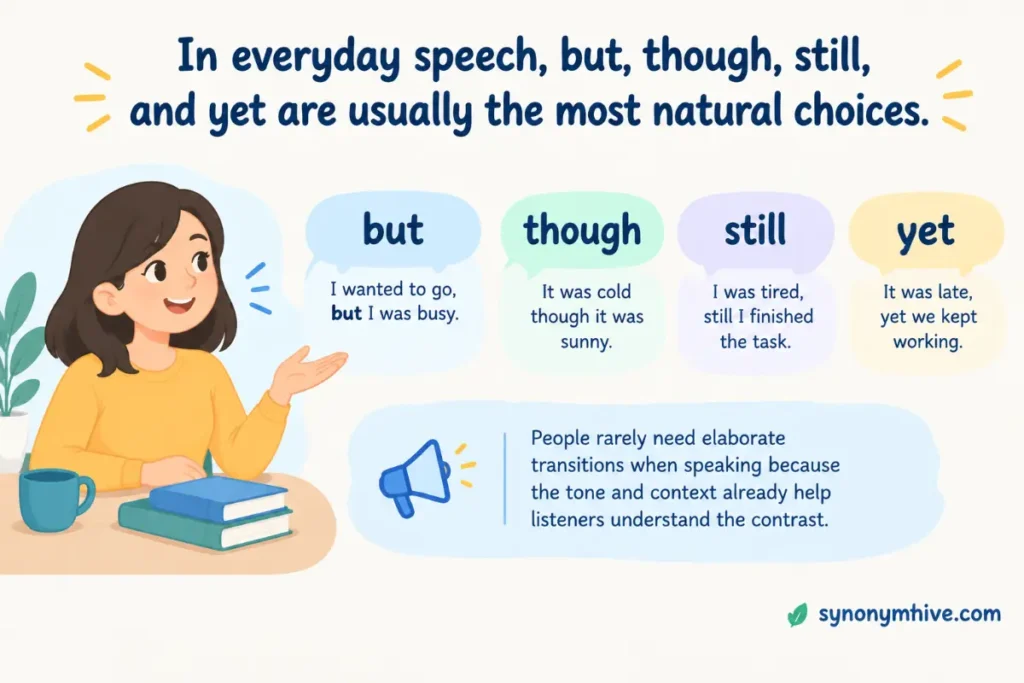
In everyday speech, but, though, still, and yet are usually the most natural choices. People rarely need elaborate transitions when speaking because the tone and context already help listeners understand the contrast.
You might say, “I understand your point, but I don’t agree with the conclusion.” You could also say, “It was a long drive, though we had a good time.”
Then again is useful when you want to introduce another thought that changes the balance of an argument. For example, “I could buy the cheaper laptop. Then again, the more expensive one will probably last longer.”
That said also works well in conversation. “I don’t think the first option is ideal. That said, it could still work if we adjust the schedule.”
Which Alternative Should You Use By Intensity
Not every contrast has the same strength. Some transitions create a mild difference, while others suggest a strong conflict between expectations and results.
| Intensity | Best Choices | Example |
|---|---|---|
| Mild | but, though, still | The room is small, but it is comfortable. |
| Moderate | yet, that said, at the same time | The plan is expensive, yet it could save time. |
| Strong | even so, nevertheless, nonetheless | The evidence was weak. Nevertheless, the claim gained support. |
| Direct comparison | in contrast, by contrast | The first option is cheap. By contrast, the second is expensive. |
| Opposite position | conversely, on the other hand | The first approach saves time. Conversely, the second offers greater control. |
A mild contrast does not need a heavy formal transition. If two simple ideas differ slightly, but or yet may be enough. Save stronger transitions for situations where the contrast actually matters.
How Does However Compare With But
But and however often communicate the same basic contrast, but their grammar differs.
But is a coordinating conjunction. It can connect two independent clauses within one sentence.
“The project was expensive, but the company approved it.”
However commonly functions as a conjunctive adverb or sentence adverb. It can connect ideas across sentences or appear inside a sentence.
“The project was expensive. However, the company approved it.”
You can also write, “The project was expensive; however, the company approved it.”
A common mistake is to connect two complete sentences with only a comma and however. This creates a comma splice.
Incorrect: “The project was expensive, however, the company approved it.”
Correct: “The project was expensive. However, the company approved it.”
Correct: “The project was expensive; however, the company approved it.”
This distinction matters in academic and professional writing because punctuation helps readers understand how your ideas connect.
How Does However Compare With Yet
Yet is close to however, but it often adds a sense of surprise. Consider these examples.
“The plan was difficult. However, we completed it.”
“The plan was difficult, yet we completed it.”
Both sentences show contrast. The second version can make the successful result sound more unexpected.
Yet is also shorter and often fits naturally into a sentence. “She had little experience, yet she handled the project well” is concise and strong.
For a formal essay, however may sound more neutral. For a sentence that needs a sharper contrast, yet can be the better choice.
How Does However Compare With Nevertheless
Nevertheless generally sounds more formal than however. Both can introduce a contrasting idea, but nevertheless often emphasizes that something remains true despite an obstacle or opposing fact.
“The instructions were confusing. However, we finished the task.”
“The instructions were confusing. Nevertheless, we finished the task.”
The first sentence simply marks the contrast. The second places more emphasis on the fact that the difficulty did not stop the result.
Use nevertheless in academic writing, formal reports, and other situations where a more formal tone fits. Use however when you want a neutral and flexible transition.
Find more synonyms in Another Word for Influence Best Synonyms 2026.
How Does However Compare With Nonetheless
Nonetheless and nevertheless are very close in meaning. Both can show that the second point remains true despite the first point.
“The method was expensive. Nonetheless, the company adopted it.”
“The method was expensive. Nevertheless, the company adopted it.”
The difference is small in most modern writing. Both sound formal and work well in essays, reports, and professional documents.
If you are trying to avoid repetition, either one can provide useful variety. Still, do not replace every instance of however with nonetheless. Good writing varies transitions according to meaning, not simply to avoid repeating a word.
How Does However Compare With On The Other Hand
On the other hand is not always a direct replacement for however. It usually introduces another side of an issue, especially when comparing advantages and disadvantages.
“The job offers a high salary. On the other hand, the commute is long.”
The second idea is not simply an unexpected result. It represents another consideration that readers should weigh.
However works differently.
“The job offers a high salary. However, the commute is long.”
The meaning is similar, but on the other hand puts more emphasis on the two sides of the decision.
Use on the other hand when you want to present another perspective or tradeoff. Use however for a broader contrast.
How Does However Compare With Although
Although changes the structure of a sentence because it introduces a dependent clause.
“Although the weather was cold, we went hiking.”
You could express a similar idea with however.
“The weather was cold. However, we went hiking.”
Both versions show contrast, but they organize the information differently. Although places the contrasting condition inside the same sentence. However normally connects separate ideas or clauses.
Also remember that although should not be combined incorrectly with but in the same basic clause structure.
Incorrect: “Although the weather was cold, but we went hiking.”
Correct: “Although the weather was cold, we went hiking.”
Correct: “The weather was cold, but we went hiking.”
What Is The Best Choice For Formal Writing
For formal writing, your strongest options include however, nevertheless, nonetheless, in contrast, by contrast, conversely, and although. The best choice depends on the exact relationship between your ideas.
Choose nevertheless or nonetheless when a result continues despite a limitation. For direct comparisons between two subjects, use in contrast or by contrast. To show an opposite situation or relationship, choose conversely. To build the contrast into one sentence, use although.
Do not assume that the longest or most formal word is automatically better. A clear sentence such as “The first method was cheaper, but the second was faster” can be stronger than a sentence filled with formal transitions.
What Is The Best Choice For Casual Writing
For casual writing, but, yet, though, still, even so, and that said are strong choices. They sound natural in texts, social posts, personal emails, and conversations.
“But” is usually the safest choice. Though works well at the end of a sentence. Still adds emphasis. Even so highlights a surprising continuation. That said introduces a qualification without sounding stiff.
For example, “I don’t really like the design. That said, the app works well” sounds natural and relaxed. You do not need a formal word such as nevertheless to express the same basic idea.
Example Sentences With Alternatives
The best way to understand these choices is to see them in real situations. Each sentence below uses a different transition and shows a slightly different relationship between ideas.
- The apartment is small, but the location is excellent.
- The instructions were confusing, yet we managed to finish the project.
- I was tired. Still, I decided to attend the meeting.
- The restaurant was crowded. Even so, we found a table.
- The first proposal had several weaknesses. Nevertheless, the board approved it.
- The road was damaged by the storm. Nonetheless, local traffic continued.
- The new phone is expensive. On the other hand, it offers better battery life.
- The first candidate had extensive experience. By contrast, the second candidate had stronger technical skills.
- The company reduced its prices. In contrast, its competitors raised theirs.
- Although the assignment was difficult, the students completed it on time.
- The plan has several advantages. That said, it also carries some risks.
- We expected the flight to be delayed. Instead, it arrived early.
- You can take the bus. Alternatively, you can walk to the station.
- The first solution costs less. Conversely, the second solution requires less maintenance.
- The room was noisy. Even then, I managed to concentrate.
- The course requires a lot of work. At the same time, it provides valuable practice.
- The laptop is not the fastest model available. Then again, it is affordable and reliable.
- The deadline was short. All the same, the team delivered the project on time.
- The weather looked terrible. We went hiking anyway.
- The instructions were clear. The final step, however, caused some confusion.
- The candidate had limited experience, but she demonstrated strong communication skills.
- The hotel was far from downtown. Still, the quiet location made the stay pleasant.
- The first experiment produced weak results. Even so, the researchers continued testing the method.
- The job offers flexible hours. However, the salary is lower than expected.
- The product received mixed reviews. Nevertheless, sales continued to grow.
These examples show why simply searching for a replacement word is not always enough. The transition should match the relationship between the ideas.
Common Mistakes With However Alternatives
One common mistake is using a formal transition simply because it sounds impressive. Words such as nevertheless, nonetheless, and conversely have specific uses. If a simple but communicates your meaning clearly, it may be the better choice.
Another mistake is using on the other hand for every contrast. This phrase usually works best when you are presenting another side or consideration. It can sound awkward if the second sentence simply gives an unexpected result.
A third mistake is confusing despite with although. Despite normally comes before a noun, pronoun, or gerund phrase.
Correct: “Despite the rain, we continued the game.”
Correct: “Despite being tired, she finished the assignment.”
Although introduces a clause with a subject and verb.
Correct: “Although it was raining, we continued the game.”
Another common error involves instead. Instead usually indicates replacement or a different choice, not a simple contrast.
“The store was closed, so we went home instead.”
You should not automatically use instead in a sentence that only needs a contrast transition.
When Should You Not Replace However
Sometimes however is already the best choice. If the word fits naturally and you have not used it repeatedly, there is no need to replace it simply for variety.
Good writing does not avoid repetition at all costs. It avoids unnecessary repetition. If however accurately communicates the relationship between your ideas, keep it.
You also should not replace however with a word that changes the meaning. Alternatively suggests another option. Instead suggests replacement. Conversely suggests an opposite relationship. On the other hand introduces another side. These words may overlap with however in some situations, but they are not interchangeable in every sentence.
The goal is not to find a different word. The goal is to choose the word that expresses your intended connection most accurately.
How To Choose The Right Alternative
First, consider what kind of contrast you want to express. For a simple contrast, choose but or yet. For a casual tone, try though or still. When the second idea continues despite a problem, even so, nevertheless, or nonetheless may work better.
When comparing two different sides, use on the other hand, in contrast, or by contrast. For another option, consider alternatively. To show an opposite relationship, conversely may be appropriate.
Next, consider your audience. A school essay may benefit from nevertheless or by contrast. A text message probably needs but, still, or though. A professional email can use however, but, although, or that said.
Finally, read the sentence aloud. The best transition usually sounds natural when spoken. If a word makes the sentence sound stiff, replace it with something simpler.
What Are The Antonyms Of However
There is no single perfect antonym for however because however is a contrast transition rather than a word with one direct opposite. Its opposite function is usually expressed through transitions that show addition, similarity, or result instead of contrast.
Useful alternatives include also, similarly, likewise, in addition, therefore, as a result, and consequently.
For example, contrast works like this.
“The first product is affordable. However, it has fewer features.”
An additive connection works like this.
“The first product is affordable. In addition, it has a long warranty.”
A result connection works like this.
“The product was affordable. Therefore, more customers purchased it.”
These words do not mean the opposite of however in a dictionary sense. They perform different logical jobs in a sentence.
Quick Guide To However Alternatives
If you need a quick answer, use this guide to choose the closest option for your situation.
| Situation | Best Alternative |
|---|---|
| Simple everyday contrast | But |
| Short strong contrast | Yet |
| Casual conversation | Though |
| Result remains true despite a problem | Still |
| Unexpected continuation | Even so |
| Formal contrast | Nevertheless |
| Formal alternative to nevertheless | Nonetheless |
| Presenting another side | On the other hand |
| Direct comparison | In contrast |
| Strong direct comparison | By contrast |
| Conversational qualification | That said |
| More formal conversational qualification | Having said that |
| Introducing another option | Alternatively |
| Showing an opposite relationship | Conversely |
| Showing replacement | Instead |
| Introducing another consideration | Then again |
| Combining contrast into one sentence | Although |
| Stronger form of although | Even though |
| Casual return to the main point | Anyway |
| Contrast despite a previous fact | Despite this |
What Is Another Word for However In Academic Writing
For academic writing, the best choices are usually nevertheless, nonetheless, yet, although, in contrast, and by contrast. Each one should match the logic of the sentence rather than simply replace however.
For example, “The sample size was small. Nevertheless, the results offer useful evidence” emphasizes that the results remain valuable despite a limitation.
If you are comparing two groups, “Group A showed higher participation. By contrast, Group B showed lower participation” gives readers a clear comparison.
If you need to combine ideas into one sentence, “Although the sample size was small, the results were consistent” provides a clean academic structure.
Strong academic writing depends on logical connections. A transition should help readers understand your argument, not distract them with complicated vocabulary.
What Is Another Word for However In Professional Communication
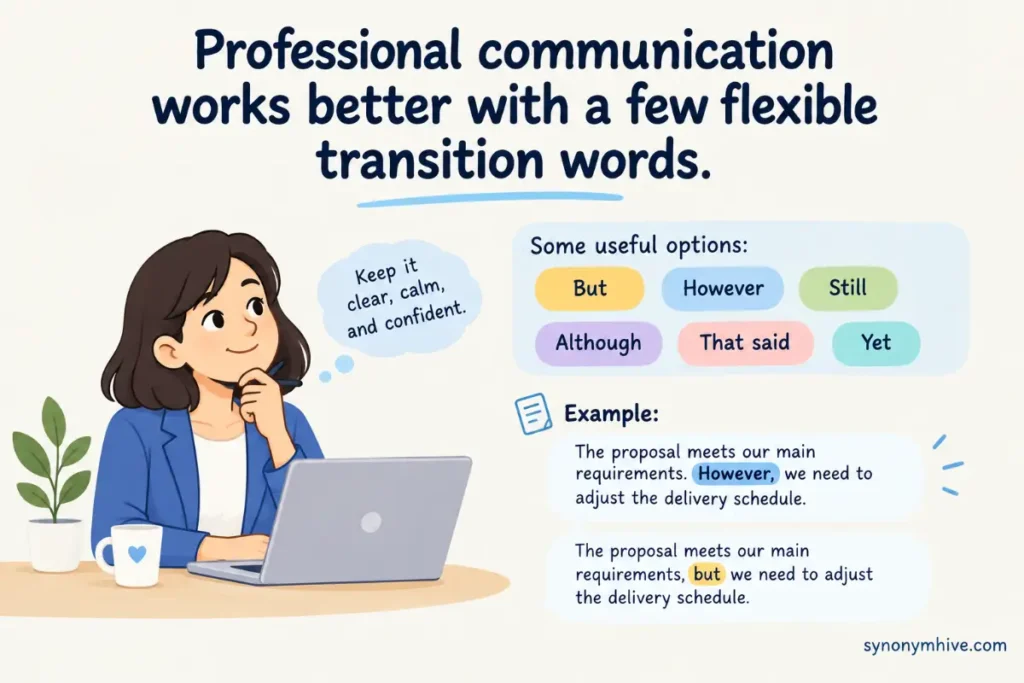
Professional communication usually benefits from a neutral and confident tone. But, however, still, although, that said, and yet can all work well.
Suppose you are writing to a client about a proposal. You could write, “The proposal meets our main requirements. However, we need to adjust the delivery schedule.”
You could also write, “The proposal meets our main requirements, but we need to adjust the delivery schedule.”
For a softer qualification, you might write, “The proposal meets our main requirements. That said, we need to adjust the delivery schedule.”
The second and third versions sound slightly more conversational. The first sounds more formal and structured. All three can work in professional communication.
How To Avoid Repeating However
If you use however several times on the same page, do not simply replace each occurrence with another transition. First, check the relationship between the ideas.
One sentence may need but because it contains two closely connected clauses. Another may need by contrast because it compares two subjects. A third may need nevertheless because it describes a result that continued despite an obstacle.
You can also remove the transition completely when the contrast is already obvious.
Instead of writing, “The project was difficult. However, the team completed it on time,” you might write, “Despite the difficulty, the team completed the project on time.”
This creates variety without forcing a synonym into the sentence.
Another useful technique is sentence restructuring. You can combine two sentences with although, use despite at the beginning, or place however inside the sentence.
“The project, however, was completed on time despite several delays.”
Good editing gives you more options than a simple synonym list.
Learn more useful word alternatives in Another Word for Furthermore Best Alternatives 2026.
Conclusion
Finding another word for however is not simply about replacing one word with another. The strongest choice depends on what your sentence actually needs to communicate. Use but for a simple contrast, yet for a sharper or more surprising contrast, though for casual writing, and still when the second point remains true despite the first. Choose nevertheless or nonetheless for formal writing, and use in contrast or by contrast when you are directly comparing two ideas. For another side of an argument, on the other hand is often more precise. The key is to match the transition to your meaning, audience, and level of formality. A good transition should make your writing clearer, not simply make it sound more complicated.
Frequently Asked Questions
What is another word for however?
Common alternatives include but, yet, though, still, even so, nevertheless, nonetheless, in contrast, and that said. The best choice depends on the sentence and tone.
What is a simple word for however?
But is the simplest and most common alternative to however. Yet and though are also useful in everyday writing and conversation.
What is another way to say however in an essay?
In an essay, you can use nevertheless, nonetheless, yet, although, in contrast, or by contrast. Choose the option that accurately shows the relationship between your ideas.
Is but better than however?
But is often more direct and conversational, while however usually sounds more formal. Neither word is always better because the best choice depends on the sentence.
Can I use nevertheless instead of however?
Yes. Nevertheless can replace however when you want to show that the second point remains true despite the first point. It usually has a more formal tone.
What can I use instead of however in a professional email?
You can use but, still, although, yet, that said, or however itself. But is direct, while that said provides a softer conversational qualification.
What is a casual way to say however?
But, though, still, and yet are natural casual alternatives. Though often sounds especially conversational when placed at the end of a sentence.