
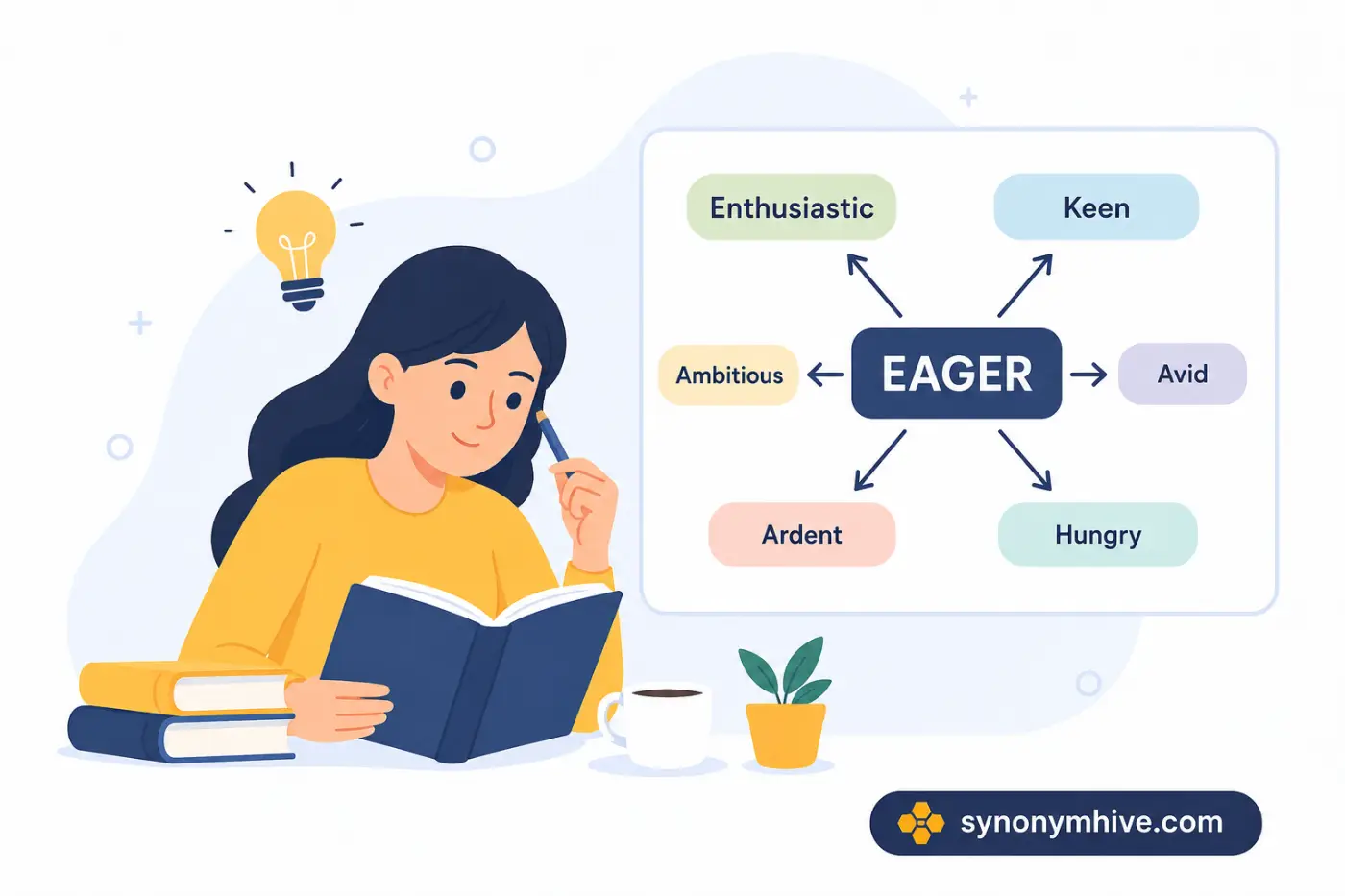
Have you ever written an email, essay, resume, or text message and felt that the word eager sounded too plain? Learning synonyms for eager helps you express excitement, enthusiasm, willingness, and motivation with greater accuracy. The right word can make your writing sound more natural and more engaging.
alternatives for eager are words that describe someone who is excited, ready, or strongly interested in doing something. Some fit everyday conversations, while others work better in resumes, professional emails, academic writing, or speeches. Using different words also keeps your writing from becoming repetitive. Instead of using eager again and again, you can choose an alternative that better matches your meaning and the situation.
This guide explains the meaning and history of the word, shares dozens of useful alternatives, compares similar words, and helps you choose the best one with confidence.
Looking for a better alternative? Visit Synonyms For Analyze Ultimate Guide: Alternatives (2026).
What Does Eager Mean
The word eager describes someone who is excited, interested, or ready to do something. People use it in many situations.
- Job applications.
- School essays.
- Business emails.
- Team meetings.
- Personal conversations.
- Everyday writing.
For example:
- She was eager to start her new job.
- The children were eager to open their presents.
- We’re eager to hear your ideas.
- He remained eager to learn new skills.
Being eager means looking forward to something with excitement and positive energy.
Word Origin And Plain English Meaning
The word eager comes from the Old French word eigre, which originally meant keen or sharp. It later entered Middle English and gradually took on the meaning of showing strong interest or excitement. Today, people use eager to describe someone who is ready, willing, and excited to take action. In plain English, eager means:
- Ready to begin.
- Excited about something.
- Looking forward to an opportunity.
- Interested in learning or helping.
- Wanting something to happen soon.
Imagine a student waiting for the first day of college. They arrive early, ask questions, and can’t wait to begin classes. That’s what being eager looks like. The same idea applies to new jobs, vacations, projects, friendships, and personal goals.
Synonyms For Eager Master Word List
Many articles list only a few alternatives. Real writing often needs more precise choices. The table below groups useful synonyms into simple, everyday, formal, and casual language.
| Word | Meaning | Tone | Example |
|---|---|---|---|
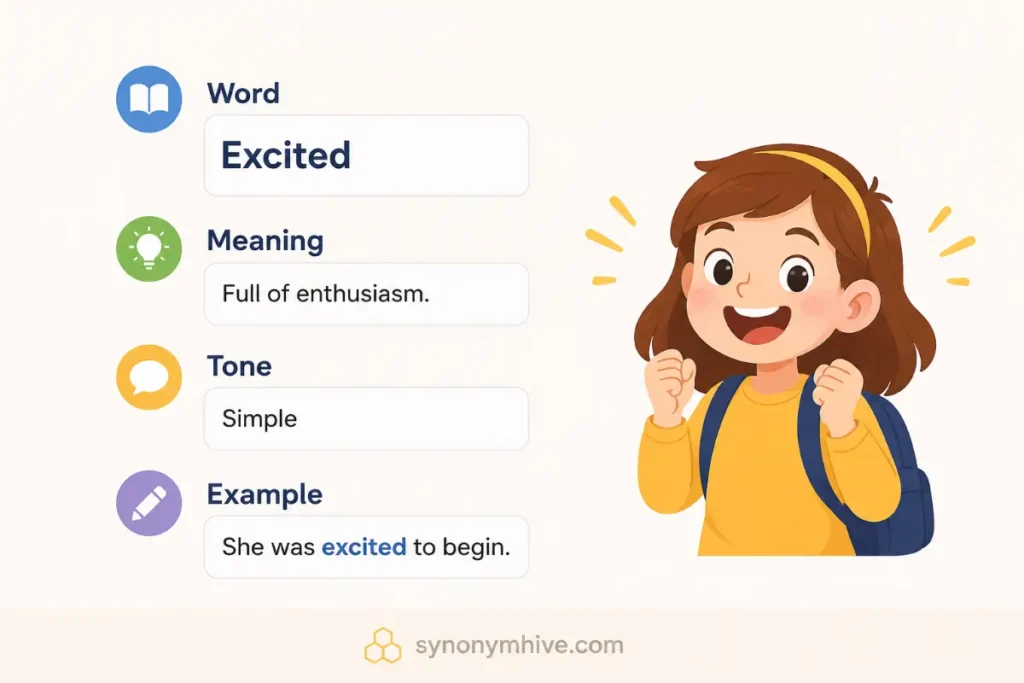
| Excited | Full of enthusiasm. | Simple | She was excited to begin. |
| Keen | Very interested. | Simple | He’s keen to learn. |
| Ready | Prepared to act. | Simple | We’re ready to help. |
| Willing | Happy to do something. | Everyday | She’s willing to assist. |
| Interested | Showing curiosity. | Everyday | I’m interested in the project. |
| Motivated | Driven to succeed. | Everyday | They’re motivated to improve. |
| Enthusiastic | Full of energy. | Everyday | The volunteers were enthusiastic. |
| Hopeful | Feeling optimistic. | Everyday | She remained hopeful about the future. |
| Passionate | Showing deep interest. | Formal | He’s passionate about education. |
| Determined | Firmly focused. | Formal | He remained determined to succeed. |
| Energetic | Full of energy. | Everyday | The new employee is energetic. |
| Animated | Showing excitement. | Casual | The children became animated. |
| Pumped | Very excited. | Casual | I’m pumped for the game. |
| Fired up | Highly motivated. | Casual | The coach got everyone fired up. |
| All in | Fully committed. | Casual | She’s all in on the project. |
| Ready to go | Prepared to begin. | Casual | We’re ready to go. |
| Looking forward | Expecting with excitement. | Everyday | I’m looking forward to tomorrow. |
| Open | Willing to consider ideas. | Everyday | He’s open to feedback. |
| Receptive | Ready to listen. | Formal | The audience was receptive. |
| Committed | Loyal to a goal. | Formal | They’re committed to success. |
| Inspired | Filled with motivation. | Everyday | The speech left everyone inspired. |
| Excitable | Easily excited. | Casual | He’s naturally excitable. |
| Hungry | Strong desire to succeed. | Casual | She’s hungry for success. |
| Go getter | Someone who takes action. | Casual | He’s a real go getter. |
This collection gives you useful choices for resumes, essays, emails, presentations, speeches, and everyday conversations.
Synonyms By Intensity
Not every situation calls for the strongest possible word. Choosing the right level of enthusiasm helps your writing sound more natural.
Mild Enthusiasm
These words describe quiet interest.
| Word | Best Use |
|---|---|
| Interested | Everyday writing. |
| Willing | Work and school. |
| Ready | General conversations. |
| Open | Professional communication. |
| Curious | Learning situations. |
Moderate Enthusiasm
These words describe noticeable excitement.
| Word | Best Use |
|---|---|
| Eager | General writing. |
| Keen | Business and education. |
| Motivated | Career discussions. |
| Enthusiastic | Team settings. |
| Inspired | Personal growth. |
Strong Enthusiasm
These words describe powerful excitement and commitment.
| Word | Best Use |
|---|---|
| Passionate | Professional and personal goals. |
| Zealous | Formal writing. |
| Driven | Career development. |
| Fired up | Casual conversations. |
| Pumped | Informal speech. |
Matching the strength of the word to the situation makes your writing sound believable and more effective.
Synonyms By Part Of Speech
Most people know eager as an adjective, but related words appear in several forms. Learning them gives you more flexibility while writing.
Adjectives
| Word | Example |
|---|---|
| Eager | She’s eager to help. |
| Keen | He’s keen to learn. |
| Enthusiastic | The students were enthusiastic. |
| Curious | Curious minds ask questions. |
| Motivated | A motivated team performs well. |
| Passionate | She’s passionate about teaching. |
Nouns
| Word | Example |
|---|---|
| Eagerness | His eagerness impressed the interviewer. |
| Enthusiasm | Her enthusiasm inspired the class. |
| Motivation | Motivation helped him stay focused. |
| Passion | Passion drives success. |
| Curiosity | Curiosity encourages learning. |
| Interest | Her interest grew over time. |
Verbs
| Word | Example |
|---|---|
| Anticipate | We anticipate great results. |
| Welcome | They welcomed the opportunity. |
| Embrace | She embraced the challenge. |
| Pursue | He pursued every opportunity. |
| Seek | They seek new experiences. |
| Encourage | Teachers encourage curiosity. |
Using different parts of speech helps your writing sound smoother and reduces repetition.
Do Americans And British People Use Different Words
Most phrases for eager are common in both American and British English. Words like keen, enthusiastic, motivated, ready, and interested sound natural in both countries. Some expressions appear more often in one region.
| Word Or Phrase | More Common In | Notes |
|---|---|---|
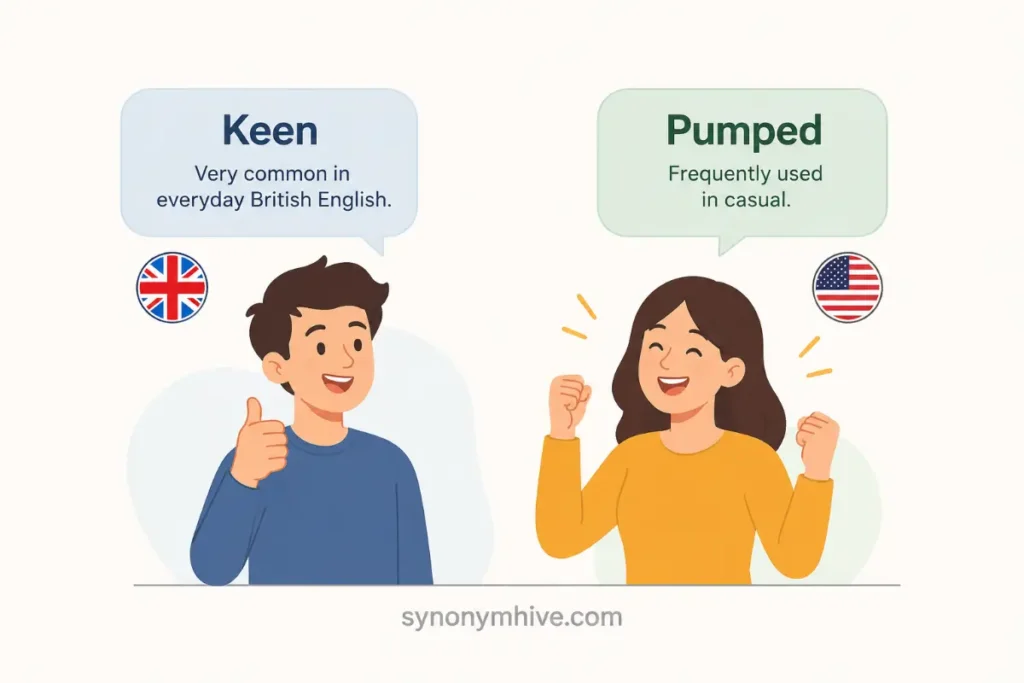
| Keen | UK | Very common in everyday British English. |
| Pumped | US | Frequently used in casual American conversations. |
| Fired up | US | Common in sports and motivational settings. |
| Looking forward | US and UK | Widely used in personal and business communication. |
| Go getter | US | Popular in career and workplace discussions. |
| Receptive | US and UK | Common in business and education. |
If you’re writing for an American audience, words like excited, motivated, enthusiastic, driven, and looking forward usually sound the most natural. If your readers come from different countries, choose clear and widely understood words instead of regional slang.
Which Synonym Fits Your Situation Best
The best synonym depends on where you’re using it. A resume, school essay, business email, and text message each call for a different tone. The sections below help you choose the most natural word.
Best Word For A Resume
A resume should show enthusiasm without sounding exaggerated. Hiring managers appreciate candidates who are motivated, dependable, and ready to grow.
| Best Word | Why It Works | Example |
|---|---|---|
| Motivated | Shows strong work ethic. | Motivated professional with five years of experience. |
| Driven | Highlights ambition. | Driven sales representative who exceeded targets. |
| Dedicated | Shows commitment. | Dedicated employee focused on customer satisfaction. |
| Enthusiastic | Sounds positive. | Enthusiastic team member with strong communication skills. |
| Willing | Shows flexibility. | Willing to learn new technologies and processes. |
These words make your resume sound confident and professional.
Best Word For An Essay
Essays usually require words that sound clear and thoughtful.
| Best Word | Best Use | Example |
|---|---|---|
| Enthusiastic | General academic writing. | The students remained enthusiastic throughout the project. |
| Keen | Formal essays. | The researcher was keen to explore new ideas. |
| Motivated | Education and psychology. | Motivated learners often improve faster. |
| Passionate | Personal essays. | She became passionate about protecting wildlife. |
| Curious | Learning and science. | Curious minds often make important discoveries. |
These words improve readability while keeping your writing natural.
Best Word For A Text Message
Friends usually prefer simple and relaxed language.
| Best Word | Example |
|---|---|
| Excited | I’m excited to see you tomorrow. |
| Pumped | I’m pumped for the concert. |
| Ready | I’m ready whenever you are. |
| Looking forward | I’m looking forward to the trip. |
| Fired up | We’re all fired up for the game. |
Simple words often sound warmer and more genuine.
Best Word For An Email
Emails should match your relationship with the reader.
| Situation | Best Word | Example |
|---|---|---|
| Business | Looking forward | We’re looking forward to working with you. |
| Customer | Enthusiastic | Our team is enthusiastic about helping you. |
| Teacher | Interested | I’m interested in learning more about the course. |
| Friend | Excited | I’m excited to catch up this weekend. |
| Team | Motivated | Everyone is motivated to reach our goals. |
Choosing the right word makes your message feel sincere and professional.
Best Word For Speaking
People naturally choose familiar words during conversations. These options sound comfortable and authentic.
| Word | Example |
|---|---|
| Excited | I’m excited about the new project. |
| Ready | We’re ready to begin. |
| Keen | She’s keen to join us. |
| Motivated | The whole team feels motivated. |
| Looking forward | I’m looking forward to seeing everyone. |
Simple language usually creates the strongest connection with listeners.
Find similar expressions in Synonyms For Establish Ultimate Guide (2026).
Original Example Sentences
These examples show how different synonyms work in real situations.
- She was eager to start her first day at work.
- The children were excited about the school trip.
- He remained motivated even after several setbacks.
- Our volunteers were enthusiastic about helping the community.
- The students were curious to learn how the experiment worked.
- I’m looking forward to meeting the new team.
- She became passionate about protecting the environment.
- The coach praised the players for staying driven all season.
- Everyone was ready to begin the presentation.
- He was willing to help anyone who needed support.
- The audience seemed receptive to the new ideas.
- Her eagerness to learn impressed every manager she worked with.
- The interns showed genuine interest in every training session.
- The young entrepreneur stayed determined to grow the business.
- The entire class felt inspired after hearing the guest speaker.
Each sentence demonstrates a different way to express excitement, willingness, or motivation.
Eager Vs Excited
These words are similar, but they are not identical.
| Eager | Excited |
|---|---|
| Shows readiness and strong interest. | Focuses on emotional excitement. |
| Often suggests taking action soon. | Often describes happy feelings. |
Examples.
Eager.
She was eager to begin her new role.
Excited.
She was excited about the concert.
Someone can feel excited without being ready to act. Being eager usually includes both excitement and willingness.
Eager Vs Enthusiastic
These words are often interchangeable, but they emphasize different ideas.
| Eager | Enthusiastic |
|---|---|
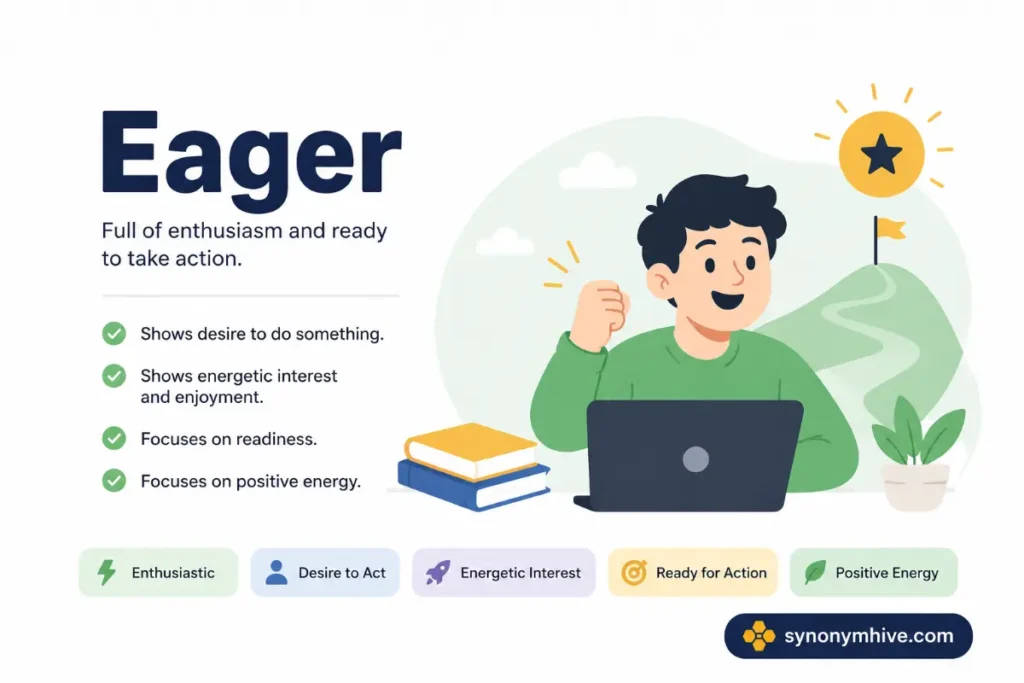
| Shows desire to do something. | Shows energetic interest and enjoyment. |
| Focuses on readiness. | Focuses on positive energy. |
Examples.
Eager.
The students were eager to answer the questions.
Enthusiastic.
The students gave enthusiastic applause.
Use eager for willingness. Use enthusiastic for visible excitement.
Eager Vs Keen
These words are close in meaning, but usage differs slightly.
| Eager | Keen |
|---|---|
| Common in American English. | Very common in British English. |
| Sounds natural in most situations. | Often sounds slightly more formal in American English. |
Examples.
Eager.
We’re eager to hear your feedback.
Keen.
She’s keen to improve her writing skills.
Both words work well in professional and academic writing.
Eager Vs Motivated
People sometimes use these words as if they mean the same thing, but they describe different ideas.
| Eager | Motivated |
|---|---|
| Describes immediate excitement and readiness. | Describes the inner drive to keep working toward a goal. |
| Often focuses on the present moment. | Often describes long term commitment. |
Examples.
Eager.
He was eager to begin training.
Motivated.
She stayed motivated throughout the entire program.
Common Mistakes People Make
Many writers accidentally choose words that don’t fit the situation.
Avoid these common mistakes.
- Repeating eager throughout the same article.
Use words like enthusiastic, motivated, keen, excited, and ready to add variety.
- Using informal slang in professional writing.
Words like pumped and fired up usually fit conversations better than resumes or business reports.
- Confusing eager with desperate.
Being eager shows positive interest. Being desperate suggests urgency or a lack of options.
- Using passionate for every situation.
Someone can be eager to complete a task without feeling deeply passionate about it.
- Ignoring your audience.
Teachers, employers, coworkers, and friends all expect different language and tone.
When You Should Not Use Eager
Even though phrases for eager give you many useful choices, the word eager is not always the best option. Avoid using it when:
- Another word describes the situation more accurately.
- You’re talking about long term commitment instead of immediate excitement.
- The same word appears several times in one piece of writing.
- A more professional or casual synonym fits the audience better.
- You want to describe determination instead of enthusiasm.
Choosing the right synonym makes your writing smoother, clearer, and more engaging.
Antonyms For Eager
Looking at opposite words helps you understand the meaning of eager more clearly. These words describe a lack of interest, excitement, or willingness.
| Antonym | Meaning | Example |
|---|---|---|
| Reluctant | Unwilling to act. | He was reluctant to speak in front of the class. |
| Uninterested | Showing no interest. | She seemed uninterested in the discussion. |
| Indifferent | Not caring one way or the other. | The audience remained indifferent to the announcement. |
| Hesitant | Slow to act because of uncertainty. | He was hesitant to accept the offer. |
| Apathetic | Showing little emotion or motivation. | The employee became apathetic after months of stress. |
| Unmotivated | Lacking drive. | The team looked unmotivated during practice. |
| Resistant | Not willing to accept change. | Some workers were resistant to the new system. |
| Passive | Waiting instead of taking action. | He took a passive approach to the project. |
| Doubtful | Unsure or lacking confidence. | She felt doubtful about the decision. |
| Disinterested | Not involved or concerned. | He appeared disinterested during the meeting. |
Understanding opposite words helps you choose the right expression in different situations.
How Do You Choose The Right Synonym
Knowing many words is useful, but choosing the best one makes your writing stronger.
Use these simple tips.
- Think about the situation.
A resume, email, essay, speech, and text message each need a different tone.
- Match the level of enthusiasm.
Interested works for mild excitement. Enthusiastic and passionate describe much stronger feelings.
- Consider your audience.
Professional readers often expect words like motivated, dedicated, or driven. Friends usually respond better to simple words like excited or ready.
- Read the sentence aloud.
If the word feels awkward, replace it with one that sounds more natural.
- Avoid repeating the same word.
Mix related terms to keep your writing fresh and engaging.
- Keep your meaning clear.
Simple vocabulary often communicates your message better than uncommon words.
- Choose the exact feeling.
Some words describe excitement. Others describe commitment, curiosity, or long term motivation. Pick the one that matches your purpose.
Quick Reference Table
Use this table when you need a fast answer.
| If You Mean | Best Choice |
|---|---|
| Ready to begin | Ready |
| Strong excitement | Excited |
| Professional enthusiasm | Motivated |
| Deep commitment | Dedicated |
| Strong ambition | Driven |
| Desire to learn | Curious |
| Positive energy | Enthusiastic |
| Long term interest | Passionate |
| Open to ideas | Receptive |
| Looking ahead with excitement | Looking forward |
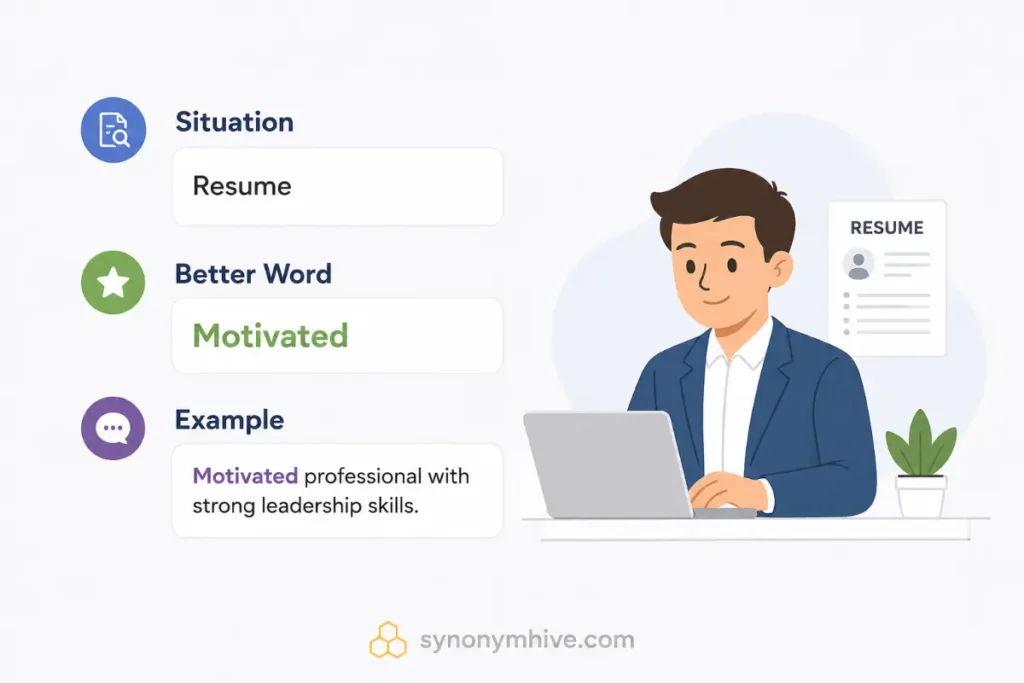
Everyday Situations And The Best Choice
Different situations call for different words.
| Situation | Better Word | Example |
|---|---|---|
| Resume | Motivated | Motivated professional with strong leadership skills. |
| School essay | Enthusiastic | The volunteers remained enthusiastic throughout the project. |
| Business email | Looking forward | We’re looking forward to your response. |
| Job interview | Driven | I’m driven to continue learning and growing. |
| Classroom discussion | Curious | Curious students often ask thoughtful questions. |
| Team meeting | Ready | We’re ready to begin the next phase. |
| Sports | Fired up | The players were fired up before the championship game. |
| Casual conversation | Excited | I’m excited to see everyone this weekend. |
| Personal goal | Passionate | She’s passionate about improving her health. |
| Volunteer work | Dedicated | The volunteers stayed dedicated to the cause. |
Using the right word helps your message sound more natural and more convincing.
Why Learning More Words Improves Your Writing
A strong vocabulary makes communication easier and more effective.
Learning more words helps you:
- Avoid repeating the same expression.
- Write stronger essays and reports.
- Improve resumes and cover letters.
- Sound more confident in conversations.
- Match your tone to different audiences.
- Keep readers interested from beginning to end.
That’s why learning expressions for eager is valuable. Every alternative highlights a different type of enthusiasm. Some describe excitement. Others focus on willingness, curiosity, motivation, or commitment. Choosing the right word helps readers understand your message more clearly.
You may also like Synonyms For Energy Simple Guide: Alternatives (2026).
Conclusion
Learning synonyms for eager gives you better ways to describe excitement, willingness, and motivation without repeating the same word. Every synonym has its own purpose. Excited expresses happy anticipation. Motivated highlights inner drive. Dedicated emphasizes commitment. Curious focuses on learning, while driven describes ambition and determination. Choosing the right word helps your writing become more natural, more precise, and more engaging.
Keep this guide nearby when you’re writing essays, resumes, emails, presentations, or everyday messages. As your vocabulary grows, expressing yourself becomes easier. Great writing doesn’t come from using difficult words. It comes from choosing words that clearly match your meaning and fit the situation.
Frequently Asked Questions
What’s Another Way To Say Eager?
There are many useful alternatives. alternatives for eager include excited, keen, enthusiastic, motivated, ready, willing, curious, driven, passionate, and looking forward. The best choice depends on the situation and the kind of enthusiasm you want to express.
What’s The Best Synonym For Eager In Formal Writing?
Motivated, dedicated, enthusiastic, driven, and keen work well in essays, resumes, business writing, and professional communication because they sound confident and natural.
What’s The Difference Between Eager And Excited?
Eager means you’re ready and willing to do something. Excited describes strong positive feelings about something that is happening or about to happen.
Can I Use Eager On A Resume?
Yes. Eager is acceptable on a resume, but words like motivated, driven, dedicated, and enthusiastic often sound stronger and more professional.
What’s Another Way To Say Eager In Everyday Conversation?
Simple expressions like excited, ready, looking forward, keen, and interested sound natural in casual conversations.
Is Eager The Same As Passionate?
No. Eager usually describes immediate excitement or readiness. Passionate describes deep and lasting enthusiasm for a subject, activity, or goal.
How Do I Stop Repeating Eager In My Writing?
Use expressions for eager naturally and choose the word that best fits your meaning. Small vocabulary changes make your writing smoother, clearer, and more enjoyable to read.