
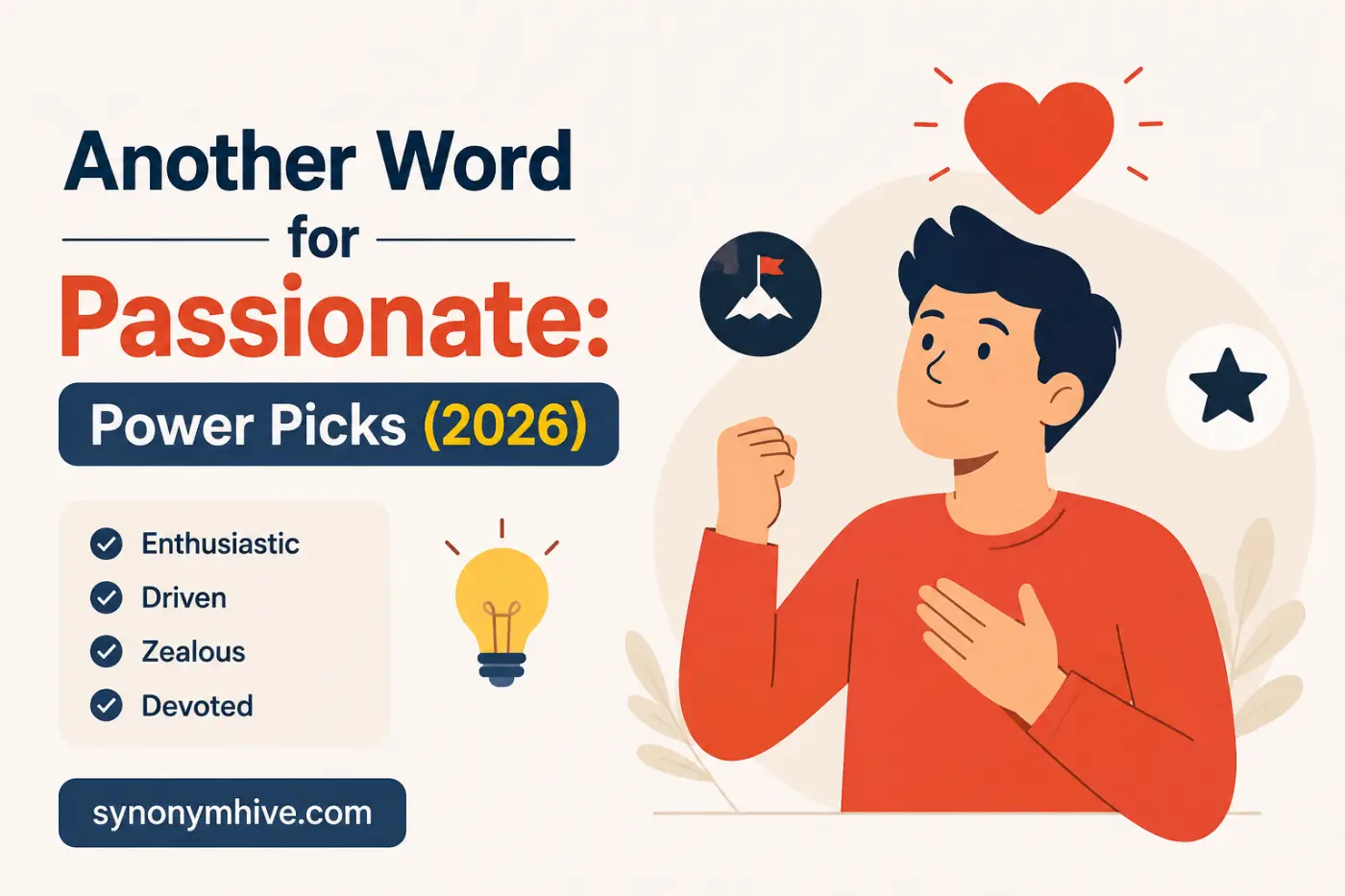
You’re writing a resume and want to say you care deeply about your work. Or maybe you’re finishing an essay and the word passionate feels too common. You might even be texting a friend and want a stronger way to describe someone who puts their whole heart into something. That’s when finding another alternative for passionate can make your writing sound more natural and precise.
The best replacement depends on the feeling you want to show. Enthusiastic suggests excitement. Devoted suggests loyalty. Fervent suggests strong emotion. Driven points to ambition and action. Ardent sounds more formal and intense.
The best another word for passionate depends on context. Use enthusiastic for everyday writing, devoted for loyalty, driven for ambition, and fervent or ardent for stronger formal language.
This guide covers the meaning and origin of passionate along with more than 30 useful alternatives. You’ll also see words grouped by tone and intensity plus examples for resumes, essays, emails, texts, and everyday speech. By the end, you’ll know which word fits your exact situation.
Compare more word options with Another Word For Brave: Bold Alternatives 2026.
What does passionate mean in plain English
Passionate means having very strong feelings about someone or something. It often describes a person who cares deeply about an activity, goal, belief, relationship, or cause.
A passionate person usually doesn’t feel mildly interested. They feel a strong inner pull toward something. They may spend extra time on it, talk about it with energy, or work hard to improve it.
For example.
- She’s passionate about teaching.
This means teaching matters deeply to her. She likely finds meaning and energy in her work.
- He’s passionate about photography.
This means photography is more than a casual hobby for him. He cares strongly about the craft.
- They’re passionate about helping their community.
This suggests deep care combined with strong commitment.
The word can describe positive emotions. However, it can also describe intense anger or strong beliefs depending on the sentence. That’s why context matters.
Where did passionate come from
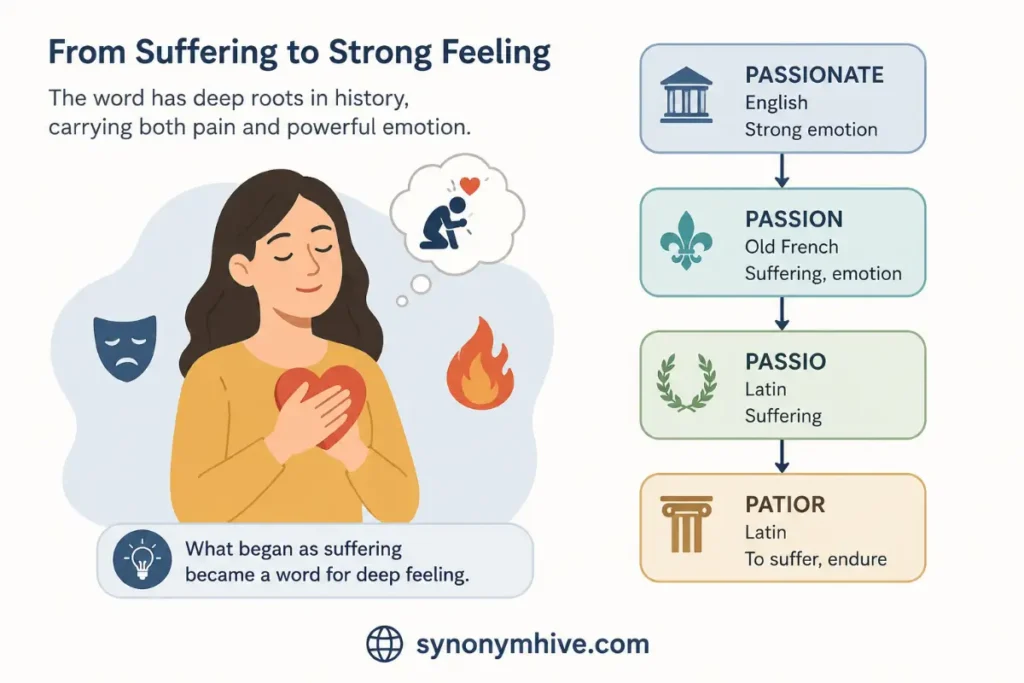
The word passionate has a surprisingly emotional history. Passionate comes from passion. Passion traces back through Old French and Latin to words connected with suffering and strong emotion. The Latin word passio referred to suffering or enduring something. Over time, passion developed broader meanings connected to powerful feelings.
English eventually used passion to describe deep emotional force. From there, passionate became a natural way to describe someone who feels strongly about something.
Today, the word has a much wider everyday meaning. You can be passionate about music, sports, education, business, family, art, cooking, science, or social causes.
The older connection to suffering still appears in religious and historical language. In modern American English, however, passionate usually points to deep enthusiasm, commitment, or emotional intensity. That history explains why passionate often feels stronger than interested.
Someone who is interested in gardening may enjoy planting flowers on weekends. Someone passionate about gardening may study plants, redesign their yard, join gardening groups, and spend hours caring for their garden.
What is another word for passionate
There isn’t one perfect replacement for passionate. The strongest choice depends on the meaning you want to express. Some alternatives describe excitement. Others describe loyalty, ambition, emotional intensity, dedication, or strong belief. Here is a broad synonym list you can use as a quick reference.
| Word | Meaning | Tone | Example |
|---|---|---|---|
| Enthusiastic | Very excited or interested | Simple | She’s enthusiastic about the new project. |
| Eager | Ready and excited to act | Everyday | He’s eager to learn new skills. |
| Excited | Full of energy or anticipation | Simple | She’s excited about the opportunity. |
| Interested | Curious or engaged | Mild | He’s interested in environmental science. |
| Dedicated | Strongly committed | Professional | She’s dedicated to helping students. |
| Devoted | Deeply loyal or committed | Warm | He’s devoted to his family. |
| Committed | Firmly focused on a goal | Professional | They’re committed to improving service. |
| Driven | Highly motivated to succeed | Strong | She’s driven to build a successful career. |
| Motivated | Ready to work toward a goal | Professional | He’s motivated to improve his performance. |
| Intense | Extremely strong in feeling | Strong | She has an intense interest in history. |
| Fired up | Very excited and energetic | Casual | The team is fired up for the game. |
| Psyched | Very excited | Slang | I’m psyched about the concert. |
| Keen | Very interested or eager | Everyday | She’s keen to learn more. |
| Energetic | Full of physical or mental energy | Everyday | She’s an energetic speaker. |
| Invested | Personally interested in an outcome | Modern | He’s invested in the success of the team. |
| Dedicated | Giving time and effort consistently | Professional | He’s dedicated to his craft. |
| Resolute | Firm and determined | Formal | She remained resolute despite setbacks. |
| Purposeful | Acting with clear meaning or intent | Professional | He takes a purposeful approach to leadership. |
| Single minded | Focused strongly on one goal | Strong | She’s single minded about reaching her target. |
| Fanatical | Extremely enthusiastic | Very strong | He’s fanatical about the sport. |
| Obsessed | Extremely focused or consumed by something | Casual to strong | She’s obsessed with vintage design. |
| Devout | Deeply committed to a belief or cause | Formal | She’s a devout supporter of the organization. |
Some of these words overlap. They aren’t interchangeable in every sentence. The difference often comes down to intensity and purpose.
Which Synonym Is Closest To Passionate
Enthusiastic is often the easiest everyday replacement for passionate. It shows excitement and strong interest without sounding overly intense. Dedicated is better when you want to highlight steady effort and commitment. It works especially well in professional writing. Devoted works when loyalty and emotional attachment matter.
Driven is useful when someone actively pursues a goal because it focuses more on ambition than emotion. Fervent and ardent work well in formal writing when you want to express deep and powerful feeling. Excited is simpler and more casual. It usually describes a current feeling rather than a long term commitment. Invested is a modern choice when someone has a personal stake in the result.
What Are The Mildest Synonyms For Passionate
Sometimes passionate sounds too strong. You may want a softer word that shows interest without suggesting intense emotion. Interested is the mildest option. It simply tells the reader that something matters to you or holds your attention. Curious works when you want to show a desire to learn.
Keen is common in British English and can also appear in American English. It means eager or strongly interested. Engaged suggests active attention and works well in professional and educational settings. Eager shows that someone is ready and excited to do something. For example you could say I’m interested in learning more about digital marketing. You might also write she’s curious about how the system works or the students stayed engaged during the discussion. These choices sound natural when passionate would feel too dramatic.
What Are Stronger Words For Passionate
When you need more emotional force you have several options. Fervent is strong and serious and often appears with beliefs causes movements or opinions. Ardent suggests deep and sincere feeling and can sound polished or literary. Zealous means highly enthusiastic and strongly committed. It can sound positive but sometimes suggests excessive enthusiasm.
Fanatical is much stronger and can suggest extreme enthusiasm with a negative meaning. Obsessed is also intense. In casual speech it can sound playful but in professional writing it can suggest unhealthy or excessive interest. Driven focuses on determination rather than emotion. Resolute focuses on firmness and persistence. The right choice depends on the type of intensity you want to express.
How do passionate synonyms change by intensity
Think of these words as sitting on a scale.
| Level | Useful words | Main feeling |
|---|---|---|
| Mild | Interested | Curiosity |
| Mild | Curious | Desire to learn |
| Moderate | Keen | Eagerness |
| Moderate | Engaged | Active interest |
| Moderate | Enthusiastic | Excitement |
| Strong | Dedicated | Commitment |
| Strong | Devoted | Loyalty |
| Strong | Driven | Ambition |
| Strong | Determined | Persistence |
| Very strong | Ardent | Deep emotion |
| Very strong | Fervent | Powerful belief |
| Very strong | Zealous | Extreme enthusiasm |
| Extreme | Obsessed | Consuming interest |
| Extreme | Fanatical | Excessive enthusiasm |
This scale can help you avoid exaggeration.
For instance, saying someone is fanatical about a small office project may sound strange. Saying they’re enthusiastic about it sounds much more natural.
What parts of speech can you use
Passionate is an adjective and most direct replacements are also adjectives. You can describe a person as enthusiastic, dedicated, driven, devoted, eager, or determined. Each word adds a slightly different meaning. Enthusiastic highlights excitement. Dedicated focuses on steady commitment. Driven emphasizes ambition. Devoted suggests loyalty while determined highlights persistence.
You can also change the sentence structure and use nouns or adverbs. Passion is the noun form. Enthusiasm is the noun related to enthusiastic. Dedication is the noun related to dedicated. Devotion is the noun related to devoted. Determination is the noun related to determined. Drive is the noun often connected with ambition and motivation.
For example you can write she’s passionate about science. You could change it to she has a passion for science. Another option is she’s enthusiastic about science or she shows great enthusiasm for science. You could also write she’s dedicated to scientific research or her dedication to science is clear. Changing the part of speech can make your writing flow better and help you avoid repeating the same adjective.
What Is The Best Word For A Resume
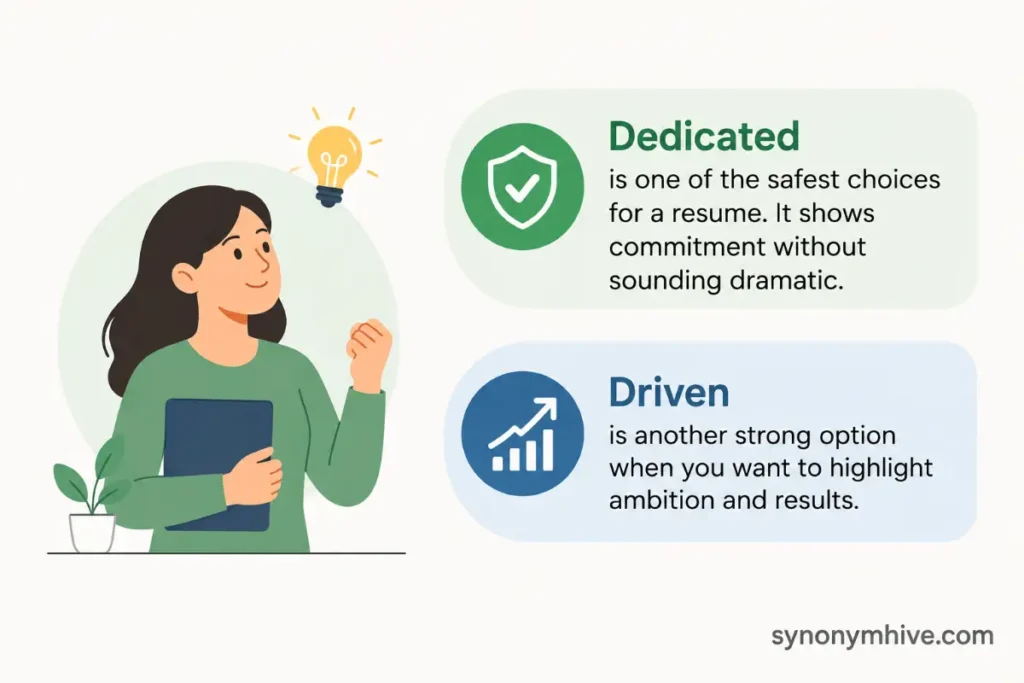
Dedicated is one of the safest choices for a resume. It shows commitment without sounding dramatic. Driven is another strong option when you want to highlight ambition and results. Motivated works well too but can sound generic when you don’t support it with evidence.
Instead of writing I’m passionate about customer service you could write I’m dedicated to creating positive customer experiences. You could also say I’m driven to improve customer satisfaction and team performance. Better still show your commitment through an accomplishment. For example I’m dedicated to customer service and helped improve client retention by 18 percent. Specific evidence makes your claim more believable because a strong resume shows what you’ve done instead of simply describing what you feel.
What Is The Best Word For An Essay
Ardent fervent dedicated and devoted can all work in essays. The best choice depends on the subject and the level of emotion or commitment you want to express. In academic writing avoid overly dramatic language unless the topic clearly calls for it.
Instead of saying the scientist was passionate about climate research you might write the scientist was deeply committed to climate research. For a historical essay you could write the reformer was a fervent advocate for public education. In a literary essay ardent can sound natural. For example the character remained an ardent supporter of his family. Academic writing benefits from precision so choose a word that tells readers exactly what kind of feeling or commitment you mean.
What Is The Best Word For A Text Message
Texting gives you more freedom to use casual language. Excited is one of the easiest choices. You can also say fired up psyched obsessed or really into something depending on your relationship with the person and the tone of the conversation.
For example you could write I’m so excited about the concert. You might also say I’m really into this new band or I’m psyched for the weekend. If you’re texting a close friend you don’t need a formal synonym. Natural everyday language usually sounds better than words such as fervent or ardent.
What Is The Best Word For An Email
The best email choice depends on the relationship and purpose of the message. Enthusiastic works in most professional emails. Dedicated works well when discussing work ethic. Committed fits goals and responsibilities. Excited works well when sharing positive news.
For example you could write I’m enthusiastic about the opportunity to join your team. You might say I’m committed to supporting the project or I’m excited to discuss the next steps. These choices sound professional without making the email feel stiff or overly formal.
What Is The Best Word For Speaking
In everyday speech enthusiastic and excited are usually the easiest choices. You can also say someone is really into something when you want a relaxed and conversational tone.
For example you could say she’s really into fitness. You might say he’s very enthusiastic about teaching or they’re excited about the new restaurant. You could also say she’s deeply committed to the project. Spoken English usually favors simple familiar words so you don’t need an unusual synonym just to sound intelligent.
What Is The Best Word For A Job Interview
Driven is especially useful in a job interview because it connects strong interest with action. Dedicated and committed also work well when you want to show reliability and professional commitment.
For example you could say I’m driven to keep improving my skills. You might also say I’m dedicated to helping customers solve problems or I’m committed to learning and growing with the company. Try to follow these statements with evidence. If you say you’re driven explain what you achieved. That turns a broad personality claim into a credible answer.
What Is Another Phrase For Passionate About Work
Dedicated is often the strongest professional choice. Committed is also useful when you want to show reliability. Driven works when ambition is central to your meaning. Enthusiastic works when you want to highlight excitement and positive interest.
For example you could write she’s dedicated to improving workplace training. You might say he’s committed to helping new employees succeed. Another option is she’s driven to create better products. You could also write he’s enthusiastic about working with young professionals. Each word gives passionate a slightly different meaning.
What Is Another Term For Passionate About Learning
Curious is an excellent choice when you mean a desire to discover or understand something. Eager works when you want to show excitement about learning. Enthusiastic highlights positive interest and energy. Dedicated works when learning requires sustained effort and commitment.
For example you could write I’m curious about how artificial intelligence works. You might say she’s eager to learn new programming skills. Another option is he’s enthusiastic about science education. You could also write she’s dedicated to continuous learning. These words help you express the specific kind of interest you mean.
What Is Another Expression For Passionate About Helping Others
Compassionate is often the best choice when your focus is caring for people. Dedicated works when you want to show ongoing service. Devoted suggests deep personal commitment. Committed works especially well in professional and community settings.
For example you could write she’s compassionate toward people facing difficult circumstances. You might say he’s dedicated to serving his local community. Another option is they’re committed to helping families find better resources. Passionate focuses on intensity while compassionate focuses on care and concern for others. That distinction can make your writing more precise.
Need a similar word? Read Another Word For Problem: Powerful Synonyms.
What Is Another Phrase For Passionate About A Cause
Fervent is a strong formal choice when you want to express deep commitment to a cause. Ardent also works well and can sound more literary. Dedicated and committed are safer choices for professional writing.
For example you could write she’s a fervent advocate for affordable housing. You might say he’s an ardent supporter of public education. Another option is they’re committed to protecting local wildlife. You could also write she’s dedicated to improving access to healthcare. The best choice depends on the level of emotional intensity you want to show.
Passionate Vs Enthusiastic
Passionate and enthusiastic are close in meaning but they aren’t identical. Enthusiastic usually suggests excitement and positive interest. Passionate often suggests deeper emotional commitment and a stronger long term connection.
You might be enthusiastic about trying pottery because the activity sounds fun and interesting. You might be passionate about becoming a professional artist because the goal has deeper personal meaning. Enthusiasm can change quickly while passion often suggests a lasting interest. Still everyday American English often uses these words in similar ways. If you want a safe replacement for passionate enthusiastic is usually a natural choice.
Passionate Vs Dedicated
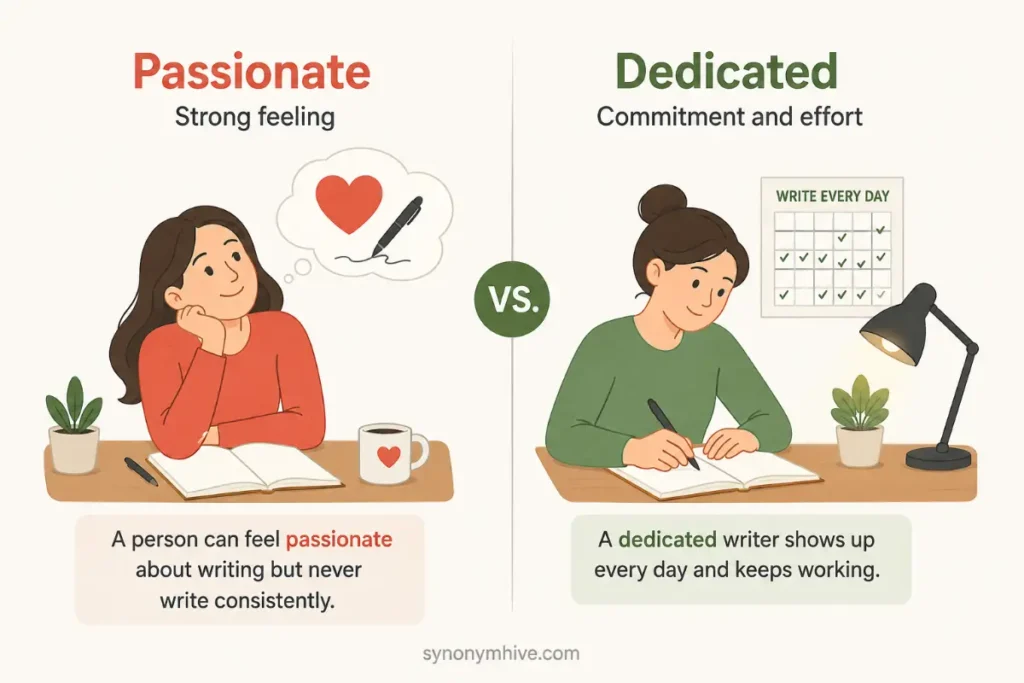
Passionate describes strong feeling while dedicated describes commitment and effort. A person can feel passionate about writing but never write consistently. A dedicated writer shows up every day and keeps working.
That’s why dedicated is often better for a resume. It tells employers something about behavior instead of emotion. Compare these sentences. She’s passionate about teaching. She’s dedicated to teaching. The first tells us how she feels. The second shows how seriously she commits to the work. If your goal is to show reliability then dedicated often works better.
Passionate Vs Driven
Passionate centers on feeling while driven centers on ambition. A passionate person may care deeply about art. A driven person may work relentlessly to become a successful artist. The two qualities can overlap but they highlight different traits.
For example you could say she’s passionate about entrepreneurship. You could also say she’s driven to build her own company. The first emphasizes interest and emotional connection. The second emphasizes action and achievement. Use driven when the sentence involves goals results growth leadership or success.
Passionate Vs Devoted
Devoted suggests loyalty and deep attachment. You can be passionate about a sport but devoted to a particular team. You can be passionate about your career but devoted to your family.
Devoted often sounds warmer and more personal. Passionate can sound energetic and intense while devoted often sounds loyal and heartfelt. The right choice depends on the relationship or commitment you want to describe. Use devoted when loyalty and lasting attachment matter more than excitement.
Passionate Vs Obsessed
Passionate and obsessed can sound similar but they carry very different meanings. Obsessed can sound playful in casual speech but can also suggest an unhealthy level of attention.
For example she’s passionate about fitness sounds positive. She’s obsessed with fitness could sound funny or concerning depending on the situation. Use obsessed carefully in professional or academic writing because it can create a stronger and more negative impression than you intend.
What Are Common Mistakes With Passionate
One common mistake is using passionate when you really mean skilled. Being passionate about photography doesn’t automatically mean you’re a great photographer. Experienced or proficient may be more accurate when you’re describing ability.
Another mistake is using passionate for every positive interest. If someone simply likes reading then calling them passionate about books may exaggerate their feelings. Avoid strong words such as fanatical or obsessed unless the intensity is truly appropriate. On a resume it’s also better to support passionate claims with evidence.
Instead of saying I’m passionate about leadership you could write I led a five person team and helped reduce project delays by 20 percent. The second sentence demonstrates the quality instead of simply naming it.
When Should You Not Use Passionate
Don’t use passionate when the emotion or interest is weak. Interested may fit better. Don’t use passionate when you mean skilled because experienced or proficient may be more accurate. If you mean reliable then dedicated or dependable can work better.
Use driven or determined when you mean ambitious. Choose compassionate or thoughtful when you mean caring. Words become more effective when they carry the exact meaning you need. A stronger word isn’t always a better word. Precision matters more than intensity.
What Are The Antonyms Of Passionate
The opposite of passionate depends on the situation. Indifferent means you don’t care much. Uninterested means you have little interest. Apathetic suggests a lack of concern or motivation. Detached suggests emotional distance. Unenthusiastic means you lack excitement. Passive can describe someone who doesn’t take active action. Cold can describe a lack of emotional warmth.
For example she’s passionate about the project creates a clear contrast with she’s indifferent to the project. Choose the antonym based on the specific quality you want to express rather than simply choosing the most direct opposite.
Which Synonym Should You Choose
Ask yourself what you want to express. Enthusiastic shows excitement and positive interest. Dedicated highlights steady commitment and effort. Determined describes someone who refuses to give up.
Curious shows a desire to learn. Committed highlights loyalty to a goal or responsibility. Fervent expresses deep and serious emotion. Ardent gives your writing a polished and formal tone. Fired up works well in casual American English. Obsessed suggests extreme focus and should be used carefully. Compassionate focuses on caring for other people.
The best synonym depends on your exact meaning. Pick the word that describes the quality you want to show rather than simply choosing the strongest sounding option.
How Can You Sound Passionate Without Saying Passionate
You don’t always need a synonym. Sometimes the strongest approach is to describe the action behind the feeling. Instead of saying I’m passionate about helping students you could write I spend my weekends mentoring students who need extra academic support.
You can use the same approach in other situations. Instead of saying he’s passionate about photography you could write he spends hours studying light and composition and regularly photographs local events. Instead of saying she’s passionate about fitness you could write she trains five days a week and helps new members build sustainable exercise habits.
Specific details create a stronger impression because readers can see the commitment through your actions instead of simply being asked to believe it. This approach also makes your writing more credible and specific.
Original Examples You Can Use
Here are natural examples that show how different synonyms work in real situations. She’s enthusiastic about starting her new role. He’s dedicated to helping first generation college students. I’m driven to improve my writing skills. They’re committed to building a stronger community.
She’s deeply devoted to her family. He’s eager to learn more about computer science. The coach is enthusiastic about developing young athletes. She’s a fervent supporter of public libraries. He’s an ardent fan of classic American literature.
I’m really into photography and spend most weekends exploring new locations. She’s determined to finish her degree while working full time. He’s highly motivated to grow his small business. The students became animated when the teacher introduced the experiment.
She took a purposeful approach to improving the company culture. He stayed resolute after several early setbacks. I’m excited to contribute to the new marketing campaign. She’s invested in creating better opportunities for young artists. He’s keen to develop stronger public speaking skills. They’re dedicated to making the neighborhood safer. She’s compassionate and deeply committed to helping people in need.
These examples show why one synonym rarely works in every sentence. Each word highlights a slightly different type of interest commitment ambition or emotion.
How Do Regional Differences Affect These Words
American English and British English share most of these synonyms. Some words appear more often in one region though. Keen is common in British English. Americans understand it but often choose eager or excited instead.
Psyched is strongly casual and familiar in American English and usually suits relaxed conversations. Fired up is also widely understood in the United States and works well in casual speech. Ardent and fervent are understood across English speaking regions but sound more formal in both American and British English.
Passionate itself is very common in American English. You’ll see it in job descriptions personal statements marketing copy interviews and everyday conversation. The main regional difference usually involves tone and frequency rather than meaning.
How Can You Avoid Sounding Repetitive
If your paragraph uses passionate several times change the sentence structure instead of swapping synonyms mechanically. For example these sentences sound repetitive. She’s passionate about teaching. She’s passionate about education.
A stronger version could be she’s dedicated to teaching and deeply committed to helping students succeed. Her enthusiasm for education shows in the extra time she spends mentoring new teachers. The ideas stay connected without repeating the same word.
You can also replace an adjective with a noun. Instead of he’s passionate about music you could write he has a deep passion for music. Another option is to describe the action. He spends most evenings composing and recording new songs. Good writing gives readers variety without forcing unusual vocabulary into every sentence.ce.
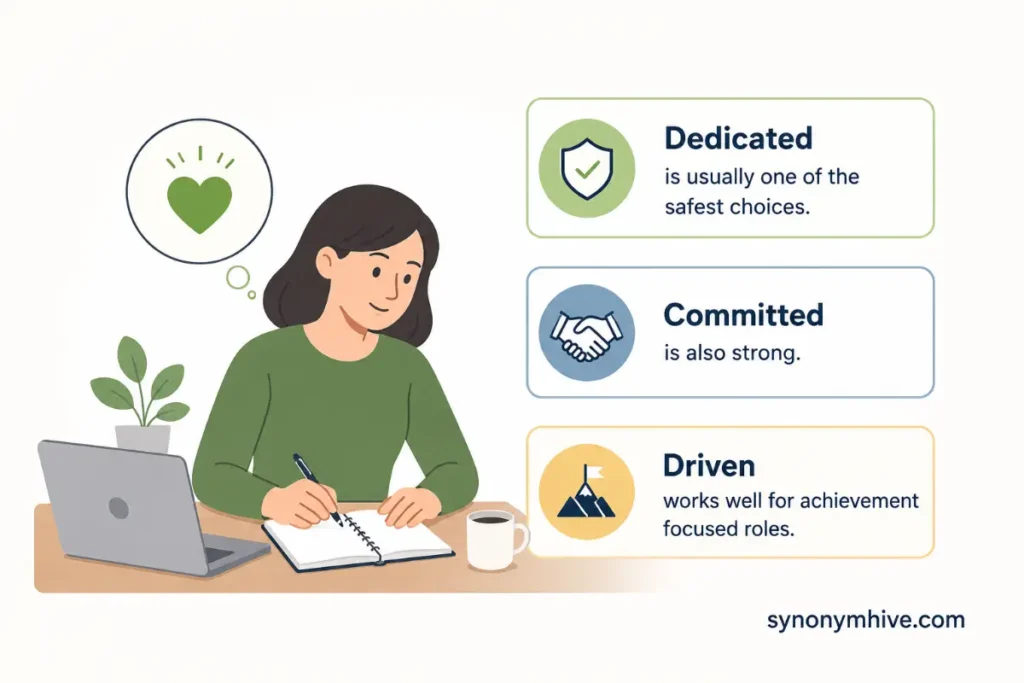
What Is Another Alternative For Passionate In Professional Writing
Dedicated is usually one of the safest choices for professional writing. Committed is also strong when you want to show reliability and responsibility. Driven works well for achievement focused roles while enthusiastic fits situations where energy and positive interest matter. Purposeful can work when the focus is intentional action.
For a professional audience evidence still matters more than the adjective. Compare I’m a passionate marketing professional with I’m a marketing professional who has led campaigns that increased qualified leads by 25 percent. The second sentence gives readers something concrete and makes the claim more credible.
What Is Another Expression For Passionate In A Personal Statement
Dedicated enthusiastic driven curious and devoted can all work in a personal statement. Personal statements give you more room to show emotion but specific details still make your writing stronger. A brief example or personal experience can show your interest more clearly than a broad adjective.
For example you could write my passion for biology began when I volunteered at a local wildlife center. You could also write my curiosity about biology grew while I volunteered at a local wildlife center. Curiosity changes the focus from emotional intensity to a desire to learn. That small change can make the sentence more precise.
How Can You Pick The Right Synonym Quickly
Use a simple three question test. Ask what feeling or quality you’re trying to show. Then decide how strong that feeling should sound. Finally consider where the reader will see the sentence.
If you mean excitement choose enthusiastic. If you mean deep belief choose fervent. For casual excitement choose fired up or psyched. If you mean curiosity choose interested or curious. This method works faster than searching through a giant thesaurus.
Find more synonyms in Another Word for Powerful Best Synonyms: Strong Words 2026.
Conclusion
Choosing another term for passionate starts with meaning rather than vocabulary. Ask yourself what kind of energy you want the reader to feel. Enthusiastic works for excitement. Dedicated shows steady commitment. Driven points to ambition. Devoted adds loyalty. Fervent and ardent bring stronger emotion. Curious works when learning matters most.
Also remember that strong writing doesn’t depend on fancy synonyms. A clear example can say more than any adjective. Instead of telling readers that someone cares deeply about a goal, show the time, effort, results, or choices behind that commitment.
The best word is the one that fits the person, situation, and audience. When you choose with that in mind, your writing sounds natural instead of forced.
Frequently Asked Questions
What’s another way to say passionate?
Enthusiastic is one of the most natural alternatives. Dedicated, devoted, driven, committed, and fervent can work when you want a more specific meaning.
What is a professional word for passionate?
Dedicated or committed usually works well in professional writing. Driven is a strong choice when you want to emphasize ambition and results.
What is a stronger word than passionate?
Fervent, ardent, zealous, fanatical, and obsessed can sound stronger. Use them carefully because some can suggest excessive emotion.
What is a softer word for passionate?
Interested, curious, engaged, and eager are softer choices. They work well when you want to show interest without suggesting intense emotion.
What is another term for passionate on a resume?
Dedicated is often the safest choice on a resume. Driven and committed can also work well when you connect them to specific achievements.
Is enthusiastic the same as passionate?
Enthusiastic and passionate are close but not identical. Enthusiastic focuses more on excitement while passionate often suggests deeper and longer lasting commitment.
Can I use passionate in an academic essay?
Yes. Passionate can work in an essay when it accurately describes strong emotion or commitment. For a more precise academic tone, dedicated, committed, ardent, or fervent may fit better.