
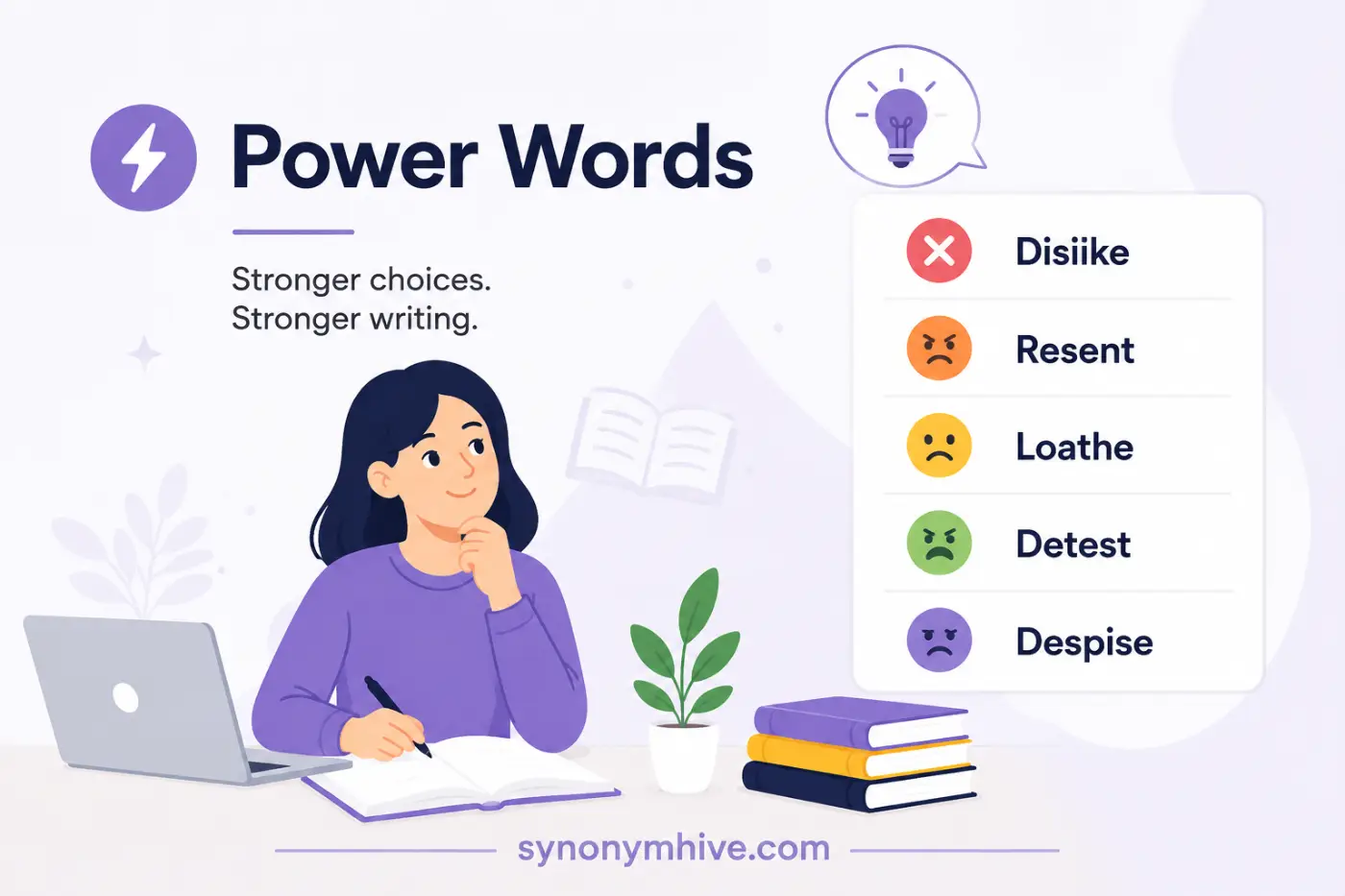
Have you ever written an email an essay or even a text message and realized you kept using the word hate. Finding another word for hate helps your writing sound more accurate more natural and less repetitive. Hate is one of the strongest emotional words in English. Sometimes you only mean dislike. Other times you want to describe anger resentment disgust or deep hostility. Choosing the right word helps readers understand exactly how strong the feeling is.
Another word for hate is a synonym that expresses dislike disgust resentment hostility or strong negative feelings. The best choice depends on the emotion the situation and the level of intensity.
This guide explains what hate means where the word came from and the best alternatives for conversations essays emails stories and everyday writing. You’ll also find comparison tables practical examples and simple tips that help you choose the right synonym.
You may also like Another Word For Stupid: Polite Alternatives 2026.
What Does Hate Mean
Hate means having a very strong feeling of dislike anger or hostility toward someone something or an idea.
People use hate in many different situations.
- Someone hates unfair treatment.
- A person hates waking up early.
- Friends may say they hate spicy food.
- A character in a story may hate an enemy.
- Someone may hate lying or dishonesty.
Because hate can describe everything from mild annoyance to deep hostility choosing a more precise synonym often makes your writing much clearer.
Where Does Hate Come From
The word hate comes from the Old English word hatian which meant to dislike strongly or feel hostility toward someone or something. Its roots go back to ancient Germanic languages where similar words described anger dislike and opposition.
Over time hate became one of the strongest emotional words in English. Today it appears in conversations books speeches news reports and everyday writing to describe powerful negative feelings.
Master List Of Another Word For Hate
The table below includes more than thirty useful choices for another term for hate. Each one describes a different type or level of negative emotion.
| Word | Meaning | Tone | Example |
|---|---|---|---|
| Dislike | Mild negative feeling | Simple | I dislike loud music. |
| Detest | Strong dislike | Neutral | She detests dishonesty. |
| Loathe | Deep hatred | Formal | He loathes cruelty. |
| Despise | Feel contempt | Formal | They despise corruption. |
| Resent | Feel bitterness | Neutral | She resents unfair criticism. |
| Abhor | Hate completely | Formal | Many people abhor violence. |
| Reject | Refuse to accept | Neutral | He rejected the proposal. |
| Oppose | Be against | Neutral | They oppose the decision. |
| Scorn | Show contempt | Formal | She scorned the idea. |
| Disgust | Cause revulsion | Neutral | The smell disgusted everyone. |
| Hostility | Open anger | Formal | Hostility grew between them. |
| Bitterness | Lingering resentment | Neutral | Years of bitterness remained. |
| Anger | Strong displeasure | Everyday | His anger was obvious. |
| Irritation | Feeling bothered | Neutral | Constant noise caused irritation. |
| Frustration | Feeling blocked | Everyday | Delays created frustration. |
| Revulsion | Strong disgust | Formal | She felt revulsion immediately. |
| Aversion | Strong dislike | Formal | He has an aversion to conflict. |
| Antipathy | Deep dislike | Formal | Their antipathy was obvious. |
| Spite | Desire to hurt | Neutral | He acted out of spite. |
| Malice | Intent to harm | Formal | The statement showed malice. |
| Grudge | Lasting resentment | Everyday | She held a grudge for years. |
| Fury | Extreme anger | Everyday | His fury shocked everyone. |
| Outrage | Angry shock | Neutral | The decision caused outrage. |
| Disdain | Feeling beneath respect | Formal | She looked at him with disdain. |
| Can’t stand | Strong dislike | Casual | I can’t stand waiting. |
| Sick of | Tired of something | Slang | I’m sick of excuses. |
| Fed up with | Extremely tired of | Everyday | We’re fed up with delays. |
| Turned off | Lost interest because of dislike | Casual | I was turned off by the attitude. |
Synonyms By Strength
Some words describe mild dislike while others express extreme hatred.
Mild Choices
- Dislike.
- Annoyance.
- Irritation.
- Frustration.
- Oppose.
- Reject.
These fit everyday conversations and professional writing.
Moderate Choices
- Hate.
- Resent.
- Detest.
- Aversion.
- Contempt.
- Grudge.
- Disgust.
These describe stronger emotional reactions.
Strong Choices
- Loathe.
- Despise.
- Abhor.
- Fury.
- Revulsion.
- Hostility.
- Malice.
Use these words only when describing very powerful negative emotions.
Synonyms By Part Of Speech
Most choices for another alternative for hate are verbs or nouns. Using different word forms helps your writing sound smoother and more natural.
Verbs
- Hate.
- Dislike.
- Detest.
- Loathe.
- Despise.
- Abhor.
- Resent.
- Reject.
- Oppose.
- Scorn.
Nouns
- Hatred.
- Dislike.
- Contempt.
- Hostility.
- Anger.
- Bitterness.
- Fury.
- Resentment.
- Aversion.
- Disgust.
Adjectives
- Hateful.
- Bitter.
- Hostile.
- Angry.
- Resentful.
- Disgusted.
Using verbs nouns and adjectives together helps your writing avoid repetition and sound more natural.
Do Americans And British People Use Different Words
Most synonyms for hate are common in both American and British English. A few informal expressions appear more often in one region.
| Word | More Common In | Notes |
|---|---|---|
| Hate | Both | Used in every type of conversation. |
| Can’t stand | Both | Very common informal expression. |
| Fed up with | United Kingdom | Also widely understood in the United States. |
| Sick of | United States | Common in casual speech. |
| Loathe | Both | Often appears in formal writing. |
| Despise | Both | Common in books speeches and articles. |
| Abhor | Both | More formal than everyday speech. |
| Turned off | United States | Often used for losing interest because of negative behavior. |
Most readers in the United States and the United Kingdom will understand every synonym in this guide without difficulty.
What Is The Best Word To Use In Different Situations
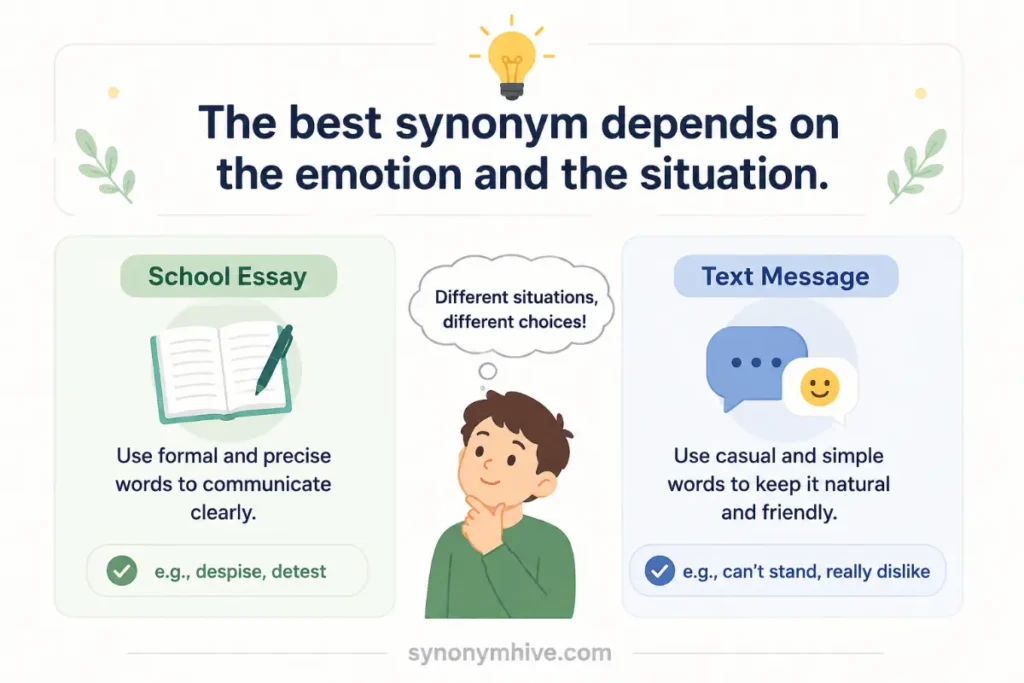
The best synonym depends on the emotion and the situation. A school essay needs different language than a text message. Choosing the right word helps your writing sound clear and believable.
What Is The Best Word For A Resume
A resume should never sound overly emotional. Instead of using hate choose professional words that explain disagreement or preference.
Good choices include.
- Prefer.
- Avoid.
- Oppose.
- Improve.
- Resolve.
- Address.
Examples.
I prefer organized work environments.
Our team works to resolve customer concerns quickly.
We address problems with practical solutions.
Professional writing focuses on solutions instead of negative emotions.
What Is The Best Word For An Essay
Essays often discuss literature history opinions and social issues. More precise vocabulary improves clarity.
Good choices include.
- Resent.
- Despise.
- Loathe.
- Abhor.
- Disdain.
- Contempt.
Examples.
The character begins to resent his former friend.
Many citizens despised the unfair laws.
The author shows deep contempt for corruption.
These words help readers understand the exact level of emotion.
What Is The Best Word For A Text Message
Text messages usually sound best with casual everyday language.
Good choices include.
- Hate.
- Can’t stand.
- Sick of.
- Fed up with.
- Dislike.
Examples.
I can’t stand this traffic.
I’m sick of waiting.
I dislike rainy weather.
We’re fed up with these delays.
These expressions feel natural in everyday conversations.
What Is The Best Word For An Email
Professional emails should avoid emotional language.
Good choices include.
- Concern.
- Disagree.
- Oppose.
- Object.
- Prefer.
Examples.
I respectfully disagree with the proposal.
We have concerns about the current schedule.
I would prefer another approach.
These words communicate your point without sounding aggressive.
What Is The Best Word For Speaking
Simple language usually sounds the most natural.
Good choices include.
- Dislike.
- Hate.
- Can’t stand.
- Fed up with.
- Resent.
- Oppose.
Examples.
I dislike loud restaurants.
He resents being ignored.
They oppose the new policy.
I’m fed up with all the delays.
Simple words often leave the strongest impression.
Real Life Examples Using Another Word For Hate
These examples show how different synonyms fit real situations.
- She dislikes waking up before sunrise.
- He can’t stand dishonesty.
- Many people oppose unfair treatment.
- The child resented being blamed for something he did not do.
- They despised corruption in the government.
- I have an aversion to horror movies.
- She felt bitterness after losing the opportunity.
- The audience expressed outrage over the decision.
- We are fed up with constant delays.
- His rude behavior disgusted everyone.
- The coach rejected poor sportsmanship.
- She loathes bullying in schools.
- The neighbors held a grudge for many years.
- They showed contempt for the unfair rules.
- He spoke without anger even though he strongly disagreed.
Using different synonyms helps readers understand the exact emotion instead of relying on one powerful word.
Hate Vs Dislike
These words are related but describe very different levels of emotion.
| Hate | Dislike |
|---|---|
| Very strong negative feeling. | Mild negative feeling. |
| Used for intense emotions. | Used for everyday preferences. |
| I hate dishonesty. | I dislike cold weather. |
Dislike sounds much softer than hate.
Hate Vs Loathe
These words both express strong emotions but have different levels of intensity.
| Hate | Loathe |
|---|---|
| Strong negative feeling. | Extremely deep hatred or disgust. |
| Common in everyday speech. | Often sounds more dramatic. |
| I hate waiting in traffic. | She loathes cruelty. |
Loathe usually sounds stronger than hate.
You may also like Another Word For Love Ultimate Guide: Top Picks (2026).
Hate Vs Despise
These words are often confused because both describe powerful negative emotions.
| Hate | Despise |
|---|---|
| Strong emotional dislike. | Includes disrespect and contempt. |
| Focuses on emotion. | Focuses on judging someone or something negatively. |
| He hates lying. | She despises dishonesty. |
Despise often suggests looking down on someone instead of simply disliking them.
Common Mistakes People Make
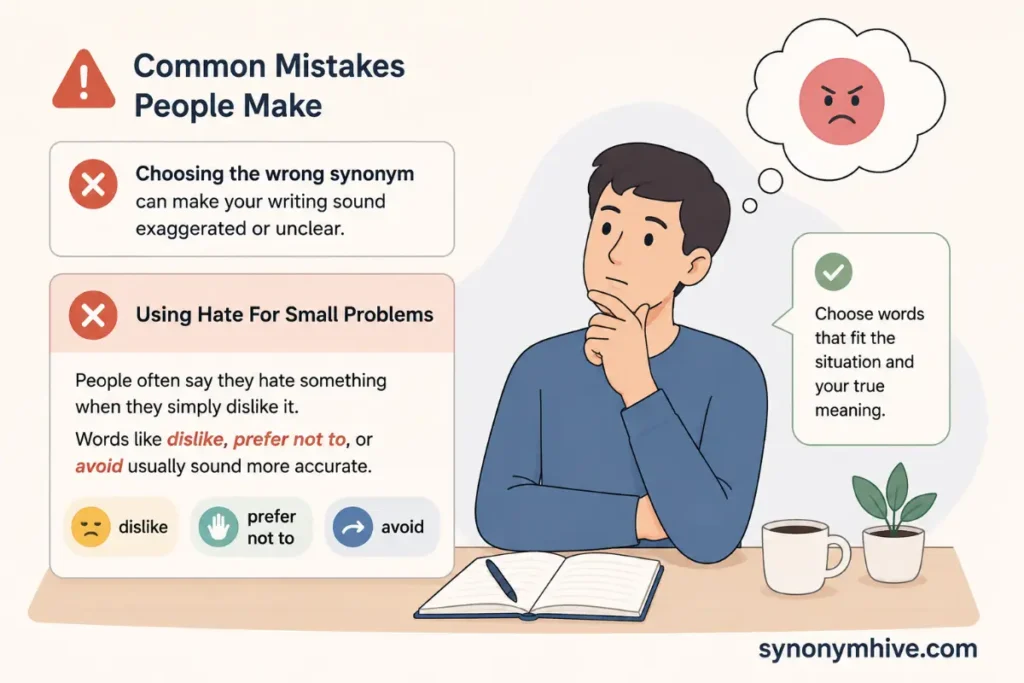
Choosing the wrong synonym can make your writing sound exaggerated or unclear.
Using Hate For Small Problems
People often say they hate something when they simply dislike it. Words like dislike prefer not to or avoid usually sound more accurate.
Mixing Casual And Formal Language
Can’t stand and sick of fit conversations with friends.
Despise abhor and contempt work better in essays books and formal writing.
Ignoring The Exact Meaning
Resent describes lasting bitterness.
Disgust describes revulsion.
Oppose describes disagreement.
Choose the word that matches your exact emotion.
Using Strong Words Too Often
Not every inconvenience deserves words like loathe or abhor.
Saving stronger words for serious situations makes your writing more believable.
Choosing Emotional Words In Professional Writing
Business emails should focus on solving problems instead of expressing anger.
Words like concern disagree prefer and recommend usually communicate your point more effectively.
Antonyms Of Hate
Learning opposite words helps you express positive emotions with greater accuracy and balance.
| Word | Meaning | Example |
|---|---|---|
| Love | Deep affection | I love spending time with my family. |
| Like | Positive feeling | She likes reading before bed. |
| Admire | Respect greatly | We admire her dedication. |
| Appreciate | Recognize value | I appreciate your support. |
| Respect | Hold in high regard | They respect each other’s opinions. |
| Enjoy | Take pleasure in | We enjoy weekend hikes. |
| Cherish | Value deeply | She cherishes old family photos. |
| Treasure | Hold dear | He treasures every memory. |
| Accept | Welcome without resistance | The team accepted the decision. |
| Support | Stand behind someone or something | They support the new project. |
Sometimes using a positive word explains your meaning better than simply saying you do not hate something.
What Is Another Word For Hate In Customer Reviews
Customer reviews sound more helpful when they explain the exact problem instead of simply saying someone hated the experience.
| Situation | Better Word | Example |
|---|---|---|
| Slow service | Frustrated | We were frustrated by the long wait. |
| Poor quality | Disappointed | I was disappointed with the product quality. |
| Bad support | Dissatisfied | The support team left me dissatisfied. |
| Loud environment | Couldn’t stand | I couldn’t stand the constant noise. |
| False advertising | Resented | Customers resented the misleading claims. |
| Dirty room | Disgusted | We were disgusted by the condition of the room. |
Specific words make reviews more useful and trustworthy.
What Is Another Word For Hate In School Writing
School assignments become stronger when you replace emotional language with words that match the situation.
| Instead Of Hate | Better Choice | Example |
|---|---|---|
| Hate | Dislike | The author dislikes social injustice. |
| Hate | Resent | The character resents unfair treatment. |
| Hate | Oppose | Many citizens opposed the new law. |
| Hate | Despise | The villain despises honesty. |
| Hate | Reject | The community rejected the proposal. |
| Hate | Condemn | The article condemns violence. |
Using precise vocabulary improves both clarity and credibility.
Common Phrases That Use Hate
Many common expressions become more meaningful when you replace hate with a more accurate synonym.
| Common Phrase | Better Alternative | Example |
|---|---|---|
| Hate waiting | Can’t stand waiting | I can’t stand waiting in long lines. |
| Hate homework | Dislike homework | Many students dislike homework. |
| Hate dishonesty | Despise dishonesty | She despises dishonesty in business. |
| Hate conflict | Avoid conflict | He prefers to avoid conflict. |
| Hate rude people | Can’t stand rude people | I can’t stand rude behavior. |
| Hate injustice | Oppose injustice | They oppose injustice wherever they see it. |
| Hate lies | Resent lies | She resents being lied to. |
| Hate bullying | Abhor bullying | Every student should abhor bullying. |
Replacing hate with a more specific word helps readers understand your message.
What Is The Most Common Another Word For Hate
Some synonyms appear more often because they fit everyday conversations.
| Synonym | Best Used For |
|---|---|
| Dislike | Everyday opinions. |
| Can’t stand | Casual conversations. |
| Resent | Long lasting bitterness. |
| Oppose | Professional and academic writing. |
| Despise | Strong dislike with disrespect. |
| Loathe | Extreme emotional dislike. |
| Fed up with | Ongoing frustration. |
| Disgust | Strong revulsion. |
| Reject | Ideas proposals or suggestions. |
| Annoyed by | Minor frustrations. |
If you are unsure which word to choose start with dislike. It sounds natural and fits almost every situation.
Why Hate Is One Of The Most Overused Words
People often say they hate something when they simply find it annoying or inconvenient.
Using a more accurate word makes your writing stronger.
| If You Mean | Better Word |
|---|---|
| Slight annoyance | Dislike |
| Ongoing frustration | Fed up with |
| Disagreement | Oppose |
| Deep bitterness | Resent |
| Strong disgust | Loathe |
| Moral rejection | Abhor |
| Lack of respect | Despise |
| Mild irritation | Annoyed by |
Choosing the right word gives readers a clearer picture of your emotions.
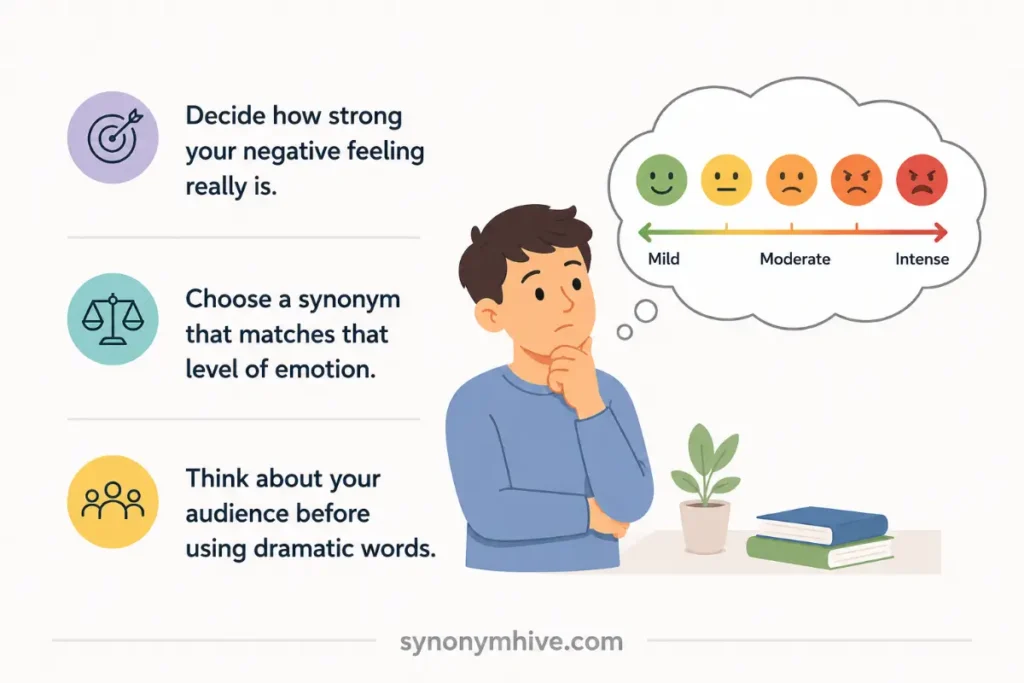
How To Replace Hate Without Sounding Dramatic
Strong language loses its impact when it appears in every sentence. A better approach is to match the word to the situation.
- Decide how strong your negative feeling really is.
- Choose a synonym that matches that level of emotion.
- Think about your audience before using dramatic words.
- Read the sentence aloud to make sure it sounds natural.
- Pick clarity over intensity every time.
The best writing does not rely on the strongest word. It relies on the most accurate one.
Quick Tips For Choosing The Right Word
Choosing the right synonym becomes much easier when you think about the exact emotion you want to express.
- Use dislike for mild negative feelings.
- Choose resent when describing lasting bitterness.
- Pick despise when you want to show both dislike and disrespect.
- Use loathe only for very strong emotional reactions.
- Choose oppose in professional writing when discussing ideas or decisions.
- Use can’t stand in casual conversations with friends and family.
- Pick fed up with when talking about ongoing frustration instead of deep hatred.
- Use abhor only for serious topics like violence cruelty or injustice.
- Match the strength of the word to the situation. Small annoyances usually do not need the strongest language.
- Read your sentence aloud before you finish. If it sounds like something you would naturally say it is probably the right choice.
Looking for another word? See Another Word For Similar Simple Guide: Better Words.
Conclusion
Finding another word for hate helps you express negative feelings with greater accuracy. Instead of repeating the same word you can choose dislike for mild opinions resent for lasting bitterness despise for contempt or loathe for deep emotional rejection. The right word gives readers a much clearer understanding of your message.
Good writing is not about using the strongest vocabulary. It is about choosing the most accurate one. Practice using these synonyms in essays conversations emails stories and everyday writing. As your vocabulary grows your writing will become more natural more expressive and easier to understand.
Frequently Asked Questions
What’s Another Way To Say Hate?
There are many choices including dislike detest loathe despise resent abhor oppose and can’t stand. The best another phrase for hate depends on how strong the feeling is and the situation you are describing.
What Is The Strongest Synonym For Hate?
Loathe abhor and despise are among the strongest alternatives. They describe much deeper emotions than everyday dislike.
Can I Use Dislike Instead Of Hate?
Yes. Dislike is often a better choice because it sounds less extreme and fits everyday conversations professional writing and school assignments.
Which Word Sounds Best In Professional Writing?
Oppose disagree object concern and prefer are usually the best choices in business emails reports and workplace communication because they sound respectful and solution focused.
Is Can’t Stand Too Informal?
Yes. Can’t stand is common in everyday conversations but it is usually too casual for formal writing academic papers or business communication.
What Is Another Expression For Hate In A Story?
Loathe despise resent hostility contempt and bitterness all work well in stories because they help readers understand different types of conflict and emotion.
How Can I Choose Another Alternative For Hate More Easily?
Think about why the negative feeling exists. Another phrase for hate should match the exact emotion instead of simply sounding stronger. Choosing the most accurate word always makes your writing clearer and more believable.