
Have you ever been writing an email, essay, resume, or even a quick text and realized you’ve used the word using several times in the same paragraph? It happens to almost everyone. Repeating the same word can make your writing feel dull, so many people look for alternatives for using to add variety and make their sentences flow better. The word using is simple, but it can describe many different actions. You might be talking about operating a tool, applying a method, taking advantage of a resource, or working with a particular material. Because it has several meanings, there isn’t one replacement that works in every sentence.
Synonyms for using include employing, applying, utilizing, operating, handling, working with, making use of, relying on, taking advantage of, and using alternatives like through or by means of, depending on the context.
This guide explains what using means, where the word came from, and how to choose the best alternative for different situations. You’ll also find a large synonym list, practical examples, and tips for improving your writing naturally.
Explore another synonym guide: Synonyms for Showing: The Ultimate Guide 2026 Edition.
What Does “Using” Mean in Plain English?
The word using means making use of something to complete a task or reach a goal.
That “something” could be:
- A tool
- A machine
- A skill
- A method
- A resource
- A piece of software
- Knowledge or experience
Here are a few examples.
- She’s using a laptop to finish her homework.
- The chef is using fresh vegetables.
- We’re using a new payment system.
- He solved the puzzle using logic.
- They’re using solar energy to power the building.
In every sentence, using explains how something is being done.
Where Does the Word “Using” Come From?
The word using comes from the verb use, which entered English through Old French and ultimately traces back to the Latin word usus, meaning “practice,” “employment,” or “use.” Over time, English speakers began using using as the present participle of use to describe an action happening now or the method someone is choosing.
Today, it appears in nearly every type of writing, including:
- School essays
- Business emails
- Technical documents
- News articles
- Instruction guides
- Everyday conversations
Because the word is so common, learning simple words for using can help you avoid repetition and choose more precise language.
Why Should You Replace “Using”?
There’s nothing wrong with the word using.
The problem comes when it appears several times in a short passage.
For example:
The engineer was using new software.
She was using advanced equipment.
The team was using online tools.
The repeated word quickly becomes noticeable.
Now compare that with this version:
The engineer was operating new software.
She was working with advanced equipment.
The team was relying on online tools.
The second version sounds more varied because each replacement better matches the sentence.
That’s why writers often search for alternatives for using when editing their work.
When Should You Replace “Using”?
Sometimes using is already the best choice.
For example:
She’s using her phone.
This sentence is short, clear, and natural.
Other times, a more specific word improves the sentence.
Instead of:
The company is using new technology.
You could write:
- The company is adopting new technology.
- The company is implementing new technology.
- The company is employing new technology.
Each version gives readers a slightly different meaning.
What’s the Best Synonym for “Using”?
There isn’t one perfect answer.
The best replacement depends on the situation.
If you’re talking about equipment, operating may work best.
When describing a method, applying or employing may sound better.
If you’re discussing software, working with or running could be a better choice.
Think about what you’re actually trying to say before replacing the word.
Master List of Synonyms for Using
Simple similar words
| Word | Meaning | Tone | Example |
|---|---|---|---|
| Employing | Putting something to work | Neutral | She’s employing a new strategy. |
| Applying | Putting into practice | Neutral | He’s applying what he learned. |
| Operating | Controlling equipment or machinery | Neutral | She’s operating the machine safely. |
| Handling | Working with or managing | Everyday | He’s handling customer requests. |
| Working With | Using something regularly | Everyday | She’s working with new software. |
| Running | Operating a program or machine | Everyday | The computer is running several applications. |
| Utilizing | Making practical use of | Formal | The team is utilizing available resources. |
| Using Up | Consuming | Everyday | We’re using up the last supplies. |
Everyday Alternatives
| Word | Meaning | Tone | Example |
|---|---|---|---|
| Making Use Of | Putting something into use | Everyday | She’s making use of online courses. |
| Depending On | Relying on something | Neutral | They’re depending on solar power. |
| Relying On | Trusting or using regularly | Neutral | We’re relying on accurate data. |
| Taking Advantage Of | Benefiting from something | Everyday | He’s taking advantage of free training. |
| Going With | Choosing | Casual | I’m going with the blue option. |
| Trying | Testing something | Casual | She’s trying a new recipe. |
| Carrying Out | Performing a task | Neutral | They’re carrying out the plan. |
| Following | Using a process or method | Neutral | The students are following the instructions. |
Formal Alternatives
| Word | Meaning | Tone | Example |
|---|---|---|---|
| Implementing | Putting into action | Professional | The company is implementing new policies. |
| Executing | Carrying out a plan | Formal | The team is executing the project carefully. |
| Adopting | Beginning to use | Professional | The school is adopting new technology. |
| Leveraging | Using something for advantage | Business | The business is leveraging customer feedback. |
| Utilizing | Making efficient use of | Formal | Researchers are utilizing advanced software. |
| Through | By means of | Formal | The issue was solved through teamwork. |
| By Means Of | Using a particular method | Formal | The survey was completed by means of an online form. |
These are some of the most useful alternatives, but there are many more depending on your sentence and writing style.
More Synonyms for Using
The word using can describe many different actions. Sometimes you’re talking about operating a tool. Other times you’re describing a method, taking advantage of a resource, or putting knowledge into practice.
Here are more useful alternatives that fit different situations.
More Everyday Synonyms
| Word | Meaning | Tone | Example |
|---|---|---|---|
| Working Through | Solving something step by step | Everyday | She worked through the problem with a calculator. |
| Practicing With | Learning by using | Everyday | The students are practicing with new software. |
| Accessing | Getting or making use of | Neutral | He’s accessing the company database. |
| Choosing | Selecting for use | Casual | They’re choosing digital tools instead of paper. |
| Testing | Trying to see how well something works | Everyday | The engineers are testing a new engine. |
| Experimenting With | Trying something new | Casual | She’s experimenting with different colors. |
| Putting Into Practice | Applying knowledge | Neutral | The team is putting new ideas into practice. |
| Taking Into Use | Beginning to use | Neutral | The factory is taking new equipment into use. |
More Formal Alternatives
| Word | Meaning | Tone | Example |
|---|---|---|---|
| Exercising | Using a right or ability | Formal | Citizens are exercising their right to vote. |
| Applying | Putting knowledge or methods into action | Professional | The doctor is applying a new treatment. |
| Drawing On | Using experience or knowledge | Professional | She is drawing on years of experience. |
| Utilizing Resources | Making efficient use of resources | Formal | The organization is utilizing resources wisely. |
| Employing Methods | Following a particular approach | Formal | Scientists are employing advanced methods. |
| Deploying | Putting into active use | Technical | The company is deploying new software today. |
Informal Alternatives
| Word | Meaning | Tone | Example |
|---|---|---|---|
| Giving It a Try | Trying something | Casual | I’m giving the new app a try. |
| Going For | Choosing to use | Casual | We’re going for the cheaper option. |
| Playing Around With | Exploring casually | Informal | He’s playing around with photo editing tools. |
| Messing With | Handling casually | Informal | Don’t keep messing with the settings. |
With these additions, you now have well over 30 useful alternatives that can replace using in different kinds of writing.
Can Synonyms for “Using” Be Grouped by Meaning?
Yes. Since using has several meanings, grouping alternatives by purpose makes choosing the right one much easier.
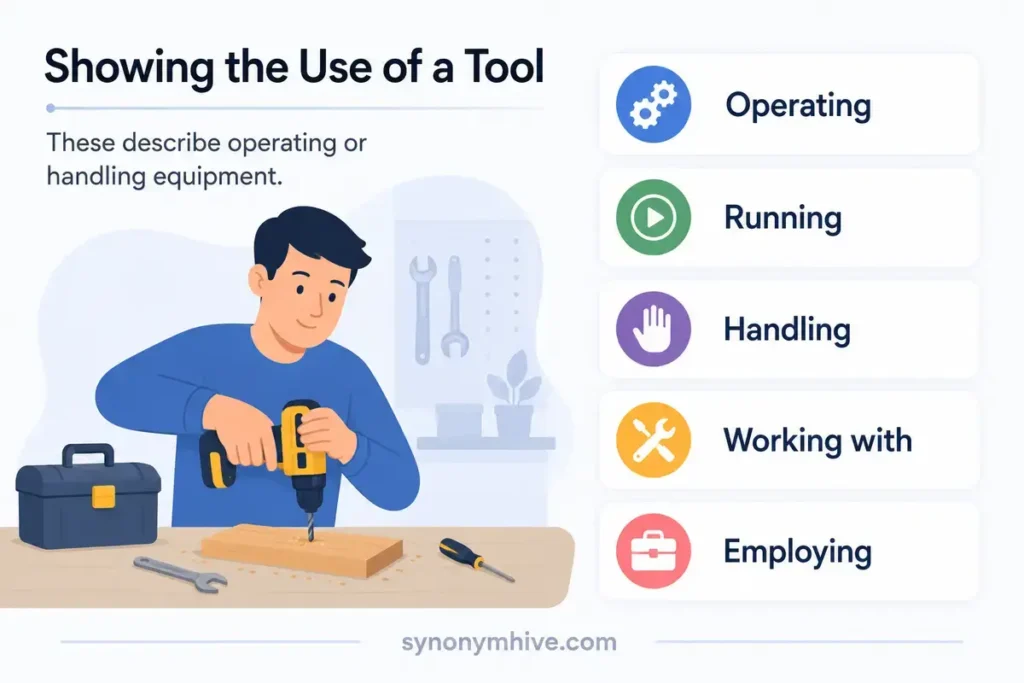
Showing the Use of a Tool
These describe operating or handling equipment.
- Operating
- Running
- Handling
- Working with
- Employing
Example:
She’s operating a new coffee machine.
Showing a Method
These explain how something is done.
- Applying
- Through
- By means of
- Following
- Implementing
Example:
The team solved the problem through careful planning.
Showing Dependence
These describe relying on something.
- Depending on
- Relying on
- Drawing on
Example:
The project is relying on volunteer support.
Showing Efficient Use
These emphasize making good use of something.
- Utilizing
- Leveraging
- Making use of
- Taking advantage of
Example:
The business is leveraging customer feedback to improve its products.
Showing Practice or Experimentation
These describe trying or learning.
- Practicing with
- Testing
- Experimenting with
- Giving it a try
Example:
The students are experimenting with simple science projects.
Do These Synonyms Belong to Different Parts of Speech?
Yes. Most alternatives are verbs or verb phrases, but some are prepositional phrases.
Verbs
These describe actions.
Examples include:
- Employ
- Apply
- Operate
- Handle
- Implement
- Deploy
Example:
The technician operated the equipment safely.
Verb Phrases
These use more than one word.
Examples include:
- Make use of
- Take advantage of
- Rely on
- Draw on
- Work with
Example:
The company makes use of renewable energy.
Prepositional Phrases
These describe the method.
Examples include:
- Through
- By means of
Example:
The report was completed through careful research.
Understanding the grammar behind these expressions helps you build smoother sentences.
Are There US vs. UK Differences?
Most alternatives are common in both American and British English.
Still, a few are used more often in one variety.
More Common in American English
- Using
- Working with
- Running
- Leveraging
- Implementing
These appear frequently in business writing, technology, and everyday conversation.
More Common in British English
- Employing
- Utilising (British spelling of utilizing)
- Drawing on
British English also spells utilizing as utilising, following standard UK spelling rules.
What’s the Best Alternative for a Resume?
Resumes should use strong action words.
Instead of:
Using customer service software.
Try:
- Operated customer service software.
- Implemented new customer support tools.
- Employed digital reporting systems.
- Leveraged CRM software to improve response times.
Example
Less effective:
Used Microsoft Excel to create reports.
Better:
Created reports using Microsoft Excel.
Or:
Leveraged Microsoft Excel to analyze sales data.
These versions sound more professional and achievement-focused.
You may also like Synonyms for With: The Ultimate Guide Write Like a Pro (2026).
What’s the Best Alternative for an Essay?
Academic writing often benefits from precise vocabulary.
Good choices include:
- Applying
- Employing
- Utilizing
- Through
- By means of
- Implementing
Example
Basic:
Researchers were using surveys to collect data.
Improved:
Researchers were employing surveys to collect data.
Or:
Researchers collected data through surveys.
What’s the Best Alternative for an Email?
Professional emails should sound clear and natural.
Good choices include:
- Using
- Applying
- Working with
- Through
- Following
Examples
We’re using the updated schedule beginning Monday.
Please complete the form using blue or black ink.
The issue was resolved through additional testing.
What’s the Best Alternative for Text Messages?
Text messages usually sound better with simple language.
People often say:
- Using
- Trying
- Going with
- Testing
- Giving it a try
Examples
I’m trying the new restaurant tonight.
We’re going with the earlier flight.
I’m testing the new update now.
Real-Life Example Sentences
Here are original examples showing different alternatives for using.
- She applied her classroom knowledge during the interview.
- The mechanic operated the lift carefully.
- The company implemented a new security system.
- We solved the problem through teamwork.
- The students practiced with online learning tools.
- The chef worked with fresh local ingredients.
- The hospital deployed new medical equipment.
- The designers leveraged customer feedback to improve the product.
- The teacher relied on interactive activities during class.
- They’re experimenting with different marketing ideas.
- The engineer drew on years of experience to solve the issue.
- The volunteers made use of donated supplies.
Using vs. Employing: What’s the Difference?
These words are similar, but they have different tones.
Using
- Everyday and simple.
- Fits almost every situation.
Example:
She’s using a calculator.
Employing
- More formal.
- Often used in business or academic writing.
Example:
The researchers are employing statistical analysis.
Choose employing when you want a more professional tone.
Using vs. Utilizing: What’s the Difference?
These words are often confused.
Using
- Means making use of something.
- Simple and natural.
Example:
He’s using a map.
Utilizing
- Means making effective or efficient use of something.
- Sounds more formal.
Example:
The organization is utilizing every available resource.
In many situations, using is the clearer and more natural choice.
What’s Coming in Part 3?
The final section includes:
- Common mistakes and when not to replace using
- Brief antonyms and opposite ideas
- Quick tips for choosing the right synonym
- A practical conclusion
- Frequently Asked Questions
- An SEO-friendly Meta Description
What Are the Most Common Mistakes When Using Synonyms for “Using”?
Replacing using can make your writing more interesting, but only if the new word matches the meaning. Here are the mistakes writers make most often.
Choosing a Word That’s Too Formal
Some alternatives sound much more formal than using.
For example:
The children were utilizing crayons.
Although this sentence is correct, using sounds more natural.
A better version is:
The children were using crayons.
Save words like utilizing, leveraging, and deploying for business, academic, or technical writing.
Using “Leveraging” When You Simply Mean “Using”
People often use leveraging because it sounds professional. However, it has a specific meaning.
Leveraging means using something to gain an advantage.
Less accurate:
She leveraged a pencil to finish her homework.
Better:
She used a pencil to finish her homework.
Correct use:
The company leveraged customer feedback to improve its products.
Confusing “Applying” and “Using”
These words are similar, but they are not always interchangeable.
Using means making use of something.
Applying means putting knowledge, rules, methods, or products into action.
Correct examples:
She used a calculator.
She applied what she learned in class.
Repeating the Same Alternative
Even after replacing using, it’s easy to repeat another word.
For example:
The team implemented a new process.
Managers implemented new software.
Employees implemented new procedures.
Instead, vary your vocabulary.
You could write:
- implemented
- adopted
- employed
- introduced
- applied
- put into practice
This makes your writing sound more natural.
Picking a Synonym That Changes the Meaning
Every alternative has its own meaning.
For example:
- Operating usually refers to machines.
- Applying often refers to knowledge or methods.
- Working with suggests regular interaction.
- Testing means trying something to evaluate it.
- Deploying usually means putting something into active service.
Always choose the word that matches your exact situation.
What Are the Antonyms of “Using”?
The opposite of using depends on the sentence, but these words often express the opposite idea.
Ignoring
Not making use of something.
Example:
He ignored the instructions.
Avoiding
Choosing not to use something.
Example:
They’re avoiding plastic bags.
Neglecting
Failing to use or care for something.
Example:
The old equipment was neglected for years.
Abandoning
Stopping the use of something completely.
Example:
The company abandoned the old system.
Discarding
Throwing something away instead of using it.
Example:
They discarded the broken tools.
These words don’t always replace using, but they often express the opposite idea.
Quick Tips for Choosing the Right Word
Choosing the best alternative becomes much easier if you follow a few simple guidelines.
Think About What Is Being Used
Ask yourself:
- Is it a tool?
- A skill?
- A method?
- Software?
- Knowledge?
- Equipment?
The answer helps you choose the most accurate synonym.
Keep Everyday Writing Simple
For most situations, simple words work best.
Examples include:
- using
- working with
- applying
- operating
- handling
Simple language is easier to understand.
Match the Tone
Choose words that fit your audience.
For formal writing:
- employing
- implementing
- utilizing
- leveraging
- deploying
For casual writing:
- using
- trying
- working with
- making use of
Avoid Replacing Every Instance
Not every using needs a different word.
Sometimes the original word is already the clearest choice.
Good writing focuses on clarity first and variety second.
Read the Sentence Out Loud
After replacing a word, read the sentence aloud.
If it sounds awkward, try another synonym or keep using.
The best writing sounds natural when spoken.

Quick Reference Guide
Best for Everyday Conversation
- Using
- Working with
- Handling
- Trying
- Making use of
Best for Essays
- Applying
- Employing
- Implementing
- Through
- Utilizing
Works Best in Professional Emails
- Using
- Applying
- Working with
- Implementing
- Following
Best for Resumes
- Implemented
- Operated
- Applied
- Leveraged
- Employed
Best for Technical Writing
- Deploying
- Operating
- Utilizing
- Implementing
- Executing
Keeping these groups in mind makes it easier to pick the right word for any situation.
Need a similar word? Read Synonyms for Clear: Better Words to Use (2026).
Conclusion
Learning the best synonyms for using helps you write with more variety while keeping your meaning clear. Although using is one of the most common words in English, it isn’t always the most precise choice. Depending on the situation, words like applying, employing, operating, handling, implementing, and working with may fit better.
The key is to think about what you’re describing before choosing a replacement. Are you talking about a tool, a method, software, knowledge, or a resource? Once you answer that question, selecting the right word becomes much easier. Keep your audience in mind, choose clear language, and don’t replace using unless another word genuinely improves the sentence. Small changes like these can make your writing smoother, more natural, and easier to read.
Frequently Asked Questions
What’s another way to say “using”?
Common alternatives include employing, applying, working with, operating, handling, making use of, and utilizing. The best choice depends on the sentence and context.
What are the best expressions for using in formal writing?
Good formal alternatives include employing, implementing, utilizing, leveraging, deploying, and applying. These words are common in academic, business, and technical writing.
Can I use “utilizing” instead of “using”?
Yes, but only when it fits the meaning. Utilizing usually suggests making efficient or effective use of something, while using is a more general word.
What are the most common phrases for using?
The most useful alternatives for using include applying, employing, operating, working with, handling, making use of, and relying on.
What’s another way to say “using” in an essay?
For essays, consider applying, employing, implementing, through, or by means of. These alternatives often sound more formal and precise.
Is “employing” the same as “using”?
Not always. Employing is a more formal way to say using and is often preferred in professional or academic writing.
Can I use variants for using in a resume?
Yes. Choosing strong action verbs instead of repeating using can make your resume sound more professional. Depending on your work, words like implemented, operated, leveraged, or applied may describe your experience more clearly.