
Imagine writing a work email, school essay, or resume and using the word positive several times. The word is useful, but it doesn’t always express the meaning you want. You might need to describe a negative result, an unfavorable opinion, a harmful effect, or a pessimistic attitude. Choosing the right opposite of positive makes your message clearer and more accurate.
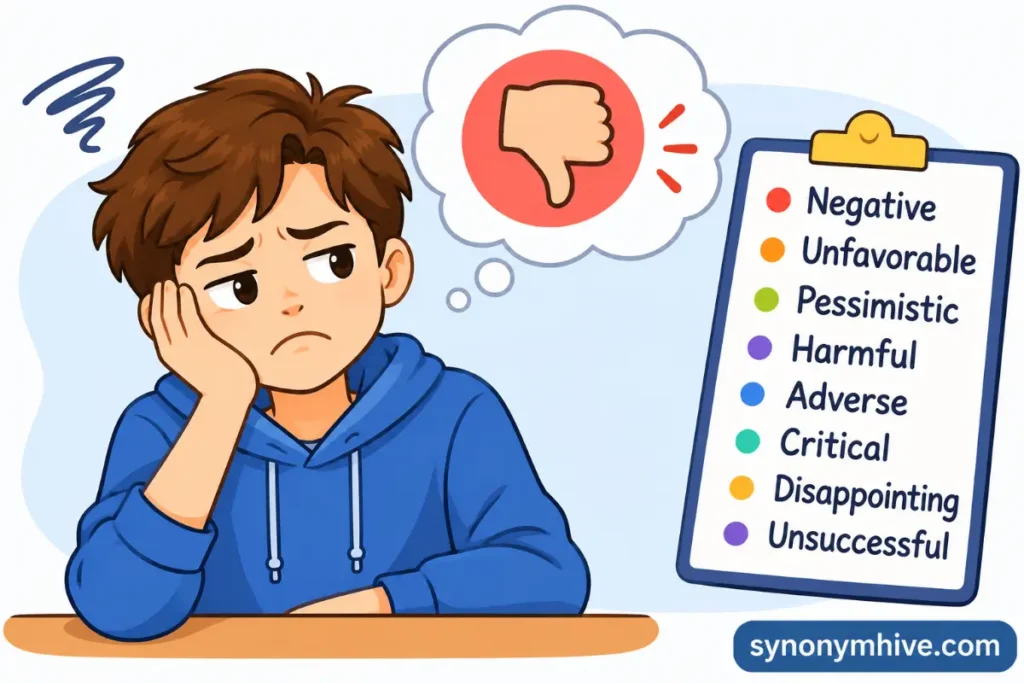
The most common opposite is negative. However, negative does not fit every situation. Unfavorable works well for results and conditions. Pessimistic describes an expectation that things will go badly. Harmful points to damage or danger, while critical can describe an opinion that finds faults.
The opposite of positive is usually negative. Other alternatives include unfavorable, adverse, pessimistic, harmful, doubtful, and critical. The best choice depends on the subject and the meaning you want to express.
This guide explains the word’s meaning and origin, compares more than 30 useful alternatives, and groups them by tone and strength. You’ll also find examples for resumes, essays, emails, texts, and everyday conversations, along with common mistakes and answers to frequently asked questions.
Discover another helpful synonym list in Opposite of Love Best Words and Examples 2026.
What Is the Opposite of Positive?
The most common opposite of positive is negative. Both words can describe opinions, results, attitudes, numbers, reactions, and many other things. However, their meanings change slightly depending on the subject.
For example, a positive review expresses approval, while a negative review points out problems. A positive result may show success or improvement, while a negative result may show failure or an unwanted outcome.
What Does Positive Mean in Plain English?
Positive has several meanings. It can describe something good, helpful, hopeful, or certain. It can also refer to a result that confirms the presence of something.
Here are common uses.
- Good or helpful: A positive change improves a situation.
- Hopeful: A positive person expects good things to happen.
- Supportive: A positive comment encourages someone.
- Certain: A positive answer shows confidence or confirmation.
- Above zero: A positive number has a value greater than zero.
- Confirmed by a test: A positive test result indicates that the test detected the condition or substance it was designed to find.
The meaning matters because negative may not be the best replacement in every case. For example, the opposite of a positive attitude is often a negative or pessimistic attitude. The opposite of a positive number is a negative number. A test result, however, follows the specific meaning of the test.
Is Negative Always the Opposite of Positive?
Negative is the standard general opposite, but other words can be more accurate.
| Meaning of positive | Suitable opposite | Example |
|---|---|---|
| Good or beneficial | Bad, harmful, unfavorable | The change had an unfavorable effect. |
| Hopeful | Pessimistic, doubtful | He had a pessimistic outlook. |
| Supportive | Critical, disapproving | She received a critical response. |
| Successful | Unsuccessful, disappointing | The project had an unsuccessful outcome. |
| Above zero | Negative | The temperature fell to negative five degrees. |
| Confirming a test result | Negative | The test result was negative. |
| Certain or definite | Uncertain, doubtful | The answer remained uncertain. |
Think about the meaning before selecting an antonym. A negative attitude, an adverse effect, and a disappointing result may all contrast with something positive, but they describe different situations.
Where Did the Word Positive Come From?
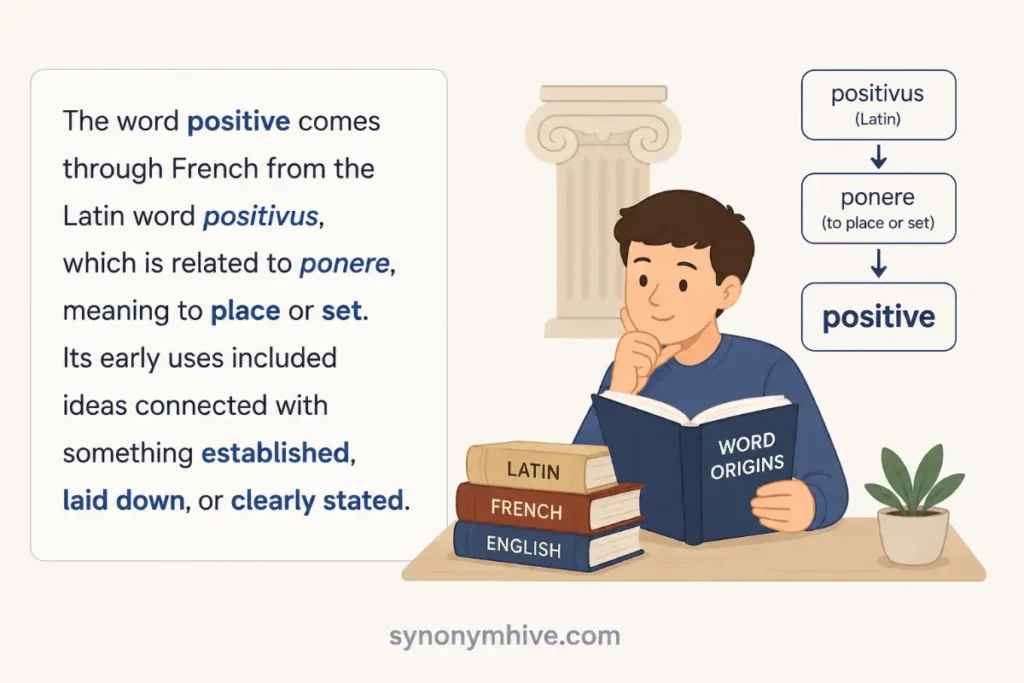
The word positive comes through French from the Latin word positivus, which is related to ponere, meaning to place or set. Its early uses included ideas connected with something established, laid down, or clearly stated.
Over time, positive developed several meanings. It came to describe something definite or certain. It also gained the familiar sense of something good, favorable, or desirable.
The word negative has a related history. It comes from Latin negativus, connected with negare, meaning to deny or say no. Its basic sense involves denial or the absence of something.
These roots help explain the contrast between the words. Positive can express approval, confirmation, or a favorable condition. Negative can express denial, disagreement, or an unfavorable condition.
How Did Positive Develop Its Modern Meaning?
Today, positive appears in many areas of life. People use it to discuss personal attitudes, health results, business performance, school feedback, and everyday experiences.
For example, a positive attitude suggests hope and confidence. A positive review shows approval. A positive result on a test means the test detected what it was designed to identify.
The word can also describe something that is definite. A positive identification means that someone has identified a person or object with confidence.
This wide range of meanings explains why the best replacement changes from one sentence to another. A word such as pessimistic works for an attitude, but it cannot replace positive in a sentence about a positive test result.
What Are the Best Words That Mean the Opposite of Positive?
The following alternatives cover simple everyday English, more specific descriptions, formal writing, and casual conversation. Some describe bad outcomes, while others refer to doubt, criticism, or a lack of hope.
Simple Words
These words are familiar and easy to use. They work well in everyday speech, basic writing, and general explanations.
| Word | Meaning | Tone | Example |
|---|---|---|---|
| Negative | Bad, unfavorable, or showing denial | Neutral | The feedback was negative. |
| Bad | Not good or desirable | Casual | The plan had a bad result. |
| Unhappy | Not pleased or satisfied | Neutral | She was unhappy with the decision. |
| Uncertain | Not sure or definite | Neutral | The outcome is uncertain. |
| Wrong | Incorrect or mistaken | Direct | That answer is wrong. |
| Poor | Below an expected standard | Neutral | The company received poor reviews. |
| Unsuccessful | Not achieving the desired result | Neutral | The campaign was unsuccessful. |
| Disappointing | Not as good as expected | Neutral | The final result was disappointing. |
These words are useful when you want to make a clear point without adding a formal or emotional tone. Bad is broad and informal, while unsuccessful describes a failure to reach a goal. Uncertain is best when the answer or outcome is not yet known.
Everyday Words
These alternatives add detail to conversations and general writing. They help explain the type of problem or reaction involved.
| Word | Meaning | Tone | Example |
|---|---|---|---|
| Unfavorable | Not helpful or likely to bring a good result | Neutral | The report showed unfavorable conditions. |
| Pessimistic | Expecting bad results | Neutral | He had a pessimistic view of the plan. |
| Doubtful | Unsure or lacking confidence | Neutral | I am doubtful about the proposal. |
| Critical | Pointing out faults or problems | Neutral | The customer gave a critical review. |
| Harmful | Causing damage or injury | Direct | The habit can be harmful. |
| Unpleasant | Not enjoyable or comfortable | Neutral | We had an unpleasant experience. |
| Disapproving | Showing a lack of approval | Neutral | She gave him a disapproving look. |
| Discouraging | Making someone lose hope or confidence | Neutral | The early results were discouraging. |
Use these words when a general term does not give enough information. A harmful action causes damage. A discouraging comment may lower someone’s confidence. A critical review points out problems, but it may still offer useful advice.
Formal Words
These terms suit reports, academic essays, workplace documents, and professional discussions. They can express a specific problem without relying on broad words such as bad.
| Word | Meaning | Tone | Example |
|---|---|---|---|
| Adverse | Unfavorable or harmful | Formal | The treatment caused adverse effects. |
| Detrimental | Causing harm or damage | Formal | The delay was detrimental to the project. |
| Negative | Showing an unfavorable view or result | Formal | The study reported negative findings. |
| Contrary | Opposite to a statement or expectation | Formal | The evidence was contrary to the claim. |
| Unproductive | Not producing useful results | Formal | The meeting was unproductive. |
| Deficient | Lacking something necessary or expected | Formal | The report was deficient in key details. |
| Inadequate | Not good enough for a purpose | Formal | The plan provided inadequate support. |
| Disadvantageous | Creating a less favorable position | Formal | The terms were disadvantageous to the buyer. |
These words are not perfect substitutes for negative. Adverse often describes conditions or effects. Detrimental focuses on damage. Deficient and inadequate describe something that lacks a needed quality or amount.
Slang and Casual Words
Informal expressions can make a conversation sound natural, but they don’t always suit professional or academic writing.
| Word or phrase | Meaning | Tone | Example |
|---|---|---|---|
| Not great | Below a good or expected standard | Casual | The service was not great. |
| Rough | Difficult or unpleasant | Casual | We had a rough day. |
| Lousy | Very poor or unpleasant | Slang | The weather was lousy. |
| Crummy | Low quality or disappointing | Slang | It was a crummy deal. |
| Downbeat | Lacking hope or excitement | Casual | His comments sounded downbeat. |
| A letdown | Something that disappoints | Informal | The final show was a letdown. |
| Bummer | Something disappointing or upsetting | Slang | Missing the event was a bummer. |
| Not promising | Giving little reason for hope | Casual | The early signs are not promising. |
Slang works best when your audience knows the expression. For example, not great is suitable for a casual message to a friend. Adverse or detrimental is a better choice for a business report.
Which Words Describe Different Levels of Negativity?
Not every unfavorable situation is equally serious. A small concern is different from a dangerous condition or a result that causes major damage. Choosing a word with the right strength helps readers understand the level of concern.
What Words Describe a Mildly Negative Situation?
Use these words when something is less than ideal but not especially serious.
- Uncertain. The situation does not have a clear answer or outcome.
- Doubtful. You have some reason to question a claim, plan, or result.
- Unpleasant. An experience is uncomfortable or not enjoyable.
- Disappointing. Something did not meet expectations.
- Less favorable. A condition is not as good as another option.
- Not ideal. A situation has problems but may still be manageable.
Examples:
- The timing is not ideal for a major launch.
- The early feedback was disappointing.
- I am doubtful about the accuracy of that estimate.
- The final decision remains uncertain.
These terms are useful when you want to be honest without sounding too harsh. They allow you to point out a concern while leaving room for improvement.
What Words Describe a Clearly Negative Situation?
Choose these words when a problem is noticeable and has a real effect.
- Unfavorable. Conditions or results do not support success.
- Unsuccessful. An effort did not reach its goal.
- Poor. The quality or standard is below expectations.
- Discouraging. Something reduces hope or confidence.
- Critical. A person identifies serious faults or concerns.
- Unproductive. An activity does not create useful results.
Examples:
- The company faced unfavorable market conditions.
- The first campaign was unsuccessful.
- The discussion became unproductive.
- The team received discouraging feedback.
These words suit work reports, school assignments, performance reviews, and everyday explanations.
What Words Describe a Strongly Negative Situation?
Use stronger terms when a condition causes serious harm, risk, or damage.
- Harmful. Something causes damage or injury.
- Adverse. A condition or effect creates a serious disadvantage.
- Detrimental. Something has a damaging effect on progress or well being.
- Damaging. An action or event causes harm to a person, object, or reputation.
- Destructive. Something causes major damage or loss.
- Dangerous. Something creates a risk of injury or harm.
- Severe. A problem is very serious or intense.
Examples:
- The chemical may have harmful effects.
- The delay was detrimental to the business.
- The storm caused severe damage to the road.
- The decision created a dangerous situation for workers.
Do not use a strong word just to make a sentence sound more powerful. If a small delay caused a minor inconvenience, calling it destructive would exaggerate the situation.
What Words Describe a Hopeless or Pessimistic Outlook?
Some words describe how people expect the future to turn out. They focus on attitude rather than the quality of an event.
| Word | Meaning | Strength | Example |
|---|---|---|---|
| Doubtful | Not confident that something will work | Mild | I am doubtful about the plan. |
| Unsure | Lacking confidence or knowledge | Mild | She was unsure about the outcome. |
| Cautious | Careful because of possible problems | Mild | He took a cautious approach. |
| Pessimistic | Expecting a bad result | Moderate | They had a pessimistic outlook. |
| Gloomy | Expecting little improvement or happiness | Strong | The forecast sounded gloomy. |
| Hopeless | Believing nothing can improve | Very strong | He felt hopeless about the situation. |
Pessimistic is often the clearest opposite of positive when describing someone’s outlook. However, cautious is not always negative. A cautious person may simply be careful and realistic.
Which Opposite of Positive Fits Each Part of Speech?
Positive is an adjective, but related forms appear as nouns and adverbs. The same is true of negative. Understanding these forms helps you build correct sentences and avoid grammar mistakes.
Which Adjectives Can Replace Positive?
Adjectives describe people, things, results, opinions, and conditions. They are the most common replacements.
| Adjective | Best use | Example |
|---|---|---|
| Negative | Opinions, results, reactions | The response was negative. |
| Unfavorable | Conditions and outcomes | The conditions were unfavorable. |
| Pessimistic | Attitudes and expectations | She had a pessimistic outlook. |
| Harmful | Actions and effects | The habit was harmful. |
| Adverse | Effects and conditions | The drug caused adverse reactions. |
| Critical | Reviews and opinions | The report was critical of the plan. |
| Disappointing | Results and experiences | The performance was disappointing. |
| Unsuccessful | Attempts and projects | The campaign was unsuccessful. |
For example, you can write, The customer gave a negative review. You can also say, The customer gave a critical review. The first sentence describes the overall opinion. The second suggests that the review pointed out faults.
Which Nouns Describe the Opposite of Positivity?
Nouns name a condition, quality, or idea. Use them when discussing an attitude or situation rather than describing a person or object.
| Noun | Meaning | Example |
|---|---|---|
| Negativity | A habit of focusing on bad points | Negativity affected the team’s mood. |
| Pessimism | The belief that bad results are likely | Pessimism spread after the announcement. |
| Doubt | A lack of confidence or certainty | Her doubt about the plan was clear. |
| Disapproval | A lack of support or approval | The proposal received strong disapproval. |
| Criticism | Comments that point out faults | The report included criticism of the process. |
| Failure | A lack of success | The failure led to a new plan. |
| Harm | Damage or injury | The policy caused harm to the community. |
| Disadvantage | A condition that makes success harder | The delay created a disadvantage. |
Notice the difference between negative and negativity. Negative is an adjective, while negativity is a noun.
Correct: His comments were negative.
Correct: His negativity affected the discussion.
Which Adverbs Describe a Negative Attitude or Result?
Adverbs explain how someone acts, speaks, or responds. Many are formed by adding the ending ly to an adjective.
| Adverb | Meaning | Example |
|---|---|---|
| Negatively | In an unfavorable way | The change affected sales negatively. |
| Pessimistically | With an expectation of bad results | She viewed the future pessimistically. |
| Critically | By pointing out faults or problems | The reviewer examined the plan critically. |
| Unfavorably | In a way that does not support success | The proposal was received unfavorably. |
| Doubtfully | With uncertainty or hesitation | He looked doubtfully at the estimate. |
| Harshly | In a severe or unkind way | The manager criticized the decision harshly. |
Avoid using an adjective when an adverb is needed. The sentence She responded negative is not standard in this meaning. Write She responded negatively.
Which Verbs Express a Negative Response?
Verbs describe actions. Some are useful when you want to show rejection, disagreement, or a lack of support.
| Verb | Meaning | Example |
|---|---|---|
| Reject | Refuse to accept something | The board rejected the proposal. |
| Oppose | Act against an idea or plan | Several members opposed the change. |
| Disapprove | Consider something wrong or unsuitable | The manager disapproved of the approach. |
| Criticize | Point out faults | The reviewer criticized the report. |
| Deny | Say that something is not true | She denied the claim. |
| Discourage | Reduce someone’s confidence or hope | The poor results discouraged the team. |
| Resist | Refuse to accept or follow something | Employees resisted the new policy. |
| Harm | Cause damage or injury | The decision harmed the business. |
These verbs are not direct grammatical replacements for positive. They express actions that may contrast with support, approval, or encouragement.
Are There Differences Between American and British English?
Most common alternatives have the same meaning in American and British English. Negative, unfavorable, pessimistic, harmful, doubtful, and disappointing are widely understood in both varieties.
Differences are more likely to appear in informal expressions and everyday preferences.
Do Americans and British Speakers Use Negative Differently?
The basic meaning of negative is the same in both countries. It can describe an unfavorable opinion, a poor result, or a denial.
For example, an American might say, The feedback was negative. A British speaker can use the same sentence with the same meaning.
Both varieties also use phrases such as not good, not ideal, and disappointing.
Are Casual Expressions Different in the US and UK?
Some informal words are more common in certain regions or social groups.
In American English, people often use bummer to describe a disappointing event. Lousy and not great are also familiar casual expressions.
British speakers may use expressions such as rubbish or a bit disappointing in everyday conversation. These choices depend on the speaker and situation. They should not be treated as strict national rules.
Which Words Work Best for International Readers?
Choose familiar words when writing for an international audience.
Useful options include:
- Negative.
- Bad.
- Unfavorable.
- Unsuccessful.
- Uncertain.
- Harmful.
- Disappointing.
- Doubtful.
These terms are widely understood and easy to translate. Avoid slang in instructions, professional documents, and academic work unless the audience expects an informal style.

What Is the Best Word for Each Writing Situation?
The right alternative depends on your purpose. A resume should highlight useful skills and honest results. An essay needs precise language. A text message can sound more relaxed.
Here are practical choices for common situations.
What Is a Better Word Than Positive on a Resume?
Use critical, cautious, realistic, or analytical when describing an ability to identify problems. Choose a word that shows professional judgment rather than simply suggesting a bad attitude.
For example:
I use a critical and analytical approach to identify risks and improve project decisions.
Other useful examples include:
- I take a realistic approach to project planning and risk assessment.
- I review unfavorable results to identify areas for improvement.
- I use careful judgment when evaluating business proposals.
- I assess potential problems before recommending a solution.
A resume should not describe you as negative unless the role specifically involves reviewing risks or identifying weaknesses. Words such as analytical and realistic often communicate the intended skill more clearly.
What Is the Best Alternative in an Essay?
Use negative, adverse, harmful, unfavorable, or detrimental, depending on the subject.
Academic writing benefits from exact descriptions. Negative can describe a result or response. Adverse often describes conditions or effects. Detrimental is useful when something causes damage.
Example: The policy had an adverse effect on small businesses.
Other examples include:
- The study reported negative findings.
- Poor planning had a detrimental effect on the project.
- The decision created unfavorable conditions for local workers.
- Excessive screen time may have harmful effects on sleep.
Avoid repeating negative throughout an essay. Use a more specific term when it helps explain the exact problem.
What Is a Good Casual Word for Texting?
Use bad, rough, disappointing, not great, or a letdown in informal messages.
These expressions sound natural when talking with friends or family.
Example: That movie was a bit disappointing.
Other text examples include:
- The service was not great today.
- I had a rough morning.
- The final result was a letdown.
- I’m doubtful that the plan will work.
- The weather looks lousy.
Use slang only when the other person understands it. A phrase such as crummy may sound too casual in a message to a teacher, client, or manager.
What Is the Best Alternative in a Professional Email?
Use unfavorable, adverse, disappointing, concerning, or unsuccessful when discussing work problems.
Professional emails should explain the issue clearly without blaming people or using unnecessarily harsh language.
Example: The latest figures show an unfavorable trend in monthly sales.
Other examples include:
- The initial results were disappointing.
- We identified several adverse effects after the change.
- The current approach has not produced the expected results.
- The proposal raises concerns about the project timeline.
- The first campaign was unsuccessful, so we recommend reviewing the strategy.
When writing to a client or manager, explain the problem and offer a useful next step. This makes your message more constructive.
What Word Works Best in Everyday Speaking?
Use negative, bad, doubtful, disappointing, or not great in normal conversation.
Example: I have a few concerns about that decision.
Other examples include:
- The food was not great.
- I’m doubtful that we’ll finish today.
- The result was disappointing.
- That sounds like a bad idea.
- The situation could become harmful if we ignore it.
Short, familiar words often work best in conversation. Choose a more formal term only when it makes your meaning more exact.
Explore more word choices in Opposite of Strong Best Words and Examples 2026.
What Are Some Examples of the Opposite of Positive in Real Situations?
Examples show how these alternatives work in daily life. They also help you understand the difference between a poor result, a harmful effect, a doubtful opinion, and a pessimistic attitude.
What Are Examples Related to Work and Business?
Workplace language should be clear and professional. It should identify problems without exaggerating them.
- The company received unfavorable feedback from several customers.
- The first marketing campaign was unsuccessful.
- The new policy had an adverse effect on employee morale.
- The manager gave a critical review of the sales report.
- The team faced disappointing results during the first quarter.
- Poor communication created an unproductive work environment.
- The proposal included several disadvantages for small businesses.
- The project faced harmful delays because of poor planning.
These sentences show different types of problems. Unfavorable feedback describes a poor response. An adverse effect describes a harmful outcome. An unproductive environment suggests that work is not moving forward effectively.
What Are Examples Related to School and Education?
Students and teachers often use these words to describe grades, feedback, opinions, and learning results.
- The student received negative feedback on the first draft.
- The test results were disappointing.
- A pessimistic attitude made the group less confident.
- The teacher gave a critical review of the assignment.
- The unclear instructions had an unfavorable effect on the class.
- The student was doubtful about the answer.
- The experiment produced an unexpected negative result.
- The lack of preparation led to an unsuccessful presentation.
In school writing, use negative when you need a broad term. Choose inaccurate, incomplete, or unsuccessful when you can identify the exact problem.
What Are Examples Related to Relationships and Personal Life?
These examples describe feelings, opinions, and experiences. The right word can help you express a concern without making an unfair judgment about someone.
- His negative comments upset the rest of the group.
- She had a pessimistic view of the relationship.
- The conversation ended on an unpleasant note.
- I was doubtful about his explanation.
- Their disagreement created an uncomfortable situation.
- Her disapproving look made the room quiet.
- The constant criticism damaged their friendship.
- He remained discouraged after the disappointing news.
Be careful when describing people. A person can have a negative opinion about one issue without being a negative person overall.
What Are Examples Related to Health and Safety?
Health and safety writing needs clear terms because vague descriptions can cause confusion.
- The medicine may cause adverse effects in some patients.
- The report identified harmful levels of air pollution.
- The test produced a negative result.
- Poor sleep can have detrimental effects on concentration.
- The chemical may be dangerous if handled incorrectly.
- The study found an unfavorable link between the two conditions.
- The warning explained the potential risks of the product.
- The unsafe work practice created a serious hazard.
Use medical and technical terms carefully. A negative test result does not automatically mean that a person is healthy. Its meaning depends on what the test checks and how professionals interpret the result.
What Are Examples Related to Everyday Decisions?
Daily choices often involve opinions, expectations, and possible outcomes.
- The weather forecast looks unfavorable for our outdoor event.
- I have a doubtful view of that offer.
- The trip was disappointing because the hotel was closed.
- His pessimistic comments made the group less hopeful.
- The plan could have harmful effects on the local community.
- The deal was disadvantageous for the buyer.
- We had an unpleasant experience at the restaurant.
- The early signs were not promising.
These examples show how a precise word can explain a problem without making the sentence longer.
Negative vs Pessimistic What Is the Difference?
Negative and pessimistic are close in meaning, but they describe different things.
| Word | Main meaning | Best use | Example |
|---|---|---|---|
| Negative | Unfavorable, rejecting, or bad | Opinions, results, comments, and effects | The review was negative. |
| Pessimistic | Expecting bad things to happen | Attitudes and expectations | She was pessimistic about the future. |
When Should You Use Negative?
Use negative when you describe an unfavorable opinion, result, comment, or condition.
For example, a negative review points out problems with a product or service. A negative result may indicate that a test did not detect something.
The word does not always describe a person’s personality. Someone can give a negative answer while remaining hopeful and friendly.
When Should You Use Pessimistic?
Use pessimistic when someone expects poor results or believes a situation is unlikely to improve.
For example, a pessimistic employee may expect a project to fail before it begins. A pessimistic outlook focuses on what could go wrong.
A person can be negative about one decision without being pessimistic about the future. The two words overlap, but they are not interchangeable in every sentence.
Adverse vs Harmful What Is the Difference?
Adverse and harmful both describe something bad, but they have different uses.
| Word | Main meaning | Best use | Example |
|---|---|---|---|
| Adverse | Unfavorable or likely to create problems | Conditions, reactions, and effects | The treatment caused adverse reactions. |
| Harmful | Causing damage or injury | Actions, habits, substances, and behavior | Smoking is harmful to health. |
When Should You Use Adverse?
Use adverse in formal writing when discussing conditions or effects that create problems.
Common phrases include adverse effects, adverse conditions, and adverse reactions. The word often appears in medical, legal, scientific, and business writing.
When Should You Use Harmful?
Use harmful when something causes damage or creates a risk of injury.
For example, harmful chemicals may damage health or the environment. Harmful behavior may hurt another person.
The main difference is focus. Adverse often describes an unfavorable condition or result. Harmful directly emphasizes damage.
What Are Common Mistakes When Choosing an Opposite of Positive?
Some words seem similar but have different meanings. Using them incorrectly can change your message or make a sentence sound unnatural.
Does Negative Mean the Same as Bad?
Not always. Negative is a broad term that can describe denial, criticism, or an unfavorable result. Bad is a general word for something undesirable or poor.
For example, a negative test result may be good news. In that case, negative does not mean bad.
Use the word that matches the subject. A bad experience is unpleasant. A negative result may simply mean that a test did not detect something.
Is Pessimistic the Same as Realistic?
No. Pessimistic describes someone who expects bad results. Realistic describes someone who judges a situation based on facts and practical limits.
A realistic person may point out serious risks without assuming that everything will fail.
For example:
- Pessimistic: The project will probably fail.
- Realistic: The project may fail unless we improve the budget.
The second statement identifies a risk and suggests a practical response.
Does Critical Always Mean Negative?
No. Critical can mean carefully examining something, pointing out faults, or being very important.
A critical review may include both good and bad points. A critical decision may be one that has a major effect on the outcome.
Use context to understand the meaning. Critical thinking is usually a useful skill, not a negative quality.
Is Uncertain the Same as Unsuccessful?
No. Uncertain means that something is not yet known or decided. Unsuccessful means that an effort did not achieve its goal.
For example, the project outcome is uncertain means the final result is not known. The project was unsuccessful means it did not meet its target.
Do not use unsuccessful when you only mean that the result is still unknown.
Can You Use Harmful for Every Negative Result?
No. Harmful suggests that something causes damage or injury. It is too strong for a small mistake or an ordinary disappointment.
A disappointing meeting may waste time, but calling it harmful may exaggerate the situation. Use unproductive or disappointing if those words better match the facts.
Should You Describe a Person as Negative?
Be careful. Calling someone negative can sound like a judgment about their whole personality.
If you mean that a person disagrees with one idea, say that they disagreed with the proposal. If they pointed out problems, say that they raised concerns or offered critical feedback.
Specific descriptions are fairer and more useful than broad labels.
What Are the Antonyms of Positive in Different Contexts?
An antonym is a word with the opposite meaning of another word. Positive has several antonyms because it can describe quality, attitude, certainty, numbers, and test results.
| Meaning of positive | Useful antonyms |
|---|---|
| Good or favorable | Bad, negative, unfavorable, poor |
| Hopeful | Pessimistic, doubtful, gloomy |
| Supportive | Critical, disapproving, discouraging |
| Beneficial | Harmful, damaging, detrimental |
| Certain | Uncertain, doubtful, questionable |
| Successful | Unsuccessful, failed, disappointing |
| Above zero | Negative |
| Confirming a test result | Negative |
The correct antonym depends on the meaning of positive in your sentence. A positive attitude calls for a word about outlook or mood. A positive business result needs a term about performance.
How Can You Choose the Right Word?
A strong word choice should match the facts, audience, and purpose of your sentence. Use these quick tips to make the right choice.
1. Identify What Positive Describes
Start by looking at the subject.
- For an attitude, consider pessimistic, doubtful, or gloomy.
- For a result, consider negative, unfavorable, or disappointing.
- For an effect, consider adverse, harmful, or detrimental.
- For an opinion, consider critical or disapproving.
- For a level of certainty, consider uncertain or doubtful.
- For a failed effort, consider unsuccessful.
This first step prevents you from using an antonym that does not fit the subject.
2. Decide How Serious the Problem Is
Think about the strength of the word.
If something is only slightly disappointing, use not ideal or less favorable. If it causes a clear problem, unfavorable or unsuccessful may fit.
Do not exaggerate. Strong words should describe strong problems.
3. Separate Facts From Opinions
A factual result and a personal opinion are not the same thing.
For example, a negative test result is a factual outcome based on the test. A pessimistic opinion is a person’s expectation about the future.
Use words that explain the kind of information you are presenting. This makes your writing more trustworthy.
4. Match the Word to Your Audience
Use familiar language in everyday communication. Negative, bad, doubtful, and disappointing are easy to understand.
Formal writing can use adverse, detrimental, unfavorable, or disadvantageous when those terms fit. Casual conversations may use not great, rough, or a letdown.
The goal is clarity, not complexity.
5. Check the Grammar
Make sure the word fits the sentence structure.
- Adjective: The report was negative.
- Noun: The report showed negativity.
- Adverb: The change affected sales negatively.
- Verb: The board rejected the proposal.
A correct word in the wrong grammatical form can make a sentence awkward.
6. Read the Sentence Again
Check the meaning and tone after replacing the word.
For example:
- Awkward: The pessimistic result confirmed the test.
- Better: The test result was negative.
Pessimistic describes an expectation or attitude. Negative is the correct term for the test result in this example.
7. Choose Precision Over Variety
You do not need a different synonym every time you use positive. Repeating a clear word is better than adding an inaccurate alternative.
Use another term when it gives readers more information. If the meaning stays the same, negative may be the best choice.
Explore another synonym guide: Opposite of Fast Best Words for Every Situation.
Conclusion
The best word to use depends on the meaning you want to express. Negative is the standard antonym of positive, but it is only one option. Pessimistic describes an outlook that expects poor results. Unfavorable works for conditions and outcomes, while adverse and detrimental describe serious problems. Harmful points to damage, and critical suits opinions that identify faults. Before choosing a replacement, consider the subject, level of seriousness, and audience. A precise term makes your writing more useful and helps readers understand the issue without confusion. You don’t need complicated vocabulary to make a strong point. Choose the clearest word that matches the facts.
Frequently Asked Questions
What Is the Opposite of Positive?
The most common opposite of positive is negative. Other choices include unfavorable, pessimistic, harmful, and disappointing, depending on the meaning and context.
What Is Another Word for Negative?
Other words for negative include unfavorable, adverse, critical, pessimistic, doubtful, harmful, and disappointing. Each has a different use, so choose one that matches your sentence.
Is Negative the Opposite of Positive in Every Situation?
Negative is the standard general antonym, but it does not fit every meaning. Pessimistic works for attitudes, harmful describes damage, and unsuccessful describes an effort that failed.
What Is the Opposite of a Positive Attitude?
The opposite of a positive attitude is usually a negative or pessimistic attitude. Negative describes an unfavorable outlook, while pessimistic suggests that someone expects bad results.
What Is a Formal Word for Negative?
Adverse, detrimental, unfavorable, and disadvantageous are formal alternatives in suitable contexts. Adverse and detrimental are especially useful when describing harmful effects or conditions.
What’s Another Way to Say Something Is Not Positive?
You can say that something is negative, unfavorable, disappointing, or not ideal. For a serious problem, harmful or detrimental may be more accurate.
What Is the Opposite of Positive Thinking?
The opposite of positive thinking is negative thinking or pessimism. Negative thinking focuses on problems and unwanted outcomes, while pessimism involves expecting things to go badly.