
You’re writing a heartfelt text, polishing an essay, or describing a character in a story, and you want to capture a smile perfectly. But words like happy and beautiful don’t always express the feeling you’re trying to share. A smile can be warm, shy, playful, reassuring, mischievous, or full of quiet sadness.
The best words to describe a smile help readers picture not only how someone’s mouth looks but also the mood the expression creates. Some words describe its shape or size, while others suggest kindness, excitement, confidence, or hidden emotion.
Phrases to describe a smile are adjectives and descriptive phrases that explain how a smile looks, feels, or affects the people who see it. The right choice makes your writing clearer and helps readers imagine the moment.
This guide covers more than 30 useful words, explains the differences between similar terms, and gives you original examples for essays, stories, professional writing, everyday conversations, and romantic messages.
You may also like words to describe a sunset Best Guide.
What Do Terms to Describe a Smile Mean?
A smile is a facial expression usually created by lifting the corners of the mouth. It can communicate happiness, friendliness, amusement, politeness, affection, or many other feelings. However, a smile doesn’t always mean someone feels happy. People also smile when they’re nervous, uncomfortable, embarrassed, or trying to be polite.
Descriptive words help you explain these differences. For instance, cheerful suggests happiness, reassuring suggests comfort, and forced suggests that the expression may not reflect a person’s true feelings.
Compare these examples.
- Basic: She smiled at him.
- More specific: She gave him a warm smile.
- More vivid: She offered a warm, reassuring smile as he stepped onto the stage.
The first sentence tells us what happened. The second adds a feeling. The third connects the expression to a real situation and explains why it matters.
The goal isn’t to make every sentence dramatic. It’s to choose a word that fits the person, moment, and tone.
Where Does the Word Smile Come From?
The English word smile comes from Old English smīlian, a verb meaning to smile. Its older Germanic roots are also connected to similar words in other languages. Over time, the word became a familiar way to describe the facial expression associated with amusement, pleasure, friendliness, or other feelings.
Today, smile works as both a verb and a noun. You can say, She smiled at the child, or She had a warm smile. The verb describes an action, while the noun names the expression itself.
The word describe comes through Latin roots associated with writing down or outlining something. In everyday English, to describe means to explain what something looks like or what makes it distinctive.
Together, these meanings explain the purpose of smile descriptions. You use words to show readers the appearance, mood, or effect of a person’s expression.
What Makes a Smile Description Effective?
A good description is specific, natural, and suited to the situation. It helps readers understand something meaningful about the moment instead of simply adding decoration.
Consider the difference between He had a nice smile and His crooked smile appeared whenever he tried not to laugh. The first sentence is positive but general. The second gives the reader a recognizable detail and hints at the person’s playful mood.
An effective description usually focuses on one or two qualities.
- Appearance: Is the smile broad, crooked, subtle, or dimpled?
- Emotion: Does it seem joyful, nervous, tender, or mischievous?
- Effect: Does it comfort someone, brighten a room, or create uncertainty?
- Context: Is the person greeting a friend, giving a speech, hiding embarrassment, or sharing a joke?
These details help you choose more accurate language. They also prevent you from relying on the same word in every sentence.
Remember that a facial expression doesn’t reveal everything about a person’s inner feelings. You can describe a smile as sad looking or reassuring without claiming to know exactly what the person thinks.
What Are the Best Words to Describe a Smile?
The best word depends on the quality you want to highlight. A bright smile suggests happiness, a gentle smile feels soft and kind, and a mischievous smile hints at playful trouble.
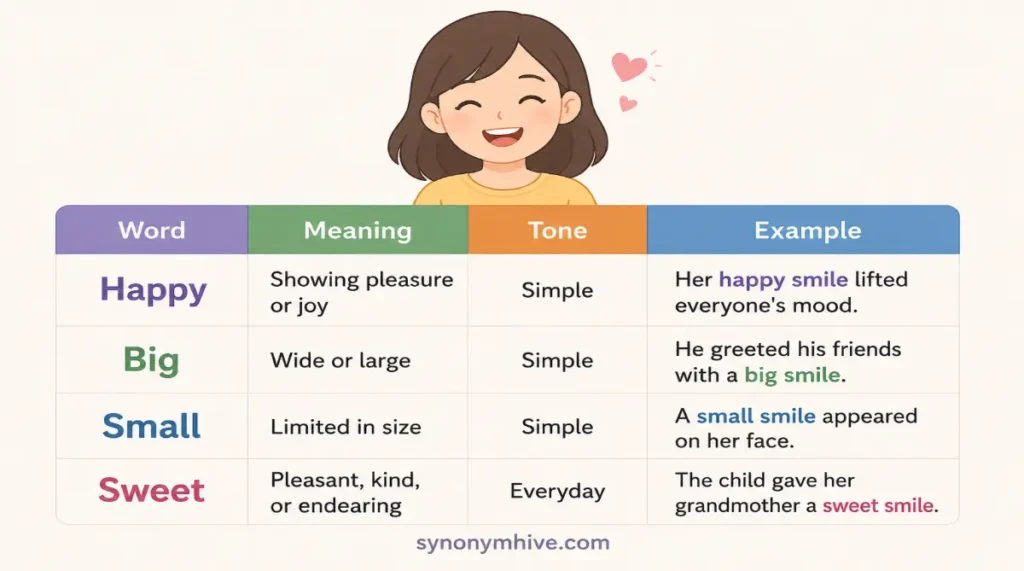
The following table gives you a broad vocabulary grouped by tone. Each word includes a plain English meaning and an example you can adapt.
| Word | Meaning | Tone | Example |
|---|---|---|---|
| Happy | Showing pleasure or joy | Simple | Her happy smile lifted everyone’s mood. |
| Big | Wide or large | Simple | He greeted his friends with a big smile. |
| Small | Limited in size | Simple | A small smile appeared on her face. |
| Sweet | Pleasant, kind, or endearing | Everyday | The child gave her grandmother a sweet smile. |
| Warm | Friendly and welcoming | Everyday | His warm smile put the new employee at ease. |
| Bright | Full of cheer or lively energy | Everyday | She wore a bright smile throughout the celebration. |
| Gentle | Soft and kind | Everyday | He offered a gentle smile before leaving. |
| Infectious | Likely to make others feel or act similarly | Expressive | Her infectious smile made the whole group laugh. |
Some entries describe the smile itself, while others name a related expression. For example, grin is a noun and verb as well as a casual alternative to smile. Infectious describes the effect an expression has on other people, not its physical shape.
Likewise, smirk often carries a negative meaning, while genuine usually suggests sincerity. These words shouldn’t be swapped just because they all relate to smiling.
What Words Describe a Smile From Mild to Strong?
Words have different levels of emotional intensity. A mild description may be enough for a quiet moment, while a strong one can help an important scene stand out.
What Are Mild Words for a Smile?
Mild words describe small, quiet, or understated expressions. They work well in everyday writing, gentle scenes, and moments where the emotion isn’t dramatic.
Useful choices include faint, slight, soft, small, subtle, gentle, and reserved.
For example, A faint smile appeared when she recognized the familiar song suggests a quiet response. It doesn’t imply overwhelming happiness.
A reserved smile may indicate that someone is holding back or behaving cautiously. A soft smile often feels gentle and relaxed. A slight smile simply means the expression is small.
Choose mild language when you want readers to notice an expression without making it the main event.
What Are Medium Intensity Smile Words?
Medium intensity words make an expression more noticeable or communicate a clearer emotional quality.
Examples include warm, sweet, playful, sincere, confident, mischievous, reassuring, and cheerful.
Consider this sentence: Her reassuring smile helped the nervous student settle into the interview. The word reassuring explains the expression’s effect. It tells the reader more than nice would.
These terms suit personal essays, character descriptions, emails, and friendly messages. They add meaning without making an ordinary moment sound extraordinary.
What Are Strong Words for a Smile?
Strong words create a powerful impression. They can suggest intense happiness, strong attraction, or a noticeable effect on other people.
Useful options include radiant, dazzling, brilliant, captivating, breathtaking, irresistible, and infectious.
For example, She greeted her family with a radiant smile after months away makes the reunion feel joyful. The word is stronger than pleasant because it suggests happiness that shines through the expression.
However, strong words need the right context. Calling a routine office greeting breathtaking may sound exaggerated. Save dramatic descriptions for moments that genuinely call for them.
How Can You Compare Smile Words by Intensity?
Use this table as a guide. The words in each row share a general quality, but they aren’t exact synonyms.
| Mild | More Expressive | Strong or Dramatic |
|---|---|---|
| Small | Noticeable | Dazzling |
| Soft | Warm | Radiant |
| Pleasant | Charming | Enchanting |
| Happy | Cheerful | Ecstatic |
| Friendly | Welcoming | Irresistible |
| Playful | Mischievous | Impish |
| Slight | Subtle | Captivating |
| Calm | Serene | Tranquil |
| Funny | Amused | Gleeful |
| Kind | Tender | Heartwarming |
For example, soft describes the gentle quality of a smile, while radiant suggests a vivid, joyful expression. They’re related in some contexts, but they don’t mean the same thing.
What Words to Describe Different Types of Smiles?
The shape and movement of a smile can communicate a lot about the moment. Describing these details makes your writing more specific and helps readers picture the expression.
What Words Describe a Genuine Smile?
A genuine smile appears natural and sincere. It may involve the cheeks and eyes as well as the mouth, though a person’s expression alone can’t prove exactly how they feel.
Useful descriptions include sincere, natural, genuine, unforced, warm, open, and heartfelt.
Example: Her genuine smile made the welcome feel sincere rather than rehearsed.
A natural smile looks relaxed instead of carefully arranged. A heartfelt smile suggests affection or honest feeling. An open smile often looks friendly and inviting.
Use these words when you want to highlight a sense of ease or sincerity. Avoid treating them as proof of someone’s honesty. They describe how the expression comes across, not a guaranteed fact about the person.
What Words Describe a Small or Subtle Smile?
Small smiles are useful in scenes where the emotion is private, uncertain, or restrained.
Try faint, slight, subtle, flickering, reserved, knowing, or half smile.
For example, A slight smile crossed his face when he saw the familiar handwriting. The phrase crossed his face suggests that the expression appeared briefly.
A half smile usually means a partial or incomplete smile. A knowing smile suggests that the person understands something others may not. A flickering smile appears briefly and may fade just as quickly.
These terms are especially useful in fiction because they allow a character to react without speaking. They also keep emotional scenes from becoming too obvious.
What Words Describe a Big or Cheerful Smile?
Large smiles often suggest strong enjoyment, excitement, or amusement, although context still matters.
Useful words include broad, beaming, radiant, joyful, wide, gleeful, and ear to ear.
Example: He walked into the room with a broad grin after passing his driving test.
A broad smile describes size. A beaming smile adds happiness. A grin from ear to ear is an informal expression for a very wide smile.
Choose the word that fits the scene. A broad smile might come from politeness, but a beaming smile usually suggests visible joy.
What Words Describe a Nervous or Awkward Smile?
A nervous smile may appear when someone feels uncertain, embarrassed, or uncomfortable. It can help a person handle a tense social moment.
Useful words include sheepish, uneasy, awkward, strained, hesitant, apologetic, and forced.
Example: He gave a sheepish smile when he realized he’d entered the wrong meeting room.
A strained smile suggests effort or discomfort. A forced smile sounds less natural and may indicate that the person is trying to hide their feelings. An apologetic smile often accompanies an apology or an attempt to make things right.
Don’t assume every nervous smile means dishonesty. People smile for many reasons, including embarrassment, stress, and social habit.
What Words Describe a Playful or Mischievous Smile?
Playful expressions add humor, teasing, and personality to a scene.
Try mischievous, cheeky, impish, playful, knowing, sly, and goofy.
Example: She flashed a mischievous smile before revealing the surprise party.
A cheeky smile suggests bold humor. An impish smile feels playful, often in a childlike way. A sly smile may suggest a hidden plan or private joke, and can sound more secretive than friendly.
These words work well in dialogue, humorous stories, and casual messages. Match the term to the person’s behavior so the expression doesn’t suggest more than the scene supports.
Which Smile Words Work Best in Different Situations?
The right description depends on where you’re using it. A resume, school essay, text message, and romantic note all call for different levels of detail. These examples show how to choose language that sounds natural for your audience.
What Words Work Best in a Resume or Professional Profile?
A resume usually doesn’t need a detailed description of someone’s smile. However, a professional biography, acting profile, customer service review, or personal reference might mention a person’s welcoming manner.
Useful words include friendly, warm, approachable, confident, professional, and reassuring.
For example, you might write, Her warm smile helped create a welcoming atmosphere for new clients.
This sentence connects the expression to a professional situation. It doesn’t focus too much on physical appearance.
Avoid words such as seductive, dazzling, or irresistible in a standard professional profile. They can sound personal or exaggerated. If your goal is to describe someone’s work style, focus on observable behavior and the effect it has on others.
What Words Work Best in an Essay?
Essays benefit from clear descriptions that support the main point. If you’re writing a personal narrative, you can use expressive words such as radiant, sheepish, wistful, crooked, and reassuring.
For literary analysis, explain what the smile contributes to the story. Does it create tension? Suggest affection? Hide embarrassment? Reveal a change in the character’s mood?
For example, The character’s forced smile suggests that she feels uncomfortable with the situation.
This sentence connects the expression to a reasonable interpretation. It doesn’t claim that the smile reveals every detail about the character’s feelings.
For a personal essay, you might write, My father’s crooked smile always appeared when he tried to hide his laughter. The specific detail makes the memory feel personal and believable.
What Words Work Best in Text Messages?
Text messages usually sound better when they’re short, warm, and direct. You don’t need formal vocabulary to give someone a thoughtful compliment.
Useful words include cute, sweet, bright, beautiful, genuine, and infectious.
For example, try these messages.
- Your smile is so warm and genuine.
- I love your bright smile.
- Your smile always makes me laugh.
- You have the cutest grin.
- Your smile lights up every picture.
- I love how your whole face changes when you laugh.
A specific compliment often feels more sincere than a long string of adjectives. Choose language that suits your relationship and sounds like something you’d actually say.
What Words Work Best in an Email?
For a personal email, words such as warm, friendly, kind, and reassuring can help describe a person’s expression.
For example, Your warm smile made everyone feel welcome at the event is friendly and natural.
If you’re writing a professional email, mention a smile only when it relates to the topic. You might say, The photograph captures a relaxed expression that suits the tone of the announcement.
Avoid overly personal comments in workplace messages unless you know they’re welcome. Clear, respectful wording is usually the safest choice.
What Words Work Best When Speaking?
Spoken language should feel easy to understand. Words such as big, sweet, warm, friendly, shy, and cheeky work well in everyday conversations.
For example, you could say, She has a really warm smile that makes people feel comfortable.
When telling a story, you can choose a more expressive phrase. He gave me a sheepish grin and admitted he’d eaten the last cookie adds humor and helps listeners picture the moment.
The best spoken descriptions sound natural when you say them aloud. If a phrase feels awkward in conversation, simplify it.
What Words Work Best for Romantic Messages?
Romantic writing often focuses on affection, attraction, and personal connection. Words such as tender, captivating, radiant, enchanting, irresistible, and heartwarming may fit.
For example, try these messages.
- Your smile is my favorite part of a long day.
- I love the way your smile reaches your eyes.
- Your smile makes ordinary moments feel special.
- You have a beautiful smile that I never get tired of seeing.
- Your playful grin always makes me smile, too.
- Your smile brings me comfort when I need it most.
Choose a phrase that reflects a real feeling. A simple, honest message usually has more impact than an exaggerated compliment filled with dramatic words.
Need a similar word? Read words to describe nature Best Guide.
What Is the Difference Between Similar Smile Words?
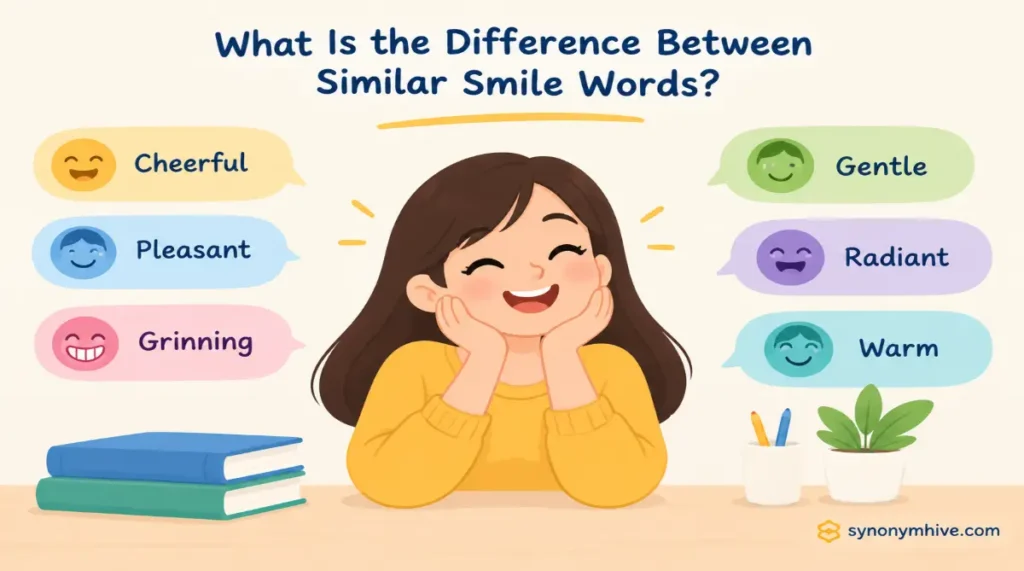
Many smile descriptions overlap, but their meanings aren’t identical. Knowing the differences helps you express the right mood and avoid confusing your reader.
Warm Smile vs Genuine Smile
| Warm Smile | Genuine Smile |
|---|---|
| Suggests friendliness, kindness, or welcome. | Suggests sincerity or a natural expression. |
| Focuses on the feeling the expression creates. | Focuses on how sincere or unforced the expression appears. |
| Example: The host greeted us with a warm smile. | Example: She gave a genuine smile when she saw her old friend. |
A warm smile makes someone feel welcome. A genuine smile seems sincere. A smile can be both warm and genuine, but the words emphasize different qualities.
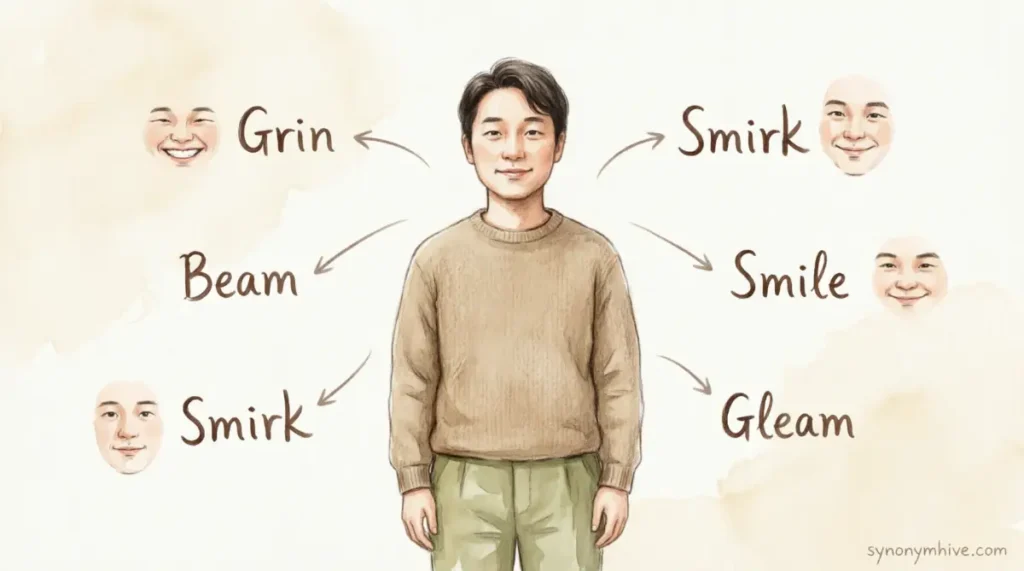
Grin vs Smirk
| Grin | Smirk |
|---|---|
| Usually describes a broad smile. | Often describes a smile that suggests smugness, superiority, or concealed amusement. |
| Can be happy, playful, silly, or excited. | Often carries a negative or teasing tone. |
| Example: He flashed a grin when his team won. | Example: He gave a smirk after making a cutting remark. |
Use grin for a broad or playful smile. Choose smirk when you want to suggest an attitude that may seem smug, knowing, or slightly rude.
Radiant Smile vs Dazzling Smile
| Radiant Smile | Dazzling Smile |
|---|---|
| Suggests happiness that seems to glow. | Suggests an impressive or striking effect. |
| Often emphasizes joy and positive emotion. | Often emphasizes visual impact or charm. |
| Example: She wore a radiant smile at graduation. | Example: His dazzling smile caught the photographer’s attention. |
A radiant smile feels full of happiness. A dazzling smile stands out and attracts attention. Either can work in a positive description, but radiant is more closely tied to joy.
Shy Smile vs Sheepish Smile
| Shy Smile | Sheepish Smile |
|---|---|
| Suggests timidity, modesty, or nervousness around attention. | Suggests embarrassment, often after a mistake or awkward moment. |
| Can appear when someone receives a compliment. | Often appears when someone realizes they’ve done something silly or wrong. |
| Example: She gave a shy smile when the teacher praised her work. | Example: He gave a sheepish smile after arriving late. |
A shy smile doesn’t require a mistake. A sheepish smile usually connects to embarrassment or mild guilt.
What Are the Common Mistakes When Describing a Smile?
A strong vocabulary helps only when you use each word correctly. Avoid these common mistakes to keep your writing clear and believable.
Are You Using Too Many Adjectives?
One of the easiest mistakes is adding several words that repeat the same idea.
Weak example: She had a beautiful, gorgeous, lovely, stunning, radiant smile.
Stronger example: Her radiant smile brightened the room.
The second sentence has a clearer focus. Instead of stacking similar adjectives, choose one strong word and let the sentence do the rest.
Are You Confusing Appearance With Emotion?
A crooked smile describes shape. A joyful smile describes an emotional impression. A forced smile suggests that the expression may not be natural.
These terms describe different things, so they aren’t interchangeable. Before choosing an adjective, decide if you’re explaining what the smile looks like, what it seems to express, or how it affects someone else.
Are You Making Assumptions About Someone’s Feelings?
A smile doesn’t always mean happiness. People may smile from politeness, nervousness, embarrassment, or discomfort.
Instead of writing, Her smile proved she was happy, consider Her smile made her seem happy in that moment. The second sentence describes an impression without treating it as a fact.
This distinction is especially important in essays, character analysis, and descriptions of real people.
Are You Using Formal Words in Casual Messages?
Words such as serene, enchanting, and captivating can work in creative writing, but they may sound unnatural in a quick text.
For a casual message, sweet, cute, bright, or warm may fit better. For a poem or romantic note, a more expressive word may be appropriate.
Match the language to the relationship and setting. You don’t need the fanciest word to create the strongest impression.
Are You Choosing a Word With the Wrong Tone?
Some smile words carry negative meanings. Smug, sly, and smirk can suggest arrogance, secrecy, or unkind amusement. They aren’t ideal if you want to describe an openly friendly expression.
Likewise, forced and strained suggest discomfort rather than ease. Check the emotional tone before using a word in a compliment or positive description.
What Are the Antonyms of Smile Descriptions?
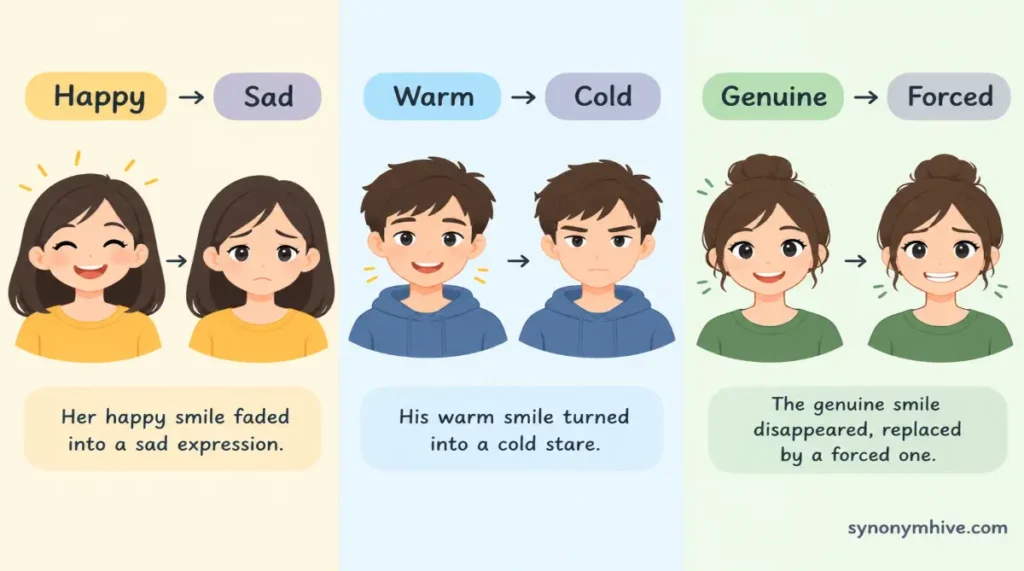
Antonyms help you show contrast, especially when a character’s expression changes. Some words have direct opposites, while others need a phrase that conveys the opposite feeling.
| Word | Possible Opposite | Example |
|---|---|---|
| Happy | Sad | Her happy smile faded into a sad expression. |
| Warm | Cold | His warm smile turned into a cold stare. |
| Genuine | Forced | The genuine smile disappeared, replaced by a forced one. |
| Broad | Faint | Her broad smile became a faint smile. |
| Cheerful | Gloomy | His cheerful expression changed to a gloomy look. |
| Friendly | Hostile | The friendly smile vanished during the argument. |
| Relaxed | Tense | Her relaxed smile gave way to a tense expression. |
| Playful | Serious | His playful grin faded into a serious look. |
| Radiant | Dull | Her radiant smile disappeared when she heard the news. |
| Reassuring | Alarming | His reassuring expression changed to one of concern. |
These pairs are useful for showing emotional shifts. For example, her playful grin faded tells the reader that the mood has changed without needing a long explanation.
How Can You Choose the Right Smile Description Quickly?
When you can’t find the right word, start with the detail that matters most. A simple process can help you narrow your choices.
- Identify the main quality. Decide if the smile looks happy, nervous, warm, playful, or sad.
- Think about its shape. Is it broad, crooked, faint, dimpled, or barely visible?
- Consider the situation. A greeting may call for friendly, while an awkward apology may call for sheepish.
- Match your audience. Use everyday words in conversation and more expressive language in creative writing.
- Check the emotional tone. Make sure the word doesn’t suggest arrogance, discomfort, or attraction when you intend something else.
- Read the sentence aloud. If it sounds unnatural, replace the word with something simpler.
- Remove repeated ideas. One accurate adjective is usually better than four similar ones.
For example, you might start with He smiled at his friend. If the moment is playful, revise it to He flashed a mischievous grin at his friend. If the moment is emotional, He gave his friend a warm, grateful smile may be a better fit.
The goal is to give readers a clear image without making the sentence feel crowded.
Looking for a better alternative? Visit Words to Describe Summer Ultimate Word List.
Conclusion
The best words to describe a smile communicate more than its size or shape. They help readers understand the mood of a moment, notice a person’s expression, and picture how that expression affects others. Words such as warm, genuine, playful, sheepish, and radiant each create a different impression, so choose the one that matches your meaning.
For everyday messages, simple language often feels most sincere. For essays and stories, a precise adjective paired with an action can make a scene more vivid. Pay attention to tone, avoid unnecessary repetition, and don’t assume a smile always reveals someone’s true feelings. With practice, you’ll find descriptions that sound natural, fit the situation, and make your writing more memorable.
Frequently Asked Questions
What Are Some Good Expressions to Describe a Smile?
Good choices include warm, genuine, radiant, sweet, playful, mischievous, gentle, and infectious. Choose the word that best captures the expression’s appearance or emotional effect.
What’s Another Way to Say Someone Has a Beautiful Smile?
You can say someone has a radiant, charming, captivating, lovely, or dazzling smile. For a more personal compliment, mention a detail that makes their smile memorable.
What Words Describe a Genuine Smile?
Words such as sincere, natural, warm, unforced, and heartfelt can describe a smile that appears genuine. These words express how the smile comes across rather than proving what someone feels.
What Is the Difference Between a Grin and a Smirk?
A grin usually means a broad smile that can show happiness or amusement. A smirk often suggests smugness, superiority, or concealed amusement and may carry a negative tone.
What Words Describe a Smile in Creative Writing?
Creative writing can use words such as wistful, radiant, sheepish, mischievous, tender, and enigmatic. Choose a term that supports the scene’s mood and the character’s actions.
How Can I Describe a Small Smile?
You can describe a small smile as faint, slight, subtle, soft, or reserved. A phrase such as a faint smile crossed her face shows that the expression appeared briefly.
What Are the Best Terms to Describe a Smile in a Compliment?
Words such as beautiful, warm, sweet, bright, and genuine work well in compliments. Keep your message natural and specific so it feels sincere rather than exaggerated.