

Summer gives writers plenty of details to work with. You might describe the warmth of the sun on your skin, the sound of children playing outside, or the smell of fresh grass after a morning rain. Yet finding the right words to describe summer can be harder than it seems, especially when every sentence starts to sound the same.
The best summer adjectives do more than tell readers that the weather is hot. They help people picture a bright beach, a quiet garden, a busy city street, or a peaceful evening on the porch. The right choice depends on the scene, the mood, and the person you are writing for.
Words to describe summer are adjectives and descriptive expressions that capture the season’s weather, colors, sounds, scents, activities, and moods. Strong choices make summer writing clearer, more vivid, and easier to remember.
This guide covers simple and advanced vocabulary, words arranged by intensity, useful comparisons, and examples for essays, emails, captions, stories, and everyday conversations. You will also learn how to choose words that fit the scene instead of relying on the same few descriptions.
Find similar expressions in words to describe a sunset Best Guide.
What Does Summer Mean in Descriptive Writing
Summer is one of the four seasons in temperate regions. In the Northern Hemisphere, it usually includes June, July, and August. In the Southern Hemisphere, summer generally occurs from December through February. Exact seasonal dates depend on the calendar system and location.
In descriptive writing, summer can mean much more than a period of warm weather. It may suggest freedom, outdoor adventures, family trips, long afternoons, bright colors, fresh fruit, or peaceful nights. A writer can use the season to establish a setting, show a character’s mood, or create a clear picture in the reader’s mind.
For example, the sentence The summer afternoon was hot gives readers basic information. Changing it to The blazing afternoon sent everyone searching for shade adds a stronger sense of heat and shows how people react to it.
The second sentence works because it combines a precise adjective with an action. That approach often creates better writing than adding several similar adjectives to one sentence.
Why Summer Descriptions Matter
Specific language helps readers imagine a scene without needing a long explanation. It also gives a piece of writing a distinct mood. A peaceful summer garden calls for different vocabulary than a crowded beach during a heat wave.
Choose words based on the detail you want to highlight. Use sunlit to focus on light, humid to describe moisture in the air, breezy to suggest moving air, and idyllic to present a setting as almost perfect.
A few well chosen words can do more than a long string of general adjectives. The goal is not to describe every part of summer at once. Instead, select the details that matter most to the scene.

What Is the Origin of the Word Summer
The word summer has roots in Old English. It comes from sumor, a word used for the warmest season of the year. Related forms appear in other Germanic languages, including Old High German and Old Norse. These shared roots show that the word has a long history across northern Europe.
Today, summer names a season, but writers also use it to suggest a certain kind of experience. The word may bring to mind school holidays, outdoor meals, road trips, gardens in bloom, and evenings that stay light for longer. These associations can make summer a useful setting for stories, poems, personal essays, and travel writing.
The season also carries different meanings across cultures and regions. In one place, summer may mean dry days and strong sunshine. Somewhere else, it may mean heavy rain, thick humidity, or frequent afternoon storms. The most accurate description depends on the climate and the scene.
What Does Summer Mean in Simple English
In simple English, summer is the warm season of the year. People often spend more time outdoors, visit beaches and parks, travel, grow plants, and enjoy seasonal foods.
For descriptive writing, summer can refer to both the season itself and the qualities people connect with it. A sunny day describes the weather. A carefree afternoon describes the mood. A lush garden describes the appearance of a place.
Keeping these meanings separate helps you select precise language. If you want readers to imagine the weather, choose a weather word. If you want to show a character’s mood, choose a word that describes emotion or behavior.
What Are the Best Words to Describe Summer
The best word depends on the detail you want to show. Some adjectives describe the weather, while others focus on nature, appearance, comfort, or emotion. The following list gives you a broad vocabulary for different types of summer writing.
Simple Summer Words for Everyday Writing
These familiar words work well in school assignments, basic descriptions, messages, and conversations.
| Word | Meaning | Tone | Example |
|---|---|---|---|
| Sunny | Full of sunshine | Cheerful | We spent a sunny afternoon at the park. |
| Warm | Comfortably hot | Pleasant | A warm breeze came through the window. |
| Hot | Having a high temperature | Direct | It was too hot to walk at noon. |
| Bright | Full of light | Positive | Bright sunlight filled the kitchen. |
| Green | Covered with or showing green plants | Natural | The green fields stretched beyond the road. |
| Fresh | Clean, cool, or newly available | Inviting | Fresh air came through the open door. |
| Dry | Having little moisture | Neutral | The dry ground cracked near the fence. |
| Cool | Slightly cold or pleasantly refreshing | Relaxed | We sat in the cool shade of a tree. |
| Long | Lasting for a great amount of time | Neutral | The long summer days gave us time to explore. |
| Fun | Enjoyable and entertaining | Casual | We had a fun day at the lake. |
Simple vocabulary is often the strongest choice when clarity matters most. A sentence such as The hot sand burned my feet is direct and easy to picture. You do not need a rare adjective when an everyday word describes the experience accurately.
Everyday Words for Vivid Summer Descriptions
These words add more detail without sounding too formal. They work well in personal essays, travel posts, short stories, and everyday writing.
| Word | Meaning | Tone | Example |
|---|---|---|---|
| Breezy | Having a light, refreshing wind | Relaxed | A breezy evening made the beach more comfortable. |
| Humid | Containing a lot of moisture in the air | Descriptive | The humid morning left the windows damp. |
| Lush | Rich with healthy green plants | Vivid | Lush trees shaded the garden path. |
| Golden | Having a warm yellow color | Warm | Golden sunlight spread across the fields. |
| Sparkling | Shining with small flashes of light | Lively | Sparkling water reflected the afternoon sun. |
| Tropical | Related to warm regions near the tropics | Evocative | Tropical flowers brightened the courtyard. |
| Fragrant | Having a noticeable, pleasant smell | Descriptive | Fragrant jasmine filled the evening air. |
| Colorful | Showing many bright or varied colors | Cheerful | Colorful umbrellas lined the beach. |
| Peaceful | Quiet and free from disturbance | Calm | The peaceful lake was still at sunrise. |
| Carefree | Free from worry or responsibility | Happy | We spent a carefree afternoon with friends. |
Everyday words are useful because most readers understand them immediately. They can still create vivid images when paired with specific details. For instance, fragrant jasmine beside the garden gate gives readers a clearer picture than simply calling a garden beautiful.
Formal Words for Essays and Creative Writing
Formal vocabulary can help you write about summer in a more polished way. These words suit school essays, literary descriptions, travel features, and thoughtful reflections.
| Word | Meaning | Tone | Example |
|---|---|---|---|
| Scorching | Extremely hot | Intense | The scorching afternoon drove visitors indoors. |
| Radiant | Shining brightly or showing happiness | Elegant | Radiant sunlight covered the open meadow. |
| Verdant | Green with healthy plant growth | Literary | Verdant hills surrounded the village. |
| Balmy | Pleasantly warm and gentle | Refined | A balmy evening encouraged an outdoor dinner. |
| Serene | Calm and peaceful | Formal | The serene garden offered a quiet place to read. |
| Sultry | Hot and humid, sometimes suggesting passion | Atmospheric | A sultry night settled over the city. |
| Idyllic | Beautiful and peaceful in an almost perfect way | Romantic | They spent a week in an idyllic coastal town. |
| Luminous | Giving off or reflecting light | Literary | The luminous sky glowed after sunset. |
| Abundant | Available in large amounts | Neutral to formal | Abundant summer produce filled the market stalls. |
| Invigorating | Giving energy or freshness | Positive | An invigorating swim refreshed us after the hike. |
Formal vocabulary works best when the meaning fits the scene. Verdant is a precise choice for green hills or fields, but it may sound unnatural in a casual text message. Likewise, sultry can suggest heavy heat and humidity, but it may also carry romantic associations. Consider the word’s extra meanings before using it.
Slang and Casual Words for Summer
Casual expressions suit texts, social media captions, informal conversations, and playful writing. Some are widely understood in the United States, while others may be more common among certain age groups or online communities.
| Word or expression | Meaning | Tone | Example |
|---|---|---|---|
| Lit | Exciting or lively | Very casual | The summer concert was lit. |
| Chill | Relaxed and easygoing | Casual | We had a chill day by the pool. |
| Epic | Remarkably exciting or impressive | Informal | Our summer road trip was epic. |
| Awesome | Extremely good or enjoyable | Casual | That was an awesome beach day. |
| Vibey | Creating a distinctive mood or atmosphere | Informal | The outdoor cafe had a vibey summer look. |
| Laid back | Relaxed and not demanding | Casual | It was a laid back weekend at the lake. |
| Poppin | Busy, lively, or full of activity | Slang | The night market was poppin after sunset. |
| Fire | Excellent or impressive | Slang | Those sunset photos are fire. |
Slang changes quickly, so it may not suit every reader. A teacher, employer, or formal audience will usually expect standard vocabulary. For a personal caption or a message to friends, however, casual expressions can make the writing sound natural.
If you are unsure which register to use, think about the person reading your words. A college essay needs a different tone from a message about a weekend barbecue.
Which Summer Words Match Different Levels of Heat
Heat can make summer feel pleasant, tiring, oppressive, or dangerous. Choosing a word that matches the actual temperature helps readers understand the conditions without confusing mild warmth with extreme heat.
Mild Summer Weather
Use these words when the temperature is comfortable or slightly warm.
- Mild. The weather is not very hot or cold. Example: The mild afternoon was perfect for a long walk.
- Warm. The air has a pleasant or noticeable amount of heat. Example: Warm sunlight fell across the garden.
- Balmy. The weather is pleasantly warm, often with a gentle quality. Example: A balmy evening made dinner on the patio enjoyable.
- Temperate. The conditions are moderate rather than extreme. Example: The coastal town enjoyed temperate summer weather.
- Pleasant. The conditions are comfortable and enjoyable. Example: Pleasant weather brought families to the park.
Use mild when you want to emphasize moderate conditions. Choose balmy when you want a warmer and more atmospheric description. Temperate is more formal and often describes a climate rather than a single afternoon.
Strong Summer Heat
These words describe hot weather that stands out.
- Hot. A basic word for high temperatures. Example: The hot pavement shimmered in the sunlight.
- Sweltering. Uncomfortably hot, often with heavy air. Example: The sweltering bus stop offered little shade.
- Scorching. Extremely hot, suggesting a burning sensation. Example: Scorching sunlight baked the empty road.
- Blistering. Intensely hot, often used for sun, heat, or wind. Example: Blistering heat slowed the hikers.
- Searing. Extremely hot in a way that seems to burn. Example: Searing sunlight beat down on the open field.
- Oppressive. So uncomfortable or heavy that it is difficult to tolerate. Example: Oppressive heat made the crowded room uncomfortable.
These terms are not perfect substitutes. Scorching and searing emphasize intense heat, while oppressive emphasizes discomfort. Sweltering often suggests a combination of high temperature and humidity.
Cool Summer Conditions
Summer does not always mean intense sunshine. These words describe refreshing air, shaded places, or cooler parts of the day.
- Cool. Slightly cold or pleasantly refreshing. Example: Cool air drifted through the open windows.
- Crisp. Fresh and slightly cool. Example: The crisp morning air made the trail pleasant.
- Refreshing. Making someone feel cooler or more comfortable. Example: A refreshing breeze moved through the orchard.
- Shady. Protected from direct sunlight. Example: We rested beneath a shady oak tree.
- Airy. Open and allowing air to move freely. Example: The airy porch stayed comfortable in the afternoon.
A cool morning and a cool swimming pool are different kinds of experiences. The first describes the air, while the second describes the water. Mentioning the exact object or setting makes your description more accurate.
Which Words Describe Summer Nature
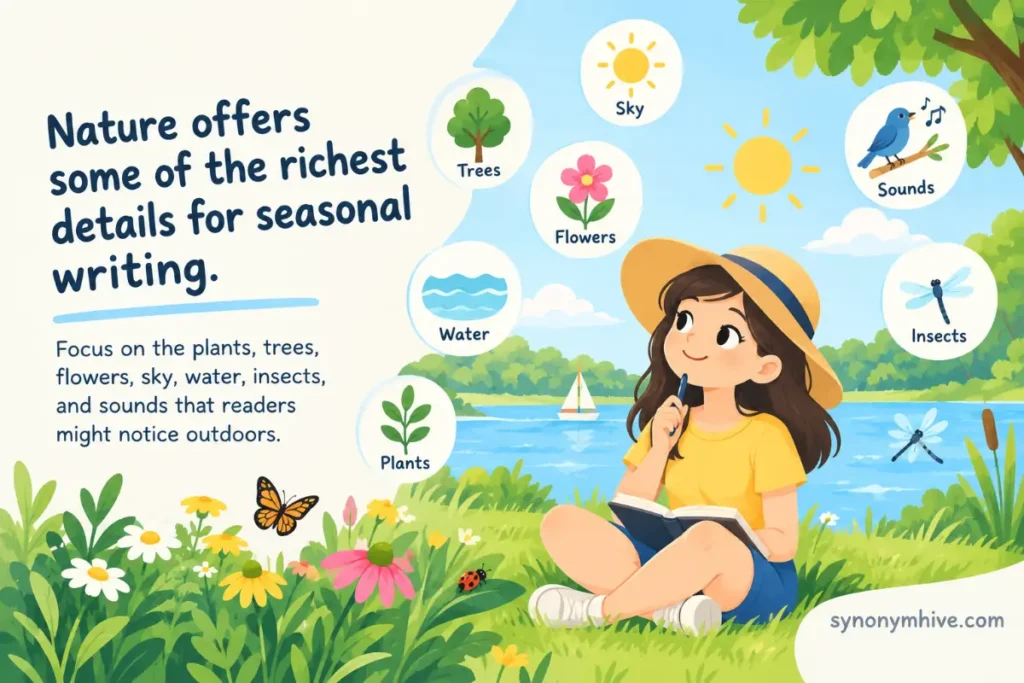
Nature offers some of the richest details for seasonal writing. Focus on the plants, trees, flowers, sky, water, insects, and sounds that readers might notice outdoors.
Words for Summer Plants and Gardens
Use lush for thick, healthy plant growth. Choose verdant for green fields or hills when a more literary tone suits the passage. Blooming describes plants producing flowers, while flourishing suggests healthy growth and progress.
Other useful choices include leafy, grassy, overgrown, fertile, thriving, and flower filled. Each term highlights a different quality. A leafy garden has many leaves, while an overgrown garden may look untidy because plants have spread beyond their intended spaces.
Example: The flourishing vegetable garden supplied fresh tomatoes, peppers, and herbs throughout the summer.
Words for Summer Skies and Sunlight
A summer sky can be clear, cloudless, hazy, pale, brilliant, or overcast. Sunlight may be bright, golden, dazzling, radiant, or harsh. Select a word based on what the sky actually looks like.
Dazzling suggests light that is so bright it can be difficult to look at. Golden adds warmth and color. Hazy describes a sky that looks unclear because of fine particles, moisture, or other conditions. Overcast means clouds cover much or all of the sky.
Example: A hazy sky softened the afternoon light, giving the distant hills a pale blue outline.
Words for Summer Water and Beaches
Water may look sparkling, clear, turquoise, rippling, calm, foamy, or shimmering. These words help readers picture a lake, pool, river, or ocean.
A tranquil lake is calm and peaceful. Turquoise describes a blue green color. Foamy suggests bubbles or froth, while rippling describes small waves moving across a surface.
Example: Turquoise waves rolled toward the shore and left a thin line of foam on the sand.
Be specific about the water’s movement. A calm pond does not need the same words as a rough sea. Matching the adjective to the scene makes the sentence more believable.
Words for Summer Sounds and Scents
Summer can be heard and smelled as well as seen. The air might carry the chirping of crickets, the buzzing of bees, the rustling of leaves, or the distant sound of children playing.
Useful sound words include buzzing, chirping, rustling, humming, lively, and quiet. For scents, consider fragrant, floral, earthy, fresh, grassy, and sweet smelling.
Example: The fragrant roses stood beside the fence while crickets chirped in the grass.
Sensory words are especially helpful in stories and descriptive essays. They make the setting seem present without requiring a long list of visual details.
Which Summer Words Match Different Moods
Summer can create feelings of joy, freedom, comfort, excitement, or exhaustion. Choose words that show the mood of the moment rather than describing every summer scene as happy and bright.
Words for a Happy Summer Mood
Use joyful, cheerful, carefree, playful, lively, exciting, or delightful when a summer scene brings happiness. These words work well for family holidays, outdoor games, festivals, and time spent with friends.
For example, The cheerful crowd filled the park with laughter and music. The adjective tells readers about the mood, while the rest of the sentence shows how that mood appears.
Carefree is especially useful when people have few worries or responsibilities. Lively describes a place or event full of activity. Joyful focuses more directly on happiness. Choose the word that matches the main idea.
Words for a Peaceful Summer Mood
A quiet summer morning may be serene, tranquil, calm, restful, gentle, or soothing. These words work well for gardens, lakes, shaded porches, and quiet afternoons spent reading.
For example, A gentle breeze moved through the trees while the lake remained tranquil.
The word serene suggests deep calm. Restful focuses on the chance to relax or recover. Soothing describes something that reduces stress or discomfort. These small differences help you describe a scene with more care.
Words for an Exciting Summer Mood
When the scene involves a festival, road trip, beach party, or outdoor concert, try thrilling, energetic, adventurous, vibrant, electric, or exhilarating.
For example, An electric atmosphere spread through the stadium as the concert began.
Energetic describes activity and movement. Thrilling suggests excitement that creates suspense or strong emotion. Exhilarating describes an experience that makes people feel excited and full of life. Use stronger terms for moments that truly deserve them.
Words for a Tired or Uncomfortable Summer Mood
Not every summer scene needs a cheerful tone. Words such as sticky, stifling, draining, exhausting, oppressive, and muggy can describe unpleasant weather.
For example, The muggy afternoon left the air heavy and uncomfortable.
Muggy usually refers to warm, humid weather. Stifling suggests conditions that make breathing or moving around feel difficult. Draining focuses on the effect that the heat has on a person.
These descriptions are useful in realistic stories because they show the difficult side of summer instead of presenting the season as perfect all the time.
Which Summer Words Work Best by Part of Speech
Adjectives are the most common choice for summer descriptions, but nouns and verbs can make your writing more varied. Instead of adding another adjective, you can sometimes choose a more specific noun or action.
Summer Adjectives
Adjectives describe people, places, objects, weather, and experiences. They include sunny, humid, vibrant, peaceful, fragrant, scorching, and breezy.
Example: The fragrant garden looked vibrant beneath the afternoon sun.
This sentence uses two adjectives to highlight different qualities. Fragrant describes the smell, while vibrant describes the garden’s strong colors and lively appearance.
Summer Nouns
Nouns name things or experiences connected with the season. Useful choices include sunshine, warmth, humidity, greenery, blossoms, twilight, wildflowers, and heatwave.
Example: The evening breeze brought relief after hours of heat.
Here, breeze and relief create a clear image without needing several adjectives.
Avoid repeating the same noun too often. If every sentence mentions sunshine, try focusing on shadows, flowers, insects, waves, or the smell of fresh grass instead.
Summer Verbs
Verbs describe actions and changes. They can make a scene feel active and natural.
Useful summer verbs include shimmer, glow, bloom, sway, sparkle, rustle, drift, ripen, bask, and wilt.
Example: Golden light shimmered across the lake as wildflowers swayed beside the path.
The verbs shimmered and swayed help readers picture movement. This approach often creates a stronger image than writing that simply labels everything beautiful.
Summer Adverbs
Adverbs describe how an action happens. Words such as brightly, gently, quietly, lazily, and vividly can add detail to summer sentences.
Example: The leaves rustled gently above the shaded picnic table.
Use adverbs carefully. A precise verb may already express the idea clearly. Instead of writing that the sun shone brightly, you might say that it blazed or glared when the heat was intense.
Looking for another word? See words to describe nature Best Guide.
What Are the Best Summer Words for Different Writing Situations
The same adjective may work in one setting but sound out of place in another. A text message can use casual slang, while a school essay usually benefits from clear standard English. A professional email may need a simple description that gets to the point.
Best Summer Words for an Essay
For a school essay, choose words that are vivid but easy to understand. Sunlit, humid, lush, peaceful, scorching, and refreshing are useful options.
Example: The sunlit meadow was filled with wildflowers, buzzing insects, and the gentle sound of a nearby stream.
This sentence gives readers several details about the setting. It also uses specific nouns rather than relying on a long series of adjectives.
When writing an essay, explain the details that support your main point. If you are discussing how summer affects a community, words such as busy, lively, and crowded may be more useful than beautiful.
Best Summer Words for a Resume
A resume rarely needs seasonal adjectives unless the work involves summer tourism, outdoor education, seasonal events, gardening, or a similar field. In those cases, choose professional words that describe the work and its results.
Useful terms include seasonal, outdoor, fast paced, adaptable, organized, and customer focused.
Example: Managed a seasonal team during the busy summer period and helped maintain efficient daily operations.
This sentence describes a real work responsibility. It is more effective than calling the summer workplace exciting or wonderful.
Use resume language to explain what you did, how you did it, and what you achieved. Avoid decorative words that do not provide useful information about your skills.
Best Summer Words for Texting
For a casual text, words such as chill, sunny, awesome, relaxing, epic, and fun usually sound natural.
Example: The weather is perfect for a chill afternoon by the pool.
Another option is That sunset was amazing. You do not need a complex adjective to share an experience with friends.
Use slang only when it fits the people receiving your message. A phrase that sounds natural in a group chat might seem too informal in a message to a teacher or manager.
Best Summer Words for an Email
For a friendly email, choose words that sound warm and natural without becoming overly casual. Pleasant, warm, enjoyable, sunny, and relaxing are often suitable.
Example: I hope you are enjoying the warm weather and having a pleasant start to the summer.
For a work email, keep the focus on the purpose of your message. You might write, Our summer schedule will begin on Monday, with updated hours for the outdoor program.
A clear sentence is usually more useful than an elaborate description of the season.
Best Summer Words for Speaking
Everyday conversation usually works best with familiar words. You might describe a day as hot, beautiful, breezy, humid, relaxing, or exhausting.
Example: It was a beautiful evening, and the breeze made sitting outside really comfortable.
When speaking, consider how the other person experiences the scene. If you are discussing a heat wave, sweltering may communicate more than warm. If you are talking about a pleasant evening, balmy may be a good choice.
Best Summer Words for Social Media Captions
Captions benefit from short, specific descriptions. Words such as golden, sun kissed, coastal, dreamy, vibrant, and carefree can work well for photographs and travel updates.
Example: Golden light, cool water, and a carefree afternoon.
Another option is A peaceful morning among the wildflowers. Both captions connect the mood to a clear detail.
Avoid adding several adjectives that communicate the same thing. A caption with two carefully selected details can be more memorable than a long string of similar words.
What Are Some Original Examples of Summer Descriptions
The following examples show how to use seasonal vocabulary in different situations. Each sentence focuses on a specific setting, action, or mood.
- A summer morning. Cool air drifted through the open window as birds chirped in the garden.
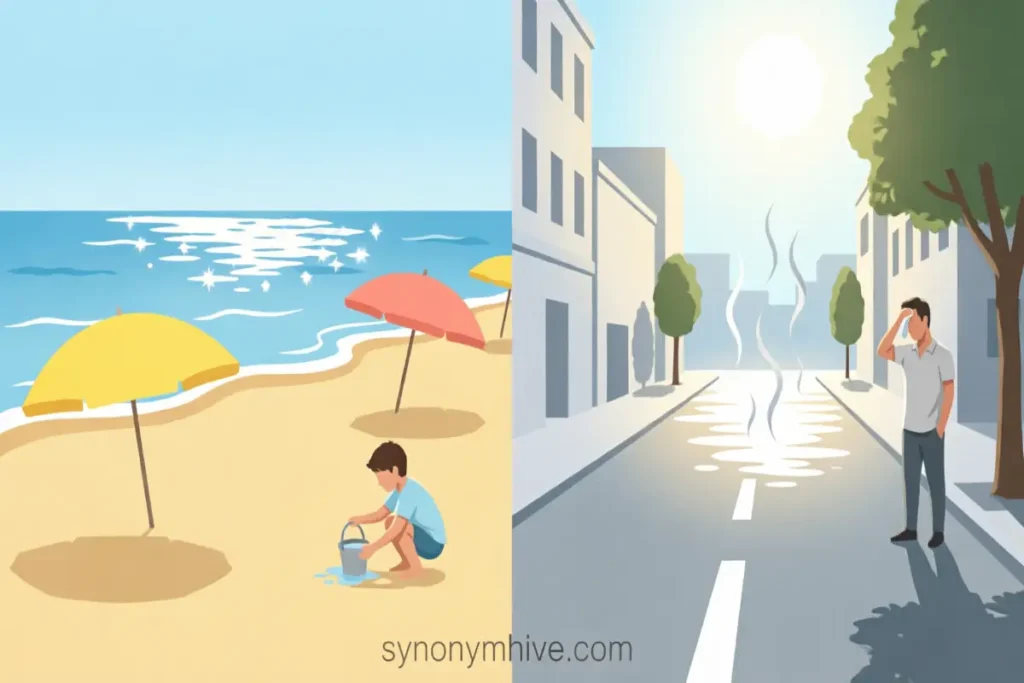
- A sunny beach. Bright umbrellas dotted the golden sand while sparkling waves rolled toward the shore.
- A hot afternoon. The scorching pavement sent heat rising above the quiet street.
- A family picnic. We spread a blanket beneath a leafy tree and enjoyed a relaxed lunch in the shade.
- A summer garden. Fragrant roses and colorful daisies brightened the path beside the fence.
- A country road. Lush fields stretched toward the horizon, glowing green beneath a clear blue sky.
- A rainy summer day. Heavy drops tapped against the windows while the earthy smell of wet soil drifted indoors.
- A summer festival. Lively music, bright decorations, and cheerful crowds filled the town square.
- A lake at sunset. Golden light shimmered on the water as the distant hills faded into blue shadows.
- A humid city afternoon. The muggy air hung over the sidewalks while people searched for cool indoor spaces.
- A quiet evening. A gentle breeze stirred the curtains as the last sunlight slipped behind the trees.
- A summer road trip. Winding roads passed through scenic valleys, small towns, and sunlit fields.
- A camping trip. We sat beside the crackling fire and listened to crickets in the surrounding grass.
These examples also show how to avoid repetition. Some focus on weather, others on sound, movement, smell, color, or human activity. Mixing these details makes descriptions more varied and believable.
What Is the Difference Between Similar Summer Words
Several summer adjectives have close meanings, but they do not always work in the same sentence. Understanding the difference helps you choose words that fit your intended message.
Sunny vs Bright
Sunny means that the sun is shining or that a place receives plenty of sunshine. Bright refers to a strong amount of light or a vivid appearance. A day can be bright even when the sun is partly hidden behind thin clouds.
| Sunny | Bright |
|---|---|
| Focuses on sunshine | Focuses on light or vividness |
| Describes weather and places | Describes light, colors, and appearances |
| Example: We enjoyed a sunny day at the beach. | Example: Bright flowers lined the garden path. |
Choose sunny when the weather matters most. Use bright when you want to describe the appearance of a room, object, or landscape.
Warm vs Hot
Warm usually suggests comfortable or moderate heat. Hot describes a higher temperature and can suggest discomfort, depending on the context.
| Warm | Hot |
|---|---|
| Often pleasant or mild | Often stronger and more intense |
| Example: Warm air drifted through the garden. | Example: Hot air rose from the pavement. |
The difference depends partly on personal experience. One person may call a day warm while another calls it hot. For precise writing, include details about how the weather affects people or objects.
Lush vs Verdant
Both words can describe green vegetation. Lush suggests thick, healthy growth and often creates an impression of abundance. Verdant specifically emphasizes rich green color and usually sounds more formal or literary.
| Lush | Verdant |
|---|---|
| Highlights fullness and healthy growth | Highlights green color |
| Common in everyday and creative writing | More common in formal or literary descriptions |
| Example: Lush vines covered the garden wall. | Example: Verdant hills surrounded the village. |
Choose lush when the plants look full and thriving. Use verdant when the green appearance is the detail you want to emphasize.
Peaceful vs Serene
Peaceful describes a place or situation without disturbance or conflict. Serene suggests a deeper, steady calm.
For example, a peaceful park might have few visitors and little noise. A serene lake may seem almost completely still, creating a strong sense of calm.
Both words are useful for summer descriptions, but serene often sounds more polished. Use peaceful when you want a simple and natural description.
Humid vs Muggy
Humid means the air contains a high amount of moisture. It is a neutral weather term. Muggy describes warm, humid conditions that often feel uncomfortable.
Example: The humid air made my hair curl. This sentence gives a straightforward description.
Example: The muggy afternoon left us searching for air conditioning. This sentence emphasizes discomfort.
Use humid for a weather report or factual description. Choose muggy when you want readers to understand how the conditions affect someone.
What Summer Words Are Used in the United States and the United Kingdom
Most common summer adjectives are understood in both American and British English. Words such as sunny, warm, humid, breezy, scorching, and peaceful do not usually require a regional change.
The bigger differences often involve spelling, everyday expressions, and local weather patterns.
In American English, vacation is the common term for time away from work or school. British English generally uses holiday for the same idea. American speakers often say vacation rental, while British speakers may use holiday rental.
Regional climate also affects which descriptions sound natural. A writer describing a humid summer in the American Southeast might focus on sticky air, afternoon storms, and heavy heat. Someone writing about a mild British summer might describe changing skies, cool breezes, and occasional sunny spells.
These are broad examples rather than rules for every place. Both countries have varied climates, and local conditions can differ sharply.
When writing for a specific audience, use familiar terms and describe the actual weather. A local detail usually adds more value than forcing a regional expression into the sentence.

What Are Common Mistakes When Describing Summer
Good descriptions depend on accuracy and variety. Some writing habits can make summer scenes sound vague, repetitive, or unrealistic.
Using Too Many Similar Adjectives
A sentence such as The hot, scorching, blazing, sweltering afternoon was unbearable repeats nearly the same idea several times.
A cleaner version is The sweltering afternoon drove everyone indoors.
One strong adjective gives the reader a clear picture. Add another only when it contributes a different detail, such as color, sound, or movement.
Calling Every Summer Day Beautiful
Summer weather varies from place to place. Some days are bright and pleasant, while others are cloudy, stormy, humid, or dangerously hot.
Instead of automatically calling the day beautiful, describe what makes it pleasant or unpleasant. You might mention a cool breeze, a clear sky, heavy rain, or heat rising from the road.
Accurate details make your writing more convincing.
Choosing Formal Words for Casual Situations
Words such as verdant, luminous, and idyllic can work well in a descriptive essay. In a quick message to a friend, they may sound unnecessarily formal.
Match the word to the audience and purpose. A simple green garden can be more natural than a verdant garden when you are chatting casually.
Using Slang in Professional Writing
Slang terms such as lit and fire can suit informal captions or conversations. They may distract readers in business emails, school reports, or formal articles.
Use standard vocabulary when you need broad understanding. Save slang for settings where the tone is clearly casual.
Describing a Scene Without Sensory Details
Words such as nice, good, and beautiful can communicate a general opinion, but they often leave readers with little to imagine.
Try adding a detail from sight, sound, smell, touch, or taste. Instead of The garden was beautiful, write Pink roses filled the garden with color, and the scent of jasmine drifted from the fence.
The second sentence gives readers something specific to picture.
Confusing Weather With Mood
Humid describes the air, while carefree describes a state of mind. These words are not interchangeable.
A scene can be humid and joyful at the same time. It can also be sunny and lonely. Keep physical conditions separate from emotions unless you deliberately connect them.
Using Words That Do Not Match the Scene
Tranquil may not suit a crowded beach party. Electric may not describe a quiet garden at dawn. Strong adjectives become less effective when they contradict the scene.
Read the sentence again and ask what a person would actually notice in that setting. Choose a word that supports those details.
What Are the Antonyms of Summer Descriptive Words
Antonyms are words with opposite or contrasting meanings. They can help you describe changing weather or create a contrast between summer and another season.
| Summer word | Opposite or contrasting word |
|---|---|
| Hot | Cold |
| Warm | Chilly |
| Sunny | Cloudy |
| Bright | Dim |
| Lush | Barren |
| Blooming | Withered |
| Humid | Dry |
| Breezy | Still |
| Lively | Quiet |
| Cheerful | Gloomy |
| Peaceful | Chaotic |
| Refreshing | Stifling |
| Colorful | Dull |
| Mild | Harsh |
| Clear | Overcast |
Some of these pairs are contextual rather than exact dictionary opposites. For example, quiet does not always mean the opposite of lively, and overcast does not always mean the opposite of clear in every sense. Use the contrasting word that best fits your intended meaning.
Antonyms are also useful for showing change. A story might begin with a bright morning and end beneath a gloomy sky. That contrast can signal a shift in mood without directly explaining how the characters feel.
How Can You Choose the Right Summer Word
Choosing the right word becomes easier when you decide what the sentence needs to communicate.
Start With the Main Detail
Ask yourself what stands out most. Is it the temperature, light, sound, smell, appearance, or mood?
If the air is full of moisture, humid is precise. If flowers fill a garden with color, blooming or colorful may work.
Match the Word to the Intensity
Do not use an extreme word for a mild experience. Scorching suggests intense heat, while warm can describe comfortable conditions. Exhilarating suggests strong excitement, while pleasant communicates a milder positive experience.
Choosing the right intensity keeps your writing believable.
Consider Your Audience
A school essay usually needs clear, standard vocabulary. A text message can be more relaxed. A formal travel feature may benefit from a literary adjective, while a weather update should favor accuracy.
Your reader should understand the description without stopping to work out what you mean.
Use Specific Nouns and Verbs
An adjective becomes more effective when it works with a concrete detail. Sparkling water is clearer than a sparkling scene. Wildflowers swayed creates more movement than the flowers were beautiful.
Try replacing a general noun or verb before adding more adjectives. This can improve a sentence without making it longer.
Read the Sentence Aloud
A sentence may look impressive but sound unnatural when spoken. Reading it aloud helps you notice repeated words, awkward phrasing, and unnecessary detail.
For example, The radiant, luminous, bright sunshine filled the sky repeats the idea of strong light. Radiant sunlight filled the garden communicates the image more clearly.
Keep the Description Natural
You do not need to use an advanced word in every sentence. Simple vocabulary often works best when the scene is familiar or the message is direct.
Use a more unusual adjective only when it adds a meaning that an everyday word cannot express as well. Precision matters more than complexity.
Discover related words in Words to Describe Eyes: Words for Eye Colors 2026.
Conclusion
The strongest summer descriptions come from choosing words that match the weather, setting, activity, and mood. A quiet garden may be serene and fragrant, while a busy beach can be lively and sunlit. For extreme heat, words such as scorching and sweltering communicate more than a general description of warm weather.
When choosing words to describe summer, focus on the details your reader needs to picture. Add sensory language when it helps, vary your verbs and nouns, and match your vocabulary to your audience. Simple words can work just as well as formal ones when they express the idea clearly. With a little attention to tone and meaning, you can make essays, captions, stories, and everyday messages more vivid without filling them with unnecessary adjectives.
Frequently Asked Questions
What Are the Best Words to Describe Summer
Some of the best choices are sunny, warm, breezy, lush, golden, vibrant, peaceful, humid, refreshing, and carefree. Choose the words that match the weather or mood you want to describe.
What Are Five Adjectives for Summer
Five useful adjectives are sunny, hot, breezy, colorful, and relaxing. Together, they describe common summer conditions and experiences, though each one highlights a different detail.
What Are Some Unique Words to Describe Summer
Words such as balmy, verdant, sultry, luminous, and idyllic can add variety to descriptive writing. Use them when their meanings fit the scene and the tone suits your audience.
What Is a Good Word for a Very Hot Summer Day
Scorching is a strong choice for a day with extreme heat. Sweltering works well when the heat is uncomfortable and the air may also feel humid.
What Is Another Way to Say Summer Is Beautiful
You could say the summer landscape is radiant, the garden is lush, or the evening is idyllic. A specific description often works better than calling the entire season beautiful.
How Can I Describe Summer in an Essay
Focus on details such as sunlight, plants, weather, outdoor sounds, and seasonal activities. Use a few precise adjectives and support them with clear examples so readers can imagine the setting.
What Words to Describe Summer Work Best for Captions
Short words such as golden, sunny, dreamy, breezy, vibrant, and carefree work well for casual captions. Pair one or two with a specific detail from the photo to make the caption more memorable.