

Writing a resume, preparing for an interview, or describing someone you admire can make one question surprisingly hard: what are the right words to describe a good leader? You may know the person is effective, trusted, and respected, but finding precise words can still take time.
The strongest descriptions do more than say someone is nice or successful. They show how that person treats others, makes decisions, handles pressure, communicates, and helps a team move forward.
The best words to describe a good leader include supportive, decisive, honest, accountable, inspiring, fair, adaptable, reliable, confident, and empathetic. The right word depends on the leader’s specific qualities and the situation you are describing.
This guide gives you a large set of useful leadership adjectives and explains the small differences between similar words. You’ll also find examples for resumes, essays, interviews, emails, texting, and everyday conversation.
Need another vocabulary suggestion? Read Words to Describe a Friend Best Guide In 2026.
What Do Words To Describe A Good Leader Mean
Words used to describe a good leader are adjectives and related terms that explain a person’s leadership qualities, behavior, character, and effect on other people.
A strong leader description should tell the reader something specific. Saying someone is good gives very little information. Saying someone is decisive, fair, and supportive gives the reader a clearer picture.
Leadership language can describe different areas of a person’s behavior. Some words focus on communication. Others describe judgment, character, teamwork, confidence, or emotional awareness.
For example, an empathetic leader understands how others may feel. A decisive leader makes choices when action is needed. An accountable leader accepts responsibility for results.
The best description usually combines several qualities rather than relying on one broad adjective.
What Are The Best Words To Describe A Good Leader
Some leadership words work in almost any setting. Others fit a specific type of leader.
| Word | Meaning | Tone | Example |
|---|---|---|---|
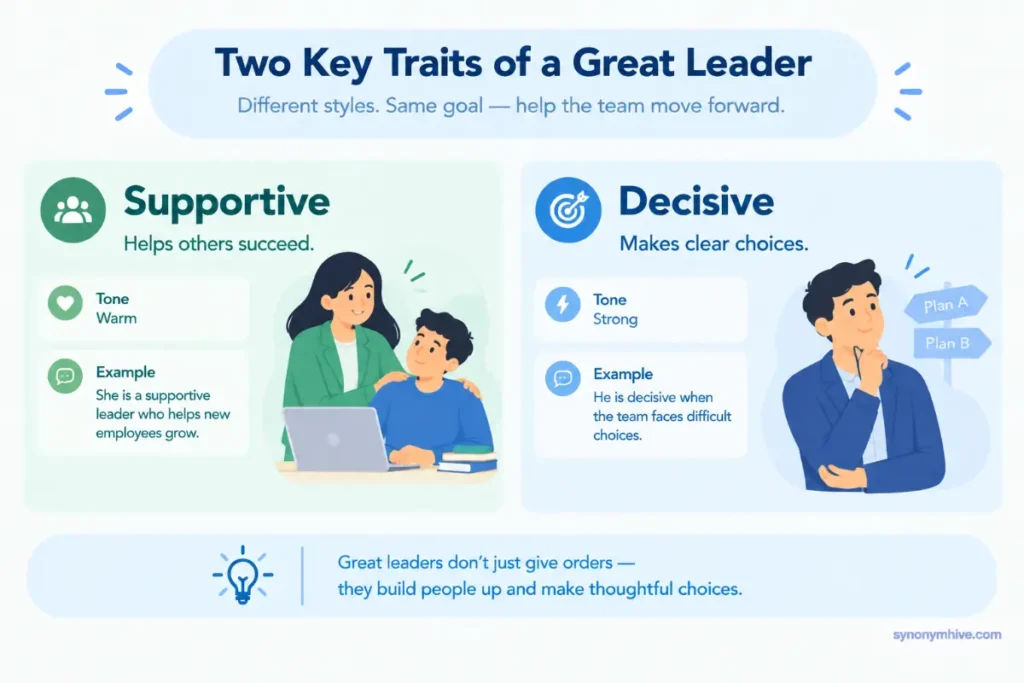
| Supportive | Helps others succeed | Warm | She is a supportive leader who helps new employees grow. |
| Decisive | Makes clear choices | Strong | He is decisive when the team faces difficult choices. |
| Honest | Tells the truth | Direct | She is an honest leader who communicates openly. |
| Accountable | Accepts responsibility | Professional | He is accountable for both successes and mistakes. |
| Inspiring | Encourages others | Positive | Her inspiring leadership brought the team together. |
| Fair | Treats people equally | Balanced | He is a fair manager who listens to every side. |
| Adaptable | Adjusts to change | Practical | She is an adaptable leader who stays calm during change. |
| Confident | Trusts their judgment | Positive | She is a confident speaker who gives clear direction. |
| Compassionate | Shows care for others | Warm | She is a compassionate leader who supports employees during hard times. |
| Resourceful | Finds practical solutions | Positive | He is a resourceful leader who solves problems quickly. |
| Humble | Does not seek excessive praise | Positive | She is a humble leader who shares credit with her team. |
| Transparent | Shares information openly | Professional | He is a transparent leader who explains important decisions. |
| Vision driven | Guided by a clear goal | Professional | She is a vision driven leader who keeps the team focused. |
| Resilient | Recovers from setbacks | Strong | He is a resilient leader who stays focused after failure. |
| Empowering | Gives others confidence and authority | Positive | She has an empowering leadership style. |
| Thoughtful | Considers people and consequences | Warm | He is a thoughtful leader who considers different viewpoints. |
| Proactive | Acts before problems grow | Professional | She is a proactive leader who spots risks early. |
| Trustworthy | Deserves confidence | Strong | He is a trustworthy leader who keeps his word. |
Which Leadership Words Are Simple And Everyday
Simple words often work best when your audience is broad. They are easy to understand and rarely sound forced.
Useful everyday choices include:
- Kind.
- Fair.
- Honest.
- Helpful.
- Patient.
- Calm.
- Strong.
- Smart.
- Reliable.
- Friendly.
- Respectful.
- Confident.
- Supportive.
- Responsible.
- Caring.
These words may look basic, but they can create strong descriptions when you connect them to real behavior.
Instead of writing, “She is a good leader,” try, “She is a fair and supportive leader who listens before making decisions.”
The second sentence gives the reader more information without using complicated language.
Which Leadership Words Sound More Professional
Professional writing often benefits from precise terms that describe a specific skill or behavior.
Consider words such as:
- Strategic.
- Accountable.
- Decisive.
- Adaptable.
- Collaborative.
- Visionary.
- Resourceful.
- Proactive.
- Transparent.
- Resilient.
- Empowering.
- Innovative.
- Organized.
- Analytical.
- Diplomatic.
These terms can work well on resumes, performance reviews, recommendation letters, and professional profiles.
Still, don’t use a word simply because it sounds impressive. The description should match the person’s actual behavior.
If someone regularly accepts responsibility for mistakes, accountable is useful. If they plan several steps ahead, strategic may fit.
Which Words Describe A Leader’s Character
Leadership is not only about making decisions. Character also shapes how people respond to a leader.
Honest
An honest leader tells the truth and avoids misleading people.
Example: “Our director is honest about the challenges facing the department.”
Trustworthy
A trustworthy leader earns confidence by keeping promises and handling responsibilities carefully.
Example: “Employees trust her because she consistently keeps her word.”
Humble
A humble leader does not need to take all the credit.
Example: “He is humble enough to recognize the team’s contribution.”
Fair
A fair leader applies standards consistently and listens before making judgments.
Example: “She is fair when resolving disagreements between employees.”
Responsible
A responsible leader takes duties seriously and considers the results of their decisions.
Example: “He is responsible and follows through on every major commitment.”
Respectful
A respectful leader treats people with dignity, even during disagreement.
Example: “She remains respectful when team members challenge her ideas.”
Which Words Describe A Leader’s Communication Skills
Good communication is one of the clearest signs of effective leadership. A leader may need to explain goals, give feedback, handle conflict, or deliver difficult news.
Useful words include:
- Clear.
- Articulate.
- Direct.
- Persuasive.
- Diplomatic.
- Approachable.
- Attentive.
- Open.
- Transparent.
- Encouraging.
- Expressive.
- Respectful.
Clear is useful when a leader explains complex information in a simple way.
Articulate describes someone who expresses ideas clearly and effectively.
Diplomatic works for leaders who handle sensitive topics without creating unnecessary conflict.
Approachable describes someone people feel comfortable talking to.
For example, “She is an approachable and articulate leader who makes difficult information easy to understand” gives the reader two specific qualities and shows how they work together.
Which Words Describe A Leader Who Makes Good Decisions
Some leaders stand out because they make sound choices under pressure.
The most useful words include:
- Decisive.
- Strategic.
- Thoughtful.
- Analytical.
- Practical.
- Judicious.
- Confident.
- Resourceful.
- Responsible.
- Courageous.
A decisive person makes choices without unnecessary delay.
A strategic person considers long term goals.
An analytical person studies information before deciding.
A thoughtful person considers the effect of a decision on others.
A courageous leader makes difficult choices even when the outcome is uncertain.
These terms overlap, but they aren’t identical. Choosing the precise word makes your description stronger.
Which Words Describe A Supportive Leader
Supportive leaders help other people improve instead of trying to control every task.
Useful words include:
- Supportive.
- Encouraging.
- Empathetic.
- Patient.
- Compassionate.
- Helpful.
- Empowering.
- Caring.
- Approachable.
- Mentoring.
An empowering leader gives people the confidence and freedom to take responsibility.
A mentoring leader focuses on helping others develop their skills.
An empathetic leader considers what other people may be experiencing.
A patient leader gives people time to learn and improve.
For example, “She is an empowering leader who gives employees room to solve problems on their own” says much more than simply calling her supportive.
Which Words Describe A Strong Leader
The word strong can mean several things in leadership. A strong leader may show confidence, courage, discipline, resilience, or sound judgment.
Good alternatives include:
- Confident.
- Decisive.
- Courageous.
- Resilient.
- Determined.
- Assertive.
- Firm.
- Capable.
- Dependable.
- Composed.
Assertive means someone communicates their needs or decisions clearly without being overly passive.
Firm describes someone who holds to a decision or standard.
Resilient describes someone who recovers from setbacks.
Composed suggests calm behavior during stressful situations.
A strong leader does not have to be loud. Quiet confidence can be just as effective.
Which Words Describe A Visionary Leader
A visionary leader thinks beyond the immediate task and gives people a clear sense of direction.
Useful words include:
- Visionary.
- Innovative.
- Forward thinking.
- Strategic.
- Creative.
- Ambitious.
- Imaginative.
- Purposeful.
- Future focused.
- Inspiring.
A visionary leader sees possibilities and communicates a future goal.
An innovative leader looks for new ways to solve problems.
A strategic leader connects present decisions to future results.
For example, “The founder is a visionary leader who helped the company move from a small local service to a national brand.”
The example works because the word is supported by a specific result.
Which Words Describe A Leader Who Motivates Others
Some leaders have a strong ability to encourage people to act.
Useful terms include:
- Inspiring.
- Motivating.
- Encouraging.
- Energetic.
- Positive.
- Passionate.
- Enthusiastic.
- Uplifting.
- Influential.
- Persuasive.
An inspiring leader gives people a reason to care about the goal.
A motivating leader encourages people to take action.
A persuasive leader influences people through clear reasoning or communication.
An uplifting leader helps improve the mood and confidence of a group.
Try to connect these words to behavior.
Instead of saying, “He is motivating,” write, “He motivates the team by setting clear goals and recognizing strong work.”
Which Words Describe An Adaptable Leader
Change can test a leader’s judgment. Someone who handles new conditions well may be described as adaptable, flexible, resilient, or resourceful.
Adaptable means able to adjust to new conditions.
Flexible suggests a willingness to change plans when needed.
Resilient focuses more on recovering after setbacks.
Resourceful describes someone who finds useful solutions when resources or options are limited.
For example, “She is an adaptable leader who quickly adjusts project plans when customer needs change.”
That sentence shows why the adjective fits.
How Strong Are Different Leadership Words
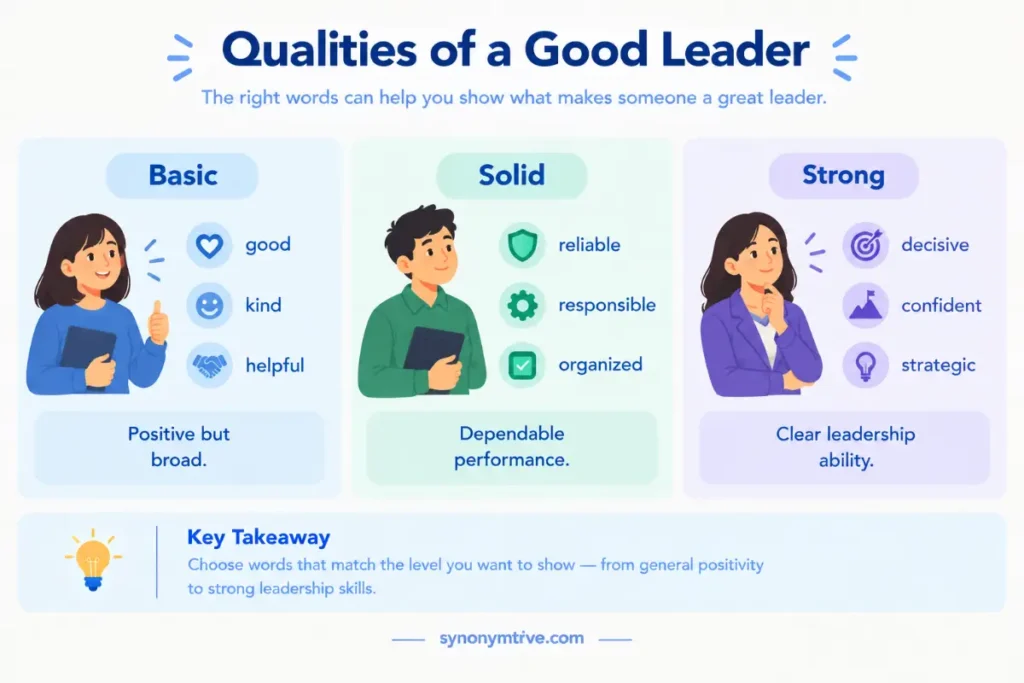
Not every adjective carries the same level of praise. Some are neutral. Others suggest exceptional ability.
| Level | Useful Words | What They Suggest |
|---|---|---|
| Basic | Good, kind, helpful | Positive but broad |
| Solid | Reliable, responsible, organized | Dependable performance |
| Strong | Decisive, confident, strategic | Clear leadership ability |
| Very strong | Inspiring, courageous, empowering | Significant influence |
| Exceptional | Visionary, transformational, outstanding | Unusual leadership impact |
The best choice depends on the evidence behind the description.
If you only know that someone completes tasks on time, reliable is safer than visionary.
If someone has changed an entire organization through a clear long term plan, visionary may be justified.
Strong writing matches the strength of the word to the strength of the evidence.
How Do Leadership Words Change By Part Of Speech
Most descriptions of people use adjectives.
Examples include:
She is patient.
He is decisive.
They are supportive.
You can also describe leadership with nouns.
Examples include:
She is a mentor.
He is a visionary.
She is an innovator.
Verbs can describe leadership behavior too.
Examples include:
She guides the team.
He motivates employees.
She supports new managers.
Adverbs can describe how a leader acts.
Examples include:
He communicates clearly.
She responds calmly.
He handles conflict fairly.
Using several parts of speech can help you avoid repeating the same adjective.
Which Words Work Best On A Resume
A resume should use leadership words that connect to real actions and results.
Good choices include:
- Strategic.
- Decisive.
- Accountable.
- Collaborative.
- Organized.
- Proactive.
- Resourceful.
- Adaptable.
- Results driven.
- Mentoring.
Instead of writing:
“Good leader who helped employees.”
Write:
“Supportive team leader who coached five new employees and improved onboarding results.”
The second version gives the reader evidence.
Another example is:
“Led a cross functional team of eight employees while meeting quarterly project goals.”
The strongest resume descriptions usually combine a leadership quality with an action or measurable result.
Which Words Work Best In An Essay
An essay can use more descriptive and thoughtful language.
Useful terms include:
- Compassionate.
- Courageous.
- Visionary.
- Influential.
- Fair.
- Principled.
- Determined.
- Resilient.
- Strategic.
- Charismatic.
The right word depends on what the essay is trying to show.
For example:
“Martin Luther King Jr. was an influential leader who used powerful communication to inspire social change.”
A different essay might say:
“The coach showed a compassionate leadership style by supporting players after difficult losses.”
Avoid using several impressive words without explaining them. One precise adjective supported by an example is stronger than a string of praise words.
Which Words Work Best In A Job Interview
Interviews give you a chance to describe your own leadership style.
Choose words that you can support with a short story.
For example:
“I’d describe my leadership style as supportive, organized, and accountable.”
Then explain:
“I like to give people clear goals, but I also give them room to make decisions. If something goes wrong, I take responsibility and focus on finding a solution.”
That answer sounds more credible than simply saying:
“I’m an amazing leader.”
The goal is to show the quality through your behavior.
Which Words Work Best In A Text
Texting allows a more relaxed tone.
You might say:
“She’s such a supportive leader.”
“He’s a really inspiring coach.”
“She’s super organized and always keeps everyone on track.”
“He’s the kind of leader people actually trust.”
Casual writing does not require formal vocabulary. Natural language often sounds better than corporate terms.
Choose the word that matches how you normally speak.
Which Words Work Best In An Email
A professional email needs respectful and specific language.
You could write:
“Maria is a thoughtful and dependable leader who always makes time for her team.”
Or:
“James has been an exceptionally supportive manager during this project.”
If you’re recommending someone, connect the quality to a real behavior.
For example:
“She is an approachable leader who encourages employees to raise concerns early.”
That gives the reader a reason to believe the description.
Which Words Work Best When Speaking
Everyday speech usually favors simple words.
You might call someone:
- Fair.
- Kind.
- Smart.
- Honest.
- Confident.
- Helpful.
- Calm.
- Strong.
- Reliable.
- Supportive.
Formal terms can still work, but they may sound unnatural in casual conversation.
Instead of saying, “He demonstrates exceptional strategic leadership capabilities,” a normal speaker might say, “He’s a great planner and always thinks ahead.”
Clear language usually sounds more natural.
Need a similar word? Read words to describe yourself best guide in 2026.
What Is The Difference Between Confident And Arrogant
Confident and arrogant can describe someone who appears sure of themselves, but the meanings differ sharply.
| Confident | Arrogant |
|---|---|
| Trusts their abilities | Thinks they are better than others |
| Can accept feedback | May reject criticism |
| Speaks with assurance | May speak down to people |
| Can share credit | Often seeks praise |
| Positive leadership quality | Usually negative quality |
A confident leader might say, “I believe this plan can work, but I’m open to better ideas.”
An arrogant leader might dismiss every alternative without listening.
Confidence helps leadership. Arrogance can damage trust.
What Is The Difference Between Assertive And Aggressive
These words are often confused because both can describe direct behavior.
An assertive person communicates clearly while respecting others.
An aggressive person may push their views in a way that ignores other people’s rights or opinions.
Consider these examples:
“She was assertive when explaining the team’s needs.”
“She was aggressive when demanding that everyone follow her plan.”
Assertive is usually positive in leadership. Aggressive often carries a negative meaning.
A good leader can be firm without being hostile.
What Is The Difference Between Supportive And Empowering
Supportive and empowering overlap, but they focus on different actions.
A supportive leader gives help, encouragement, and guidance.
An empowering leader gives people confidence, authority, and room to make decisions.
For example:
“She is supportive because she helps employees when they face problems.”
“She is empowering because she trusts employees to solve problems themselves.”
A leader can be both.
In fact, strong leadership often requires knowing when to provide direct help and when to step back.
What Is The Difference Between Inspiring And Motivating
Inspiring and motivating are close, but they point to different effects.
An inspiring person creates excitement, belief, or a sense of purpose.
A motivating person encourages action toward a goal.
For example:
“Her story was inspiring.”
“Her clear goals were motivating.”
A leader may inspire people through a strong vision and motivate them through clear goals and recognition.
What Is The Difference Between Strategic And Visionary
Strategic and visionary leadership both involve the future, but they focus on different things.
A visionary leader describes where the organization or group could go.
A strategic leader develops practical plans for getting there.
Think of it this way:
Vision answers, “Where do we want to go?”
Strategy answers, “How will we get there?”
A leader can be visionary without being highly strategic. The strongest leaders often combine both qualities.
What Are Good Words For A Leader Who Handles Pressure
Pressure reveals a lot about leadership style.
Useful words include:
- Calm.
- Composed.
- Resilient.
- Steady.
- Courageous.
- Decisive.
- Patient.
- Practical.
- Level headed.
- Reliable.
A calm leader controls their reactions during stressful moments.
A composed leader remains controlled when others become emotional.
A resilient leader recovers after setbacks.
A level headed leader makes practical decisions without overreacting.
For example:
“She remained calm and decisive when the project faced an unexpected delay.”
That sentence gives the reader a clear picture of leadership under pressure.
What Are Good Words For A Leader Who Solves Problems
Problem solving is another important part of leadership.
Useful descriptions include:
- Resourceful.
- Practical.
- Creative.
- Analytical.
- Strategic.
- Innovative.
- Observant.
- Decisive.
- Adaptable.
- Solution focused.
A resourceful leader finds ways forward with the tools available.
An analytical leader examines information carefully.
A creative leader thinks of new possibilities.
An innovative leader applies new ideas or methods.
For example:
“He is a resourceful leader who finds practical solutions when projects run into unexpected problems.”
What Are Good Words For A Leader Who Builds Trust
Trust develops through repeated behavior.
Words that describe trust building include:
- Honest.
- Reliable.
- Consistent.
- Transparent.
- Accountable.
- Fair.
- Respectful.
- Dependable.
- Authentic.
- Trustworthy.
A trustworthy leader does not need to make dramatic promises. People learn to trust them because their actions match their words.
For example:
“Her transparent communication helped employees trust the new plan.”
Another strong description is:
“He is consistent, fair, and accountable, so his team knows what to expect.”
What Are Good Words For A Leader Who Works Well With Others
Leadership does not mean doing everything alone.
A collaborative leader invites ideas, shares responsibility, and works toward common goals.
Useful terms include:
- Collaborative.
- Cooperative.
- Team oriented.
- Inclusive.
- Supportive.
- Respectful.
- Open minded.
- Approachable.
- Diplomatic.
- Considerate.
An inclusive leader makes space for different voices.
A collaborative leader works with others instead of controlling every decision.
A diplomatic leader handles disagreement carefully.
For example:
“She is a collaborative and inclusive leader who encourages every team member to contribute.”
What Are Good Words For A Leader Who Accepts Feedback
A leader who listens to feedback can learn and improve.
Useful words include:
- Open minded.
- Humble.
- Receptive.
- Teachable.
- Flexible.
- Reflective.
- Self aware.
- Thoughtful.
- Adaptable.
- Accountable.
An open minded leader considers ideas from others.
A humble leader can admit that they do not know everything.
A self aware leader understands their own strengths and weaknesses.
For example:
“He is a self aware leader who actively asks for feedback after major projects.”
That description is stronger than simply saying he is a good listener.
What Are Common Mistakes When Describing Leaders
One common mistake is using vague praise.
Words such as good, great, amazing, and excellent can sound empty when they appear without evidence.
Another mistake is choosing a word that does not match the person’s behavior.
Calling someone visionary simply because they manage a team does not explain anything. Calling them visionary because they created and communicated a clear long term direction gives the word meaning.
A third mistake is using too many positive adjectives at once.
For example:
“She is an amazing, incredible, outstanding, inspiring, wonderful, excellent leader.”
The sentence gives praise but little information.
A stronger version would be:
“She is an inspiring and accountable leader who gives employees clear goals and takes responsibility when projects fall behind.”
Specific details create a stronger description.
When Should You Avoid Certain Leadership Words
Some leadership terms can create unintended meanings.
Be careful with bossy. It usually suggests someone gives too many orders.
Use assertive when you mean confident and direct.
Be careful with aggressive. It can suggest hostility.
Use decisive or firm when you mean someone makes clear decisions.
Be careful with controlling. It usually has a negative meaning.
Use organized or detail focused if you mean someone pays close attention to work.
Be careful with charismatic. It describes personal charm and influence, not necessarily good judgment or character.
Be careful with ambitious too. It can be positive, but some readers may see it as overly focused on personal success.
The best word depends on the exact quality you want to communicate.
What Are The Opposite Words For A Good Leader
Leadership descriptions can also use negative terms when you need to explain poor leadership.
Common opposites include:
- Dishonest.
- Unreliable.
- Unfair.
- Arrogant.
- Controlling.
- Indecisive.
- Impatient.
- Inflexible.
- Careless.
- Unaccountable.
- Dismissive.
- Self centered.
These words can help when writing a character analysis, workplace review, essay, or leadership comparison.
For example:
“The manager was indecisive and inconsistent, which made it difficult for employees to understand the team’s priorities.”
A negative description becomes more useful when you explain the behavior behind it.
How Can You Choose The Right Leadership Word
Start with the behavior you actually want to describe.
Ask yourself:
- Does this person help others?
- Do they make decisions quickly?
- Do they listen to different views?
- Do they stay calm under pressure?
- Do they accept responsibility?
- Do they encourage other people?
- Do they plan for the future?
- Do they solve problems creatively?
- Do people trust them?
- Do they communicate clearly?
Your answer will point you toward a more precise word.
If the person listens carefully, consider empathetic or attentive.
If they accept responsibility, consider accountable.
How Can You Make A Leadership Description More Specific
The easiest way to strengthen a description is to connect the adjective to an action.
Weak:
“She is a great leader.”
Better:
“She is a supportive leader who helps new employees build confidence.”
Weak:
“He is very organized.”
Better:
“He is an organized leader who gives the team clear deadlines and priorities.”
Weak:
“She is inspiring.”
Better:
“She inspires her team by explaining the purpose behind each project.”
This simple pattern works in resumes, essays, interviews, recommendation letters, and professional profiles.
Quality plus behavior creates a clearer description.
What Are Good Leadership Words For Different Situations
| Situation | Strong Choices |
|---|---|
| Resume | Strategic, accountable, proactive, collaborative |
| Interview | Supportive, decisive, adaptable, reliable |
| Essay | Visionary, courageous, influential, compassionate |
| Recommendation letter | Dependable, thoughtful, inspiring, responsible |
| Supportive, professional, respectful, approachable | |
| Texting | Great, solid, fair, inspiring, supportive |
| Performance review | Accountable, organized, strategic, consistent |
| Character description | Confident, humble, ambitious, empathetic |
The setting affects the best choice.
A word that works well in a text may sound too casual on a resume. A formal business term may sound stiff in a conversation with a friend.
How Can You Avoid Repeating The Same Leadership Words
Repeating good or great can make your writing dull.
Instead, change the word based on the quality you want to highlight.
For character:
Use honest, humble, fair, or trustworthy.
For communication:
Use clear, articulate, direct, or diplomatic.
For decision making:
Use decisive, strategic, analytical, or thoughtful.
For teamwork:
Use collaborative, inclusive, supportive, or cooperative.
For resilience:
Use calm, steady, resilient, or determined.
For future planning:
Use visionary, strategic, innovative, or forward thinking.
This approach gives your writing more detail without making it complicated.
How Can You Describe A Good Leader In One Sentence
A strong one sentence description combines a few qualities with a clear effect.
Here are some examples:
“She is a fair, supportive leader who brings people together and helps them do their best work.”
“He is a decisive and accountable leader who stays calm under pressure.”
“She is an empathetic leader who listens carefully and gives her team confidence.”
“He is a strategic leader who turns long term goals into practical plans.”
“She is an inspiring and collaborative leader who makes every team member feel valued.”
“He is a trustworthy leader who communicates clearly and accepts responsibility for his decisions.”
These sentences work because they don’t simply praise the person. They explain what makes the person effective.
What Are 20 Strong Example Sentences
- She is a supportive leader who helps every employee understand their role.
- He is a decisive leader who makes clear choices when problems arise.
- Her empathetic style makes people comfortable sharing concerns.
- He is a reliable leader who always follows through on his promises.
- She is an inspiring leader who gives the team a clear purpose.
- He is an accountable manager who takes responsibility for mistakes.
- Her strategic thinking helped the company prepare for future challenges.
- He is a calm leader who stays focused during stressful situations.
- She is an approachable manager who welcomes questions and new ideas.
- He is a collaborative leader who values input from every team member.
- She is a resilient leader who recovered quickly after a major setback.
- He is a humble leader who gives credit to the people around him.
- Her transparent communication helped the team understand the change.
- He is a resourceful leader who finds practical solutions to difficult problems.
- She is an organized leader who keeps projects moving toward their deadlines.
- He is a fair manager who listens carefully before making a decision.
- Her courageous leadership helped the team handle a difficult transition.
- He is an empowering leader who trusts employees to make important decisions.
- She is an adaptable leader who changes plans when new information appears.
- He is a thoughtful leader who considers both results and people.
These examples show how a single adjective can become much stronger when the sentence explains the person’s behavior.
What Is The Best Way To Describe A Leader Without Sounding Generic
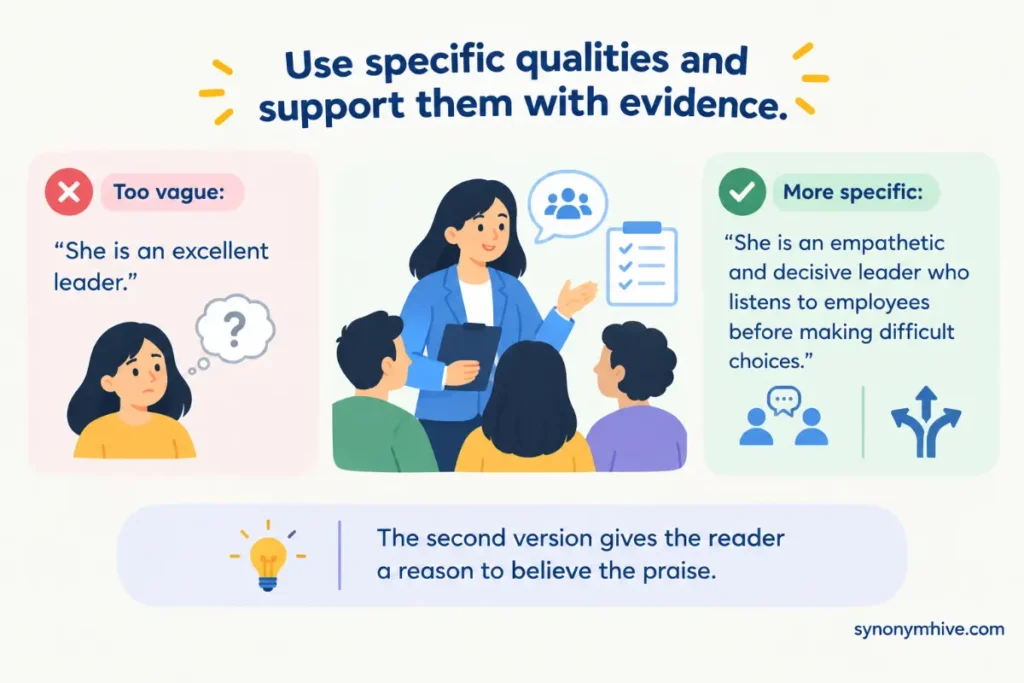
Use one or two precise qualities and support them with evidence.
Instead of saying:
“She is an excellent leader.”
Try:
“She is an empathetic and decisive leader who listens to employees before making difficult choices.”
The second version gives the reader a reason to believe the praise.
You can also use a simple formula:
Leadership quality + action + result.
For example:
“She is a proactive leader who identified a training gap and helped the team improve its onboarding process.”
This structure works especially well for resumes and professional writing.
You may also like Words to Describe Friendship Best Guide.
Conclusion
The best words to describe a good leader are specific enough to show what makes that person effective. Supportive describes a leader who helps others grow. Decisive fits someone who makes clear choices. Strategic points to long term planning, while empathetic highlights an ability to understand other people.
Strong leadership descriptions also depend on context. A resume may call someone accountable and proactive. An essay may describe a leader as courageous or visionary. A casual conversation may simply use words such as fair, honest, helpful, or inspiring.
The key is to match the word to real behavior. Don’t stack several impressive adjectives together without proof. Pick the quality that matters most, explain what the person does, and show the result. That approach makes your description clearer, more believable, and much more useful.
Frequently Asked Questions
What are the best words to describe a good leader?
The strongest choices include supportive, decisive, honest, accountable, inspiring, fair, adaptable, reliable, empathetic, strategic, and trustworthy. Choose words that match the person’s actual behavior.
What is a good word for a leader who inspires others?
Inspiring is the clearest choice, but motivating, influential, uplifting, and visionary can also work. The best word depends on how the leader affects other people.
What’s another way to say a good leader?
You can say an effective leader, strong leader, capable leader, inspiring leader, trusted leader, or respected leader. For a more specific description, name the quality that makes the person effective.
What are good leadership words for a resume?
Strategic, accountable, proactive, collaborative, decisive, adaptable, resourceful, and organized work well on resumes. Connect the word to an action or measurable result whenever possible.
What words describe a leader who cares about people?
Supportive, empathetic, compassionate, respectful, approachable, patient, and empowering are strong choices. Each word highlights a slightly different way of supporting others.
What is the difference between a confident and an arrogant leader?
A confident leader trusts their abilities while respecting other people’s ideas. An arrogant leader may believe they are better than others and refuse to consider different opinions.
What is a powerful word for a great leader?
Visionary can be powerful when a leader creates a clear future direction, while inspiring works well for someone who motivates others. Accountable is strong when the main quality is taking responsibility.