
Writing a resume, answering an interview question, or filling out a dating profile can make a simple task surprisingly hard. You know who you are, but finding the right words to explain your personality, skills, and strengths takes some thought. That is where words to describe yourself can help.
The best description does more than list positive adjectives. It gives people a clear idea of how you work, communicate, solve problems, and treat others. The right word also depends on the setting. Confident may work well in an interview, while thoughtful may sound more natural in a personal introduction.
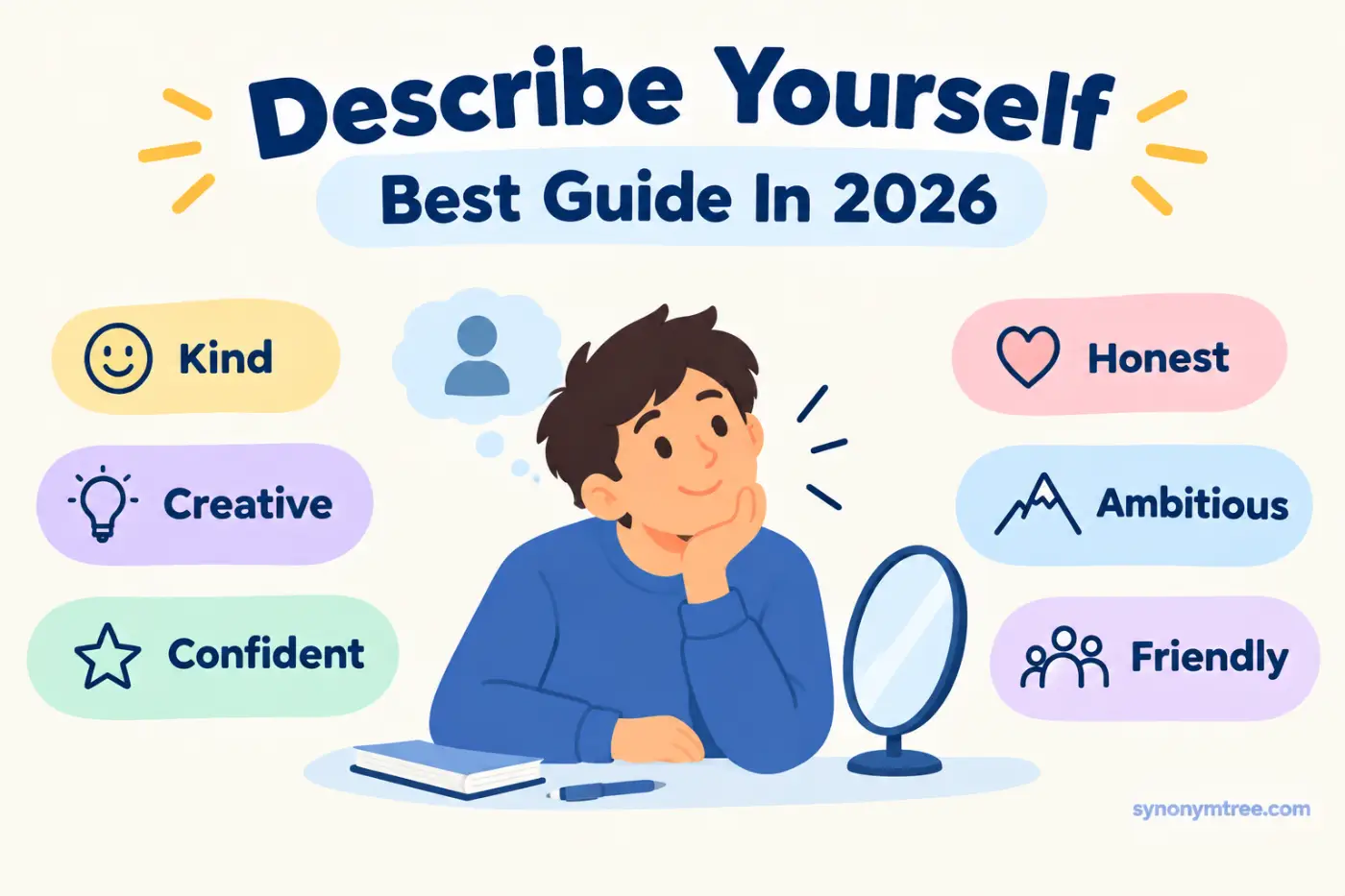
The best words to describe yourself are specific, honest, and connected to your actions. Strong choices include reliable, curious, organized, adaptable, thoughtful, confident, patient, creative, responsible, and hardworking.
This guide explains what these words mean, how strong they sound, and where they work best. You will also find examples for resumes, essays, interviews, emails, texting, and everyday conversations.
Check out more vocabulary ideas in Words to Describe a Mother Best Guide In 2026.
What Are Words To Describe Yourself
Terms to describe yourself are adjectives and descriptive phrases that explain your personality, behavior, skills, values, or work style. They can show how you think, how you work with others, and what qualities you bring to a situation.
For example, someone might describe themselves as reliable because they complete tasks on time. Another person might choose curious because they enjoy learning new things. Someone who stays calm during difficult situations might use patient or composed.
A good description should match real behavior. Saying you are organized is more convincing when you can explain how you plan projects, track deadlines, or keep information easy to find.
The goal is not to choose the most impressive sounding word. The goal is to choose the word that describes you most accurately.
How Do You Choose The Right Words
Start with the situation. A resume needs professional language. An interview needs confident language that you can support with examples. A personal introduction can sound warmer and more relaxed.
Next, think about your strongest habits. Do you finish tasks without reminders? You might be reliable. Do you enjoy learning? Curious could fit. Do you notice small mistakes? Detail oriented may describe you well.
Then ask yourself what you actually do that supports the word. This step matters because descriptive words become stronger when you connect them to real actions.
Instead of saying:
I am hardworking.
You could say:
I am hardworking because I stay focused on difficult projects until I finish them.
The second version gives the reader something concrete to understand.
Master List Of Words To Describe Yourself
The table below groups useful descriptive words by tone and purpose. Some work best in professional settings, while others fit personal conversations.
| Word | Meaning | Tone | Example |
|---|---|---|---|
| Calm | Able to stay relaxed under pressure | Positive | I stay calm during stressful situations. |
| Focused | Able to give attention to a task | Professional | I am focused when working toward a goal. |
| Ambitious | Wants to achieve meaningful goals | Strong | I am ambitious and always set new goals. |
| Practical | Focuses on useful solutions | Professional | I take a practical approach to problems. |
| Supportive | Helps and encourages others | Warm | I am supportive when teammates need help. |
| Flexible | Comfortable with changes | Professional | I am flexible when plans change. |
| Determined | Keeps working toward a goal | Strong | I am determined to finish challenging projects. |
| Dependable | Can be trusted to do what is expected | Professional | I am dependable and consistent. |
| Respectful | Treats people with care and consideration | Positive | I am respectful of different opinions. |
| Motivated | Has a strong desire to act or improve | Professional | I am motivated to learn new skills. |
| Independent | Can work without constant help | Professional | I am comfortable working independently. |
| Cooperative | Works well with others | Professional | I am cooperative during group projects. |
| Observant | Notices details and changes | Professional | I am observant and catch small errors. |
| Sincere | Genuine and honest in communication | Warm | I am sincere when giving feedback. |
| Open minded | Willing to consider new ideas | Positive | I am open minded when hearing different views. |
| Disciplined | Able to follow through consistently | Strong | I am disciplined about meeting my goals. |
| Compassionate | Cares about other people’s needs | Warm | I am compassionate when supporting others. |
| Analytical | Uses careful thinking to understand problems | Professional | I am analytical when reviewing information. |
| Assertive | Expresses ideas clearly and confidently | Strong | I am assertive when communicating my needs. |
Which Words Describe A Positive Personality
Positive personality words usually describe how you treat people and respond to situations.
Kind suggests that you care about other people.
Friendly suggests that you are pleasant and approachable.
Patient shows that you can remain calm.
Thoughtful suggests that you consider how your actions affect others.
Compassionate points to a strong concern for other people’s needs.
Respectful shows that you treat people with consideration.
Supportive means you help others and encourage them.
Honest shows that you value truth and clear communication.
These words work especially well when you can connect them to a short example.
For instance:
I am thoughtful because I try to consider other people’s needs before making decisions.
That sentence sounds stronger than simply saying:
I am thoughtful.
The example gives the reader a reason to believe the description.
Which Words Describe A Strong Work Ethic
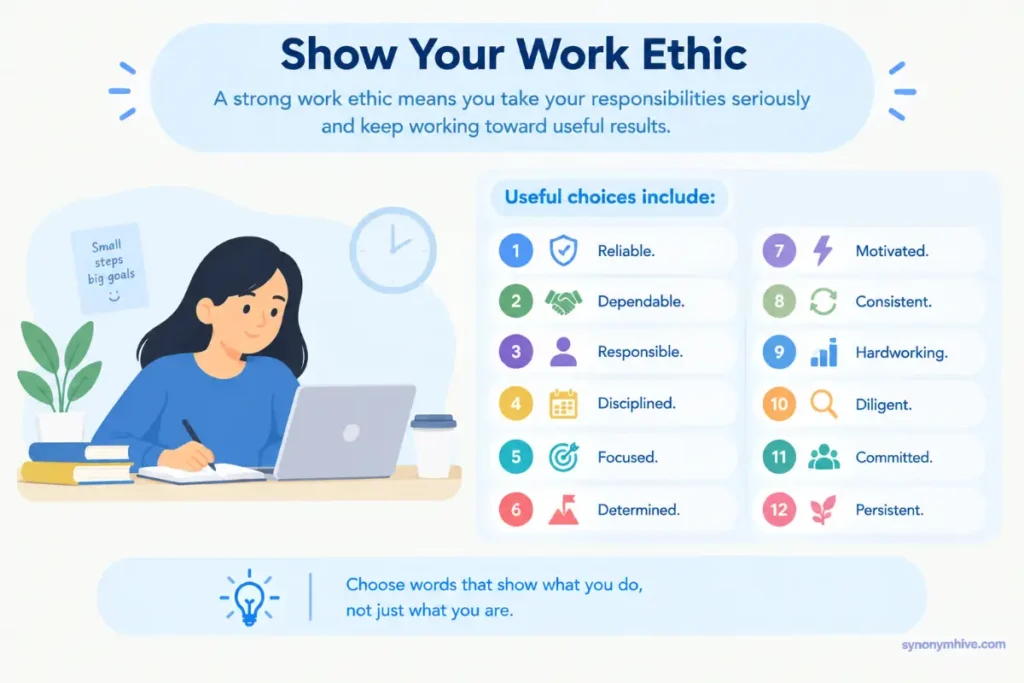
A strong work ethic means you take your responsibilities seriously and keep working toward useful results.
Useful choices include:
- Reliable.
- Dependable.
- Responsible.
- Disciplined.
- Focused.
- Determined.
- Motivated.
- Consistent.
- Hardworking.
- Diligent.
- Committed.
- Persistent.
Reliable is useful when people can count on you.
Disciplined works when you follow routines and stay focused without needing constant reminders.
Determined suggests that you keep going when something becomes difficult.
Diligent has a more formal tone. It suggests careful and steady effort.
Persistent highlights your ability to continue after setbacks.
Choose the word that matches your actual behavior. If you regularly finish difficult tasks, determined may fit better than ambitious. Ambition describes your desire to achieve. Determination describes how you keep moving toward the goal.
Which Words Describe Communication Skills
Communication involves more than speaking clearly. It also includes listening, explaining ideas, asking questions, and responding respectfully.
Useful descriptive words include clear, articulate, thoughtful, patient, respectful, persuasive, attentive, and approachable.
Someone who explains complex ideas in simple language might describe themselves as clear or articulate.
Someone who listens carefully before responding might use attentive.
A person who helps others feel comfortable sharing ideas might use approachable.
For example:
I am an attentive listener who takes time to understand different points of view.
Or:
I am an articulate communicator who can explain complex ideas clearly.
These descriptions work because they connect a personal quality with a useful skill.
Which Words Describe Leadership Skills
Leadership does not always mean managing employees. A person can show leadership by taking responsibility, helping others, making decisions, and keeping a group focused.
Strong choices include confident, responsible, decisive, supportive, organized, motivated, fair, calm, and accountable.
Decisive means you can make choices without unnecessary delay.
Accountable means you take responsibility for your actions and results.
Fair suggests that you treat people and situations with balance.
Supportive shows that you help other people succeed.
For example:
I am a supportive leader who helps teammates solve problems and stay focused.
Another option is:
I am a calm and decisive person who makes clear choices under pressure.
These statements tell the reader more than a simple claim that you are a good leader.
Which Words Describe Intelligence And Thinking
If you want to describe how you think, choose a word that explains your actual thinking style.
Analytical works for someone who studies information carefully.
Logical describes someone who uses clear reasoning.
Curious works for someone who asks questions and wants to learn.
Observant fits someone who notices details.
Creative describes someone who develops new ideas.
Resourceful suggests that you can find solutions when the obvious option does not work.
Thoughtful can describe someone who considers a problem carefully before acting.
For example:
I am analytical and enjoy finding patterns in complex information.
Or:
I am curious and often look for better ways to solve everyday problems.
The strongest choice depends on what you actually do.
Which Words Describe Confidence
Confidence can be difficult to describe because the wrong word can sound arrogant.
Confident is the clearest choice. It means you trust your abilities without necessarily suggesting that you think you are better than everyone else.
Assertive means you express your needs, ideas, or opinions clearly.
Self assured means you have a strong sense of confidence in yourself.
Composed suggests that you stay calm and controlled.
Decisive describes confidence in making choices.
Be careful with words such as superior, unbeatable, perfect, or brilliant. They can make a self description sound exaggerated.
Instead of:
I am the best person on every team.
Try:
I am confident in my ability to contribute ideas and take responsibility for my work.
The second statement sounds strong without making an extreme claim.
Which Words Describe Creativity
Creative people can generate ideas, approach problems from new angles, and experiment with different solutions.
Good choices include:
Creative means you produce original or useful ideas.
Innovative suggests that you introduce new approaches or solutions.
Imaginative highlights the ability to think beyond ordinary ideas.
Inventive suggests that you can create clever solutions.
Resourceful focuses on finding practical ways to solve problems.
For example:
I am creative and enjoy finding simple solutions to difficult problems.
Or:
I am imaginative when developing ideas for new projects.
Creative does not always mean artistic. A person can show creativity in writing, business, science, technology, teaching, cooking, or problem solving.
Which Words Describe Adaptability
Adaptability matters when plans, teams, tools, or expectations change.
Useful choices include adaptable, flexible, open minded, versatile, resilient, and resourceful.
Adaptable means you can adjust to new conditions.
Flexible means you can change your approach when needed.
Open minded means you are willing to consider different ideas.
Versatile suggests that you can handle different types of work or roles.
Resilient focuses more on recovering from setbacks.
For example:
I am adaptable and can adjust quickly when project priorities change.
That statement works well in professional settings because it describes a useful behavior rather than making a vague claim.
Which Words Describe Yourself On A Resume
A resume should use professional words that you can support with evidence.
Some of the strongest options include:
Reliable for consistency and trust.
Organized for planning and task management.
Adaptable for handling change.
Analytical for careful problem solving.
Resourceful for finding solutions.
Collaborative for working with others.
Detail oriented for careful work.
Motivated for strong drive.
Dependable for consistent performance.
Results focused for attention to outcomes.
Instead of writing:
I am hardworking and good at everything.
Write:
I am a reliable and organized professional who manages deadlines carefully and follows projects through to completion.
The second version gives the reader useful information.
What Is A Good Resume Example
Suppose you are applying for an office position.
You could write:
I am organized, dependable, and detail oriented, with a strong focus on accurate work and timely results.
For a customer service role, you might write:
I am patient, approachable, and attentive, with a strong ability to understand customer needs and solve problems clearly.
For a creative role:
I am curious, imaginative, and resourceful, with a strong interest in developing practical ideas.
Each version uses traits that connect to the job.
Which Words Describe Yourself In An Interview
Interviews often include a question such as:
Tell me about yourself.
Another common question is:
What are your greatest strengths?
The best response usually includes two or three traits plus evidence.
For example:
I would describe myself as organized, adaptable, and dependable. I like planning my work early, but I can also adjust quickly when priorities change. In my previous role, I regularly handled several deadlines at the same time without missing important details.
This approach works better than listing ten adjectives.
Choose traits that relate to the position. Then explain how your behavior supports each one.
What Is A Good Interview Example
Imagine an interviewer asks you to describe your personality.
You could say:
I am curious, responsible, and calm under pressure. I like learning new things, I take ownership of my work, and I try to stay focused when unexpected problems appear.
That answer sounds natural because each adjective connects to a behavior.
Which Words Describe Yourself In An Essay
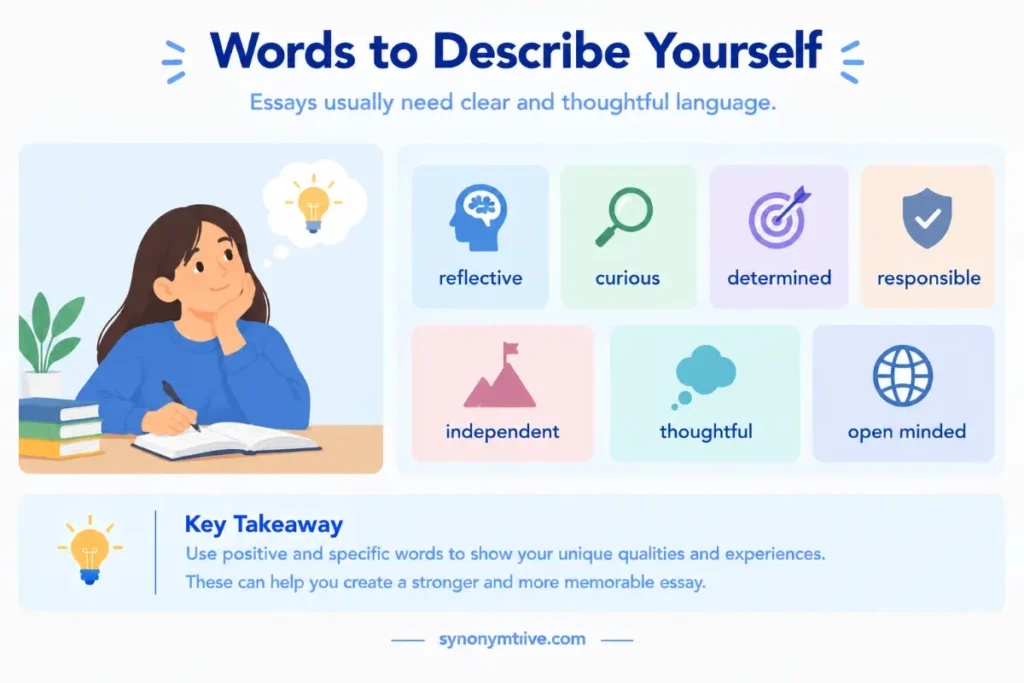
Essays usually need clear and thoughtful language.
Words such as reflective, curious, determined, responsible, independent, thoughtful, and open minded can work well.
For a personal essay, you might write:
I am a curious person who enjoys learning from people with different experiences.
For a school essay:
I consider myself a responsible student who takes deadlines seriously.
For a college application:
I am an independent learner who enjoys exploring questions beyond the classroom.
The tone should match the assignment. Personal writing can sound warm. Academic writing should stay clear and controlled.
Which Words Describe Yourself In A Text
Texting gives you more freedom.
You can use casual words such as chill, easygoing, friendly, funny, curious, quiet, outgoing, or laid back.
For example:
I’m pretty easygoing and I get along with most people.
Or:
I’m quiet at first, but I open up once I know someone.
Another natural option is:
I’d say I’m curious, friendly, and pretty laid back.
These descriptions sound more natural than formal words such as conscientious or diligent in a casual text.
Which Words Describe Yourself In An Email
The right word depends on who will receive the email.
A professional email might use reliable, organized, responsive, responsible, or flexible.
A casual email can use friendly, helpful, easygoing, or thoughtful.
For example:
I would describe myself as organized and responsive, so I make a point of keeping tasks and deadlines clear.
For a personal email:
I’d describe myself as pretty easygoing, but I like to stay organized when plans involve other people.
The same person can use different words in different situations without being dishonest.
Which Words Describe Yourself When Speaking
Spoken introductions usually sound better when they use simple words.
You can say:
I’m quiet at first, but I become more talkative once I know people.
I’m patient and usually stay calm when things get stressful.
These sentences sound natural because they use everyday language.
Avoid stuffing several impressive adjectives into one sentence. A long list can sound rehearsed.
You may also like Words to Describe Friendship Best Guide.
What Are The Best Words For A Positive Self Description
Here are some useful choices by quality.
| Quality | Strong Words |
|---|---|
| Trust | Reliable, dependable, honest, loyal |
| Work ethic | Diligent, disciplined, committed, persistent |
| Thinking | Analytical, logical, curious, observant |
| Creativity | Creative, imaginative, inventive, innovative |
| Social skills | Friendly, approachable, respectful, supportive |
| Leadership | Confident, decisive, responsible, accountable |
| Flexibility | Adaptable, flexible, versatile, open minded |
| Emotional strength | Calm, patient, resilient, composed |
| Motivation | Ambitious, motivated, determined, driven |
| Teamwork | Cooperative, collaborative, supportive, considerate |
This list can help you narrow down your choices before writing a sentence.
What Is The Difference Between Confident And Arrogant
Confident and arrogant can sound similar, but they carry very different meanings.
| Confident | Arrogant |
|---|---|
| Trusts their abilities | Thinks they are better than others |
| Can accept feedback | May reject criticism |
| Speaks clearly | May dominate conversations |
| Shows self belief | Shows excessive pride |
| Sounds positive in most settings | Often sounds negative |
You can describe yourself as confident because it is generally a positive trait.
Calling yourself arrogant would usually suggest a flaw.
For example:
I am confident when presenting my ideas.
sounds positive.
I am arrogant because I know I’m better than everyone else.
sounds negative and is unlikely to help you in a professional setting.
What Is The Difference Between Ambitious And Determined
Ambitious and determined both suggest strong motivation, but they focus on different things.
Ambitious describes what you want to achieve.
Determined describes how strongly you keep working toward it.
Someone can be ambitious because they want to become a manager.
They can be determined because they keep improving their skills and applying for new opportunities.
For example:
I am ambitious and want to grow into a leadership role.
I am determined and continue working even when a project becomes difficult.
The two words can work together:
I am ambitious about my career and determined to keep improving my skills.
What Is The Difference Between Reliable And Responsible
Reliable means people can count on you.
Responsible means you take ownership of your duties and choices.
A reliable employee arrives on time and completes tasks as promised.
A responsible employee accepts ownership of an assignment and makes sure it gets done correctly.
The ideas overlap, but the focus differs.
For example:
I am reliable and consistently meet deadlines.
I am responsible for checking that all project details are complete.
Both can be strong choices for a resume.
What Is The Difference Between Organized And Detail Oriented
Organized describes how you manage information, tasks, time, or plans.
Detail oriented describes how carefully you notice small parts of a task.
A person can be organized without being highly detail oriented.
For example, you may create a perfect project schedule but miss a small spelling mistake.
Another person may catch every tiny error but struggle to keep deadlines organized.
If you manage schedules and priorities, organized may be the better word.
If you carefully check numbers, names, documents, or technical details, detail oriented may fit better.
What Is The Difference Between Creative And Innovative
Creative usually means producing new ideas.
Innovative often suggests using new ideas to create a useful change or solution.
For example:
I am creative when developing new content ideas.
I am innovative when finding new ways to improve a process.
A person can be both.
Creative thinking can produce the idea. Innovation can turn that idea into something useful.
What Is The Difference Between Friendly And Approachable
Friendly means pleasant and kind toward other people.
Approachable means people feel comfortable starting a conversation with you or asking you for help.
Someone may be friendly but quiet.
An approachable person often gives others signals that they are open to conversation.
For example:
I am friendly and enjoy meeting new people.
I am approachable, so teammates often feel comfortable asking me questions.
Both are useful, but approachable can sound more professional in some work settings.
What Are Common Mistakes When Describing Yourself
One common mistake is choosing words that sound impressive but don’t match your behavior.
Calling yourself exceptional, brilliant, or perfect can make a reader question your judgment.
Another mistake is using too many positive adjectives.
For example:
I am amazing, hardworking, talented, intelligent, creative, organized, confident, ambitious, friendly, reliable, and perfect.
That sentence gives the reader very little useful information.
A better approach is to choose two or three traits and support them with examples.
Another problem is repeating the same idea.
Reliable, dependable, trustworthy, and consistent overlap heavily. You usually don’t need all four.
It is also easy to confuse a skill with a personality trait. Coding is a skill. Patient is a personality quality. Communication can be both a skill and a personal strength.
Choose the category that best matches what you want to explain.
When Should You Avoid Certain Descriptive Words
Avoid words that make claims you cannot support.
For example, calling yourself an expert may be too strong if you have limited experience.
Similarly, perfect is almost never useful in a professional self description.
Words such as aggressive can also create problems unless you are discussing a specific style where that trait has a positive meaning.
Instead, choose precise alternatives.
Aggressive communication can become assertive communication.
Stubborn can become persistent if the situation supports that meaning.
Quiet can become thoughtful or observant if those qualities accurately describe you.
The goal is not to hide weaknesses. It is to choose accurate language that presents your qualities clearly.
What Are The Opposites Of Positive Personality Words
Opposites depend on the quality you are describing.
| Positive Word | Possible Opposite |
|---|---|
| Reliable | Unreliable |
| Organized | Disorganized |
| Patient | Impatient |
| Confident | Insecure |
| Flexible | Rigid |
| Friendly | Unfriendly |
| Focused | Distracted |
| Honest | Dishonest |
| Responsible | Irresponsible |
| Calm | Anxious |
| Open minded | Closed minded |
| Cooperative | Uncooperative |
| Motivated | Unmotivated |
| Decisive | Indecisive |
| Careful | Careless |
These opposites can help you understand the exact meaning of a word.
For example, if you are unsure about adaptable, think about its opposite. Someone who is adaptable can adjust. Someone who is rigid struggles to change their approach.
How Can You Make A Self Description Sound Natural
Use specific words instead of broad praise.
Instead of:
I am a great person.
Try:
I am patient, dependable, and easy to work with.
Then add evidence when needed:
I am dependable because I keep track of deadlines and finish tasks on time.
You can also combine a trait with a situation.
For example:
I stay calm when plans change, so I can adjust without losing focus.
That sentence sounds more natural because it shows the quality instead of simply announcing it.
Another useful technique is to avoid trying to sound perfect. Real people have different strengths in different situations.
You might say:
I’m usually quiet when I first meet people, but I’m friendly and open once I get comfortable.
That sounds honest and human.
What Are Some Natural Example Sentences
Here are practical examples you can adapt.
- I am reliable and take my commitments seriously.
- I am curious and enjoy learning from new experiences.
- I am organized and like keeping my work easy to manage.
- I am patient when helping people understand difficult ideas.
- I am creative and enjoy finding simple solutions.
- I am confident when I know I have prepared well.
- I am adaptable when plans or priorities change.
- I am thoughtful and consider other people’s needs.
- I am responsible and take ownership of my work.
- I am determined when I set an important goal.
- I am friendly and enjoy making people feel comfortable.
- I am observant and usually notice small details.
- I am analytical and like understanding how things work.
- I am resourceful when I need to solve a problem with limited tools.
- I am open minded and willing to consider different ideas.
- I am calm during stressful situations.
- I am disciplined about reaching long term goals.
- I am supportive when friends or coworkers need help.
- I am independent and comfortable completing tasks on my own.
- I am cooperative and enjoy working toward shared goals.
- I am ambitious but realistic about the steps needed to reach my goals.
- I am resilient and learn from setbacks.
- I am respectful of people with different opinions.
- I am flexible when unexpected changes affect a plan.
- I am sincere when I give feedback or share my opinion.
These sentences can work as starting points. Change them so they reflect your actual personality and experience.
How Should You Describe Yourself In Three Words
When someone asks you to describe yourself in three words, choose words that work together.
For a professional interview:
Reliable, adaptable, organized.
For a creative role:
Curious, creative, resourceful.
For customer service:
Patient, friendly, attentive.
For leadership:
Confident, responsible, decisive.
For a school setting:
Curious, disciplined, thoughtful.
Don’t simply choose three words because they sound impressive. Pick three that you can explain with real examples.
An interviewer may immediately ask:
Why did you choose those words?
You should have a short story ready for each one.
How Can You Turn Three Words Into A Strong Answer
Suppose your three words are reliable, curious, and adaptable.
A weak answer would be:
I’m reliable, curious, and adaptable.
A stronger answer would be:
I’d describe myself as reliable, curious, and adaptable. I take deadlines seriously, I enjoy learning new things, and I can adjust when plans change.
An even stronger answer adds proof:
I’d describe myself as reliable, curious, and adaptable. I take deadlines seriously, enjoy learning new skills, and adjust quickly when priorities change. In my last project, I had to learn a new tool while handling a tight deadline, so I created a simple plan and finished the work on time.
The final version gives the reader something real to remember.
How Can You Pick Words That Sound Like You
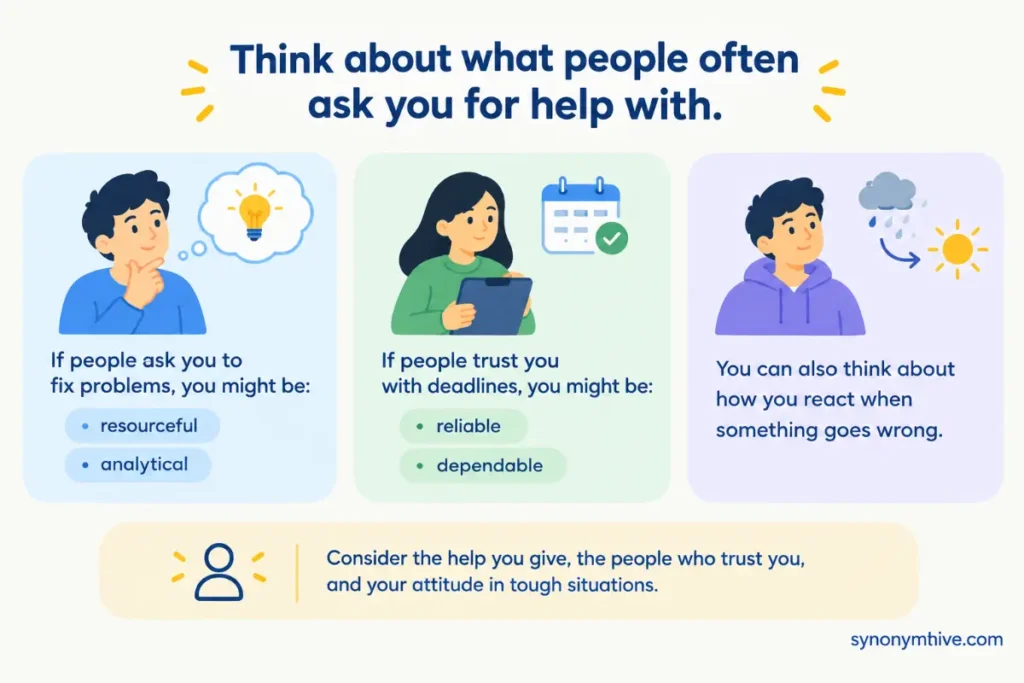
Think about what people often ask you for help with.
If people ask you to fix problems, resourceful or analytical may describe you.
If people trust you with deadlines, reliable or dependable may work.
You can also think about how you react when something goes wrong.
Do you ask questions?
Do you take responsibility?
Your answers can reveal better descriptive words than a random list of adjectives.
Quick Tips For Choosing The Best Words
- Choose words that describe real behavior.
- Match your language to the audience.
- Use professional terms on resumes.
- Use simple language when speaking.
- Give examples when making strong claims.
- Pick two or three strong qualities instead of a long list.
- Avoid exaggerated words such as perfect or unbeatable.
- Don’t use a word just because it sounds impressive.
- Check the difference between similar words.
- Think about your strongest habits.
- Connect personality traits to useful skills.
- Use positive language without hiding important weaknesses.
- Keep casual descriptions natural.
- Avoid forcing slang into professional writing.
- Choose words that you can explain if someone asks for proof.
Need another vocabulary suggestion? Read words to describe love Best Guide in 2026.
Conclusion
The strongest words to describe yourself are not always the most impressive sounding ones. They are the words that accurately explain how you think, work, communicate, and treat other people. Reliable can show that people can count on you. Curious can show that you enjoy learning. Adaptable can show that you handle change well. Thoughtful can show that you consider other people’s needs.
Context matters just as much. A resume may need organized and dependable, while a casual introduction may sound better with friendly and easygoing. Interviews often work best when you combine a strong adjective with a real example.
Start by choosing two or three qualities that genuinely match you. Then connect each one to something you have done. That simple approach makes a self description clearer, more believable, and much more useful.
Frequently Asked Questions
What are the best words to describe yourself?
The best words depend on the situation, but reliable, organized, curious, adaptable, thoughtful, confident, patient, creative, responsible, and motivated are useful choices. Pick words that match your real behavior.
What’s another way to describe yourself positively?
You can describe yourself with words such as dependable, thoughtful, resourceful, open minded, calm, ambitious, supportive, or resilient. Choose a word that explains a real quality rather than simply sounding impressive.
What are good terms to describe yourself on a resume?
Reliable, organized, adaptable, analytical, resourceful, motivated, collaborative, and detail oriented work well on many resumes. Support each word with experience or results when possible.
What are three good words to describe yourself in an interview?
Reliable, adaptable, and organized are strong choices for many professional interviews. You can also choose words that match the job, such as creative for a design role or patient for a customer service role.
How do I describe myself in three words?
Choose three qualities that accurately describe your behavior and fit the situation. Then prepare a short example that proves each quality.
What are good words to describe personality?
Friendly, patient, thoughtful, confident, calm, honest, curious, supportive, and easygoing can describe positive personality traits. The best choice depends on the specific quality you want to show.
What words describe a hardworking person?
Diligent, disciplined, determined, persistent, committed, motivated, and dependable can describe someone with a strong work ethic. Each word highlights a slightly different part of hard work.