

You’re writing a resume and want to show that you understand people. You type another term for empathetic into a search box because empathetic feels useful but also a little overused. The right replacement can make your resume sound more specific and credible.
Another word for empathetic is compassionate. Other strong choices include understanding, considerate, perceptive, supportive, and emotionally intelligent. The best choice depends on the situation and the quality you want to highlight.
Choosing the right term matters because empathy can describe several skills. You might understand a customer’s frustration. You might support a coworker during a difficult project. Each situation calls for a slightly different word.
This guide explains the meaning and origin of empathetic words and gives you more than 20 useful alternatives. You’ll also see the best choices for resumes, essays, emails, texting, and everyday speech. The examples focus on natural American English so you can choose a word that sounds like something a real person would say.
Learn more useful word alternatives in Another Word for Responsible for: Best Resume Choices (2026).
What Does Another Word for Empathetic Mean
An empathetic person can understand and respond to another person’s feelings. The idea goes beyond simply being nice. It involves noticing what someone may be experiencing and responding with care.
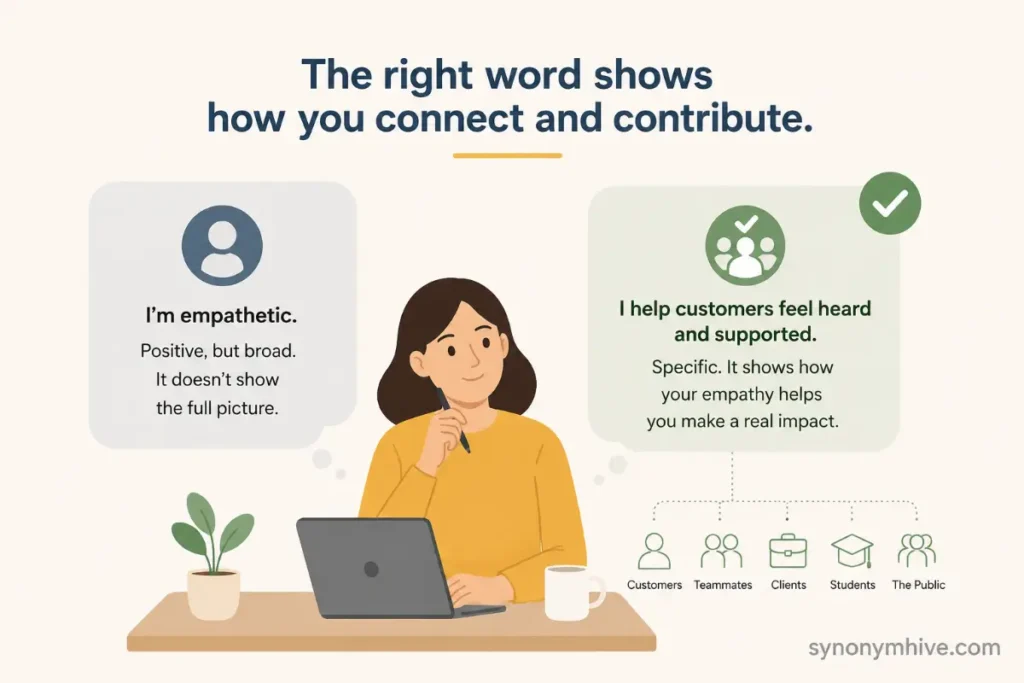
For a resume, that distinction matters. Saying you’re empathetic tells an employer something positive but broad. A more specific word can show how your empathy helps you work with customers, teammates, clients, students, or the public.
For example, compassionate suggests genuine concern for someone’s situation. Understanding highlights patience and acceptance. Perceptive suggests that you notice feelings or needs that others might miss. Supportive focuses on the way you help people.
The strongest resume choice is usually the word that connects to an action.
Instead of simply writing that you’re empathetic, you can explain that you listened to customer concerns, helped resolve team conflicts, supported new employees, or adjusted your communication style to meet different needs.
That approach gives the reader evidence instead of a label.
Where Does Empathetic Come From
Empathetic comes from empathy. The word empathy has roots in the Greek word empatheia, which referred to feeling into something or experiencing a strong feeling.
The modern idea of empathy developed through psychology and philosophy. It describes the ability to understand another person’s feelings and perspective.
Empathetic became a common English adjective for describing someone who shows empathy. Empathic is also correct and has the same basic meaning.
The two forms have been used for many years. Empathetic is especially common in everyday American English and professional writing.
What Is the Plain English Meaning
In plain English, empathetic means able to understand how another person feels and respond with care.
That can look different in real life. A manager may listen to an employee who is struggling. A nurse may recognize a patient’s fear. A customer service representative may understand why a customer is upset. A teacher may notice when a student needs more support.
Empathy doesn’t mean agreeing with everyone. It means making an effort to understand another person’s experience.
That point is important on a resume. Employers usually care less about the label itself and more about how the skill appears in your work.
Synonyms for Empathetic You Can Use on a Resume
Your resume should use precise language. The best synonym depends on what you actually did.
If you helped customers feel heard, considerate or understanding may work well. If you helped people during difficult situations, compassionate or supportive may be stronger.
Here is a broad synonym guide you can use when choosing your wording.
| Word | Meaning | Tone | Example |
|---|---|---|---|
| Compassionate | Shows care for people who are struggling | Warm | Provided compassionate support to clients during difficult situations. |
| Understanding | Shows patience and acceptance | Friendly | Took an understanding approach when addressing customer concerns. |
| Considerate | Thinks about other people’s needs | Polite | Used a considerate communication style with customers and coworkers. |
| Supportive | Helps people feel encouraged or assisted | Positive | Created a supportive environment for new team members. |
| Caring | Shows genuine concern for others | Warm | Built caring relationships with clients and families. |
| Sensitive | Aware of people’s feelings and needs | Gentle | Used sensitive communication when discussing personal concerns. |
| Perceptive | Quickly notices feelings or needs | Professional | Used perceptive listening skills to identify customer needs. |
| Thoughtful | Carefully considers other people | Friendly | Took a thoughtful approach to resolving workplace concerns. |
| Attentive | Pays close attention to people | Professional | Remained attentive to customer questions and concerns. |
| Patient | Remains calm while helping others | Practical | Used patient communication when assisting frustrated customers. |
| Respectful | Treats people with dignity | Professional | Maintained respectful communication during difficult conversations. |
| Sensitive minded | Aware of emotional needs | Gentle | Demonstrated sensitive minded communication with families. |
| Kind | Shows goodness and consideration | Casual | Used kind communication when helping customers. |
| Warm | Friendly and emotionally welcoming | Friendly | Built warm relationships with clients and colleagues. |
| Gentle | Careful and calm in difficult situations | Soft | Used a gentle approach when discussing sensitive issues. |
| Accommodating | Willing to adjust to someone’s needs | Professional | Took an accommodating approach with clients who needed extra assistance. |
| Responsive | Acts appropriately after noticing a need | Professional | Provided responsive service based on customer feedback. |
Which Words Are Simplest
If you want clear everyday language, choose understanding, caring, kind, patient, supportive, or considerate.
These words are easy to understand and rarely sound forced. They also work well in emails and conversations.
For example, you could say that you’re understanding when helping customers through difficult situations. You could describe a coworker as supportive because they help others succeed.
Simple words often make stronger resumes because the reader doesn’t have to decode them.
Which Words Sound More Professional
For a resume, consider perceptive, attentive, responsive, tactful, diplomatic, accommodating, or emotionally intelligent.
These words can show a more specific workplace skill.
For example, perceptive suggests that you notice details. Responsive suggests that you act on what you notice. Tactful suggests that you can handle sensitive conversations without making them worse.
The best professional word still needs evidence. A strong adjective can’t rescue a vague resume bullet.
Which Words Work in Casual Speech
For texts and everyday conversation, caring, kind, understanding, supportive, patient, and thoughtful usually sound natural.
You might tell a friend that someone is really understanding. You might describe a family member as caring.
These words feel more personal than formal workplace terms.
Another Word for Empathetic By Intensity
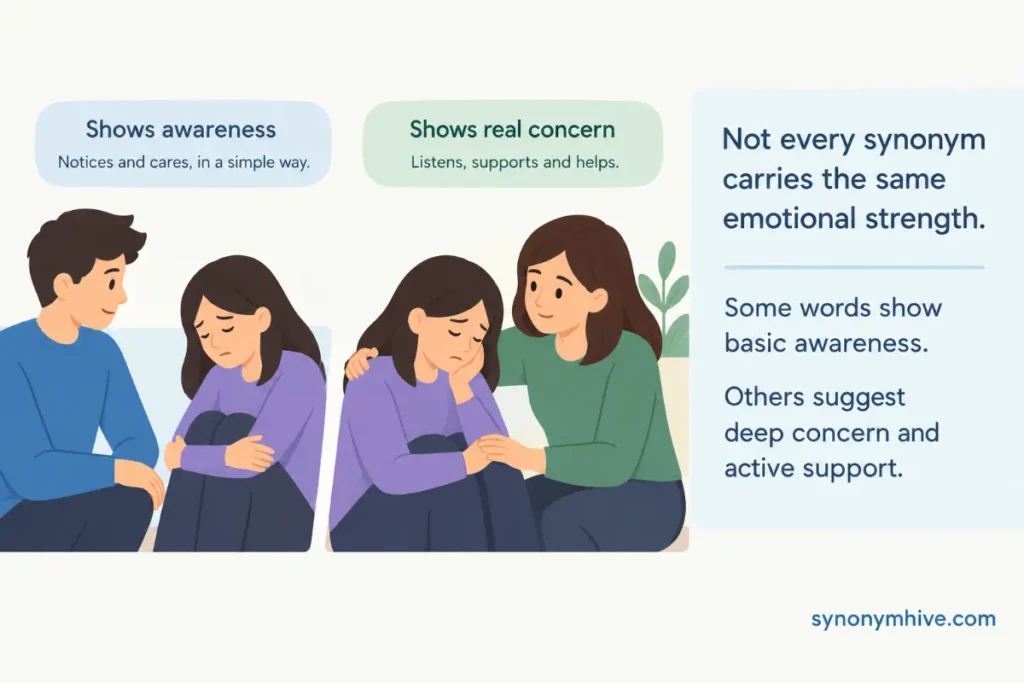
Not every synonym carries the same emotional strength. Some words show basic awareness. Others suggest deep concern and active support.
Mild Words for Empathy
Understanding, attentive, receptive, respectful, and considerate are relatively mild choices.
They show awareness without making a strong emotional claim.
Considerate is especially useful when you want to describe behavior. Someone who considers another person’s needs is being considerate.
Attentive focuses more on listening and noticing.
Respectful focuses on dignity and treatment.
Moderate Words for Empathy
Supportive, thoughtful, sensitive, perceptive, patient, and responsive carry more meaning.
These terms suggest that a person doesn’t just notice another person’s needs. They respond in a helpful way.
Supportive is useful for teamwork. Perceptive works well when observation matters. Responsive is strong for customer service because it suggests action.
Strong Words for Empathy
Compassionate, emotionally intelligent, diplomatic, and humane can communicate a deeper level of understanding.
Compassionate often carries the strongest emotional warmth. It suggests concern and a desire to help.
Emotionally intelligent is broader. It can include self awareness, emotional control, social awareness, and relationship skills.
Diplomatic is more specific to difficult conversations. It suggests that you can understand different perspectives while keeping communication productive.
The strongest word isn’t always the best word. Match the intensity to the situation.
Another Term for Empathetic By Part of Speech
Most alternatives for empathetic are adjectives. They describe a person, approach, attitude, or behavior.
Empathy is the noun. It names the ability or quality itself.
Empathetic and empathic are adjectives. Both describe someone who shows or has empathy.
Compassionate, considerate, supportive, thoughtful, sensitive, perceptive, and patient are also adjectives.
You can also use related nouns in professional writing. Examples include compassion, understanding, patience, awareness, emotional intelligence, sensitivity, and consideration.
Verbs can make your resume even stronger because they show action.
Instead of saying you were empathetic, you could say you listened, supported, reassured, recognized, understood, guided, encouraged, or assisted people.
Action verbs often give your resume more energy.
Is There a US and UK Difference
American and British English use empathetic, empathic, compassionate, understanding, considerate, and supportive in similar ways.
The bigger difference usually comes from style rather than meaning. American professional writing often favors direct and practical wording. British writing can sometimes use slightly more formal phrasing depending on the setting.
Empathetic is widely understood in both varieties of English.
Empathic is also correct in both. However, empathetic may feel more familiar to many American readers.
For a US resume, you don’t need to change the word simply because you are concerned about regional meaning. Focus on clarity and context instead.
What Is Another Phrase for Empathetic on a Resume
For a resume, compassionate, supportive, understanding, considerate, perceptive, and emotionally intelligent are among the most useful choices.
The right word depends on the job.
For education, patient, supportive, attentive, and understanding are often natural choices.
For human resources, perceptive, respectful, diplomatic, considerate, and emotionally intelligent can communicate strong people skills.
The strongest resume language combines the word with an action and a result.
For example, instead of writing:
Empathetic customer service representative.
You could write:
Provided patient and understanding support to customers while resolving complex service concerns.
That sentence tells the employer what you did. It also shows how your people skills affected your work.
What Is Another Expression for Empathetic in an Essay
Compassionate, understanding, perceptive, sensitive, and considerate often work well in essays.
Academic writing needs more precision than casual conversation. Think about the exact idea you want to communicate.
If you’re describing a character who understands another person’s pain, compassionate may fit.
If the character notices subtle emotional signals, perceptive could be the strongest option.
Example:
The counselor takes a compassionate approach to the family’s situation.
Another example is:
The narrator offers a perceptive view of the character’s emotional struggle.
The goal is not to replace every use of empathetic. The goal is to choose the word that carries the exact idea.
What Is Another Term for Empathetic in an Email
For professional emails, understanding, considerate, thoughtful, supportive, and respectful usually sound natural.
Email language needs balance. You want to sound warm without becoming overly emotional.
For example:
Thank you for being so understanding about the scheduling change.
Or:
I appreciate your thoughtful response to the concern.
Or:
We’ll take a considerate approach and make sure everyone has the information they need.
These choices sound more natural than forcing an advanced synonym into every sentence.
What Is Another Expression for Empathetic in Texting
In texts, caring, understanding, supportive, kind, thoughtful, and sensitive usually sound best.
Text messages are personal and informal. A phrase like emotionally intelligent can sound too formal unless you’re talking about the concept itself.
You might text:
You’ve always been really understanding about this.
Or:
She’s such a caring person.
Or:
Thanks for being so supportive.
Natural language wins in texting. Use the word you would actually say out loud.
What Is Another Word for Empathetic When Speaking
In everyday speech, understanding, caring, compassionate, thoughtful, supportive, and kind are strong choices.
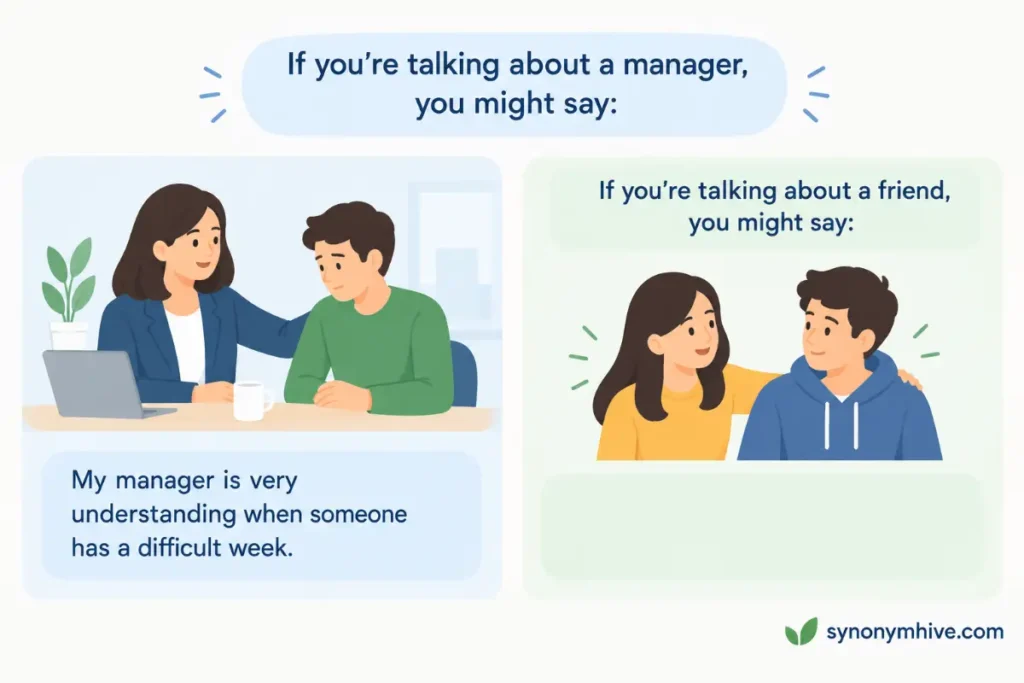
If you’re talking about a manager, you might say:
My manager is very understanding when someone has a difficult week.
If you’re talking about a friend, you might say:
She’s incredibly caring and always notices when someone needs help.
If you’re describing a professional, you might say:
He has a compassionate approach to working with patients.
The best spoken word usually feels effortless. If it sounds like something from a dictionary instead of something you’d say naturally, choose a simpler option.
Learn more useful word alternatives in another word for efficient Resume Words 2026.
What Are Some Real Examples of Empathetic Synonyms
The meaning becomes clearer when you see these words in real situations.
- The customer service agent took a patient approach with an upset customer.
- The manager used thoughtful communication when discussing the employee’s concerns.
- The nurse provided compassionate care during a stressful appointment.
- The teacher created a supportive classroom where students felt comfortable asking questions.
- The supervisor was understanding when an employee needed extra time to complete the task.
- The counselor used sensitive language when discussing a difficult family situation.
- The team leader showed diplomatic judgment during a disagreement between coworkers.
- The sales representative was attentive to the customer’s concerns and responded quickly.
- The mentor offered reassuring advice to a new employee who lacked confidence.
- The HR manager used tactful communication when handling a workplace dispute.
- The receptionist remained calm and considerate when helping frustrated visitors.
- The social worker took a compassionate approach when supporting families in crisis.
- The project manager was perceptive enough to notice tension within the team.
- The teacher remained patient while helping students understand a difficult lesson.
- The supervisor created a respectful environment where employees felt heard.
- The customer support team provided responsive service after receiving negative feedback.
- The manager showed emotional intelligence by listening to both sides before making a decision.
- The volunteer offered caring support to people who needed practical assistance.
These examples show why a direct synonym isn’t always enough. Each word points the reader toward a different part of empathy.
Compassionate vs Understanding What Is the Difference
Compassionate suggests concern for another person’s suffering and often implies a desire to help. Understanding focuses more on recognizing and accepting another person’s feelings or situation.
Imagine an employee tells a manager that they are struggling.
An understanding manager listens without judgment and recognizes the employee’s situation.
A compassionate manager may do that and then look for a practical way to help.
Use understanding when acceptance and patience matter most. Use compassionate when care and support are central to the situation.
For a healthcare resume, compassionate can be powerful because care is often part of the job itself.
For customer service, understanding may sound more natural because the role often involves listening and responding to customer concerns.
Perceptive vs Empathetic What Is the Difference
Perceptive and empathetic describe different abilities.
An empathetic person understands another person’s feelings. A perceptive person notices important details or signals that others might overlook.
For example, a perceptive manager might notice that an employee has become unusually quiet during meetings.
An empathetic manager may understand that the employee could be dealing with stress and respond with care.
A person can be both perceptive and empathetic.
This distinction makes perceptive a useful resume word when your strength involves observation. It can be especially valuable in management, sales, customer service, counseling, education, and communication roles.
Supportive vs Caring What Is the Difference
Supportive and caring are close but have different emphasis.
Caring focuses on concern and warmth. Supportive focuses on helping someone.
A caring coworker may check in when you seem upset.
A supportive coworker may help you finish a difficult task or give you advice.
On a resume, supportive often works better because it can connect directly to workplace behavior.
For example:
Supported new employees during their first three months of training.
That sentence gives the reader something concrete.
When Should You Avoid Empathetic Words
Empathetic language can become weak when you use it without evidence.
Don’t describe yourself as compassionate simply because you want to sound kind. Connect the quality to something you actually did.
Avoid stacking several similar adjectives together.
A sentence such as this can feel inflated:
I’m compassionate, caring, understanding, supportive, thoughtful, considerate, and empathetic.
The reader learns almost nothing from it.
Instead, choose one strong quality and prove it through an example.
You should also avoid using emotionally focused words for roles where a more specific skill would communicate more value.
For example, if you helped reduce customer complaints, say that you improved customer satisfaction or resolved service issues. The result carries more weight than an adjective.
Don’t use a synonym simply because it sounds more advanced. Clear writing beats fancy writing.
What Are Common Mistakes With Empathetic Synonyms
One common mistake is confusing empathy with sympathy.
Empathy involves understanding another person’s feelings or perspective.
Sympathy usually means feeling concern for someone who is experiencing difficulty.
Another mistake is treating empathy as agreement. You can understand someone’s point of view without agreeing with their decision.
A third mistake is using sensitive in the wrong way. Sensitive can describe emotional awareness, but it can also describe someone who is easily affected or offended. Context matters.
A fourth mistake is using emotionally intelligent as a synonym for simply being nice. Emotional intelligence is broader and can include self awareness, emotional control, social awareness, and relationship management.
A fifth mistake is using compassionate in a situation that only requires basic courtesy. Compassion can carry stronger emotional weight than considerate.
Precision makes your writing more believable.
What Are the Antonyms of Empathetic
The main opposites include insensitive, uncaring, inconsiderate, indifferent, dismissive, cold, unsympathetic, and unfeeling.
Insensitive describes someone who fails to recognize another person’s feelings.
Inconsiderate describes someone who doesn’t think about other people’s needs.
Indifferent suggests a lack of concern.
Dismissive describes someone who treats another person’s concerns as unimportant.
These opposites can help you understand the boundaries between related synonyms. For example, considerate sits close to empathetic behavior because it involves thinking about another person’s needs.
How Do You Choose the Right Empathy Word
Start with the action behind the quality.
Ask yourself what you actually did.
Did you listen carefully. Use attentive or understanding.
Did you help someone through a difficult situation. Use supportive or compassionate.
Did you notice something others missed. Use perceptive.
Did you handle disagreement calmly. Use diplomatic or tactful.
Did you adjust your approach to meet someone’s needs. Use accommodating.
Did you remain calm and patient. Use patient.
Did you understand emotions and manage relationships effectively. Use emotionally intelligent.
Then think about your audience.
A resume needs clear professional language. An essay may need more precise descriptive language. A text message should sound natural. An email should balance warmth and professionalism.
Finally, look at the evidence.
If you can’t give a real example that supports the word, choose a different word or remove the claim.
Strong writing works like a good photograph. It shows the reader something instead of simply telling them what to believe.
Quick Tips for Using Empathy Words on a Resume
- Choose one precise word instead of several similar adjectives.
- Connect the word to a real workplace action.
- Add a result when you can.
- Match the word to the job description.
- Use compassionate for genuine care and concern.
- Use understanding for patience and acceptance.
- Use supportive for helping teammates or customers.
- Use perceptive for noticing needs or emotional signals.
- Use diplomatic for handling disagreement.
- Use emotionally intelligent when the broader emotional skill matters.
- Prefer clear words over complicated ones.
- Read the sentence aloud before adding it to your resume.
A good resume doesn’t need to sound impressive at every turn. It needs to sound believable. Specific language gives your claims more weight.
Need a similar word? Read Another Word For Created Career Boosting Words 2026.
Another Word for Empathetic That Fits Your Goal
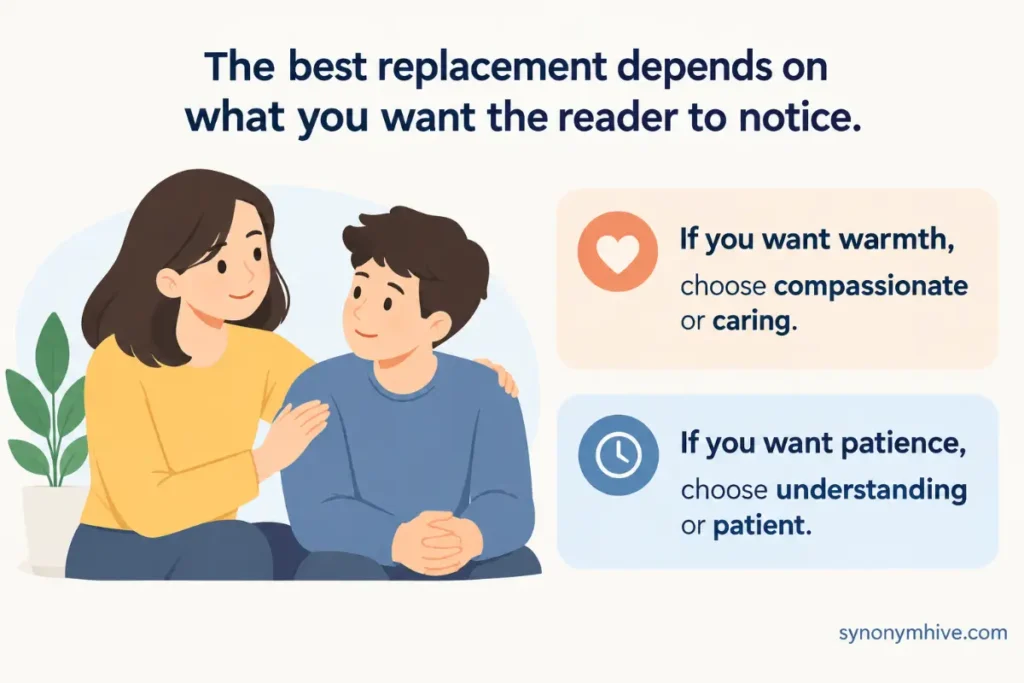
The best replacement depends on what you want the reader to notice.
If you want a broader workplace skill, choose emotionally intelligent.
If you want simple everyday English, choose kind, caring, understanding, or supportive.
For most resumes, supportive, understanding, compassionate, perceptive, and emotionally intelligent offer the most useful range. Still, don’t choose a word just because it sounds good. Choose the one your experience can prove.
Conclusion
Choosing another word for empathetic becomes easier when you focus on the exact quality you want to show. Compassionate highlights care. Understanding shows patience and acceptance. Supportive focuses on helping others. Perceptive shows that you notice needs and feelings. Diplomatic points to calm and thoughtful communication.
For a resume, the strongest choice is the one that connects to something you actually did. Don’t fill your profile with several similar adjectives. Pick a precise word and support it with a clear action or result.
Good word choice is less about sounding impressive and more about sounding accurate. When your language matches your experience, your resume feels more credible and gives employers a clearer picture of how you work with people.
Frequently Asked Questions
What is another phrase for empathetic?
Compassionate is one of the strongest alternatives, but understanding, supportive, considerate, perceptive, and caring can also fit depending on the context.
What is the best synonym for empathetic on a resume?
Supportive, compassionate, understanding, perceptive, and emotionally intelligent are strong resume choices when they accurately describe your experience.
Is empathetic the same as compassionate?
They are closely related but not identical. Empathetic focuses on understanding another person’s feelings while compassionate adds a stronger sense of care and concern.
What is another way to say empathetic?
You can say understanding, caring, supportive, considerate, perceptive, compassionate, or emotionally intelligent depending on the meaning you want to express.
Is empathic or empathetic correct?
Both are correct. Empathetic is common in American English while empathic is also widely accepted and has the same basic meaning.
What is the opposite of empathetic?
Common opposites include insensitive, uncaring, inconsiderate, indifferent, dismissive, and unsympathetic.
What is the best simple word for empathy?
Understanding is one of the simplest choices. Caring and supportive also work well when the context involves helping another person.