

You’re writing a resume and want to show that you can guide people and make smart decisions. You type leader into your profile or experience section, then stop and wonder if another word for leader would sound more polished and specific.
A leader is someone who guides people toward a shared goal. Leadership can involve decision making, planning, communication, motivation, problem solving, and responsibility. Still, the word leader can mean different things in different jobs.
Another word for leader is manager, supervisor, director, guide, mentor, coordinator, or head.
The best choice depends on what you actually did. A manager usually oversees people or operations. A mentor helps others grow. A coordinator organizes activities. A director often carries broader responsibility. A guide helps people move in the right direction.
This guide covers the meaning and origin of leader plus more than 30 useful alternatives. You’ll also find choices for resumes, essays, emails, texts, and speaking, along with intensity levels, close synonym comparisons, examples, common mistakes, and practical tips.
Looking for a better alternative? Visit Another Word for Delivered Best Resume Choices 2026.
What Does Leader Mean In Plain English
A leader is a person who guides, directs, supports, or influences other people toward a goal.
Leadership doesn’t always require a formal job title.
A manager can be a leader because they oversee employees. A teacher can be a leader because they guide students. A project coordinator can be a leader because they organize people around a shared deadline. An employee can also show leadership by taking initiative and helping coworkers solve problems.
This distinction matters on a resume.
Someone can have a leadership title without being an effective leader. Someone else can show strong leadership without having the word manager anywhere in their job title.
For example:
Team leader responsible for daily operations.
This statement tells the reader very little.
A stronger version might say:
Supervised a team of eight employees and improved daily productivity by 18 percent.
The second sentence shows what the person actually did.
That is usually more valuable than a broad label.
When choosing another term for leader, think about your exact responsibility. Did you supervise people? Did you guide a project?
The answer will point you toward the strongest word.
Where Did The Word Leader Come From
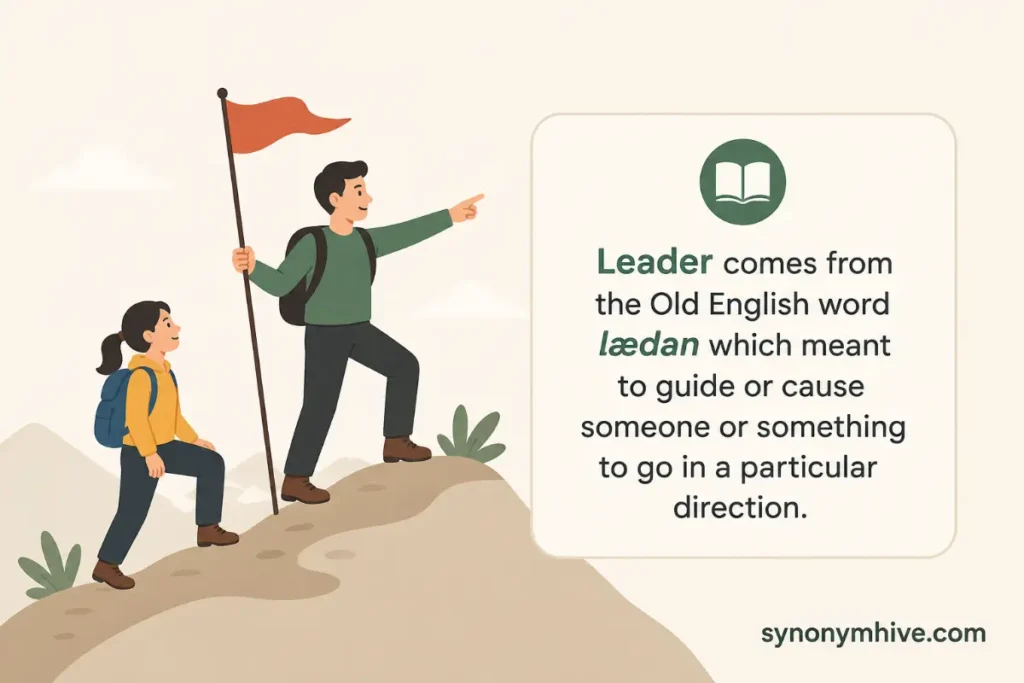
Leader comes from the Old English word lædan which meant to guide or cause someone or something to go in a particular direction.
The modern word developed from the verb lead.
Lead has always carried the idea of guiding movement or action. Over time, its meaning expanded beyond physical direction to include social influence, management, authority, and guidance.
That history explains why leader has such a broad meaning today.
Someone can lead a group.
A manager can lead a project.
A teacher can lead a discussion.
An executive can lead an organization.
A professional can also lead by example.
The word doesn’t automatically mean boss.
A leader can have formal authority, but leadership can also come from knowledge, trust, experience, or initiative.
That difference helps explain why terms such as mentor, guide, facilitator, and influencer can sometimes work as alternatives.
What Are The Best Synonyms For Leader
The best synonym depends on the type of leadership you want to describe.
| Word | Meaning | Tone | Example |
|---|---|---|---|
| Manager | Person who oversees people or work | Professional | Managed a team of 12 employees. |
| Chair | Person who leads a meeting or committee | Formal | Chaired the planning committee. |
| Facilitator | Person who helps a group work effectively | Professional | Facilitated team planning sessions. |
| Strategist | Person who develops plans for long term goals | Professional | Developed strategy for regional growth. |
| Decision Maker | Person responsible for important choices | Professional | Served as a key decision maker for product planning. |
| Authority | Person with recognized knowledge or control | Formal | Became an authority in technical operations. |
| Representative | Person who speaks or acts for a group | Professional | Represented the department during client meetings. |
| Spokesperson | Person who speaks for an organization | Professional | Served as the company spokesperson. |
| Advocate | Person who strongly supports a cause or group | Professional | Advocated for employee development programs. |
| Champion | Person who strongly supports an idea or goal | Strong | Championed improvements to customer service. |
| Influencer | Person who affects opinions or actions | Modern | Influenced adoption of new workplace practices. |
| Trailblazer | Person who creates a new direction | Strong | Became a trailblazer in digital education. |
| Pioneer | Person who develops or introduces something first | Strong | Pioneered new research methods. |
| Visionary | Person with bold ideas about the future | Strong | Created a visionary growth strategy. |
| Authority Figure | Person with recognized power or influence | Formal | Served as an authority figure during the transition. |
| Role Model | Person whose actions inspire others | Positive | Became a role model for junior employees. |
| Mentor | Person who gives advice and development support | Professional | Mentored new managers across the organization. |
| Facilitator | Person who helps people work toward agreement | Professional | Facilitated discussions between departments. |
| Overseer | Person who watches and manages work | Formal | Oversaw daily warehouse operations. |
| Steward | Person trusted to manage something responsibly | Formal | Served as a steward of company resources. |
| Foreperson | Person who supervises workers | Professional | Served as foreperson for the construction crew. |
Which Synonyms For Leader Are Mild Or Strong
Leadership words have different levels of strength.
Choosing the right level keeps your writing accurate and believable.
What Are Mild Alternatives To Leader
Mild options include guide, supporter, organizer, representative, and coordinator.
These words work well when you had responsibility without formal authority.
For example:
Guided new employees through the company’s training process.
This shows leadership without claiming that you managed the employees.
Another example is:
Coordinated daily tasks across a five person project group.
The word coordinator shows responsibility while staying specific.
These terms can be useful for students, interns, entry level employees, and professionals who led projects without managing staff.
What Are Moderate Alternatives To Leader
Moderate choices include manager, supervisor, mentor, coach, facilitator, and administrator.
These terms suggest clear responsibility.
For example:
Supervised a team of 10 customer service representatives.
Or:
Mentored junior analysts and supported their professional development.
Or:
Facilitated weekly planning meetings for a cross department project.
These words often work well on resumes because they describe recognizable responsibilities.
What Are Strong Alternatives To Leader
Strong choices include director, executive, visionary, pioneer, trailblazer, champion, and steward.
These words suggest broader authority or influence.
For example:
Directed a regional expansion project across four markets.
That statement shows significant responsibility.
Another example is:
Championed a new customer service strategy that increased retention by 15 percent.
Pioneer and trailblazer carry even more weight.
Pioneered a new approach to renewable energy research.
Use strong words only when your work supports them.
A powerful word with weak evidence can hurt your credibility.
What Part Of Speech Is Leader
Leader is a noun.
It names a person who guides or directs others.
She is a respected leader.
He became the team leader.
The related verb is lead.
She leads the customer service team.
The related noun leadership describes the ability or process of guiding others.
He demonstrated strong leadership during the project.
The adjective is leading.
She is a leading expert in the field.
Other related forms include leadership, leader, leading, led, and lead.
Many alternatives also have related verb forms.
Manager becomes manage.
Supervisor becomes supervise.
Director becomes direct.
Coordinator becomes coordinate.
Mentor becomes mentor.
Coach becomes coach.
Facilitator becomes facilitate.
These verb forms are often more powerful on resumes because they let you describe action.
Compare:
Team leader for a major software project.
With:
Led a major software project from planning through launch.
The second version is more direct.
What Is Another Phrase For Leader On A Resume
When looking for another phrase for leader on a resume, focus on your actual level of responsibility.
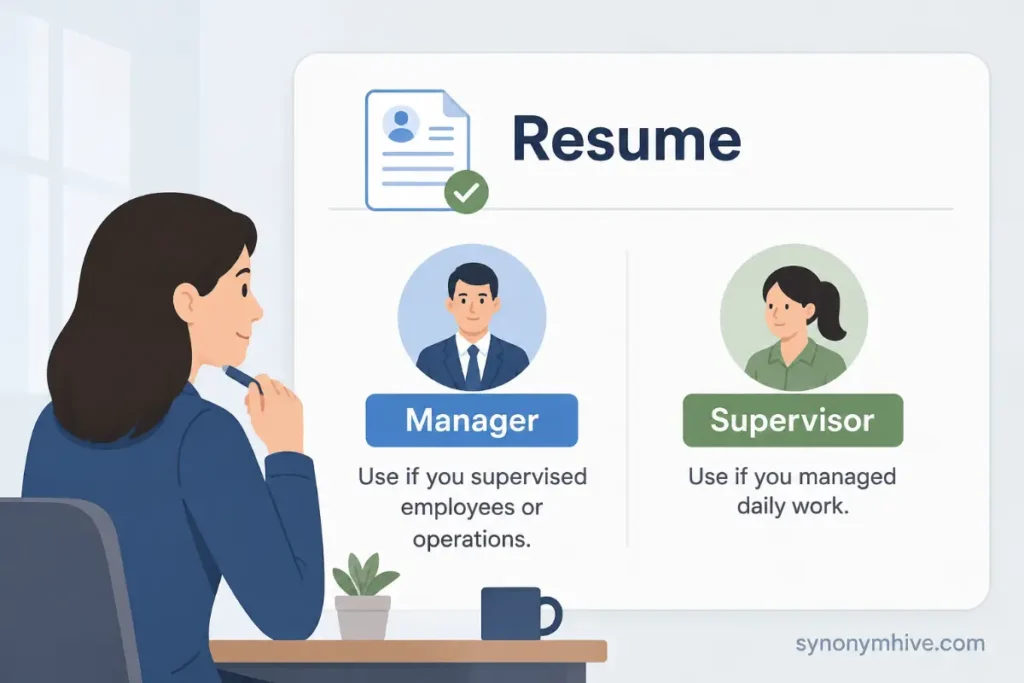
Choose manager if you supervised employees or operations.
Pick supervisor if you managed daily work.
Call yourself a director if you held senior responsibility for a department or function.
Use coordinator if you organized people, tasks, or schedules.
Describe yourself as a mentor if you helped other employees develop their skills.
Highlight your role as a coach if you improved performance through training and guidance.
Act as a facilitator if you helped groups communicate and reach decisions.
Position yourself as a strategist if you created plans that supported business goals.
Use champion if you strongly supported and advanced an initiative.
Describe yourself as visionary if you shaped a clear long term direction.
For example:
Team leader with excellent communication skills.
This sounds broad.
A stronger version is:
Supervised a team of eight employees and improved project completion rates by 20 percent.
You can also use a leadership verb.
Led eight employees through a process redesign that reduced processing time by 20 percent.
Action gives the reader a clearer picture of your value.
What Is Another Expression For Leader In An Essay
In an essay, the best word depends on the type of leader you are discussing.
Leader itself is often the clearest choice.
However, manager, authority, pioneer, visionary, advocate, guide, or role model may fit specific situations.
For example:
The leader encouraged the community to support the new program.
You could write:
The advocate encouraged the community to support the new program.
The second version emphasizes the person’s support for a cause.
For historical writing:
The pioneer introduced new methods that changed the field.
For education:
The mentor helped younger students develop confidence and practical skills.
For business:
The executive guided the company through a period of rapid growth.
A good essay doesn’t replace words simply to sound more advanced. Use the word that makes the person’s role easiest to understand.
What Is Another Term For Leader In An Email
Professional emails usually work best with clear words such as manager, coordinator, director, mentor, or team lead.
For example:
Please send the report to the team leader.
You could write:
Please send the report to the project manager.
The second sentence is better if the person actually manages the project.
Another example:
I’d like to thank our leader for guiding the team through the transition.
A more specific version is:
I’d like to thank our project manager for guiding the team through the transition.
Specific job roles make emails easier to understand.
What Is Another Phrase For Leader In A Text
Text messages usually need simple language.
Good choices include boss, manager, team lead, coach, guide, or captain.
For example:
I’ll check with my manager and get back to you.
Or:
Our team lead wants to meet at three.
In a casual conversation you might say:
She’s been a great guide through all of this.
Avoid formal words such as steward, authority figure, or principal unless the context really calls for them.
Natural language usually sounds better in texts.
What Is Another Word For Leader In Speaking
In everyday speech, leader, manager, boss, guide, coach, and mentor are common choices.
For example:
She’s a great leader.
He’s a strong manager.
My coach really helped me improve.
She’s been a great mentor.
In professional speaking, you might use director, coordinator, facilitator, strategist, or executive.
For example:
Our director is leading the expansion project.
Or:
The facilitator helped both teams reach an agreement.
The best spoken word should feel natural when you say it aloud.
How Do Leader And Manager Differ
Leader and manager overlap, but they aren’t identical.
| Leader | Manager |
|---|---|
| Focuses on direction and influence | Focuses on managing people or operations |
| Can lead without formal authority | Usually has formal responsibility |
| May inspire or guide others | Usually plans and organizes work |
| Can exist at any level | Usually describes a formal role |
A manager can be a leader.
However, not every leader is a manager.
An employee may lead a project without having direct reports. A subject matter expert may guide coworkers without managing them.
That is why leader is broader.
On a resume, use manager when you actually managed people or operations. Use leader when the broader idea of guidance or influence matters.
How Do Leader And Supervisor Differ
Supervisor is more specific than leader.
A supervisor usually oversees employees and their daily work.
A leader can have many different responsibilities.
For example:
Supervised 15 warehouse employees during daily operations.
This statement clearly shows direct oversight.
By contrast:
Led a warehouse improvement project.
This doesn’t necessarily mean the person supervised the warehouse staff.
If you managed employees directly, supervisor may be more precise.
If you guided a project or initiative, leader may fit better.
How Do Leader And Mentor Differ
A mentor helps another person grow through advice, support, knowledge, and experience.
A leader may guide an entire team toward a goal.
The two roles can overlap.
For example:
Mentored five junior employees through their first year.
This focuses on development.
Led a team of five junior employees through a major project.
This focuses on project responsibility.
Choose mentor when growth and learning are central.
Choose leader when direction and results are central.
How Do Leader And Coordinator Differ
A coordinator organizes people, activities, schedules, or information.
A leader can coordinate work but often carries a broader role.
For example:
Coordinated schedules across three departments.
This shows organization.
Led three departments through a process improvement project.
This shows broader direction.
Coordinator is especially useful for resumes because it describes a specific function without overstating authority.
If you organized the work but didn’t manage the people, coordinator may be more accurate than manager.
How Do Leader And Director Differ
Director usually indicates a senior position with broad responsibility.
Leader is more general.
A director may manage a department, budget, strategy, or large group.
For example:
Directed regional sales operations across five states.
This suggests senior responsibility.
You shouldn’t use director simply because you led a small project.
If you led a project without holding a director level role, project lead or project manager may be more accurate.
Compare more word options with Another Word For Improved: Winning Resume Words 2026.
What Are Real Examples Of Leader Synonyms
The best examples show leadership through action rather than empty claims.
- Managed a team of 12 employees and improved productivity by 18 percent.
- Supervised daily operations for a busy customer service department.
- Coordinated a six month project involving four internal departments.
- Mentored eight junior employees and helped improve training completion rates.
- Coached new team members through updated service procedures.
- Directed a regional marketing campaign that increased qualified leads by 24 percent.
- Facilitated weekly planning meetings for a cross department project.
- Championed a new customer support process that reduced response times by 20 percent.
- Guided new employees through onboarding and role specific training.
- Organized a volunteer team of 25 people for a community event.
- Led product testing from initial planning through final launch.
- Developed a growth strategy that helped expand the customer base.
- Partnered with department managers to improve employee retention.
- Served as the primary decision maker during a major system transition.
- Represented the department during meetings with senior executives.
- Mentored junior analysts and reviewed their work during weekly development sessions.
- Coordinated communication between technical teams and business stakeholders.
- Directed workflow changes that reduced project delays by 15 percent.
- Built team confidence through regular coaching and feedback.
- Guided a remote team through a successful software implementation.
These examples work because they show the type of leadership involved.
They don’t simply say the person was a great leader.
They show what the person did.
How Can You Show Leadership Without Using Leader
You don’t have to use the noun leader to demonstrate leadership.
Strong action verbs can do the work.
Choose led when you directed a group or project.
Pick managed when you had responsibility for people or operations.
Apply supervised when you oversaw daily work.
Describe your role as directed when you had significant authority over an activity.
Mention guided when you helped people move toward a goal.
Highlight mentored when you supported someone’s development.
Use coached when you improved skills or performance.
Select facilitated when you helped people communicate or reach agreement.
Consider organized when planning and coordination were central.
Emphasize championed when you strongly supported and advanced an initiative.
For example:
Led a team of 10 employees during a major software transition.
This is stronger than:
Strong leader with software experience.
The first statement provides evidence.
How Can You Make Leadership Sound Stronger On A Resume
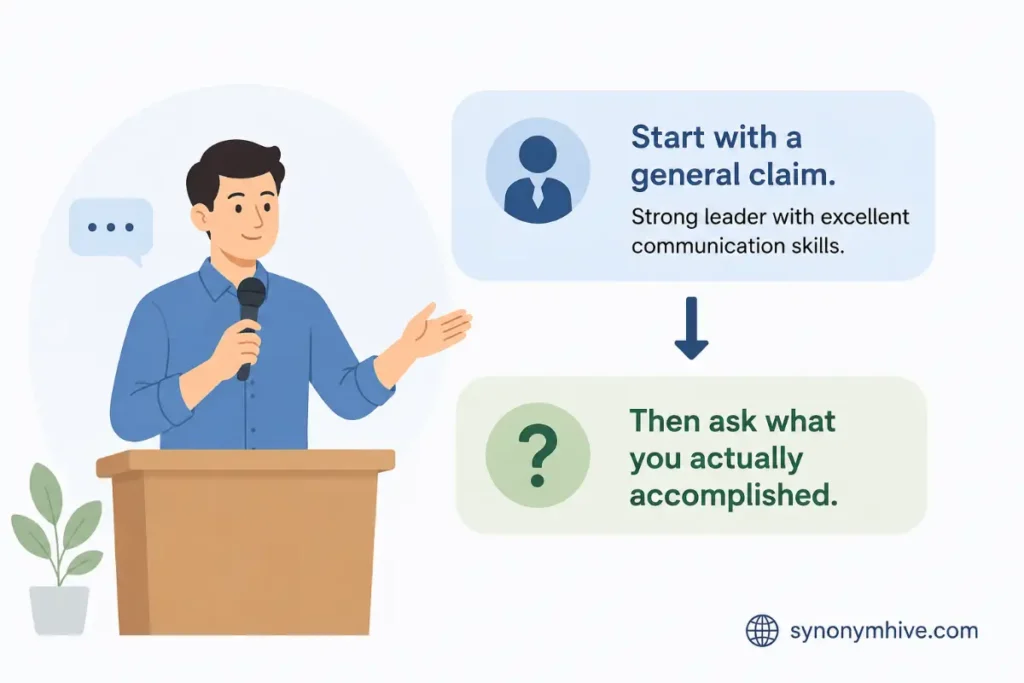
Start with a general claim.
Strong leader with excellent communication skills.
Then ask what you actually accomplished.
Maybe you managed a team.
Managed a team of 10 employees and increased productivity by 16 percent.
Maybe you led a project.
Led a cross department project that reduced processing time by 25 percent.
Maybe you mentored people.
Mentored six junior employees and helped improve training completion rates.
Maybe you changed a process.
Championed a new workflow that reduced customer response times by 18 percent.
The key is specificity.
A hiring manager can understand numbers, actions, responsibilities, and results.
Broad adjectives are harder to evaluate.
What Are Common Mistakes With Leader Synonyms
Calling Yourself A Manager Without Managing People
Manager usually implies formal responsibility.
If you only led a temporary project, project lead or coordinator may be more accurate.
Using Director For A Small Project
Director suggests senior authority.
Don’t use it as a fancy replacement for leader unless it accurately describes your role.
Using Visionary Without Evidence
Visionary is a powerful word.
It suggests that you developed bold ideas and saw opportunities others didn’t.
Use it carefully.
A better resume may show the vision instead of simply claiming it.
Using Pioneer For A Normal Improvement
Pioneer suggests that you were among the first to develop or introduce something.
A routine process improvement isn’t necessarily pioneering.
Calling Yourself A Mentor Without Mentoring
Mentoring involves helping someone learn or develop.
Simply answering a coworker’s question once doesn’t usually make you a mentor.
Using Boss In Formal Writing
Boss works in casual conversation.
It usually doesn’t belong in a professional resume.
Use manager, supervisor, director, or another accurate role.
Repeating Leader Too Often
A resume can become repetitive if every section uses leader, leadership, or led.
Vary the language based on the actual action.
Choose managed for people.
Pick coordinated for projects.
Highlight mentored for development.
Use directed for major initiatives.
Making Leadership Claims Without Results
Strong leadership claims become more credible when supported by outcomes.
Show what changed because of your work.
When Should You Not Use A Synonym For Leader
You don’t need to replace leader every time you see it.
Sometimes leader is the clearest word.
For example:
She became a respected leader in her community.
Replacing leader with an unusual term may make the sentence less natural.
The same applies to resumes.
If your official job title is Team Leader, don’t change the title to Manager unless manager was actually your job title.
You can describe your responsibilities separately.
For example:
Team Leader.
Led eight employees, coordinated schedules, and improved daily productivity by 18 percent.
That approach keeps the official title accurate while showing what you accomplished.
Accuracy should always come before variety.
What Are The Antonyms Of Leader
Common opposites include follower, subordinate, participant, supporter, and team member.
The best choice depends on the context.
A follower usually describes someone who follows another person’s direction.
A subordinate is someone who has a lower position of authority.
A participant simply takes part in an activity.
A team member belongs to a group but doesn’t necessarily lead it.
These words aren’t negative in every situation.
Being a team member doesn’t mean someone lacks valuable skills. Many successful employees contribute through expertise, creativity, reliability, and cooperation rather than formal leadership.
How Does US English Use Leader
Leader is common in American English and works naturally in business, education, sports, politics, community work, and everyday conversation.
The basic meaning remains similar across major English speaking regions.
Some job titles can vary by industry.
For example, team lead is common in American workplaces. Team leader is also widely understood.
Manager and supervisor are especially common in US business writing.
On American resumes, action verbs often work better than broad leadership labels.
Compare:
Experienced leader with excellent people skills.
With:
Managed a team of 14 employees and reduced staff turnover by 12 percent.
The second sentence gives the employer something concrete.
Regional vocabulary matters less than accuracy and clarity.
What Is The Best Word For Different Types Of Leaders
Different leadership situations call for different words.
| Situation | Best Word |
|---|---|
| Manages employees | Manager |
| Oversees daily work | Supervisor |
| Leads a department | Director |
| Organizes a project | Coordinator |
| Develops employees | Mentor |
| Improves employee performance | Coach |
| Helps groups reach agreement | Facilitator |
| Creates long term plans | Strategist |
| Supports a major initiative | Champion |
| Creates future focused direction | Visionary |
| Introduces a new field or method | Pioneer |
| Creates a new direction | Trailblazer |
| Represents an organization | Representative |
| Leads a committee | Chair |
| Manages resources responsibly | Steward |
| Guides people informally | Guide |
| Leads a team | Team Lead |
| Makes important choices | Decision Maker |
| Oversees a worksite | Foreperson |
| Inspires others through actions | Role Model |
This kind of matching makes your writing more precise.
Don’t start with the synonym you like most.
Start with the responsibility you want to describe.
How Can You Choose The Right Leadership Word
Ask yourself a few simple questions.
Did you manage people?
Use manager or supervisor.
Did you organize a project?
Use coordinator or project lead.
Did you help someone develop?
Use mentor or coach.
Did you guide a group without formal authority?
Use guide or facilitator.
Did you make major decisions?
Use decision maker or executive when appropriate.
Did you create a new direction?
Use pioneer or trailblazer if the achievement truly supports it.
Did you create long term plans?
Use strategist or visionary.
Did you support an important initiative?
Use champion.
Then look at the level of your role.
An entry level employee may have led a small project without being a manager.
A department head may have managed budgets, employees, and strategy.
Both can demonstrate leadership, but the best vocabulary will differ.
How Can You Avoid Repeating Leader On A Resume
Look at each sentence and identify the specific leadership action.
Instead of:
Strong leader who works well with teams.
Try:
Managed a team of eight employees and improved project completion rates by 20 percent.
Instead of:
Leadership skills in project management.
Try:
Coordinated cross department projects from planning through completion.
Instead of:
Experienced leader and mentor.
Try:
Mentored six junior employees through structured training and monthly feedback sessions.
Instead of:
Innovative leader.
Try:
Championed a new workflow that reduced processing time by 25 percent.
Each version gives the reader a clearer reason to trust the claim.
You don’t need to force a different synonym into every sentence.
You need to describe different actions accurately.
How Can You Show Leadership With Numbers
Numbers can make leadership experience easier to understand.
Mention the size of the team you managed.
Managed a team of 15 employees.
Mention the scope of the project.
Led a project across four departments.
Mention the size of the budget when appropriate.
Directed a $2 million annual operations budget.
Mention measurable improvements.
Supervised a team that improved customer satisfaction by 18 percent.
Mention time.
Led a six month process improvement initiative.
Mention growth.
Guided a sales team that increased quarterly revenue by 22 percent.
You don’t need numbers in every bullet.
However, useful measurements can turn a broad leadership claim into strong evidence.
How Can You Choose Another Phrase For Leader In An Interview
In an interview, don’t focus too much on finding the fanciest synonym.
Focus on explaining what you did.
Instead of saying:
I’m a visionary leader.
Explain:
I like to give my team a clear goal and then help each person understand how their work supports it.
That answer sounds more human and gives the interviewer something useful to discuss.
You can then support the point with a real example.
In my last role, I led a team of 10 people through a process change. We reduced processing time by 20 percent while keeping customer satisfaction steady.
The example carries more weight than the label.
How Can You Choose Another Expression For Leader In An Essay
Start with the person’s role.
Choose manager or executive if the person manages an organization.
Describe them as a leader or advocate if they guide a movement.
Call them a pioneer if they introduce a new method.
Use role model if they inspire others through their actions.
Refer to them as a mentor if they support someone else’s development.
Then check the tone.
Academic writing may favor terms such as authority, pioneer, strategist, or executive.
Personal writing may sound better with guide, mentor, or role model.
Don’t choose a word simply because it sounds sophisticated.
A simple accurate word is usually stronger than a complicated one that doesn’t quite fit.
What Makes A Leader Description Credible
Credible leadership writing connects responsibility with action.
Start by saying what you led.
Then explain who you worked with.
Next show what you changed.
Finally add the result when possible.
For example:
Led a team of 12 customer service representatives to redesign the support process and reduce average response time by 21 percent.
This sentence gives the reader several useful facts.
It shows the team size.
It shows the responsibility.
That is much stronger than:
Excellent leader with strong communication skills.
Leadership is easiest to believe when the reader can see it in action.
What Are The Best Quick Tips For Choosing Another Term For Leader
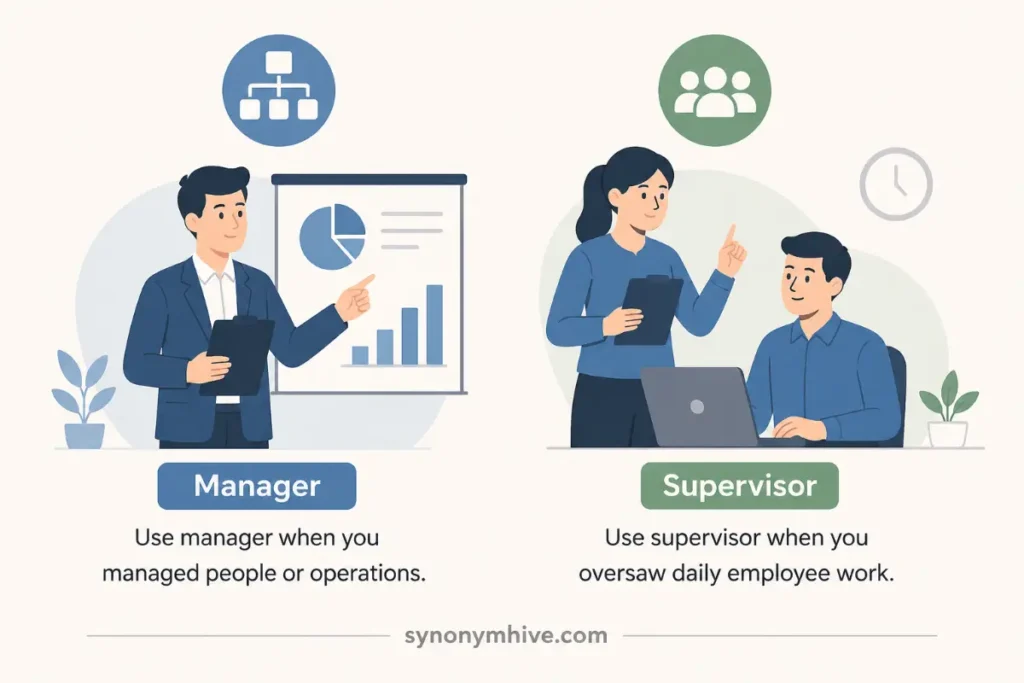
- Use manager when you managed people or operations.
- Use supervisor when you oversaw daily employee work.
- Use director when you held broad senior responsibility.
- Use coordinator when you organized people or tasks.
- Use mentor when you helped others grow.
- Use coach when you developed skills or performance.
- Use facilitator when you helped groups communicate and reach agreement.
- Use strategist when planning was a major part of your role.
- Use champion when you strongly supported an initiative.
- Use visionary when you created bold future focused plans.
- Use pioneer when you introduced something genuinely new.
- Use trailblazer when your work opened a new direction.
- Use guide when you provided direction without formal authority.
- Use role model when your behavior inspired others.
- Use decision maker when important choices were part of your responsibility.
- Use action verbs to show leadership instead of relying on labels.
- Add numbers when they accurately show your impact.
- Keep your official job titles accurate.
- Don’t use stronger words than your experience supports.
- Choose clarity before impressive vocabulary.
- Match the word to your audience.
- Avoid repeating the same leadership term throughout a resume.
- Show the people you led when that information matters.
- Explain the goal you were responsible for reaching.
- Include the result when you can prove it.
The strongest choice isn’t always the biggest word.
It’s the word that tells the truth clearly.
Compare more word options with Another Word For Self Motivated Best Resume Words 2026.
Conclusion
Choosing another word for leader depends on the kind of responsibility you want to show. Manager fits people and operations. Supervisor works for daily oversight. Coordinator highlights organization. Mentor shows that you help others grow. Director suggests broader authority. Strategist highlights planning while visionary points to future focused thinking.
If you need more options for your writing, explore our guide to another word for implemented and find the right word for different types of support.
On a resume, strong action matters more than a fancy title. Show who you guided, what you changed, and what happened because of your work. A sentence that says you managed 10 employees and improved productivity gives far more useful information than a claim about being an excellent leader. Pick the word that matches your real role and support it with clear evidence. When your language and achievements line up, your leadership experience becomes much easier for employers to see.
Frequently Asked Questions
What is another phrase for leader?
Another term for leader can be manager, supervisor, director, guide, mentor, coordinator, coach, or strategist. The best option depends on the type of leadership you want to describe.
What is another phrase for leader on a resume?
Another term for leader on a resume can be manager, supervisor, coordinator, mentor, director, strategist, or facilitator. Choose the term that matches your actual responsibilities.
What’s another way to say leader?
You can say manager, supervisor, guide, mentor, coach, coordinator, director, or team lead. Simple terms often work best when they accurately describe the role.
What is a professional word for leader?
Manager, supervisor, director, strategist, coordinator, and facilitator are professional alternatives to leader. The right word depends on your level of authority and the work you performed.
What is a stronger word for leader?
Director, executive, visionary, pioneer, and trailblazer can sound stronger than leader. Use them only when your experience supports the level of responsibility or influence they suggest.
Is manager the same as leader?
A manager can be a leader but the words aren’t identical. Manager usually describes formal responsibility for people or operations while leader can describe anyone who guides or influences others.
What is the opposite of leader?
Common opposites include follower, subordinate, participant, and team member. The best choice depends on the specific situation.