

Writing a resume can be harder than solving some of the problems you handled at work. You know you’re good at finding answers. Yet the phrase problem solver can feel too basic when you want your resume to stand out. If you’re looking for another term for problem solver, you have several strong choices.
A good alternative can show more than your ability to fix problems. It can highlight critical thinking, resourcefulness, creativity, judgment, analysis, adaptability, or decision making. The best word depends on the kind of problems you solve and how you solve them.
Another word for problem solver can be troubleshooter, strategist, fixer, analyst, innovator, or solution focused professional. The right choice depends on the skill you want to highlight.
This guide explains the meaning and origin of problem solver and gives you a useful list of alternatives. You’ll also learn which words work best on resumes, essays, emails, texts, and in everyday speech. Along the way, you’ll see real examples, close synonym comparisons, common mistakes, and practical tips.
Looking for another word? See Another Word for Punctual Best Resume Words: Stand Out 2026.
What Does Problem Solver Mean In Plain English
A problem solver is someone who finds practical ways to deal with challenges. The problem may be technical, financial, operational, personal, or related to people. The person notices what isn’t working, thinks about possible causes, and takes action to improve the situation.
Problem solving involves more than simply finding an answer. A strong problem solver understands the situation before acting. They look at the available information, consider possible solutions, choose a sensible approach, and check the result.
For example, an employee may notice that customers are waiting too long for support. Instead of simply working faster, the employee studies the process, finds the bottleneck, and suggests a better system.
A manager may solve a staffing problem by adjusting schedules. A technician may fix a system failure. A teacher may find a new way to explain a difficult topic. A salesperson may find a way to address a customer’s concern and keep the relationship strong.
The phrase problem solver is positive because it focuses on action. It suggests that someone doesn’t simply notice problems. They work toward solutions.
Still, the phrase can be broad. That’s why a more specific word can make your writing stronger.
Where Does The Phrase Problem Solver Come From
Problem solver is made from two familiar English words. Problem comes through Latin and Greek roots connected with something put forward as a question or challenge. Solver comes from the Latin word solvere, which means to loosen, release, or resolve.
The modern phrase problem solver developed naturally from the idea of someone who resolves a difficult situation. It is now common in business, education, technology, management, customer service, and everyday conversation.
The phrase can describe a person or a skill.
For example:
She is a strong problem solver.
The job requires excellent problem solving skills.
The team needs a creative problem solver.
The meaning stays simple. A problem solver sees a challenge and works toward a useful answer.
However, resumes often benefit from more specific language. A hiring manager learns more from a phrase such as strategic thinker or skilled troubleshooter than from problem solver alone.
What Is Another Word For Problem Solver
The best alternative depends on the type of problem you handle.
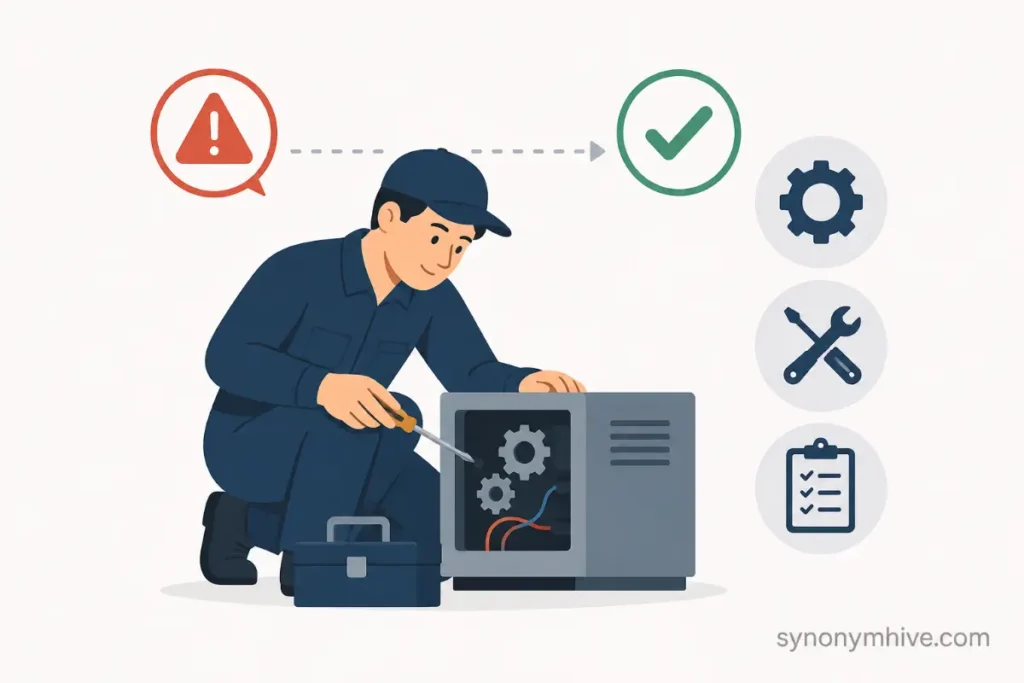
Troubleshooter works well for someone who identifies faults and fixes them. It is common in technical, mechanical, and operational settings.
Strategist works well when solving problems requires planning, priorities, and long term thinking.
Analyst fits someone who studies information before deciding what to do.
Innovator works well for someone who creates new solutions instead of relying on standard methods.
Fixer is more casual. It describes someone who can step into a difficult situation and get things working again.
Resourceful is useful when someone finds practical solutions with limited time, money, tools, or information.
Critical thinker works well when careful reasoning is central to the solution.
Solution focused is useful in professional writing when you want to emphasize action and results.
The strongest alternative isn’t always the most formal one. It should describe how you actually solve problems.
What Are The Best Synonyms For Problem Solver
The following list gives you more than simple replacements. Each word carries a slightly different meaning and tone.
| Word | Meaning | Tone | Example |
|---|---|---|---|
| Fixer | Someone who gets difficult situations working again | Casual | She’s the fixer everyone calls when plans go wrong. |
| Troubleshooter | Someone who finds and fixes faults | Professional | He works as a skilled troubleshooter for technical issues. |
| Analyst | Someone who studies information to find answers | Professional | She is a strong analyst who finds patterns in complex data. |
| Strategist | Someone who develops plans to solve challenges | Professional | He is a thoughtful strategist who improves business processes. |
| Innovator | Someone who creates new solutions | Professional | She is an innovator who develops better ways to serve customers. |
| Thinker | Someone who uses careful thought to solve issues | Everyday | He’s a strong thinker who stays calm under pressure. |
| Critical thinker | Someone who evaluates information carefully | Professional | She is a critical thinker who makes sound decisions. |
| Creative thinker | Someone who finds original solutions | Professional | He is a creative thinker who develops fresh campaign ideas. |
| Resourceful | Able to find useful solutions with limited resources | Professional | She is resourceful when unexpected problems arise. |
| Practical | Focused on useful and workable answers | Everyday | He takes a practical approach to difficult problems. |
| Analytical | Skilled at examining information and causes | Professional | She has an analytical approach to complex issues. |
| Solution focused | Focused on finding useful answers | Professional | He takes a solution focused approach to customer concerns. |
| Decisive | Able to make clear choices | Professional | She is decisive when urgent problems require action. |
| Adaptable | Able to change when circumstances shift | Professional | He is adaptable when project requirements change. |
| Resourceful thinker | Someone who finds useful answers in difficult conditions | Professional | She is a resourceful thinker who handles unexpected challenges well. |
| Problem solver | Someone who finds ways to resolve challenges | Everyday | He is a reliable problem solver. |
| Planner | Someone who prepares steps to reach a goal | Everyday | She is a careful planner who prevents many problems. |
Which Synonyms Are Simple And Everyday
Simple words are useful when you want your writing to sound natural.
Fixer is one of the most familiar choices. It suggests someone who can step into a difficult situation and make things work.
Practical describes someone who prefers useful solutions over complicated ideas.
Thinker can work in casual speech, though it is too broad for most resumes.
Planner fits someone who prevents problems through preparation.
Improviser describes someone who can find answers when plans suddenly change.
These words are easy to understand. They can work well in conversation, informal writing, or personal descriptions.
For a resume, though, you usually want a word that explains the skill more clearly.
Which Synonyms Sound More Professional
Professional writing benefits from precise language.
Strategist suggests planning and long term thinking. Analyst highlights research and careful examination. Troubleshooter focuses on finding faults and correcting them.
Critical thinker emphasizes judgment and reasoning. Resourceful shows that you can find practical answers even when resources are limited.
Innovator suggests that you create new solutions. Solution focused highlights your attention to results. Decisive shows that you can act when a problem requires a choice.
These words can be especially useful on resumes because they connect problem solving with a specific workplace strength.
Which Synonyms Are More Casual
Casual language doesn’t need to sound impressive. It needs to sound natural.
Fixer is a common informal choice.
Improviser works when someone can handle unexpected situations.
Thinker can describe someone who takes time to understand an issue.
You can also use phrases such as good at finding answers or good at figuring things out.
For example:
She’s great at figuring things out when something goes wrong.
He’s the person we call when we need someone to fix a tricky situation.
These phrases sound natural in conversation but usually don’t belong in a formal resume.
How Do Problem Solving Synonyms Change In Strength
Not every alternative carries the same level of intensity.
Mild terms include thinker, planner, practical, and coordinator. These words describe useful abilities but don’t necessarily suggest that someone handles difficult problems.
Medium strength choices include analytical, resourceful, adaptable, decisive, and troubleshooter. These terms suggest active problem solving and useful judgment.
Stronger professional terms include strategist, innovator, critical thinker, strategic thinker, and solution focused professional. These choices can suggest deeper reasoning, creativity, or leadership.
Still, don’t choose a strong word simply because it sounds better. A strategist should actually make strategic decisions. An innovator should contribute new ideas. A troubleshooter should diagnose and fix problems.
Accuracy gives professional language its power.
How Does Problem Solver Change By Part Of Speech
Problem solver is a noun. It describes a person.
For example:
She is an excellent problem solver.
Problem solving is a noun phrase that describes the skill or process.
For example:
She has strong problem solving skills.
Solve is a verb.
For example:
He solves customer problems quickly.
Solution is a noun.
For example:
She developed a practical solution.
Analytical, strategic, resourceful, adaptable, and decisive are adjectives that can describe someone who solves problems well.
For example:
She takes an analytical approach to difficult situations.
He is a resourceful employee who finds practical answers.
They use strategic thinking to improve operations.
Using different forms can help you avoid repeating the same phrase across a resume.
What Is Another Term For Problem Solver On A Resume
For resumes, the strongest choice depends on your role.
Troubleshooter is excellent for technical support, maintenance, IT, engineering, and operations.
Analyst works well in finance, research, business, data, and consulting.
Strategist can fit marketing, leadership, business development, and planning roles.
Resourceful works across many industries because it shows that you can handle challenges with limited resources.
Critical thinker works well when the job requires careful judgment.
Innovator can fit technology, product development, design, marketing, and creative roles.
Solution focused is useful for customer service, management, healthcare, sales, and other people centered roles.
Instead of writing:
I am a great problem solver.
Try this:
Analyze customer issues, identify root causes, and develop practical solutions that improve response times.
The second sentence gives the employer evidence. It also uses strong action words.
What Is Another Expression For Problem Solver In An Essay
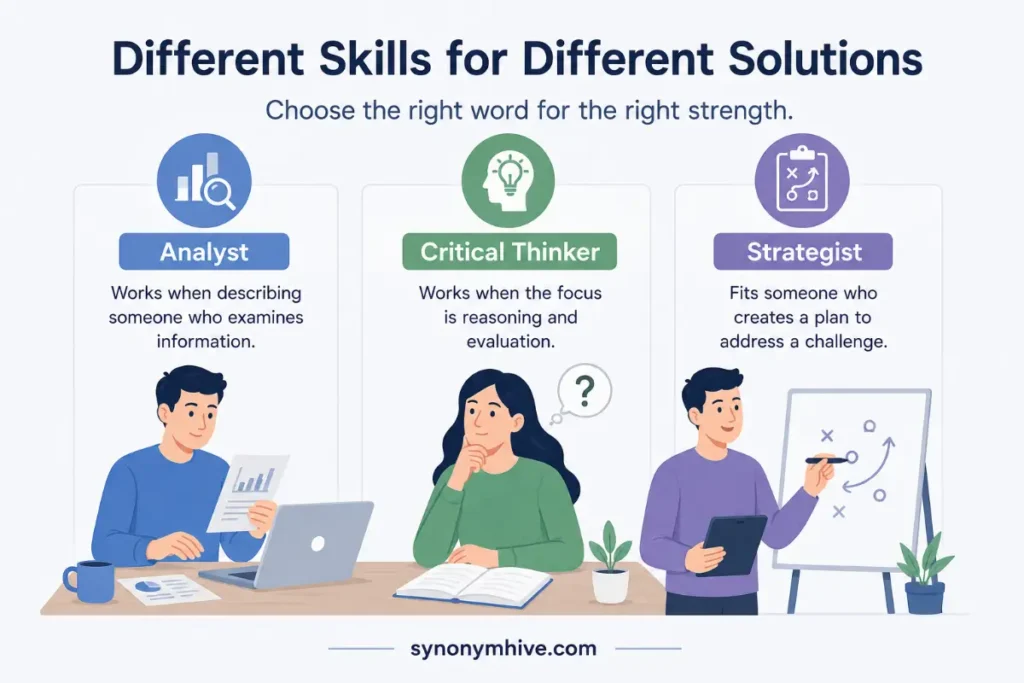
Academic writing needs precise language. Analyst works when describing someone who examines information. Critical thinker works when the focus is reasoning and evaluation. Strategist fits someone who creates a plan to address a challenge.
For example:
The researcher takes an analytical approach to the issue.
The author demonstrates strong critical thinking when evaluating competing arguments.
The team uses a strategic approach to address the problem.
Solution focused can also work in an academic discussion about management, education, or psychology.
Avoid casual terms such as fixer when writing a formal essay. The word may be understandable, but it can sound too informal for academic work.
What Is Another Phrase For Problem Solver In An Email
Email usually calls for simple and direct language.
If you’re describing a coworker, resourceful, practical, or solution focused can work.
For example:
Maria is very resourceful when unexpected issues come up.
John takes a practical approach to customer concerns.
The team stayed solution focused throughout the project.
If you’re writing to a customer, you can avoid labels completely and focus on the action.
For example:
I’ve reviewed the issue and found a practical solution.
I’ve identified the cause and corrected the problem.
This approach sounds professional without trying too hard.
What Is Another Phrase For Problem Solver In A Text
Text messages favor familiar language.
Fixer is a natural casual option. Thinker can work in the right context. You can also use simple phrases such as good at figuring things out or great at finding answers.
For example:
You’re such a fixer when things go wrong.
She’s really good at figuring things out.
He’s the person everyone calls when they need help.
These phrases feel more natural in a text than strategist or diagnostician.
What Is Another Alternative For Problem Solver In Everyday Speech
In everyday conversation, people often use simple phrases rather than formal job language.
You might call someone a fixer. You might say they’re resourceful or good at figuring things out.
For example:
She always finds a way to make things work.
He’s really good at figuring out what went wrong.
She’s the person I call when I can’t solve something myself.
These expressions sound natural because they focus on what the person actually does.
What Are Some Real Examples Of Problem Solving Synonyms
Different situations call for different words. These examples show how the meaning changes.
For example:
The technician is an experienced troubleshooter who identifies system faults quickly.
She is a resourceful employee who finds practical solutions when supplies are limited.
The manager takes a strategic approach to recurring staffing problems.
He is an analytical thinker who studies data before making decisions.
The customer service lead stays solution focused during difficult conversations.
She is a creative thinker who finds new ways to reduce production delays.
He acts as a mediator when team members disagree.
The project coordinator resolves scheduling conflicts before they affect deadlines.
She is a decisive manager who makes clear choices during urgent situations.
He is an innovator who develops new tools for repetitive tasks.
The researcher is a critical thinker who evaluates evidence carefully.
She is an effective negotiator who finds workable agreements with clients.
The technician is a practical thinker who fixes issues without wasting resources.
He is a skilled diagnostician who identifies the cause of recurring equipment failures.
These examples show why a direct synonym isn’t always the best answer. Each word gives the reader a different picture.
Troubleshooter Vs Fixer What Is The Difference
Troubleshooter and fixer both describe people who solve problems. However, the tone and meaning differ.
Troubleshooter usually suggests a person who identifies the cause of a problem and corrects it. It often appears in technical and professional settings.
Fixer is more casual. It suggests someone who can step into a difficult situation and get it working again.
| Troubleshooter | Fixer |
|---|---|
| More professional | More casual |
| Often used for technical problems | Often used for general problems |
| Suggests diagnosis and correction | Suggests practical action |
| Strong for resumes | Better for casual speech |
For example:
He is a skilled troubleshooter who resolves network problems.
She’s the fixer everyone calls when plans fall apart.
Both are useful. The setting determines which one sounds right.
Strategist Vs Analyst What Is The Difference
Strategist and analyst describe different parts of problem solving.
An analyst studies information. A strategist uses information to decide how to move forward.
An analyst may examine sales data and identify a drop in customer retention.
A strategist may use that information to create a plan for improving retention.
| Strategist | Analyst |
|---|---|
| Focuses on direction and planning | Focuses on information and causes |
| Looks at broader goals | Looks closely at details |
| Strong for leadership and planning | Strong for research and evaluation |
| Often involves future decisions | Often involves evidence and patterns |
If your strength is understanding complex information, analyst may fit better.
If your strength is turning information into a plan, strategist may be stronger.
Resourceful Vs Creative What Is The Difference
Resourceful and creative overlap but aren’t identical.
Creative usually means you can generate original ideas.
Resourceful means you can find useful ways to solve a problem with the resources available.
A creative person may invent a new approach. A resourceful person may use an existing tool in an unexpected way to solve an urgent problem.
| Resourceful | Creative |
|---|---|
| Focuses on practical solutions | Focuses on original ideas |
| Works well with limited resources | Works well when new ideas are needed |
| Strong for adaptability | Strong for innovation |
| Practical in tone | Imaginative in tone |
Both can be valuable resume terms. Choose resourceful when flexibility matters. Choose creative when original thinking matters.
Critical Thinker Vs Problem Solver What Is The Difference
Critical thinking focuses on evaluating information. It involves questioning assumptions, checking evidence, comparing ideas, and making sound judgments.
Problem solving focuses on moving from a challenge toward a solution.
A person may use critical thinking as part of the problem solving process.
For example, a manager may use critical thinking to determine why sales are falling. They then use problem solving to create and apply a plan.
Critical thinker is useful when judgment and analysis matter. Problem solver is broader and focuses more directly on resolving challenges.
How Does Problem Solver Usage Differ In The US And UK
The phrase problem solver has the same basic meaning in American and British English.
American English often uses problem solver in resumes, business writing, and everyday conversation. British English uses the phrase in much the same way.
Related terms can vary slightly in tone. Troubleshooter is common in both varieties of English. Resourceful and analytical are also widely understood.
For a US resume, problem solver is completely natural. Still, a more specific term can often create a stronger impression.
For example, a US resume might say:
Skilled troubleshooter with experience resolving technical support issues.
Or:
Resourceful analyst who identifies process problems and develops practical solutions.
The key is clarity rather than regional complexity.
What Are Common Mistakes With Problem Solver
One common mistake is calling yourself a problem solver without showing evidence.
For example:
I am an excellent problem solver.
This statement sounds positive but gives the reader very little information.
A stronger version explains the challenge and your action.
For example:
Identify recurring customer issues and create process improvements that reduce response delays.
Another mistake is choosing a synonym that doesn’t match your actual work. Calling yourself an innovator may sound impressive, but it can be misleading if your role mainly involves following established procedures.
Using fixer on a formal resume can also sound too casual. Troubleshooter may communicate the same basic idea with a more professional tone.
Another mistake is treating creativity and problem solving as identical. Creative thinking can help solve problems, but not every solution needs to be original. Sometimes the best answer is simple and practical.
When Should You Not Use Problem Solver
Don’t use problem solver when you really mean analytical.
If your main strength is examining data and identifying patterns, analyst or analytical thinker may be more precise.
Don’t use problem solver when you mainly create long term plans. Strategist may fit better.
Don’t use problem solver when you focus on new ideas. Innovator or creative thinker may communicate more.
Don’t use problem solver when you resolve disagreements between people. Mediator or negotiator may be stronger.
Don’t use problem solver when you mainly identify technical faults. Troubleshooter or diagnostician may be more accurate.
The goal is not to avoid the phrase. The goal is to use language that describes your real strength.
What Are The Antonyms Of Problem Solver
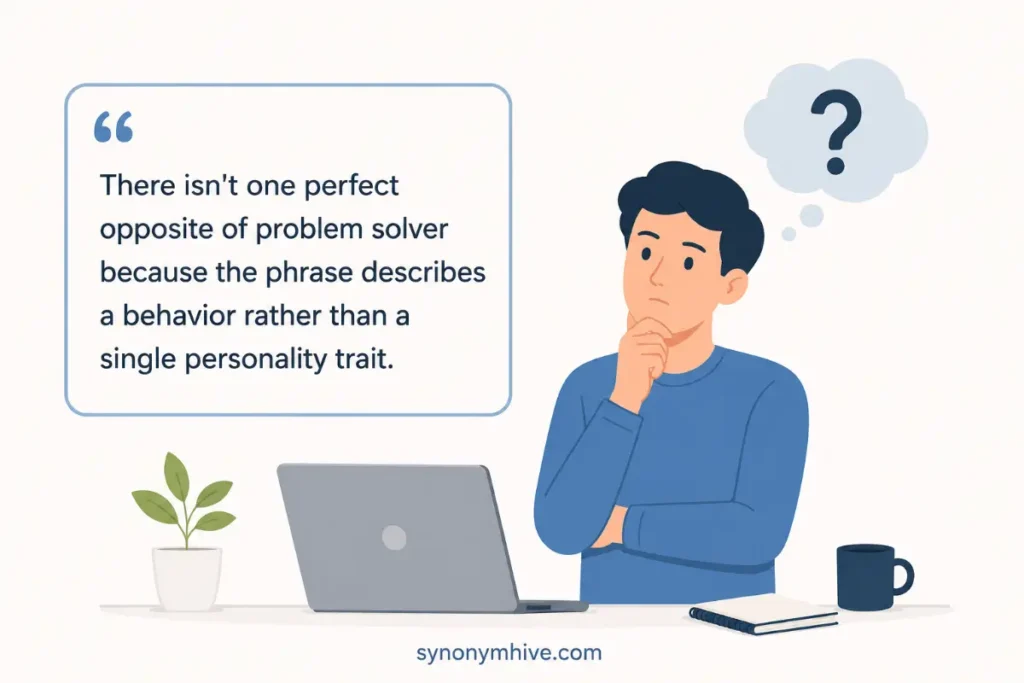
There isn’t one perfect opposite of problem solver because the phrase describes a behavior rather than a single personality trait.
Useful opposites can include obstacle creator, avoider, indecisive person, unhelpful person, or passive person depending on the situation.
For example, someone who avoids difficult issues might be described as an avoider. Someone who makes problems worse could be called an obstacle creator.
In professional writing, it’s usually better to describe the positive behavior you want rather than label someone with a harsh opposite.
Find more synonyms in Another Word For Teamwork Resume Choices 2026.
How Can You Choose The Right Word Quickly
Start by asking what you actually do when a problem appears.
When you identify faults, choose troubleshooter.
After you study information, choose analyst.
Once you create plans, choose strategist.
When you find practical answers with limited resources, choose resourceful.
As you create original ideas, choose innovator or creative thinker.
While you evaluate evidence carefully, choose critical thinker.
Whenever you make urgent choices, choose decisive.
As you bring people together, choose coordinator or mediator.
When you reach agreements, choose negotiator.
As you improve systems, choose process improver or innovator.
This simple approach can help you avoid vague resume language.
How Can You Make Problem Solving Sound Stronger On A Resume
The strongest resume language usually combines a skill with an action and a result.
Instead of:
Strong problem solver.
Try this:
Resolve recurring customer issues by identifying root causes and improving support procedures.
Instead of:
Excellent problem solving skills.
Try this:
Analyze workflow problems and implement practical changes that improve team efficiency.
Instead of:
Creative problem solver.
Try this:
Develop new solutions that simplify customer onboarding and reduce unnecessary steps.
These versions do more than describe a personality trait. They show how the skill affects your work.
A hiring manager can see the problem, the action, and the value.
How Can You Replace Problem Solver With An Action Verb
Sometimes the best replacement isn’t a noun or adjective. It’s a strong verb.
Choose resolve when you fix an issue.
Select diagnose when you identify a cause.
Apply analyze when you study information.
Prefer improve when you make a process better.
Choose troubleshoot when you identify and correct technical problems.
Select develop when you create a solution.
Prefer streamline when you make a process simpler.
Choose mediate when you help people resolve disagreements.
Select negotiate when you work toward an agreement.
Use prevent when your work stops problems before they occur.
For example:
I resolve customer complaints quickly.
I develop practical solutions to recurring operational issues.
These sentences often sound stronger than simply calling yourself a problem solver.
What Is Another Word For Problem Solver In A Cover Letter
A cover letter gives you room to explain how you approach challenges.
Instead of saying:
I am a strong problem solver.
Try this:
I take a practical approach to complex challenges and focus on solutions that improve both customer service and team efficiency.
You can also use a more specific word.
For example:
My resourceful approach helps me find practical answers when projects face unexpected obstacles.
Or:
My analytical approach helps me identify root causes before I recommend a solution.
These examples sound stronger because they connect the skill to your work style.
What Is Another Phrase For Problem Solver In A Job Interview
In an interview, problem solver is completely acceptable. Still, a short story usually makes the answer much stronger.
For example:
I’m very resourceful when unexpected issues come up. In my last role, we had a scheduling problem that affected several customers. I reviewed the available options, adjusted the schedule, and helped the team contact everyone before the issue became larger.
This answer gives the interviewer evidence.
You can also say:
I’m analytical when I solve problems. I like to understand the cause first so I don’t just treat the symptom.
That gives the interviewer a better sense of how you think.
What Is Another Expression For Problem Solver In Business Communication
Business communication benefits from precise terms.
Choose troubleshooter for technical issues.
Select analyst for research and data.
Apply strategist for planning.
Highlight resourceful for adaptability.
Describe yourself as solution focused for customer service and management.
Present yourself as negotiator for agreements.
Use mediator for conflicts.
For example:
Our team needs a strategic approach to the recurring issue.
Maria has been very resourceful in handling customer requests.
James is an excellent troubleshooter for technical problems.
The manager used a solution focused approach to resolve the complaint.
These words make professional communication more specific.
How Can You Describe Problem Solving Without Saying Problem Solver
You can often make your writing stronger by describing the actual behavior.
Instead of saying you are a problem solver, say that you identify root causes.
Instead, say that you resolve customer concerns.
Alternatively, say that you analyze complex information.
For example, say that you improve inefficient processes.
Another option is to say that you develop practical solutions.
You might say that you prevent recurring issues.
In technical roles, say that you troubleshoot technical problems.
For adaptability, say that you manage unexpected challenges.
For leadership, say that you make decisions under pressure.
These phrases show problem solving without using the exact phrase.
What Resume Words Show Strong Problem Solving
Several resume words can communicate strong problem solving.
Resourceful shows that you can work with what you have.
Analytical shows that you examine information carefully.
Strategic shows that you think about goals and direction.
Innovative shows that you create new approaches.
Adaptable shows that you respond well to change.
Decisive shows that you can choose a course of action.
Practical shows that your solutions work in real situations.
Critical thinker shows that you evaluate evidence before deciding.
Troubleshooter shows that you can locate and correct faults.
Solution focused shows that you keep attention on useful results.
The best choice depends on the job. A software support role may value troubleshooting. A marketing role may value creative thinking. A management role may value strategic thinking and decision making.
Why Does Specific Evidence Beat Generic Claims
Many resumes contain broad claims such as hardworking, motivated, organized, and good problem solver.
These words aren’t useless. They simply become stronger when backed by evidence.
Compare these statements:
I am an excellent problem solver.
With:
Reduced recurring customer complaints by reviewing the support process and creating clearer response steps.
The second example gives the reader something concrete. It shows what you noticed, what you changed, and what happened next.
You don’t need to explain every detail. One clear example can communicate more than several adjectives.
What Is The Best Problem Solving Word For Different Jobs
Different careers call for different problem solving language.
When writing about IT and technical support, troubleshooter, diagnostician, analytical, and resourceful are strong choices.
In management, strategist, decisive, solution focused, and strategic thinker can work well.
Within finance, analyst, critical thinker, methodical, and detail oriented can show careful judgment.
For sales roles, negotiator, resourceful, adaptable, and solution focused can describe useful strengths.
In customer service, solution focused, practical, adaptable, and resourceful are natural choices.
Within engineering, troubleshooter, analytical, methodical, and innovator can fit well.
For marketing roles, creative thinker, innovator, strategist, and analytical thinker may be stronger.
In education, adaptable, creative thinker, planner, and critical thinker can describe useful abilities.
The strongest word should connect to the real demands of the role.
How Can You Show Problem Solving In A Resume Summary
Your summary should not simply say that you’re a great problem solver.
Instead, connect the skill to your experience.
For example:
Resourceful customer service professional with experience resolving complex customer concerns and improving support processes.
Or:
Analytical operations professional who identifies workflow problems and develops practical solutions that improve efficiency.
Or:
Strategic project manager who resolves competing priorities and keeps complex projects moving toward key goals.
These summaries give the reader a clear idea of your value.
How Can You Show Problem Solving In Resume Bullet Points
Resume bullet points work best when they describe actions and results. Since the goal is to show problem solving, focus on challenges you noticed and improvements you made.
For example:
Resolved recurring customer complaints by identifying gaps in the support process.
Diagnosed workflow delays and introduced a simpler review system.
Developed a new scheduling process that reduced missed appointments.
Analyzed customer feedback to identify common service issues.
Created a practical solution for tracking urgent requests.
Coordinated multiple teams to resolve a project delay.
Improved reporting procedures by removing unnecessary steps.
These examples show the skill without repeatedly using problem solver.
How Can You Use Problem Solving In A Cover Letter
A cover letter gives you more space to tell a short story.
Start with a real challenge from your experience. Explain what you noticed. Then describe the action you took and the result.
For example:
In my previous role, customer requests were taking too long to reach the right team. I reviewed the process, identified the main delay, and helped create a clearer routing system. The change made it easier for staff to handle requests and helped customers receive faster responses.
This type of example is more convincing than saying you are an excellent problem solver.
It gives the employer a reason to believe the claim.
How Can You Use Problem Solving In An Interview
Interviewers often ask questions about difficult situations because they want to understand how you think.
A strong answer should explain the situation, your responsibility, the action you took, and the result.
Keep the story focused. You don’t need to describe every detail.
For example:
A project was falling behind because two teams were working from different schedules. I brought both groups together, compared their deadlines, and created one shared timeline. The teams followed the new schedule and completed the remaining work on time.
That story demonstrates coordination, communication, planning, and problem solving without relying on a vague claim.
What Is Another Phrase For Problem Solver When You Mean Good At Planning
Strategist is often the strongest choice when solving problems requires planning around larger goals.
Planner is simpler and works when preparation is the main skill.
For example:
She is a strategic planner who anticipates project risks.
Or:
He creates practical plans that keep projects moving when priorities change.
Strategic thinking is especially useful for leadership, management, business development, and project work.
What Is Another Expression For Problem Solver When You Mean Good At Analysis
Analyst and analytical thinker are strong choices.
Use analyst when the role itself involves examining information.
Use analytical thinker when you want to describe the person’s reasoning style.
For example:
She is an analytical thinker who uses customer data to identify service problems.
Or:
He works as an analyst who evaluates business data and recommends improvements.
These choices focus on understanding the cause before deciding what to do.
What Is Another Phrase For Problem Solver When You Mean Creative
Creative thinker and innovator are strong options.
Creative thinker suggests that you approach challenges from different angles.
Innovator suggests that you create or introduce something new.
For example:
She is a creative thinker who develops fresh ways to improve customer engagement.
He is an innovator who creates tools that simplify repetitive work.
Choose creative thinker when ideas are the main strength. Choose innovator when those ideas lead to new products, systems, methods, or improvements.
What Is Another Term For Problem Solver When You Mean Resourceful
Resourceful is one of the strongest broad alternatives.
It describes someone who can find useful solutions even when conditions aren’t ideal.
For example:
She is resourceful when managing unexpected customer requests.
He is resourceful and can find practical solutions with limited time and information.
This word works well across many industries because real workplaces rarely give you perfect conditions.
What Is Another Word For Problem Solver When You Mean Good With People
Mediator and negotiator can be better choices when the problem involves people.
A mediator helps people reach understanding during a disagreement.
A negotiator works toward an agreement between different interests.
For example:
She acts as a mediator when team members disagree.
He is an effective negotiator who finds workable agreements with clients.
Coordinator can also work when the challenge involves getting people and tasks aligned.
These words are more specific than problem solver because they show exactly how you handle people related challenges.
What Are The Most Useful Problem Solving Words For A Resume
If you need a short list, focus on words that communicate a clear professional strength.
Troubleshooter is strong for technical problem solving.
Analyst is strong for research and data.
Strategist is strong for planning and leadership.
Resourceful is strong for practical adaptability.
Innovator is strong for new ideas.
Critical thinker is strong for judgment.
Solution focused is strong for customer service and management.
Decisive is strong for urgent choices.
Negotiator is strong for reaching agreements.
Mediator is strong for resolving conflict.
These choices are more useful than simply replacing problem solver with another broad phrase.

How Can You Choose The Best Word In Five Seconds
Ask what happens after you notice the problem.
When you investigate the cause, choose analyst or diagnostician.
Once you fix a technical issue, choose troubleshooter.
When you create a long term plan, choose strategist.
If you find a practical answer with limited resources, choose resourceful.
When you create a new approach, choose innovator.
As you evaluate evidence, choose critical thinker.
When you make the final call, choose decisive.
If you help people reach an agreement, choose mediator or negotiator.
When you bring several moving parts together, choose coordinator.
This quick test makes your word choice more accurate.
How Can You Make Your Resume Sound More Human
Strong resumes don’t read like lists of impressive adjectives. They show real work.
Instead of filling your resume with words such as innovative, strategic, resourceful, and analytical, connect those qualities to actions.
For example:
Identified recurring service issues and created a clearer process for handling urgent requests.
This sentence shows analytical thinking, problem solving, communication, and process improvement without naming all four qualities.
That is often the best approach. Let the evidence carry the weight.
What Should You Remember About Problem Solving Synonyms
The best synonym depends on the problem and your method.
Choose troubleshooter for faults.
Select analyst for information.
Apply strategist to planning.
Highlight resourceful for practical solutions.
Describe yourself as an innovator for new ideas.
Show critical thinker for careful judgment.
Choose mediator for disagreements.
Select negotiator for agreements.
Highlight decisive for quick choices.
Use coordinator for people and moving parts.
When you choose the word that matches your real work, your writing becomes more credible and easier to understand.
Discover another helpful synonym list in Another Word for Team Player: Best Resume Choices (2026).
Final Takeaway
Choosing another word for problem solver starts with understanding the kind of challenge you handle. A technical expert may be a troubleshooter. A data focused professional may be an analyst. A planner may be a strategist. Someone who finds practical answers under pressure may be resourceful.
For a resume, don’t rely on the label alone. Show how you identify issues, analyze causes, make decisions, develop solutions, or improve results. That evidence makes your skill believable.
The right word should fit your experience and the role you’re targeting. Simple language can be powerful when it says exactly what you mean. Choose the term that gives the reader a clear picture of how you handle challenges and turn them into useful outcomes.
Frequently Asked Questions
What Is Another Term For Problem Solver?
Strong alternatives include troubleshooter, strategist, analyst, innovator, resourceful, critical thinker, and solution focused professional. The best choice depends on the type of problems you handle.
What’s Another Way To Say Problem Solver?
You can say troubleshooter, fixer, strategist, analyst, resourceful thinker, or solution focused professional. In casual speech, fixer or someone who finds a way may sound more natural.
What Is Another Expression For Problem Solver On A Resume?
Another term for problem solver on a resume can be troubleshooter, strategist, analyst, innovator, or resourceful. Choose the word that matches the skill shown in your work.
What Is A Professional Word For Problem Solver?
Troubleshooter, strategist, analyst, and critical thinker are strong professional choices. Resourceful is also useful because it shows practical judgment and adaptability.
What Word Describes Someone Who Finds Solutions?
Resourceful describes someone who can find useful solutions in difficult situations. Troubleshooter is better for someone who identifies and fixes specific faults.
What Is The Difference Between A Troubleshooter And A Problem Solver?
A troubleshooter usually identifies and fixes a specific fault. Problem solver is broader and can describe someone who handles many kinds of challenges.
What Is The Opposite Of A Problem Solver?
There is no single perfect opposite. Depending on the context, you could describe someone as passive, avoidant, indecisive, or unhelpful.