
Writing a resume can get tricky when you reach the leadership section. You may want to show that you can guide people and make decisions. However, you don’t want to repeat the same word in every application. If you’re searching for another word for leadership, you have plenty of strong options such as guidance, direction, management, supervision, influence, authority, initiative, and stewardship.
Another term for leadership can be guidance, direction, management, supervision, authority, influence, or stewardship. The best choice depends on the type of leadership you want to describe.
Leadership isn’t only about having a job title. A person can lead a project without being a manager. Someone can guide a new employee without being a supervisor. Another person can influence a team through expertise and strong communication.
Looking for a better alternative? Visit Another Word for Supported Best Resume Choices 2026.
What does leadership mean in plain English
Leadership means guiding people toward a goal. A leader helps people decide what to do and how to move forward. Good leadership can involve planning, communication, decision making, problem solving, motivation, accountability, and support.
For example:
She showed strong leadership during the project.
This sentence gives a positive impression. However, it doesn’t tell the reader how she led.
A stronger version could be:
She guided a team of eight employees through a major process change.
Now the reader can see the leadership in action.
Leadership can take many forms.
A manager may lead a department.
A teacher may lead students.
A project manager may lead a project.
A senior employee may guide newer team members.
A volunteer may coordinate a community event.
A technical expert may influence decisions without managing anyone.
This is why the best synonym depends on the situation.
If you mean managing employees then management or supervision may fit.
If you mean taking action without being asked then initiative may be the strongest choice.
Where did leadership come from
Leadership comes from the word leader.
Leader is related to the old English verb lædan which meant to guide or lead.
The basic idea has remained surprisingly consistent. Leadership involves showing a path and helping others move toward a destination or goal.
The suffix ship appears in many English words. It can describe a state a condition or a skill connected with something.
For example:
Friendship refers to the relationship between friends.
Partnership describes a relationship between partners.
Leadership describes the quality or position connected with leading.
Over time the word developed beyond simply directing people. Modern leadership can involve service collaboration vision accountability communication and influence.
That broader meaning explains why there are so many useful alternatives.
A manager may demonstrate leadership through organization.
A coach may demonstrate leadership through motivation.
A mentor may demonstrate leadership through guidance.
An executive may demonstrate leadership through strategy.
A team member may demonstrate leadership through initiative.

What is another phrase for leadership
The best alternative depends on the exact meaning.
Guidance describes helping others make progress.
Direction describes showing people what path or action to take.
Management describes organizing people resources or activities.
Supervision describes overseeing work.
Authority describes the power to make decisions or give instructions.
Influence describes the ability to affect people or decisions.
Mentorship describes helping someone develop.
Coordination describes bringing people or activities together.
Stewardship describes responsible care of something important.
Governance describes the systems and practices used to direct an organization.
Oversight describes careful monitoring.
Command describes direct control or authority.
Initiative describes taking action without waiting for instructions.
Vision describes a clear idea of a desired future.
Advocacy describes publicly supporting a person cause or idea.
These aren’t perfect replacements in every sentence.
That matters.
For example:
Her leadership improved the team.
Could become:
Her guidance improved the team.
That works if she helped people improve.
But:
Her management improved the department.
Works better if she organized employees and operations.
The right synonym adds precision.
What are simple synonyms for leadership
Simple English often works best because the reader understands it immediately.
- Guidance.
- Direction.
- Management.
- Support.
- Influence.
- Control.
- Supervision.
- Authority.
- Initiative.
- Mentorship.
These words work in everyday writing and many professional settings.
For example:
His leadership helped the team succeed.
You could write:
His guidance helped the team succeed.
Or:
His direction helped the team stay focused.
Or:
His support helped the team handle the change.
Each version gives the reader a slightly different idea.
What are everyday alternatives for leadership
Everyday English gives you several natural choices.
- Guidance.
- Direction.
- Support.
- Influence.
- Management.
- Initiative.
- Mentoring.
- Supervision.
- Coordination.
- Team guidance.
These options sound natural in conversations and general writing.
For example:
She showed great leadership during the event.
You could say:
She took charge during the event.
Or:
She guided the team through the event.
Or:
She kept everyone organized during the event.
The best choice depends on what she actually did.
What are formal synonyms for leadership
Formal writing offers more precise terms.
- Governance.
- Stewardship.
- Administration.
- Management.
- Supervision.
- Direction.
- Oversight.
- Authority.
- Coordination.
- Strategic guidance.
- Executive direction.
- Organizational management.
These words can work well in reports business documents academic writing and professional resumes.
However formal doesn’t always mean better.
Use the simplest accurate word.
If management explains the role clearly you don’t need governance.
If guidance explains the action you don’t need strategic direction.
Clear writing usually beats complicated wording.
What are casual alternatives for leadership
Casual speech gives you several useful phrases.
- Taking charge.
- Calling the shots.
- Leading the way.
- Showing the way.
- Keeping everyone on track.
- Running the show.
- Stepping up.
- Taking the lead.
- Helping people move forward.
- Keeping the team together.
For example:
She showed leadership during the crisis.
A casual version could be:
She stepped up during the crisis.
Or:
She took charge when things got difficult.
These expressions sound natural in conversation.
They don’t always belong on a formal resume.
What are leadership synonyms for a resume
| Word | Meaning | Tone | Example |
|---|---|---|---|
| Management | Organizing people or resources | Professional | Led daily management of a 15 person team. |
| Supervision | Overseeing employees or work | Professional | Provided supervision for new staff. |
| Direction | Showing people what to do | Professional | Provided direction during a major project. |
| Guidance | Helping people move forward | Professional | Provided guidance to junior employees. |
| Oversight | Monitoring work and progress | Formal | Provided oversight for department operations. |
| Coordination | Bringing activities together | Professional | Coordinated work across four departments. |
| Mentorship | Helping others develop | Professional | Provided mentorship to new team members. |
| Influence | Affecting decisions or behavior | Professional | Influenced strategic planning decisions. |
| Initiative | Acting without waiting | Professional | Took initiative to improve team workflows. |
| Authority | Formal power to make decisions | Formal | Exercised authority over daily operations. |
| Stewardship | Responsible care and management | Formal | Provided stewardship of company resources. |
| Governance | Directing an organization or system | Formal | Supported governance and compliance programs. |
| Administration | Managing operations and systems | Formal | Led administration of regional programs. |
| Command | Direct control | Strong | Served in command during emergency operations. |
| Advocacy | Supporting a cause or group | Professional | Provided advocacy for employee development. |
| Facilitation | Helping a group work effectively | Professional | Facilitated team meetings and planning sessions. |
| Coaching | Developing people through support | Professional | Coached employees toward performance goals. |
| Accountability | Taking responsibility for results | Professional | Built accountability across the sales team. |
| Lead | Directing people or work | Simple | Led a team through a major transition. |
| Facilitation | Helping people reach agreement | Professional | Facilitated discussions between departments. |
| Ownership | Taking responsibility for outcomes | Professional | Took ownership of a high priority project. |
| Influence | Shaping decisions or behavior | Everyday | Influenced the team through clear communication. |
What are leadership synonyms by intensity
Leadership words vary in strength.
Some describe gentle guidance.
Others suggest formal authority.
A useful scale looks like this.
| Intensity | Word | Main idea |
|---|---|---|
| Mild | Support | Helps others succeed |
| Mild | Guidance | Helps people find a path |
| Moderate | Mentorship | Develops another person’s abilities |
| Moderate | Coordination | Brings people together |
| Moderate | Facilitation | Helps groups work together |
| Moderate | Supervision | Oversees work |
| Strong | Management | Directs people and resources |
| Strong | Direction | Sets the path |
| Strong | Authority | Holds decision making power |
| Strong | Command | Gives direct orders |
| Strategic | Governance | Directs systems or organizations |
| Strategic | Stewardship | Protects and manages important resources |
| Strategic | Vision | Sets a future direction |
Use mild terms when your role was supportive.
Use stronger terms when you had real responsibility.
Don’t describe yourself as having authority if you had no authority.
Don’t claim command if you simply coordinated a project.
Accuracy makes professional writing more believable.
What are leadership synonyms by part of speech
Leadership is mainly a noun.
For example:
Her leadership improved team performance.
You can replace it with other nouns.
Guidance improved team performance.
Management improved team performance.
Influence improved team performance.
Supervision improved team performance.
Coordination improved team performance.
You can also use verbs to make resume writing more direct.
Instead of:
Leadership of a team of ten employees.
Write:
Led a team of ten employees.
Instead of:
Leadership of the company transition.
Write:
Directed the company transition.
Instead of:
Leadership in process improvement.
Write:
Led process improvement efforts.
Action verbs often make resumes stronger because they show what you did.
What is the best alternative to leadership on a resume
Management is a strong choice when you managed people or operations.
Direction works when you guided a project or group.
Supervision works when you oversaw employees.
Mentorship works when you developed other people.
Coordination works when you brought multiple activities or groups together.
Initiative works when you acted without waiting for instructions.
Influence works when you shaped decisions without formal authority.
Stewardship works when you were trusted with important resources.
Governance works when you helped direct systems policies or organizational decisions.
The key is to match the word with your actual responsibility.
For example:
Leadership of a customer service team.
Could become:
Managed a customer service team of 12 representatives.
That’s clearer.
Another example:
Leadership during system implementation.
Could become:
Directed system implementation across three departments.
Again the action is specific.
How do you replace leadership on a resume
Start with the action.
Ask yourself what you actually did.
Managed people?
Guided employees?
Coordinated departments?
Made decisions?
Mentored junior staff?
Developed strategy?
Resolved conflicts?
Organized resources?
Influenced senior leaders?
Took ownership?
Your answer determines the strongest word.
For example:
Managed people? Use managed or supervised.
Guided people? Use guided or mentored.
Organized teams? Use coordinated.
Made strategic decisions? Use directed.
Improved systems? Use led.
Influenced decisions? Use advised or influenced.
This approach creates a more useful resume.
What is the best word for leadership on a resume summary
The best choice depends on the position.
Managers use management.
Executives use strategic direction or governance.
Project managers use project leadership or coordination.
Team leads use team management or supervision.
Mentors use coaching or mentorship.
Senior specialists use influence initiative or guidance.
Operations professionals use oversight or management.
Nonprofit professionals use stewardship or advocacy.
Sales professionals use team management coaching or direction.
For example:
Experienced manager with a strong record of team development and operational improvement.
This is more specific than:
Strong leadership skills.
What is another expression for leadership skills
Leadership skills can include communication decision making delegation coaching problem solving planning accountability mentoring and conflict resolution.
You can also describe them as:
- Management abilities.
- Team management skills.
- Supervisory skills.
- Decision making abilities.
- People management skills.
- Coaching abilities.
- Strategic planning skills.
- Communication strengths.
- Organizational abilities.
- Team building skills.
However a resume shouldn’t simply list leadership skills.
Show them through accomplishments.
Instead of:
Excellent leadership skills.
Write:
Managed a team of 15 employees and increased project completion rates by 22 percent.
That sentence demonstrates leadership.
What is another expression for leadership experience
Management experience is useful when you’ve formally managed people.
Supervisory experience works when you’ve overseen employees.
Team management experience is useful for people focused roles.
Project leadership experience works when you’ve led projects.
Mentorship experience works when you’ve developed others.
Strategic experience works when you’ve shaped long term decisions.
For example:
Five years of leadership experience.
Could become:
Five years of team management experience across sales and customer service operations.
That’s much more informative.
What is another word for leadership qualities
Leadership qualities can be described as:
- Initiative.
- Accountability.
- Integrity.
- Communication.
- Confidence.
- Decision making.
- Empathy.
- Adaptability.
- Vision.
- Responsibility.
- Problem solving.
- Delegation.
- Organization.
- Resilience.
- Collaboration.
These aren’t direct synonyms for leadership.
They are qualities that support effective leadership.
That distinction matters.
For example:
Integrity isn’t another term for leadership.
It’s a leadership quality.
Communication isn’t another term for leadership.
It’s a leadership skill.
Management isn’t exactly a synonym either.
It’s a type of leadership activity.
Precise language helps readers understand your meaning.
What is the best word for leadership in an essay
Guidance direction influence management authority governance and stewardship can work in essays.
The best option depends on your topic.
For example:
The president’s leadership influenced public opinion.
You might write:
The president’s influence shaped public opinion.
If you’re discussing how an organization was run:
The organization’s governance changed after the reform.
If you’re discussing responsible care:
Her stewardship protected the community’s resources.
If you’re discussing a person’s ability to guide others:
His guidance helped the group overcome the crisis.
Avoid forcing formal synonyms into academic writing.
Use the word that fits the idea.
What is the best word for leadership in an email
Professional emails usually benefit from simple language.
Use:
Guidance.
Direction.
Management.
Support.
Oversight.
Coordination.
For example:
Thank you for your leadership during the project.
You could write:
Thank you for your guidance during the project.
Or:
Thank you for coordinating the project so effectively.
Or:
Your direction helped the team stay focused.
These versions sound warm and professional.
What is the best word for leadership in texting
Texting usually needs casual language.
Try:
- Taking charge.
- Stepping up.
- Leading the way.
- Keeping everyone on track.
- Running the show.
- Taking the lead.
- Guiding everyone.
For example:
She showed great leadership.
You could text:
She really stepped up.
Or:
She took charge when everyone needed help.
These phrases sound more natural in casual communication.
What is the best word for leadership when speaking
Guidance influence management direction and initiative are easy to use in conversation.
For example:
He has strong leadership skills.
You could say:
He’s great at guiding people.
Or:
She’s really good at keeping the team focused.
Or:
He knows how to take charge when things get difficult.
Natural speech doesn’t need complicated vocabulary.
Clear words usually make the strongest impression.
Expand your vocabulary with Another Word for Flexible: Best Resume Choices 2026.
What are examples of leadership synonyms in real situations
The right word becomes easier to understand when you see it in context.
- Her guidance helped the new employees adjust to their roles.
- His management improved productivity across the department.
- She provided direction during a difficult client project.
- His supervision helped the team maintain high quality standards.
- Her mentorship helped three junior employees prepare for promotions.
- He used his influence to gain support for the new strategy.
- Her coordination brought four departments together.
- His initiative helped the company solve a recurring customer problem.
- Her stewardship protected important company resources.
- His governance work improved compliance across the organization.
- She took ownership of the project and delivered it ahead of schedule.
- He coached new managers through difficult employee conversations.
- She facilitated discussions between teams with different priorities.
- He directed a major system transition across several locations.
- She supervised a team of 20 employees during a period of rapid growth.
- He mentored interns and helped them build practical workplace skills.
- She influenced senior executives through clear data and strong recommendations.
- He coordinated the launch across marketing sales and operations.
- She developed a clear strategy for improving customer retention.
- He created a shared vision that helped the team stay focused.
- She strengthened accountability by setting clear goals and regular reviews.
- He delegated responsibilities based on each employee’s strengths.
- She resolved conflicts quickly and kept the team focused on its goals.
- He led the department through a major organizational change.
- She took charge when the project faced an unexpected delay.
These examples show that leadership is an action as much as a quality.
How are leadership and management different
Leadership and management overlap but they aren’t identical.
| Leadership | Management |
|---|---|
| Focuses on direction and influence | Focuses on organization and execution |
| Often involves vision | Often involves processes |
| Can happen without a formal title | Often comes with formal responsibility |
| Encourages people toward goals | Organizes people and resources |
| Can shape culture | Can maintain systems |
A manager can be a leader.
A leader doesn’t always need to be a manager.
For example a senior engineer may guide technical decisions without managing employees.
That person demonstrates leadership through expertise and influence.
A department manager may demonstrate leadership through strategy while also handling schedules budgets and performance reviews.
When writing a resume choose the word that reflects the actual work.
How are leadership and authority different
Leadership is broader than authority.
Authority comes from formal power.
Leadership can come from trust knowledge experience communication or influence.
A manager may have authority because of their position.
A respected employee may have leadership influence without having formal authority.
For example:
She had authority over the department.
This means she had formal decision making power.
She had influence across the department.
This means people listened to her or were affected by her ideas.
The distinction can make a big difference in professional writing.
How are leadership and influence different
Influence means affecting what people think decide or do.
Leadership can include influence but involves more than influence.
A person can influence a decision without leading a team.
For example:
The analyst influenced the company’s pricing strategy.
That doesn’t necessarily mean the analyst managed anyone.
If the analyst guided the team responsible for pricing then leadership may be appropriate.
Use influence when the main idea is impact.
Use leadership when the main idea is guiding people or directing action.
How are leadership and supervision different
Supervision is more specific.
It means overseeing someone’s work.
Leadership is broader and can include vision motivation strategy communication and influence.
For example:
She supervised ten employees.
This tells us about her formal responsibility.
She led ten employees through a major organizational change.
This tells us about direction and change.
Both can be accurate.
The better word depends on what you want the reader to notice.
What are common mistakes when replacing leadership
One common mistake is treating every leadership related word as an exact synonym.
They aren’t.
Management means organizing and directing.
Mentorship means developing another person.
Influence means affecting decisions.
Supervision means overseeing work.
Governance means directing systems or organizations.
Initiative means taking action.
Stewardship means responsible care.
Another mistake is using overly powerful language.
Don’t write:
Commanded a team of 15 employees.
If you simply coordinated them.
Don’t write:
Governed the department.
If you only assisted the manager.
Don’t write:
Directed company strategy.
If you only contributed research.
Accurate language builds credibility.
When should you not use leadership
Avoid leadership when you can describe the action more clearly.
For example:
Leadership of customer onboarding.
Could become:
Managed customer onboarding for 200 new accounts.
That’s stronger.
Another example:
Leadership in process improvement.
Could become:
Led a process improvement project that reduced processing time by 25 percent.
The second version gives the reader evidence.
Leadership is useful as a broad concept.
Specific actions are usually better in resumes.
What are the antonyms of leadership
Leadership doesn’t have one perfect opposite.
Possible contrasting ideas include:
- Followership.
- Submission.
- Passivity.
- Dependence.
- Disorganization.
- Inaction.
- Neglect.
These words describe different contrasts.
Followership means taking the role of a follower.
Passivity means not taking action.
Dependence means relying heavily on others.
Disorganization describes a lack of structure.
Inaction means failing to act.
Use the opposite that matches the specific idea.
Can leadership exist without a job title
Yes.
Leadership doesn’t always require formal authority.
A person can lead by solving problems communicating clearly helping others and taking responsibility.
For example a junior employee may notice a recurring issue and create a better process.
That employee may not manage anyone.
Still the initiative demonstrates leadership.
A strong resume can show this through action.
Instead of:
Demonstrated leadership skills.
Write:
Identified a recurring reporting problem and created a new process that reduced errors by 30 percent.
That accomplishment shows initiative problem solving ownership and leadership.
How can you prove leadership on a resume
Use evidence that shows responsibility influence and results.
Strong evidence can include:
- Team size.
- Project size.
- Budget responsibility.
- Revenue impact.
- Efficiency gains.
- Employee development.
- Process improvements.
- Customer results.
- Project completion.
- Promotions.
- Cross department coordination.
- Strategic decisions.
For example:
Managed a team of 18 employees and improved monthly productivity by 24 percent.
This is stronger than:
Excellent leadership skills.
Another example:
Mentored six junior employees with five earning expanded responsibilities within one year.
That sentence demonstrates leadership through development.
How can you show leadership without saying leadership
Use strong action verbs.
Led.
Managed.
Directed.
Supervised.
Coordinated.
Mentored.
Coached.
Guided.
Facilitated.
Developed.
Organized.
Influenced.
Delegated.
Advised.
Initiated.
Improved.
Built.
Created.
Resolved.
Implemented.
For example:
Led a cross functional team through a six month software transition.
That sentence already shows leadership.
You don’t need to add:
Demonstrated strong leadership skills.
The action speaks for itself.
What leadership words work best for different jobs
Different roles call for different language.
Managers use managed supervised directed and coached.
Executives use strategic direction governance stewardship and organizational leadership.
Project managers use coordinated facilitated directed and led.
Teachers use guided mentored coached and developed.
Sales managers use coached motivated directed and managed.
Nonprofit leaders use advocacy stewardship coordination and community engagement.
Technical professionals use influenced advised guided and led.
Customer service leaders use coached supervised supported and managed.
Operations professionals use managed coordinated improved and oversaw.
Human resources professionals use coached mentored advised and facilitated.
The job description should guide your choice.
Look at the responsibilities.
Then choose language that matches those responsibilities.
How can you choose the right leadership synonym quickly
Start with the action.
Ask yourself what you actually did.
Managed people? Use management.
Oversaw work? Use supervision.
Helped someone grow? Use mentorship.
Brought groups together? Use coordination.
Helped people make progress? Use guidance.
Shaped decisions? Use influence.
Made important choices? Use authority or direction.
Took action without being asked? Use initiative.
Protected resources? Use stewardship.
Directed systems? Use governance.
Created a future plan? Use vision or strategy.
If you developed employees use coaching or mentoring.
This approach makes your writing more precise.
How can you make leadership sound stronger on a resume
Don’t rely on vague claims.
Show scope.
Show results.
Weak:
Strong leadership skills.
Better:
Led a team of ten employees through a major process change.
Stronger:
Led a team of ten employees through a process change that reduced customer response time by 35 percent.
The final sentence gives the reader evidence.
Another example:
Weak:
Demonstrated leadership in sales.
Better:
Managed a regional sales team.
Stronger:
Managed a regional sales team that exceeded annual revenue targets by 17 percent.
Results make leadership easier to believe.
What should you use instead of leadership skills
Choose the exact skill.
For example:
Team management.
Decision making.
Strategic planning.
Employee coaching.
Conflict resolution.
Delegation.
Communication.
Project coordination.
Performance management.
Mentorship.
Change management.
Stakeholder communication.
These terms are more specific than leadership skills.
Instead of:
Strong leadership skills.
Write:
Strong team management and employee coaching skills.
Or:
Experienced in strategic planning and cross functional coordination.
Specific language helps employers understand what you can actually do.
What is the best word for someone who leads a team
Manager works when the person formally manages employees.
Supervisor works when the person oversees employees.
Team lead works when the person leads a team without necessarily being a formal manager.
Coordinator works when the person organizes activities.
Mentor works when the main role involves developing others.
Coach works when the focus is performance and development.
Leader is the broadest term.
Choose the title that accurately reflects the person’s role.
What is the best word for someone who guides others
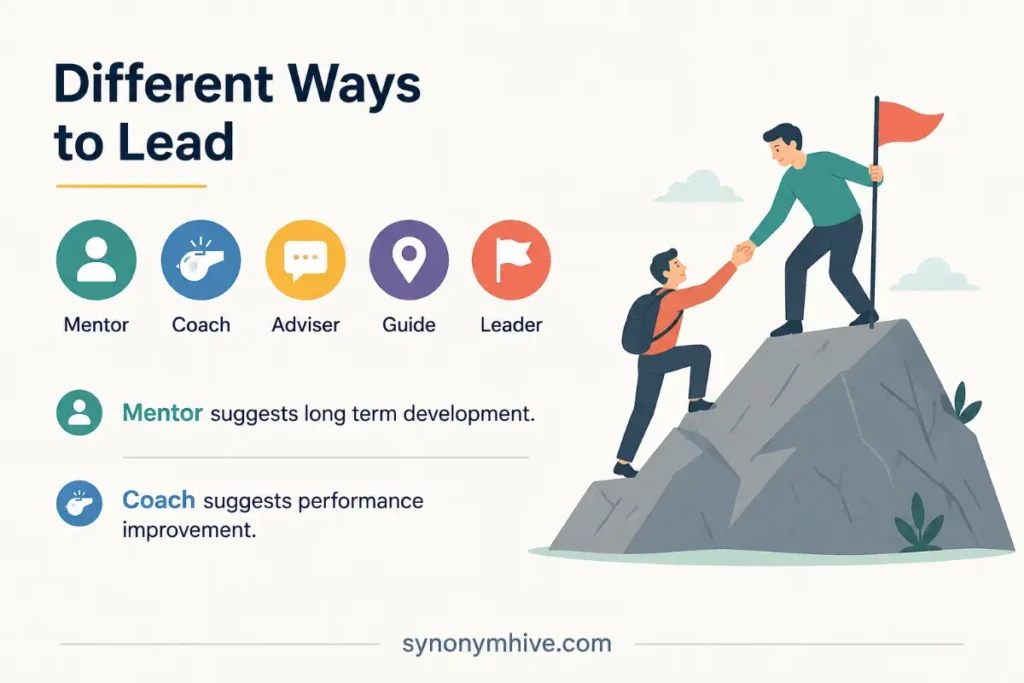
Mentor coach adviser guide and leader can work.
Mentor suggests long term development.
Coach suggests performance improvement.
Adviser suggests expert guidance.
Guide is simple and broad.
Leader suggests broader responsibility and direction.
For example:
She mentored five new employees.
This means she helped them develop.
She coached five employees.
This suggests performance focused support.
She advised five employees.
This suggests expert recommendations.
Each word creates a different picture.
What is the best word for someone who takes charge
Determined proactive decisive confident responsible and assertive can work.
In casual speech you can say:
She stepped up.
He took charge.
They led the way.
In professional writing use precise action verbs.
For example:
Took ownership of a delayed project and brought it back on schedule.
That sounds stronger than:
Was good at taking charge.
What is the best word for leadership in a recommendation letter
Dedicated management guidance initiative influence mentorship and direction can work well.
For example:
Her leadership helped our department adapt to major changes.
You could write:
Her guidance helped our department adapt to major changes.
Or:
Her initiative helped the department adopt a more efficient process.
Or:
Her mentorship helped several junior employees develop professionally.
Specific praise feels more credible than broad praise.
What is the best word for leadership in an interview
Use natural language.
You don’t need to force formal vocabulary.
You can say:
I led a team of eight people.
I guided the team through a difficult transition.
These answers sound confident because they describe real actions.
Looking for a better alternative? Visit Another Word for Effective Best Resume Words for 2026.
Conclusion
Choosing another term for leadership starts with understanding the exact kind of leadership you want to describe. Use management for organizing people and resources. Choose supervision for overseeing work. Use guidance for helping others move forward. Pick mentorship for developing people. Choose influence when your ideas shape decisions. Use initiative when you take action without waiting. Stewardship works for responsible care while governance fits organizational direction.
On a resume the strongest choice is often an action verb supported by evidence. Instead of simply claiming leadership skills describe the team you managed the project you directed the problem you solved or the result you achieved. That approach makes your experience easier to understand and much more convincing.
Good professional writing doesn’t need fancy words. It needs accurate words that show what you actually did. Choose the term that fits your experience and let the results give it weight.
Frequently Asked Questions
What’s another way to say leadership?
Another term for leadership can be guidance direction management supervision influence authority initiative mentorship coordination or stewardship. The best choice depends on the type of leadership you mean.
What is another term for leadership on a resume?
Another phrase for leadership on a resume can be management supervision direction coordination mentorship influence or initiative. Specific action verbs often work better than broad nouns.
What is a professional way to say leadership?
Professional alternatives include management supervision direction governance stewardship oversight mentorship and strategic guidance. Choose the term that matches your actual responsibilities.
What can I say instead of leadership skills on a resume?
You can name the exact skill such as team management decision making coaching delegation strategic planning conflict resolution or project coordination. Specific skills give employers a clearer picture of your abilities.
What is the best synonym for leadership experience?
Management experience works for formal people management. Supervisory experience fits employee oversight while project leadership experience works for people who have directed major projects.
How do I show leadership without saying leadership?
Show what you led managed improved coordinated or developed. Add measurable results such as team size project scope revenue growth cost savings or efficiency gains.
Is leadership a good word for a resume?
Leadership is a useful resume word but it can be too broad by itself. Specific action verbs and measurable achievements usually make the claim stronger.