
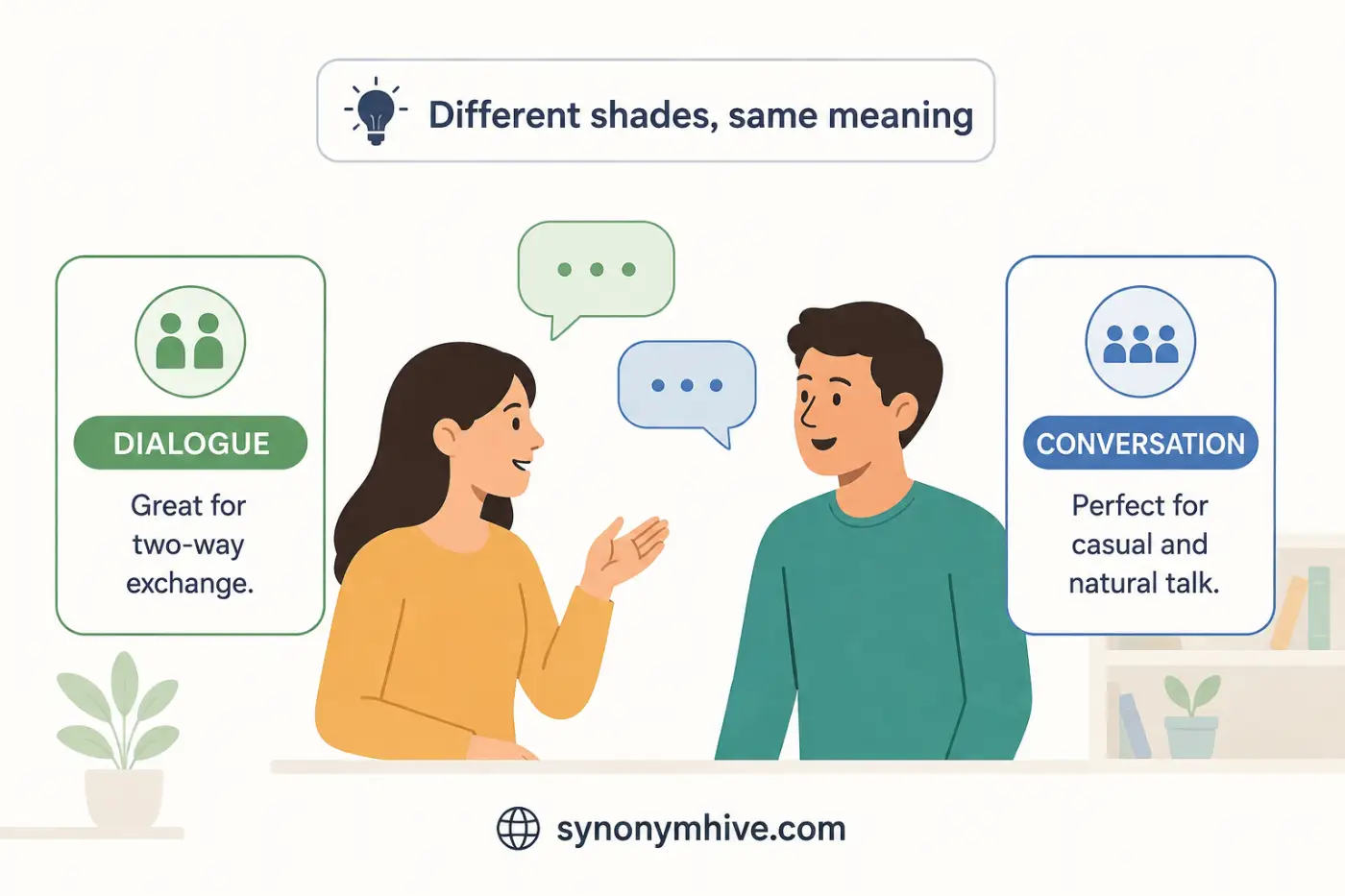
You’re writing a resume and want to describe yourself as motivated without using the same word everyone else uses. Maybe you’re working on an essay and need a stronger personality word. You might also be writing an email or text and want a natural way to describe someone who’s ready to act. That’s when finding another word for motivated can make your sentence sharper.
The best choice depends on what drives the person. Ambitious points to big goals. Determined shows persistence. Driven suggests strong inner energy. Eager shows excitement. Dedicated highlights commitment. Self directed shows independence.
Other strong choices include ambitious, determined, eager, dedicated, committed, and purposeful.
This guide explains what motivated means and where the word comes from. You’ll also get more than 30 alternatives grouped by tone and intensity. Then we’ll compare close synonyms and show which word works best for resumes, essays, emails, texts, interviews, and everyday speech.
Expand your vocabulary with Another Word for Ambitious: Best Choices (2026).
What does motivated mean in plain English
Motivated means having a reason or desire to do something. A motivated person wants to reach a goal and has enough drive to take action.
The word often describes someone who works hard because they have a clear purpose. That purpose might come from personal ambition, a reward, responsibility, curiosity, or a desire to help others.
For example.
- She’s motivated to finish her degree.
This means she has a strong reason to keep working toward graduation.
- He’s motivated by the chance to build his own business.
This tells us what pushes him forward.
- The team stayed motivated after losing the first game.
This means the team kept its energy and desire to succeed.
Motivation doesn’t always mean ambition. A person can be motivated by kindness or responsibility too. A parent may be motivated to provide a better life for their children. A student may be motivated by curiosity. An employee may be motivated by a desire to solve difficult problems. That’s why the right synonym depends on the reason behind the action.
Where did motivated come from
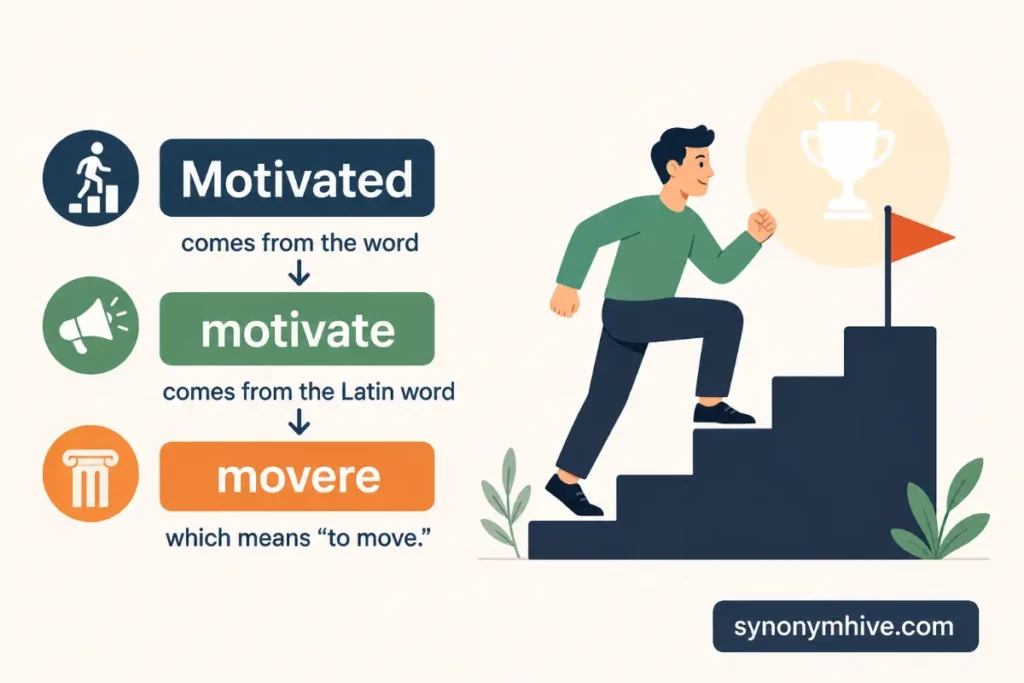
Motivated comes from the word motivate. Motivate comes from the Latin word movere which means to move. That origin gives the word a useful image. Motivation is something that moves a person toward action.
English later developed motivate as a verb for causing someone to act. Motivated became the adjective used to describe someone who has a reason or desire to take action. Today the word appears everywhere.
You’ll see it in job descriptions. Teachers use it when talking about students. Coaches use it with athletes. Managers use it when discussing employees. People also use it in everyday conversations about goals and personal growth.
The word has a broad meaning. It can describe someone who is ambitious and competitive. It can also describe someone who simply has enough energy and purpose to keep moving forward.
What is another phrase for motivated
There are many useful alternatives. Each one adds a slightly different shade of meaning. Some words are simple and natural. Others sound more formal. A few work best in casual speech.
Here is a broad synonym guide.
| Word | Meaning | Tone | Example |
|---|---|---|---|
| Driven | Strongly pushed toward a goal | Strong | She’s driven to succeed. |
| Focused | Concentrating strongly on a goal | Professional | He stays focused on his targets. |
| Persistent | Keeps trying despite problems | Strong | She’s persistent when challenges arise. |
| Tenacious | Refuses to give up | Strong | He’s a tenacious problem solver. |
| Aspiring | Working toward a future goal | Professional | He’s an aspiring entrepreneur. |
| Self directed | Able to work independently | Professional | She’s a self directed learner. |
| Diligent | Careful and hardworking | Formal | He’s diligent with every assignment. |
| Zealous | Extremely enthusiastic | Strong | She’s a zealous supporter of the cause. |
| Spirited | Full of energy and enthusiasm | Friendly | He gave a spirited performance. |
| Inspired | Filled with a strong desire to act | Positive | She felt inspired to help others. |
| Ready | Prepared and willing to act | Simple | He’s ready to take on the challenge. |
| Willing | Open to making an effort | Simple | She’s willing to learn new skills. |
| Fired up | Very excited and energetic | Casual | The players are fired up for the game. |
| Psyched | Very excited | Slang | I’m psyched about the opportunity. |
| Hungry | Strongly eager for success | Casual | She’s hungry for a chance to prove herself. |
| Go getter | Someone who actively pursues goals | Casual | He’s a real go getter. |
| Hustling | Working hard toward a goal | Casual | She’s hustling to build her business. |
| Ambitious | Strongly focused on achievement | Professional | They’re ambitious and ready to grow. |
Some entries overlap because motivation can come from several qualities. Still, the differences matter when you want your writing to sound precise.
Which synonym is closest to motivated
Driven is one of the closest choices when motivated means strongly pushed toward a goal.
Determined is close too. However, determined focuses more on refusing to quit.
Dedicated focuses on long term effort.
Ambitious focuses on achievement and success.
Eager focuses on excitement and willingness.
Committed focuses on loyalty to a goal or responsibility.
Proactive focuses on taking action without waiting for instructions.
For example.
She’s motivated to improve her writing.
She’s driven to improve her writing.
These sentences are very close.
Now compare.
She’s determined to improve her writing.
This suggests she won’t give up.
She’s dedicated to improving her writing.
This suggests she consistently puts time and effort into it.
She’s eager to improve her writing.
This suggests excitement and readiness.
Each word changes the picture slightly.
What are mild synonyms for motivated
Sometimes motivated sounds too strong. You may simply want to show interest or willingness.
Eager is a good choice when someone is excited to act.
Willing works when the person is open to making an effort.
Interested works when curiosity matters more than action.
Ready works when the person has prepared and wants to begin.
Keen can show strong interest and eagerness.
For example.
He’s interested in learning more about the position.
He’s ready to take on the position.
The first sentence shows curiosity. The second shows enthusiasm. The third shows preparation and willingness.
Choosing the softer word can make your writing more accurate.
What are strong synonyms for motivated
When you want more force you can use driven, determined, ambitious, persistent, tenacious, resolute, or zealous.
Driven suggests an inner force.
Determined suggests persistence.
Ambitious suggests a desire for achievement.
Persistent suggests repeated effort.
Tenacious suggests toughness when facing obstacles.
Resolute suggests firmness and strong decision making.
Zealous suggests extreme enthusiasm.
These words aren’t identical. Think about what the person actually does.
Someone who keeps pushing hard toward success may be driven.
Someone who refuses to let obstacles stop them may be tenacious.
How do motivated synonyms change by intensity
You can picture motivation as a scale.
| Level | Words | Main idea |
|---|---|---|
| Mild | Interested | Wants to know more |
| Mild | Willing | Open to making an effort |
| Mild | Ready | Prepared to act |
| Moderate | Eager | Excited to act |
| Moderate | Enthusiastic | Positive energy |
| Moderate | Focused | Concentrated on a goal |
| Strong | Dedicated | Consistent commitment |
| Strong | Committed | Firm attachment to a goal |
| Strong | Determined | Refuses to quit |
| Strong | Driven | Strong inner push |
| Very strong | Ambitious | Strong desire for achievement |
| Very strong | Persistent | Keeps trying |
| Very strong | Tenacious | Refuses to surrender |
| Very strong | Resolute | Firm and unwavering |
| Extreme | Zealous | Extremely enthusiastic |
This scale helps you avoid exaggeration.
For example a person who simply wants to learn a new skill may be eager. Calling that person zealous could sound strange.
On the other hand a person who spends years working toward a major goal might genuinely be driven or determined.
What parts of speech relate to motivated
Motivated is an adjective.
The noun form is motivation.
The verb is motivate.
You can also use related nouns such as drive, ambition, determination, dedication, commitment, persistence, and enthusiasm.
For example.
She’s motivated to succeed.
She has strong motivation to succeed.
She’s driven to succeed.
She has strong drive and ambition.
She’s determined to succeed.
Her determination is clear.
Changing the form can make your writing more natural. It also helps you avoid repeating motivated several times in one paragraph.
What is the best word for motivated on a resume
Driven, dedicated, proactive, ambitious, and goal oriented are strong resume choices.
However, don’t simply replace motivated with another adjective. Show the behavior behind the word.
Weak.
I’m a highly motivated employee.
Stronger.
I’m a proactive employee who identifies problems and finds practical solutions.
Even stronger.
I introduced a new tracking process that reduced response times by 15 percent.
The final example gives evidence. That matters because employers want to know what your motivation produces.
What is the best word for motivated on a resume
Driven works well when you want to show ambition.
Example.
I’m a driven professional focused on improving customer satisfaction.
Dedicated works when consistency matters.
Example.
I’m a dedicated team member with a strong record of meeting deadlines.
Proactive works when initiative matters.
Example.
I take a proactive approach to solving customer problems.
Goal oriented works when results matter.
Example.
I’m a goal oriented professional who consistently meets quarterly targets.
What is the best word for motivated in an essay
Determined and driven often work well in essays.
Dedicated and committed can sound more measured.
Ambitious works when the subject involves future goals or achievement.
For example.
The young entrepreneur was determined to build a business that could support local workers.
You could also write.
The young entrepreneur was driven by a desire to create new opportunities.
The first sentence focuses on persistence. The second focuses on the force behind the person’s actions.
Academic writing benefits from exact meaning. Avoid choosing an unusual synonym simply because it sounds impressive.
What is the best word for motivated in a text
Texting usually calls for simple language.
Eager, excited, fired up, psyched, ready, and pumped are natural choices.
For example.
I’m really excited to start.
I’m really motivated to finish this tonight.
Casual writing gives you room to sound relaxed. A formal word such as resolute would probably feel out of place in a normal text.
What is the best word for motivated in an email
Professional emails usually work best with driven, eager, enthusiastic, committed, or excited.
For example.
I’m excited to contribute to the project
I’m enthusiastic about the opportunity to work with your organization.
These phrases sound positive without becoming overly dramatic.
What is the best word for motivated in speaking
In everyday speech use simple words.
Driven, excited, determined, eager, focused, and ready are easy to understand.
For example.
She drives herself to succeed. He determines to make it work. I look forward to getting started. They focus on winning.
He’s eager to learn.
Natural speech doesn’t need complicated vocabulary. Clear words usually have more impact.
What is the best word for motivated in a job interview
Driven and proactive are strong choices in interviews.
Driven shows ambition.
Proactive shows initiative.
Determined shows persistence.
Dedicated shows commitment.
A good interview answer should connect the word to an example.
For example.
In my last role I noticed that customers were waiting too long for responses so I created a simple tracking system that helped the team respond faster.
That answer gives the interviewer something concrete.
The word itself isn’t the proof. Your experience is.
What is another expression for motivated at work
Dedicated, driven, proactive, committed, focused, and goal oriented are useful choices.
Each one describes a different workplace strength.
Dedicated suggests reliable effort.
Driven suggests ambition.
Proactive suggests initiative.
Committed suggests loyalty to the goal.
Focused suggests concentration.
Goal oriented suggests attention to results.
For example.
She’s a dedicated employee.
He’s a proactive manager.
They’re highly focused on customer needs.
She’s goal oriented and consistently meets deadlines.
These choices are more specific than simply saying motivated.
What is another synonym for motivated to learn
Curious, eager, interested, enthusiastic, and self directed work well.
Curious emphasizes the desire to understand.
Eager emphasizes excitement.
Interested emphasizes attention.
Enthusiastic emphasizes positive energy.
Self directed emphasizes independence.
For example.
She’s a curious learner who enjoys exploring new ideas.
He’s eager to develop new technical skills.
She’s a self directed learner who regularly studies outside work.
The best word depends on what kind of learner you want to describe.
What is another term for motivated to succeed
Driven, ambitious, determined, goal oriented, and hungry are common choices.
Driven sounds professional.
Ambitious focuses on achievement.
Determined focuses on persistence.
Goal oriented focuses on results.
Hungry is more casual and energetic.
For example.
She’s driven to succeed.
He’s ambitious and focused on long term growth.
She’s determined to succeed despite the setbacks.
He’s hungry for the chance to prove himself.
How do motivated and driven differ
Motivated and driven are close but driven usually sounds stronger.
| Motivated | Driven |
|---|---|
| Has a reason to act | Feels a strong push toward a goal |
| Can describe many types of motivation | Often suggests ambition |
| Broad and neutral | Stronger and more forceful |
| Works in many situations | Often fits careers and achievement |
Consider these examples.
She works hard to prepare for the exam.
She strives to become the best student in her class.
The first sentence shows a desire to act. The second adds strong ambition.
Use driven when you want more energy.
How do motivated and determined differ
Motivated means you want to act.
Determined means you intend to keep going.
That distinction is small but useful.
A student can be motivated to study because an exam is coming.
A determined student keeps studying even after receiving a poor grade.
Determination includes persistence.
So if the sentence focuses on overcoming obstacles use determined.
If it focuses on the reason for taking action use motivated.
How do motivated and ambitious differ
Motivated is broad.
Ambitious is strongly connected to achievement.
A motivated person may want to learn a new hobby.
An ambitious person may want to become a leader in that field.
Ambition usually points toward a larger goal.
For a career focused sentence ambitious can be more precise.
For a general sentence motivated may be better.
How do motivated and dedicated differ
Motivated describes the desire to act.
Dedicated describes ongoing commitment.
A motivated employee may work hard to complete a project.
A dedicated employee keeps putting in effort over time.
Dedicated often sounds stronger in professional writing because it suggests consistent behavior.
How do motivated and proactive differ
Motivated describes internal desire.
Proactive describes action taken before someone asks.
A motivated employee wants to improve a process.
A proactive employee notices a problem and starts fixing it.
The two qualities can work together.
She’s motivated to improve the department and takes a proactive approach to solving problems.
That sentence gives both the reason and the behavior.
What are common mistakes with motivated
One common mistake is treating motivated and hardworking as exact synonyms.
They overlap but they aren’t the same.
Hardworking describes effort.
Motivated describes the reason or desire behind that effort.
Another mistake is using highly motivated without evidence.
This phrase appears so often in resumes that it can lose impact.
A third mistake is calling someone motivated when the sentence actually means skilled.
A skilled employee knows how to do something well. A motivated employee wants to do it.
A fourth mistake is choosing a synonym that is too strong.
Calling someone fanatical about a job can sound negative. Calling them dedicated usually sounds more professional.
When should you not use motivated
Don’t use motivated when you mean experienced.
Use experienced or seasoned.
Don’t use motivated when you mean talented.
Use skilled or capable.
Don’t use motivated when you mean persistent.
Use determined or persistent.
Don’t use motivated when you mean ambitious.
Use driven or ambitious.
Don’t use motivated when you mean excited.
Use enthusiastic or eager.
Don’t use motivated when you mean independent.
Use self directed or autonomous.
Precise vocabulary makes your writing clearer.
What are the antonyms of motivated
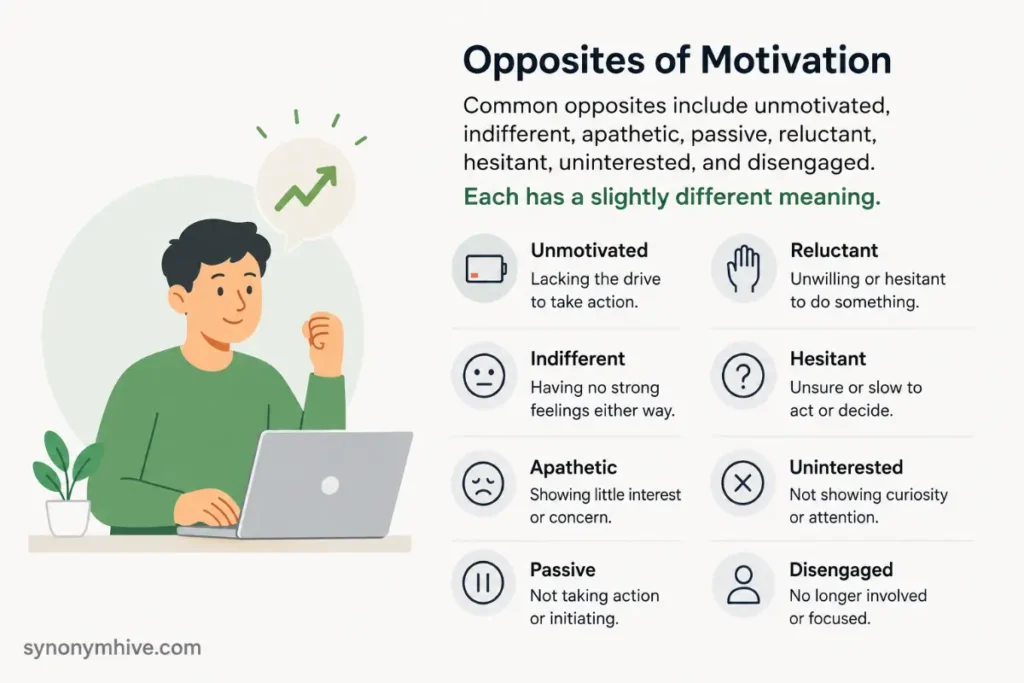
Common opposites include unmotivated, indifferent, apathetic, passive, reluctant, hesitant, uninterested, and disengaged.
Each has a slightly different meaning.
Unmotivated means lacking motivation.
Indifferent means not caring much.
Apathetic suggests a lack of interest or concern.
Passive suggests a lack of action.
Reluctant means unwilling or hesitant.
Disengaged means no longer actively involved.
For example.
She’s motivated to improve.
She’s disengaged from the project.
The second sentence doesn’t simply say she lacks motivation. It suggests she has stopped actively participating.
How can you choose the right synonym quickly
Start with the reason behind the action.
If the person wants success use ambitious or driven.
If they feel strong enthusiasm use enthusiastic.
This simple approach keeps your word choice natural.
How can you show motivation without saying motivated
The strongest writing often shows motivation through action.
Instead of saying.
She’s motivated to help students.
Write.
She stays after class to help students who need extra support.
Instead of saying.
He’s motivated to improve sales.
Write.
He studies customer feedback each week and uses it to improve his sales approach.
Instead of saying.
I’m motivated to learn coding.
Write.
I spend several evenings each week building small coding projects.
These examples feel more convincing because they give the reader something they can picture.
Actions carry weight.
What are natural examples of motivated synonyms
Here are examples from real situations.
- She’s driven to become a better leader.
- He’s eager to learn the new software.
- I’m determined to finish the course this year.
- She’s dedicated to helping new employees succeed.
- He’s ambitious and wants to build his own company.
- They’re committed to improving the customer experience.
- She takes a proactive approach to solving problems.
- He’s focused on reaching his quarterly goals.
- The students were enthusiastic about the science project.
- She’s persistent even when the work becomes difficult.
- He’s a tenacious negotiator who keeps looking for solutions.
- I’m excited to start my new position.
- She’s a self directed learner who enjoys studying new subjects.
- He’s hungry for a chance to prove himself.
- The team was fired up before the championship game.
- She’s an aspiring writer who spends time practicing every day.
- He remained resolute after several failed attempts.
- They’re goal oriented and track their progress every week.
- She’s industrious and rarely misses a deadline.
- He’s diligent about checking every detail before submitting his work.
These examples show how much more precise your writing becomes when you choose a word based on meaning.
What is the best synonym by context
Different settings call for different words.
| Context | Best choices | Why |
|---|---|---|
| Resume | Driven | Shows ambition |
| Resume | Dedicated | Shows commitment |
| Resume | Proactive | Shows initiative |
| Essay | Determined | Shows persistence |
| Essay | Driven | Shows strong purpose |
| Text | Excited | Sounds natural |
| Text | Psyched | Sounds casual |
| Eager | Shows positive interest | |
| Committed | Shows reliability | |
| Interview | Driven | Shows ambition |
| Interview | Proactive | Shows action |
| Speech | Enthusiastic | Sounds natural |
| Academic writing | Dedicated | Precise and measured |
| Personal statement | Driven | Shows purpose |
| Casual conversation | Fired up | Shows energy |
Context should guide your vocabulary.
A word that works beautifully in a resume may sound strange in a text message.
How does American English use motivated
Motivated is very common in American English.
Americans frequently use it in workplace conversations, education, sports, personal development, and everyday speech.
The alternatives are also familiar.
Driven is common in professional settings.
Eager appears often in emails and formal writing.
Keen is understood in the United States but is more strongly associated with British English.
Psyched is very casual and sounds natural in American speech.
Fired up is another casual American expression for high energy and excitement.
There is no major difference in the core meaning of motivated between American and British English. The main difference comes from which alternatives sound most natural in each region.
How can you avoid repetition in your writing
If you use motivated several times in one paragraph the writing can become flat.
Instead of repeating it choose a related word that adds a new idea.
For example.
She’s motivated to improve. She’s motivated to succeed.
A better version is.
She’s driven to improve her skills. She’s determined to reach her career goals.
Now each word adds something different.
You can also remove the adjective completely and show the behavior.
She arrives early. She keeps improving.
That paragraph communicates motivation without using the word at all.
What should you remember about another synonym for motivated
The best choice depends on the exact quality you want to describe.
Use driven for strong ambition.
Use self directed for independence.
These distinctions make your writing more useful and more believable.
How can you use motivated in a resume sentence
A resume needs evidence more than adjectives.
You can use motivated as a starting point but connect it to an action or result.
For example.
I’m a motivated customer service professional with five years of experience solving complex customer issues.
That sentence is acceptable.
A stronger version is.
I’m a customer service professional who resolved more than 80 customer issues each week while maintaining a high satisfaction rating.
The second version demonstrates motivation through performance.
You can still use another term for motivated when the synonym adds a clear quality.
For example.
I’m a proactive customer service professional who identifies recurring issues and recommends practical solutions.
That sentence tells the employer something specific.
How can you use driven in professional writing
Driven works best when the person has clear goals.
For example.
She’s a driven sales professional focused on building long term client relationships.
The word fits because sales often involves targets and measurable outcomes.
Driven can also describe entrepreneurs, athletes, managers, students, and creative professionals.
Still, avoid using it simply because it sounds powerful.
If the sentence has no goal or achievement behind it, driven may feel empty.
How can you use dedicated in professional writing
Dedicated works when consistency matters.
For example.
He’s a dedicated teacher who spends extra time helping students understand difficult concepts.
The word suggests steady commitment.
It also carries a warm tone. That makes it useful in education, healthcare, nonprofit work, customer service, and community roles.
Dedicated is less aggressive than driven.
That difference can matter.
A driven executive sounds ambitious.
A dedicated teacher sounds committed to people.
How can you use ambitious correctly
Ambitious usually describes a strong desire to achieve something important.
For example.
She’s an ambitious professional who wants to lead large scale projects.
It can sound positive.
However, ambition can sometimes sound self focused. In some contexts you may want to balance it with words such as collaborative, thoughtful, or service focused.
For example.
She’s ambitious but also committed to helping her team grow.
That gives the reader a fuller picture.
How can you use determined correctly
Determined works best when the sentence involves a challenge.
For example.
Despite several setbacks, he remained determined to finish the program.
The word naturally connects with obstacles.
You can use it in personal stories, essays, interviews, speeches, and professional writing.
If there is no challenge or goal the word may feel unnecessary.
How can you use eager correctly
Eager means excited and ready to do something.
For example.
I’m eager to contribute to the team.
This phrase works well in professional emails.
You can also say.
She’s eager to learn.
He’s eager to take on new responsibilities.
They’re eager to begin.
Eager has a positive tone without sounding too intense.
How can you use proactive correctly
Proactive describes someone who takes action before a problem grows or before someone tells them what to do.
For example.
She took a proactive approach to customer complaints.
This is stronger than simply saying she was motivated.
Motivation describes the internal desire.
Proactive describes the behavior.
That distinction makes proactive especially useful on resumes.
How can you use goal oriented correctly
Goal oriented means focused on reaching specific outcomes.
For example.
He’s a goal oriented manager who tracks progress and adjusts plans when needed.
The phrase is common in professional English.
However, don’t use it in every resume. It can become generic if you don’t show the goals or results behind it.
What is the difference between motivated and hardworking
Motivated describes the desire to act.
Hardworking describes the amount of effort someone gives.
A person can be motivated but not hardworking.
A person can also work hard without feeling deeply motivated.
For example.
He’s motivated to earn his degree.
This tells us why he keeps going.
He’s hardworking and studies six hours every weekend.
This tells us what he does.
Strong writing can combine both.
He’s highly motivated and consistently puts in the work needed to reach his goals.
What is the difference between motivated and disciplined
Motivation gives you the desire to act.
Discipline helps you act even when you don’t feel motivated.
This distinction matters in real life.
You may feel motivated to exercise after watching an inspiring video.
Discipline gets you to the gym on a rainy morning.
So disciplined is often a stronger word when you want to describe consistent behavior.
For example.
She’s disciplined about studying every evening.
That sentence tells us more about her habits than motivated would.
What is the difference between motivated and inspired
Inspired suggests that an idea or person creates a strong positive feeling that encourages action.
Motivated suggests a reason or desire that pushes someone toward a goal.
For example.
The teacher inspired her to become a scientist.
She was motivated to study science.
The first sentence focuses on the source of the feeling.
The second focuses on the resulting desire to act.
Both words can work together.
The speech inspired him and motivated him to volunteer.
Explore more word choices in Another Word For Journey: Powerful Alternatives 2026.
What is the difference between motivated and enthusiastic
Enthusiastic means excited and positive.
Motivated means ready or willing to act because of a reason.
Someone can be enthusiastic without taking action.
Someone can be motivated without feeling excited.
For example.
She’s enthusiastic about the new project.
She’s motivated to finish the new project before Friday.
The first sentence describes emotion.
The second describes purpose and action.
What is the difference between motivated and committed
Committed suggests a stronger sense of responsibility or loyalty.
For example.
She’s motivated to improve her performance.
She’s committed to improving her performance.
The second sentence sounds more lasting.
Commitment often suggests that someone intends to stay with the goal even when things become difficult.
What are the strongest words for someone who never gives up
Determined, persistent, tenacious, and resolute are strong choices.
Determined is the most common.
Persistent emphasizes repeated effort.
Tenacious sounds tougher and more forceful.
Resolute sounds formal and firm.
For everyday writing use determined.
For strong descriptive writing use tenacious.
What words describe someone who takes initiative
Proactive, enterprising, self directed, resourceful, and ambitious can all work.
Proactive means acting before being asked.
Enterprising means finding opportunities and taking action.
Self directed means working independently.
Resourceful means finding ways to solve problems.
Ambitious means wanting to achieve more.
These words describe behavior more clearly than motivated.
What words describe someone who wants to succeed
Driven, ambitious, determined, goal oriented, hungry, and aspiring can fit.
Driven is strong and professional.
Ambitious points to large goals.
Determined points to persistence.
Goal oriented points to results.
Hungry is casual.
Aspiring points to a future role or achievement.
For example.
She’s an aspiring entrepreneur who’s building her first company.
He’s a driven professional focused on long term growth.
They’re ambitious and ready to take on bigger challenges.
What words describe someone who loves their work
Passionate, enthusiastic, dedicated, devoted, engaged, and invested can work.
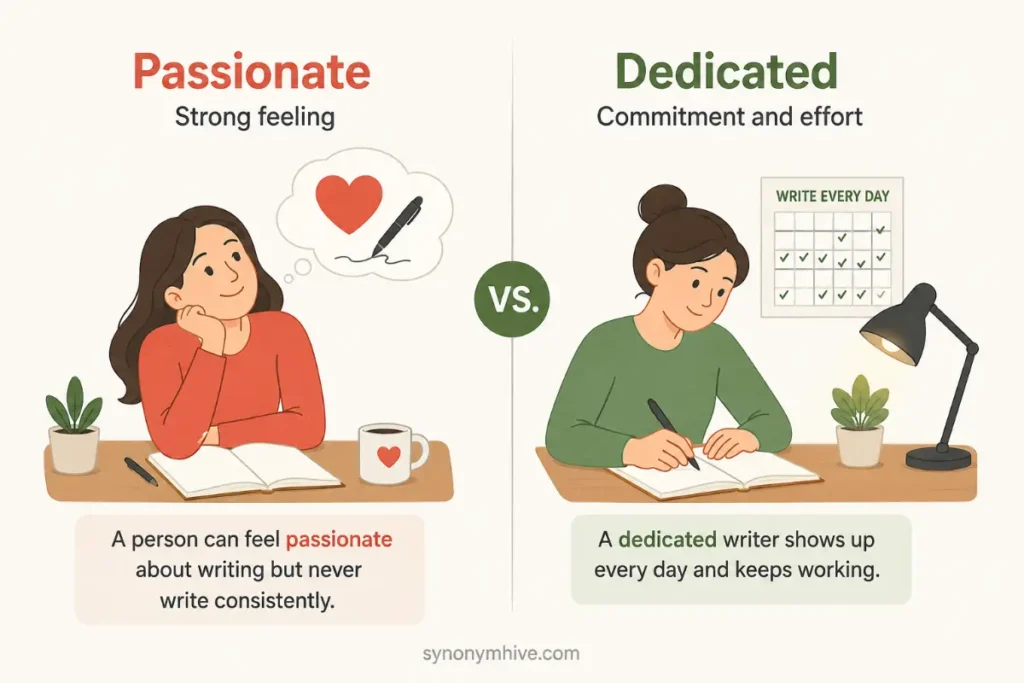
Passionate focuses on strong feeling.
Enthusiastic focuses on excitement.
Dedicated focuses on commitment.
Devoted focuses on loyalty.
Engaged focuses on active involvement.
Invested focuses on personal interest in the outcome.
Choose based on the idea you want to emphasize.
What words describe someone who works hard
Hardworking, diligent, industrious, persistent, dedicated, disciplined, and diligent are useful.
Hardworking is simple and direct.
Diligent suggests careful effort.
Industrious suggests steady productivity.
Persistent suggests repeated effort.
Dedicated suggests commitment.
Disciplined suggests consistent habits.
These words can be stronger than motivated when the sentence focuses on work ethic.
How can you replace motivated in a sentence
Start by identifying the reason behind the motivation.
Original.
She’s motivated to become a better writer.
If you mean ambition.
She’s driven to become a better writer.
If you mean persistence.
She’s determined to become a better writer.
If you mean commitment.
She’s dedicated to becoming a better writer.
If you mean excitement.
She’s eager to become a better writer.
If you mean learning.
She’s curious about becoming a better writer.
This method gives you a precise replacement instead of a random synonym.
What is a natural synonym for motivated in everyday English
Driven, eager, excited, determined, focused, and ready are among the most natural choices.
For example.
I’m really driven to finish this project.
I’m ready to take the next step.
These expressions sound normal in American conversation.
What is a formal synonym for motivated
Determined, resolute, diligent, industrious, zealous, purposeful, and committed can sound formal.
Resolute is especially formal.
For example.
The committee remained resolute despite strong opposition.
Diligent works well in academic and professional writing.
For example.
She was diligent in reviewing every application.
Don’t choose a formal word simply to make writing sound smarter. Clear language usually works better.
What is a casual synonym for motivated
Fired up, psyched, hungry, ready, and pumped can work in casual American English.
For example.
I’m fired up for the big game.
I’m psyched about the new job.
She’s hungry for a chance to compete.
These expressions are best for texts, conversations, social posts, and other informal settings.
How does tone change with each synonym
Word choice creates emotional color.
Driven sounds forceful.
Dedicated sounds reliable.
Ambitious sounds achievement focused.
Determined sounds persistent.
Eager sounds excited.
Enthusiastic sounds positive.
Proactive sounds capable.
Disciplined sounds controlled.
Curious sounds thoughtful.
Fired up sounds energetic.
Choosing the right tone can make a sentence feel natural.
Why does context matter so much
A synonym doesn’t exist in isolation.
Imagine describing a new employee.
She’s driven.
This suggests ambition.
She’s dedicated.
This suggests reliability.
She’s eager.
This suggests excitement.
She’s proactive.
This suggests initiative.
She’s disciplined.
This suggests consistency.
All five can describe a good employee. Yet they create five different impressions.
That’s why a strong vocabulary isn’t about collecting fancy words. It’s about choosing the right word for the job.
How can you use synonyms without sounding forced
Use the word that you would actually say in that situation.
If you’re writing a formal report, committed
If you’re writing an essay, determined may fit.
Don’t replace every common word with an unusual synonym.
Readers notice when vocabulary feels forced.
Simple language can sound more confident because the meaning is clear.
What should you avoid when writing about motivation
Avoid vague claims.
Avoid stacking several synonyms together.
For example.
I’m highly motivated, driven, ambitious, determined, dedicated, and enthusiastic.
That sentence tries too hard.
Pick one or two qualities and support them with evidence.
For example.
I’m a driven professional who consistently takes initiative and follows projects through to completion.
That sounds stronger because the description has a clear point.
How can you make a motivation statement more convincing
Give a reason.
Give a result.
For example.
I’m motivated by the chance to help small businesses grow. In my last role I created a customer education program that increased repeat purchases by 12 percent.
Now the reader understands the motivation and sees the result.
This approach works in resumes, interviews, essays, cover letters, and personal statements.
How can you use motivation words in an interview
Interviewers often want examples rather than labels.
Instead of saying you’re motivated say what motivates you and how that affects your work.
For example.
I’m motivated by challenging problems. When I see a process that wastes time I like finding a simpler way to handle it.
Then give a real example.
This approach makes your answer sound personal.
It also gives the interviewer something useful to discuss.
How can you answer what motivates you
A strong answer usually has three parts.
- Name the motivation.
- Explain why it matters.
- Give a short example.
For example.
I’m motivated by learning new skills. I enjoy taking on problems that force me to think differently. In my last role I learned a new reporting system and then trained the rest of my team.
This answer sounds more credible than simply saying.
I’m highly motivated.
How can students describe themselves as motivated
Students can use curious, eager, determined, focused, dedicated, ambitious, and self directed.
For example.
I’m a curious student who enjoys learning how technology affects everyday life.
Or.
I’m determined to improve my math skills and have started practicing for 30 minutes each evening.
Specific habits make the description stronger.
How can athletes describe motivation
Driven, determined, disciplined, focused, competitive, dedicated, and tenacious are strong choices.
For example.
She’s a disciplined athlete who trains consistently even during the off season.
He’s driven to improve his performance before the next competition.
The word motivated works too. However, disciplined often says more because it describes behavior.
How can leaders describe motivation
Purposeful, driven, proactive, committed, focused, and determined work well.
For example.
She’s a purposeful leader who sets clear goals and helps her team stay focused.
He takes a proactive approach to solving problems before they affect customers.
These words connect motivation with leadership behavior.
How can you describe a motivated employee
A motivated employee may be driven, engaged, proactive, dedicated, focused, ambitious, or self directed.
But motivation can look different from person to person.
One employee may volunteer for difficult projects.
Another may consistently improve processes.
Another may quietly produce excellent work.
Don’t assume motivation always looks energetic.
Some highly motivated people are calm and methodical.
How can you describe a motivated student
A motivated student may be eager, curious, focused, disciplined, determined, ambitious, or dedicated.
For example.
She’s curious and self directed. She often researches topics beyond the classroom.
That sentence gives a clearer picture than simply calling her motivated.
How can you describe a motivated team
A motivated team can be engaged, focused, energized, committed, determined, or enthusiastic.
For example.
The team stayed focused after the first setback.
The employees remained committed to finishing the project on time.
The players were fired up before the final match.
Choose the word based on the kind of energy you want to show.
What is the best word for motivated in a cover letter
Driven, dedicated, enthusiastic, committed, and eager can work well.
For example.
I’m eager to bring my customer service experience to your team.
Or.
I’m a dedicated professional who enjoys solving complex customer problems.
Avoid opening every cover letter with I’m a highly motivated professional.
Recruiters see that phrase often.
Show what you can do instead.
How can you improve a sentence with motivated
Take a basic sentence.
I’m motivated to improve my skills.
Now make the reason clear.
I’m motivated to improve my skills because I want to take on more complex projects.
Now add action.
I’m motivated to improve my skills so I regularly complete training courses and practice new techniques.
Now add evidence.
I’m motivated to improve my skills so I complete regular training and recently earned a certification that helped me take on more complex projects.
The final version tells a story.
What is another phrase for motivated by success
Driven is often the best choice.
Ambitious also works.
For a more casual tone use hungry.
For example.
She’s driven by the desire to succeed.
He’s ambitious and wants to build a strong career.
He’s hungry for success.
These phrases differ in tone but share the idea of achievement.
What is another term for motivated by purpose
Purposeful, committed, inspired, dedicated, and mission driven can work.
Purposeful suggests clear intention.
Committed suggests responsibility.
Inspired suggests a source of emotional energy.
Dedicated suggests long term effort.
Mission driven is common in nonprofit and organizational settings.
For example.
She’s deeply committed to improving access to education.
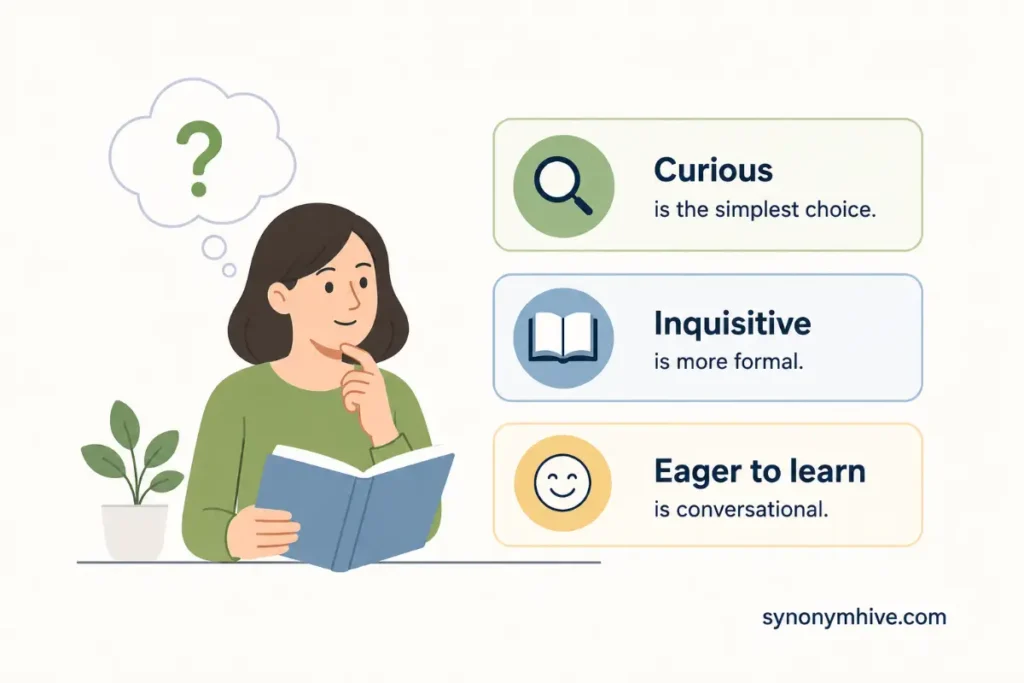
What is another phrase for motivated by curiosity
Curious is the simplest choice.
Inquisitive is more formal.
Eager to learn is conversational.
Intellectually curious works well in professional and academic writing.
For example.
He’s intellectually curious and enjoys exploring unfamiliar subjects.
That sentence says more than simply calling him motivated.
What is another term for motivated by helping others
Compassionate, caring, service oriented, dedicated, devoted, and altruistic can work.
Compassionate emphasizes empathy.
Caring is simple and warm.
Service oriented sounds professional.
Dedicated emphasizes commitment.
Altruistic suggests acting for the benefit of others.
Choose carefully because altruistic can sound more formal than everyday speech.
What is another word for motivated by challenge
Driven, determined, competitive, ambitious, and energized can work.
For example.
She’s driven by difficult problems and enjoys finding practical solutions.
He’s energized by new challenges.
She’s determined to solve problems that others have given up on.
Each sentence gives the reader a different impression.
How can you use motivated without repeating it
Use related words only when they add meaning.
For example.
He’s motivated to grow his business. He’s proactive about finding new opportunities.
This works because each word has a different job.
You can also restructure the sentence.
Instead of.
She’s motivated to learn.
Write.
She actively seeks opportunities to learn.
Instead of.
He’s motivated to improve.
Write.
He regularly asks for feedback and uses it to improve.
Strong verbs can remove the need for an adjective.
What are the best action words for motivated people
Action verbs often make writing more convincing.
Words such as leads, builds, improves, creates, solves, learns, develops, organizes, studies, trains, supports, and achieves can show motivation.
For example.
She builds new skills through regular training.
He solves customer problems before they become larger issues.
She studies industry trends and applies what she learns.
These sentences show motivation without naming it.
What should you choose for a professional audience
For professional readers choose words that connect to behavior.
Proactive.
Dedicated.
Driven.
Focused.
Committed.
Goal oriented.
Self directed.
These words tell readers something about how the person works.
Avoid dramatic terms such as fanatical unless the context genuinely calls for them.
What should you choose for a casual audience
For friends or informal readers use simple words.
Excited.
Ready.
Eager.
Fired up.
Psyched.
Hungry.
Focused.
These words sound more natural in conversation.
What should you choose for academic writing
Academic writing usually benefits from precise and measured words.
Dedicated.
Committed.
Determined.
Driven.
Purposeful.
Persistent.
Avoid slang and exaggerated expressions.
Also make sure the word fits the evidence.
If the research shows repeated effort use persistent.
If the subject has strong ambition use driven.
What should you choose for a personal story
Personal writing gives you more freedom.
Driven can show ambition.
Determined can show struggle.
Eager can show excitement.
Curious can show discovery.
Inspired can show emotional change.
Dedicated can show long term commitment.
The best choice often depends on the story you’re telling.
What are the best synonyms for motivated in one quick list
If you need a fast answer these are strong options.
- Driven.
- Determined.
- Ambitious.
- Dedicated.
- Committed.
- Eager.
- Enthusiastic.
- Focused.
- Proactive.
- Persistent.
- Tenacious.
- Disciplined.
- Purposeful.
- Goal oriented.
- Self directed.
- Industrious.
- Diligent.
- Resolute.
- Inspired.
- Energetic.
- Aspiring.
- Enterprising.
- Keen.
- Fired up.
- Psyched.
- Hungry.
- Spirited.
- Willing.
- Ready.
- Engaged.
Each word carries a slightly different meaning. Use the one that matches the quality you want to show.
What is the easiest way to remember the differences
Think about the action behind the word.
Driven means pushing toward a goal.
Determined means refusing to quit.
Dedicated means staying committed.
Ambitious means wanting achievement.
Eager means wanting to start.
Proactive means acting first.
Focused means concentrating.
Disciplined means following consistent habits.
Curious means wanting to learn.
Enthusiastic means showing excitement.
This simple mental map can help you choose faster.
What is the biggest mistake people make with synonyms
The biggest mistake is assuming synonyms are interchangeable.
They aren’t.
A thesaurus may list several words together because they share a broad meaning. That doesn’t mean they sound natural in the same sentence.
For example.
She’s motivated to learn.
She’s fanatical to learn.
The second sentence sounds wrong.
Instead.
She’s eager to learn.
Or.
She’s determined to learn.
Good word choice depends on grammar, context, tone, and meaning.
How can you make your writing sound more human
Use specific details.
Use natural verbs.
Avoid exaggerated claims.
Write the way a thoughtful person would actually speak.
Instead of.
I’m an extremely highly motivated and exceptionally driven individual who is deeply passionate about success.
Write.
I like difficult problems and I’m willing to put in the work to solve them.
The second sentence sounds more believable.
Human writing doesn’t need to announce every positive quality. It lets the reader notice those qualities through the details.
What is the direct answer to another expression for motivated
If you need a word for excitement choose eager or enthusiastic.
If you need a word for independent action choose self directed.
The best word depends on the exact meaning you want.
Looking for a better alternative? Visit Another Word for Passionate: Power Picks (2026).
Conclusion
Finding another term for motivated is less about finding a fancy synonym and more about choosing the exact quality you want to show. Driven works for strong ambition. Determined works for persistence. Dedicated shows steady commitment. Proactive shows initiative. Eager shows excitement. Focused shows concentration. Disciplined shows consistent action.
Your audience also matters. A resume may call for proactive or driven. An essay may benefit from determined or dedicated. A text can use fired up or psyched. A professional email often sounds best with eager or committed.
Most importantly, don’t rely on adjectives alone. Show motivation through actions, habits, goals, and results. When readers can see what a person does, your writing becomes more convincing. Pick the word that matches the real behavior and your sentence will feel stronger without sounding forced.
Frequently Asked Questions
What’s another way to say motivated?
Driven is one of the closest alternatives. Determined, dedicated, ambitious, proactive, and eager can also work depending on the meaning.
What is a professional word for motivated?
Proactive, driven, dedicated, committed, and goal oriented are strong professional choices. The best option depends on the quality you want to emphasize.
What is another term for motivated on a resume?
Driven or proactive often works well on a resume. Dedicated is useful when you want to highlight consistent effort.
What is a stronger word for motivated?
Driven, determined, tenacious, and resolute can sound stronger. Ambitious is also strong when the focus is achievement.
What is a softer word for motivated?
Interested, willing, ready, and eager can sound softer. These words work well when you don’t want to suggest intense ambition.
Is driven the same as motivated?
Driven is close to motivated but usually sounds stronger. It often suggests a powerful desire to achieve a goal.
What word describes someone who never gives up?
Determined is the most natural choice. Persistent and tenacious also work when you want to emphasize continued effort.