

You’re writing a resume and want to show that you work well with other people. Then you notice you’ve used collaborate several times. If you’re searching for another word for collaborate you have many useful choices such as cooperate, partner, coordinate, contribute, work together, team up, assist, communicate, and join forces.
The best replacement depends on what you actually did. Cooperate is simple and direct. Partner suggests shared responsibility. Coordinate focuses on organizing people or tasks. Contribute highlights your part in a shared effort. Team up sounds friendly and natural in everyday speech.
Another term for collaborate can be cooperate, coordinate, partner, contribute, cooperate with, work together, team up, or join forces. The best choice depends on the situation and the level of teamwork involved.
This guide covers the meaning and origin of collaborate along with more than 30 useful alternatives. You’ll also see the best choices for resumes, essays, emails, texts, and everyday speaking. Real examples and close synonym comparisons will help you choose a word that fits instead of simply swapping one word for another.
Find more synonyms in Another Word for Supported Best Resume Choices 2026.
What Does Collaborate Mean In Plain English
Collaborate means working with another person or group to achieve a shared goal.
The word usually suggests active participation. Two people don’t simply exist on the same project. They communicate, share ideas, divide tasks, solve problems, or make decisions together.
For example.
The marketing and sales teams collaborated on the campaign.
This tells us that both teams worked together.
You could also say.
The marketing and sales teams worked together on the campaign.
That version has almost the same meaning but sounds more casual.
Collaborate often appears in professional settings because it sounds clear and businesslike. You’ll see it in resumes, workplace emails, project descriptions, academic writing, and company reports.
Still, the word can become repetitive.
If every resume bullet says collaborated with the team, the reader learns very little about your actual contribution.
A stronger sentence might say.
Coordinated with designers and developers to launch a new customer portal.
Now the reader can see what you did.
That’s why another expression for collaborate can make your writing more precise. The goal isn’t to replace collaborate just for variety. The goal is to choose a verb that explains your role.
Where Did The Word Collaborate Come From
Collaborate comes from the Latin word collaborare. It combines a word meaning together with a word meaning work.
That history matches the modern meaning closely.
To collaborate means to work together.
The word entered English in the early 19th century and became common in contexts involving shared work and joint effort.
Today you can collaborate with a person, team, company, department, school, organization, or community.
For example.
The designers collaborated with engineers.
The two companies collaborated on a new product.
Teachers collaborated to improve the curriculum.
Students collaborated on a research project.
The basic idea stays the same. More than one person contributes toward a shared purpose.
What Are The Best Synonyms For Collaborate
The right synonym depends on the type of teamwork you want to describe.
| Word | Meaning | Tone | Example |
|---|---|---|---|
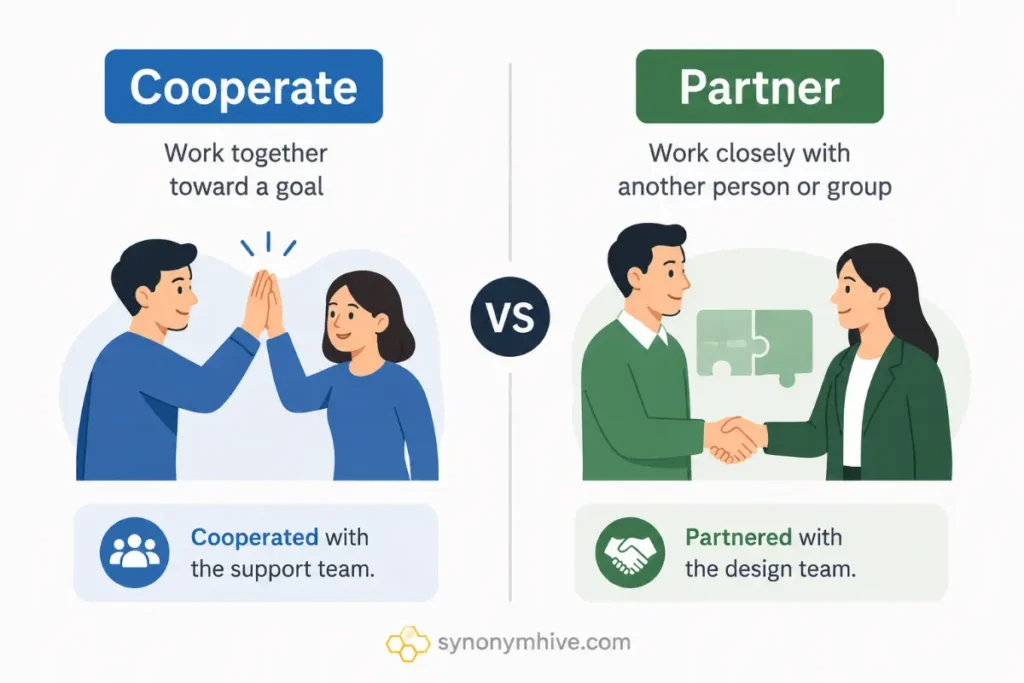
| Cooperate | Work together toward a goal | Simple | Cooperated with the support team. |
| Partner | Work closely with another person or group | Professional | Partnered with the design team. |
| Coordinate | Organize people or activities so they work well together | Professional | Coordinated with three departments. |
| Join forces | Combine efforts | Conversational | Joined forces with another department. |
| Engage | Take part in active communication or work | Professional | Engaged with stakeholders throughout the project. |
| Cooperate with | Work jointly with another person | Neutral | Cooperated with local partners. |
| Consult | Seek or provide expert advice | Professional | Consulted with engineers on the design. |
| Communicate | Exchange information and ideas | Everyday | Communicated with team members daily. |
| Connect | Build a working relationship | Casual | Connected with partners across the region. |
| Unite | Come together for a shared purpose | Formal | United with community leaders. |
| Combine | Bring efforts or resources together | Neutral | Combined efforts with the research team. |
| Contribute to | Add work or ideas to something shared | Professional | Contributed to a companywide project. |
| Participate in | Take part in shared work | Neutral | Participated in a product review. |
| Liaise | Communicate and coordinate between groups | Formal | Liaised with external vendors. |
| Associate | Work or connect with another person or group | Formal | Associated with industry partners. |
| Consult with | Discuss something to gain advice or input | Professional | Consulted with senior managers. |
| Pool | Combine resources or efforts | Professional | Pooled resources with partner teams. |
| Engage with | Work or communicate actively with others | Professional | Engaged with customers during testing. |
| Interact | Communicate or work with others | Everyday | Interacted with clients during the project. |
| Coordinate efforts | Organize shared work | Professional | Coordinated efforts across departments. |
| Co develop | Develop something jointly | Professional | Co developed a new training program. |
| Co produce | Produce something together | Professional | Co produced an educational series. |
| Co author | Write something together | Formal | Co authored a research paper. |
| Teamwork | Joint effort toward a goal | Neutral | Used strong teamwork to complete the project. |
| Join | Become part of a shared effort | Simple | Joined the team to solve the problem. |
Which Synonyms Are Mild And Which Are Strong
Not every synonym carries the same level of teamwork.
Some words simply show that you helped. Others suggest shared ownership, leadership, or deep involvement.
Choosing the right strength can make your writing much more accurate.
What Are Mild Alternatives To Collaborate
Assist, support, participate, communicate, and join are mild alternatives.
They show involvement but don’t necessarily suggest equal responsibility.
For example.
Assisted the marketing team with customer research.
That sentence says you helped the team.
It doesn’t claim that you shared ownership of the whole project.
Use these words when your contribution was important but you weren’t responsible for the full outcome.
What Are Medium Strength Alternatives To Collaborate
Cooperate, coordinate, contribute, partner, engage, and work together are stronger.
For example.
Coordinated with five departments to prepare the annual conference.
This suggests an active role.
Partnered with the sales team to improve customer retention.
This suggests closer shared responsibility.
Contributed to a companywide process improvement project.
This shows that you played a meaningful part without claiming sole ownership.
What Are Strong Alternatives To Collaborate
Co developed, co produced, co authored, joined forces, united, and partnered can suggest deep involvement.
For example.
Co developed a new employee training program with the human resources team.
That tells the reader that you helped develop the program rather than simply attending meetings.
Pioneering a joint effort may also require a stronger verb depending on the project. Still, don’t use an impressive sounding word if it doesn’t match your real contribution.
Accuracy always matters more than drama.
What Is Another Term For Collaborate On A Resume
A strong resume alternative depends on your exact role.
Select coordinated when you organized people tasks or information.
Consider partnered when you shared responsibility with another person or group.
Mention contributed when you added ideas skills or work to a larger project.
Choose assisted when you supported someone else’s work.
Use co developed when you jointly built something.
Apply liaised when you acted as a communication link between groups.
Describe consulted when you provided or gathered expert input.
Highlight supported when your work helped another team reach its goal.
For example.
Collaborated with the product team to improve customer satisfaction.
A more specific version could be.
Partnered with the product team to improve customer satisfaction by 18 percent.
Another option could be.
Coordinated with product managers to identify and resolve customer issues.
The second sentence tells the reader more about your role.
What Is Another Expression For Collaborate In An Essay
Cooperate, work together, partner, contribute, coordinate, and join forces can work in essays.
The best choice depends on the subject and level of formality.
For example.
Researchers collaborated to study the effects of climate change.
You could write.
Researchers worked together to study the effects of climate change.
For a more formal academic style you might use.
Researchers cooperated to examine the effects of climate change.
The meaning stays similar but the tone changes.
In academic writing, avoid forcing a complicated word into a sentence simply to sound formal. Clear writing usually wins.
What Is Another Phrase For Collaborate In A Text
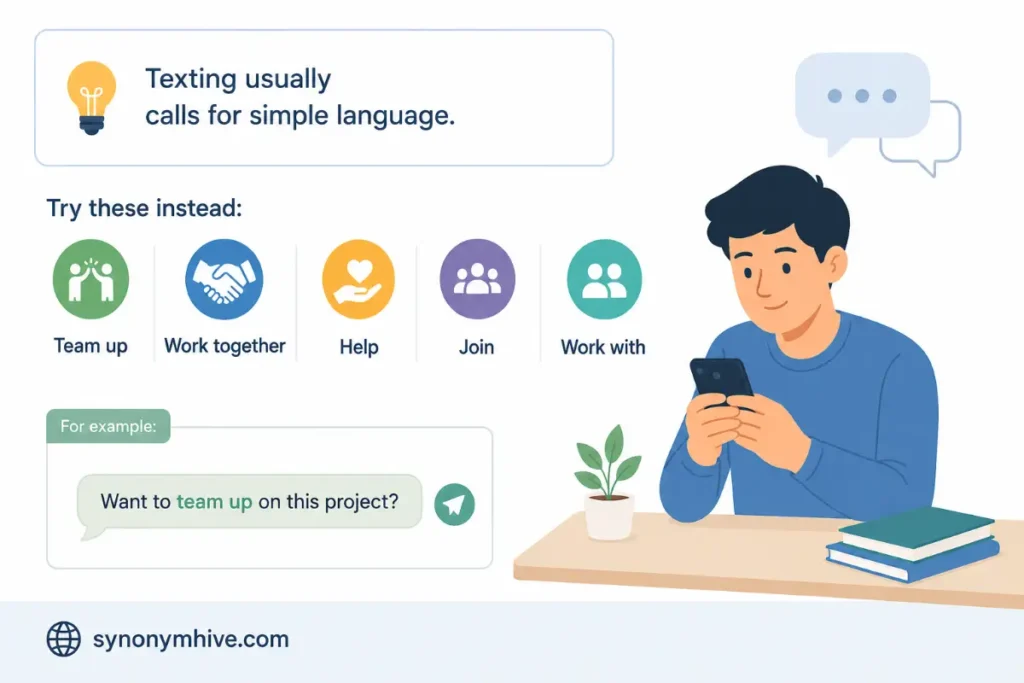
Texting usually calls for simple language.
Try team up, work together, help, join, or work with.
For example.
Want to team up on this project?
That sounds natural.
You could also say.
Want to work together on this?
That’s even more casual.
Collaborate isn’t wrong in a text. It just sounds more formal.
The setting matters. A message to a close friend can use relaxed language. A message to a coworker about a professional project may use collaborate or partner.
What Is Another Term For Collaborate In An Email
Professional emails often benefit from clear and specific verbs.
Use coordinate, partner, work with, consult, contribute, or cooperate.
For example.
I’d like to coordinate with your team before the meeting.
Or.
We’d like to partner with your department on the new project.
Or.
I’d like to consult with your team before we finalize the proposal.
Each sentence has a slightly different meaning.
Coordinate focuses on organizing.
Partner focuses on shared work.
Consult focuses on getting advice or expert input.
What Is Another Expression For Collaborate In Speaking
In everyday speech, work with, work together, team up, help, and partner are natural.
For example.
I worked with the design team on the new website.
That sounds simple and clear.
You could say.
I collaborated with the design team on the new website.
That’s correct too. It simply sounds more formal.
In conversation, simple words often feel more natural.
What Are Examples Of Collaborate Synonyms
Seeing the words in real situations makes their differences easier to understand.
- Partnered with the sales team to improve customer retention.
- Coordinated with five departments to prepare the annual company meeting.
- Contributed research and analysis to a new market study.
- Worked with software engineers to test the new platform.
- Cooperated with local agencies to improve community services.
- Assisted the project manager with scheduling and reporting.
- Teamed up with the design department to create new promotional materials.
- Consulted with senior managers before launching the new service.
- Liaised with vendors to resolve delivery problems.
- Co developed a training program for new employees.
- Supported the customer service team during a major product launch.
- Joined forces with local organizations to increase event attendance.
- Participated in weekly planning sessions with the operations team.
- Coordinated efforts across three departments to reduce processing delays.
- Co authored a research report with two industry specialists.
These examples show why one replacement cannot always do the job. The right word depends on what you contributed.
How Does Collaborate Compare With Cooperate
Collaborate and cooperate are close in meaning but they aren’t always interchangeable.
Collaborate usually suggests active shared work toward a specific project or goal.
Cooperate has a broader meaning. It can simply mean being willing to work with someone or follow a request.
| Collaborate | Cooperate |
|---|---|
| Usually involves shared work | Can involve general willingness to help |
| Often used for projects | Used in many everyday situations |
| Suggests active contribution | Can suggest basic support |
| Common in professional settings | Common in everyday speech |
Consider these examples.
The engineers collaborated on the new system.
The employees cooperated with the investigation.
The first sentence describes joint project work.
The second describes willingness to help with a process.
Use collaborate when people actively build something together. Use cooperate when the focus is on working with someone or complying with a request.
How Does Collaborate Compare With Coordinate
Collaborate means working together.
Coordinate means organizing activities so people or groups can work effectively together.
For example.
The teams collaborated on the project.
The project manager coordinated the teams.
The first sentence shows shared effort.
The second shows organization.
You can do both at the same time.
For example.
Coordinated with three departments while collaborating on the new product launch.
Still, that sentence may be too wordy for a resume. Choose the verb that best reflects your actual role.
How Does Collaborate Compare With Partner
Partner usually suggests a closer relationship or shared responsibility.
For example.
We collaborated with the marketing department.
We partnered with the marketing department.
The first focuses on working together.
The second can suggest a deeper working relationship.
Partner is especially useful in business writing.
For example.
Partnered with regional sales teams to increase customer retention.
That sounds active and results focused.
How Does Collaborate Compare With Contribute
Contribute focuses on your individual part of a shared effort.
Collaborate focuses more on the act of working together.
Compare these sentences.
Collaborated with the research team.
Contributed data analysis to the research project.
The first tells us you worked with the team.
The second tells us what you personally added.
For a resume, contribute can sometimes be more useful because it highlights your own value.
How Does Collaborate Compare With Assist
Assist means help.
Collaborate usually suggests a more balanced working relationship.
For example.
Assisted the manager with the project.
Collaborated with the manager on the project.
The first sentence suggests that you supported the manager.
The second suggests that both people worked together.
Neither is automatically better.
Use assist if you mainly supported someone.
Use collaborate if you shared responsibility.
What Are The Best Synonyms By Part Of Speech
Collaborate is a verb.
Most direct alternatives are also verbs.
These include cooperate, coordinate, partner, contribute, assist, support, consult, communicate, participate, engage, liaise, combine, unite, and join.
Related nouns can help you describe the same idea in other sentence structures.
Collaboration describes the act of working together.
Cooperation describes joint effort or willingness to work with others.
Partnership describes a working relationship.
Teamwork describes people working effectively as a group.
Coordination describes the organization of shared activities.
For example.
Strong collaboration helped the project succeed.
The team showed excellent cooperation during the transition.
Their partnership led to a successful product launch.
Good teamwork helped us meet the deadline.
These nouns can add variety to essays and reports.
What Are Regional Differences In The Word Collaborate
Collaborate has the same basic meaning in American and British English.
It is common in both forms of English.
American professional writing often uses collaborate, partner, coordinate, work with, and team up.
British English uses the same core terms.
The bigger difference comes from tone and context.
For a US audience, work with and team up may sound more natural in casual communication. Collaborate and coordinate are common in workplace and academic settings.
There is no major US versus UK spelling difference for collaborate.
How Should You Use Collaborate With People
The most common structure is collaborate with someone.
For example.
I collaborated with the design team.
She collaborated with several researchers.
The two companies collaborated on the project.
You can also use collaborate on to describe the shared project.
For example.
They collaborated on a new training program.
The developers collaborated on the software update.
You can combine both forms.
The developers collaborated with the design team on the new platform.
That sentence tells us who worked together and what they worked on.
What Are Common Resume Mistakes With Collaborate
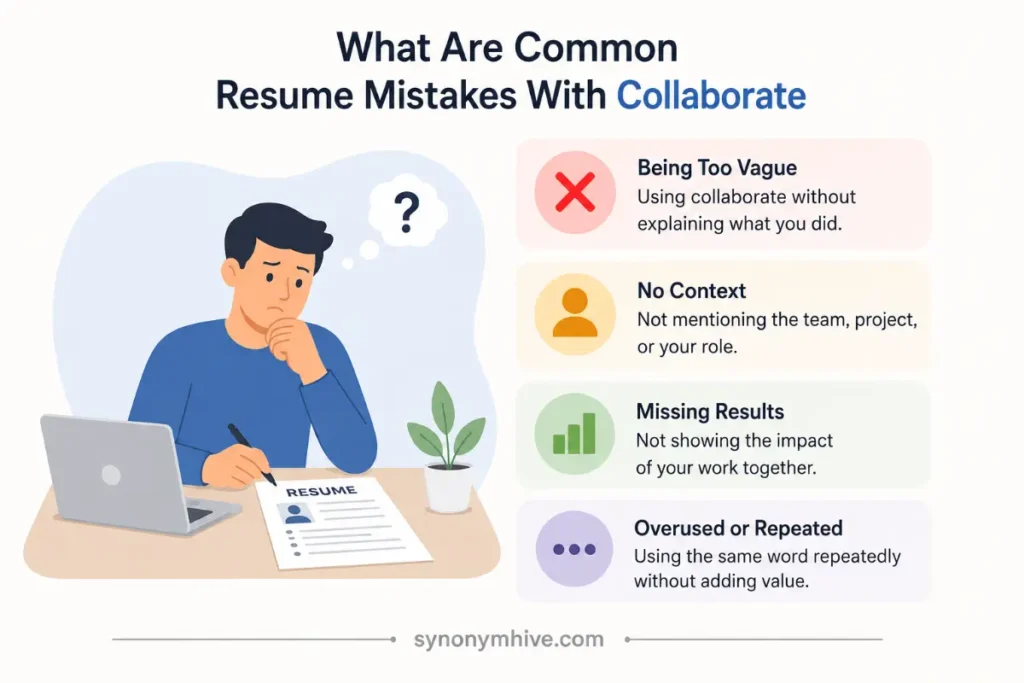
The biggest mistake is using collaborate without explaining the contribution.
For example.
Collaborated with team members.
That sounds fine but doesn’t tell the employer much.
A better version is.
Collaborated with five designers to launch a new customer portal.
Even better.
Coordinated with five designers to launch a customer portal that increased online bookings by 24 percent.
Now the reader can see the people involved, the project, and the result.
Another mistake is using collaborate for work that wasn’t actually shared.
If you completed the project alone, collaborate isn’t accurate.
Use developed, created, designed, built, or completed instead.
A third mistake is repeating collaborate in every bullet.
Your resume should show different skills.
Choose partnered for shared ownership.
Select coordinated for organization.
Mention contributed for your individual input.
Describe supported for assistance.
Apply consulted for expert input.
Specific language makes your experience easier to understand.
When Should You Not Use Collaborate
Don’t use collaborate when the people involved didn’t actually work together.
For example.
You reviewed a report written by another department.
Saying you collaborated with that department may overstate your role.
Reviewed the report and provided feedback is more accurate.
Likewise, don’t use collaborate when you simply attended a meeting.
Participated in a planning meeting is more precise.
Don’t use collaborate when you gave someone instructions but didn’t share the work.
Directed the project team may be more accurate if you were the leader.
Good word choice isn’t about finding the most impressive synonym. It’s about telling the truth clearly.
Discover related words in Another Word For Communication: Best Guide (2026).
What Are The Antonyms Of Collaborate
Common opposites include compete, oppose, resist, disagree, conflict, separate, isolate, and work alone.
The best antonym depends on the context.
Compete works when two groups are trying to win against each other.
Oppose works when someone actively disagrees with a plan or position.
Work alone works when no shared effort takes place.
For example.
The two companies collaborated on research.
The two companies competed for the same customers.
The contrast is clear.
What Is The Best Word For Collaborate On A Resume
Partnered is often one of the strongest choices when you want to show shared responsibility.
For example.
Partnered with product managers to improve customer satisfaction by 20 percent.
Coordinated is better when your role involved organizing people or tasks.
For example.
Coordinated with four departments to complete a major system upgrade.
Contributed is useful when you want to emphasize your specific input.
For example.
Contributed market research to a new product strategy.
Liaised works well when you connected internal and external groups.
For example.
Liaised with vendors and internal teams to resolve supply issues.
Co developed works well when you genuinely helped build something with another person or team.
For example.
Co developed a customer training program used across five regional offices.
What Is The Best Word For Collaborate In A Cover Letter
Partner, work with, coordinate, and contribute can sound natural in a cover letter.
For example.
I’m excited about the opportunity to partner with your product team to improve customer experiences.
You could also write.
In my current role, I coordinate with sales and support teams to solve customer issues.
These examples sound more specific than simply saying you are a good collaborator.
Instead of writing.
I’m an excellent collaborator.
Show the skill.
I regularly coordinate with sales and support teams to solve complex customer problems.
The second sentence gives evidence.
What Is The Best Word For Collaborate In An Interview
In an interview, work with and partner are usually natural.
For example.
I worked closely with the design team to solve the issue.
You can also say.
I partnered with our engineers to test several solutions.
If you’re answering a behavioral question, explain the situation, your role, the action you took, and the result.
For example.
I worked with our customer support team after we noticed a rise in complaints. We reviewed the most common issues and changed the onboarding process. Complaints dropped by 22 percent over the next quarter.
That answer proves collaboration instead of simply claiming it.
What Is The Best Word For Collaborate In A Business Email
Coordinate and partner are useful for professional emails.
For example.
I’d like to coordinate with your team before we finalize the schedule.
Or.
We’d like to partner with your department on the upcoming training project.
If you need advice, use consult.
For example.
I’d like to consult with your team before we move forward.
If you need information, use connect or communicate.
For example.
I’ll connect with the finance team and send you an update tomorrow.
Simple language often makes professional emails stronger.
What Is The Best Word For Collaborate In Academic Writing
Cooperate, work together, partner, contribute, and participate can work in academic writing.
For more formal research writing, collaborate remains perfectly appropriate.
For example.
Researchers collaborated across several universities to complete the study.
You could also write.
Researchers worked together across several universities to complete the study.
The second sentence is easier for a general audience.
Academic writing doesn’t need complicated vocabulary. It needs accurate language.
What Is The Best Word For Collaborate In Casual Conversation
Team up and work together are usually the most natural choices.
For example.
Do you want to team up on the presentation?
Let’s work together and finish this today.
You could say collaborate, but it may sound more formal.
Casual language should sound like something you’d actually say aloud.
How Can You Choose The Right Synonym
Start by identifying the type of relationship.
When you worked as equal partners, use partnered or collaborated.
For shared tasks you organized, use coordinated.
When you provided a specific skill or idea, use contributed.
For work where you helped someone, use assisted or supported.
When you gave expert advice, use consulted.
To describe connecting two groups, use liaised.
For simple joint work, use cooperated or worked together.
For casual joint work, use teamed up.
The verb should match your role.
How Can You Make Teamwork Sound Stronger On A Resume
Avoid vague statements such as.
Collaborated with the team.
Instead, answer three questions.
Who did you work with?
What did you do?
What happened because of your work?
For example.
Collaborated with the sales team.
This gives little information.
Partnered with eight sales representatives to improve customer follow up.
That’s better.
Partnered with eight sales representatives to improve customer follow up and increase renewal rates by 15 percent.
Now the reader sees the team, action, and result.
How Can You Show Collaboration Without Using The Word Collaborate
You don’t need to mention teamwork directly.
Show it through action.
For example.
Coordinated product testing with engineers and designers.
Partnered with sales representatives to improve customer retention.
Consulted with senior managers before launching the new service.
Contributed research to a companywide market study.
Liaised with external vendors during the system upgrade.
Co developed training materials with the human resources team.
These sentences prove that you can work with others.
That’s stronger than simply saying you’re a team player.
What Are More Natural Alternatives In Everyday English
Everyday English often favors short phrases.
Work with.
Work together.
Team up.
Help each other.
Join forces.
Pitch in.
Coordinate.
Partner up.
For example.
I worked with Sarah on the presentation.
We teamed up to finish the project.
Everyone pitched in to get the event ready.
The whole department joined forces to solve the issue.
These phrases sound natural because people use them in real conversations.
What Are More Formal Alternatives
Formal writing can use cooperate, coordinate, collaborate, liaise, consult, contribute, partner, and engage.
For example.
The research teams collaborated on the study.
The departments coordinated their efforts.
The committee consulted with industry experts.
The organization liaised with local agencies.
The researchers contributed data to the project.
Choose formal language only when the setting calls for it.
What Are More Casual Alternatives
Team up, work with, work together, join forces, pitch in, and help out can sound casual.
For example.
Let’s team up on this.
Can you help out with the event?
We all pitched in to finish the work.
The design and sales teams joined forces for the campaign.
These choices fit texts, casual emails, conversations, and friendly workplace messages.
What Is A Good Replacement For Collaborate With Colleagues
Work with, partner with, coordinate with, and cooperate with are strong choices.
For example.
Worked with colleagues to improve the customer onboarding process.
Partnered with colleagues across three departments to solve recurring service issues.
Coordinated with colleagues to prepare the annual report.
The choice depends on the type of teamwork.
What Is A Good Replacement For Collaborate With Clients
Partner, work with, consult, communicate with, and coordinate with can work.
For example.
Partnered with clients to develop custom training solutions.
Consulted with clients to identify product requirements.
Coordinated with clients to manage project timelines.
These phrases make the relationship clearer.

What Is A Good Replacement For Collaborate With Other Departments
Coordinate, partner, liaise, work with, and cooperate can all work.
For example.
Coordinated with finance and operations to improve reporting accuracy.
Liaised with three departments during the system migration.
Partnered with the sales department to improve customer retention.
The verb should show what you actually did.
How Can You Avoid Repeating Collaborate
Variation works best when each verb adds meaning.
Instead of using collaborate five times, use a mix of accurate verbs.
- Partnered with the sales team to improve retention.
- Coordinated with finance to update reporting procedures.
- Consulted with engineers before testing the product.
- Contributed research to the market analysis.
- Liaised with vendors during the supply transition.
- Supported the customer service team during the product launch.
- Co developed training materials with human resources.
Each sentence shows a different type of teamwork.
Quick Tips For Choosing The Right Word
- Use cooperate when the focus is on working together or showing willingness to help.
- Use partner when people share responsibility or work closely toward a goal.
- Use coordinate when you organize people tasks or schedules.
- Use contribute when you want to highlight your individual input.
- Use assist when you mainly helped another person.
- Use support when your work helped another person or team succeed.
- Use consult when you gave or requested expert advice.
- Use liaise when you connected groups and managed communication between them.
- Use team up for casual situations.
- Use work together when you want the clearest everyday phrase.
- Use join forces when two groups combine their efforts.
- Use participate when you took part without necessarily sharing ownership.
- Use co developed when you jointly built something.
- Use co authored when you wrote something with another person.
- Use co produced when you jointly created a product or piece of media.
- Use communicate when exchanging information was the main part of the work.
- Use engage when active interaction with people was central to the task.
- Use combine when people or groups brought resources together.
- Use unite when the shared purpose is especially important.
- Use pooled when several people or groups combined resources.
What Is The Main Takeaway About Collaborate
The strongest another term for collaborate depends on your role.
Choose partner if you shared responsibility.
Select coordinate if you organized people or tasks.
Mention contribute if you added your skills or ideas.
Describe assist or support if you provided help.
Use consult if you gave expert advice.
Apply liaise if you connected different groups.
Prefer work together or team up for simple everyday language.
On a resume, specific language can make your experience much clearer. Instead of saying that you collaborated with a team, explain what you did with that team and what happened because of your work.
A strong sentence doesn’t need a fancy verb. It needs an accurate verb and a clear result.
Discover another helpful synonym list in Another Word For Improved: Winning Resume Words 2026.
Conclusion
Finding another word for collaborate becomes much easier when you focus on the kind of teamwork you actually performed. Partner works well for shared responsibility. Coordinate fits work that involves organizing people or tasks. Contribute highlights your personal input. Assist and support show that you helped another person or group. Consult fits expert advice. Liaise works when you connect different groups. For casual writing, work together and team up sound natural.
If you want to describe support more precisely, explore our guide to synonyms for helped for more useful alternatives.
On a resume, don’t stop at the teamwork word. Explain the project and show the result when you can. That gives employers a clearer picture of your value. Choose the simplest accurate verb that fits your situation. When the word matches the work, your writing sounds more confident and believable.
Frequently Asked Questions
What’s another way to say collaborate?
Another way to say collaborate is cooperate, partner, coordinate, contribute, work together, team up, assist, support, or join forces. The best choice depends on your role.
What is another phrase for collaborate on a resume?
A strong another term for collaborate on a resume can be partnered, coordinated, contributed, consulted, liaised, supported, or co developed. Choose the verb that best describes your actual contribution.
What is a stronger word than collaborate?
Partnered, coordinated, co developed, pioneered, or joined forces can sound stronger in specific situations. The best choice depends on the type of work you performed.
What is another phrase for collaborate with coworkers?
Work with, partner with, coordinate with, cooperate with, and team up with are natural alternatives. Partner with works especially well when you shared responsibility.
What is a professional way to say collaborate?
Professional alternatives include coordinate, partner, cooperate, contribute, consult, liaise, and work together. The right option depends on the task and your level of involvement.
What is a casual way to say collaborate?
Team up, work together, join forces, and work with are casual alternatives. These choices sound natural in everyday conversations and informal messages.
Is collaborate a good word for a resume?
Collaborate is a good resume word when you clearly explain the project and your contribution. Specific verbs such as partnered, coordinated, contributed, and co developed can make individual resume bullets more informative.