

Finding the right words to describe friendship can be harder than it sounds. You may be writing a birthday message, a school essay, a social media caption, or a note to someone who has been there for you. A simple word like good may not fully explain what makes the friendship special.
Words to describe friendship include loyal, supportive, caring, trusting, honest, genuine, close, lasting, meaningful, dependable, and uplifting. The best word depends on the kind of friendship and the quality you want to highlight.
A friendship can be fun without being deep. It can also be quiet, loyal, and strong without being exciting every day. Some friendships are built on trust and honesty, while others grow through shared memories, humor, kindness, or years of support.
This guide explains the most useful words and phrases for describing friendship. You’ll find simple definitions, stronger and softer choices, examples, context based suggestions, common mistakes, and close word comparisons. By the end, you’ll have a much better way to describe the friendship you mean.
Explore more word choices in Words to Describe a Mother Best Guide In 2026.
What Do Words to Describe Friendship Mean?
Terms to describe friendship are adjectives and phrases that explain the quality, feeling, strength, or nature of a relationship between friends. They can show trust, loyalty, affection, closeness, support, humor, respect, or shared history.
For example, loyal describes a friend who stays supportive during difficult times. Caring describes someone who shows concern for another person. Genuine suggests that the friendship is sincere and not based on personal gain.
The right word depends on the specific quality you want to show. Saying a friendship is fun tells the reader that you enjoy spending time together. Calling it meaningful says something deeper about its emotional value.
What Is the Best Word to Describe a Friendship?
There isn’t one best word for every friendship. Strong choices include loyal, supportive, genuine, trustworthy, caring, close, lasting, meaningful, honest, dependable, and uplifting.
Choose a word that describes something real about the relationship. If your friend always helps you during hard times, supportive may be better than fun. If you’ve known each other for many years, lasting or lifelong may fit better.
Why Is It Hard to Describe a Friendship?
Friendship involves many qualities at the same time. A person can be funny, loyal, honest, caring, and dependable, all within the same relationship.
That makes a single adjective feel too small sometimes.
Think about what you want your reader to understand. Do you want to show how much you trust the person? Focus on words such as trustworthy, reliable, or loyal. Do you want to show emotional closeness? Consider close, intimate, meaningful, or deep.
The purpose also matters. A school essay may need precise descriptive language. A birthday message can sound warmer and more personal. A casual text can use simple words such as amazing, fun, awesome, or solid.
Good word choice starts with the idea behind the sentence.
Where Do Friendship Descriptions Come From?
Many common friendship words come from older English and Latin or French roots. Their histories can help explain why they carry certain meanings today.
Loyal comes through French from a word connected with law and faithfulness. Its modern meaning focuses on remaining faithful or supportive.
Trustworthy comes from trust, which relates to confidence in another person.
Genuine comes through French from Latin and carries the idea of something real, sincere, or authentic.
Companion has roots connected to the idea of someone who shares time or experiences with another person. The word can describe a person who regularly spends time with you.
Friendship itself comes from the word friend, which has very old Germanic roots. Its meaning has long centered on affection, goodwill, and a bond between people.
You don’t need to know word history to choose a good adjective. Still, understanding these meanings can help you see why loyal, trustworthy, caring, and genuine describe different parts of a relationship.
What Are the Best Words to Describe Friendship?
The strongest choices depend on the quality you want to highlight. Here is a broad list that includes simple, everyday, formal, and casual choices.
| Word | Meaning | Tone | Example |
|---|---|---|---|
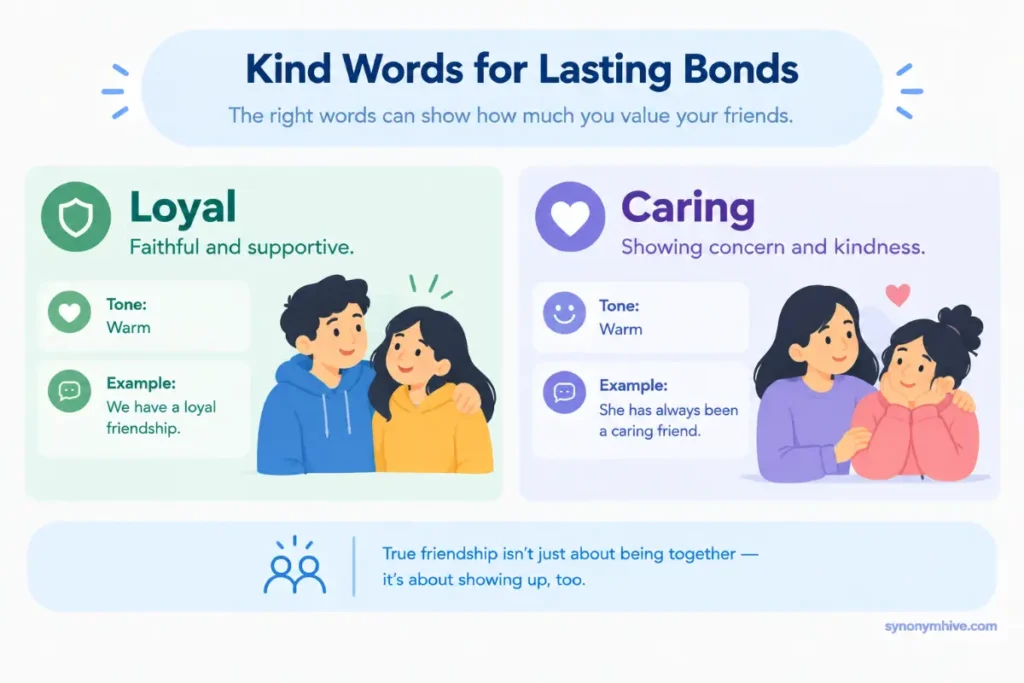
| Loyal | Faithful and supportive | Warm | We have a loyal friendship. |
| Caring | Showing concern and kindness | Warm | She has always been a caring friend. |
| Supportive | Giving help and encouragement | Positive | Their friendship is supportive and strong. |
| Trustworthy | Worthy of trust | Positive | He’s a trustworthy friend. |
| Dependable | Reliable and consistent | Positive | She is a dependable friend. |
| Kind | Considerate and caring | Simple | He’s a kind friend. |
| Fun | Enjoyable and lively | Casual | We have a fun friendship. |
| Playful | Full of humor and lightness | Casual | Their friendship is playful. |
| Uplifting | Making someone feel better | Positive | Her friendship is uplifting. |
| Respectful | Showing mutual respect | Positive | They have a respectful friendship. |
| Understanding | Sensitive to another person’s feelings | Warm | He’s an understanding friend. |
| Encouraging | Giving confidence or hope | Positive | She is an encouraging friend. |
| Generous | Willing to give or help | Warm | Their friendship is generous and caring. |
| Deep | Emotionally meaningful | Reflective | They share a deep friendship. |
| Lifelong | Lasting throughout life | Strong | They formed a lifelong friendship. |
| Unbreakable | Very difficult to damage or end | Strong | They have an unbreakable bond. |
| Enduring | Continuing despite challenges | Formal | Their enduring friendship has lasted decades. |
| Cherished | Loved and valued deeply | Warm | It is a cherished friendship. |
| Solid | Reliable and dependable | Casual | We’ve got a solid friendship. |
| Real | Sincere and authentic | Casual | It’s a real friendship. |
| Amazing | Extremely good or enjoyable | Casual | She’s an amazing friend. |
| Special | Unusually meaningful or valuable | Warm | We have a special friendship. |
| Easygoing | Relaxed and comfortable | Casual | Their friendship is easygoing. |
| Tight knit | Very close and connected | Casual | They are part of a tight knit group. |
This list gives you choices for different situations instead of forcing the same few adjectives into every sentence.
What Words Describe a Friendship Mildly?
Some words describe friendship in a positive way without making a very strong emotional claim.
Friendly is a basic choice. It shows warmth and goodwill but doesn’t necessarily mean the people are close.
Pleasant suggests that spending time together is enjoyable.
Fun shows that the relationship brings enjoyment.
Easygoing describes a relaxed friendship without much conflict or pressure.
Positive is useful when you want to describe the relationship in a broad way.
For example:
We have a friendly relationship with our neighbors.
Our friendship is easygoing and relaxed.
We share a fun friendship built around our love of music.
These words work well when you want to sound positive but not overly emotional.
What Words Describe a Strong Friendship?
Stronger words suggest trust, loyalty, history, or emotional connection.
Loyal is useful when a friend stays beside you during difficult moments.
Deep suggests emotional understanding and strong connection.
Lasting emphasizes time.
Enduring highlights a friendship that survives problems or changes.
Unbreakable is very strong and often sounds emotional or dramatic.
Lifelong suggests a bond that has continued for many years or is expected to continue throughout life.
For example:
Their friendship remained strong even after they moved to different states.
We have a deep friendship built on years of trust.
Their lifelong friendship began when they were children.
The stronger the word, the more specific the evidence should be.
What Words Describe a Caring Friendship?
A caring friendship usually includes kindness, support, attention, and concern.
Good choices include:
- Caring.
- Compassionate.
- Supportive.
- Kind.
- Thoughtful.
- Understanding.
- Encouraging.
- Considerate.
- Generous.
- Nurturing.
A caring friend doesn’t just say nice things. They may listen when you’re having a hard day, remember something that matters to you, or offer help when you need it.
For example:
She is a thoughtful friend who always remembers important dates.
His supportive nature makes difficult situations easier.
Their caring friendship gives both people a safe place to talk.
What Words Describe a Loyal Friendship?
Loyalty means staying faithful and supportive over time.
Useful words include loyal, faithful, dependable, reliable, devoted, committed, steadfast, and trustworthy.
Each word has a slightly different focus.
Loyal is the most natural everyday choice.
Faithful can sound more formal or emotional.
Dependable focuses on reliability.
Trustworthy focuses on keeping confidence and acting honestly.
Steadfast is stronger and more formal. It suggests someone remains firm even when circumstances become difficult.
For example:
She has been a loyal friend through every major change in my life.
His dependable nature makes him someone I can always count on.
Their steadfast friendship survived years of distance.
What Words Describe a Fun Friendship?
Some friendships are mainly defined by laughter, adventure, shared interests, and easy conversation.
Try words such as fun, playful, lively, humorous, entertaining, cheerful, spontaneous, adventurous, relaxed, and easygoing.
These words work especially well for social posts and personal writing.
For example:
Our friendship is playful and full of inside jokes.
We have an adventurous friendship that has taken us to some amazing places.
Their lively friendship makes every group gathering more enjoyable.
A fun friendship doesn’t have to be shallow. Humor and shared activities can exist alongside trust and emotional support.
What Words Describe a Deep Friendship?
A deep friendship involves emotional understanding, trust, openness, or shared history.
Strong choices include deep, meaningful, intimate, profound, genuine, trusting, close, personal, and significant.
Deep is simple and natural.
Meaningful focuses on value and importance.
Genuine focuses on sincerity.
Significant sounds more formal and emphasizes importance.
For example:
We developed a deep friendship after years of working together.
Our conversations helped create a meaningful friendship.
They share a genuine connection built on honesty.
How Do Friendship Words Change by Intensity?
Not every positive adjective carries the same emotional weight. You can think of friendship descriptions as a rough scale.
| Level | Useful Words | What They Suggest |
|---|---|---|
| Mild | Friendly, pleasant, fun | Positive interaction |
| Moderate | Caring, kind, supportive | Warmth and concern |
| Strong | Loyal, close, trustworthy | Strong connection |
| Very strong | Deep, meaningful, devoted | Emotional importance |
| Long lasting | Enduring, lasting, lifelong | Time and stability |
| Very intense | Unbreakable, inseparable | Extremely close bond |
This scale isn’t a strict grammar rule. People use words differently depending on the situation.
Someone might call a friendship amazing simply because they had a great weekend together. Another person might use amazing to describe a bond that has lasted twenty years.
Think about the claim your word makes before you choose it.
What Are Friendship Words by Part of Speech?
Most descriptions of friendship use adjectives because adjectives describe people, relationships, and qualities.
Examples include:
Adjectives: loyal, caring, supportive, honest, genuine, close, strong, meaningful, dependable, fun.
You can also use nouns to describe the relationship itself.
Nouns: bond, connection, companionship, relationship, trust, loyalty, support, closeness.
Verbs can describe what friends do for each other.
Verbs: support, encourage, trust, help, respect, celebrate, comfort, listen, understand.
Adverbs can describe how friends interact.
Adverbs: honestly, kindly, warmly, openly, respectfully, faithfully.
Compare these sentences:
They have a loyal friendship.
Their loyalty has lasted for years.
They support each other loyally.
The first uses an adjective. The second uses a noun. The third uses an adverb.
What Is the Best Word for Friendship on a Resume?
A resume usually isn’t the place to describe a personal friendship. If you’re describing teamwork, collaboration, or professional relationships, use workplace language instead.
Words such as supportive, dependable, respectful, collaborative, trustworthy, reliable, and cooperative can work when they describe a professional quality.
For example:
I built strong working relationships with team members.
I supported new employees during their first month.
I developed trusted professional relationships across departments.
Avoid phrases such as best friend, ride or die, inseparable, or my favorite person on a professional resume.
The goal is to show a useful quality rather than describe your personal life.
What Is the Best Word for Friendship in an Essay?
Essays often need precise words rather than vague praise.
Instead of writing:
They had a really good friendship.
Try:
They shared a loyal friendship built on mutual trust.
Or:
Their meaningful friendship shaped both characters throughout the story.
If you’re analyzing a novel, choose words that connect directly to the evidence.
Complex can describe a friendship with conflict.
Supportive works when the characters help each other.
Complicated works when the relationship contains both positive and negative elements.
Tense describes a friendship marked by discomfort or conflict.
Fragile suggests that the relationship could easily break.
Specific language makes an essay stronger because it tells the reader exactly what you mean.
What Is the Best Word for Friendship in a Text?
Texts are usually more relaxed, so natural everyday words work well.
You could say:
You’re such a loyal friend.
I’m really lucky to have you.
We’ve got such a fun friendship.
Our friendship is honestly one of my favorite things.
You’re always there for me.
Casual messages don’t need fancy vocabulary. A simple sentence can sound more sincere than an overly formal one.
If you’re writing a birthday text, words such as amazing, caring, funny, supportive, special, and genuine are easy to use.
What Is the Best Word for Friendship in an Email?
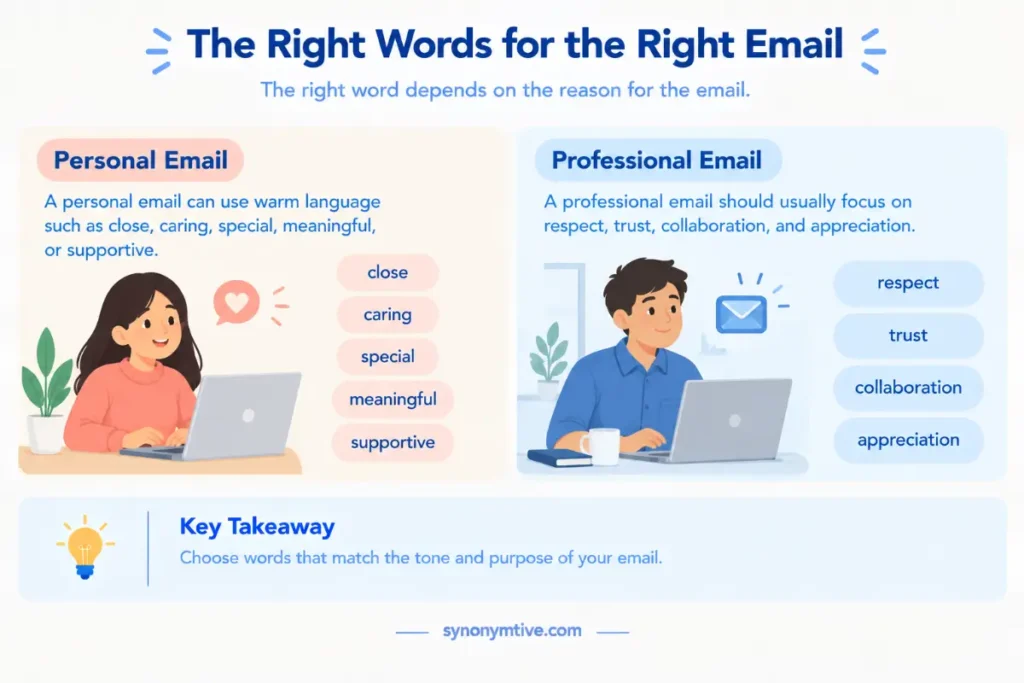
The right word depends on the reason for the email.
A personal email can use warm language such as close, caring, special, meaningful, or supportive.
A professional email should usually focus on respect, trust, collaboration, and appreciation.
For example:
I’ve always valued our close friendship.
A professional version might be:
I’ve always valued our strong professional relationship.
The second sentence fits a workplace better because it clearly defines the type of relationship.
Explore another synonym guide: Words To Describe A Person Best Guide In 2026.
What Is the Best Word for Friendship When Speaking?
Everyday speech usually favors simple words.
You might say:
She’s a really good friend.
He’s always been there for me.
We have a really close friendship.
They’re great friends.
We’ve been close for years.
These phrases sound natural because people don’t usually speak like a thesaurus.
When talking, choose the word that comes naturally. A complicated word can sound forced if you wouldn’t normally use it.
What Are Some Examples of Friendship Descriptions?
Here are natural examples you can adapt for messages, essays, captions, speeches, and everyday conversation.
- We have a close friendship built on years of trust.
- She is one of the most loyal friends I’ve ever had.
- Their friendship is strong because they respect each other’s differences.
- We share a fun friendship filled with jokes and good memories.
- His caring nature makes him a wonderful friend.
- They have a meaningful friendship that grew stronger over time.
- Our friendship is genuine because we can always be ourselves around each other.
- She is a dependable friend who keeps her promises.
- Their friendship is uplifting and gives both people confidence.
- We have an easygoing friendship that never feels forced.
- His honest advice has made our friendship stronger.
- Their enduring friendship survived years of distance.
- She has been a supportive friend during some difficult moments.
- We share a deep connection based on mutual trust.
- Their playful friendship is full of humor.
- He is a thoughtful friend who notices when someone needs help.
- Their lifelong friendship began in elementary school.
- We have a respectful friendship even when we disagree.
- Her encouraging friendship helped me believe in myself.
- Their friendship is special because they accept each other as they are.
Notice how each sentence gives the reader a reason to understand the relationship.
Loyal vs Supportive What Is the Difference?
Loyal and supportive are closely related, but they focus on different qualities.
| Word | Main Idea | Example |
|---|---|---|
| Loyal | Staying faithful and standing by someone | She is a loyal friend who never abandons people she cares about. |
| Supportive | Giving help, encouragement, or emotional support | She is a supportive friend who always encourages me. |
A loyal friend stays beside you.
A supportive friend actively helps or encourages you.
One person can easily be both.
He’s a loyal friend who supports me whenever things get difficult.
That sentence shows how the two ideas work together.
Close vs Deep Friendship What Is the Difference?
Close usually describes emotional or personal connection. Deep suggests a stronger level of understanding or meaning.
A close friendship might mean you spend a lot of time together and know each other well.
A deep friendship often involves honest conversations, emotional trust, shared experiences, or a strong understanding of each other.
For example:
We’re close friends.
This is a simple everyday statement.
We have a deep friendship built on years of honesty.
This makes a stronger emotional claim.
You can use both words together when appropriate.
They have a close, deep friendship that has lasted for years.
Good vs Meaningful Friendship What Is the Difference?
Good is broad. It tells the reader that the friendship is positive but doesn’t explain why.
Meaningful gives more information. It suggests the relationship has personal value or emotional importance.
Compare:
We have a good friendship.
We have a meaningful friendship.
The second sentence tells the reader more about how the relationship matters.
If you’re writing an essay or personal statement, meaningful often gives you more detail. If you’re speaking casually, good may sound more natural.
Genuine vs Real Friendship What Is the Difference?
Genuine and real can both suggest that a friendship is sincere.
Real is simple and conversational.
Genuine sounds slightly more polished and focuses on sincerity.
Compare:
We have a real friendship.
We have a genuine friendship.
Both can work. The first sounds casual. The second can sound more thoughtful or formal.
Genuine is especially useful when you want to contrast sincere friendship with relationships based on status, money, convenience, or personal gain.
Common Mistakes When Describing Friendship
One common mistake is using a word that is too vague.
Good isn’t wrong, but it doesn’t tell the reader much.
Instead of:
She is a good friend.
Try:
She is a loyal friend who always keeps her promises.
The second sentence gives evidence.
Another mistake is using strong words without support.
Calling a friendship unbreakable makes a big claim. If the relationship has only existed for a few months, that word may sound exaggerated.
A third mistake is treating every positive word as interchangeable.
A caring friend and a funny friend offer different qualities. A loyal friend and an adventurous friend may have completely different strengths.
Another issue is repeating the same adjective.
She is kind, caring, nice, and kind.
That sentence adds little after the first few words.
Pick distinct qualities instead.
She is kind, dependable, funny, and honest.
Now each word adds something new.
When Should You Avoid Certain Friendship Words?
Avoid overly emotional words when the relationship doesn’t support them.
Words such as soulmate, inseparable, unbreakable, lifelong, and devoted carry strong emotional meaning. They work best when the relationship truly fits that description.
You should also avoid slang when your audience expects formal writing.
For example, ride or die can work in a casual caption but may not fit a school essay or professional statement.
Some words can also sound negative even when you don’t intend them to.
Possessive means someone wants to control another person.
Dependent can suggest that one person relies too heavily on the other.
Intense can be positive in some situations but may sound overwhelming in others.
Always check the emotional meaning of a word before using it.
What Are the Opposites of Friendship Words?
The opposite depends on the quality you’re describing.
| Positive Word | Possible Opposite |
|---|---|
| Loyal | Disloyal |
| Caring | Uncaring |
| Honest | Dishonest |
| Trustworthy | Untrustworthy |
| Supportive | Unsupportive |
| Close | Distant |
| Friendly | Hostile |
| Respectful | Disrespectful |
| Dependable | Unreliable |
| Genuine | Insincere |
| Strong | Fragile |
| Meaningful | Meaningless |
Not every opposite is a perfect match. Context changes the best choice.
For example, the opposite of a close friendship might be a distant relationship, while the opposite of a trustworthy friend might be an unreliable or dishonest person.
What Words Describe a Difficult Friendship?
Not every friendship is positive all the time. Sometimes you need words that describe conflict or emotional distance.
Useful choices include complicated, tense, distant, strained, fragile, unhealthy, competitive, controlling, unreliable, and troubled.
Complicated suggests mixed feelings or a difficult history.
Tense suggests conflict or discomfort.
Distant suggests reduced emotional connection.
Strained means the relationship has become difficult because of problems or conflict.
Fragile suggests the friendship could break easily.
For example:
Their friendship became strained after a serious disagreement.
They remained friends, but their relationship felt distant.
The characters have a complicated friendship shaped by rivalry and trust.
These words can make descriptions more balanced and realistic.
What Words Describe a New Friendship?
A new friendship may be described as developing, promising, exciting, fresh, growing, friendly, enjoyable, or budding.
Budding friendship is a common phrase for a relationship that is starting to grow.
For example:
The two students formed a budding friendship during their first week at school.
You can also say:
We’re developing a close friendship.
We have a new friendship built around our shared interest in photography.
These descriptions work because they show that the relationship is still developing.
What Words Describe an Old Friendship?
For a friendship that has lasted many years, use longstanding, longtime, lasting, enduring, lifelong, established, close, or cherished.
Longstanding focuses on duration.
Enduring suggests that the friendship survived change or difficulty.
Cherished focuses on how deeply the relationship is valued.
For example:
They have a longstanding friendship that began in college.
Their enduring friendship has survived many changes.
She is a cherished friend who has been part of my life for decades.
What Words Describe a Friendship Between Best Friends?
Best friends often share qualities such as close, deep, loyal, trusting, supportive, honest, playful, inseparable, genuine, and meaningful.
The best choice depends on what makes the friendship special.
If you want to highlight honesty:
We have an open and honest friendship.
If you want to highlight humor:
Our friendship is playful and full of inside jokes.
Specific descriptions usually sound better than simply saying best friendship.
How Can You Choose the Right Friendship Word?
Start with the quality you want to show.
Ask yourself:
- Does this person support me?
- Can I trust this person?
- Have we known each other for a long time?
- Do we laugh together?
- Can we talk honestly?
- Do we help each other?
- Does the friendship make life better?
- Is the relationship emotionally deep?
- Does the friendship survive difficult moments?
- Is the relationship new or longstanding?
Then choose a word that answers one of those questions.
If the answer is kindness, try caring or thoughtful.
If the answer is enjoyment, try fun or playful.
Quick Tips for Choosing Friendship Words
- Choose specific words instead of relying on good.
- Match the word to the quality you want to describe.
- Use loyal for faithfulness and support.
- Use trustworthy when someone keeps confidence and acts honestly.
- Use supportive when someone gives help or encouragement.
- Use meaningful when the relationship has strong personal value.
- Use deep for strong emotional connection.
- Use lasting or longstanding for friendships that have continued over time.
- Use playful or fun when humor is a major part of the relationship.
- Use genuine when you want to emphasize sincerity.
- Use dependable when you want to show reliability.
- Use caring when someone shows concern for others.
- Save very strong words such as unbreakable for relationships that truly justify them.
- Match your vocabulary to your audience.
- Give examples when one adjective doesn’t fully explain the relationship.
- Avoid repeating several words that mean almost the same thing.
- Don’t force fancy vocabulary into casual writing.
- Read the full sentence aloud before choosing the final word.
How Can You Make Friendship Descriptions More Powerful?
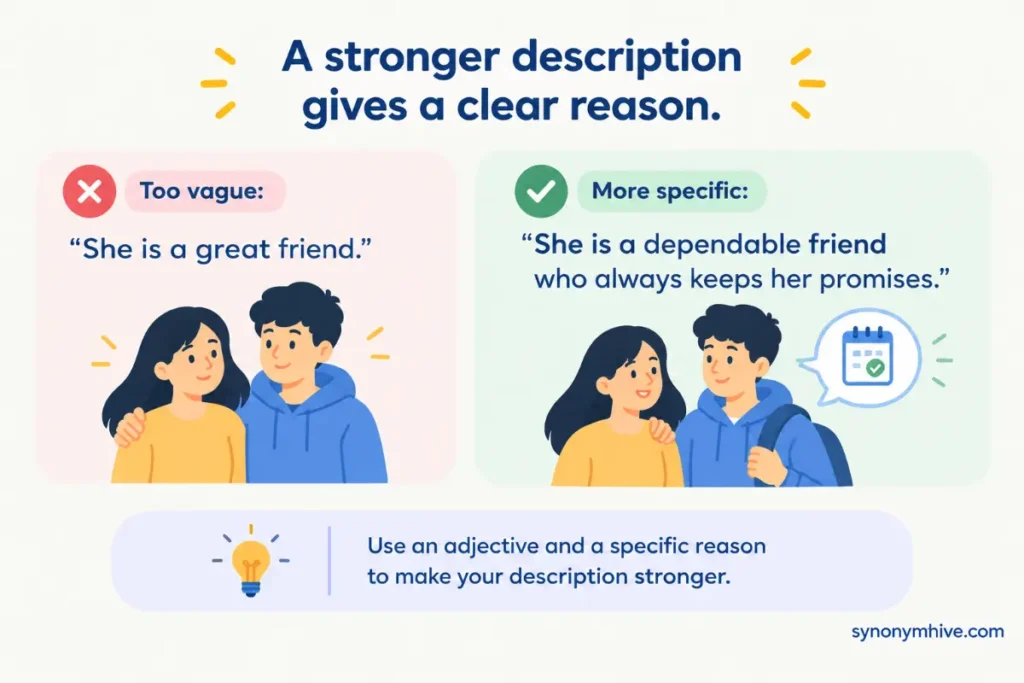
A strong description usually combines an adjective with a specific reason.
Instead of:
She is a great friend.
Try:
She is a dependable friend who always keeps her promises.
Instead of:
We have a good friendship.
Try:
We have a close friendship built on honesty and mutual respect.
Instead of:
He’s a nice friend.
Try:
He’s a thoughtful friend who notices when someone needs help.
This approach works because the adjective gives the idea while the second part proves it.
You can also combine two different qualities.
We have a fun and supportive friendship.
She is a loyal and trustworthy friend.
Their friendship is close, genuine, and lasting.
Try not to pile up adjectives that mean almost the same thing. Three distinct qualities usually tell the reader more than six similar ones.
You may also like words to describe yourself best guide in 2026.
Conclusion
The best words to describe friendship are the ones that explain what makes the relationship valuable. Loyal shows faithfulness. Supportive shows encouragement. Trustworthy highlights confidence and honesty. Meaningful and deep suggest emotional importance, while lasting and lifelong focus on time.
You don’t need complicated vocabulary to describe a special friendship well. A simple word becomes much stronger when you connect it to a real quality or memory. Instead of saying someone is a good friend, explain how they support you, make you laugh, keep your secrets, or stay beside you during hard times.
Before choosing your final word, ask what you really want the reader to understand. Then pick the adjective that says exactly that. A specific word paired with a real example will almost always create a clearer and more memorable description.
Frequently Asked Questions
What are good words to describe friendship?
Good choices include loyal, caring, supportive, trustworthy, genuine, close, meaningful, dependable, honest, fun, and lasting. Choose the word that best matches the quality you want to show.
What’s another way to say a good friendship?
You can say close friendship, strong friendship, meaningful friendship, genuine friendship, lasting friendship, or supportive friendship. Each phrase adds a slightly different meaning.
What are positive words to describe a best friend?
Loyal, caring, trustworthy, funny, dependable, honest, supportive, thoughtful, encouraging, and genuine are strong choices. You can combine two or three to create a more personal description.
What is a word for a friendship that lasts a long time?
Longstanding, lasting, enduring, and lifelong can describe a friendship that continues for many years. Lifelong is the strongest choice because it suggests a connection lasting throughout a person’s life.
What word describes a deep friendship?
Deep, meaningful, close, genuine, and trusting can describe a strong emotional friendship. Deep is the simplest and most natural choice for everyday writing.
What are some terms to describe friendship in an essay?
Useful academic choices include meaningful, supportive, loyal, complex, enduring, significant, genuine, and respectful. Pick words that connect to specific actions or evidence from the people or characters you’re describing.
What are the best words to describe friendship in a birthday message?
Warm words such as amazing, loyal, caring, special, supportive, genuine, funny, and cherished work well. Add a personal example to make the message sound sincere rather than generic.