

When you’re writing a resume, email, essay, or recommendation, you may stop at one simple question. What is another term for committed that sounds natural and professional. The answer depends on the quality you want to show. You might mean loyal, determined, dedicated, dependable, or deeply involved.
Another word for committed can be dedicated, devoted, loyal, determined, devoted, responsible, or dedicated depending on the context.
The word committed has a strong positive meaning. It usually shows that someone takes a goal, responsibility, person, or cause seriously and continues to support it. Still, the best synonym changes with the situation.
This guide explains the meaning and origin of committed and gives you more than 30 useful alternatives. You’ll also learn which words work best on resumes, in essays, emails, texts, and everyday speech. By the end, you’ll know how to choose a synonym that sounds natural and fits your exact meaning.
Compare more word options with Another Word for Skills: Best Choices (2026).
another word for committed for clear professional writing
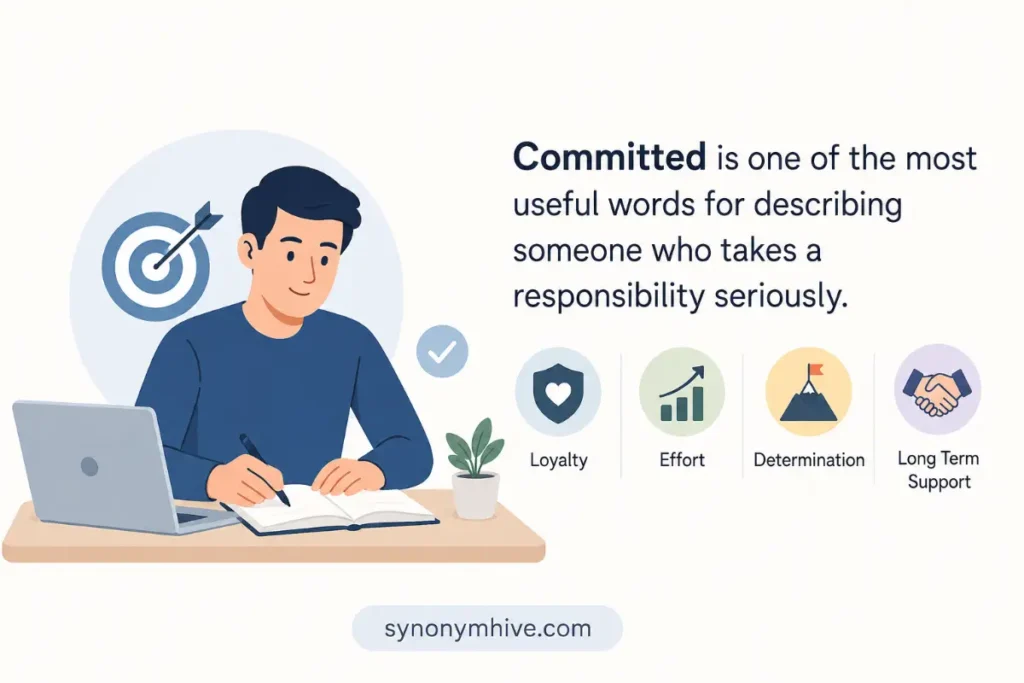
Committed is one of the most useful words for describing someone who takes a responsibility seriously. It can show loyalty, effort, determination, or long term support.
On a resume, however, you may want a more specific word. A hiring manager learns more from diligent, dependable, or results driven than from a general statement that someone is committed.
The right synonym should tell the reader something useful.
When you want to show loyalty, use loyal.
To show strong effort, use dedicated or hardworking.
When you want to show persistence, use determined or persistent.
To describe careful work, use diligent.
When you want to show reliability, use dependable or responsible.
This small shift can make your writing more precise without making it sound complicated.
What does committed mean in plain English
Committed means strongly devoted to a person, goal, task, responsibility, or cause.
A committed person doesn’t give up easily. They take something seriously and are willing to give it time, effort, attention, or support.
For example, a committed employee takes responsibility for their work. A committed student keeps working toward a goal. A committed volunteer continues helping a community group.
The word can also describe a firm decision. If someone is committed to a plan, they have decided to support or follow that plan.
Committed can also have other meanings in specific situations. In legal or institutional language, committed may describe someone being officially placed in an institution or being responsible for an action. In everyday professional writing, though, the positive meaning is much more common.
Where does the word committed come from
Committed comes from the verb commit. The English word traces back through French to the Latin committere. The original idea involved bringing something together or entrusting something to someone.
Over time, commit developed several meanings. One important meaning became the idea of entrusting yourself to a task, person, cause, or decision.
That meaning gives committed its modern sense of serious involvement.
When you say someone is committed to a goal, you suggest more than simple interest. You show that the person has chosen to give the goal real attention and effort.
This is also why words such as devoted, dedicated, loyal, and determined can overlap with committed while still carrying different shades of meaning.
What are the best synonyms for committed
The best synonym depends on what you want the reader to notice. Some words focus on effort. Others focus on loyalty, reliability, emotion, or determination.
| Word | Meaning | Tone | Example |
|---|---|---|---|
| Dedicated | Giving serious time and effort | Professional | She is dedicated to helping clients. |
| Devoted | Showing deep care and loyalty | Warm | He is devoted to his family. |
| Loyal | Showing steady support | Personal or professional | She is loyal to her team. |
| Determined | Strongly focused on reaching a goal | Strong | He is determined to succeed. |
| Diligent | Careful and consistent with work | Professional | She is a diligent employee. |
| Dependable | Reliable and trustworthy | Professional | He is a dependable team member. |
| Hardworking | Willing to put in strong effort | Everyday | She is a hardworking employee. |
| Focused | Giving full attention to something | Modern | He stays focused on his goals. |
| Persistent | Continuing despite difficulty | Strong | She is persistent when solving problems. |
| Responsible | Taking duties seriously | Everyday | He is responsible with every assignment. |
| Motivated | Eager to achieve something | Professional | She is motivated to improve results. |
| Driven | Strongly motivated to succeed | Modern | He is a driven professional. |
| Passionate | Showing strong interest or enthusiasm | Energetic | She is passionate about teaching. |
| Dedicated | Strongly devoted to a purpose | Professional | He is dedicated to his work. |
| Conscientious | Careful and responsible | Formal | She is a conscientious worker. |
| Steadfast | Firm and loyal over time | Formal | He remained steadfast in his support. |
| Persistent | Continuing without giving up | Strong | She remained persistent during setbacks. |
| Tenacious | Very determined and persistent | Strong | He is a tenacious problem solver. |
| Engaged | Actively involved | Professional | She stays engaged with customers. |
| Dedicated | Strongly committed to a purpose | Neutral | They are dedicated to their mission. |
Which simple synonyms work best
Simple words are often the safest choice. Dedicated, loyal, hardworking, focused, reliable, responsible, and determined are easy to understand.
They also sound natural in everyday professional writing.
For example, you could write:
She is a hardworking employee who always meets deadlines.
You could also write:
She is a reliable employee who follows through on important tasks.
Both sentences are clear. The first focuses on effort. The second focuses on trust.
Which everyday synonyms sound natural
In casual writing, you can use hardworking, focused, driven, motivated, loyal, serious, and invested.
These words fit conversations, text messages, social posts, and informal emails.
For example, you might tell a friend:
You’re really driven when you care about something.
That sounds much more natural than using a formal word such as resolute in an ordinary conversation.
Which formal synonyms work best
Formal writing can use diligent, conscientious, steadfast, resolute, tenacious, and devoted.
These words can work well in academic writing, recommendations, professional evaluations, and formal reports.
Still, don’t choose a formal word just because it sounds impressive. If committed communicates the idea clearly, it may remain the better choice.
another word for committed by intensity
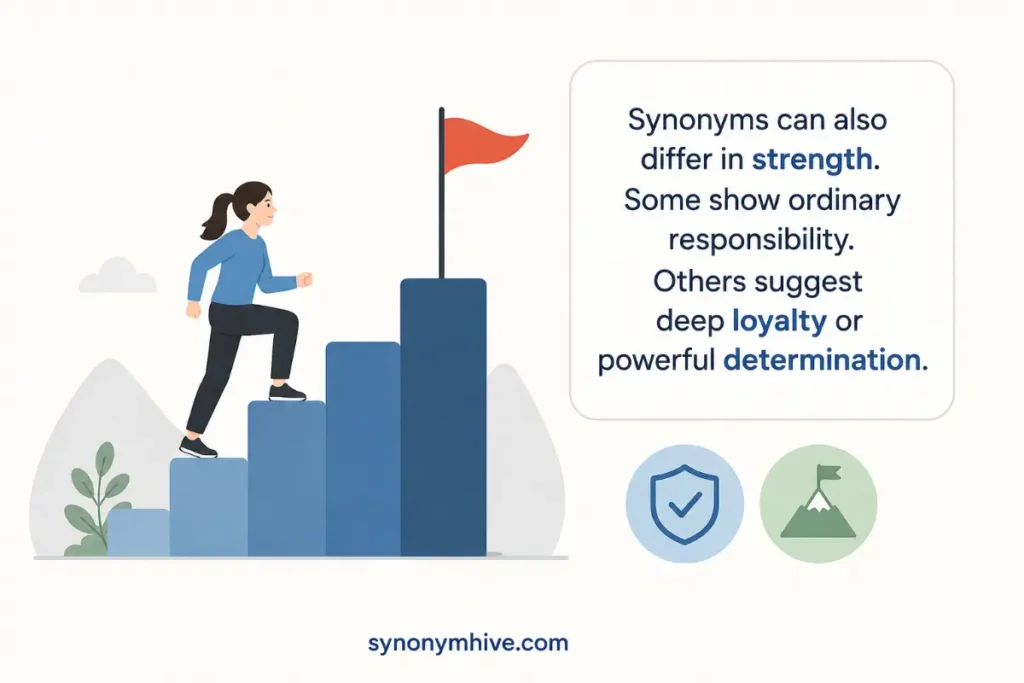
Synonyms can also differ in strength. Some show ordinary responsibility. Others suggest deep loyalty or powerful determination.
Mild alternatives
Attentive, involved, responsible, reliable, focused, and engaged can create a moderate sense of commitment.
These words work well when you want to praise someone without making a strong emotional claim.
For example, an attentive employee listens carefully to customers. A reliable employee consistently completes responsibilities. A focused employee keeps attention on a goal.
Moderate alternatives
Dedicated, committed, hardworking, diligent, motivated, persistent, and dependable usually sound stronger.
These words suggest that someone regularly puts effort into a task or goal.
They are especially useful in professional writing because they communicate strength without sounding dramatic.
Strong alternatives
Devoted, determined, steadfast, tenacious, resolute, and passionate can create a stronger impression.
Use them when the situation supports that level of intensity.
A person can be passionate about a career or cause. Someone can be devoted to a family member. A determined athlete may keep training after repeated setbacks.
The strongest word isn’t automatically the best word. If you use an intense synonym for an ordinary situation, the sentence may sound exaggerated.
How can you match the synonym to the right strength
Start by identifying the main idea.
When the person simply does reliable work, use dependable or responsible.
If the person works carefully, use diligent.
When the person gives a lot of time and effort, use dedicated.
To describe someone who refuses to give up, use determined or persistent.
When the person has deep emotional loyalty, use devoted.
To describe someone who strongly supports a group or person, use loyal.
When the person has strong enthusiasm, use passionate.
This method keeps your writing honest and precise.
How does committed work as a part of speech
Committed is mainly used as an adjective when it describes a person’s attitude or level of involvement.
You can write:
She is committed to improving customer service.
He is committed to his education.
They are committed to the project.
The related noun is commitment.
For example:
Her commitment to customer service is clear.
The related verb is commit.
For example:
She decided to commit to the training program.
You can also use dedication, devotion, determination, diligence, loyalty, persistence, and motivation as related nouns.
This gives you flexibility when you want to avoid repeating the same sentence pattern.
Which adjectives can replace committed
Dedicated, devoted, loyal, determined, diligent, dependable, focused, persistent, motivated, passionate, conscientious, steadfast, and responsible can all work as adjectives.
The correct choice depends on the sentence.
Which nouns express the same idea
Commitment, dedication, devotion, determination, diligence, loyalty, persistence, motivation, and responsibility all express related ideas.
For example:
His dedication to the project impressed the manager.
Her determination helped her finish the program.
Their loyalty to the organization lasted for years.
Which verbs can show commitment
You can often avoid adjectives by using strong action verbs.
Try commits, supports, pursues, serves, contributes, completes, maintains, improves, manages, follows, and continues.
For example:
Instead of saying that you are committed to improving customer service, you can explain that you improved response times and resolved customer concerns.
Action often speaks louder than description.
another term for committed on a resume
A resume needs clear language that connects your strengths to real results. Committed can work, but a more specific word may create a stronger impression.
Dedicated is useful when you want to show sustained effort.
Example:
Dedicated professional who consistently supports clients and meets demanding deadlines.
Diligent works when accuracy and careful work matter.
Example:
Diligent administrative professional with strong attention to records and documentation.
Driven works well for achievement focused roles.
Example:
Driven sales professional who consistently works toward ambitious revenue goals.
Dependable is useful when reliability matters.
Example:
Dependable team member trusted with time sensitive customer requests.
Determined can highlight persistence and goal achievement.
Example:
Determined professional who consistently meets challenging performance goals.
Try to connect the adjective to proof. Instead of simply calling yourself committed, explain what you achieved.
A hiring manager can verify an accomplishment. They can’t measure an unsupported adjective.
another expression for committed in an essay
Essays often need more precise language than everyday speech.
Dedicated works well when describing sustained effort.
Devoted can show deep emotional loyalty.
Determined can show strong effort toward a goal.
Passionate can show enthusiasm.
Steadfast can show firm support over time.
For example:
The teacher remained dedicated to improving literacy in the community.
You could also write:
The teacher remained steadfast in her support for public education.
These sentences overlap, but they emphasize different ideas. The first highlights effort. The second highlights loyalty.
Academic writing should favor accuracy over dramatic language. If your evidence only shows steady work, don’t use a word that suggests extreme emotion.
another term for committed in texting
Texting usually calls for short and familiar words.
Hardworking, driven, loyal, focused, serious, and motivated work well.
For example:
You’re really driven when you set your mind to something.
Or:
I respect how hardworking you are.
You could also avoid a synonym altogether and describe the behavior.
For example:
You never give up when you care about something.
That sounds natural and personal.
another phrase for committed in an email
Professional emails need clear and respectful language.
Committed, dedicated, focused, reliable, and responsible are strong choices.
For example:
Our team is committed to resolving your concern quickly.
You could make the sentence more specific:
Our team is dedicated to finding a practical solution and keeping you updated.
If you are praising a coworker, dependable can work especially well.
For example:
Jordan has been dependable throughout the project and consistently follows through on client requests.
Specific praise sounds more believable than a string of general compliments.
another word for committed in speaking
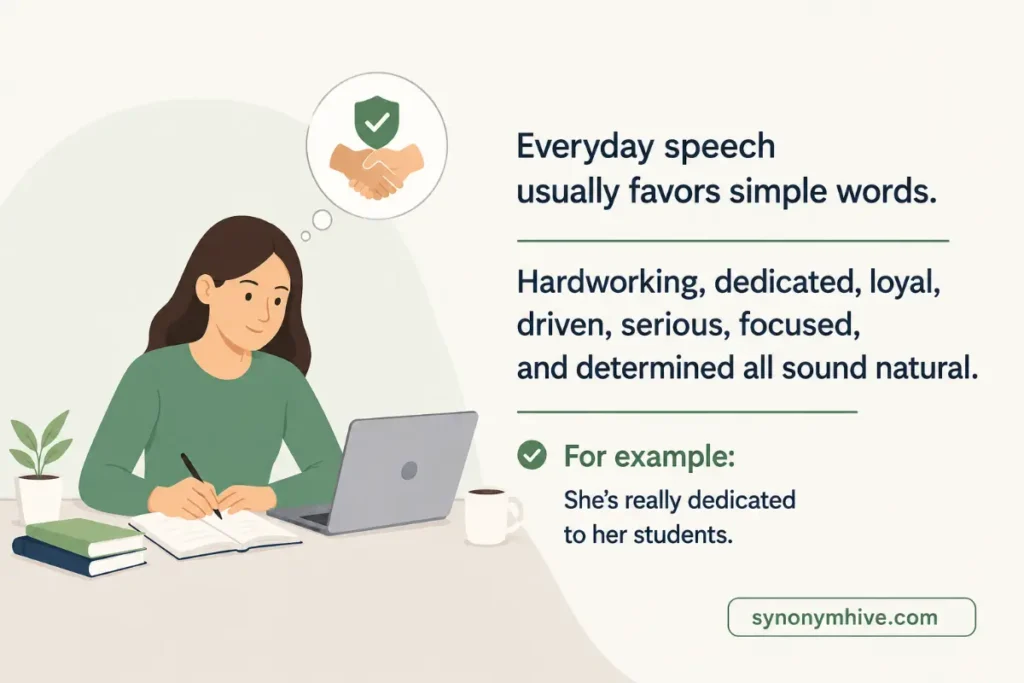
Everyday speech usually favors simple words.
Hardworking, dedicated, loyal, driven, serious, focused, and determined all sound natural.
For example:
She’s really dedicated to her students.
He’s very driven and doesn’t give up easily.
They’re loyal to the team.
You don’t need a formal synonym to sound intelligent. Clear language usually sounds stronger when spoken.
What is the difference between committed and dedicated
Committed and dedicated are very close. Both can describe strong effort and loyalty.
Committed often emphasizes a firm decision or responsibility. Dedicated often emphasizes the time, energy, and effort someone gives to something.
| Word | Main idea | Example |
|---|---|---|
| Committed | Firm support or responsibility | She is committed to improving the program. |
| Dedicated | Serious effort and devotion | She is dedicated to improving the program. |
The difference is small in many situations.
If you want to emphasize a promise or firm decision, committed may be better.
If you want to emphasize sustained effort, dedicated may be better.
What is the difference between committed and devoted
Devoted usually carries more emotional weight than committed.
Committed works naturally in professional situations. Devoted often works better when deep personal care is involved.
| Word | Main idea | Best context |
|---|---|---|
| Committed | Firm support and responsibility | Work goals and causes |
| Devoted | Deep care and loyalty | Family relationships and personal causes |
For example:
She is committed to her career.
She is devoted to her children.
You can use devoted in professional writing, but it can sound more emotional than necessary.
What is the difference between committed and determined
Committed and determined both suggest strong effort. They don’t focus on exactly the same thing.
Committed emphasizes dedication to something.
Determined emphasizes the will to reach a goal.
| Word | Main idea | Example |
|---|---|---|
| Committed | Strong dedication | He is committed to his work. |
| Determined | Strong desire to reach a goal | He is determined to finish the project. |
A person can be committed to a career for years without facing a major challenge. A determined person is often pushing toward a specific outcome.
Learn more useful word alternatives in Another Word For Reliable Best Resume Choices 2026.
What is the difference between committed and loyal
Loyal focuses strongly on continued support.
Committed has a wider meaning. It can describe loyalty, effort, responsibility, or dedication to a goal.
| Word | Main idea | Example |
|---|---|---|
| Committed | Strong involvement or dedication | She is committed to the project. |
| Loyal | Steady support or faithfulness | She is loyal to her company. |
Use loyal when support is the main idea. Use committed when you want to express broader involvement.
What is the difference between committed and diligent
Diligent focuses on careful work. Committed focuses on dedication.
| Word | Main idea | Example |
|---|---|---|
| Committed | Strong dedication | He is committed to the project. |
| Diligent | Careful and consistent effort | He is diligent when reviewing reports. |
A diligent worker may be extremely careful without having a strong emotional connection to the project.
A committed worker may care deeply about the goal while not necessarily being known for detailed work.
What are common mistakes with committed synonyms
One mistake is treating every synonym as an exact replacement. Most synonyms share a core meaning but differ in tone or focus.
Another mistake is using an intense word for a simple situation. Calling someone zealous or devoted can sound excessive when you only mean they work reliably.
A third mistake is using formal language in casual settings. Words such as resolute and steadfast may sound unnatural in a text message.
Another common problem appears on resumes. Many people write that they are committed, hardworking, motivated, and dedicated without giving evidence.
That creates a list of claims instead of a clear picture of ability.
Instead, show what you did.
For example:
I improved customer response time by reorganizing the support process.
This sentence gives the reader something concrete.
You should also avoid repeating the same synonym in every paragraph. Good writing uses variety naturally, but forced variety can be just as distracting as repetition.
What are the antonyms of committed
Common opposites include uncommitted, indifferent, unreliable, careless, distracted, unmotivated, inconsistent, and apathetic.
The best antonym depends on the meaning.
Uncommitted is the clearest opposite when someone hasn’t made a firm decision.
Indifferent works when someone doesn’t care.
Unmotivated works when someone lacks drive.
Unreliable works when someone doesn’t consistently follow through.
Careless works when someone fails to give proper attention.
These words don’t all mean the exact opposite. Pick the one that matches the specific quality you want to contrast.
How does committed differ in US and UK English
Committed has the same basic meaning in American and British English.
The most common alternatives also overlap. Americans and British speakers both use dedicated, devoted, loyal, determined, diligent, dependable, hardworking, and focused.
The main difference comes from style and context rather than meaning.
American professional writing often favors direct language such as committed, focused, reliable, and hardworking. British professional writing also uses these words and may use formal choices such as conscientious or diligent more often in certain settings.
You don’t need a different synonym simply because your audience is American. Focus on tone, purpose, and clarity.
How can you choose the right synonym quickly
Choosing the right alternative becomes much easier when you identify the main idea first.
When you mean strong loyalty, choose loyal.
If you mean serious effort, choose dedicated.
When you mean deep personal care, choose devoted.
For careful work, choose diligent.
When you mean reliability, choose dependable.
To describe persistence, choose persistent.
When you mean strong goal focused effort, choose determined.
To express ambition, choose driven.
When you mean enthusiasm, choose passionate.
For responsibility, choose responsible.
This method prevents a common writing problem. You won’t pick a synonym simply because it looks impressive.
Think of each synonym as a different lens. One shows loyalty. Another shows effort. Another shows persistence. The meaning becomes clearer when you use the lens that matches your message.
How can you make your resume sound more committed
The best way to show commitment on a resume is to connect words with evidence.
Instead of writing:
I am a committed employee.
Try:
Consistently managed high priority customer requests while meeting strict response targets.
Instead of:
I am dedicated to teamwork.
Try:
Supported five team members during a major project and helped keep deadlines on track.
Instead of:
I am motivated and hardworking.
Try:
Completed a six month training program while managing a full workload.
These examples do more than describe a personal quality. They show behavior and results.
That is especially important for EEAT focused professional writing. Claims become stronger when they connect to real experience, clear actions, and measurable outcomes.
How can you use committed without sounding repetitive
You don’t need to remove committed every time it appears. If it is the clearest word, keep it.
When repetition becomes noticeable, replace it with a synonym that adds a different shade of meaning.
For example:
She remains determined when problems appear.
She is dependable when the team needs support.
These sentences don’t simply repeat the same idea. Each one adds a different quality.
You can also vary your sentence structure.
Instead of repeatedly writing that someone is committed to something, describe what the person actually does.
For example:
She consistently meets deadlines and takes ownership of difficult tasks.
This gives the writing more energy and makes the person easier to understand.
What are useful examples of committed synonyms
Real examples make word choice easier to understand. The following sentences cover work, education, relationships, leadership, volunteering, and everyday situations.
- Maria is dedicated to helping new employees adjust to their roles.
- James is determined to complete his degree despite a demanding work schedule.
- Our most diligent employee checks every report before sending it to clients.
- Sarah is dependable and always follows through on important assignments.
- The coach is passionate about helping young athletes develop confidence.
- Daniel is driven to improve his sales performance each quarter.
- The volunteer remained loyal to the organization after many years of service.
- The teacher is focused on helping students build strong reading skills.
- She remained persistent after several applications were rejected.
- He is a responsible manager who takes ownership of difficult decisions.
- The nurse was attentive to every patient’s concerns.
- The team stayed motivated during a challenging project.
- She is conscientious and carefully reviews each document.
- He remained steadfast in his support for the community program.
- The student is hardworking and rarely misses an opportunity to improve.
- She is deeply devoted to caring for her family.
- The manager is engaged with employees and listens to their concerns.
- He is invested in the success of the new training program.
- The company is committed to improving customer service.
- She is serious about building a long term career in education.
Each sentence uses a related word for a specific reason. That’s the key to strong synonym use.
How should you choose the best word
Start with meaning. Then consider the audience. Finally, read the sentence aloud.
When the sentence sounds stiff, try a simpler word.
Whenever the sentence feels too weak, choose a more precise synonym.
When it sounds exaggerated, step back to a calmer option.
For resumes, favor clear professional terms and support them with results.
When writing an essay, choose words that fit your argument and evidence.
For emails, keep the tone direct and respectful.
When texting, use familiar everyday language.
While speaking, choose words that feel natural when said aloud.
You don’t need to impress readers with difficult vocabulary. You need to make your meaning easy to understand.
Quick tips for choosing another word
- Use dedicated when you want to show strong effort and sustained involvement.
- Use loyal when continued support is the main idea.
- Use devoted when deep personal care matters.
- Use determined when someone is working toward a clear goal.
- Use diligent when careful work matters most.
- Use dependable when you want to show reliability.
- Use persistent when someone keeps going through difficulty.
- Use driven when ambition is important.
- Use passionate when genuine enthusiasm matters.
- Use focused when attention and concentration are the main qualities.
- Use responsible when someone handles duties seriously.
- Use conscientious when careful responsibility is central to the sentence.
- Use hardworking when you want simple everyday language.
- Use steadfast when someone remains firm over time.
- Use specific evidence whenever you’re describing yourself on a resume.
The strongest word is the one that fits the meaning naturally. Don’t choose a complicated synonym just to sound smarter.

Learn more useful word alternatives in Another Word for Team Player: Best Resume Choices (2026).
Another word for committed final takeaway
The best synonym depends on the exact quality you want to show. Dedicated works well for serious effort. Loyal emphasizes steady support. Determined shows strong resolve. Diligent highlights careful work. Dependable points to reliability. Devoted adds a sense of deep personal care. Driven shows ambition and motivation.
When writing resumes, choose a professional word that matches your real experience and support it with specific results. For essays, focus on accuracy and tone. When writing emails, keep your language clear and respectful. In texts and conversations, simple words usually sound more natural.
Good word choice isn’t about finding the fanciest replacement. It is about choosing a word that says exactly what you mean. When the meaning and tone line up, your writing becomes stronger without sounding forced.
Frequently Asked Questions
What is another term for committed?
Common alternatives include dedicated, devoted, loyal, determined, diligent, dependable, hardworking, focused, and persistent. Each word highlights a slightly different quality.
What’s another way to say committed?
You can say dedicated, devoted, loyal, determined, hardworking, or dependable. The best choice depends on the sentence and the quality you want to emphasize.
What is a professional word for committed?
Dedicated, diligent, dependable, conscientious, and steadfast can work well in professional writing. Choose the word that accurately matches the person’s behavior.
What is another term for committed on a resume?
Dedicated, diligent, driven, dependable, and determined are strong resume choices. Support the word with a specific achievement or responsibility for greater impact.
Is dedicated the same as committed?
Dedicated and committed have very similar meanings but emphasize slightly different ideas. Dedicated often highlights effort and devotion while committed can emphasize a firm responsibility or decision.
What is a stronger word than committed?
Devoted, determined, steadfast, tenacious, and resolute can sound stronger in the right context. The best choice depends on the level of loyalty or determination you need to express.
What is the opposite of committed?
Common opposites include uncommitted, indifferent, unmotivated, unreliable, careless, distracted, and inconsistent. Choose the opposite that matches the specific meaning of the original word.