
When you’re writing a resume and want to describe how you helped someone grow, the word mentor can feel a little too common. You may be looking for another word for mentor that sounds professional while still showing real guidance and support.
Strong alternatives to mentor include coach, guide, advisor, counselor, trainer, teacher, tutor, and role model.
The best choice depends on what you actually did. A coach helps someone improve performance. An advisor gives useful direction. A trainer teaches skills. A guide helps someone find the right path. On a resume, the right verb can make your experience clearer and more convincing.
This guide explains the meaning and origin of mentor and gives you more than 30 alternatives grouped by tone. You’ll also see the best choices for resumes, essays, emails, texting, and everyday speech, along with examples, close synonym comparisons, common mistakes, antonyms, and quick tips.
Discover another helpful synonym list in Another Word For Contributed Resume Choices 2026.
What Does Mentor Mean In Plain English
A mentor is someone who gives another person advice, support, knowledge, and guidance over time.
The relationship usually involves someone with more experience helping someone who is learning or developing. A mentor doesn’t simply give instructions. Good mentoring often includes listening, sharing experience, asking useful questions, offering feedback, and helping another person make better decisions.
For example, a senior employee might mentor a new employee during their first year. The senior employee could explain workplace expectations, answer questions, review work, and share lessons learned from past experiences.
The word can describe a person or an action.
You can say someone is a mentor.
You can also say that someone mentors junior employees.
That makes mentor useful on resumes because it can show leadership, employee development, training, and knowledge sharing.
Still, mentor isn’t always the most precise word.
When teaching a specific skill, trainer may be better.
For giving professional advice, advisor may fit better.
When helping someone improve performance, coach could be stronger.
If supervising someone’s work, supervisor is more accurate.
The goal isn’t to find the fanciest replacement. The goal is to find the word that tells the reader exactly what you contributed.
Where Did The Word Mentor Come From
The word mentor comes from Greek mythology.
Mentor was the name of an older man in Homer’s Odyssey who was connected with Odysseus and his household. Mentor became known as a trusted guide and adviser to Odysseus’s son Telemachus.
Over time, the name became a common English word for a person who guides and advises someone with less experience.
Today, mentor has moved far beyond its literary roots. Schools, businesses, professional organizations, sports programs, and community groups all use the word.
The basic idea has stayed the same.
A mentor helps another person develop.
That development can involve career skills, personal growth, leadership, education, or professional judgment.
The long history of the word also explains why mentor carries a warmer meaning than some workplace terms. Supervise can sound like authority. Manage can suggest control. Mentor usually suggests support and development.
That difference matters when you’re choosing a resume word.
What Is Another Word For Mentor
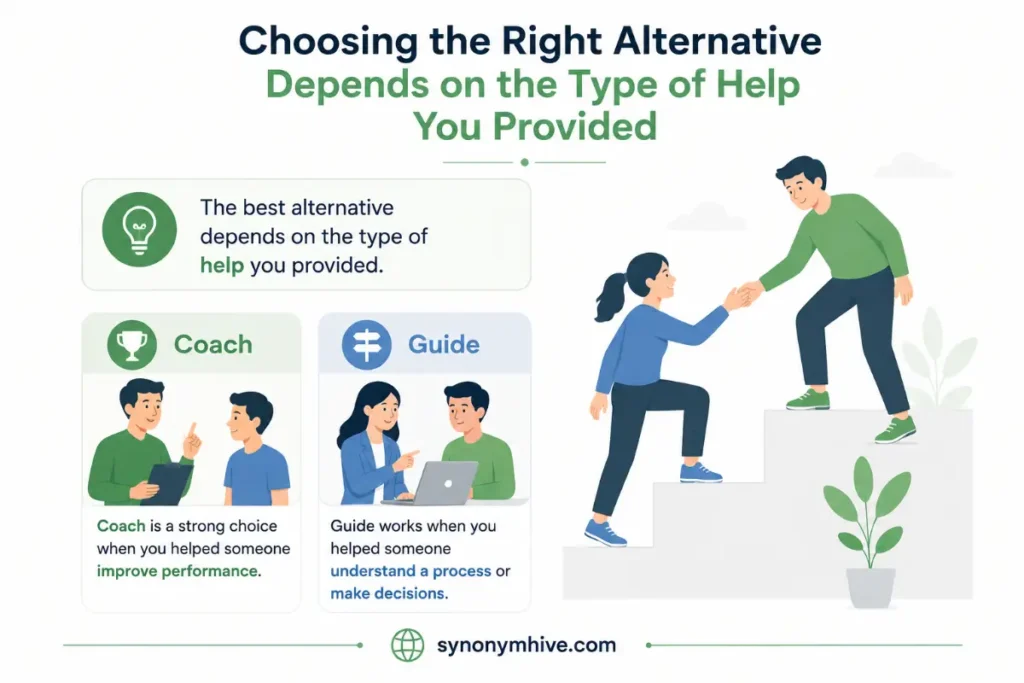
The best alternative depends on the type of help you provided.
Coach is a strong choice when you helped someone improve performance.
Guide works when you helped someone understand a process or make decisions.
Advisor fits professional or strategic advice.
Trainer is useful when you taught practical skills.
Teacher works when education was the main part of your role.
Tutor fits one to one academic instruction.
Counselor can work when you provided advice and support in a formal setting.
Role model fits someone who influenced others through their behavior and example.
Here are more options you can use.
| Word | Meaning | Tone | Example |
|---|---|---|---|
| Instructor | Provides structured training | Formal | Instructed employees during onboarding sessions. |
| Advocate | Supports someone’s growth or interests | Professional | Advocated for employee development opportunities. |
| Role model | Sets an example others can follow | Positive | Served as a role model for new team members. |
| Leader | Guides people toward a goal | Strong | Led junior employees through major projects. |
| Supervisor | Oversees someone’s work | Professional | Supervised and developed five junior employees. |
| Manager | Takes responsibility for people or operations | Strong | Managed and developed a team of new employees. |
| Coach | Helps people build confidence and performance | Professional | Coached employees toward monthly performance goals. |
| Guide | Provides direction during learning | Friendly | Guided interns through their first major assignments. |
| Consultant | Gives specialized advice | Formal | Consulted with junior managers on project planning. |
| Facilitator | Helps a group learn or make progress | Professional | Facilitated career development sessions. |
| Instructor | Teaches structured material | Formal | Instructed new hires during orientation. |
| Sponsor | Supports someone’s career or advancement | Corporate | Sponsored junior employees for leadership opportunities. |
| Developer | Helps build another person’s skills | Professional | Developed junior staff through targeted training. |
| Counselor | Offers thoughtful advice and direction | Formal | Counseled employees on career goals. |
| Educator | Helps others gain knowledge | Professional | Educated staff on updated workplace procedures. |
| Trainer | Builds job related skills | Practical | Trained new hires in customer support systems. |
| Role model | Influences others through personal example | Positive | Served as a role model for junior staff. |
Which Mentor Synonyms Are Simple And Everyday
Simple words often work best when you want clear and natural communication.
Guide, coach, teacher, helper, supporter, and adviser are easy to understand.
These words work well in conversations and general writing.
For example:
I mentored new employees.
You could say:
I guided new employees.
Or:
I coached new employees.
The choice changes the meaning slightly.
Guided sounds supportive.
Coached suggests improvement.
Teacher suggests instruction.
Supported focuses on encouragement.
A simple word can still sound professional. In fact, plain language often makes a resume easier to scan.
Recruiters usually don’t need a complicated term when a familiar word communicates the same idea more clearly.
Which Mentor Synonyms Sound More Formal
Formal alternatives include advisor, adviser, counselor, consultant, facilitator, educator, instructor, and sponsor.
These words can fit professional resumes, academic writing, reports, and formal workplace documents.
For example:
Advised junior managers on career development.
Facilitated leadership training for new supervisors.
Instructed employees on workplace safety procedures.
Consulted with new managers on team development.
Each sentence sounds professional because the verb matches the activity.
Still, don’t choose a formal word just because it sounds impressive.
Consultant implies expertise.
Instructor implies teaching.
Sponsor can suggest active support for someone’s advancement.
Counselor can carry a specific professional meaning in some settings.
Precision matters more than formality.
Which Mentor Synonyms Sound Strongest
Mentor is already a positive word, but some alternatives can communicate a stronger type of responsibility.
A useful progression looks like this.
- Supported suggests basic encouragement and help.
- Guided suggests direction and assistance.
- Taught suggests direct knowledge transfer.
- Trained suggests structured skill development.
- Coached suggests active performance improvement.
- Advised suggests informed recommendations.
- Counseled suggests deeper guidance and support.
- Led suggests responsibility and direction.
- Developed suggests that you helped build someone’s skills.
- Sponsored suggests active support for someone’s career growth.
The strongest word should still match your actual work.
If you answered occasional questions from a coworker, developed may be too strong.
If you created a formal development plan and tracked that employee’s progress, developed may be appropriate.
A resume works best when the language is confident but honest.
What Part Of Speech Is Mentor
Mentor can work as both a noun and a verb.
As a noun, mentor refers to a person.
For example:
She was my mentor during my first year.
As a verb, mentor describes the act of guiding someone.
For example:
She mentors new employees.
The past tense is mentored.
For example:
She mentored five junior employees.
Many resume alternatives also work as verbs.
Coached.
Guided.
Trained.
Advised.
Taught.
Developed.
Supervised.
Led.
Some alternatives can also appear as nouns.
Coach.
Advisor.
Teacher.
Trainer.
Instructor.
Consultant.
The best resume style usually uses an active verb.
Instead of:
Mentor for five junior employees.
Write:
Mentored five junior employees.
Even better:
Mentored five junior employees and helped improve their onboarding performance.
The active construction makes your role much clearer.
What Is Another Phrase For Mentor On A Resume
For resumes, coach, guided, trained, advised, developed, and led are among the most useful alternatives.
The best choice depends on your actual contribution.
For helping people improve performance, use coached.
When teaching job specific skills, use trained.
For giving professional recommendations, use advised.
When helping people navigate a process, use guided.
For building employee skills over time, use developed.
When holding formal leadership responsibility, use led.
For example:
Mentored five junior employees.
This is clear but broad.
A stronger version might be:
Coached five junior employees on customer service skills and performance goals.
Another option is:
Trained five new employees on company systems and customer service procedures.
Both sentences give the reader more information.
The word alone isn’t enough. Strong resume writing connects the action with scope and results.
How Can You Choose Another Word For Mentor On A Resume
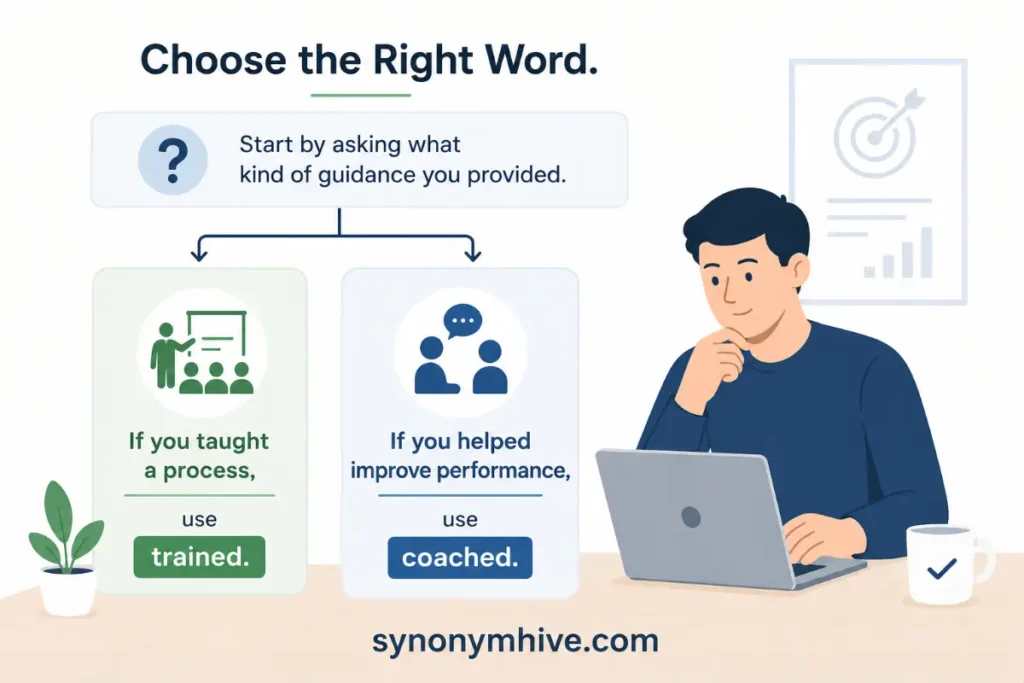
Start by asking what kind of guidance you provided.
When teaching a process, use trained.
For improving performance, use coached.
When giving career advice, use advised.
For helping someone navigate a new role, use guided.
When managing someone’s development, use developed.
For formal authority, use supervised or managed.
When helping someone reach a goal through leadership, use led.
This simple method prevents vague resume writing.
For example:
Mentored interns.
This doesn’t tell the reader much.
You could write:
Guided six interns through research projects and weekly presentations.
Now the reader knows who you helped and what you did.
Another option is:
Coached six interns on research methods and presentation skills.
That version focuses on skill development.
The right verb makes the sentence more informative without making it longer.
What Is The Best Word For Mentoring Employees
Coach is often a strong choice when you helped employees improve their skills or performance.
Trainer works better for structured instruction.
Developer can work when you were responsible for long term employee growth.
Supervisor fits direct workplace oversight.
Advisor works well for professional guidance.
For example:
Coached new employees on customer service skills and performance standards.
This shows active development.
Another strong example is:
Trained new employees on company systems and workplace procedures.
That sentence makes the teaching role clear.
If you created development plans, tracked progress, and helped employees prepare for advancement, you could write:
Developed junior employees through structured training and career planning.
That communicates a deeper role than simple mentoring.
What Is The Best Word For Mentoring Interns
Guided, trained, coached, and advised are all useful for interns.
Guided is especially natural when interns were learning how the workplace operates.
Trained works when you taught specific job skills.
Coached works when you focused on performance.
Advised works when you provided career or professional direction.
For example:
Guided four interns through research projects and client presentations.
Or:
Trained interns on research tools, reporting procedures, and presentation skills.
Both versions are stronger than simply saying you mentored interns because they show what you actually did.
What Is The Best Word For Mentoring New Employees
Trained is often the strongest choice for new employees because onboarding usually involves teaching systems and procedures.
You can also use coached or guided.
For example:
Trained 10 new employees on customer service systems and company procedures.
If you helped them improve after training:
Coached 10 new employees through their first three months and improved onboarding performance.
If you helped them adjust to the workplace:
Guided new employees through onboarding and early career development.
The best choice depends on the purpose of your support.
What Is The Best Word For Mentoring Students
Teacher, tutor, instructor, coach, and advisor can all work for students.
Tutor is useful for academic one to one support.
Teacher is broader.
Instructor suggests structured education.
Coach works for performance or skill development.
Advisor fits academic or career guidance.
For example:
Tutored high school students in academic writing.
Or:
Advised college students on career planning and internship opportunities.
Or:
Coached student leaders on public speaking and presentation skills.
Each verb tells a different story.
What Is The Best Word For Mentoring Someone In Leadership
Coach, develop, guide, advise, and prepare are useful choices.
If you helped someone become a better leader, coaching may be especially accurate.
For example:
Coached five emerging managers on leadership skills and team communication.
Another option is:
Developed junior managers through leadership training and one to one feedback.
If you prepared someone to take on a larger role:
Prepared junior managers for leadership responsibilities through structured development plans.
These examples show that mentoring can involve several different activities.
What Is Another Phrase For Mentor In An Essay
In an essay, guide, adviser, teacher, counselor, coach, and role model can work.
The right choice depends on the relationship you’re describing.
For historical figures, adviser may fit.
Within education, teacher or instructor may work.
For personal development, guide or role model may be better.
In sports, coach is usually the natural choice.
For example:
Her father served as an important role model during her childhood.
The sentence doesn’t mean he formally mentored her. Instead, his behavior influenced her development.
That is an important distinction.
What Is Another Expression For Mentor In An Email
Professional emails usually benefit from simple and direct words.
Guided, trained, coached, advised, and supported are useful choices.
For example:
I mentored the new team members during their first month.
You could write:
I guided the new team members during their first month.
Or:
I trained the new team members during their first month.
If you helped them learn company procedures, trained is more specific.
If you mainly answered questions and helped them adjust, guided may be better.
What Is Another Expression For Mentor In Texting
Texting usually calls for casual language.
Coach, guide, help, teach, and advise can all sound natural.
For example:
I helped him get ready for the interview.
That’s more conversational than:
I mentored him for the interview.
You could also say:
I coached him through the interview process.
That sounds natural when you gave practice and feedback.
In casual writing, simple words often sound more human.
What Is Another Word For Mentor In Speaking
Coach and guide are especially natural in everyday speech.
You might say:
I coached a few new employees.
I trained the new hires.
These sentences sound natural because they describe a specific action.
Mentor itself is also completely normal in professional conversation.
You don’t need to replace it every time.
Synonyms are useful when you need variety or want to make the exact meaning clearer.
What Are Some Real Examples Of Mentor Synonyms
Here are practical examples from different situations.
- Employee development.
Coached junior employees on communication skills and performance goals. - New hire training.
Trained new employees on customer service systems and company procedures. - Career guidance.
Advised junior staff members on career planning and professional development. - Intern support.
Guided interns through research assignments and client presentations. - Leadership development.
Developed emerging managers through structured coaching and feedback. - Academic support.
Tutored students in writing and research skills. - Sports development.
Coached student athletes during weekly training sessions. - Workplace onboarding.
Guided new hires through their first 90 days. - Professional advice.
Advised employees on career opportunities and workplace goals. - Skill development.
Trained junior staff on software and reporting tools. - Team leadership.
Led junior employees through a major client project. - Personal development.
Supported new employees as they adjusted to workplace expectations. - Academic advising.
Advised college students on course planning and career goals. - Workshop instruction.
Instructed employees during professional development workshops. - Career sponsorship.
Sponsored high performing employees for leadership opportunities. - Group development.
Facilitated peer learning sessions for new supervisors. - Technical support.
Trained junior technicians on equipment and safety procedures. - Management development.
Coached new managers on employee communication and conflict resolution. - Writing development.
Guided junior writers through editing and research processes. - Public speaking.
Coached team members on presentations and public speaking.
These examples show why context matters.
Mentoring is a broad activity. A more precise verb can reveal the part of the work that mattered most.
Coach Vs Mentor What Is The Difference
Coach and mentor overlap, but they often describe different relationships.
| Coach | Mentor |
|---|---|
| Often focuses on performance | Often focuses on long term development |
| Common in sports and workplaces | Common in careers and education |
| May focus on specific skills | May cover broader growth |
| Often provides direct feedback | Often provides advice and perspective |
| Can work toward measurable goals | Can support long term career direction |
For example:
I coached the sales team on closing techniques.
This focuses on a specific skill.
I mentored a junior salesperson throughout her first year.
This suggests broader support and development.
Neither word is automatically better.
Choose coach when performance improvement is central.
Choose mentor when broader growth and guidance are central.
Looking for another word? See Another Word for Versatile Resume Choices 2026.
Mentor Vs Advisor What Is The Difference
Mentor and advisor both involve guidance, but the relationship can differ.
An advisor usually gives recommendations or expert opinions.
A mentor often provides longer term support and personal development.
For example:
The advisor recommended several career paths.
The mentor helped the employee explore strengths, goals, and career options over several months.
Advisor can sound more formal and professional.
Mentor often feels more personal.
On a resume, advisor works well if giving expert recommendations was the main responsibility.
Mentor works well if you supported someone’s broader development.
Mentor Vs Coach What Is The Difference In A Resume
Use coach when you want to emphasize improvement.
Use mentor when you want to emphasize development and guidance.
Compare these examples.
Mentored five junior employees.
Coached five junior employees to improve customer service performance.
The second version gives the reader a clearer picture of the action.
However, if you helped employees with career planning, mentor may be the better word.
If you helped employees improve a measurable skill, coach may be stronger.
Guide Vs Mentor What Is The Difference
Guide is broader and usually simpler.
Mentor often suggests a deeper or longer relationship.
For example:
Guided new employees through the onboarding process.
Mentored junior employees throughout their first year.
The first sentence describes a defined process.
The second suggests continuing development.
Guide can also work well in essays and everyday speech because it is easy to understand.
Mentor is more specific when you want to emphasize personal growth.
What Are The Best Mentor Synonyms For Leadership
Leadership focused alternatives include coach, guide, develop, advise, lead, sponsor, and support.
Lead is especially useful if you had formal responsibility.
Coach works when you helped people improve.
Develop works when you helped build skills.
Sponsor works when you actively supported someone’s career advancement.
For example:
Developed three junior managers for future leadership roles.
That sentence shows a strong development responsibility.
Another option is:
Coached three junior managers on team leadership and communication.
That focuses more on the actual skills you helped improve.
How Do Mentor Synonyms Change By Industry
Different industries favor different words.
For business, coach, advisor, consultant, trainer, and manager are common.
Within education, teacher, tutor, instructor, advisor, and counselor are common.
In sports, coach is the natural choice.
For technology, trainer, guide, instructor, and coach can describe technical development.
Within healthcare, educator, trainer, advisor, and preceptor may fit specific roles.
For nonprofit work, mentor, coach, facilitator, and advocate can all be useful.
In professional services, consultant and advisor often suggest specialized expertise.
Industry language can help your resume sound natural, but accuracy still matters.
What Are The US And UK Differences
Mentor is widely used in both American and British English.
The spelling stays the same.
Advisor and adviser are both used in English. In the United States, advisor is common in many professional settings, although adviser remains correct.
Counselor is also common in American English. British English may use counsellor with a double l in many contexts.
Trainer, coach, teacher, guide, and mentor are broadly understood in both varieties.
For a US resume, simple terms such as coach, guide, trainer, advisor, and mentor are all natural choices.
You don’t need to use regional slang to make your writing sound American.
Clear professional English works best.
What Are Common Mistakes When Choosing Another Word For Mentor
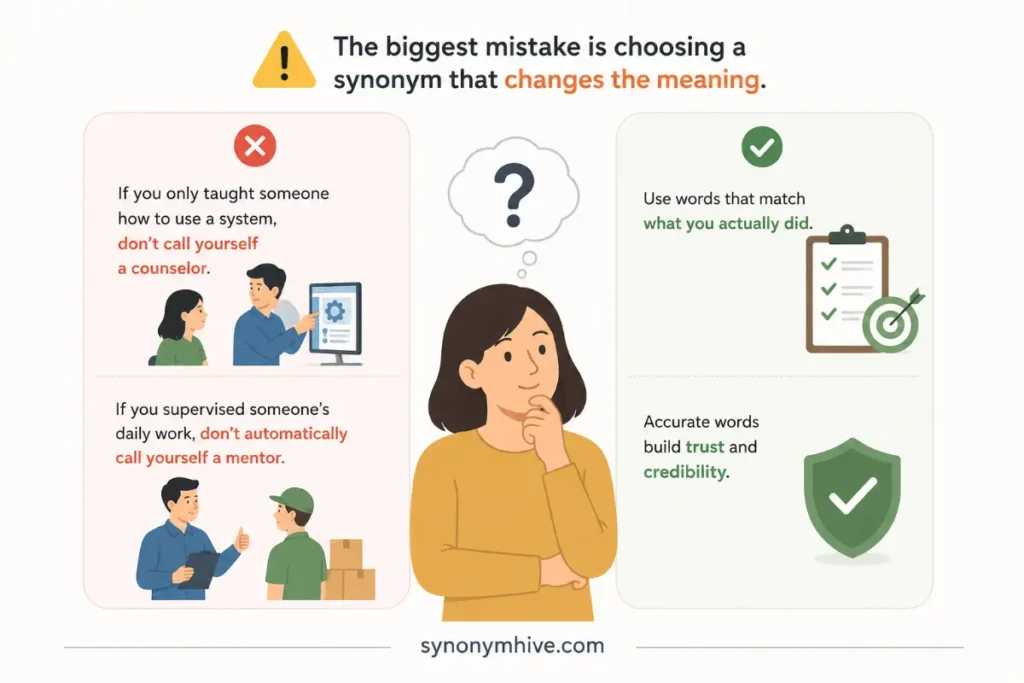
The biggest mistake is choosing a synonym that changes the meaning.
When teaching someone how to use a system, don’t call yourself a counselor.
For supervising someone’s daily work, don’t automatically call yourself a mentor.
When giving occasional advice, don’t claim that you developed the person’s entire career.
Accuracy makes professional writing stronger.
Another mistake is choosing words that sound too formal.
For example, stewarding someone’s career may sound unusual when coaching or mentoring would be much clearer.
A third mistake is using several synonyms in one sentence.
You don’t need to write:
Mentored, coached, guided, advised, and trained employees.
That sounds inflated.
Pick the word that best represents the main action.
You should also avoid vague claims.
Mentored employees.
This tells the reader very little.
A stronger version is:
Coached eight junior employees on customer service skills and helped them meet monthly performance goals.
The details make the contribution believable.
When Should You Not Use Mentor
You don’t need to replace mentor simply for the sake of variety.
Mentor is already a strong and professional word.
Keep it when you provided broad guidance and long term support.
For example:
Mentored junior employees throughout their first year.
That sentence is clear.
You should also avoid using mentor when the relationship was mainly instructional.
When teaching employees how to operate equipment, trained is probably more accurate.
For managing their daily work, supervised may fit better.
When giving expert recommendations, advised may be stronger.
For helping someone improve performance, coached may tell the story better.
The goal is precision.
How Can You Make A Resume Bullet About Mentoring Stronger
Start with an action verb.
Then add who you helped.
Next, explain what you helped them do.
Finally, include a result when you have one.
For example:
Mentored employees.
Becomes:
Mentored eight junior employees through onboarding and professional development.
Stronger:
Coached eight junior employees through onboarding and helped improve first year performance.
Even stronger:
Coached eight junior employees through onboarding and professional development, contributing to a 15 percent improvement in team productivity.
Only use real results.
Numbers should come from your actual experience.
A resume isn’t a place to guess.
How Can You Show Mentoring As Leadership
Mentoring can show leadership when you connect it to responsibility and results.
For example:
Mentored junior employees.
This shows support.
Now compare:
Led a development program for 12 junior employees.
This shows leadership and ownership.
Another option is:
Coached 12 junior employees and prepared three for promotion.
That shows a direct outcome.
If you trained others, helped them improve, and influenced their progress, mentoring can become strong evidence of leadership.
The key is to show what changed because of your work.
How Can You Avoid Repeating Mentor On A Resume
Use different verbs based on the specific action.
Coach employees on performance.
Train new hires on systems.
Guide interns through projects.
Advise junior staff on career planning.
Develop emerging managers.
Lead team development programs.
Teach employees new skills.
Facilitate professional development sessions.
Supervise junior employees.
Support new team members.
This creates natural variety.
You don’t need to force a different word into every bullet.
If mentor is the most accurate term, use it.
Then make the next bullet more specific with a different action.
Strong resumes don’t sound like thesauruses. They sound like clear records of what you did.
What Are The Best Words For Different Resume Situations
| Resume Situation | Best Word | Why It Works |
|---|---|---|
| Employee development | Developed | Shows skill growth |
| Performance improvement | Coached | Shows active improvement |
| New hire training | Trained | Shows practical instruction |
| Career guidance | Advised | Shows professional direction |
| Internship support | Guided | Shows hands on support |
| Academic support | Tutored | Shows focused teaching |
| Leadership preparation | Developed | Shows long term growth |
| Team direction | Led | Shows leadership |
| Daily work oversight | Supervised | Shows authority |
| Workshop delivery | Instructed | Shows formal teaching |
| Group learning | Facilitated | Shows process support |
| Career advancement | Sponsored | Shows active support |
This approach helps you choose a verb based on evidence rather than preference.
What Are The Antonyms Of Mentor
Mentor doesn’t have one perfect opposite.
Depending on the context, possible opposites include discourage, misguide, hinder, ignore, neglect, abandon, and undermine.
Discourage means reducing someone’s confidence or motivation.
Misguide means giving someone poor direction.
Hinder means making progress harder.
Ignore means providing no attention or support.
Neglect means failing to provide needed care or guidance.
These words are not direct opposites in every sentence, but they describe actions that go against the supportive purpose of mentoring.
How Can You Pick The Right Mentor Synonym Quickly
Use this simple process.
- Ask what you actually did.
Did you teach, coach, advise, guide, supervise, or lead.
- Identify the person you helped.
Was it an employee, student, intern, manager, teammate, or client.
- Identify the goal.
Were you improving performance, teaching skills, supporting career growth, or helping someone learn.
- Choose the most specific verb.
Don’t use mentor when trainer gives the reader more information.
- Add proof.
Include team size, project scope, time period, or measurable results when possible.
- Read the sentence aloud.
If it sounds stiff, choose a simpler word.
- Check accuracy.
Your resume should show your real responsibilities without exaggeration.
How Can You Use Another Phrase For Mentor Naturally
The phrase another term for mentor can lead you toward a long list of synonyms, but a long list isn’t the real goal.
The real goal is choosing a word that fits the situation.
For a resume, coach, trained, guided, advised, and developed are especially useful.
For an essay, guide, adviser, teacher, role model, and counselor may fit.
In a text, coach, help, teach, and guide often sound more natural.
During professional speech, mentor, coach, advisor, and guide all work well.
Think about the picture you want the reader to see.
When the reader should picture you teaching a new employee, use trained.
For helping someone improve, use coached.
When giving career direction, use advised.
For supporting long term growth, mentor may still be the best choice.
What Makes A Mentor Related Resume Verb Strong
A strong resume verb does more than describe an activity.
It shows value.
Compare:
Mentored employees.
With:
Coached 10 employees on customer service skills.
The second sentence provides scope and purpose.
Now add an outcome:
Coached 10 employees on customer service skills and helped reduce customer complaints by 12 percent.
That sentence gives the reader evidence.
The verb matters, but the supporting details matter just as much.
Think of the verb as the doorway. The details invite the reader inside.
How Can You Show Mentoring Skills Without Using Mentor
You can show mentoring through actions.
For example:
Trained new hires during their first month.
Coached employees on communication and performance.
Guided interns through research projects.
Advised junior staff on career planning.
Developed new managers through leadership workshops.
Facilitated peer learning sessions.
Instructed employees on company systems.
Supervised junior employees and provided weekly feedback.
These examples communicate mentoring skills without using the word mentor.
That can help if your resume already uses mentor several times.
What Is The Best Synonym Based On Your Main Goal
When your main goal was teaching, use trained or instructed.
For performance improvement, use coached.
When focusing on career advice, use advised.
For general direction, use guided.
During long term development, use developed or mentored.
When providing leadership, use led.
For daily oversight, use supervised.
When offering expert advice, use consulted.
For career advancement support, use sponsored.
This method gives you a reliable answer without forcing one synonym into every situation.
How Can You Make Your Writing Sound More Human
Natural writing usually favors specific words over impressive words.
Instead of saying:
Provided comprehensive developmental guidance to emerging personnel.
Say:
Coached junior employees on leadership and communication skills.
The second sentence sounds clearer because the reader can picture the work.
You don’t need complicated vocabulary to show expertise.
Clear writing builds trust.
That matters on resumes, professional profiles, essays, and applications because readers want to understand your experience quickly.
Learn more useful word alternatives in Another Word For Communication: Best Guide (2026).
Conclusion
Choosing another word for mentor depends on the kind of guidance you provided. Coach is a strong choice for performance improvement. Trainer fits practical instruction. Advisor works for professional recommendations. Guide shows direction and support. Developer highlights long term growth. Lead communicates stronger responsibility.
For a resume, don’t focus only on finding a more impressive word. Focus on making your contribution clear. Think about who you helped, what you taught or improved, and what happened because of your work. Then choose the verb that tells that story accurately.
A good resume doesn’t need fancy language. It needs precise language backed by real details. When your word choice matches your experience, your leadership and people skills become much easier for a reader to see.
Frequently Asked Questions
What is another term for mentor?
Common alternatives include coach, guide, advisor, trainer, teacher, tutor, counselor, instructor, and role model. The best option depends on the kind of guidance you provided.
What’s another way to say mentor?
You can say coached, guided, trained, advised, taught, developed, or supported. Choose the word that best describes the specific action you took.
What is a professional word for mentor on a resume?
Coach, advisor, trainer, developer, and guide can all work well on a resume. The strongest option depends on your actual responsibility and the result you achieved.
What is a stronger word than mentor?
Coach, lead, develop, or sponsor can sound stronger in specific situations. They should only be used when your role included performance improvement, leadership, development, or active career support.
Is mentor a good resume word?
Yes. Mentor is a strong resume word when you provided meaningful guidance and long term development. A more specific verb can be better when it explains exactly how you helped.
What is the best word for mentoring employees?
Coach or train often works best for employees. Use coach for performance improvement and train for teaching job specific skills.
What is the difference between a mentor and a coach?
A mentor often provides broader long term guidance while a coach usually focuses on specific skills or performance. The two roles can overlap in professional settings.